Feeds:
Posts
Comments

Posts Tagged ‘access’

Photo: Connatural Archive.
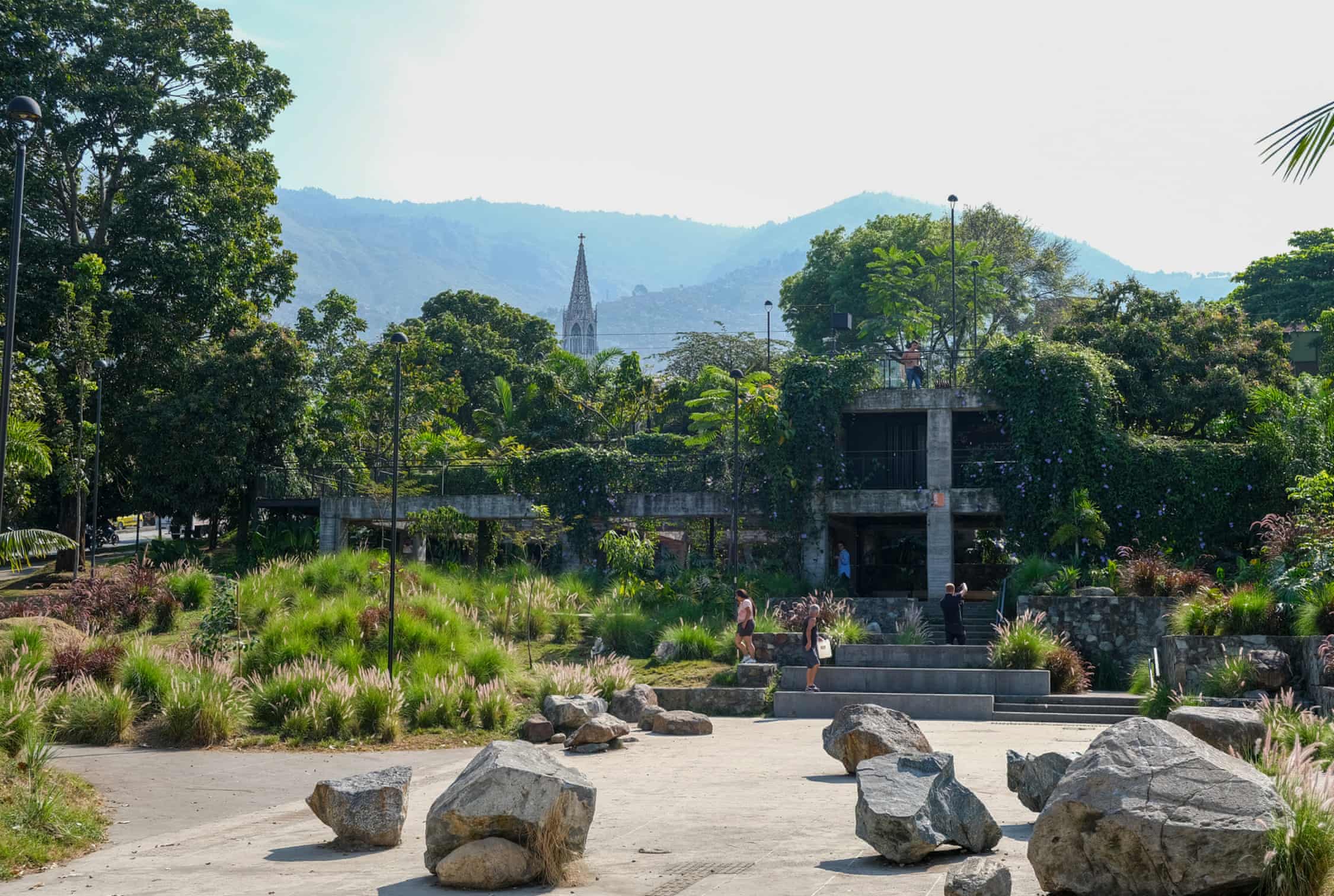
Surrounded by hills: Colombia’s Parque Prado, no longer abandoned to illegal activity.

What is your first reaction to the words Medellín and Colombia? If you have kept up on the news for a few decades, your associations may include both drug wars and change.

Oliver Wainwright at the Guardian focuses on the change.

“Lilac-flowering creepers engulf an abandoned house on a street corner in Medellín, Colombia, spilling from the roof and smothering most of the upstairs windows. A giant fan palm is visible through one opening, while a knotty tangle of aerial roots cascades down to the pavement from another. Step through the doorway of this overgrown ruin, and you find not a scene of desolation and decay but a sleek steel frame holding up the crumbling facade, which forms an unusual entrance to an enchanting new public park.

“ ‘We behaved more like archaeologists than landscape architects,’ says Edgar Mazo of Connatural, the firm behind the Parque Prado, in the working-class neighborhood of Aranjuez. He leads me through a series of planted terraces; fountain grasses and trumpet trees sprout from where a derelict car park and abandoned homes once stood. ‘You dig up the concrete, water gets into the ground, vegetation grows up, and the people come back,’ he adds, speaking through a translator. ‘That’s natural regeneration.’

“In recent decades, Medellín has been widely celebrated for its astonishing urban transformation. In the 2000s, it went from being one of the most dangerous cities on the planet, riven by murderous drug cartels, to a case study in the miraculous peace-bringing powers of architecture and landscape. Sergio Fajardo, the son of an architect who served as Medellín’s charismatic mayor from 2004 to 2008, was hailed for sprinkling the city’s poorest neighborhoods with dazzling new libraries, stadiums and swimming pools.

“These determinedly ‘iconic’ projects were enthusiastically feted on the pages of glossy design magazines, and their stories recounted in keynotes at international conferences. Impoverished hillsides were connected to a new metro system with an elegant web of cable cars and outdoor escalators, while parks dotted with expressive architect-designed canopies sprang up across the city. The dramatic fall in crime during Fajardo’s term was largely credited to this vision of ‘social urbanism,’ and the increase in the amount of public space per citizen.

“But the Medellín miracle has since lost some of its sparkle. Take the Biblioteca España, one of the flagship projects, designed by Colombian star architect Giancarlo Mazzanti. It stands as a striking cluster of chiseled concrete boulders, rising from the hillside in the formerly no-go barrio of Santo Domingo. But it has been shuttered since 2015, due to structural defects. …

“Mazo’s work takes a markedly different approach from the 00s penchant for spectacle. When he was asked to look at the sloping half-hectare site in Aranjuez, which was home to a rundown car park and six boarded-up houses, abandoned for more than a decade, there was an existing plan to raze everything and replace it with a park traversed by a big zigzagging ramp. It looked like a hangover from the earlier lust for shape-making, something that might photograph well from a helicopter.

“Instead, Mazo and his team decided to keep most of what was already there. Almost 70% of the material on-site remains, albeit in a new form. Walls and floor slabs were chiseled from the two-storey parking structure, and the rubble used to fill the basements of the houses, with soil packed on top. The buildings’ roof timbers were reclaimed and used to make benches, while the landscape was shaped in such a way that rainwater is retained, meaning that no artificial irrigation is needed. The team even collected seeds from the plants that had sprung up on the plot, so they could be scattered around the new park after the project’s construction – allowing the natural colonizers back in.

“The project was built during the pandemic for a cost of just [$1.5m] and the lockdowns allowed time for the plants to establish, without the threat of being trampled by visitors. Five years on, the planting has reached a level of maturity that makes this urban oasis seem like it’s always been there. …

“The former car park’s concrete frame makes for an imposing armature at the centre of the park, supporting a raised steel walkway and framing a series of semi-enclosed spaces beneath it. Reclaimed bricks and stacked roof tiles serve as retaining walls, creating a rugged backdrop to lush clumps of grasses and palms. Gabion cages filled with rocks and rubble line water retention ponds, and provide platforms for seating. A sandy clearing down below makes space for ballgames and events, while park-goers can watch the action from the terraced decks above, and enjoy a grandstand view across the sprawling city and its seven hills.

“ ‘When people first colonized this valley,’ says Mazo, ‘they used to climb up to the top of the hills to communicate with each other. The park now becomes part of that system, giving people an elevated view to connect with others.’ …

“Crucially, there’s a space for everyone here – from elevated walkways, to quiet shrub-lined reading areas, to seating tucked away from prying eyes. The sense of fragmentation, as well as the level changes, allow different social groups to coexist.” 

Read more about this and other pilot projects at the Guardian, here. No paywall, but anything you can donate helps to keep factual news accessible to all.
Read Full Post »

Photo: Melanie Stetson Freeman/CSM Staff.
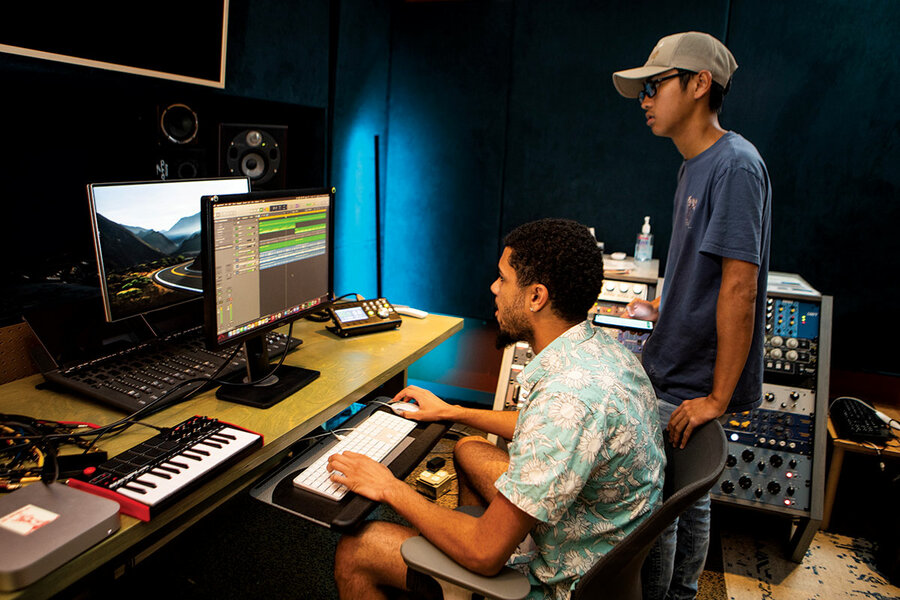
Kyle Johnson (left) and Jonathan Hua-Phan create beats in a studio Aug. 24, 2023. Musicians can rent studio space for as little as $10 an hour – as opposed to the $100 an hour average rate in Boston.

Music belongs to everyone, but sometimes making music is expensive, especially if you need a soundproof studio with electronic bells and whistles. Fortunately, there are options.

Alessandro Clemente writes at the Christian Science Monitor, “Sanyé Mylo’s eyes twinkle with excitement. He is standing in the sound booth of The Record Co. in Boston, eager to bring his creation to life.

“ ‘This place is a musical creative sandbox,’ he says. With the press of a button, his latest rap track fills the room. As the speakers blast Mr. Mylo’s beat-pulsing rhythms, it’s hard to resist the urge to dance. ‘I didn’t know spaces like this existed,’ says Mr. Mylo, who grew up in the low-income neighborhood of Dorchester. ‘It’s the community. It’s the mission. It’s the energy. It’s more than just the environment.’

“Mr. Mylo is one of the young musicians in Boston who, thanks to The Record Co., has turned his music into a full-time occupation. The sound studio, located amid a graying backdrop of warehouses on Massachusetts Avenue, is an unexpected island of creativity and hope.

“Founded in 2010 by Matt McArthur, The Record Co. aims to give musicians more affordable access to creative workspaces and introduce the world of music to those who may have never considered their place in it.

“Mr. McArthur understands this challenge firsthand. As a music technology student at Berklee College of Music, he was frustrated by the high costs of renting time in production studios. …

“On average, a recording studio in Boston costs more than $100 per hour to rent. Mr. McArthur’s vision flipped that model on its head. He saw a recording studio not as a sanctuary for wealthy people but as a community hub available to all.

“He took out loans, collected donations, and opened a studio in a tiny basement in Cambridge, Massachusetts. Slowly but steadily, Mr. McArthur expanded it and eventually rented a new property to include rehearsal spaces and production suites.

“Today, The Record Co., with a full-time staff of more than 20 people, is a state-of-the-art, 12,000-foot facility that can be rented for as little as $10 per hour. Each month, it receives about 1,000 reservations, and around 3,500 musicians pass through its doors.

‘We don’t care if you’re good or trying to do it for a living,’ says Mr. McArthur. ‘Our philosophy is that every single person deserves to express their musical creativity.’

“At The Record Co., the ethos is clear: Music belongs to everyone, and so does the space to create it. The building has been shaped not only with an ear to acoustics but also with an eye to inclusivity, ensuring it is as welcoming to a musician in a wheelchair as to one who walks in with a guitar slung over their shoulder. …

“Beat the Odds serves low-income communities to help young people channel their energies into creative pursuits, and confront and discuss their mental health challenges. Thanks in part to the music production facility available at The Record Co., the group continues to expand its reach. It recently received a $600,000 grant from Boston Mayor Michelle Wu to finance its after-school programs. …

“Since rental fees don’t fully cover the operational costs, The Record Co. relies on donations. As a graduate of Berklee with her own memories of scraping by as a poor music student in Boston, Rachel Jordan says her investment feels personal. Now head of marketing for a tech startup in California, she says she welcomes the opportunity to help eliminate barriers to producing music, and she is committed to attracting investors to believe in the value of The Record Co.’s mission.

“ ‘There are so many quantitative ways to measure impact,’ says Ms. Jordan, ‘but sometimes the most meaningful way is through one human story at a time. We can talk about the economic impact of a thriving arts community, and that matters. But the artists themselves also tell the story of impact so well.’ …

“The Record Co.’s purpose becomes more meaningful in the context of the neighborhood surrounding it, which struggles with addiction and homelessness.

“In Boston, the stretch where Massachusetts Avenue intersects with Melnea Cass Boulevard is known as Methadone Mile, a reference to the addiction treatment centers that share the same block as the studio. Mr. McArthur, who lives in the neighborhood, acknowledges the challenges facing those with addictions, noting, ‘I’m not delusional to think that somebody is going to kick a chemical habit just because they got in the studio one day.’ Yet he holds that music offers a positive alternative to counter the pull toward destructive behaviors.

“Mr. Mylo can attest to the transformative power of music. He felt the one-size-fits-all educational system stymied his creativity. College seemed more like an insurmountable debt rather than an opportunity to learn and grow.

“A friend introduced him to Beat the Odds and The Record Co. Here he felt that his talent was not only recognized, but also nurtured.. .. Walls, built from years of distrust and self-preservation, began to crumble, recalls Mr. Mylo.  

“Now he works not only as a musician but also as a producer and mentor for new musicians who join Beat the Odds.”

More at the Monitor, here. No paywall.

Read Full Post »

Photo: Brooklyn Public Library.
Teens in towns where some books are banned were given access to a card from the Brooklyn Public Library, just like one the New Yorker above enjoys.

It’s hard to imagine, but this is where we are. We don’t ban websites that tell you how to make a lethal weapon, but there are apparently ideas in books young people shouldn’t think about.

In one small step for humankind, the Brooklyn Public Library decided not to be passive about the situation.

I’m sorry to be late with this story, but I only just learned about the initiative and believe you might be interested. On April 13 last year, the library posted the following release on its website.

“Brooklyn Public Library (BPL) is launching a new campaign today, titled Books Unbanned, to help teens combat the negative impact of increased censorship and book bans in libraries across the country. For a limited time, young adults ages 13 to 21 nationwide, will be able to apply for a free eCard from BPL, unlocking access to the library’s extensive collection of eBooks.

“ ‘Access to information is the great promise upon which public libraries were founded,’ said Linda E. Johnson, President and CEO, Brooklyn Public Library. ‘We cannot sit idly by while books rejected by a few are removed from the library shelves for all.’ …

“The card will be good for one year and is designed to complement access to resources for teens in their local communities. The Brooklyn Public Library eCard provides access to 350,00 eBooks; 200,000 audiobooks and over 100 databases. Teens will also be connected to their peers in Brooklyn, including members of BPL’s Intellectual Freedom Teen Council, to help one another with information and resources to fight censorship. …

“To apply for the card, teens can send a note to BooksUnbanned@bklynlibrary.org, or via the Library’s s teen-run Instagram account, @bklynfuture. The $50 fee normally associated with out-of-state cards will be waived. Teens are encouraged to share videos, essays, and stories on the importance of intellectual freedom and the impact that book challenges and bans have had on their lives. 

“The Library will also make a selection of frequently challenged books available with no holds or wait times for all BPL cardholders, available through the library’s online catalog or Libby app. The titles include: The Black Flamingo by Dean Atta, Tomboy by Liz Prince, The Bluest Eye by Toni Morrison, The 1619 Project by Nikole Hannah-Jones, Juliet Takes a Breath by Gabby Rivera, On Earth We’re Briefly Gorgeous by Ocean Vuong, and Lawn Boy by Jonathan Evison.

“While challenges to books and ideas are nothing new, the initiative was conceived in response to an increasingly coordinated and effective effort to remove books tackling a wide range of topics from library shelves. The American Library Association’s Office of Intellectual Freedom counted more than 700 complaints last year, the most since it began keeping records more than 20 years ago.  

“In Texas, Matt Krause, chairman of the Texas House of Representatives General Investigating Committee, has called for public school libraries to ‘account’ for 850 sexually explicit or racially preferential books. The list includes a wide range of titles from National Book Award winner How to be an Antiracist by Ibram Kendi to John Irving’s bestselling Cider House Rules. Books which feature LBGQT characters; advice for dealing with bullies; and tips for teens on relationships are all included on the list, along with titles on historical events including the rise of the KKK, the Indian Removal Act and the election of Harvey Milk. …

“Locally, the New York State Education Department (NYSED) removed a tweet by the New York State Librarian after she recommended the book Gender Queer: A Memoir. NYSED said it was not aware of the graphic contents in the book. …

“Said Nick Higgins, Chief Librarian, ‘Limiting access or providing one-sided information is a threat to democracy itself.’ ”

The only one of the books mentioned that I have read is The Bluest Eye, by Toni Morrison, a Nobel winner. There is no doubt it is heavy-duty stuff, but that doesn’t mean people should be bliocked from reading it. The ideas are serious, and, I think, important, and even if they weren’t, I don’t see that any group of people should make decisions about what to read for any other group.

More at the Brooklyn Public Library, here.

Read Full Post »


Art: Roy Lichtenstein
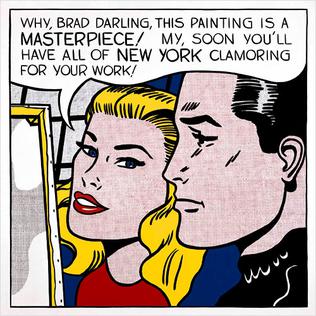
Masterpiece, 1962, was sold by philanthropist Agnes Gund to launch the Art for Justice Fund. 

There’s a movement in the world of philanthropy to combine the arts with social justice. In some cases, donations to arts organizations specify reaching out to poor communities and new audiences. This particular article focuses on collectors who sell art to fund causes they believe in.

Mike Scutari writes at Inside Philanthropy, “After Agnes Gund launched the $100 million Art for Justice Fund with the proceeds from the sale of Roy Lichtenstein’s ‘Masterpiece,’ I wondered if collectors represented the sleeping giants of arts philanthropy. The prognosis thus far seems promising.

“A number of founding donors to Art for Justice have committed gifts of artwork or contributions, and late last year, the fund allocated $22 million to 30 criminal justice reform groups and education and arts initiatives. Around the same time, the anonymous consignor of Jean-Michel Basquiat’s ‘Red Skull’ announced they would donate the proceeds to a nonprofit that opens new public charter schools. …

“Glenn Fuhrman and his wife Amanda partnered with Suzanne Deal Booth and The Contemporary Austin to transform the existing $100,000 Suzanne Deal Booth Art Prize, which is currently celebrating its inaugural exhibition, into one of the nation’s largest awards presented to an artist.”

Scutari notes that although the prize doesn’t require attention to social causes, sometimes a winner’s work turns out to have been strongly influenced by the issues of the day.

“Collectors have historically deferred to institutional givers to do the heavy lifting when it comes to traditional grantmaking and the red-hot area of activist art in particular. This is why Gund’s Art for Justice Fund is so important. It’s predicated on the idea that by selling their work, collectors can advance social justice. As Ford [Foundation] President Darren Walker noted, ‘art has meaning on a wall, but it also has meaning when it is monetized.’ …

“An open question is the extent to which the Suzanne Deal Booth / FLAG Art Foundation Prize will align with the surging fields of boosting access to the arts and promoting socially focused work. Corroborating evidence suggests it will.

“Regarding access, the Fuhrmans’ FLAG Art Foundation exhibition space has been free and open to the public since its 2008 opening. The Fuhrman family has also underwritten free admission at the Institute of Contemporary Art [in Philadelphia] annually for nearly a decade. The couple is clearly committed to eliminating financial barriers to access.

“Exemplifying its social focus, in the charged aftermath of the 2016 election, the FLAG Art Foundation curated an exhibition that focused on artists who ‘negotiate politics, tragedies, social issues, and their own perspectives’ by using the New York Times as an inspiration for their work. …

“I recently spoke with VIA Art Fund President and collector Bridgitt Evans on the state of arts philanthropy and floated the theory that collectors are the sleeping giants of arts philanthropy. [VIA means Visionary initiatives in Art. It’s located in Boston.] She concurred with this assessment. Collectors, she said, are ‘exposed to a wider variety of artists, practices, ideas, and social commentary,’ and moving forward, they will ‘direct the same passion they have to collecting to philanthropy.’ ”

Read more at Inside Philanthropy, here.

Read Full Post »


Photo: The Stage
Open Access Smart Capture’s glasses enable deaf theatergoers in Britain to read live captioning during a performance.

Earlier this month I posted about how the Vienna State Opera provides captions in six languages.

Today’s entry is on making dramatic productions more accessible to the deaf by means of glasses that churn out captions.

Georgia Snow writes at the Stage, “The National Theatre has unveiled new technology that will enable deaf audiences to see captions for performances in front of their eyes using special glasses, … removing the need for captioning screens in the auditorium.

“Developed by the NT with its innovation partner, consultancy firm Accenture, Open Access Smart Capture is being introduced during a year-long pilot.

“If it is a success, the result would be ‘transformational,’ [NT director Rufus] Norris said. …

“The glasses boast 97% accuracy in the timing of the captions, and can also facilitate audio description, for audiences with restricted vision. …

“The project is one of two new initiatives being introduced by the NT around accessibility, the second being an online video database showcasing deaf and disabled actors. …

“It is part of a drive to tackle the under-representation of disabled actors working in the profession, Norris said. …

“He added that ProFile also hopes to remove some of the barriers for deaf and disabled performers, for whom travelling to auditions and meetings can be difficult and expensive.” More at the Stage, here.

If nothing the else, the glasses will be fun. A few years ago, I got to see that for myself using Google Glass. An executive where I worked was having summer interns play around with programming the glasses to test the possibilities for the Fed. That didn’t go anywhere, but it was definitely fun.

Read Full Post »

Photo: Martina Bacigalupo for The New York Times
An American pediatric specialist during a radiology teaching session with pediatric residents in Kigali, Rwanda. In the past 15 years, Rwanda has worked to build a near-universal health care system.

We like to think that American medical care is top drawer, but in some developing countries, access, at least, is much better. Would you believe Rwanda, where Paul Farmer’s Partners in Health and others have offered help to local leaders?

Eduardo Porter has the story at the NY Times, “Rwanda’s economy adds up to some $700 per person, less than one-eightieth of the average economic output of an American. A little more than two decades ago it was shaken by genocidal interethnic conflict that killed hundreds of thousands. Still today, a newborn Rwandan can expect to live to 64, 15 years less than an American baby.

“But over the past 15 years or so, Rwanda has built a near-universal health care system that covers more than 90 percent of the population, financed by tax revenue, foreign aid and voluntary premiums scaled by income.

“It is not perfect. A comparative study of health reform in developing countries found that fewer than 60 percent of births there were attended by skilled health workers. Still, access to health care has improved substantially even as the financial burden it imposes on ordinary Rwandans has declined. On average, Rwandans see a doctor almost twice a year, compared with once every four years in 1999.

“Rwandan lives may be short, but they are 18 years longer than they were at the turn of the century — double the average increase of their peers in sub-Saharan Africa. …

“In some dimensions of health care, [Rwanda] gives the United States a run for its money.

“Its infant mortality rate, for one, dropped by almost three-quarters since 2000, to 31 per 1,000 births in 2015, vastly outpacing the decline in its region. In the United States, by contrast, infant mortality declined by about one-fifth over the period, to 5.6 per 1,000 births. …

“Critically, Rwanda may impress upon you an idea that has captured the imagination of policy makers in even the poorest corners of the world: Access to health care might be thought of as a human right.”

Read how poor countries, such as Ghana, Peru, Vietnam, and Thailand, are acting on that belief, here. At the rate they’re going with access, it is reasonable to suppose that more citizens will choose a medical profession and that quality improvements will follow.

Read Full Post »

Photo: Paul Chinn, The Chronicle 
Artificial turf is installed in a park under construction in San Francisco, which claims to be the first city with a park near every home.

More and more research is showing that access to nature and urban parks improves not only quality of life but the health of city dwellers. Municipalities save, too, when they have healthier residents.

Recently San Francisco was able to claim the distinction of being first in the nation to offer a park 10 minutes from every home.

Lizzie Johnson reports at the San Francisco Chronicle, “In 10 minutes, you can load a TV episode on Netflix, check your mail waiting for BART or make an avocado toast. Now, you can add to that list: take a walk to the park.

“San Francisco is the first city in the nation to have every resident live within a 10-minute walk of a park or open space. The percentage is calculated by the Trust for Public Land, a nonprofit that facilitates the creation of parks and analyzes park systems for the 100 largest cities nationwide. …

“But don’t expect to see a small army of city workers and volunteers with stopwatches in hand counting their steps. The data were gathered using a complex geographic mapping program. The average person can walk a half-mile in about 10 minutes, according to the U.S. Department of Transportation, which counts even your two legs as a mode of transportation. The distance has to include sidewalks — crossing highways or skirting canals doesn’t count.

“ ‘We developed this as the gold standard,’ said Adrian Benepe, the Trust for Public Land’s director of city park development. ‘A 10-minute walk to a park is an important indicator of the livability of a city.’ …

“Criteria for the nonprofit’s annual ParkScore analysis also includes the number of individual parks, overall spending and facilities upkeep. …

“The city has spent $355 million in bond and general fund money over the past four years to purchase land, renovate dilapidated parks and improve open spaces. In 2012, voters passed the $195 million Clean and Safe Neighborhood Parks Bond to fix up neighborhood parks.

“Those measures made the difference in reaching the No. 1 spot, said Recreation and Park Department Director Phil Ginsburg.

“ ‘It speaks volumes about this city’s commitment to open space,’ he said. “It is the reflection of literally a century and a half of decisions regarding parks and open space.’ ”

More at the San Francisco Chronicle.

Read Full Post »

With increasing numbers of Americans experiencing food insecurity, it seems like an appropriate time of year to be grateful that at least there are many goodhearted people managing food banks and community meals and doing what they can.

If you know of anyone in New England who could use the help just now, or if you want to volunteer or donate, this partial list may be a good starting place.

Rhode Island

http://www.rifoodbank.org
“The Rhode Island Community Food Bank works to end hunger in our state by providing food to people in need. We envision a day when all Rhode Islanders have access to nutritious food and a healthy lifestyle.

Massachusetts

East
http://Gbfb.org
“The Greater Boston Food Bank’s mission is to End Hunger Here. Our objective is to distribute enough food to provide at least one meal a day to those in need.”

West
https://www.foodbankwma.org/
“We are fortunate to live in such a special part of the country, allowing for the growth and harvest of a multitude of fresh fruits and vegetables. As this harvest season comes to an end, we have received more than 266,800 pounds of fresh produce — including potatoes, lettuce, carrots, apples and squash — donated by local farms this year.”

Vermont

http://www.vtfoodbank.org/FindFoodShelf.aspx
“If you are looking for a place to have a Thanksgiving meal or to volunteer to help cook, serve or clean-up, download our list of Thanksgiving meals.”

New Hampshire

http://www.nhfoodbank.org/
“Need Food? We Can Help. If you are in need of assistance, use our search to locate the nearest food pantry or soup kitchen to you. Search by your town or county, or view all of our partner agencies.”

Maine

http://www.foodpantries.org/st/maine
“There are several food pantries and food banks in the Maine. With help from users like you we have compiled a list of some. If you know of a listing that is not included here please submit new food pantries to our database.”

Connecticut

http://www.ctfoodbank.org/
“The mission of Connecticut Food Bank is to provide nutritious food to people in need. We distribute food and other resources to nearly 700 local emergency food assistance programs in six of Connecticut’s eight counties: Fairfield, Litchfield, Middlesex, New Haven, New London and Windham.”

harvest


Read Full Post »

It’s not always easy for low-income people to get access to food that is healthful, and once children get accustomed to salty, fatty, sugary snacks, junk food becomes comfort food and stores see little demand for better items. But if children know what would taste good and be good for them, they are on the road to better nutrition.

That is why the folks fighting childhood obesity are enlisting the support of several hip-hop artists that young people admire.

Winnie Hu at the NY Times writes, “Adrian Harris, known as Easy A.D. to his fans, has rapped about street life in the South Bronx as a member of the Cold Crush Brothers, a group that is among the pioneers of hip-hop.

“Now Mr. Harris also raps about broccoli.

“ ‘If you think you eat healthy, say ‘”me,” ‘ Mr. Harris called out over a pounding bass that shook the gym at the Future Leaders Institute, a charter school in Harlem, on a recent morning. A photo of a cart laden with fruits and vegetables filled a screen behind him. ‘Boys and girls,’ he added, ‘there are no Doritos on that cart.’

“Mr. Harris, calling himself a ‘health M.C.,’ aims to reach children who might otherwise tune out nutrition lessons. His vegetable rap is part of a growing public health campaign that has enlisted hip-hop artists such as Doug E. Fresh, Chuck D and DMC of Run-DMC to work alongside doctors and nutritionists in fighting obesity and related illnesses in poor communities. The campaign is being rolled out this year in 18 cities.” More here.

Photo: Ozier Muhammad/The New York Times
Adrian Harris, also known as Easy A.D., made a pitch for healthy eating recently at the Future Leaders Institute in Harlem.
 

Read Full Post »

Take two tomatoes and call me in the morning.

***

The University of South Carolina has developed a manual for health centers that want to collaborate with farmers markets on health, even writing food prescriptions for patients who need to improve their eating habits.

The manual’s authors, Darcy Freedman and Kassandra Alia, write in the intro of their manual:

“Farmers’ markets have grown in popularity in recent years as a place for improving health, increasing economic growth for local agriculture, and building communities. …

“Though the rebirth of farmers’ markets represents an exciting movement in the United States, data reveal that the benefits of farmers’ markets are not evenly distributed. Communities with the greatest need for farmers’ markets, for instance, are least likely to have them.

“In the present manual, we describe an approach for developing a health center‐based farmers’ market. Health centers, in particular federally qualified health centers or FQHCs, were identified as a strategic place to locate farmers’ markets because they may be located in food desert contexts (i.e., low‐income communities with low‐access to healthy food retailers). Additionally, locating at a health center makes an explicit connection between farmers’ market and preventive medicine.” More.

Photo: Aram Boghosian for The Boston Globe

Read Full Post »

A friend is helping to build a playscape, a playground for all ages and abilities that takes advantage of the natural environment‘s restorative qualities.

My husband and I went to see where the playscape is emerging with a boost from the state’s Community Preservation Act. It is located over by Gowing’s Swamp, a lovely wooded area with native plants once cataloged by Thoreau. We walked on a hilly woodland path around the swamp and took note of Canada Mayflowers like tiny bottle brushes and a starlike white flower with six long, narrow leaves growing out from the stem at the same height. (If I’d had my camera, I’d have uploaded a picture at MisterSmartyPlants.com.)

The Sudbury Valley Trustees oversee Gowing’s Swamp, and have this to say about it:

“Gowing’s Swamp, named by Thoreau for its landowner in the mid-1850’s, is an 8.9 acre acidic wetland complex located in a protected, glaciated hollow on the eastern side of a glacial kame known as Revolutionary Ridge.  A kettlehole bog, at the southern end of the wetland, contains specialized plant communities that are locally rare in Southern New England.  The natural area provides habitat for a diverse range of wildlife.

” ‘Unlike any other bog in New England, Gowing’s Swamp found its way into American literature by virtue of significant passages in Thoreau’s Journal,’ says botanist Ray Angelo, and has been visited and studied regularly over the last 160 years by Concord naturalists, literary and historical scholars, and has been the subject of ongoing scientific studies.” More here.

Photograph of Gowing’s Swamp: Sudbury Valley Trustees

Read Full Post »

Like most Americans, I don’t know much about the multibillion-dollar Farm Bill, which is up for renewal this year. NYU professor Marion Nestle talks about its enormous complexity in the Boston Globe.

“I’d like to bring agricultural policy in line with health policy. Health policy tells us that we ought to be making fruits and vegetables inexpensive.” Her biggest concern is that those who produce and sell processed foods benefit most from current policy, which has had the effect of lowering prices for processed food and increasing the prices for the fresh fruits and vegetables people really need.

I have blogged before about the related problem of “food deserts,” localities where there is no reasonably priced market and people end up eating too much junk food. (Check out this post and this one.)

Today I would also like to point you to a National Public Radio story by Nancy Shute.

“Increasingly, metropolitan areas are creating or bolstering their food policies, recognizing the need to ensure that healthful and affordable foodstuffs are available for residents. Baltimore fashioned a food policy initiative in 2009 which involves multiple city departments and an advisory group of over 30 organizations. Priorities included the reduction of ‘food deserts’ and the support of projects that allow low-income residents to order groceries online and pick them up at the local library. New York and San Francisco have also created their own food policy initiatives, and mayors across the U.S. have met to launch a food policy task force.”

“In the summer, Shirley and Ewald August grow blueberries at their Windsor Mill, Md., farm and sell at Baltimore farmers markets.” Photograph: Amy Davis/MCT/Landov

Read Full Post »