Feeds:
Posts
Comments

Posts Tagged ‘affordable housing’

Photo: Hufton+ Crow.
This affordable housing in New York was designed by the firm of famed architect Daniel Libeskind.

If you’ve spent your career catering to the wealthy, where do you go for other worlds to conquer? One architect turned to the poor.

The story is from Justin Davidson at Markets Today via MSN.

“Walk down an ordinary blah-colored stretch of Marcus Garvey Boulevard in Bedford-Stuyvesant, past the dispiriting bulk of Woodhull Hospital and the brown-brick boxes of the Sumner Houses project, and you come upon an incongruous apparition, a great white sugar cube that’s been carved, beveled, and knocked askew. Stranger still, this work of obviously ambitious architecture was executed on a spare budget for residents with meager incomes. Even more startling, the Atrium, an affordable-housing development for seniors and veterans of the shelter system, was designed by the firm of Daniel Libeskind, he … of the kind of jagged form that would defy attempts to gift-wrap it.

“With the Jewish Museum in Berlin, opened in 2001, Libeskind established himself as a pioneer of deconstructivism, a style based on the illusion that buildings were lifting off, bursting, imploding, or peeling apart. After the 9/11 attacks, when he was appointed master planner of the World Trade Center rebuilding project, he became famous as the embodiment of advanced architecture, headlining a period when a dozen or so celebrities scattered the world with signature structures. You might not know where a building was or what it was for or how it stood up, but you could quickly identify who designed it. His global brand would seem like an odd choice for the most basic tier of New York’s urban shelter. …

“Spend some time in and around the Atrium, though, and you begin to see that the pairing of high-design auteur and low-income residents meets an assortment of needs and isn’t just noblesse oblige. Erected by a cluster of nonprofits — Selfhelp Community Services, Riseboro Community Partnership, and the nonprofit developer Urban Builders Collaborative — on a patch of NYCHA [New York City Housing Authority] land, the Atrium leavens the neighborhood with 190 new apartments, a spacious community room, fresh landscaping, and a jolt of jauntiness.

“Like many public-housing projects, the original Sumner Houses, built in the late 1950s, withdraw from the street, lurking behind a perimeter of pointless lawn. The Atrium does the opposite, hugging the sidewalk, peppy and reassuring. This is an active, even restless building that greets passersby with a smooth dance move. … The whole structure makes a quarter-twist from ground to roof, and you can trace its sinews stretching diagonally across the grid of ribbon windows.

“Inside, comfortable apartments encircle the raised, skylit courtyard that gives the building its name. That arrangement is a resonant one for Libeskind, who grew up in the Amalgamated Houses in the Bronx, a complex developed in the 1920s by the garment workers union. …

” ‘It stood out,’ Libeskind told me. ‘It was populated by working-class people, but it had a sense of elegance.’ The courtyard was essential, a way for mostly Jewish immigrants to replace the tenement’s narrow, stinking air shaft with a form of genuinely gracious living. …

“Still, there’s a difference between an outdoor courtyard and an indoor atrium. Carelessly handled, the nine-story doughnut form could easily have evoked stifling precedents. … To avoid any hint of that oppressiveness, Libeskind laced the floor with diagonal walkways between raised planters and sculpted the inner façade almost like a climbing gym, with protrusions, ledges and trapezoidal windows placed in an apparently random arrangement. The goal was to make the court a destination rather than a vestibule. Since it’s one floor up from the lobby, going there requires an affirmative decision. …

“The success of a low-income housing complex depends on its social warmth. Selfhelp maintains a small team of social workers on-site, mostly to help residents navigate the welfare bureaucracy but also just to be there if they want to chat. …

“The residents I spoke to enjoy the Atrium, not because of its architectural pedigree but because it is clean and safe and orderly and bright, a rare haven for New Yorkers whose lives have often been turbulent. Still, loneliness is a tough enemy. …

“Designing a building and running it are different arts, but doing each one well fortifies the other. With the Atrium, Libeskind has given vulnerable people a place they can gradually make their own. He has also demonstrated that the daunting list of rules, requirements, prohibitions, and economic strictures that govern affordable housing in New York don’t have to choke off inventive architecture. …

“Ahmed Tigani, a deputy commissioner at the city’s Department of Housing Preservation and Development, insists that the Atrium shouldn’t be a one-off showcase of precious design. Recruiting architects like Libeskind makes it clear that low-income housing is an integral part of the cityscape. City housing staffers should wrestle with loftier questions than those described by the number of units built, Tigani says. ‘What is the physical impact of our investment, but also the social and spiritual impact? What does a building visually contribute? Does it feel like a part of your neighborhood? Does it feel like a statement of belief in what that housing can be?’ ”

More at MSN, here.

Read Full Post »

Photo: @antoninjapan on TikTok.
Screengrabs from a viral TikTok video posted by Anton Wormann (pictured right), who bought an abandoned farm in Japan for $15,000. 

Here’s a young man with a novel approach to making his fortune. It involves abandoned houses, or akiya, in Japan.

In October, Soo Kim wrote at Newsweek, “Anton Wormann, 31, who is originally from Sweden, relocated to Japan in 2018 after living in New York. He recently purchased an abandoned farm for $15,000 ‘right by the beach’ in Kujukuri, a town in the Chiba prefecture of Honshu, the largest and most populous island of Japan.

“Wormann shared a tour of the abandoned property, where ‘everything was left as is,’ in a video posted on his TikTok account Anton in Japan (@antoninjapan). …

“The farm comes with 11 rooms in a 250-square-meter house (about 2,690 square feet) and 0.62-acre garden ‘where you can hear the waves,’ he said in the clip.

“Located about 150 meters (0.09 mile) from the beach in Kujukuri, the farmhouse has six bedrooms and five living rooms as well as a kitchen, a toilet, a big garage and two other smaller structures on the compound.

” ‘I bought this farm about two months ago but only recently found the time to begin renovations,’ Wormann told Newsweek. ‘The land is … located about an hour away from central Tokyo by car. The previous owners were a family with grown-up children who no longer wanted to maintain the property after it had been vacant for so long. …

“Wormann, who has a background in fashion modeling and media, now focuses on real estate projects, particularly DIY renovations of abandoned homes.

“He’s been buying and renovating vacant homes in Tokyo for the past five years and ‘wanted to take on a project in the Japanese countryside to try something new,’ he told Newsweek. Wormann is also the author of the book Free Houses in Japan, released in 2023, which explains how he earns money through renovation projects like this in Japan.

” ‘There are tons of cheap abandoned homes in Japan, but this one is the cheapest one I’ve come across in the vicinity of Tokyo that still had a great location, a big piece of land and the potential of turning gorgeous again,’ he said.

“The renovation of the abandoned farm is in its early stages, ‘but there’s a lot of work ahead,’ Wormann noted, adding that ‘my vision is to transform the farmhouse into a mix of traditional Japanese and Scandinavian design, maintaining the rustic charm while modernizing it.’

“The footage in the viral video shows a building surrounded by greenery, including a large tree near a doorway in the garden space.

“The camera later enters the home, which is cluttered with various items, from cleaning products, shoes and umbrellas to toys, random memorabilia and several boxes.

” ‘The potential of this place is phenomenal,’ he says in the clip. ‘Now the crazy part is everything is left as is by the previous owners. When I say everything, I mean everything,’ he notes, as the footage shows various items such as a bottle of ‘very old rare’ Suntory whiskey, around 20 stuffed animals, about 500 kimonos (a traditional Japanese garment), ‘loads and loads’ of games, Pokemon cards and ‘anime-related stuff,’ as well as an unopened safe.

“Holding his shirt up toward his face, he says in the video: ‘This is what nine years abandoned plus a minor water leak in the kitchen smells like.’ The footage shows a kitchen setting with several plastic buckets filled with murky water.

“He continues: ‘The worst part is we can’t start the renovation and actually see what we bought until we’ve cleaned out all these treasures. …

” ‘Some of these things are probably worth a lot but I don’t know where to start,’ he says as the video concludes.

“Wormann’s been buying and renovating abandoned homes before turning them into short-term rentals at a rate of about one house a year since moving to Japan. He finds the homes by looking through Japanese websites and has a network of brokers around him who also help find the houses.

” ‘There are many reasons why there are so many abandoned homes in Japan,’ he noted, from a declining population and a preference for newer residences to ‘a high stock of apartment and houses.’

” ‘Japanese houses and real estate also depreciates over the years, making older houses over 20 to 30 years more or less worthless, and you basically only pay for the land if you buy older houses,’ he said.”

More at Newsweek, here. I first learned about the issue of abandoned houses in Japan at the radio show The World, here. See more pictures at Koryoya.

Now watch this video from an American couple who also have made a business doing this. Very cool.

Read Full Post »

Photo: Melanie Stetson Freeman/CMS Staff.
The Christian Science Monitor reports that the upscale Boston Back Bay neighborhood “worked with nonprofits to create affordable housing and apartments for formerly unhoused people, at 140 Clarendon.”

My friend Lillian and her siblings are among the few Black families that own their building in Boston’s upscale Back Bay. That’s because Lillian’s mother had the foresight to buy it in installments many years ago. Nowadays the area is prohibitive for most families, whatever their race. And as we know, affordable housing is usually fought tooth and nail in such communities. But …

Troy Aidan Sambajon writes at the Christian Science Monitor, “Garry Monteiro pauses and looks down, twiddling his thumbs. He contemplates the biggest change to his life last year. There’s a glint in his eye that wasn’t there before.

“ ‘To be honest with you, the refrigerator was a big deal,’ Mr. Monteiro chuckles, speaking in a community room at the 140 Clarendon building in Boston’s upscale Back Bay neighborhood. … But, he adds, the biggest change is having somewhere to call his own. Before moving into his apartment, the former mail courier spent nearly every night for two years on an assigned bunk at a men’s shelter.

“His routine was dictated by the shelter’s hours. He had to be out by 5:30 a.m. and back before 8 p.m. He spent his days looking for jobs or with his siblings. Every day, he worried about making it back by curfew. If he didn’t, he’d have to sleep outside. …

“The 140 Clarendon building is the rare story of a wealthy community finding solutions to homelessness. When private hotel plans stalled at the address in 2020, the neighborhood took charge. Community associations and developers backed a permanent supportive housing community – complete with on-site social services – in the heart of one of Boston’s most expensive neighborhoods.

“ ‘With homelessness numbers rising everywhere and the lack of affordable housing overwhelming, this project in the Back Bay is a welcome development,’ says Howard Koh, faculty chair of the Initiative on Health and Homelessness at Harvard University. Dr. Koh and his team say that 140 Clarendon is ‘highly unusual,’ because instead of worrying about property values, residents in a high-end neighborhood rolled out the welcome mat. …

“ ‘The collaboration of all the partners, public and private, to make such progress is a great example of how people can … rise to the challenge,’ Dr. Koh says of 140 Clarendon.

“The 111 studio apartments that now house Mr. Monteiro and his new neighbors also come with support services and case managers. The idea isn’t new, experts on ‘housing-first’ solutions say. Studies have shown the most cost-effective way to combat homelessness is to prioritize putting people in homes before securing other services. … What’s remarkable about 140 Clarendon is that Back Bay’s neighborhood and business associations signed letters of support, inviting the project onto their streets….

“ ‘It is one of those all-too-rare occasions when the public sector, the private sector, and nonprofits were able to come together and provide at least some relief,’ says Martyn Roetter, chair of the Neighborhood Association of the Back Bay, who signed one of the letters. …

“For nearly 100 years, 140 Clarendon has anchored the neighborhood’s educational and cultural character. The building was owned by the YWCA and, at various points, has housed the Lyric Stage Company of Boston, the Snowden International School, and a 210-unit boutique hotel.

“In 2019, the YWCA decided to sell the property. The first buyer planned to evict all tenants and face-lift the exterior to make way for a ritzy private hotel. When the pandemic sank the hotel market, a new developer – Beacon Communities – stepped in, while Pine Street Inn agreed to provide on-site services to formerly houseless tenants. ‘It checked all our boxes, and the location couldn’t be better,’ says Jan Griffin, vice president of Pine Street Inn. The 13-story brick-faced building has elevators and is easily accessible to public transit, grocery stores, the Boston Public Library, and churches. …

“The Back Bay neighborhood associations – which wanted to preserve the historic brownstone and its commercial tenants – had caught wind of the development plans. In two public letters of support, the associations advocated for affordable housing to be expedited in the neighborhood. …

“In addition to 111 apartments for people experiencing homelessness, 99 other units were made into affordable housing. All the commercial tenants supported the plan, which allowed them to remain in the building. ‘The fact that the local businesses and the neighbors wanted it is a really nice testament to how that neighborhood is leaning in to trying to end homelessness on their streets with housing rather than criminalizing people for existing in their neighborhood,’ says Ann Oliva, CEO of the National Alliance To End Homelessness.

“When Mr. Monteiro arrived at Pine Street’s shelters in 2021, his only possessions were the clothes on his back and a canvas messenger bag from his past life as a courier. … After 20 years of working, Mr. Monteiro left it all behind to take care of his parents. ‘I knew basically that once they passed away, I would have to start over,’ he says. ‘And I’d still do it again.’ “

More at the Monitor, here. No paywall. Subscriptions encouraged — and very reasonable.

Read Full Post »

Photo: Richard Conway/Bloomberg CityLab.
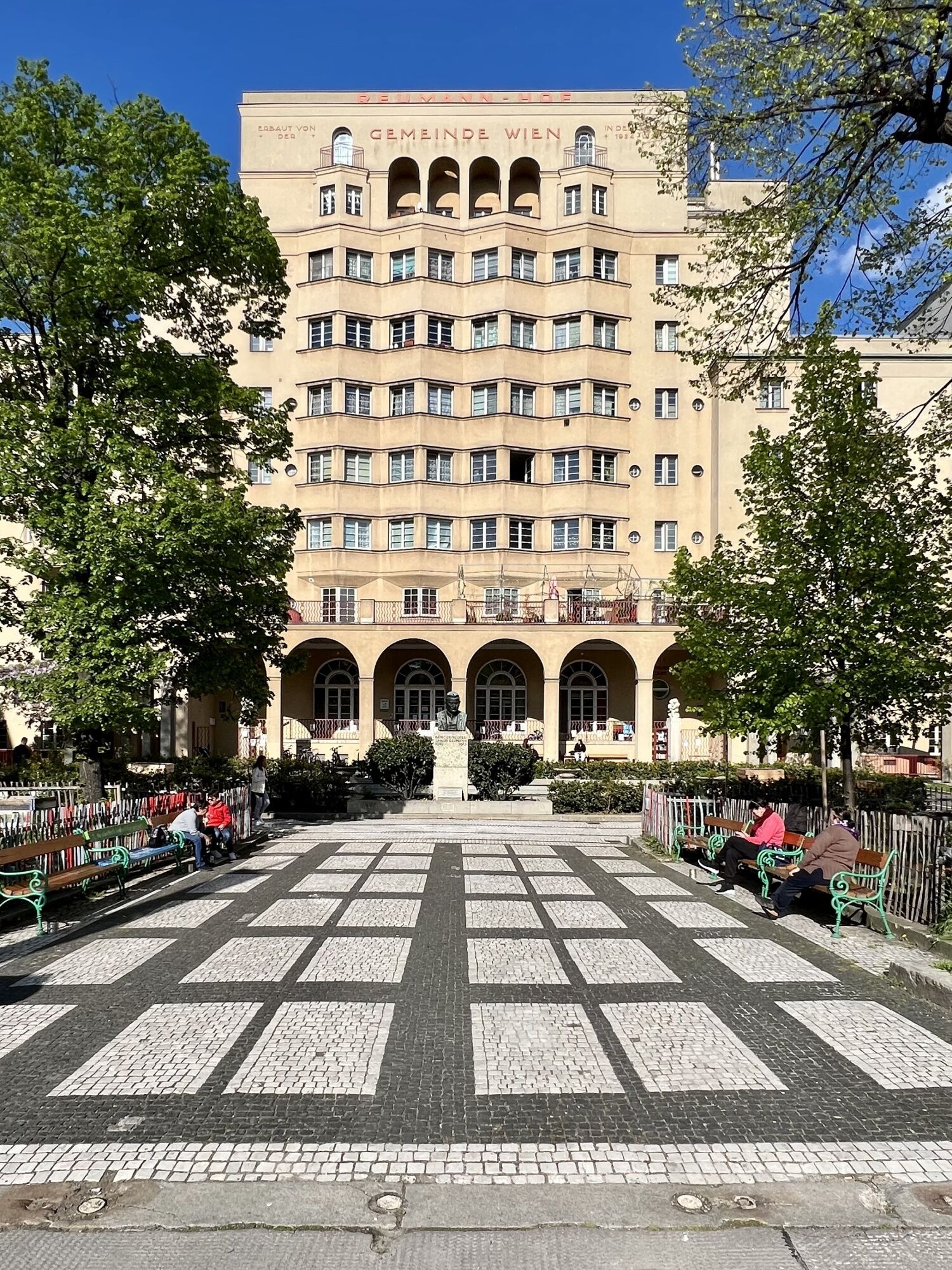
The 478-unit Reumannhof, public housing completed in 1926, was named for Vienna’s first Social Democratic mayor, Jakob Reumann.

Making sure all residents have decent housing is a challenge for cities around the globe. Richard Conway at Bloomberg CityLab says Vienna pretty much figured it out in the 1920s. He maintains it’s the reason Vienna is such a livable city today.

“The housing crunch that the growing city of Vienna faced a century ago,” he writes, “might seem strikingly familiar today: Private developers in the Austrian capital were good at building elegant luxury residences and substandard tenements for the poor, but they’d failed to create enough units to allow average residents to live in decent comfort at an affordable price.

“In response, Vienna’s Social Democratic government pursued a solution that modern cities still struggle to emulate: a massive construction program for public housing.

“The municipal apartment complexes they built, known as Gemeindebau, provided new homes at a volume and level of quality never seen before, and rarely seen since. The long-term results not only saw conditions for the average Viennese skyrocket, they also provided a hugely influential example for cities from Moscow to Manhattan.

These cities-within-a-city included medical facilities, schools, libraries, post offices and theater spaces.

“The Viennese Gemeindebau — plural Gemeindebauten — emerged in a city already in flux. Following Austria’s defeat in World War I, the country’s empire had dissolved and its monarchy was replaced by a democracy, in which the Social Democratic Workers Party (SDAPÖ) had the largest number of seats, both nationally and in Vienna. Once in power, the Social Democrats started addressing an issue central to their base: the overcrowding plaguing the new republic’s capital.

“In the 40 years leading up to 1918 … working-class families often lived in tenements known as Bassena, so named after the communal sinks found in their hallways. While they could look grand from the street, six or seven people might pack into a single apartment; often, each household shared a toilet and a sink and lacked electricity or heating beyond coal and wood stoves. They weren’t cheap, either: About 25% of a tenant’s wages went toward monthly rent, according to a 2022 MIT study.

“Starting in 1919 and continuing through to 1934, the Social Democrats launched a series of wide-reaching urban reforms focused on improving living conditions, education and social services. This period of SDAPÖ rule, widely known as Red Vienna, was informed by non-Bolshevik Austro-Marxism, which emphasized democracy, parliamentary politics and public investment. The Gemeindebauten, or municipal housing projects, were born.

“In the early days of the administration, there were two competing types of Gemeindebau. The first was associated with the settler movement: a group of low-income Viennese and refugees displaced from Austria’s fragmenting empire who occupied squatter settlements on the city’s periphery in an era of postwar political and social disruption. Viennese authorities eventually took over these informal communities, formalizing and planning them using elements of the Garden City philosophy.

“It was a second, much more common type of Gemeindebau, however, that came to define Vienna — the superblock-scaled Volkswohnungspaläste (‘people’s apartment palaces’). …

“Neither elaborately decorative like Vienna’s prewar tenements nor strikingly spare like the glass-and-steel apartments of the later International Style, the Gemeindebau often straddled an intriguing line between late 19th historicism and 20th century modernism. …

“Like older tenements, the buildings were typically aligned with streets, accessorized with some decorative features such as fancy brickwork or statuary and grouped around shared common yards. But while Bassena courtyards tended to be narrow, treeless and drab, the huge courtyards of the Gemeindebauten were spacious enough to serve as as combined garden, sports facility and public square, all accessible and sheltered from street noise. …

“In general, the shared areas within the superblocks were in fact as important as the individual homes, reflecting the Viennese administration’s social philosophy. These cities-within-a-city included medical facilities, schools, libraries, post offices and theater spaces. Curved staircases connected large floors — often as many as seven — and spacious landings. …

“The individual apartments, while varying in layout, shared key features. They included a living room, a bedroom, a kitchen, and some had small entrance hallways inside the front door. Almost all units featured running water, while many had large windows and balconies. Each apartment usually housed an individual family.

“Vienna employed nearly 200 architects to build more than 380 Gemeindebau complexes between the wars, a construction boom that created 60,000 new municipal apartments. In her book The Architecture of Red Vienna 1919-1934, Harvard professor Eve Blau describes how the municipal government was able to do this through expropriation, the use of tax policies to reduce land values and zoning laws. By 1931, it owned a third of the city’s area.

“Working-class citizens might now expect to live in airy apartments and access shared facilities. Indeed, the urban philosophy of Gemeindebauten is neatly captured by a term carved by artist Mario Petrucci into a statue outside a housing project: … ‘Light in the home. Sun in the heart.’ This was more than just a slogan; it represented an entire worldview.”

More at CityLab, here. No paywall. Interesting pictures.

Read Full Post »

Photo: Whitney Eulich.
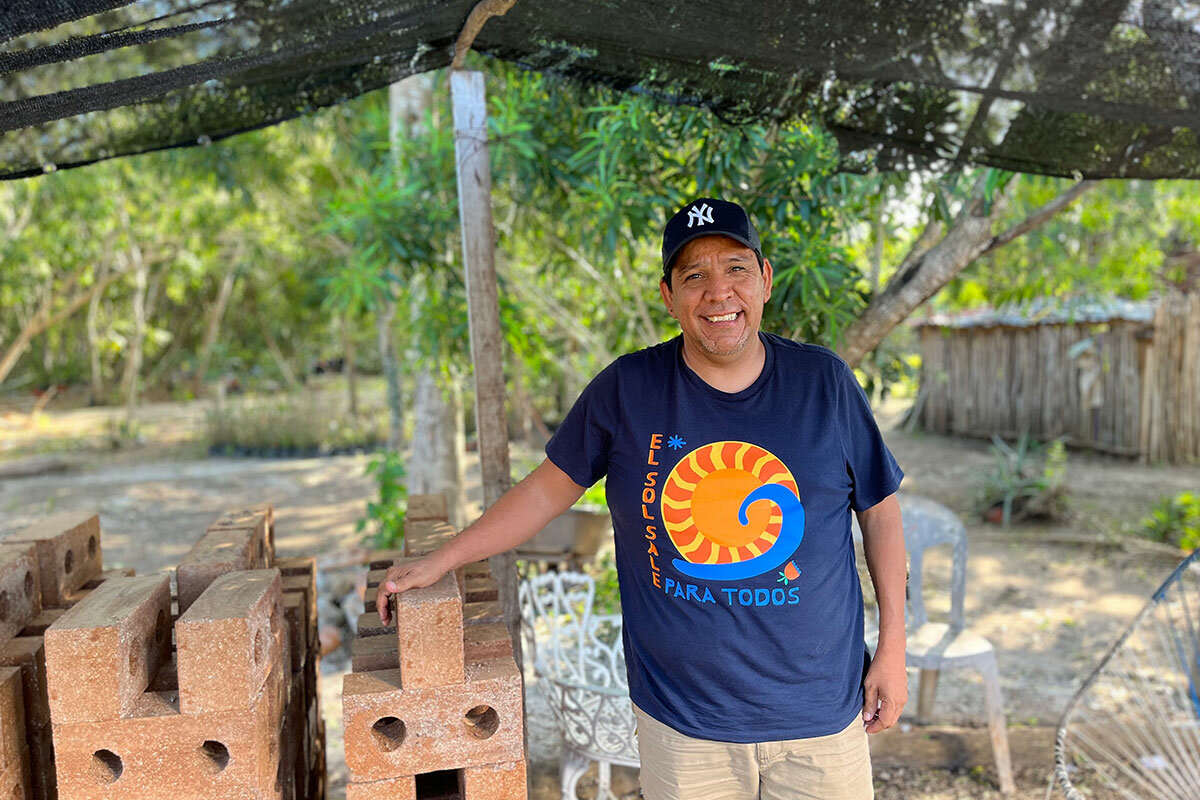
Omar de Jesús Vazquez Sánchez shows his Sargablock solution to the smelly seaweed invasion across the Caribbean shore of Mexico. He makes construction blocks out of it.

Today’s story is an example of someone with too many “lemons” who finds a way to make “lemonade.” It all started with smelly seaweed.

Christian Science Monitor writer Whitney Eulich reports from Puerto Morelos, Mexico, “Sargassum, the invasive, sewage-scented seaweed piling up on beaches across the Caribbean, isn’t something most people look upon kindly.

“But for Omar de Jesús Vazquez Sánchez, his first encounter was ‘love at first sight.’

” ‘Everyone said, “It smells horrible!” and I remember thinking, “There’s something more here,” ‘ says Mr. Vazquez, the founder of Sargablock, a small company in Mexico’s Yucatán Peninsula that transforms the algae into construction blocks.

“A record amount of sargassum is turning crystal blue Caribbean coast waters brown and smelling of rotten eggs as it decomposes in tourist spots from Mexico to Caribbean islands and now along the beaches of Florida’s east coast.

“Researchers blame pollution, overdevelopment, and global warming for the seemingly never-ending seaweed invasion that’s also present in the Atlantic.

“In 2015, as part of his gardening business, Mr. Vazquez launched a beach cleanup service to remove the leafy seaweed. But, as its arrival intensified, he started considering how to turn it into something useful, and in 2018 conceived a way to use sargassum in building blocks. Today he not only sells those blocks to construction projects, but also builds affordable housing in his community.

“ ‘When I look at Sargablock, it’s like looking in a mirror,’ he says, comparing his company to conquering his personal struggles, including addiction, and briefly, homelessness.

‘When you have problems with drugs or alcohol, you’re viewed as a problem for society. No one wants anything to do with you. They look away.’

“ ‘When sargassum started arriving, it created a similar reaction. Everyone was complaining,’ he says. … ‘I wanted to mold something good out of something everyone saw as bad.’ …

“The state government of Quintana Roo collected 19,000 tons of sargassum from beaches in 2020; 44,000 tons in 2021; and 54,000 tons last year. Researchers say the amount could nearly double this year, and it arrived months ahead of what is typically the start of sargassum ‘season’ in May. …

“Mr. Vazquez mixes 40% sargassum with other organic materials, like clay, that he then puts it into a cement-block-forming machine. The blocks bake in the sun for several days before they’re ready to use. He says he used 3,000 tons of sargassum in  2021, 2,000 tons last year. By early April 2023, he’d already used 700 tons.

“The UNDP [United Nations Development Program] selected Mr. Vazquez’s work transforming sargassum for their Accelerator Lab, which identifies and broadcasts creative solutions to environmental and sustainability challenges globally. The idea is that some of the most timely and creative responses come from locals living the repercussions of environmental dilemmas firsthand. …

“A joint study by universities in England and Ghana found that blocks made with organic material like sargassum can last for 120 years. The ecology and environment offices of Quintana Roo concluded the blocks are safe for use in construction. 

“Mr. Vazquez grew up surrounded by nature – and the hardships of poverty. It shaped him into someone who takes action, he says. He remembers singing for spare change on the street as a child, before his single mother moved the family to the U.S. as unauthorized immigrants. They picked grapes in California, and Mr. Vazquez dropped out of high school to double down on what he considers his profession: gardening.

“ ‘There’s this idea of the American dream. But, for me, personally,’ he says, ‘I was always asking God to let me come back to Mexico.’

“It took almost 30 years to do so. ‘Coming back, it took a lot of time to adapt – the salaries are different. Sometimes people are skeptical’ of Mexicans returning from the U.S. he says. He worked odd jobs, like selling timeshares to tourists passing through the Cancún airport. Eventually he invested his savings – $55 at the time – in a nursery.

“As his nursery grew, he was making a name for himself creating a small but promising solution to the sargassum challenge. He gained attention through appearances on Shark Tank Mexico and a locally organized Ted Talk. Although he was living the ‘Mexican dream,’ something was missing. He reflected on when he was happiest in his life and it came down to two things: Memories of spending time in his grandparent’s simple adobe-block home in Jalisco, and being with his mother, who had sacrificed so much for him before passing away in 2004.

“ ‘We never had a house of our own, we didn’t have much food or clothes. I didn’t have a father,’ he says. When he built what he expected to be his nursery’s new office with Sargablock, he designed it as a replica of his grandparents’ home and named it after his mother, Angelita.

“ ‘The first thing that came to my mind and heart was to donate houses to women like my mother, who are doing everything in their power to make it work,’ he says.

“Enter Casas Angelitas. Using Sargablock, Mr. Vazquez has built and donated 14 homes to families in need, many single moms, but also elderly couples and parents supporting kids with disabilities.”

More at the Monitor, here. No firewall. Subscriptions for the online publication are reasonably priced.

Read Full Post »

Photo: MJ Gautrau/ University of Maine.
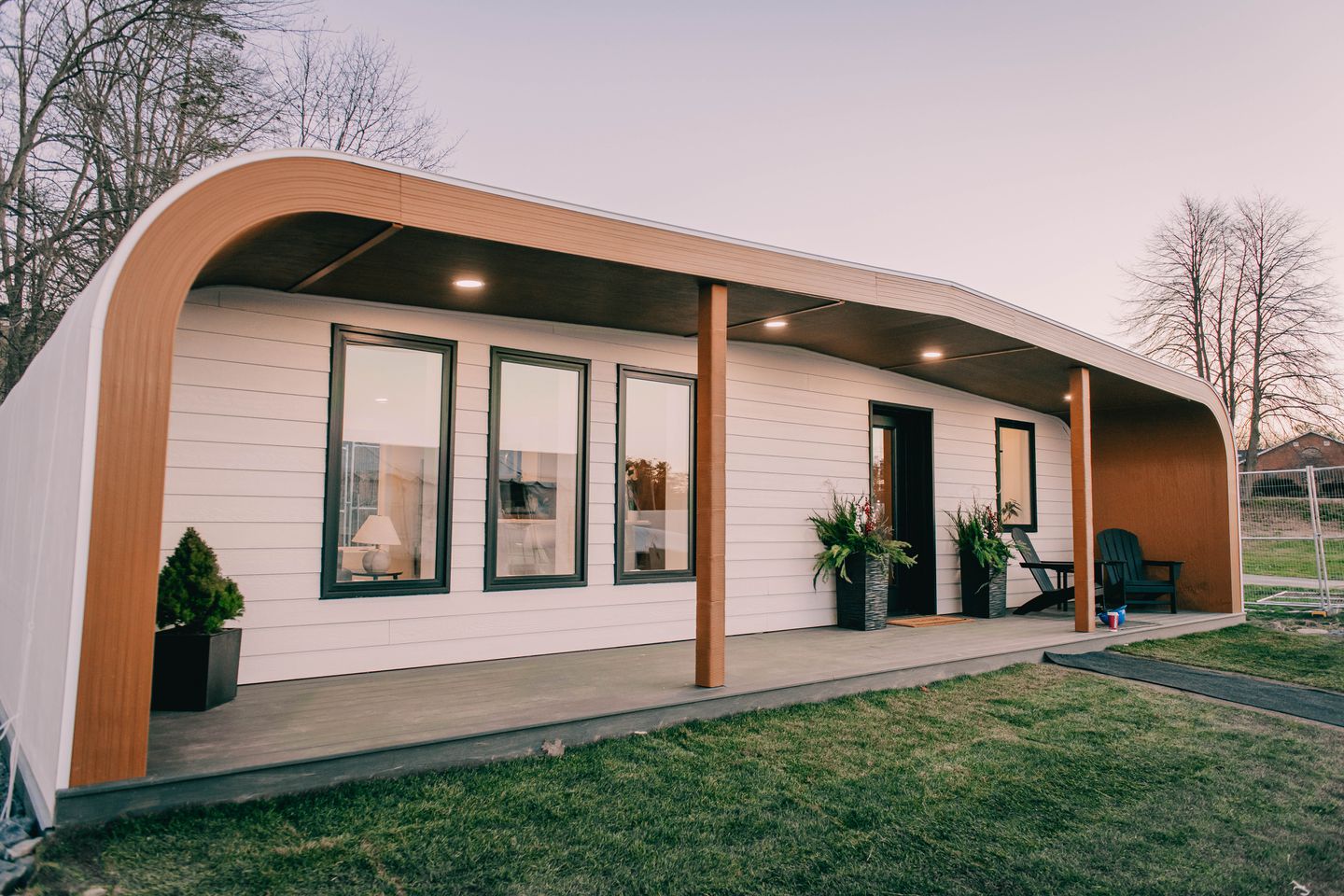
BioHome3D, the first 3D-printed home made entirely of organic, renewable materials, was unveiled on Nov. 21 at the University of Maine’s Orono campus.

I wonder if writer Laura Graves, blogging from what she calls the Hinterlands of Central Maine, has heard about this initiative in her state. It actually looks like a good idea for any state (or nation). See what you think.

Maya Homan writes at the Boston Globe, “How do you create lots of affordable housing with limited materials, labor, and other resources? One group of researchers at the University of Maine has come up with a proposed solution: hook up a 3D printer.

“The United States faces rising rents and housing shortages, intensified by the COVID-19 pandemic, but Maine has its own unique, overlapping challenges: The state needs another estimated 20,000 homes to meet the current demand for low-income housing. It also has the oldest average population in the nation, with a median age of 44.7, an issue that exacerbates the state’s labor shortage. With pandemic-related supply chain issues and rising costs of raw materials, the already-expensive housing market has surged.

“Enter BioHome3D, the first 3D-printed home made entirely of organic, renewable materials.

“The prototype, which was created by the University of Maine’s Advanced Structures and Composites Center, has been in the works for three years, according to founding director Habib Dagher. It is 600 square feet in total, with a modern, unvaulted barrel roof, and a wide front porch with white shiplap exterior walls. The interior contains an open-concept kitchen, living, and dining area with grooved wooden walls and tall windows. The single bedroom doubles as an office, and a tiled bathroom completes the space.

“The materials used to manufacture the 3D-printed home also help address another issue in Maine: the shuttering of several pulp and paper mills that once processed residual sawdust and other byproducts from local sawmills. …

“Dagher said, ‘We asked ourselves, could we print a home with that material?’ The answer, thus far, has been yes.

“The prototype, which was unveiled Nov. 21 at the University of Maine’s Orono campus, is now undergoing tests to see how the building fares during Maine’s harsh winters. …

“Dagher’s lab is building on over two decades of research into using biomaterials to create sound structures. Though Dagher’s lab is not the first to 3D print a house, they are the first to use a 3D printer to create the entirety of the structure, as well as the first to use environmentally friendly and reusable materials.

“ ‘The walls, the floor, the roof are all bio-based, and it’s 100 percent recyclable,’ Dagher said. …

“While there are certain drawbacks to using engineered materials over natural ones — fire safety being one — Dagher said the homes have displayed an added durability throughout different climates, as well as increased resistance to termites. …

“The homes are designed using modular construction, meaning that individual rooms are manufactured indoors and driven to the construction site, where they can be quickly assembled. Dagher hopes that this method will help cut down on construction time, as builders will not be as impacted by weather conditions.

“As the project is still in the testing phase, there aren’t yet definitive estimates for how many people will be needed to construct the homes, or how much each tiny house will cost to manufacture. However, Dagher said the use of sustainable materials and the ability to 3D print the structure ‘really changes the game in terms of how we think of housing content and how we think of construction.’

“Though the research process is far from over, ‘we’ve learned a lot,’ he said. ‘We’ve learned what not to do, as well as what to do, and the learning has not ended.’

“The lab’s next steps are to build a manufacturing plant (which Dagher affectionately nicknamed the ‘factory of the future’) to be able to produce the homes en masse. Once the factory is up and running, they hope to be able to 3D print a home within 48 hours, and move on to larger projects like housing developments.

“ ‘There’s a lot of potential, not only to solve a crisis in Maine, but to assist in a solution to the housing crisis nationally as well,’ he said.”

More at the Globe, here. See also my 2018 post on a different kind of 3-D house in the Netherlands, here.

Read Full Post »

Photo: Jean-Christophe Quinton Architecte. Illustration: Stephanie Davidson.
“At street level,”
CityLab reports, “12 Rue Jean-Bart blends into its neighborhood. At the top, things get a little funky.” 

Blogger Laurie and I exchanged comments the other day about how neighbors with decent housing too often vote against building affordable housing nearby. True, even though we all know that forcing families into homelessness hurts us all.

A recent story about Paris, where the neighbors didn’t get to vote, shows that good architecture can enable what the French call “social” housing to be constructed in the most exclusive neighborhoods.

Marie Patino and Kriston Capps write at CityLab, “The project at 12 Rue Jean-Bart is a modest one, just eight units of affordable housing on a narrow lot in Paris near the Luxembourg Gardens. The social housing project nevertheless caused a stir with neighbors in the 6th arrondissement, one of the city’s more affluent areas.

“When local politicians backing the project came to visit the building during its construction, neighbors shouted from windows across the street that it was a shame to build social housing here, according to Jean-Christophe Quinton, the Paris-based architect who designed the small in-fill development.

“Local resistance was a persistent feature of the project throughout its three-year-long construction, Quinton says; the building regularly faced harsh scrutiny in local newspaper Le Parisien.

“Quinton responded to critics with design. The final building that emerged at 12 Rue Jean-Bart is striking: Its facade features great concave swoops of limestone, like ribbons of frosting atop a particularly elegant slab of cake. Yet in many ways, it’s a traditional project. The architect strived to make the building familiar: It’s finished with the same materials found throughout Paris and built to the same proportions as some of the 19th-century buildings on the street.

“ ‘We need to destigmatize social housing,’ Quinton told Bloomberg CityLab from his Paris design studio, his Zoom background cluttered with building models. ‘That’s also why it’s made out of stone, because it’s totally integrated into the city, to say that you can build social housing in Paris, and that’s a good thing.’

“Quinton says he’s learned that there’s no use trying to compete with the street in Paris, so 12 Rue Jean-Bart does its best to fit in amongst its neighbors, in a way that makes it almost invisible from afar. The design’s most dramatic gestures are reserved for the upper floors. At street level, the building’s curves look almost like classical fluted columns. Twin weight-bearing stone culs de lampe on each side of the front entrance, which support the corners of the building where the curves meet, are hidden feats of engineering. …

“Other details are traditional, too, and as typical of Paris architecture as possible. The white balconies and joinery at 12 Rue Jean-Bart are common in the city. So is the honey limestone, which comes from a quarry in Vassens, not far from the city. The scale of the project is simply driven by local building codes. The setbacks at the top of the building match those built during the mid-19th century. …

“For residents at 12 Rue Jean-Bart, the experience is rather dramatic. The building is narrower at the back than at street level, and each floor fans out from a central staircase column. The layouts of the upper-floor units with balconies shift dramatically from those below in order to maximize light while adhering to strict accessibility standards required by Paris codes — a challenge, given the limited size of the lot. The balconies provide a rhythmic frame for the street.

“The building’s been fully rented for almost a year now. The residents love it, according to the architect. And the neighbors have learned to live with it.

“ ‘From afar, you don’t see it, and up close, it has personality,’ Quinton says. ‘It’s a Parisian personality.’ ”

More at CityLab, here. No firewall.

Fellow bloggers who visit Paris: If you are ever in Rue Jean-Bart, do send us a picture of number 12.

Read Full Post »

Photo: Melanie Stetson Freeman/CSM.
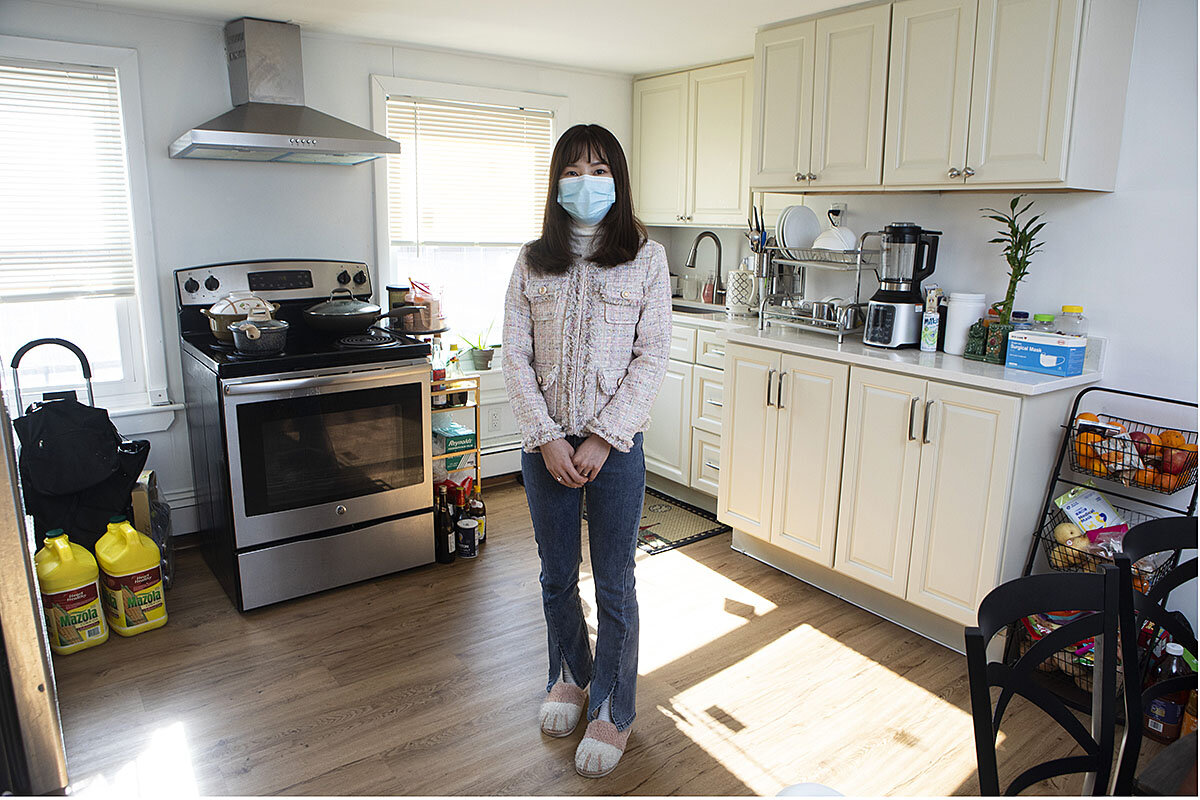
Meidan “Abby” Lin poses in her apartment in Boston’s Chinatown. She and her husband bought the unit with help from the Chinatown Community Land Trust, which aims to stabilize the community through affordable housing, ownership of land, control of public lands like parks, and the preservation of cultural and historical sites.

One of the biggest challenges for America in these times is housing. Housing can help people with addictions get clean. It can reduce the need for long, polluting commutes to jobs in expensive urban areas, it can give people breathing space to pursue their interests and make better lives for their children.

One of the current experiments in providing housing that people can afford involves community land trusts.

Jocelyn Yang and Alexander Thompson write at the Christian Science Monitor, ‘In March 2016, [Meidan ‘Abby’] Lin; her husband, Yin Zheng; their young son, Yuchen; and Mr. Zheng’s mother left Fuzhou, Chin, … for another port half a world away on the Charles River in Boston.

“They shared their first apartment in Boston’s Chinatown with another family. During nights in that cramped space, Ms. Lin started dreaming of a place she could call her own. But Boston’s soaring real estate prices seemed to put that dream out of reach. Mr. Zheng works at a restaurant. Ms. Lin works at home.

“Then a friend told Ms. Lin about the Chinatown Community Land Trust. … The group was selling apartments at discount prices, and Ms. Lin jumped on the waitlist. But there was only one apartment big enough for her family. ‘I didn’t think we were able to get it,’ she says. All she could do was hope.

“Community land trusts [are] buying their own properties to preserve them as affordable housing in perpetuity and give residents more say over what happens in quickly changing neighborhoods. 

“That mission has gained new urgency over the past year as homeowners reap the rewards of a red-hot real estate market while renters are hit with steep rent hikes, deepening the divide between the housing haves and have-nots. …

“ ‘As neighborhoods change and gentrify really fast, the idea of having community control and having more say about how neighborhoods are changing and who’s going to be able to live in the neighborhood over time, from an affordability perspective, I think becomes really important,’ says Beth Sorce, who works with community land trusts nationwide at the Grounded Solutions Network, an affordable housing advocacy group. …

“Land trusts raise money from donations, grants, and government funds to buy property. Then they lease the house or apartment to a buyer well below market value, but the trust retains ownership of the land.

“This way, occupants typically get an ownership stake in their homes. They build equity over time, but at a rate that is often capped at 1% or 2% a year. The trust, which is governed democratically by residents and neighbors, can decide to whom the dwelling can be sold and at what price, usually through a covenant in the lease. This ensures the property remains affordable.

“The land trust idea was imported to the United States by civil rights activist Charles Sherrod in the early 1970s from the kibbutzim of Israel. Mr. Sherrod saw land trusts as a way for Black Americans to buy agricultural land in the South. …

“Andre Perry, a housing policy expert at the Brookings Institution [has shown] that an ‘intrinsic value of whiteness’ persists at almost every step of home buying from the appraisal to the sale. Minorities, but especially Black people, must pay more and get less. 

“By taking property out of the traditional market, land trusts reduce the discrimination baked into that system and empower communities to actively fight it, Dr. Perry says. …

“In California, justice is what drives Jacqueline Rivera and her fellow housing activists in San Jose. In the heart of Silicon Valley, where even high-paid tech employees struggle to find housing, development was pushing out vibrant Black, Hispanic, and immigrant neighborhoods.

“In community conversations Ms. Rivera and her colleagues held around the city in 2018, land trusts kept coming up. Ms. Rivera grabbed hold of the idea, and by 2020 she was heading up the South Bay Community Land Trust.

“Success has not come easily, though.  By definition, land trusts do not make profits, and fundraising is the biggest challenge they face. To buy their first property, a fourplex in downtown San Jose, they need to fundraise at least $1 million, on top of the half million dollars they need to pay professional staff and make the organization run. Speed is a problem, too. Developers snap up properties with cash in a matter of days, while the land trust moves ‘at the pace of community,’ Ms. Rivera says. 

“Yet, in order to disrupt traditional real estate, land trusts ‘still have to play in the real estate game,’ she adds.

“Advocates stress that land trusts are just one tool in a broader approach to the affordability crisis, but it could be a more effective one with government help. Ms. Sorce, of Grounded Solutions, says state and local governments should invest money in land trusts and change appraisal policies so land trust properties aren’t paying taxes based on their speculative value. With or without such help, land trusts must innovate to succeed.

“ ‘When we think about community land trusts, so many times we think about just the homeownership level,’ says Sheldon Clark, who recently served as president of the board of the Douglass Community Land Trust in Washington, D.C. ‘And that really just doesn’t cover the housing needs that we have.’

“Douglass has units it’s maintaining as permanently affordable rentals and other properties set up as cooperatives. They’ve also helped tenants take advantage of a District of Columbia law that entitles them to buy their unit if their landlord plans to sell.

“Really, land trust leaders say, homeownership is just one aspect of their focus on what Mr. Clark calls the ‘big C’ in community land trusts: the community.

“Douglass organized food drives during the pandemic and helps connect residents to credit unions, as many are unbanked. In Boston’s Chinatown, the land trust helped save a local park.”

Find other examples of how land trusts strengthen communities at the Monitor, here. No firewall; nice photos.

Read Full Post »

Photo: David L Ryan/ Globe Staff.
Homeowner Paul E. Fallon hopes to inspire others to bequeath their homes to an affordable-housing nonprofit that will help moderate-income families in Cambridge, Mass., to build wealth through homeownership.

As much as I believe that lack of homeownership is a major cause of inequality, keeping many lower-income families from passing on their nest egg to another generation, I could never bring myself to do what Paul E. Fallon recently committed himself to doing. He’s really putting his money where his mouth is. And his children are amazingly supportive.

As Jon Gorey reported for the Boston Globe, “When Paul E. Fallon purchased a Victorian four-family in Cambridge nearly 30 years ago, he wasn’t angling to become a minor real estate tycoon. But he wanted to raise his children in the city, and a single-family home was, even then, more than he could afford. ‘I bought it when a four-family house in Cambridge was a pariah because it was under rent control,’ Fallon said. ‘There was no crystal ball in 1992 that told me this house was going to make me rich.’

“But it did. Fallon lived in one unit and rented out the others, first under rent control, then at fair market rents. Now a single man in his mid-60s, the writer and retired architect owns his property outright. … In just one generation, his home in what had long been a middle-class neighborhood of plumbers and electricians has become a multimillion-dollar asset.

“That makes Fallon uncomfortable as he sees young families, especially people of color, unable to plant the kind of roots in Cambridge he did. His own children, despite being well-launched in good careers, he said, could never afford to buy the house they grew up in now. ‘Cambridge’s vanishing middle class makes my city a less diverse, less dynamic place to live’ he said.

“So when he turned 65 last year, … Fallon realized he wanted to do something very different with his property. He decided to leave his house to a local nonprofit when he dies. The goal is to create not just affordable housing, but long-term generational homeownership opportunities for four Cambridge households. …

‘I don’t just want to give people a secure place to live; I want to give the opportunity for people to be in the middle class, to accrue equity, to be able to pass the house down to their own children if they want to … to really build wealth.’

” ‘The difference between the haves and have-nots in the United States is largely a matter of who owns their house,’ Fallon added. … ‘I feel like if we’re going to be serious about creating a more equitable world, then those of us who have more than we need have to spread our wealth. We can’t just talk about it.’ …

“Fallon first wanted to make sure his two adult children were on board with his idea, even though it meant they would be losing out on a significant portion of their inheritance. But that, too, was part of his plan. ‘My house is worth so much money that, if my children inherited it, they would be living on Easy Street. And I’ve never met anyone who inherited wealth that wasn’t changed for the worse as a result,’ Fallon said. Gratefully, his kids understood where he was coming from. ‘They’ve spent their whole lives around me — they were not surprised,’ he said.

“He then sent letters to eight Cambridge nonprofits explaining his still-nebulous idea in vague terms — big on concept, short on logistics. After interviewing a handful of them, Fallon landed on Just-A-Start, a 53-year-old Cambridge organization that develops and manages affordable housing and offers youth programs, job training, and other economic advancement services.

“ ‘Just-A-Start really got it,’ Fallon said. Their goals aligned with his, and he felt confident they would still be around when the time comes to implement his vision. ‘They understood that what I’m trying to do is to help Cambridge be a more diverse place, a more equitable place,’ he said. …

“When Just-A-Start executive director Carl Nagy-Koechlin received the inquiry, he recognized Fallon’s name; they had worked together on an affordable housing development in Somerville a few years prior. He also realized that Fallon’s explicit instructions — that the house be used for homeownership opportunities — would help fill a key gap in the city’s affordable housing stock. ‘Most of the housing we’ve developed is rental housing, and that’s because it’s needed — but also because the financing sources for affordable housing are skewed in that direction,’ he said. …

“Fallon and Nagy-Koechlin spent a few months hammering out the details into a memorandum of understanding, which Fallon then brought to [Gregory Pearce, the Cambridge lawyer who assisted Fallon with his estate plan] to review. ‘All the heavy lifting was done before it got to me,’ Pearce said. ‘All I really had to do was to make sure that the plan is actually going to happen upon Paul’s death.’ That meant establishing an estate plan and selecting a reliable trustee to make sure Fallon’s wishes are faithfully carried out.”

Read the details about how this is going to work, here.

Read Full Post »

Looking back, don’t you feel like you always knew malls would go the way of the Dodo as soon as online shopping started taking hold? I had no idea, but now I imagine I was ahead of the curve. I wonder how many people in the 1990s were already pondering what to do with empty mall real estate in future decades.

There will probably always be a need for someplace like a mall for people to gather with friends and maybe have an indoor walk when the weather is bad. Maybe retail shops for people who’d rather see items up close — or try them on before buying — will survive, but they’ll never fill all that space.

In today’s article, we learn about a conversion effort at a mall in Washington State.

In June, Patrick Sisson wrote at Bloomberg’s City Lab, “The multiple crises impacting the U.S. economy — the botched response to the coronavirus and the resulting economic fallout, and lack of spending power — have delivered a new gut punch to brick-and-mortar retail, a sector that was already reeling.

“More than half of all U.S. department stores in malls will be gone by 2021, one real estate research firm predicts, and surviving retailers may not be far behind; once-mighty brands such as Cheesecake Factory and the Gap are skipping rent payments, Starbucks is closing physical locations, and developers see a future for big box stores as office complexes. …

“At the Alderwood Mall in Lynnwood, a suburb north of Seattle, an adaptive reuse project already in progress suggests that America’s vast stock of fading shopping infrastructure could indeed get a second life as places to live. …

“Developers are turning a wide swath of the 41-year-old shopping center into Avalon Alderwood Place, a 300-unit apartment complex with underground parking. The project won’t completely erase the shopping side of the development: Commercial tenants will still take up 90,000 square feet of retail. But when the new Alderwood reopens, which developers expect will happen by 2022, the focus will have shifted dramatically. …

“Lynnwood may offer an ideal testing ground for the long-term opportunities in large-scale suburban mall-to-housing conversion. The suburb of roughly 40,000 people is a commuter bedroom community for Seattle, which has been struggling mightily with a severe housing shortage. …

“ ‘There have been some great examples of this kind of redevelopment, such as Tyson’s Corner in Virginia, but it’s very specific to individual cases, and very expensive,’ says Nick Egelanian, president of retail consultancy SiteWorks, who predicts up to a third of malls will be vacant due to the economic fallout from the pandemic. ‘If it’s a good location, you can backfill that with residential, hotel, office and entertainment.’ …

“Brian Lake, a senior attorney at the Pacific Legal Foundation who focuses on housing issues, believes that, minus the hurdles put up by zoning regulations and red tape, such commercial conversions should be happening everywhere. From a construction standpoint, conversions are simple.

‘We need to open up every opportunity possible to develop new affordable housing,’ he says. ‘Fannie Mae estimated we need an additional 2.5 million units just to satisfy the long-term demand, and that’s before this year’s crises.’

“Converting commercial real estate to housing may be the best use of land in such an over-retailed country. Big shopping centers tend to be centrally located and connected to transit. … During a time of housing shortages, Lake believes that transforming empty commercial buildings is a ‘moral imperative.’

“The Alderwood redevelopment brings challenges. … So the city is working on a housing action plan to make sure social services and education arrive in the community, not just new apartments. The mall may be evolving, but the desire, and challenges, in creating a community-oriented development still remain.

“ ‘You can have acres and acres of housing, but without a community, is it a place?’ [David Kleitsch, the city’s economic development director,] says. ‘Does it fulfill somebody’s experience?’ ”

More at City Lab, here.

Read Full Post »

3203

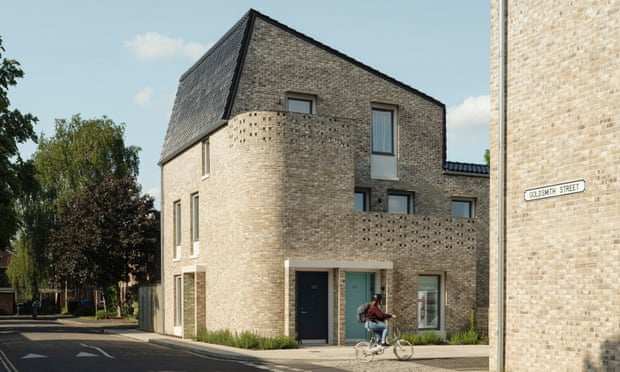
Photo: Tim Crocker/RIBA/PA
The Goldsmith Street project in Norwich marks the first time the UK’s Stirling architecture prize has gone to affordable housing.

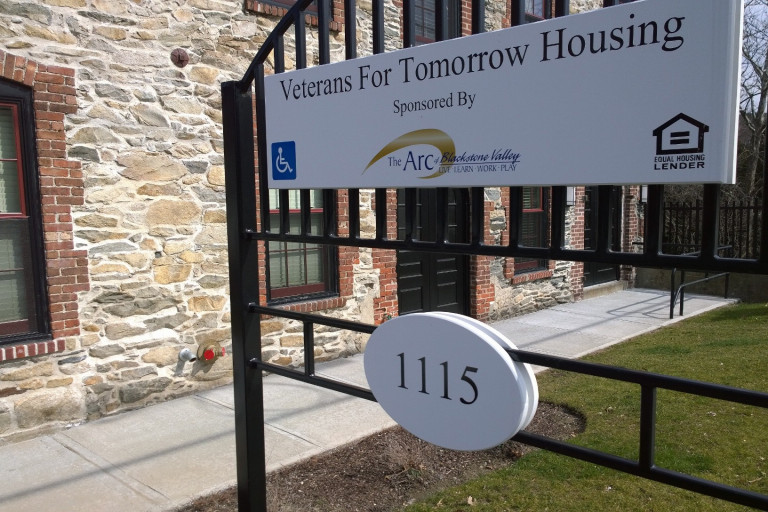
I’m looking at pictures of a handsome affordable-housing project in England and remembering that during my short stint at Rhode Island Housing, a similar building, restored to provide affordable housing for homeless veterans, also won a prize. I blogged about interviewing one happy resident here. Clearly, homes for low-income people need not be ugly.

Oliver Wainwright reports at the Guardian, “One hundred years since the 1919 Addison Act paved the way for the country’s programme of mass council housing, the prize for the best new building in the UK has been awarded to one of the first new council housing projects in a generation.

“Goldsmith Street in Norwich represents what has become a rare breed: streets of terraced homes built directly by the council, rented with secure tenancies at fixed social rents. And it’s an architectural marvel, too.

“ ‘A modest masterpiece’ is how the RIBA [Royal Institute of British Architects] Stirling prize judges described the project, designed by London firm Mikhail Riches with Cathy Hawley, representing ‘high-quality architecture in its purest most environmentally and socially conscious form.’

“The 105 creamy-brick homes are designed to stringent Passivhaus environmental standards, meaning energy costs are around 70% cheaper than average. The walls are highly insulated and the roofs are cleverly angled at 15 degrees, to ensure each terrace doesn’t block sunlight from the homes behind, while letterboxes are built into external porches, rather than the front doors, to reduce any possibility of draughts.

“Immense thought has gone into every detail – from the perforated brick balconies to the cleverly interlocking staircases in the three-storey flats at the end of each terrace – to ensure that every home has its own front door on the street. The back gardens look on to a planted alley, dotted with communal tables and benches, while parking has been pushed to the edge of the site, freeing up the streets for people, not cars. …

The architects won the original competition because they were one of the few firms to propose streets, rather than slabs of apartment blocks.

“They took inspiration from the city’s Golden Triangle, a desirable neighbourhood of Victorian terraced houses, where the streets are laid out more tightly than modern overlooking regulations would allow. The architects used this precedent to argue that their new neighbourhood could be just as humanely scaled, while fitting in more homes.

“Marking the first time in the 23-year history of the Stirling prize that it has been awarded to social housing, the project beat stiff competition from the revamped London Bridge station, an opera house in a former stable block, the Macallan whisky distillery in Scotland, a visitor centre for the Yorkshire Sculpture Park, and a house made entirely of cork. …

“This year’s choice sends a clear message that, despite government cuts, it is eminently possible for brave councils to take the initiative and build proper social housing.”

Read more here.

Photo: Suzanne’s Mom
An impressive coalition of funders, including Rhode Island Housing, collaborated on this 2015 award-winning mill restoration to house homeless veterans.

030716-vets-for-tomorrow-providence

Read Full Post »

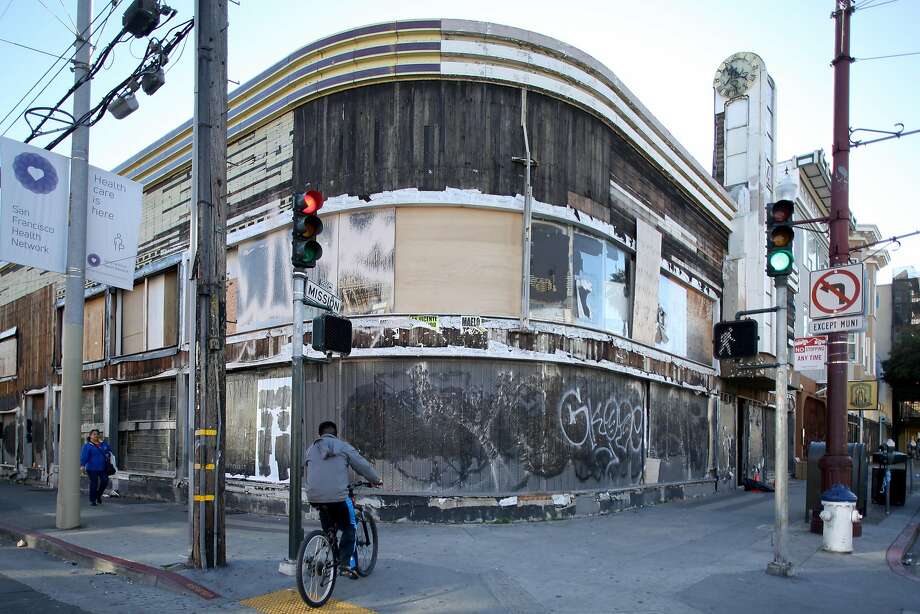
Photo: Elizabeth Hafalia, The Chronicle
Facing a need for affordable housing and arts space, San Francisco’s Mission Economic Development Agency is joining with Dance Mission Theater and the Mission Neighborhood Centers to repurpose this neglected 1919 building.

Have you ever visited San Francisco’s Mission District? A poor, immigrant neighborhood, it is nevertheless a vibrant experiment in people-oriented housing and support for food entrepreneurs and the arts. The creative energy there is tangible.

Moreover, the neighborhood’s community-development folks never stop turning dreams into reality. J.K. Dineen has an update at the San Francisco Chronicle.

“A historic but long-neglected commercial building at Mission and 18th streets in San Francisco is poised to be rejuvenated with a mix of affordable housing, child care and dance.

“The dilapidated 1919 structure, a former furniture store that was remodeled with an Art Deco flair in the late 1930s, has been on and off the market for more than a decade. …

“Finally the Mission Economic Development Agency, a politically powerful group that often opposes market-rate housing, reached a deal to buy it by collaborating with Dance Mission Theater and the Mission Neighborhood Centers, which will open a child care facility there.

“ ‘We are all going in together to do a new model of cooperative living and dancing and taking care of our children,’ said Krissy Keefer, executive director of Dance Mission Theater. ‘It’s going to be very communal.’ …

“Brokers with the San Francisco office of the realty firm Marcus & Millichap … said market-rate developers were scared off by the Mission’s anti-gentrification political environment and that ‘MEDA was very good to work with.’ …

“The building will be the group’s first home ownership project — the others are rentals — and the first targeting middle-income families rather than low-income folks. Mission Neighborhood Centers is providing some of the project funding, along with two nonprofits: Low Income Investment Fund, a financial intermediary that provides capital for community developments, and the Neighbor to Neighbor fund.”

I’m sure everyone has read about the housing crunch in San Francisco, with tech employees pushing prices up. It’s good to hear of anything designed to ease the shortage. More here.

Read Full Post »


Photo: Melissa Lyttle for The New York Times
Noreen McClendon, executive director of Concerned Citizens of South Central Los Angeles, works to create affordable housing and job opportunities. A byproduct: crime reduction.

When people focus on getting “tough on crime,” crime can get worse. Emily Badger writes at the New York Times about research suggesting that people in communities where crime has gone way down since the 1990s “were working hard, with little credit, to address the problem themselves.

“Local nonprofit groups that responded to the violence by cleaning streets, building playgrounds, mentoring children and employing young men had a real effect on the crime rate. That’s what Patrick Sharkey, a sociologist at New York University, argues in a new study and a forthcoming book. Mr. Sharkey doesn’t contend that community groups alone drove the national decline in crime, but rather that their impact is a major missing piece. …

“Between the early 1990s and 2015, the homicide rate in America fell by half. Rates of robbery, assault and theft tumbled in tandem. In New York, Washington and San Diego, murders dropped by more than 75 percent. Although violence has increased over the last two years in some cities, including Chicago and Baltimore, even those places remain safer than they were 25 years ago. …

“This long-term trend has fundamentally altered city life. It has transformed fear-inducing parks and subways into vibrant public spaces. It has lured wealthier whites back into cities. It has raised the life expectancies of black men. …

“The same communities were participating in another big shift that started in the 1990s: The number of nonprofits began to rise sharply across the country, particularly those addressing neighborhood and youth development. …

“Nonprofits were more likely to form in the communities with the gravest problems. But they also sprang up for reasons that had little to do with local crime trends, such as an expansion in philanthropic funding. …

“Comparing the growth of other kinds of nonprofits, the researchers believe they were able to identify the causal effect of these community groups. …

“The research also affirms some of the tenets of community policing: that neighborhoods are vital to policing themselves, and that they can address the complex roots of violence in ways that fall beyond traditional police work. …

“Many similar groups did not explicitly think of what they were doing as violence prevention. But in creating playgrounds, they enabled parents to better monitor their children. In connecting neighbors, they improved the capacity of residents to control their streets. In forming after-school programs, they offered alternatives to crime.

“In the East Lake neighborhood of Atlanta, the crime rate in the mid 1990s was 18 times the national average. …

“ ‘We knew we wanted to see violence and crime go down in the community,’ said Carol Naughton, who led the foundation for years and today is the president of a national group, Purpose Built Communities, that is trying to teach East Lake’s model in other cities. ‘But we’ve never had a crime-prevention program.’

“Today violent crime in East Lake is down 90 percent from 1995.”

One and one and 50 make a million. As solutions to the world’s problems fail to come top-down, ordinary folks are leading the way. More here.

Read Full Post »

Photo: Amelia Templeton/Oregon Public Broadcasting
The Granny Pods of Portland, Oregon, aren’t just for grannies. This woman and her family live in one — technically an accessory dwelling unit (ADU) — in their landlord’s backyard. Last year, Portland issued building permits for roughly one ADU a day, easing a housing crunch.

When I was a child, I used to hear a lot about zoning from my politically oriented mother — large lots were good, allowing  residential uses in commercial or industrial areas was bad. Times change. Some industrial areas are clean; mixed-use development improves community vitality; higher density in cities is good for keeping rents affordable.

Amelia Templeton reports for National Public Radio about recent initiatives in Oregon.

Earlier this year, Michelle Labra got a notice that the rent on her family’s two-bedroom apartment was doubling, from around $620 a month to more than $1,300. She worried she was being priced out of Portland and would have to move to the suburbs.

“But Labra, her husband and their two children didn’t get pushed out of Cully, their North Portland neighborhood. They were able to stay by moving into a little house, 800 square feet, built in a neighbor’s backyard. It’s a type of housing city planners refer to as an accessory dwelling unit, or ADU, often called a granny flat or granny pod. …

“With a lot of cities looking for solutions to rising housing prices, the idea of making it easier for homeowners to add small second units in their backyards and garages is gaining traction. Portland has among the fastest rising rents in the country, and it has embraced the ADU as a low cost way to create more housing in desirable neighborhoods. …

“Talking about the sudden rent increase [at her old home] brings Labra to tears. She was close to the other families in the apartment complex, and so were her children …

“The [apartment complex] was on the main street in Cully, a neighborhood on the northern edge of Portland with mobile home parks, ranch houses and small apartments built in the 1960s and 1970s.

“It’s also, according 2010 census data, one of the most diverse neighborhoods in Oregon. Close to half of the people who live there are people of color.

“The residents of the Normandy started working with a community group called Living Cully and staged a protest against the rent increase. Hundreds of people marched in the streets back in February. …

“In an effort to arrest the gentrification of the neighborhood, Living Cully helped about half the families relocate to new homes in Cully. …

“Eli Spevak, a developer with the company Orange Splot, which builds smaller homes including ADUs … [says] Portland’s zoning code is contributing to its housing problems.

“On much of the city’s land, the code limits how many units you can build on a lot, so developers build the biggest house possible, to turn the most profit. There is an exception for ADUs as long as they meet certain criteria. …

” ‘The good thing about it from my perspective is they allow a neighborhood to have people with a wide range of incomes living with each other.’ ”

More here.

Read Full Post »

Love this story by Leigh Vincola at EcoRI News.

“The Harvest Kitchen Project is one of the many arms of Farm Fresh Rhode Island that keeps local food circulating in our communities. The program takes area youth, ages 16-19, who are involved with juvenile corrections, and puts them to work making sauces, pickles and other preserves.

“The teenagers participate in a 20-week job-readiness program that prepares them for employment in the food industry. The program touches not only on kitchen skills but the on the many aspects of work in the culinary industry, from sales and customer service to local farm sourcing to teamwork and cooperation. …

“For the past several years, Harvest Kitchen has operated out of a commercial kitchen space in Pawtucket.”

But when Pawtucket Central Falls Development (PCF) “approached Farm Fresh with its rehabilitation plan for 2 Bayley St., a downtown [Pawtucket] multi-use building that would include affordable housing, retail space and job-training opportunities, the match seemed perfect.” More  at EcoRI, here.

I’ve been buying Harvest Kitchen’s applesauce at the Burnside Farmers Market, and I’m being completely honest when I say it’s the best applesauce I’ve had in years. That’s partly because I love chunks in my applesauce, but also because it’s sweet with no sugar added. If you return the empty jar, you get 25 cents back on the next jar.

Harvest Kitchen offers cranberry and strawberry applesauce, too. Other products include dried apple slices, peach slices in season, whole tomatoes, pickles with veggies, dilly beans and onion relish.

In addition to PCF, organizations that have helped to make this happen include Rhode Island Housing, RI Department of Children Youth and Families (Division of Juvenile Correction), Amgen Foundation, Fresh Sound Foundation, The Rhode Island Foundation and TriMix Foundation.

Find sales locations here.

Photo: FarmFreshRI

Read Full Post »

Older Posts »