Feeds:
Posts
Comments

Posts Tagged ‘art’

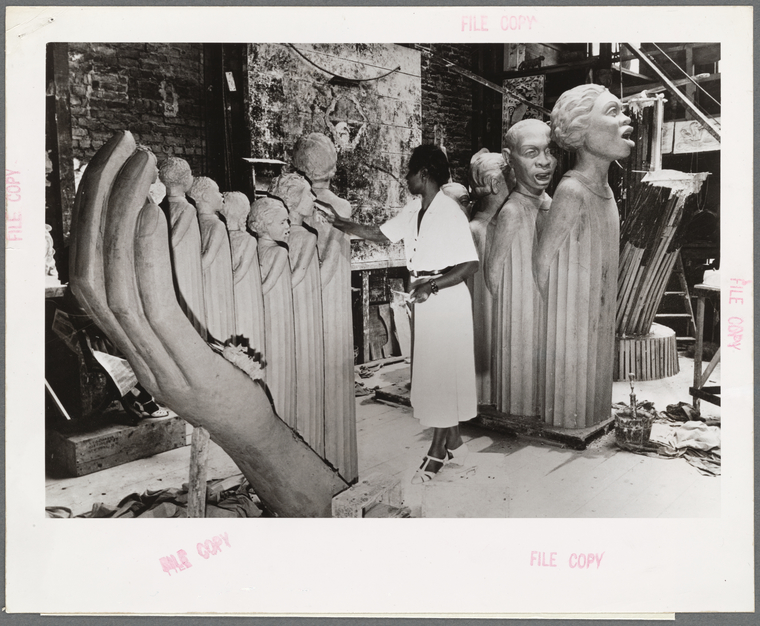
Candice Frederick, of the New York Public Library’s Schomburg Center for Research in Black Culture, recently posted research by Katherine Ellington on an African American artist who was new to me.

From Ellington notes: “Augusta Savage was among [a] group of artists who came to Harlem from the Jim Crown South in search of opportunity and where her creative expression could thrive.

“My quest for Augusta Savage (1892 –1962) sculpture led me to a first-time visit to the Art and Artifacts Division of the Schomburg Center for Research in Black Culture. … As a young girl in the early twentieth century, Savage began shaping ducks out of red clay found in the backyard of her home in Green Cove Springs, Florida. Savage’s work gained local attention when she entered and won a prize at a local county fair, which led to community support for further study.

“In 1921, she moved to Harlem after studying at State Normal College for Colored Students (now Florida A & M University). Savage later completed a four-year program in sculpture in three years at Cooper Union. …

“In 1931, Savage … opened the Savage Studio of Arts and Crafts — a fine arts training ground for over 1,500 students including many well-known Harlem Renaissance artists such as Charles Alston, Ernest Crichlow, Norman Lewis, Morgan Smith and Marvin Smith, Jacob Lawrence and Gwendolyn Knight Lawrence. …

“In 1934, Savage became the director of the newly established Harlem Community Art Center, after she was commissioned by the 1939 World’s Fair. Around that time she created “The Harp” as a series, but it was destroyed during the cleanup after the fair. …

“Savage’s art was often in response to the fight against racism. She used a variety of methods, shaping clay and plaster, casting bronze, and later years, carving marble and wood. In the Augusta Savage collection, there are works that illustrate themes such as nineteenth-century romanticism and African and Greek culture. As a trained portraitist, her busts include Marcus Garvey, W.E.B. Du Bois, James Weldon Johnson and Gwendolyn Bennett.”

More here.

Photo: The New York Public Library. Image ID: 1654255
“Harp,” by Augusta Savage

Read Full Post »

091615-Penguins-by-Keilan

Penguins by Keilan

My friend Kristina Joyce gives art lessons to a talented middle schooler who has brittle bone disease.

Henry Schwan wrote about young Keilan Hughes in the Concord Journal last April, reporting that he was “one of several students whose art [was] on display in the children’s room at the Concord Library. Joyce had them focus on nature in the Middle East, and Keilan drew a bird titled, ‘Yellow Wagtail from the Holy Land.’

“ ‘It’s relaxing, it takes my mind off things,’ Keilan said of his art.

“Keilan’s talents could take him in a number of directions. He dreams of being a doctor one day, but also has a backup plan of becoming a residential architect. …

“He was diagnosed with brittle bone disease the day he was born. ‘I don’t mind,’ Keilan said. ‘Most of the time, I forget that I even have [it].’ …

“Currently, there is no cure for brittle bone disease, but Keilan and his mom hope for a breakthrough. …

“ ‘It’s important to look at the bright side and look to the future,’ says his mother.”

Kristina tells me Keilan’s mother, who is from Trinidad, the family as a whole, and the school district have all been extremely supportive. One well-wisher made a website for Keilan to show his art. Others have given him specific requests for drawings. “Everybody loves Keilan,” she said.

More at the Concord Journal, here.

Photo: Ann Ringwood/Wicked Local Staff
Keilan Hughes is submitting yearbook cover art that his teacher said was so good she didn’t suggest a single correction.

Read Full Post »

Our 5-year-old grandson’s friend had been planning to attend an American Repertory Theater musical with her grandmother today at 10 a.m. We decided to go, too.

The show was The Pirate Princess and was loosely (very loosely) based on Shakespeare’s Twelfth Night. It was a hoot for me, and the young man in the photo seemed riveted. But whether he could make head or tail of the  convoluted plot, I have my doubts. It will be interesting to see down the road what he remembers — and whether he wants to see more plays.

The plot involves a brother and sister who get separated in a shipwreck (in this case, it’s thanks to a monster called the Kraken) and have separate adventures with characters who later mistake the sister dressed as a boy for the boy and vice versa. (I kept whispering in my grandson’s ear, “The pirate thinks he’s the girl that he thinks is a boy”; “The Queen thinks he’s his sister but doesn’t know his sister is a girl.” My grandson didn’t respond.)

There were songs, musical instruments, fancy costumes, pirates storming up lighted platforms in the middle of the audience, sword fights, and imaginative special effects. I especially like the jellyfish created by glowing umbrellas with streamers, carried along the aisles in the dark. The Kraken with his many legs was pretty great, too.

After the show, we had hot chocolate and cookies at the Darwin on Mt. Auburn Street. I’m not sure what our grandson will be able to tell his parents about the madcap entertainment he witnessed, but bits and pieces will likely emerge over time. I myself saw Peter Pan and Alice in Wonderland when I was four, but I didn’t become a theater nut until I was 10.

010216-hot-chocolater-after-theater

Read Full Post »

The poet Marianne Moore once helped to save a special tree by writing a poem about it, proving that art is more powerful than apathy.

Maria Popova writes at Brain Pickings, “In 1867, Brooklyn’s Prospect Park, once an American Revolution battlefield, opened its gates to a community hungry for a peaceful respite of wilderness amid the urban bustle. So intense was public enthusiasm that local residents began donating a variety of wildlife to fill the 585-acre green expanse, from ducks to deer. But the most unusual and enduring gift turned out to be a tree, donated by a man named A.G. Burgess and planted in 1872.

“This was no ordinary tree. Ulmus glabra ‘Camperdownii,’ better-known as Camperdown Elm, is a species unlike regular trees in that it cannot reproduce from a seed. The rare elm carries its irregularity on the outside — its majestic, knobby branches grow almost parallel to the ground, ‘weeping’ down. To ameliorate its reproductive helplessness, the Camperdown Elm requires outside help — a sort of assisted grafting, be it by accident of nature or intentional human hand. …

“As excitement over the novelty of Prospect Park began dying down, the Camperdown Elm came to suffer years of neglect. …

“But then, in the 1960s, it was saved by a force even more miraculous than that by which its Scottish great-great-grandfather had been born — not by a botanist or a park commissioner or a policymaker, but by a poet fifteen years the tree’s junior.

“The poet was Marianne Moore (November 15, 1887–February 5, 1972), who had been elected president of New York’s Greensward Foundation — an advocacy group for public parks — in 1965. This brilliant and eccentric woman … created a citizen group called Friends of Prospect Park, aimed at protecting the Camperdown Elm and other endangered trees in the park.

“In 1967, eighty at the time and with a Pulitzer Prize under her belt, Moore penned ‘The Camperdown Elm’ — a beautiful ode to this unusual, dignified, yet surprisingly fragile life-form of which humans are the only bastions. …

“Moore’s poem mobilized the Friends of Prospect Park to envelop the Camperdown Elm in attentive and nurturing care, which ultimately saved it.”

Read the poem and the rest of the story here.

Come to think of it, the Camperdown Elm’s reliance on humans to do the right thing make it very little different from the rest of the natural world.

Read Full Post »

121115-ICA


Until January 24, you can see at the ICA in Boston an exhibition on the artistic legacy of one of the most interesting colleges ever. It couldn’t last, but while it did, it burned with a bright flame.

Let me drop a few names of people who worked and studied there: Robert Rauschenberg, Josef Albers, Robert Motherwell, Cy Twombly, Jacob Lawrence, Willem de Koonig (painters); Buckminster Fuller (architect); Merce Cunningham (choreographer); John Cage (music); and Robert Creeley (poetry). I am leaving out too many, including the women, whose names are not as well known.

I went on my lunch hour and so swept through the exhibition too fast. I confess I am not crazy about much of the art from this period. My favorites here are Motherwell, Lawrence, Cunningham, and Creeley. But how amazing that they all gathered North Carolina’s Blue Ridge Mountains, energizing one another across disciplines and making the school their life for a while, even pitching in with the chores.

Surprisingly, the things I took away with me were two ideas I’d like to apply to art with grandchildren.

I’ve done photographic paper before (you put objects like leaves or shells on the paper, leave it in the sun a few minutes, then run in the house and rinse it in water), but someone in the show did a full body. I might try a hand or a face. I also loved the textures of one piece of art I saw. Not quite a collage, it used string and bumpy surfaces in imaginative ways that reminded me of a project I watched Earl Gordon do when I was a child. He sliced the seed pod of a flower and used it as a stamp. Got to try more of that.

You can read about the school and the exhibit here.

Photo: Craig F. Walker/Globe
I liked “Female Figure” on sun-exposed photographic paper, by Susan Weil and Robert Rauschenberg, left.

Read Full Post »
Maria Popova at Brain Pickings finds the most wonderful books to blog about. In a recent post she extolled the wonders of fairy tale illustrations by Kay Rasmus Nielsen.

I was surprised to learn that’s a man’s name in Denmark. Wikipedia says, “Kay Nielsen was born in Copenhagen into an artistic family; both of his parents were actors – Nielsen’s father, Martinus Nielsen, was the director of Dagmarteater and his mother, Oda Nielsen, was one of the most celebrated actresses of her time, both at the Royal Danish Theater and at the Dagmarteater.

“Kay … received his first English commission from Hodder and Stoughton to illustrate a collection of fairy tales, providing 24 colour plates and more than 15 monotone illustrations for In Powder and Crinoline, Fairy Tales Retold by Sir Arthur Quiller-Couch in 1913. In the same year, Nielsen was also commissioned by The Illustrated London News to produce a set of four illustrations to accompany the tales of Charles Perrault; Nielsen’s illustrations for ‘Sleeping Beauty’, ‘Puss in Boots’, ‘Cinderella’ and ‘Bluebeard’ were published in the 1913 Christmas Edition.”

This is from Maria Popova: “As a lover of illustrated fairy tales and having just returned from Sweden, I was delighted to discover, thanks to the relentlessly wonderful 50 Watts, East of the Sun and West of the Moon: Old Tales from the North … illustrated by Danish artist Kay Rasmus Nielsen (1886-1957), whose work you might recall from [my list of] the all-time greatest illustrations of Brothers Grimm and the fantastic visual history of Arabian Nights. Originally published in 1914, this magnificent tome of 15 stories was recently reissued by Calla Editions, the same Dover imprint that revived Harry Clarke’s magnificent illustrations for Edgar Allan Poe, and features 25 color illustrations, along with a slew of black-and-white ones, in Nielsen’s singular style of haunting whimsy.”

There are more than 20 amazing Nielson illustrations here, at Brain Pickings.

Art: Kay Rasmus Nielsen
The North Wind went over the sea.

Read Full Post »

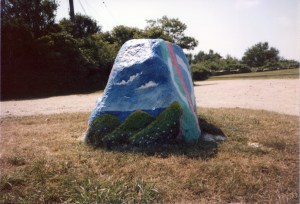
island-scene-on-Painted-Rock


Feeling the cold setting in?  Well here’s a summery scene on New Shoreham’s famed Painted Rock, one of my favorite pictures of the island’s constantly changing bulletin board. Wish I knew who the artist was.

John is behind the new tumblr blog featuring the Painted Rock in as many iterations as folks can dig out of the albums and send along.

Here’s what John had to say about it on the island e-board:

“Thanks for the kind comments and great pics submitted to paintedrockbi.tumblr.com The ‘mini cooper rock’ and the ‘hamburger rock’ are especially cool.

“There was also a question about me and the reason for the blog, so here goes.

“About 20 years ago my mother painted the rock early one morning to celebrate my sister turning 16 and my turning 21. Our summer home is a only short walk down Mohegan Trail from the rock, but if you took careful note of our ages, you might guess that my sister and I were not really morning people.

“So by the time we had rolled out of bed and made it down the street to look, it was already painted over. No photos were taken, but I know it’s there buried under all the layers. Now I am a parent, and it kind of reminds me of the many things we do for our children that no one ever really sees, but we keep doing anyhow.

“For many years I’ve been thinking about how best to document the many cool rock paintings. And last week I finally got around to doing something about it; hopefully the page will continue to get submissions and we can save the many small memories behind each coat of paint.”

Check it out: http://paintedrockbi.tumblr.com/

Read Full Post »

A few photos.

The Barrow Bookstore featured a Thoreau quote on its kale-decorated book barrow at Thanksgiving: “My Thanksgiving is perpetual … for my wealth is not possession but enjoyment.” This shop off Main Street is the place to go for gently used and out-of-print books.

A yellow rose was blooming on Beacon Hill as late as November 19.

Fort Point Arts has a new show by six contemporary mosaic artists using a variety of techniques and materials. One favorite example: Aesop’s wisdom about the fox, the grapes, and the crow, rendered as a mirror.

Finally, no matter how many times I have walked up and down School Street in Boston, I have failed until now to zero in on the reason it is called School Street. A Latin school was established there in 1635, before the founding of Harvard even, and many notables attended over the years. You should be able to read these names on the plaque in the sidewalk: Benjamin Franklin, Samuel Adams, John Hancock, Charles Bullfinch, and Ralph Waldo Emerson. Boston Latin is still going strong, but in a new location.

I love that the original Boston Lain was teaching Latin and Greek, languages I once knew a bit. I am also reminded that those languages were taught at outdoor hedge schools in 18th Century Ireland, when the English were blocking education by Catholics.

112915-thoreau-quote-barrow-bookstore

111915-rose-on-Beacon-Hill


112015-fort-point-art-gallery

112015-Aesop-fox-and-crow-mosiac


112515-Boston-School-Street

11-25-15-who-went-to-early-Latin-school


Read Full Post »

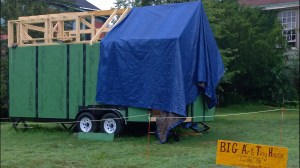
I’ve been watching a tiny house go up in front of the Umbrella Community Arts Center. It’s an art project that started in June and is supposed to wrap up next June.

The Umbrella said “Artist Miranda Aisling will be building a tiny house on the front lawn of The Umbrella and filling it with handmade items.”

I am now going to post the photos I have taken periodically, and I hope I get them in the right order. Even though the project is only half way, when I saw the new color today I said to myself, “Time to report.”

concord-tiny-house-1

072515-tiny-house-grows


070815-tiny-house-2

070815-tiny-house


072515-tiny-house-moving-along

082615-tiny-house-lantern


090415-tiny-house-growing

100315-Concord-tiny-house


100315-explains-tiny-house-art-project

101815-tiny-house-new-siding


110815-tiny-house-gets-roof

2115-tiny-house-at-half-way

Read Full Post »

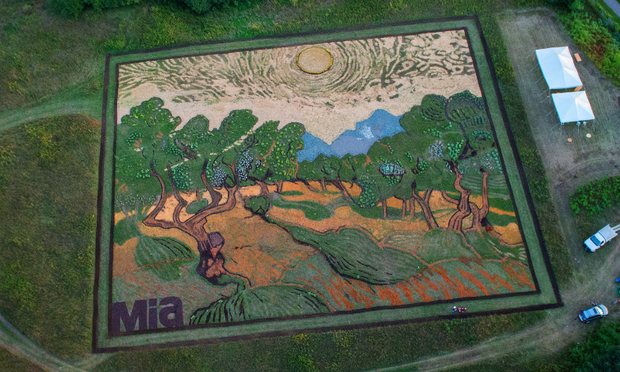
An art museum in Minnesota has used the occasion of its 100th birthday to grow a field-size replica of a Van Gogh work.

Emile Klein at Studio 360 has the story.

“The Minneapolis Institute of Art [MIA] has been throwing a year-long party for its 100th birthday, and the guest list has been a bit of a cultural catch-all. …

“How about a 1.2 acre rendition of a Vincent van Gogh painting, composed with items you could buy at the Home Depot?

“Van Gogh’s original piece, Olive Trees with Yellow Sky and Sun, measures about two feet by three feet and hangs on a wall in the MIA. The new rendition, by land artist Stan Herd, covers 1.2 acres, or 7,230 Olive Trees. It’s so big that you’d have to fly a plane over to appreciate it …

“As a land artist, Herd knows that most of his work is just too big to fit inside a traditional museum, and that’s OK by him. ‘I’m a Kansan, and I make art on a frickin’ tractor. Do I really want the avant garde en Paris to see it?’

“Even if a major museum could secure zoning rights, representational art like the kind Herd makes is out of fashion in the art world. Surprisingly, the person who might appreciate Herd’s work the most is van Gogh himself. …

“Herd’s slice of Saint-Rémy won’t last forever. It will fade over time. Surprisingly, so will van Gogh’s. That’s because he painted with pigments now known to be ‘fugitive,’ like a very slowly disappearing ink. The chrome yellows and scarlets scattered throughout the painting’s sky will, in time, wilt like the marigolds in Herd’s field. Everything in nature is ephemeral — van Gogh would probably like that.”

More at Studio 360, here.

Photo: Minneapolis Institute of Art
A living representation of a Van Gogh painting. (Those are actual cars in the lower right corner.)

Read Full Post »

With a little creative thinking, a woman in Detroit was able to put a rundown house to good use, improve the neighborhood, promote her flower business, and help florists who focus on locally grown flowers.

Stacy Cowley writes at the NY Times, “Eleven months ago, a derelict house here that is now filled with 36,000 flowers contained far grimmer things. …

“Twelve thousand pounds of trash had to be hauled out before Lisa Waud, a florist who bought the duplex at auction for $250, could see what kind of canvas she had purchased.

“The house remains a structural wreck, but its atmosphere has been transformed. [In October] some 2,000 visitors [toured] Flower House, an art installation Ms. Waud and more than three dozen floral collaborators from around the country created on the site. Their goal is to cast a new light on the Detroit metropolitan area’s infamous blight, and on their own trade. …

“All of the plants and flowers filling [the rooms] are American-grown, a rarity in an industry that imports a majority of its wares from Colombia and elsewhere. …

“The inspiration for Flower House struck in 2012, when she saw images from that season’s Christian Dior couture show, held in a Parisian mansion filled with flowers in a rainbow of colors.

“ ‘It was stunning, and I knew immediately that I wanted to do that — but living in Detroit, I pictured it in an abandoned house,’ she said. ‘I’m trying to rebrand abandoned houses as a resource.’ …

“Ms. Waud estimated that she would need to raise $150,000 to cover the installation’s floral costs, but when she contacted her usual wholesalers, the California Cut Flower Commission, Mayesh and Nordlie, all three offered to donate their flowers.” Read about the inspiring results here.

Photo: Laura McDermott for The New York Times 
Lisa Waud, a Michigan florist, works on her room on the back side of the Flower House on the first day of the installation in Hamtramck. 

Read Full Post »

Here’s an imaginative trompe l’oeil, art that gives the illusion of a welcome at the border.

Jude Joffe-Block writes at Fronteras, “Artist Ana Teresa Fernandez is attempting to paint a stretch of the border fence in Nogales, Sonora, so it looks like it is no longer there. … The project is an expansion of an earlier installation Fernandez did on the Tijuana border fence.

“Fernandez was born in Mexico, moved to San Diego as a child, and grew up going back and forth between the two countries. She heard story after story of migrants who lost their lives trying to cross the border, and of families divided by it. …

“In 2011, Fernandez went to Tijuana from her home in San Francisco with a plan to paint the fence.

“ ‘I just had this epiphany, of like, you know I can bring the sky down and erase it, just using paint and painting it sky blue,’ Fernandez said.

“She picked a stretch of the fence on the beach on the Mexican side, climbed up a ladder, and began to paint. …

“Fernandez carefully chose a shade of blue that would make it look like the fence disappeared into the sky and the Pacific Ocean behind it.

“The illusion worked. As she was finishing up a jogger came running up excitedly.

“ ‘And this runner was all sweaty,’ Fernandez remembered. ‘He was like, “I get it! I get it!” I looked down from the ladder, and I was like,”Excuse me sir, what do you get?” And he was like, “It looks like it is gone from far away!” ‘…

“Fernandez says her goal is to inspire people to imagine what if the fence really did come down.”

More here at WBUR, where you also can listen to the story.

Photo: Ana Teresa Fernandez
Ana Teresa Fernandez’s art installation on the border fence in Tijuana.

Read Full Post »

Greg Cook has a lovely story at WBUR’s “The Artery” on Boston artist Nate Swain’s Zen garden.

Swain tells the reporter, ” ‘I worked driving a tour trolley in Charlestown, and I drove over that bridge every day to go to work, and looked down … I went down there not even knowing what I wanted to do.’

“At the edge of the Charles River, near the North Washington Street Bridge, by the dock in front of the Residence Inn by Marriott on the east end of the park, he’s been assembling ‘Low Tide City’ or ‘Barnacle City.’ It’s ‘a little city’ of bricks and stones that disappears under the river and appears when the tide goes out. ‘I realized it could be an art piece about sea level change,’ he says. ‘People could watch it flood and imagine Boston could do that if sea level rises.’

“And right under the Zakim Bridge, Swain realized he could rake the existing expanse of gravel he found there into patterns, much like a traditional Zen rock garden, to create ‘Zen Under the Zakim.’ He says, ‘If you really sit there and you listen to all the noise, some of the traffic, even though it’s really noisy, it does sound like ocean waves.’ …

” ‘I try to find places where I can do art without asking permission. In Boston, there’s so much bureaucracy. There’s no room for spontaneity. … With all the bureaucracy and the permission-asking, it sucks all the energy and all the inspiration out of the art piece itself.’ …

” ‘I have this theory,’ he adds, ‘if you put something up beautiful and colorful and fun, in good taste, uplifting, it will stay and everyone will love it and no one will bat an eye.’ ”

More here.

Photo: Greg Cook
Nate Swain’s “Zen Under the Zakim” in 2015.

Read Full Post »
Artists love a challenge. Tell them it’s impossible and they’ll find a way to do it.

As Ralph Gardner Jr. writes for the Wall Street Journal, a good example may be found at one to the most polluted waterways in America, Brooklyn’s Gowanus Canal.

“What is it about the Gowanus Canal,” Gardner asks, “that attracts art and artists? I visited a bit more than a year ago and spotted some sort of homemade art project floating in the middle of the canal. It was as if the anonymous artist was saying, ‘Take that, Superfund site!’

“A far more ambitious project alighted [in late September], when Diana Balmori, a celebrated landscape architect and urban designer, oversaw the launch of a floating landscape at the foot of the Whole Foods parking lot that overlooks the canal.

“ ‘The reason we picked the Gowanus Canal is the attempt to show that plant material can clean water,’ Ms. Balmori explained. At the same time, she acknowledged, ‘We picked the hardest.’ …

“The floating island was to be filled with multiple tubes. In a poetic twist, the tubes were to be made of the same culvert pipe used to dump pollution and sewage into the canal.

“Perhaps even more poetically, the goal of the experiment was to test the viability of creating large-scale ‘edible’ islands in polluted urban rivers to serve as a food source. Some plants were to be irrigated with distilled water, others with captured rainwater, and a hearty few even with water directly from the canal. …

“I was told that a duck had laid an egg on some earlier iteration of the project. And indeed, we stood there admiring the island’s three monarch butterflies, a beleaguered species in recent years, flitting about the plants.”

More at the Wall Street Journal, here, but there may be a firewall. The author is highly skeptical about anyone ever eating plants from this island, but you can tell he has a grudging admiration for an optimistic artistic vision that insists on a better future.

Photo: Cassandra Giraldo for The Wall Street Journal

Read Full Post »

When the MBTA subway system decided to rebuild the stop called Government Center a couple years ago, it began a search for the artist who created the original murals there to see if she would like them back, and if not, if she would be OK with selling them.

It wasn’t easy to find her.

As Malcolm Gay writes at the Boston Globe, she was baking pies as part-owner of the Pie Place Café in Grand Marais, Minnesota.

“ ‘I got a phone call one day,’ [Mary] Beams explained, ‘and a voice I didn’t know said, “How does it feel to know that all of Boston is looking for you?” I had no idea what to say.’

“Beams, it turned out, hadn’t disappeared at all. An animator who had been a teaching assistant at Harvard’s Carpenter Center for the Visual Arts, and whose work has been collected by the Museum of Modern Art, she’d simply left the art world …

“With her blessing, the MBTA plans to hold an online public auction of the artworks, giving Bostonians a chance to own a piece of the city’s history.

“The online auction and display of murals will run Oct. 20-29, with a kick-off event at the state Transportation Building at 10 Park Plaza on Oct. 21. … The event will be something of a homecoming for Beams, who left Boston soon after completing the murals. She has never been back.

“ “I am so curious to see them again,’ she said. ‘I’ve gone on and lived this whole other life. But to be able to confront something that you made 35 years ago and ponder what they’ve been through? It’s quite amazing.’ ”

Pictures of the murals — and more information on the artist — here.

Mural by Mary Beams, for sale at Skinner

Read Full Post »

« Newer Posts - Older Posts »