Feeds:
Posts
Comments

Posts Tagged ‘art’

If I come to work early, I often take a walk at lunch. I love the Greenway, which is especially nice in spring and summer. And the Fort Channel district (the Mayor likes to call it the Innovation District) seems to have something new to see almost every week — repurposed warehouses, galleries, restaurants, pocket parks.

Fort Point Arts got bumped from its space next to Flour (a yummy restaurant) on Farnsworth, so one lunchtime I made a point of checking out its new space off A Street.

I especially like that they show art depicting the Fort Point neighborhood — partly because walking there makes me attached to that part of Boston, and partly because Fort Point is changing fast. (About 18 years ago, when I went to an arts open house there, many artists had studios with beds on ledges and  tiny kitchens. Some artists were squatting in dangerous buildings with wires hanging down, no heat, no doors, no lighting. That world is gone.)

Laura Davidson was one of the featured artists when I was last in the Fort Point Arts shop. She had some block prints of her neighborhood that I admired.

Be sure to check her home page. Everyone should have a home page that looks like a treasure map.

Art:Endangered Neighborhood” reprint of 1995 view of Fort Point), 2012, Laura Davidson

Read Full Post »

I got this story from a recent post by Andrew Sullivan, who got it from Mark Frauenfelder at BoingBoing, who links to Leo Kent at Humans Invent.

It’s about Swiss artist/comedian Ursus Wehrli, who has written a book called The Art of Clean Up.

Leo Kent asks the artist how the book came about.

“I had already done two books before this one,” Wehrli answers. “The first two were about tidying up art and for the third one I devoted myself more to everyday situations or objects. I very often go to museums and I actually like modern art but I was standing in front of a piece by the very messy Swiss artist Jean Tinguely. He is famous for putting all sorts of colours, material and objects on a canvas and I tried to imagine what a cleaning lady would do if she had to clean up his studio.

“I imagined how she would not really know where the mess starts and the art begins so she would end up cleaning not only the floor and the tables but the artworks. I realised this was a fun approach because you really start to look at art very differently if you try to bring some order to it.” More.

More on Wehrli’s process here, at FastCoCreate.com, where Hugh Hart adds to the story.

(You just never know what will turn up next at Andrew Sullivan.)

Photo: The Art Of Clean Up

Read Full Post »

Facebook can be annoying, but I guess it does sometimes pay to be on it.

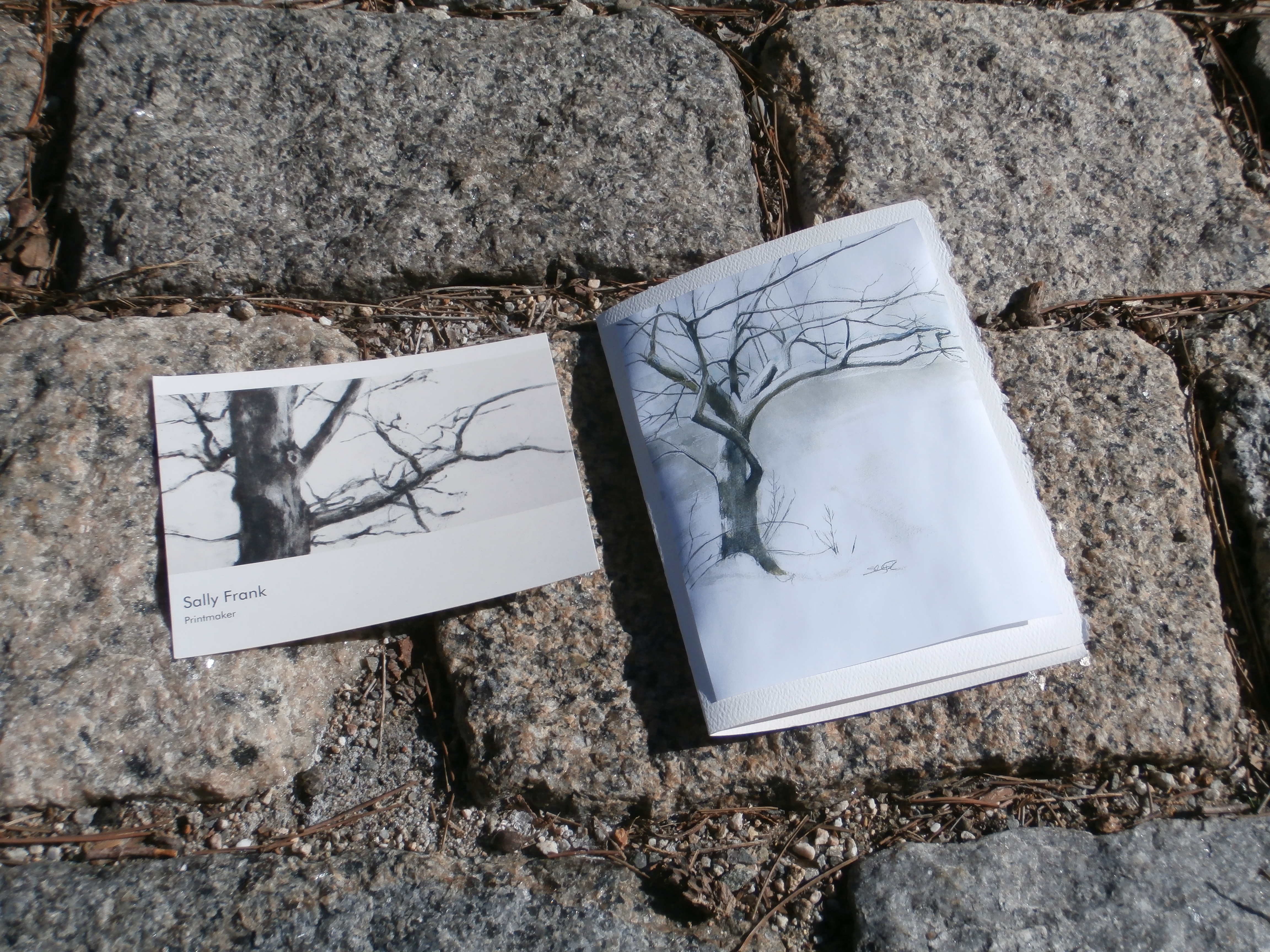
After “liking” a number of my cousin Sally Frank’s nature photos and art over the years, I finally figured out via Facebook that much of her work is on a WordPress blog — and she has had the blog longer than I have had this one.

Trees are a specialty. Often she will start with a photograph like the one below for inspiration. She then turns to printmaking, which you can learn about at her blog.

“Ms. Frank uses centuries-old printmaking techniques like etching and aquatint on copper plates, as well as innovative methods like solarplate intaglio. She says that although her work is grounded in drawing, she finds the unpredictable nature of printmaking inspirational and exciting.” More.

This photo reminds me of the strangler fig that I saw years ago in Costa Rica, a tree that wraps itself around a host and literally loves it to death. The host tree crumbles, and only the strangler is left — with an empty space inside.

Sally’s photo probably has a happier story — perhaps a nymph turned into a tree to escape danger.

Photo called “bound”: Sally Frank

Read Full Post »

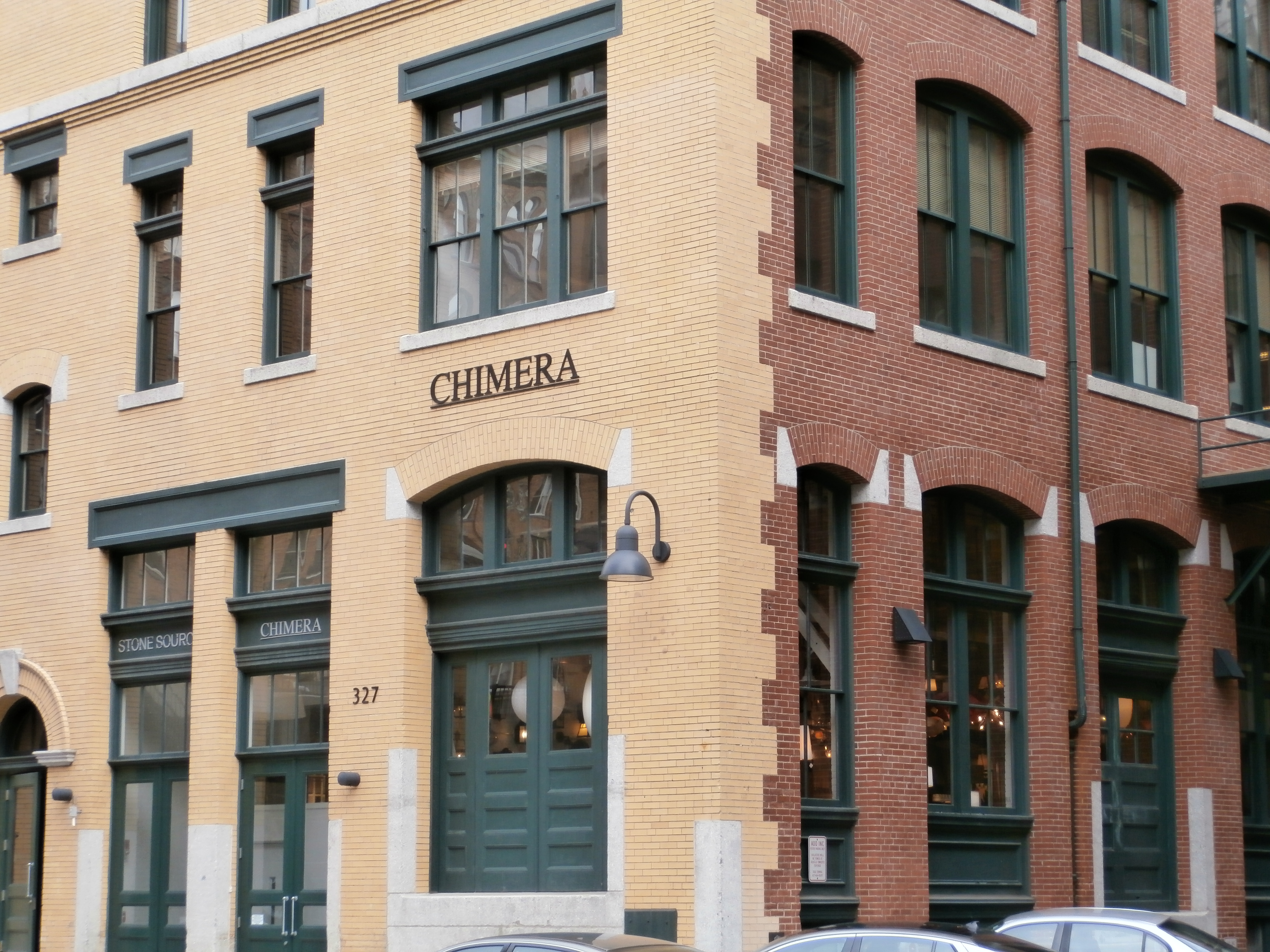
According to wikipedia, “The term chimera has come to describe any mythical or fictional animal with parts taken from various animals.” Which explains why it has been appropriated in genetics where it relates to the phenomenon of different creatures sharing T-cells.

Anyway, I have a brother who studies chimerism and its potential application for organ-transplant retention. I may not have this quite right, but I think if you could have enough of the cells of an organ donor in you when you get a transplant, you wouldn’t need to take antirejection drugs.

I had been trying to explain this to people when I decided to go out for a walk in Fort Point Channel. Eerily, this sign greeted me.

chimera

I think it’s an eclectic gift shop or interior decorator business.

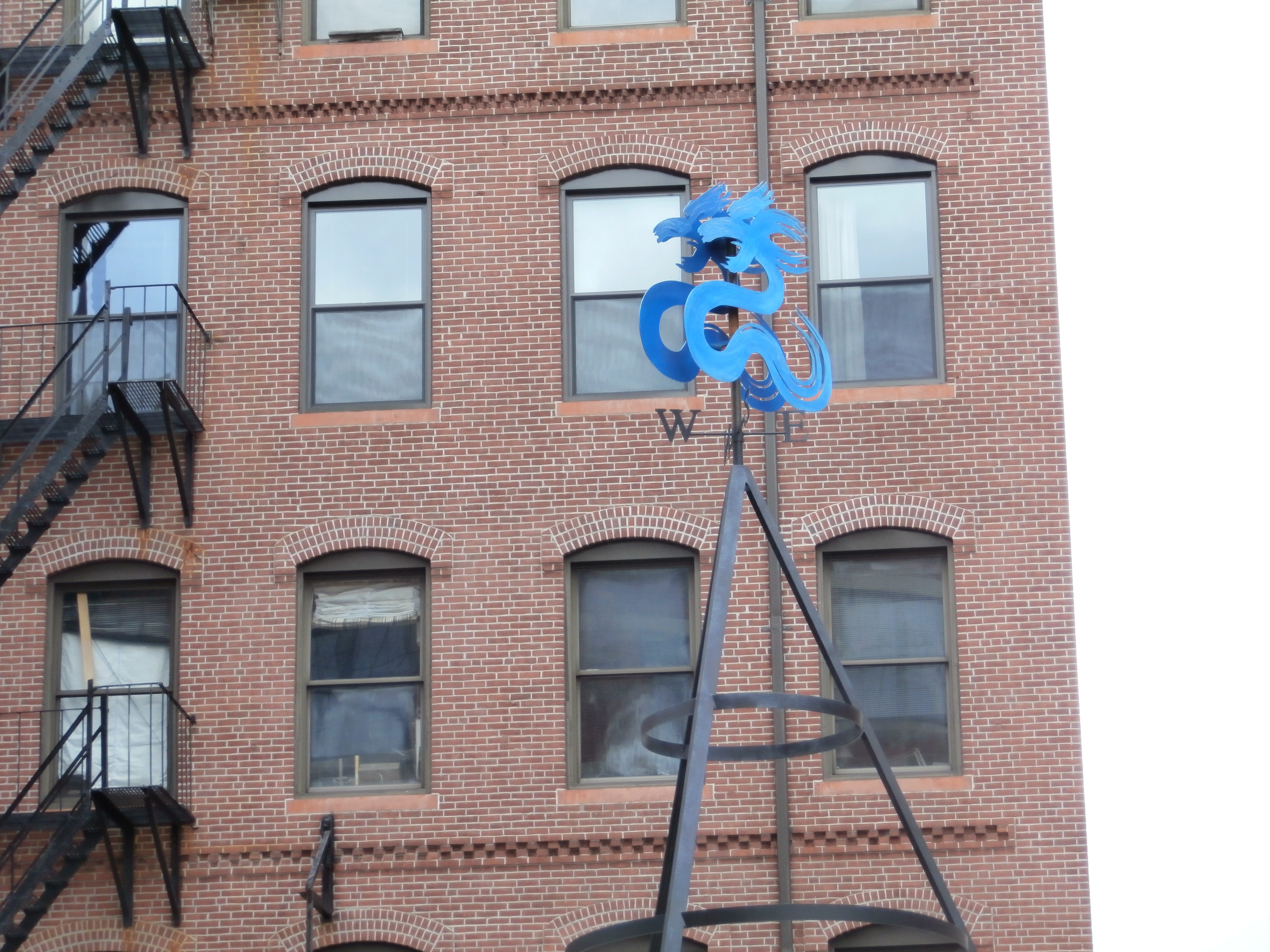
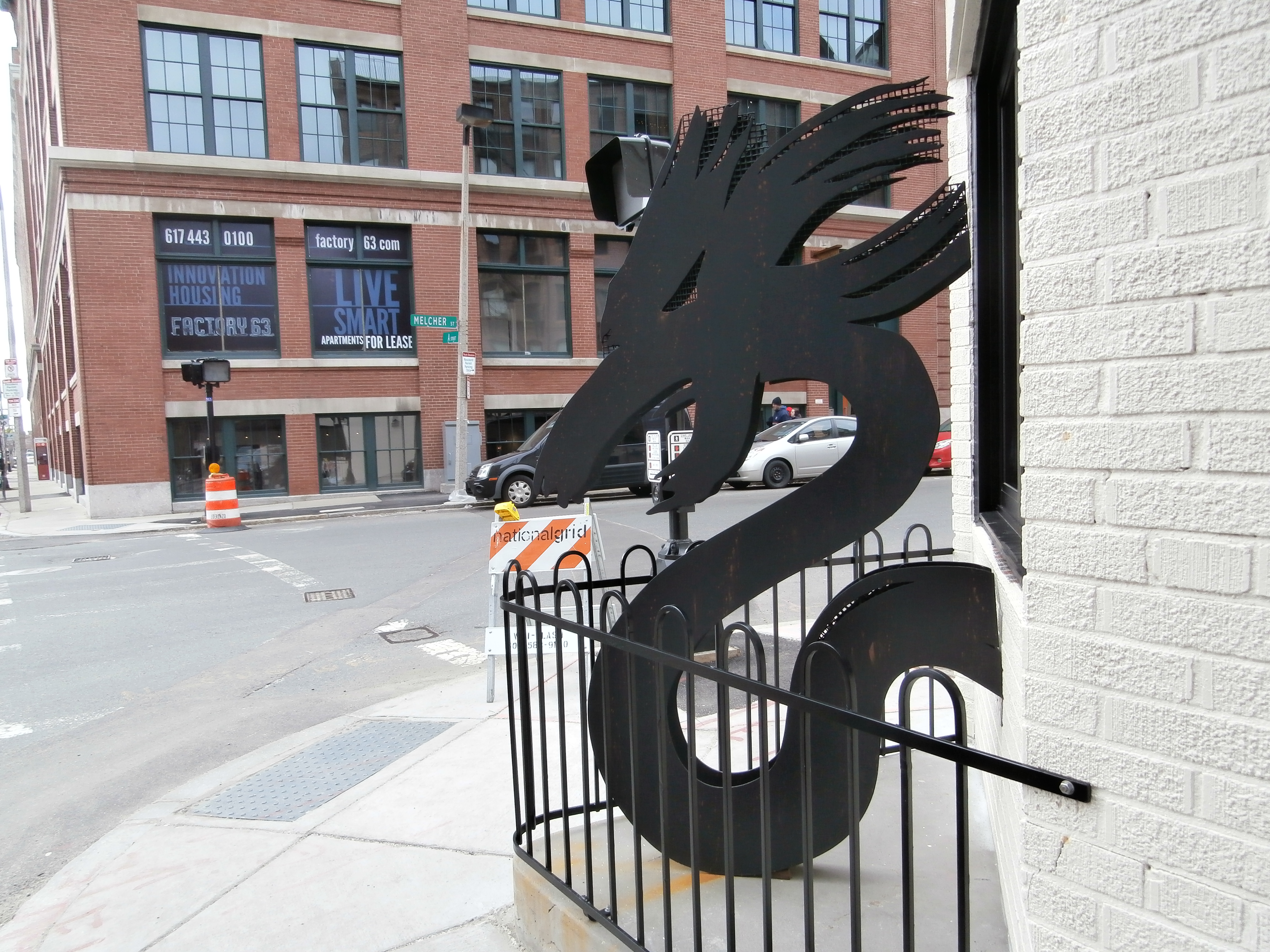
Other signs and portents on the same walk related to Suzanne and Erik’s Year of the Dragon baby.

dragon on roof

dragon sculpture in fort point

Who is the dragon artist? I need to know more.

Read Full Post »

Today it’s a bit hard to imagine Cezanne, Matisse, Duchamp, and Van Gogh shocking anyone, but at the Armory art show in New York City 100 years ago, they did. Tom Vitale at National Public Radio has the story.

“On Feb. 17, 1913, an art exhibition opened in New York City that shocked the country, changed our perception of beauty and had a profound effect on artists and collectors.

“The International Exhibition of Modern Art — which came to be known, simply, as the Armory Show — marked the dawn of Modernism in America. It was the first time the phrase ‘avant-garde’ was used to describe painting and sculpture. …

“It was the Europeans — Van Gogh, Gauguin, Cezanne, Picasso, Matisse, Duchamp — that caused a sensation.

“American audiences were used to seeing Rembrandts and Titians in their galleries — ‘a very realistic type of art,’ says Marilyn Kushner, the co-curator of an exhibition called ‘The Armory Show at 100’ that opens in October at the New York Historical Society. …

“The most talked-about painting in the 1913 Armory Show deconstructed a human figure in abstract brown panels in overlapping motion. Marcel Duchamp’s Cubist-inspired Nude Descending a Staircase was famously described by one critic as ‘an explosion in a shingle factory.’

“In 1963, on the 50th anniversary of the Armory Show, Duchamp was interviewed by CBS reporter Charles Collingwood. The audio is now at the Smithsonian’s Archive of American Art.

“When Collingwood asked Duchamp if he had realized that the piece would create ‘such a “furor,” ‘ the artist responded: “Not the slightest.” …

“Duchamp went on in the 1963 interview to say that, at the time, artists had lost the ability to surprise the public.

” ‘There’s a public to receive it today that did not exist then. Cubism was sort of forced upon the public to reject it. You know what I mean?’ Duchamp said. ‘Instead, today, any new movement is almost accepted before it started. See, there’s no more element of shock anymore.’ ” More.

Photograph: Marcel Duchamp’s Cubist-inspired Nude Descending a Staircase was famously described by one critic as “an explosion in a shingle factory.” (Copyright succession Marcel Duchamp / ADAGP, Paris / Artists Rights Society (ARS), New York 2013)

Read Full Post »

I am grateful to my friend Mary Ann for posting a link to this story on Facebook today.

Julian Guthrie writes in the San Francisco Chronicle:

“Starting in the summer of 2000, a man named Someguy launched 1,000 blank, leather-bound journals into the world to encourage creativity and see how art could connect people.

“The journals trickled back in from places as far flung as Iraq — reaching 40 countries and 50 states — and were filled with gorgeous drawings, political musings, disturbing rants, and poetic vignettes of daily lives.

“The journals, registered and tracked online, were eventually turned into a book, displayed at museums in San Francisco (at the Museum of Modern Art), Los Angeles and Scottsdale, Ariz., and featured in a documentary.

“More than 12 years later, the global art experiment has a new twist: The idea has now been adopted by Bay Area children’s hospitals, where young patients use the journals as a way to connect with other children going through something similar.

“Brian Singer, the San Francisco artist whose handle is Someguy, has been touched by this latest chapter in his social experiment.

” ‘I have heard stories of the impact of these journals, of kids opening up in ways they hadn’t before,’ says Singer, who built a website, 1001journals.com, to help others start similar projects. …

“Singer, 39, who grew up in Cupertino, lives in Noe Valley and commutes by shuttle to his job at Facebook in Menlo Park, where he manages a design group. …

“He remains interested in the phenomenon of sharing among strangers and looking at how to connect people through a physical artifact. Tangible items ‘drive connections in the real world,’ he said.

“There are still many of Singer’s original blank journals out in the world that may one day return.

” ‘They travel on their own,’ Singer says, ‘like a message in a bottle.’ ”

Read more.

Image: San Francisco Chronicle

Read Full Post »

My husband, who has made a lot of business trips to Japan (and also has been reading my posts about 100-year-old workers), pointed me to something interesting at the Japan Times.

Jiji writes, “A business project focused on selling decorative leaves for use in Japanese cuisine is attracting overseas attention to Kamikatsu, a mountain town in Tokushima Prefecture. …

“The [Irodori, or bright colors] project, which succeeded in commercializing colored leaves grown in local mountains and fields and now claims members from nearly 200 farms, has become a vital industry in Kamikatsu, which has a population of less than 2,000. …

“The average age of the farmers involved in the project is 70, and many are women. Some earn more than 10 million [yen, more than $100,000] a year from the business.

“Irodori members use tablet computers to check for updated information on orders. The leaves are grown in their own mountains and fields, then distributed to markets across Japan via an agricultural cooperative. …

“According to the Japan International Cooperation Agency, which promotes international visits to Kamikatsu, the response to its English DVD on the Irodori project was huge. It has been translated into Bengali, Spanish and French.

“Tomoji Yokoishi, 54, who came up with the Irodori idea and is president of the managing company, said perceptional shifts are responsible for its success.

“The project turned regular leaves into a valuable resource and turned its elderly into a workforce, Yokoishi explained.”

I’m guessing that the phrase “for use in Japanese cuisine” doesn’t mean anyone eats the leaves. They are probably used to decorate tables where Japanese cuisine is served. Do you think?

Read the Japan Times article, here.

Art: Elaine Richards, 1994 7″ X 10″ Watercolor Collection B. Riff

Read Full Post »

Unless you are going to the Danforth Museum of Art, I do not recommend ever going to Framingham (traffic issues, strip mall issues).

But I am very glad I finally made it to the Danforth today because it is a lovely museum with a community outreach effort that I admire.

The exhibit I went to see was described in the Boston Globe by by Sebastian Smee.

“One of the things you notice first in ‘Eternal Presence,’ a terrific career survey of John Wilson at the Danforth Museum of Art, is how attentive Wilson is to the faces of children. From his earliest days sketching his brother to his most recent large-scale drawings in charcoal, the impulse has remained the same: It is an impulse toward clarity, toward truth. He doesn’t sentimentalize or caricature children. …

“What you notice later is the high number of pictures showing children in the arms of adult men and women. … Wilson is after something elemental and profound. But the resulting image is not just another mother and child, or dad with young kid. There is instead, each time, something tender and hard-won about what you are looking at. A hope, a promise, a lament all in one.

“Wilson, 90, is one of Boston’s most esteemed and accomplished artists. He was born in Roxbury, the son of parents from British Guiana (now the nation of Guyana), was admitted to the School of the Museum of Fine Arts in 1939 after developing a natural aptitude for art at the Roxbury Boys Club, where he attended classes taught by SMFA students.”

Smee goes on to describe Wilson’s long career, including a stint in France, his interest in the Mexican muralists, and his sculptures of Martin Luther King Jr. (one is in the Capitol rotunda).

Amazing that the artist is around and will be giving a talk at the museum. Try to go. The show is up until March 24. And you may enjoy as much as I did the African American sculptures by Meta Vaux Warrick Fuller from the permanent collection and the joyful Harlem watercolors of Richard Yarde.

More at the Globe.

Lithograph by John Wilson

Read Full Post »

Photograph: Ginnette Riquelme for The New York Times
Artist Amor Muñoz pays workers at her mobile factory about $7.50 an hour. “I’m interested in sharing the experience of art,” Ms. Muñoz says.

An artist in Mexico City hires people off the street at $7.50 an hour to help create “electronic textiles.”

Amor Muñoz uses a megaphone to shout, “One hundred pesos an hour!”

Damien Cave at the NY Times continues the story. “The rush was on. By the time Ms. Muñoz parked in her usual spot outside a hospital in one of Mexico City’s peripheral neighborhoods, a line had already formed. Women of all ages squeezed together — one held a baby, another was nearly too old to walk — as Ms. Muñoz opened up a white wooden box revealing thread, needles, cloth, timecards and employment contracts. The work involved creating interactive art pieces that combine the old craft of sewing with 20th-century electronics and 21st-century tags allowing smartphone users to look up who worked on a given piece. …

“Her maquiladora, or factory, she said, is a ‘fantasy’ meant to condemn the harsh reality of a global economy that uses and discards poor workers, especially women, to keep prices low. …

“She described Mexican wages as an insult to human dignity, and every time her mobile factory appears, the power of work for reasonable pay goes on display. The crowds that gather are typically large. Sometimes people push and shove for two hours of work and $15, though once the day’s employees are selected (first come first hired), a calm tends to follow. …

“Many of the women seemed to appreciate a chance to be involved in an art project. María González, 75, smiled widely when handed a needle and adjusted her purple scarf, excited to be creating something rather than worrying about her husband in the hospital. ‘This,’ she said, sewing without looking down, ‘is a wonderful distraction.’ ”

Read more about how happy the women are to work at that wage on art, even if it’s only for two hours.

Read Full Post »

A busy holiday here in New England with both our kids, their spouses, and the two grandsons. Every time we thought we were nearly done opening presents, one or more of us needed a nap.

The distaff side produced a chicken masala (with rice, nuts, raisins, cilantro, coconut, and chutney from Swaziland via the Servv catalog), creamed spinach, salad, and pear crumble.

Meanwhile, here’s a Christmas-y story from South America …

“In 2001, when Argentina’s economy was near collapse and property prices plummeted, UCLA art prof Fabian Wagmister bought a 15,000-square-foot abandoned warehouse in Buenos Aires. When he finally set out to clear the remaining debris from the building last year, he uncovered more than 100,000 Christmas ornaments piled in one of the back rooms.

“What to do with a trove of metallic bulbs, plastic wreaths, and bags of fake snow for a sunny Argentine Christmas?

“Re-gift them, of course,” writes Elise Hennigan at Pacific Standard.

“ ‘As artists we were immediately taken by the powerful expressive potential of the materials,’ says Wagmister.

“Now the director of the University of California, Los Angeles’s Center for Research in Engineering, Media, and Performance (REMAP), Wagmister invited a team of ten artists, researchers, and programmers from Los Angeles to distribute the ornaments to the surrounding community …

“Starting on December 15, the team invited community groups to visit the warehouse, one among many lining a historically working-class district that has seen an influx of technology companies. There, the researchers have encouraged participants to develop projects that will use the ornaments to express their identities, struggles and aspirations. On December 23, the groups took to the streets and decked the halls accordingly.” More.

 Photograph: Pacific Standard
Some of the found ornaments going up around Argentina’s capital

Read Full Post »

, a National Public Radio (NPR) reporter, had an intersting story a while back about a vibrant art community in rural Marfa, Texas.

“This tiny town perched on the high plains of the Chihuahua desert is … a blue-chip arts destination for the sort of glamorous scenesters who visit Amsterdam for the Rijksmuseum ...

“It all started when the acclaimed minimalist artist Donald Judd left New York City in the 1970s for this dusty dot of a town. He wanted to escape the art scene he claimed to disdain. With the help of the DIA Foundation, Judd acquired an entire Army base, and before he died in 1994, he filled it with art, including light installations by Dan Flavin and Judd’s own signature boxes. One hundred of them, made of silvery milled aluminum, are housed in two old brick artillery sheds. … Now, all 400 acres of the site are run by the Chinati Foundation. …

Sculptor Campbell Bosworth, for one, loves living and working in Marfa.

” ‘You just come out here and you feel like, I want to make something; I want to do something!’ ”

Read more about art in exurbia. Cities are not the only places where art can be made.

But you knew that.

Photograph: Judd Foundation/Licensed by VAGA, New York, NY
In the 1970s, minimalist artist Donald Judd moved to Marfa, Texas, where he created giant works of art.

Read Full Post »

Suzanne says I have an art esthetic. That makes me laugh.

My esthetic, as far as I can tell, is mostly a preference for painting that is wavy: Charles Burchfield, Virginia Lee Burton, Grant Wood, Marsden Hartley, Kate Knapp, Edvard Munch, Reginald Marsh.

A massive mural by one of my wavy favorites, Thomas Hart Benton, has recently been rescued from storage. Carol Vogel has the story in the NY Times.

“On New Year’s Day 1931, a new and radically different building opened amid the town houses of West 12th Street: Joseph Urban’s International-Style New School for Social Research, with one room in particular as a star attraction. Thomas Hart Benton, the American realist painter, had lined the third-floor boardroom with nine panels of what would be a 10-panel mural, ‘America Today,’ depicting a panoply of pre-Depression American types, from flappers to farmers, steel workers to stock market tycoons. Lloyd Goodrich, a prominent art historian, pronounced it a breakthrough that heralded a new approach to mural painting, ‘of actually taking reality and making mural art directly out of it.’

“Eight decades later, ‘America Today,’ now considered one of the most important and famous examples of American scene painting, is languishing in storage. That will change, however, because AXA Equitable, the insurance company that bought it nearly 30 years ago, has decided to donate it to the Metropolitan Museum of Art. …

“The only problem,” writes Vogel, “is that the museum is so squeezed for space that the mural’s first public appearance after the handover won’t be until at least 2015, when the Met takes over the Whitney Museum of American Art’s landmark Marcel Breuer building on Madison Avenue (after the Whitney’s move to the meatpacking district).” More.

Something to look forward to in 2015.

Photograph: The Metropolitan Museum of Art, New York

Read Full Post »

Every day, no matter what else is going on around the world, artists are thinking of new ways to express beauty.

Henry Grabar writes an Atlantic Cities “postcard” about two Belgian designers’ insight that plates lit from the inside could make something wonderful out of discards — while saving a tree from being cut down for Christmas.

The resulting “tree” of broken cups and plates glows ethereally and was selected for display in the town square of Hasselt, Belgium.

” ‘We decorated the tree with objects which would otherwise have remained invisible,’ MOOZ designers Inge Vanluyd and Stefan Vanbergen wrote in their DesignBoom submission.” Not just invisible, I would add, but thought to be useless.

More.

Photograph: MOOZ, via DesignBoom (an independent publication dedicated to architecture and design)

Read Full Post »

For architecture buffs everywhere, an article on a collaboration between Hariri Pontarini Architects and Gartner Steel and Glass that has led to an unusual place of worship in South America.

Lisa Rochon writes in Toronto’s Globe and Mail that starting last September “at the Gartner Steel and Glass testing facility in Bavaria, Germany, translucent panels of cast glass [were] mocked up. Artisans at Toronto’s Jeff Goodman Studio, working in close collaboration with Toronto’s Hariri Pontarini Architects, produced the thick, milky glass for a Baha’i temple on the edge of metropolitan Santiago, Chile.

“The protective embrace of the domed temple, to be defined by nine petals (or veils), will be fabricated of myriad shapes in cast glass, with 25 per cent of them noticeably curved. Luminous and white is what design lead Siamak Hariri had in mind; seen up close, they look like streams of milk frozen in place.

“It took years of testing and the rejection of hundreds of samples at the acclaimed Goodman Studio (which typically makes chandeliers or small-scale screens of glass) to arrive at the 32-millimetre-thick cast glass with matte finish. ‘That the design is finally being mocked up in Germany represents a major milestone,’ says Hariri. …

“The project is unique in the world, says Gartner’s managing director, Armin Franke, from his office in Germany. Hariri’s exacting specifications have presented many challenges. For one thing, the architects want only the most minimal silicon joints between the heavy cast-glass panels. The panels – made from countless glass rods laid on a sheet and baked at Goodman Studio – are stronger than stone, according to tests, to satisfy a Baha’i requirement that the building endure for 400 years, and to survive one of the most active earthquake zones in the world.”

I love how many players around the world are collaborating on the innovations behind this project.

Lots more on the project here and at the Baha’i website, here.

Photograph: Hariri Pontarini Architects. A computer-generated rendition of the Baha’i House of Worship under construction in Santiago, Chile.

Read Full Post »

I keep a folder of things I want to check out in walking distance of the office. Today I pulled out a Boston Globe article from 2-1/2 years ago, “Depression-era mural gets a second chance to shine,” and set out.

A Stephen Etnier mural of Boston Harbor that had been rolled up and stored away in 1981 was back on display.

Etnier, as Brian Ballou wrote in the Globe, was “one of hundreds of artists across the country picked by the federal government in the late 1930s to early ’40s to depict characteristic scenes of their region in post offices. …

“In early 2005, postal employee Brian Houlihan came across the painting and alerted Dallan Wordekemper, the federal preservation officer for the United States Postal Service. The mural was sent to Parma Conservation in Chicago, which began to restore the artwork in late 2008.”

The restored painting, “Mail for New England,” was unveiled in April 2010, but it took me until today to get to the post office branch at Stuart and Clarendon.

I got an extra bonus, too, because on the way I saw a completely unexpected bit of street art by the famed Gemeos twins, whose work at the ICA and Dewey Square was described in an earlier post.

Read Full Post »

« Newer Posts - Older Posts »