Feeds:
Posts
Comments

Posts Tagged ‘art’

323_mu_sk_russian_avant_garde_02web

Photo: Vasnetsov Brothers Art Museum
In Soviet times, avant-garde art such as Ilya Mashkov‘s Landscape (1911) were hidden in the provinces for fear of censorship and persecution. Recently the authenticity of a cache uncovered in a small history museum was verified.

I can never resist a story about antiquities that have just been unearthed or long-lost art that has been found. Rediscoveries give me hope that other losses may be retrieved. Even intangibles such as, say, nationwide respect for science, concern for the marginalized, friendly collaboration, kindness.

Today I want to tell you about exceptional art once labeled “degenerate” that was recently authenticated. Surprisingly, in the first five years after the Bolshevik Revolution, the works were considered OK and were part of a traveling show. It was only later that they fell out of favor.

Sophia Kishkovsky reports at the Art Newspaper, “A leading Russian avant-garde expert says he has identified dozens of works by artists such as Wassily Kandinsky, Alexander Rodchenko and Varvara Stepanova languishing in an obscure history museum in the Kirov region, [500 miles] from Moscow.

“Andrey Sarabyanov says he was ‘astounded’ at what he found in the basement store of the Yaransk Museum of Local Lore, in a town of fewer than 16,000 people. Discoveries included three watercolours by Kandinsky, a gouache by Stepanova and a ‘completely unknown’ work by Rodchenko from 1915 — a painting on cardboard that is now being restored.

“Sarabyanov, the editor of a Russian avant-garde encyclopaedia that will be published in English in 2022, believes the works were abruptly abandoned after featuring in an early Soviet travelling exhibition in 1921. …

“Sarabyanov learned of Yaransk’s hidden treasures from a local cultural official, Anna Shakina, during a 2017 visit to the regional capital, Kirov, where the Vasnetsov Brothers Art Museum holds a rich avant-garde collection. Shakina’s 2008 dissertation research had unearthed the catalogue of the 1921 exhibition, for which the early Bolshevik government transported more than 350 works by 20th-century artists around the region by horse-drawn cart.

“According to records, 85 of the works remained in Yaransk. Around half were transferred to Kirov in the 1960s for restoration and hidden in storage due to censorship from the Soviet authorities, which had long since banned avant-garde art. They are now openly displayed as part of the Vasnetsov Brothers Art Museum’s collection. Sarabyanov knew those pieces from visits in the late Soviet era and in 2015, when he was preparing a Moscow exhibition of forgotten avant-garde art from provincial museums.

“Together with Shakina — now the Kirov museum’s director — and Natalia Murray, a lecturer at London’s Courtauld Institute of Art, Sarabyanov plans to reconstruct the 1921 exhibition at the Yeltsin Center in Yekaterinburg, reuniting the works divided between Kirov and Yaransk. The show is currently scheduled to open in September. The whereabouts of the 250-plus other works are still unknown but alternative pieces will be lent by the Slobodskoy Museum and Exhibition Center.” More here.

Photo: Wikimedia Commons
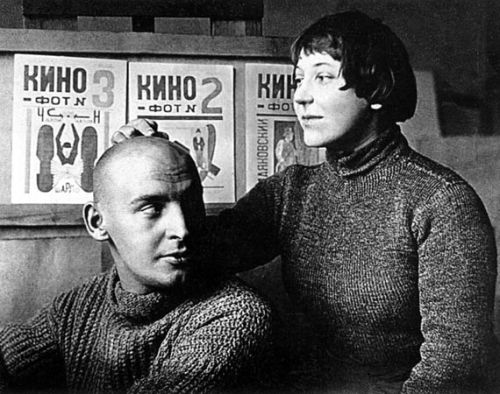
Married Soviet avant-garde artists Alexander Rodchenko and Varvara Stepanova are pictured here in the 1920s.
1920s_rodchenko_and_stepanova

Read Full Post »

gerbil-museum-2-1080x607-1

Photo: Filippo and Marianna
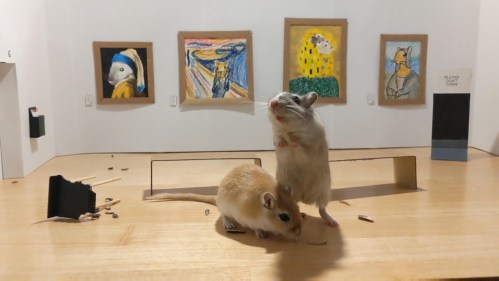
Nine-month old gerbils Pandoro and Tiramisù survey London’s newest art institution, the Gerbil Museum.

This cute story from London about two imaginative shut-ins and their pets makes me think of Beatrix Potter books. But which one in particular? Maybe The Tale of Two Bad Mice? What do you think?

Hrag Vartanian reports for Hyperallergic, “Pandoro and Tiramisù are not your ordinary gerbils. The London-based pair got a special surprise when their owners, Filippo and Marianna, created a miniature museum  just for them during the current COVID-19 quarantine. …

“Both Filippo and Marianna are art lovers, with one working in a local museum and the other as an artist and writer. The gerbils declined to comment.

“Hyperallergic: Tell us about your gerbils!

“Filippo and Marianna: They are 9-month-old brothers and their names are Pandoro and Tiramisù. Pandoro is tawny while Tiramisù is the taupe one.

“H: Have they demonstrated a love of art before?

“F&M: Not really, this was their first time in a museum. They much enjoyed the display and paid close attention to the quality of the gallery’s props. They can’t read, so the sign to advise the visitors to not chew [on the furniture] went completely unnoticed. Overall, it seemed to be a satisfying and engaging experience.

“H: How did you choose the paintings?

“F: Initially we wanted to select less famous paintings but in the end we thought it would have been funnier and more engaging to choose some of the best known works in art history. … Marianna is very good at painting and I couldn’t help but wonder how ‘The Kiss’ and “’Girl with a Pearl Earring’ could have looked with a gerbil twist. …

“H:  Did Pandoro and Tiramisù enjoy the opening of their private museum?

“F&M: Initially they explored the gallery space looking for clues about the rather eclectic selection of artworks. After a while, boredom and a certain love for disruptive gestures grew to a point they managed to start a performance by chewing the empty gallery assistant’s stool — an act that we were lucky enough to film. …

“H: Is this a complicated ploy to write off your gerbils on your taxes?

“F&M: Maybe yes, although they are not very expensive. As long as we have seeds and mini gallery assistants’ stools we are good.”

The blogger Bereaved Single Dad, also in England, frequently mentions gerbils. This is from 2019: “A couple of days back we set off for the pet shop to get a gerbil. A couple of hours later we had fallen for the story of the three inseparable brothers who they didn’t want to split up. … Happy Son. Confused Dad.

“Meet our three new faces. Cupid, Jeff and Hendrix. Unbelievably the house is already covered in wood chippings. Suspect I will need a bigger Hoover.”

The video of the museum-going gerbils is at Hyperallergic, here.

As the New Yorker magazine used to say in a bottom-of-the-column feature: “There’ll always be an England.”

Read Full Post »

lot_daughters_1200

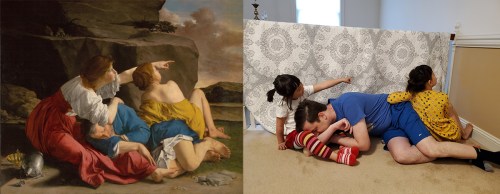
Lot and His Daughters, about 1622, Orazio Gentileschi, at the J. Paul Getty Museum. Recreation on Twitter by Qie Zhang, Erik Carlsson, and their daughters with sheet and yellow dress.

Oh, my goodness! How I loved reading about this yesterday! The J. Paul Getty Museum in California invited fans on social media to use everyday objects from around the house to replicate pieces of art in the museum’s collection. I’m posting a couple of the results, but you really have to go to the site and enjoy everything that the museum has shared.

Sarah Waldorf and Annelisa Stephan wrote at the Getty blog, “On [March 25] we issued a playful challenge on Twitter, Facebook, and Instagram to re-create your favorite art using just three objects lying around home. And wow, did you respond! Thousands and thousands of re-creations later, we’re in awe of your creative powers and sense of humor.

“The challenge was inspired by the Rijksmuseum in Amsterdam and a brilliant Instagram account called Between Art and Quarantine, but adapted with the invitation to use digitized and downloadable artworks from Getty’s online collection. …

“You’ve re-created Jeff Koons using a pile of socks, restaged Jacques-Louis David with a fleece blanket and duct tape, and MacGyvered costumes out of towels, pillows, scarves, shower caps, coffee filters, bubble wrap, and — of course — toilet paper and toilet rolls.

Cézanne and Vermeer have been a popular source of inspiration, especially Still Life with Apples (done to perfection with household pottery and gin) and Girl with a Pearl Earring (restaged with selfies and grandma, pug, or lab). Grant Wood’s American Gothic seems to capture the current socially distant mood, while Munch’s The Scream is appropriate for all ages and apparently tastes good on toast. …

“Christian Martinez’s 6-year-old daughter Bella has a love of nature that drew her immediately to this page from a Renaissance manuscript. Encountering the challenge over breakfast, the family let their imaginations run wild. …

“ ‘Pasta being life for a 6-year-old, it was first selected, followed by the boiled eggs, which happened to be cooling off to the side,’ Christian told us. Next came a brown paper bag as the canvas, and a basil stem from last night’s dinner. …

“[An] early 20th-century Scandinavian interior spoke to Tracy McKaskle ‘because we are all confined to home,’ she said. … For her re-creation, she stood on a chair and carefully placed some pins to hold the little picture, moved her dining room furniture out of the way, then perfectly placed an easel with a blank canvas. …

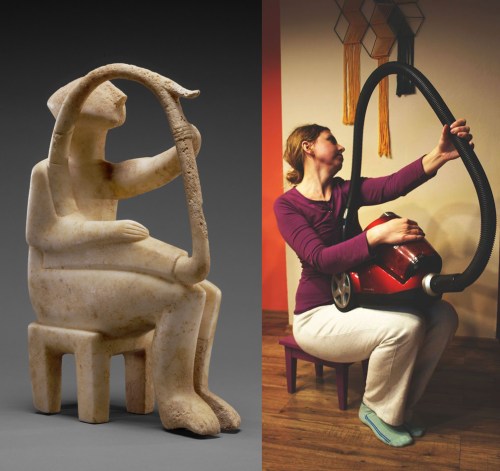
“Transforming into an ancient harp player with a vacuum cleaner ‘was the first thing that came to mind when I was looking at your collection,’ says Irena Irena Ochódzka, who posed herself into this amazing sculptural recreation. …

“[A] Baroque masterpiece ‘was the first painting that stood out to me [in the Getty collections] and I thought we could do it pretty easily,’ said Qie Zhang of this family project. Her two girls fought over the yellow dress, she told us, but you can’t tell from the delightful end result.

“Her husband’s pose also made us laugh with its allusion to parental exhaustion.”

More here. Don’t miss the Van Gogh made of Play Doh, carrot slices, and wooden beads! And tell me your favorite.

Male Harp Player of the Early Spedos Type, 2700–2300 B.C., Cycladic. Marble. Recreation via Facebook DM by Irena Ochódzka with canister vacuum.

irena_harpist_1008

Read Full Post »

1949

Photo: Ben Stansall/AFP via Getty Images
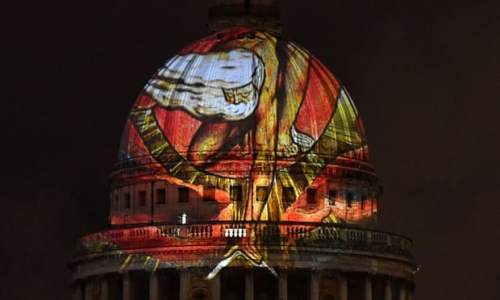
Tate Britain’s curator said the projection of William Blake’s Ancient of Days was in keeping with Blake’s ‘lifelong dream to be an artist with real public impact.’

As happens all too often, I miss the deadline for when you could go see something I’ve written about. If you were in London two months ago, I apologize. I would have loved to see this art myself, having long been a fan of William Blake.

Mark Brown, writing at the Guardian in November, explains what we all missed.

“William Blake always dreamed of making vast works for churches and palaces but to his bitter disappointment he never achieved it. More than two centuries after his death Tate has announced it is going some way to making up for that by projecting his final work on to the giant dome of St Paul’s Cathedral.

“For four evenings [in November], his illustration Ancient of Days will dramatically light up the skyline of London.

“Martin Myrone, the senior curator of pre-1800 art at Tate Britain, said Blake always had grand ambitions as an artist, proposing huge frescoes that were never realised. … ‘What he said he wanted to do was produce altarpieces and large-scale pictorial schemes in churches and palaces.’ …

“Blake is regarded as a visionary, radical artist who was ahead of his time and unappreciated for most of his life.

“ ‘He had a frustrating career and had moments when he was really down and depressed,’ said Myrone. ‘He felt alienated from the art establishment and he never really won the audience that he wished to have. He did see himself as an artist who should be read and seen by not just a few connoisseurs but by lots and lots of people.’

“The project, which marks his birthday, stems from Tate Britain’s current exhibition of Blake, the biggest for a generation. … The St Paul’s dome takes it to another level and is an appropriate venue because it is home to a memorial to Blake. His body was buried in an unmarked grave in Bunhill Fields burial ground near Old Street in London.” More at the Guardian.

A Wikipedia post says in part, “The Ancient of Days is a design by William Blake, originally published as the frontispiece to the 1794 work Europe a Prophecy. It draws its name from one of God’s titles in the Book of Daniel and shows Urizen [who in the mythology of William Blake is the embodiment of conventional reason and law] crouching in a circular design with a cloud-like background. His outstretched hand holds a compass over the darker void below. Related imagery appears in Blake’s Newton, completed the next year. As noted in Gilchrist’s Life of William Blake, the design of The Ancient of Days was ‘a singular favourite with Blake and as one it was always a happiness to him to copy.’ ”

Anyone else a Blake fan?

Read Full Post »

012920-window-ConcrdMa

I wanted to do another photo post but didn’t have very many photos. That’s mainly because I have been doing my daily walk indoors when it’s not nice out. ‘Round and ’round indoors. Kind of dull.

So I went to a couple free art exhibits, and now I have more pictures.

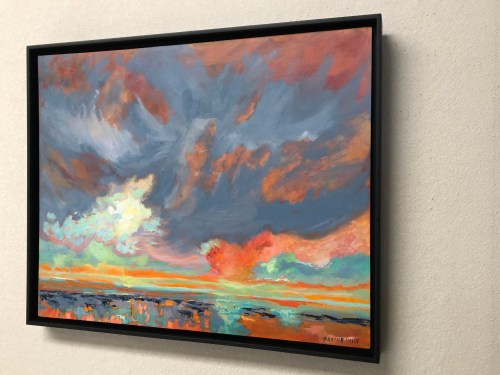
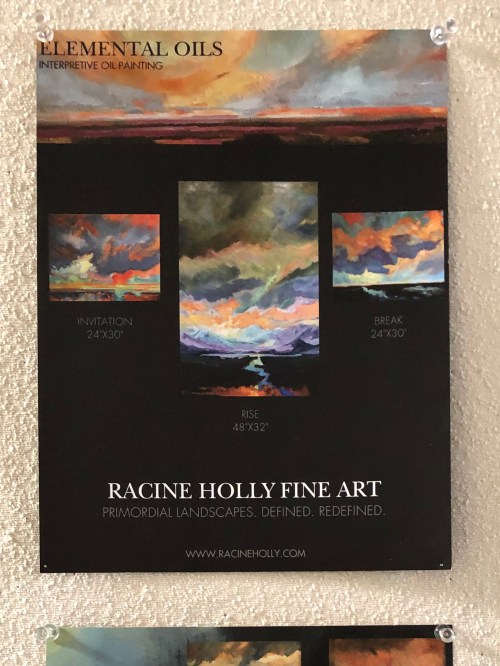
In Providence, Racine Holly was showing some dramatic skies at a church. When I went in, I didn’t see anyone around. Very trusting. I could hear construction workers talking behind a screen at least. I’m sharing the two oils I liked best. They both had “sold” stickers. The second one was tiny.

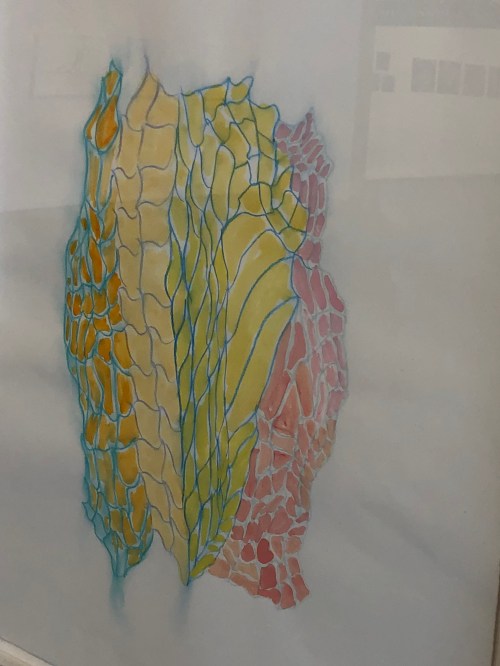
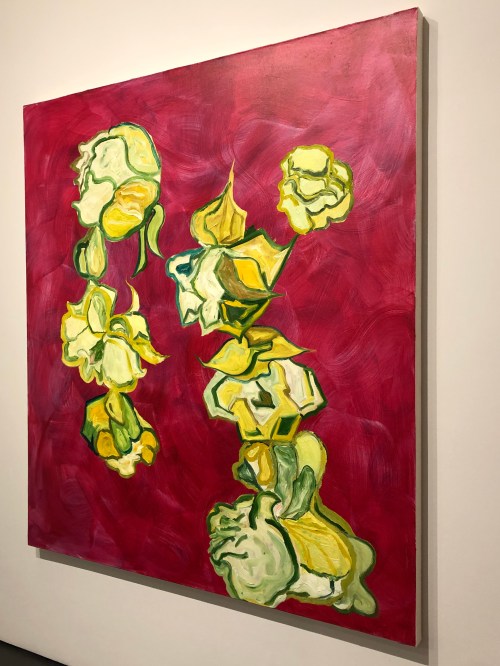
Then I went to the Bell Gallery at Brown University, where there was a show of work by Brown art professor Wendy Edwards that had been recommended by critic Cate McQuaid at the Boston Globe. I find I like art that McQuaid likes.

021720-free-Providence-art-gallery

This artist had a lot of works related to reproduction. The giant peach looks great in the Globe article but up close was “too buch for be,” to quote the Elephant’s Child. Below are a few paintings I liked better.

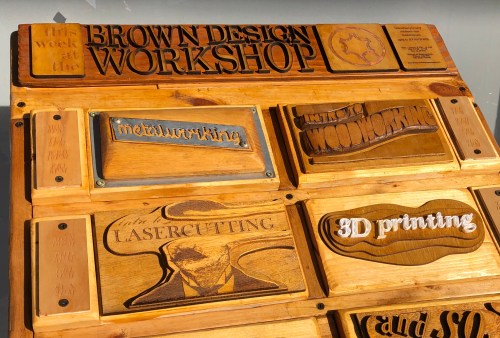
While at the Bell Gallery, I also took a picture of a Brown University Design Workshop pedestal that I didn’t quite understand. It looks like a range of stamping techniques carved in different styles. But if you used one as a stamp, the words would be backwards. It’s probably just to show potential clients what can be done.

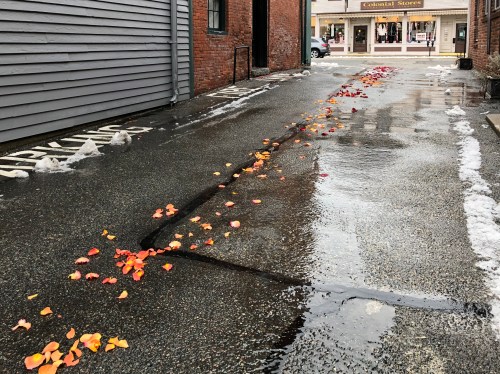
The final six photos reflect recent travels in Massachusetts and Rhode Island. Note the path of rose petals a clever florist scattered to her door for Valentine’s Day shoppers to follow.

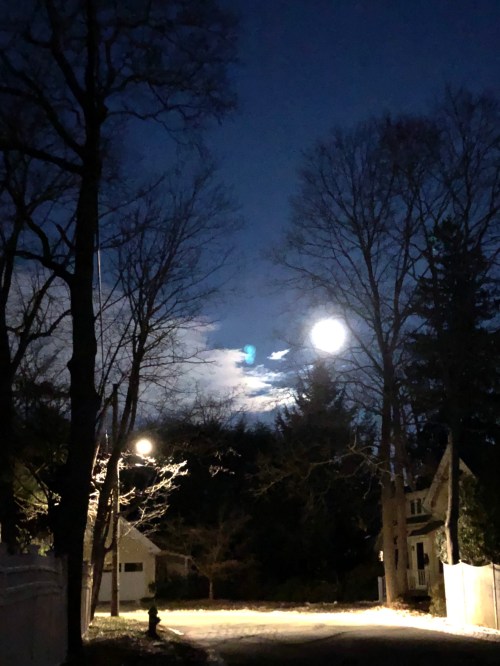
If anything needs more explanation, please let me know in Comments. (Did you get where I’m trying to imitate Magritte?)

021720-dramatic-Racine-Holly-sky

021720--small-Racine-Holly-painting

021720-exhibit-in-Providence-church

021720-no-idea-but-I-like-it

021720-artist-Wendy-Edwards-likes-fruit-with-seeds

021720-Brown-U-art-prof-shows-where-you=-come-from

021720-Brown-U-Design-carved-pedestal

020320-bring-your-own-container

020320-sign-in-Providence-about-a-horse

021320-rose-petal-path-to-florist

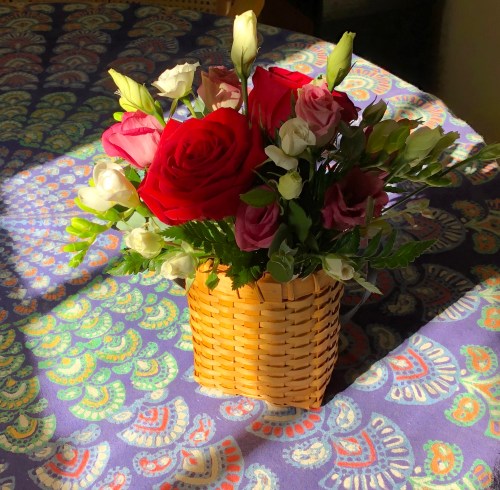
021420-bouquet

020620-Magritte-in-the-neighborhood

020820-Magritte-moon


Read Full Post »

new_york_city___artist_and_photo_credit___molly_dilworth___pg_41

Photo: Molly Dilworth
“Molly Dilworth’s rippling mural helped reimagine Times Square as a car-free place,” says
Curbed. The work was part of an initiative by Bloomberg Philanthropies.

As much as I want to tell folks about anyone’s good works, I’m afraid that the wealthy presidential candidate whose name is on the initiative I’m covering today is getting too much free publicity.

I’m annoyed. I’m sure we all clicked “like” when the former mayor did something positive about, say, gun violence. But as a result, his campaign videos are showing up on Facebook saying they were “liked” by us, which is not the case. So you are just going to have to fill in the blank when I refer to [B] Philanthropies today.

Alissa Walker writes at Curbed, “Over the last decade, U.S. cities have carved out dozens of public plazas from existing streets using little more than paint. A new grant program and guide announced today by [B] Philanthropies will fund the creation of 10 street murals in 10 U.S. cities, as well as track the safety, economic, and civic impact of these projects.

“The Asphalt Art Initiative … will award 10 small or mid-sized cities with grants of up to $25,000 to create colorful murals on streets, intersections, and crosswalks, or vertical surfaces of transportation infrastructure like utility boxes, traffic barriers, and highway underpasses. Cities that apply must have populations ranging from 30,000 to 500,000 and must implement the project by the end of 2020.

“ ‘It’s not just about art — it’s about creating safe spaces for people for pennies on the dollar,’ says Janette Sadik-Khan. …

“As former transportation commissioner for New York City, Sadik-Khan championed the conversion of Times Square into a network of car-free pedestrian plazas. But the project, which included several asphalt murals, also ended up achieving other goals, she says, like ensuring nearby residents lived within a 10-minute walk of a public space, and helping pedestrian injuries in the area plummet by 30 percent.

“ ‘We’re not looking for just pretty pictures, we’re looking for projects that encourage safety benefits and community engagement,’ Sadik-Khan tells Curbed, noting that the selected cities will be gathering data to track the overall impact of their projects. …

“In addition to the grants, [B] Philanthropies, in collaboration with Street Plans Collaborative and public art consultant Renee Piechocki, has created a free publication that provides a how-to guide and dozens of case studies for city leaders wanting to implement these types of projects on their own.

“While the street plazas are intended to be temporary or ‘tactical’ — how long they last depends on the paint material used and how often it’s reapplied — the projects often end up leading to permanent, systemic changes, says Tony Garcia, principal at Street Plans Collaborative. …

“But even with paint that’s meant to fade away, the impact is lasting. Garcia points to a project in Asheville, North Carolina, which saw retail sales increased by 25 to 30 percent and a 20 to 30 percent drop in vehicular speeds along the corridor. …

“Asphalt art like plazas and crosswalks can help residents realize they don’t have to accept their transportation system’s status quo, says [Kate D. Levin, cultural assets management principal at (B) Associates], who notes that the current design of U.S. streets lends a sense of permanence to cities that isn’t particularly aspirational.

“ ‘People lose a sense that they have a choice. That can lead people to accept a public realm that doesn’t optimize what they want or need,’ she says. ‘These projects are helpful in reminding people to not to take their environment for granted.’ ”

More at Curbed, here. Hat tip: ArtsJournal.com.

Photo: Justin Mitchell via Street Plans
Coxe Avenue in Asheville, North Carolina, was transformed when Street Plans Collaborative used art to help create a safer, more profitable street.

45333824_10218821591639153_3578706341759287296_o

Read Full Post »

last-supper-detail

Photo: Evy Mages
Detail from a massive sculpture of a black Last Supper discovered by a demolition crew in the Columbia Heights section of Washington, DC.

Oh, my! Imagine the wonder of the demolition crew that uncovered this artwork in a former church! I wish reporter Andrew Beaujon at the Washingtonian had tracked them down and interviewed them for their immediate thoughts.

Here’s his story.

“Joy Zinoman got an unexpected phone call [in early October]. Demolition had just begun inside a former church in Columbia Heights that she’s turning into the new home of the Studio Acting Conservatory. Now the boss of the the crew working was on the line to tell the Studio Theatre founder about a remarkable discovery his guys made: An enormous frieze of the Last Supper that was hidden behind drywall for more than a decade.

“The building on Holmead Place, Northwest, had been slated to become condos before the conservatory bought it earlier this year. It was built in 1980, city records say, to house New Home Baptist Church, which moved to Landover, Maryland, in the 1990s. After that it became a building for the Church of Jesus Christ of Latter-Day Saints. A signature on the lower right of the sculpture  leaves no doubt at which point it joined the building’s history: ‘All rights reserved 1982 Akili Ron Anderson.’ …
“New Home trustee board chairman Willie L. Morris told Post reporter Esther Iverem, ‘It was very important to us that we have a black artist. All the other Last Supper pictures we’d seen were always in a white framework.’ …
“Anderson now teaches at Howard University and some of his artwork is easier to see, particularly his work Sankofa at the east and west entrances of the Columbia Heights Metro Station as well as stained glass at Andrew Rankin Memorial Chapel and the Prince George’s County Courthouse.

“The fact that the participants in the Last Supper are black reflects a movement among African American artists, beginning in the late 1960s, to make the art in places of worship look like the people inside them. ‘I think it’s important for black children sitting in churches all over this country on Sunday morning to look up at the windows, look up at images and see themselves and believe that they can ascend to heaven, too,’ Anderson told Iverem in 1993.

“It’s not clear when the 232 square feet of religious art was covered by drywall. City records show that an inspector reviewed some ‘Close-in (concealment)-Walls Construction’ in 2003. Anderson says he undertook the artwork when he worked at Duke Ellington School of the Arts and had a coworker who attended New Home. ‘Most of the time I was in there by myself,’ he says.

‘It actually got to be something of a spiritual experience for me.’ …

“When you first view the frieze in person, as I did Friday, you’re likely to gasp: It’s difficult to convey just how large and impressive this sculpture is.

“Acting studios are supposed to be bare, and Zinoman, who likens this piece to the Sistine Chapel, really hopes it won’t end up behind a curtain at her conservatory. … She’s hoping a museum might wish to take it. Removing it from the wall will not be easy and will require a lot of skill and experience (and presumably money) to do properly. ‘All I want is for it to be in a place where people can see it,’ Zinoman says. ‘I think it’s a great work.’ ”

You can tell that a lot of love went into this frieze. If it does end up behind a curtain, at least it will still be available to visitors. If you know of any venue that could afford to move it and make it available to the public, please get in touch with the Studio Acting Conservatory, 202.232.0714.

More at the Washingtonian, here. Lots of great photos.

Read Full Post »

grandprize_wide-2fc2c36c86c8cd252a3b1bc853b6437d840515a9-s600-c85

Photo: Kristen Hartke/NPR
For the 2018 grand prize winner in Asheville, the judges were impressed by the intricate, working gingerbread gears of the clock inside Santa’s workshop.

Following up on last week’s post about extreme Christmas cooking, I’ll just say that whether the labor is for love or business, for fun or for cutthroat competition, it’s a treat to see what sorts of edibles our cooks turn out for the winter holidays.

Kristen Hartke reported at National Public Radio (NPR) on Christmas Eve last year, “Nadine Orenstein never expected to judge gingerbread houses. But several years ago, the curator in the Department of Drawings and Prints at New York’s Metropolitan Museum of Art happened to see a program on the Food Network about a competition in Asheville, N.C., and was intrigued. …

“Fourteen years later, Orenstein is still a judge for the National Gingerbread House Competition. … ‘In a way, it’s very similar to what I do as a career and, in some ways, completely different,’ she says.

“The biggest difference, of course, is that each entry must be entirely edible — although it’s fairly rare for the judges to actually eat the sweet creations — and must consist of at least 75 percent gingerbread. …

“The competition didn’t originate as a contest in 1992, but as simply a display of gingerbread houses made by Asheville locals. … This year, there were 195 entries from across the U.S. and Canada, which means that judging this contest is no cakewalk.

“Other than Orenstein, most of the eight judges come with a serious pastry pedigree, like Mark Seaman, master sugar artist for Barry Callebaut chocolate company, one of the world’s largest cocoa producers. Seaman has been judging the competition for over a dozen years.

” ‘It is a long and somewhat complicated process,’ he says. ‘Some people are literally spending hundreds of hours creating their entries, so we want to pay attention to the work they’ve put into it, but we also have to do all the judging in one single day.’ …

“Using specific criteria — creativity, difficulty, overall appearance, consistency of theme, and precision — each judge starts the morning by spending two hours choosing 10 favorites in each category. The competition staff collects the information, plugs it into Excel, and tabulates the first round of results, narrowing it down to a universal top 10 entries. Then the judges really get down to business, parsing the technical difficulty and design elements in half-points — numbers that go back into the spreadsheet for the final result.

“But while the competition relies on numbers to achieve fairness — sometimes the grand prize winner isn’t even selected by all the judges as one of their initial top 10 favorites — it’s ultimately a combination of technique and creativity that determines the winners. …

“For Seaman, craftsmanship is a key element, particularly when he sees something especially innovative, like this year’s

grand prize winner, which depicts Santa’s workshop with a clock made of functional gingerbread gears. The gingerbread was baked by creators Julie and Michael Andreacola, of Indian Trail, N.C., for several hours, then precision-cut with lasers. …

“While Orenstein finds the technical elements impressive, she is also looking for a compelling story, … ‘Sometimes, the lack of perfection is key in art,’ says Orenstein, ‘but what I’ve learned over time is that perfection in these gingerbread houses matters.’ …

“Those details might be the tiny copper Moscow mule mugs that grace a table where a group of reindeer are playing a game of poker, the labels on the cans lining the walls of a general store — all edible, mind you — or realistic-looking candles made of white chocolate that stand next to a gingerbread clock. …

” ‘You don’t enter a competition because you want to win,’ says Seaman. ‘You enter because you want to do the best work you can possibly do. The people who win are attached to the piece in some personal way. Even though the technique is really important, you shouldn’t learn how to do hot sugar just for the purposes of entering this contest.’ ”

More at NPR, here.

Noncompetitive gingerbread displays involve less pressure and may be more fun. Here are a few local efforts: one at the library, two at the Colonial Inn.

121119-Concord-Library-gingerbread

121219-Frozen-movie-as-Gingerbread

121219-Scouts-do-gingerbread


Read Full Post »

picture2_sq-a1d7c85e7f7ab272b3c4ae2b72308ec950caad5f-s600-c85

Photo: Arty McGoo
These artistic Santas are an example of Arty McGoo’s cookie handiwork.

Before I share today’s story about Christmas cookies that are works of art, I want to tell you what Sandra does every Christmas for her extended Italian family in Connecticut. Sandra, you should know, is beloved of a large network of friends and family for her kindness, insight, moral support, good sense, and many other sterling attributes — not least of which is her cooking skill.

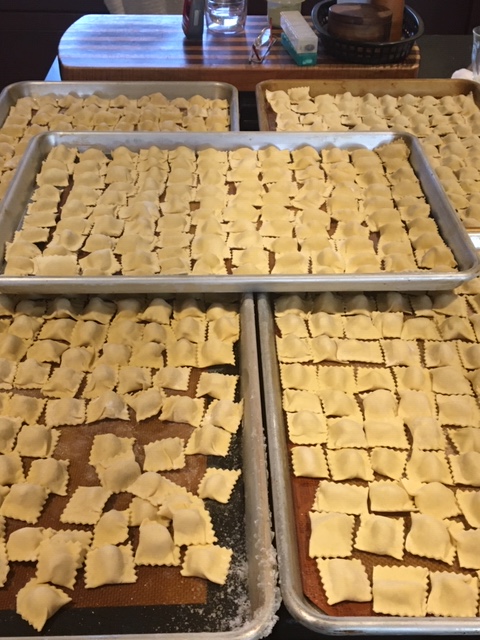
At Christmas, her family produces a prodigious feast, and her role is to make the cheese-filled anolini below, which she serves with chicken soup. She’s ahead of the game today having made and frozen roughly 1,100 of the small, ravioli-like dumplings.

Photo: Sandra M. Kelly
It’s traditional among Sandra’s Italian family members to serve anolini in chicken soup as one of the Christmas-dinner courses. She’s already made and frozen 1,100.

120619-Kelly-anolini-cheese-filled

Nina Keck reported a story about another edible art form at National Public Radio [NPR] last year.

“For many people the holidays wouldn’t be the holidays without baking and decorating cookies. But a growing number of creative bakers, known as ‘cookiers,’ are taking their art to a whole new level.

“Mary Thode of Chittenden, Vt., is one of them. This time of year, she bakes all sorts of cookies — some of the recipes were her mother’s, she says, which bring back nice memories.

” ‘But I do like a painted cookie,’ she says, nodding toward the nine coffee cups on her dining room table that are each filled with different colored frosting. … Thode makes cookies all year — baby-bottle shaped ones for shower gifts and pumpkins at Halloween. But during the holidays, she’ll bake about 700 cookies, half of which she’ll paint, often with many layers of different colored frosting. …

“Thode is among a growing number of people, who’ve changed bite-sized treats into an art form. Many, like Thode, are hobbyists, who give their cookies away as gifts. But it’s also big business. Some of the most elaborate designs by top artists sell for $150 per dozen, or even more. …

“Elizabeth Adams [is] known in the cookie world as Arty McGoo. McGoo has made a career out of cookies. The California resident has more than 80,000 followers on Facebook and now devotes most of her time to teaching others her craft. …

“The popularity of decorating cookies has been great for companies like CK Products, which manufactures and distributes things like edible glitter, sprinkles, meringue powder and piping gel. …

“Ann Clark Cookie Cutters, a family-owned business in Rutland, Vt., that began in 1989, has also ramped up production. CEO Ben Clark says 52 employees work two shifts and their assembly line churns out 22,000 cookie cutters a day. …

“Clark says llamas are big this year: ‘We immediately said “let’s do a llama.” And are our creative director said we’re going to do two; we’re going to do one that looks like a llama and we’re gonna have one that’s more of a cartoony llama. … Ten days later [both] those products were dominating Amazon as the llama cookie cutter.’ ”

More here. By the way, next year’s serious cookie convention, Cookie Con, will be held in Louisville. Get your tickets here.

The cookies my grandchildren made at the church’s craft workshop Saturday are works of art that have meaning for me. This one is by my youngest grandchild.

120719-V-MADE-COOKIES-AT-CHURCH

Read Full Post »

Art in Time of War

m.d.0018-1024x683

Photo: Dalloul Foundation
Installation view of the Ramzi and Saeda Dalloul Art Foundation in Beirut, Lebanon. The private museum is not expected to open to the public for a few years.

Today’s article brings up the dilemma I mentioned recently about trying to share something interesting when the situation on the ground is changing fast and the thing described could disappear overnight. (My version of the Greek philosopher Heraclitus: “You can’t step in the same river twice.”)

In September,  Rebecca Anne Proctor of artnet News attempted to capture the fluid art scene in Beirut, Lebanon, amid daily antigovernment protests.

“Hanging in the booth of Saleh Barakat Gallery during the 10th edition of the Beirut Art Fair last week was the latest work by Lebanese painter Ayman Baalbaki: a large-scale depiction of Beirut’s Piccadilly Theatre in its present, ruined state, priced at $250,000. Painted in fleshy red and black brushstrokes, the empty, ghostly theatre in Hamra serves as a potent reminder of both the city’s rich cultural history and its present economic predicament.

“Bordered by Syria to the north and east and Israel to the south, the little Levant country of Lebanon is used to continuous states of economic and political woe. Yet after its parliament approved a 2019 austerity budget in late July in an attempt to rescue the economy from spiraling debt and unlock billions of dollars in international aid, many believe the country is now experiencing some of its darkest days yet. …

“The country has also been deeply affected by the Syrian refugee crisis. Lebanon, home to a population of six million, is currently hosting more than 950,000 Syrian refugees, according to the UNHCR. There are also mounting tensions with Israel—in late August, Israeli drones struck an Iranian-backed Palestinian militia in the Eastern Bekaa Valley. …

“ ‘The crisis is very present and things are very tough, but what do you do in such a moment?’ asks the prominent Beirut art dealer Saleh Barakat. … ‘It’s either you close or you make a decision to continue. We took the latter decision. We want to resist by moving on in a positive way.’

“One small silver lining, he says, is that artists feel less pressure to churn out commercial material, freeing them up to experiment. … Often, that results in art that reflects the world around them.

“Most recently, Barakat mounted ‘Interminable Seasons of Migration,’ an exhibition of sculptures made out of bits of car metal by Lebanese artist Ginane Makki Bacho that portrayed the millions of refugees escaping conflict in Syria.

‘I wanted to show the tremendous exodus of people fleeing the war with or without expectation or hope of a secured destination,’ the 71-year-old artist says. …

“Even in times of crisis, however, the art market manages to chug along, and Beirut is home to a number of deep-pocketed collectors who can ride out the storm … ‘It was a really good week,’ [Barakat] says. ‘I was very surprised.’

“The fair remains under the leadership of its founder, French-born Laure d’Hauteville, who has worked to raise the profile of the event. … She claims that ‘the fair has not at all been affected by the economic crisis — we had more museum groups and collectors than ever.’ …

“ ‘I remain an optimist,’ says Mazen Soueid, an economist and advisor to Lebanon’s prime minister, of Lebanon’s future. ‘Resilience is part of the country’s DNA; a lot of the downside is due to the regional rather than the local factors. Let us be frank: the region is at war; and for a country in the middle of a region at war, we are actually still holding up.’ …

“Indeed, the new austerity measures seem not to have dramatically affected Beirut’s rising crop of new museums. … Among them is the Beirut Museum of Art (BeMA), dedicated to Lebanese art and slated to open in 2023. …

“There’s also the Dalloul family collection, known as the Ramzi and Saeda Dalloul Art Foundation (DAF), comprising more than 4,000 Modern and contemporary Middle Eastern artworks. Their private museum is scheduled to open within the next three years. …

“[Some dealers are] facing challenges they never could have anticipated. ‘We are going through a huge crisis,’ says Joumana Asseily, owner of Marfa’ Gallery, … They new austerity measures have affected Asseily’s ability to transport artworks abroad. … Recently, she tried to reclaim three works that were lent to a traveling exhibition in Europe, only to be asked at customs to pay for the objects as if she had purchased them.

“ ‘It’s a nightmare. … I still have artworks stuck in customs — it’s been around eight weeks. [But] even if it is a struggle, I want to stay and work. There are great artists, a great scene, and amazing energy in Beirut.’ ”

More here.

Read Full Post »

102719-Middlesex-Volunteers

I was hurrying along Walden Street on a cold and rainy Sunday, awkwardly carrying parcels and a heavy umbrella, when whom should I see but a couple of historical reenactors. So of course I had to put everything down in the damp and find my phone to take a picture. I still don’t know what the occasion was for the guys above or who they were supposed to be, but this sort of thing happens all the time where I live.

Here are a few more photos, going back to October.

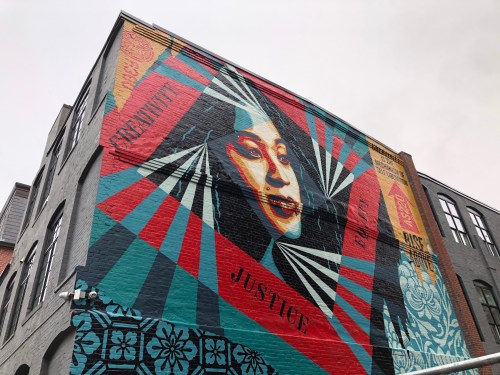
First, I wanted to show you the finished mural by Shepard Fairey in Providence. I posted the work in progress here. The sign by RISD Coworks is just one example of the welcome that Providence and the Rhode Island School of Design give to artists in general.

And speaking of RISD, my husband and I took my sister’s husband to the RISD art museum at Thanksgiving, and he loved it. I took pictures of some art I liked below, but I also want to tell you about an auditory installation that meant a lot to us.

In one room, a museum guard pointed out a circle of chairs on a dais and an old-fashioned microphone. You could vaguely hear a tape of voices looping softly in the background. The guard said that one could speak into the microphone and in a few seconds, one could hear the words projected and amplified. I stepped up and said to my sister, who died in September, “Hey, Nell, wherever you are. We’re thinking of you.”

The effect of hearing those words resonate around the room a moment later was spectral, indescribable. We felt we were communicating.

I close with the ruined wall in Providence that features a constantly changing array of artworks. And then one of my shadow pictures, this one taken in late afternoon in the local cemetery.

102919-finished-Fairey-mural-RI

102919-Fairey-fan-club

112919-Esther-and-Modecai-at-RISD

112919-Esther-and-Mordecai

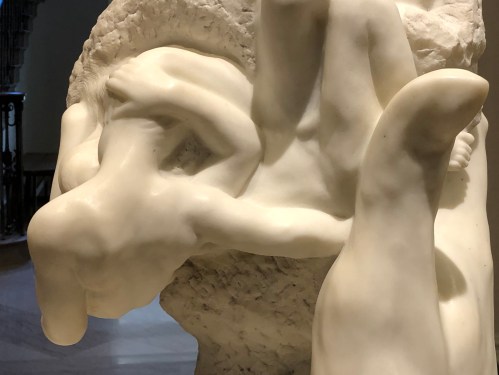
112919-Hand-of-God

112919-Rodin-at-RISD

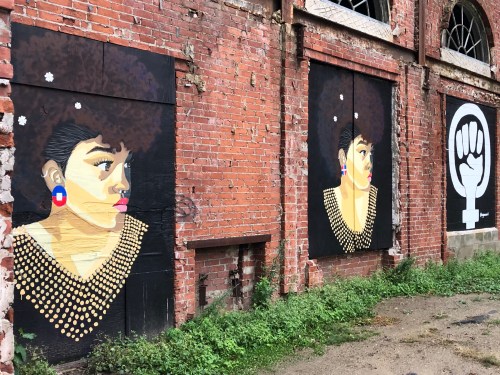
102919-strong-woman-mural-on-Weybosset

102919-glowing-haunted-windows

102919-blood-moon-mural

112119-late--afternoon-cemetery-2


Read Full Post »

cruise-auction-4

Photo: Cruise Critic
A Park West art auction in the Star Lounge on Royal Caribbean’s Navigator of the Seas.

My family went on a cruise only once (1990, New York to Bermuda), so in terms of special features, we know about Broadway-type entertainments, and that’s it. “Let’s give a warm welcome to the Royal Viking singers and dancers, Everyone!”

But cruise lines keep trying to outdo each other in offerings. One couple I know chooses their trip based on what chamber music group will be playing. And if you are into fine art or auctions, there’s a cruise for you, too.

Of course, you’re not going to pick up something valuable for cheap.

Sarah Cascone writes at Artnet, “I was lounging poolside, cocktail in hand, when I heard the announcement. The grand finale art auction was about to start.

“It was a weekend cruise from Miami to the Bahamas aboard Royal Caribbean’s recently refurbished Navigator of the Seas. … As I entered the event, hosted by cruise-ship auctioneer Park West Gallery, I bypassed the registration table, heading straight for the auction floor, where a waiter was handing out glasses of sparkling white wine.

“From the start, it was clear that this was no regular art auction. After a brief spiel encouraging folks to buy art as a legacy to leave to their children, the auctioneer, Robert Borotescu, got down to business.

‘I don’t know if you’ve seen Oprah,’ he said. ‘We have some surprises under the chairs.’

“Cue a frenzy as the few guests in the room rushed to upturn every seat cushion. There were no car keys to be found, but there were $100 certificates for discounts on winning bids.

“Borotescu, a dark-haired Romanian man in his mid-to-late 30s, endeared himself toward the crowd by offering additional raffle tickets for $100 credits throughout the auction. … With his pleasantly urbane accent, Borotescu set his audience at ease, acknowledging that they probably never had the time to visit art museums and galleries. But they were here now, and it was his job to make sure that they went home with something they absolutely loved. …

“Borotescu told us that [Park West] operates on 100 cruise ships, and claimed that the art aboard the Navigator of the Seas alone was worth $3 million. Representing some 200 artists, the company holds 1,200 auctions every month. …

“Unlike most art world organizations, Park West seems to hire employees with largely non-art backgrounds. Borotescu’s LinkedIn lists six years in fine jewelry and watch sales at Louis Vuitton Moet Hennessy before joining the company. A quick perusal of resumes of other auctioneers and art directors at the company yields unconventional experience in HVAC, used car sales, fitness instruction, and Royal Caribbean’s beverage team, to list just a few. …

“Park West specializes in what it calls ‘graphic works’: Mass-produced reproductions of original paintings, signed by the artist and released in limited editions. Some are giclée prints — a fancy term for high-quality inkjet prints. Other pieces might look like paintings, but these more expensive offerings are often merely hand-embellished, with brushstrokes layered over a printed image to give it a more ‘authentic’ feel. …

“ [The auctioneer] said: ‘If we look at the Oxford Dictionary of Art, every single artwork that can be traced back to the artist, or was created under the artist’s supervision, is considered to be an original work of art.’ …

“Most of the time, you won’t even take home the exact work you’re bidding on. Park West will ship you a functionally identical copy from its warehouse, rather than going through the trouble of turning over the on-board stock, according to Bloomberg Business. …

“The bidding kicked off with a piece by Peter Max, a well-known Pop artist who met Scaglione, Park West’s founder, back in the late 1960s, and has been represented by him ever since. …

“ ‘This is one of the gems we have on the Navigator of the Seas,’ Borotescu told the crowd, claiming that the ‘printed painting on canvas’ was valued at $23,500, but that he could start the bidding at $20,000. Less than 30 seconds later, the work was sold for $20,700.

“Max has decades of experience exhibiting at international museums. The highest auction record for a work of his is $53,125, according to the artnet Price Database. … Other artists on offer had decidedly less impressive CVs. Borotescu proudly proclaimed that Park West is the only gallery to represent David ‘Lebo’ Le Batard, noting that the artist is known for his paintings of cats and owls. …

“Every attendee was encouraged to enter a free raffle to take home a massive, unframed Thomas Kinkade [your blogger comments, ‘Ugh!’]. … One gimmick in particular stood out: A pair of works presented turned away from the audience, and sold as one lot, without any idea of what they looked like. ‘They are going to be two of the most gorgeous works of art that anyone has ever seen,’ Borotescu promised the audience. ‘Once you turn it around, if it’s something you don’t like, you don’t have to keep it.’ …

“And then there was Tweety.

“Borotescu never named the artist responsible for designing the tiny print, relying on the Looney Toons character’s name recognition … Supposedly, the artwork, which was just a couple inches high and therefore impossible to see from across the room, was valued at $549.

“ ‘Let’s have some fun,’ Borotescu suggested, asking everyone in the room to hold up their bid card. He opened the bidding at just $20. Two thirds of the crowd dropped out when he raised the price to $40, and suddenly the auctioneer slammed down the hammer, selling the cartoon bird to a handful of guests.”

More here, where you can also read about the latest confusion surrounding works by Peter Max, one of the featured artists.

I think if you didn’t take it too seriously, an onboard art auction would be fun. Gimmicks such as surprises under the chairs somehow make me think of a kid’s birthday party. The whole experience seems to play to the child worldview that is buried but available for anyone to tap in adulthood.

Read Full Post »

qa8yx8zyrhobzjys_optwa2frothkothumb800

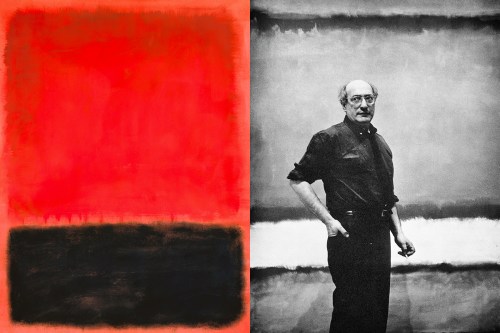
Abstract Expressionist artist Mark Rothko had strong opinions on how to teach children art without dampening their natural creativity.

The little I know about modern artist Mark Rothko is from a theatrical production called Red that I saw in Boston. It was pretty comprehensive, but I don’t believe it covered Rothko’s views on teaching art to children. That is something I learned about from an Artsy editorial.

Sarah Gottesman wrote, “If you’ve ever seen Mark Rothko’s paintings — large canvases filled with fields of atmospheric color — and thought, ‘a child could do this,’ you’ve paid the Abstract Expressionist a compliment.

“Rothko greatly admired children’s art, praising the freshness, authenticity, and emotional intensity of their creations. And he knew children’s art well, working as an art teacher for over 20 years at the Brooklyn Jewish Center. To his students — kindergarteners through 8th graders — Rothko wasn’t an avant-garde visionary or burgeoning art star, he was ‘Rothkie.’ ‘A big bear of a man, the friendliest, nicest, warmest member of the entire school,’ his former student Martin Lukashok once recalled.

“Rothko was a thought leader in the field of children’s art education. He published an essay on the topic (‘New Training for Future Artists and Art Lovers’) in 1934, which he hoped to follow up with a book. Though he never completed the project, he left behind 49 sheets of notes, known as ‘The Scribble Book,’ which detailed his progressive pedagogy — and from which we’ve taken five lessons that Rothko wanted all art teachers to know.

“Lesson #1: Show your students that art is a universal form of expression, as elemental as speaking or singing

“Rothko taught that everyone can make art — even those without innate talent or professional training. According to the painter, art is an essential part of the human experience. … For Rothko, art was all about expression — transforming one’s emotions into visual experiences that everyone can understand. And kids do this naturally. …

“Lesson #2: Beware of suppressing a child’s creativity with academic training

“As Rothko saw it, a child’s expressiveness is fragile. When art teachers assign projects with strict parameters or emphasize technical perfection, this natural creativity can quickly turn to conformity. ‘The fact that one usually begins with drawing is already academic,’ Rothko explains. ‘We start with color.’ …

“When children entered his art room, all of their working materials — from brushes to clay — were already set up, ready for them to select and employ in free-form creations. No assignments needed.

“ ‘Unconscious of any difficulties, they chop their way and surmount obstacles that might turn an adult grey, and presto!’ Rothko describes. ‘Soon their ideas become visible in a clearly intelligent form.’ With this flexibility, his students developed their own unique artistic styles, from the detail-oriented to the wildly expressive. …

“Lesson #3: Stage exhibitions of your students’ works …

“For Rothko, an art teacher’s premier responsibility was to inspire children’s self-confidence. To do this, he organized public exhibitions of his students’ works across New York City, including a show of 150 pieces at the Brooklyn Museum in 1934. And when Rothko had his first solo exhibition at the Portland Art Museum a year earlier, he brought his students’ works along with him and exhibited them next to his own. … Rothko wanted critics to see that fine art only requires emotional intensity to be successful.

“Lesson #4: Introduce art history with modern art (not the Old Masters) …

“With 20th-century art, children can learn from works that are similar to their own, whether through the paintings of Henri Matisse, Milton Avery, or Pablo Picasso. These iconic artists sought pure, personal forms of visual expression, free from the technical standards of the past. … But while exposure to modern art can help boost children’s confidence and creativity, it shouldn’t interfere with the development of a unique style. Rothko discouraged his students from mimicking museum works as well as his own painting practice. …

“Lesson #5: Work to cultivate creative thinkers, not professional artists

“In addition to fanning students’ creative instincts, great art teachers can help students become more self-aware, empathetic, and collaborative — and this generates better citizens in the long run, Rothko believed. At the Brooklyn Jewish Center, he hardly cared whether his students would go on to pursue careers in the arts. Instead, Rothko focused on cultivating in his students a deep appreciation for artistic expression.

“ ‘Most of these children will probably lose their imaginativeness and vivacity as they mature,’ he wrote. ‘But a few will not. And it is hoped that in their cases, the experience of eight years [in my classroom] will not be forgotten and they will continue to find the same beauty about them. As to the others, it is hoped, that their experience will help them to revive their own early artistic pleasures in the work of others.’ ”

More here.

Read Full Post »

BN_YarnBombing1.jpg

Highlights of yarn bomber Magda Sayeg’s early work include a knitting/crochet-covered bus in Mexico City.

Over the years, I’ve shared photos of guerilla-knitting projects around the world — anonymous knitted and crocheted decorations in unexpected places. Although the story is mostly a visual one, I like having some text for my posts and managed to find this interview with yarn artist Magda Sayeg.

Liza Graves at StyleBluePrint spoke with Sayeg by phone.

“Have you noticed a statue in your city covered in knitting? Or perhaps some trees, or a stop sign? This is known as yarn bombing and Magda Sayeg, a globally recognized textile artist, is known as the mother of yarn bombing. …

“Graves: When did you start knitting?

“Sayeg: Oh, maybe 15 or 16 to make a scarf for a then-boyfriend. … That first door knob? That took about three minutes. It was fast and quickly satisfying and I started doing more. …

“Graves: I recently saw an entire city block that was ‘yarn bombed’ in Columbia, South Carolina. How would I know if this was yarn bombing or a sanctioned art installation?

“Sayeg: Most likely it was sanctioned. When something is done at that level, where you can tell it took coordination on many levels … usually somebody approved something.

“Graves: What was the reaction to your first yarn bomb and when was it?

“Sayeg: That was the door handle on my boutique, in 2004, and it was surprisingly positive. … Then, I did a stop sign pole down the street. Then, several stop sign poles. Houston’s urban environment was my playground. Houston was a great city for this. It’s overdeveloped and there was not a lot of civic pride, at the time at least. As a citizen, you felt powerless. Old homes were being torn down for condos … Beautiful art comes from dark places. If you’re happy, are you motivated? When you are frustrated, you act accordingly. I was frustrated.

“Graves: Does anyone get upset about it? …

“Sayeg: Sure, there has been some backlash. Some people would say that it gets ugly and dirty. Some say it’s littering. … It’s silly for anyone to get mad about this. We are bombarded by advertising that says ‘lose weight now’ and auto insurance or other things. This has no financial profit. It’s sweet. It should not be vilified in any way. …

“Graves: Where are you? [Laughing] It’s so loud!

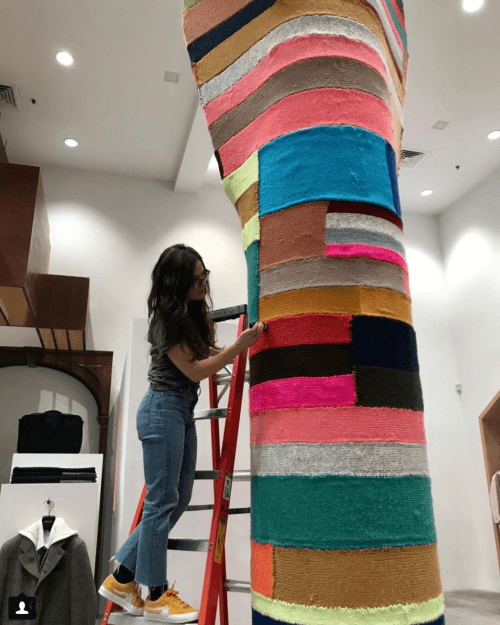
“Sayeg: Dover Street Market! I’m in a department store. I believe so strongly in this piece. I have so much gratitude and love for this store. I have a permanent installation here and over time, it just needs a little bit of love. We need to defuzz it and that’s what we’re doing here today.

“Graves: Do you miss anything about the South [after moving from Texas to New York]?

“Sayeg: I think we have a southern hospitality that is hard to explain unless you are southern. … I miss the accents. Texmex is something I totally miss and I will never get the same here. … And, the word y’all. Y’all means ‘all,’ and I’ve always defended that. …

“Graves: Any advice or quotes? …

“Sayeg: You can come from dark places and you can come out shining. I could live the rest of my life complaining. Now, I’m a globally recognized artist. My mother still comes from the belief that women are here for men. She doesn’t care that my TED Talk has had over a million views … she cares that I’m not married. My want is to let women know that nothing is insurmountable. You can get to the other side alive and well and be proud of yourself.” More here.

On Instagram, the artist is @magdasayeg. And there are other great pictures at Sayeg’s website, here.

Photo: Ben Sayeg
Sayeg defuzzing her knitting installation in a New York department store.

magda-sayeg-dover-market

Read Full Post »

I haven’t shared photos for a while. Some of these are from my last sad visit to New York, others are closer to home.

The first one makes me think of how hopeful I was on September 24th, when I arrived in New York and stayed with my sister’s devoted friend. I learned that my sister was doing better than the day before although she was still in the hospital. She was talking again and saying she wanted to carry on with treatment. We allowed ourselves a flutter of hope.

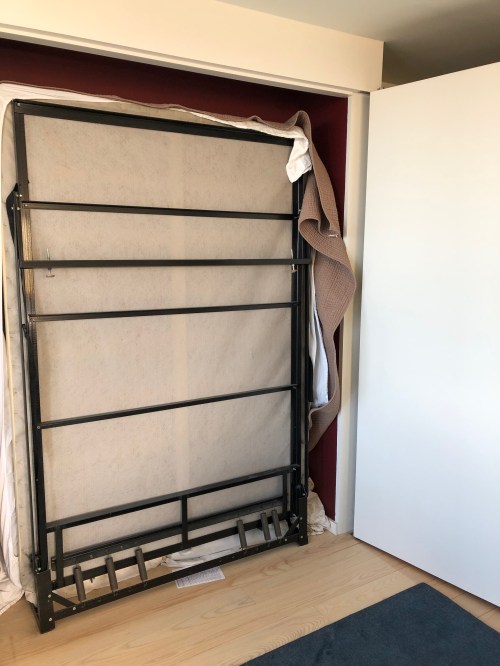
The bed is a Murphy Bed, made famous in old, silent movies, where someone like Charlie Chaplin might accidentally get closed up in it. This one was comfortable and not at all recalcitrant.

My hosts’ balcony had a glorious view. I sat there and had a cup of tea. I also took an early walk around their neighborhood, which features a statue of the Dutch director-general of the colony of New Netherland (now New York), “Peg Leg” Peter Stuyvesant. I couldn’t help wondering what the descendants of the Lenape natives thought of the statue.

Alas, the next day my sister took a dramatic turn for the worse and died the day after that. Miraculously, our brothers arrived in time from Wisconsin and California.

On days that followed, my sister’s husband, her friend, Suzanne, and I wandered around the city trying to enjoy nature and art and focus on good memories.

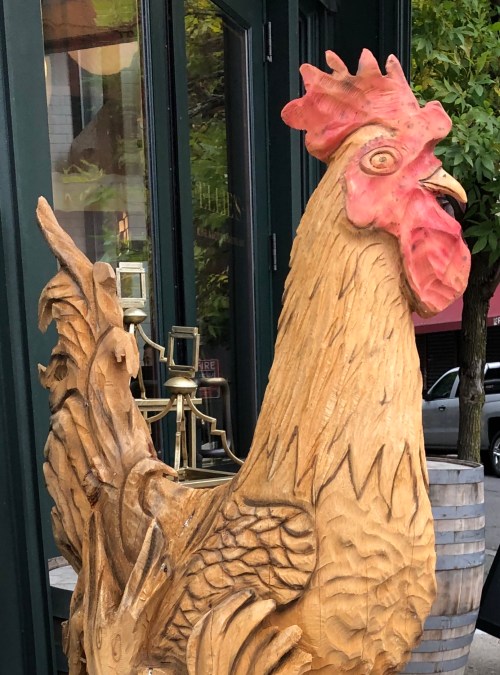
Then I took a bus back to Rhode Island, where I had left my car in a hurry. The rooster is in Rhode Island.

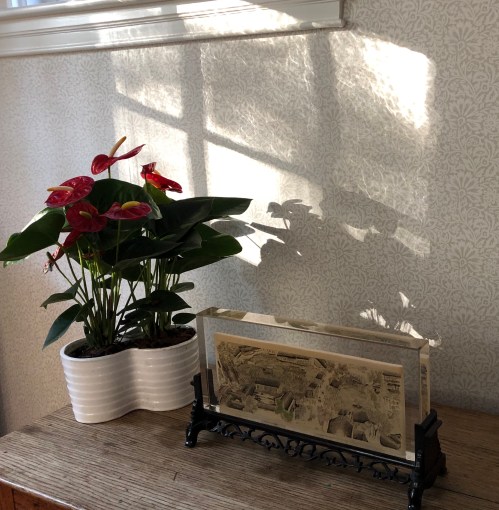
The concluding set of photos embraces art and nature back home in Massachusetts, where a long-life sympathy plant from my niece and nephew holds pride of place in the living room.

092519-Murphy-bed-at-Nancy's

092519-morning-shadows-NYC

092519-Peter-Stuyvesant

092619-vine-on-tree-NYC

092719-Met-Museum-NYC

092719-three-bears-NYC

092819-Peter-Pan-bus

100819-Ellie-rooster-Providence

093019-painting-the-church

100119-blue-painting

100119-window-box-at-jeweler

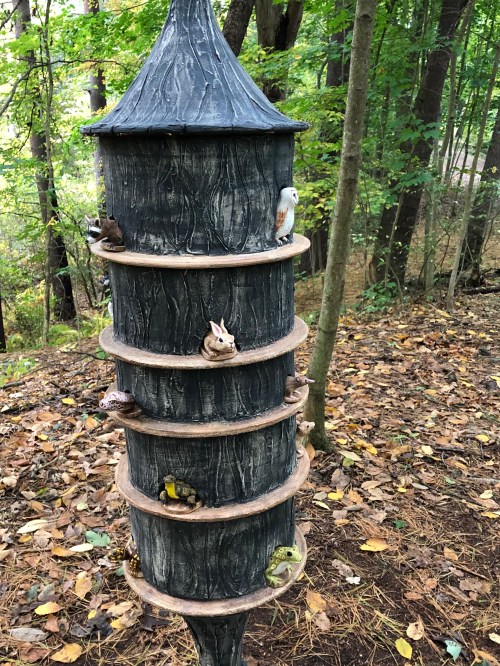
100919-sit-here-town-forest-art

100919-some-endangered-some-not-1

100919-some-endangered-some-not-2

100919-Hapgood-Wright-Forest-pond-2

100919-Hapgood-Wright-Forest-pond

100619-sympathy-plant-from-niece-and-nephew


Read Full Post »

« Newer Posts - Older Posts »