Feeds:
Posts
Comments

Posts Tagged ‘artist’

Art: Thomas Hart Benton
One of my favorites: Spring on the Missouri, 1945, oil and tempera on Masonite panel. On loan to the PEM from the North Carolina Museum of Art.


When I was moonlighting as a theater reviewer, I always liked to “sleep on it” before writing anything, just in case my unconscious had anything useful to add.

Well, I slept on the big Thomas Hart Benton exhibition I saw yesterday, and sleep confirmed that certain lesser-known aspects of his work are troubling. I still adore the wavy energy of his landscapes, people, horses, trains, clouds, smoke, even fence posts. I still love the way Benton honors ordinary people and ordinary jobs and the way his paintings comment on social injustice.

But I really did not like the gruesome murals of invading armies that Benton created to jolt overly complacent Americans after Pearl Harbor. There was something cheap about them.

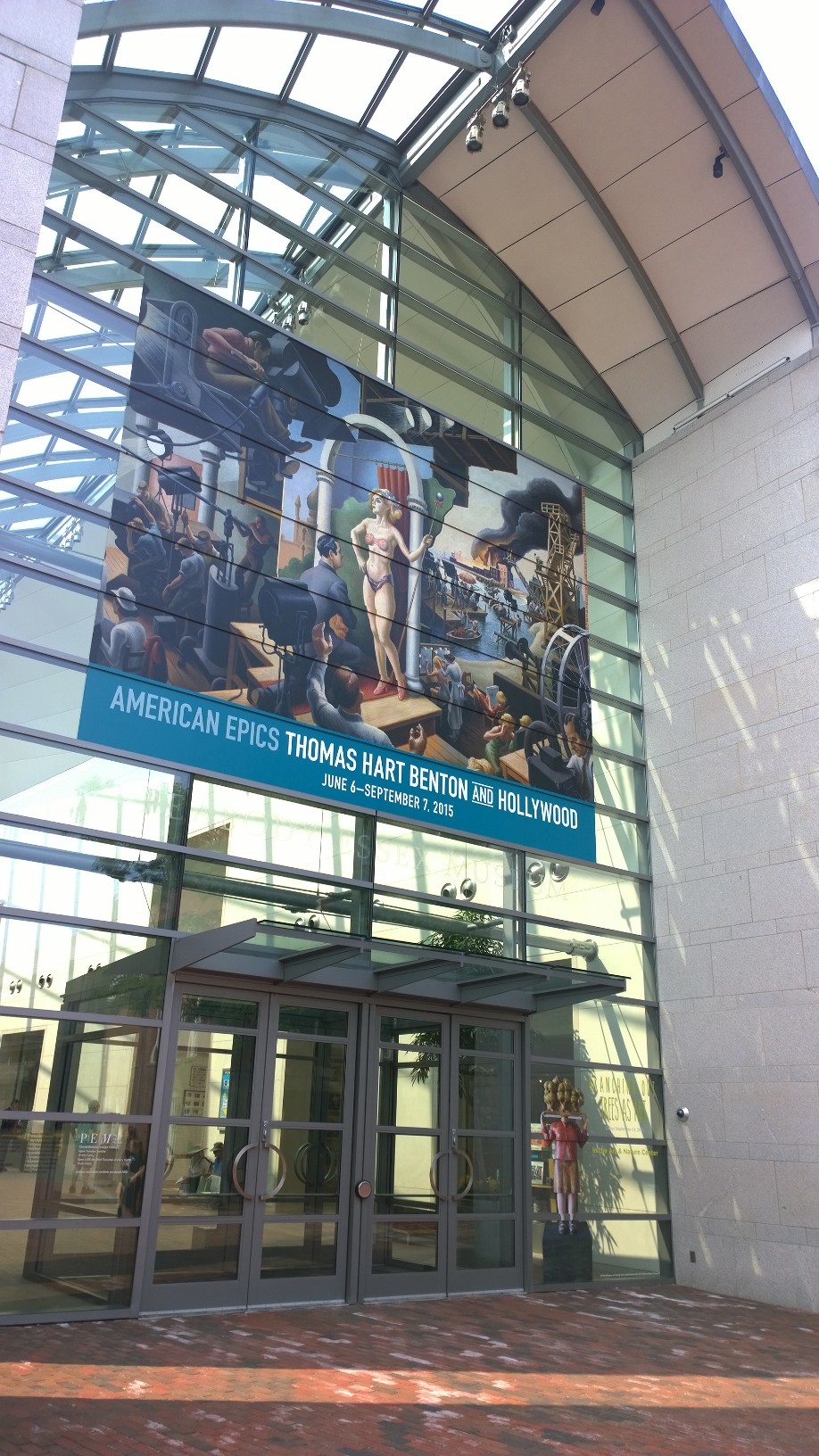
Of course, there was a lot more than that to the exhibition “American Epics: Thomas Hart Benton and Hollywood,” a sweeping retrospective of most of the artist’s work: murals showing Indians or slaves being mistreated, paintings of the the vibrant life of the West and Midwest, detailed depictions of the inner workings of Hollywood sets, designs for the Henry Fonda version of The Grapes of Wrath, illustrations for an edition of Huckleberry Finn, posters touting the contributions of African Americans to the war effort.

The day before, I had been hearing about Irving Berlin’s dedication to the war effort, and I think these two different artists conveyed, more viscerally than I had previously experienced, the underlying fear prevalent at that time. Since I grew up after it was all over, I probably unconsciously assumed that everyone always knew the Allies would win.

Do go to the show at the Peabody Essex Museum in Salem. You have until September 7. An enormous array of Benton’s work has been gathered from near and far — and there are some intriguing movie clips. (I was moved by a character’s tears to put The Grapes of Wrath on my Netflix list.)

Details of the exhibition here, at the PEM website.

071215-Thos-Hart-Benton-show

071215-Thos-Hart-Benton-at-PEM

Read Full Post »

Kate Colby (for whose offer of a room to Suzanne and Erik when they were house hunting there can never be enough gratitude) is a poet.

She came to the rescue when Suzanne was starting Luna & Stella and was having trouble finding a writer to capture the more ethereal qualities of the birthstones.

“What you need,” I said, “is a poet.”

“I know a poet!” she cried. She remembered Kate used to write copy for a catalog.

Beyond such marketing endeavors, Kate publishes poetry, choreographs offbeat theater, and co-leads art/poetry walks. An example of the latter will occur soon.

As Eryn Carlson writes at the Boston Globe, Kate is collaborating with artist Todd Shalom to offer “Duly Noted,” a participatory walk incorporating techniques from poetry, sound, and performance, at deCordova Sculpture Park and Museum in Lincoln, Massachusetts, July 18, at 2 p.m. and 5 p.m.

Carlson comments, “Shalom and Colby know that the very nature of tours makes it easy to overlook the ways in which artworks and their settings inform one another. … The pair created the collaborative walk ‘Duly Noted,’ a poetic exchange between participants and the Lincoln museum’s site and surroundings.

“ ‘Reading the art is apt because it’s so framed by woods and walls and water, and all this history,’ said Colby, who grew up in Wayland and lives in Providence. …

“ ‘It’s all about reframing the site,’ said Shalom, a Brooklyn, N.Y.-based artist who founded Elastic City.”

At a performance in May, “participants evolved from visitors to artists and performers. Individuals gave one-word soliloquies atop a stump, announcing their visual discoveries, and, guided by a partner, wandered the grounds with eyes closed to pay special attention to the surrounding cacophony. …

“Shalom and Colby, who met while working on their master’s degrees in fine arts at California College of the Arts, planned ‘Duly Noted’ meticulously over the course of a year, visiting the deCordova several times to perfect the route, pacing, and segues. But a degree of uncertainty and room for spontaneity remained.”

This could be a fun activity on July 18 if you live in the area. The grounds of the museum offer breathtaking views and sculptures everywhere you turn. Add to that a participatory happening like this, and you have the ingredients for a memorable day.

Read more here.

Photo: Barry Chin/Globe staff
Visitors at the deCordova Sculpture Park and Museum on a participatory walk titled “Duly Noted.’’

Read Full Post »

Teny Gross tweeted this nice story from the Brown University alumni magazine.

Courtney Coelho wrote, “On a snowy December evening, lights were visible through the second-floor windows of List Art Center as the visual arts department’s Critique Intensive held its last session. Mixed with the students in the large studio space were four working artists—Elise Ansel ’84, Chitra Ganesh ’96, Keith Mayerson ’88, and Rob Reynolds ’90—who’d spent sixteen weeks with the class, teaching, critiquing, and discussing art.

“The class was the brainchild of Chair of Visual Art Wendy Edwards, who hopes it will serve as a model for future classes. ‘Alumni bring a generosity to their approach to the Brown students,’ Edwards said. ‘They love coming back here, they love giving, and they’re very professional and committed to helping our students.’ ” More here.

Speaking of art education in Providence, RISD just got a new president, an artisan herself. Meredith Goldstein at the Boston Globe writes, “The Rhode Island School of Design has chosen its 17th president. Rosanne Somerson takes the title effective immediately, the Board of Trustees announced [in February]. Somerson, a RISD grad and furniture designer, has been serving as the school’s interim president since January 2014. The board says it chose to keep Somerson in the job after a nine-month international search.”

The Globe article is here. Disegno magazine has an interview with Somerson, here.

Photo: Mike Cohea
Rose Congdon ’15, left, and her classmates critique work created for the visual art department’s Critique Intensive, a class taught by four alumni artists last semester. 

Read Full Post »

Looking for an affordable venue for your chamber music group, your living-room theatrical production, your poetry group’s public readings? Need a performance space with a cat to give your book promotion that certain je ne sais quoi?

Nidhi Subbaraman has a nice piece at the Boston Globe‘s betaboston site on a tool that can help you find the perfect space.

“Gregorian Oriental Rugs opens at 10 a.m. every weekday, and with wood floors and high ceilings, this converted paper mill in Newton is an airy showroom for antique Turkish flat-weaves, Ikats from India, and countless other intricate, handmade imports from the Far East and Middle East. Some evenings, however, the expensive carpets and rugs are folded, stacked, and put aside, and the store is transformed into an intimate performance venue for local artists. …

“Most people hear about this unusual event space from friends. But to reach community art groups, Gregorian recently listed his venue on SpaceFinder Mass, a kind of Airbnb for the performance world that came to Massachusetts in January. The service connects artists hunting for budget performance or rehearsal space with unusual, informal, and affordable venues.

“ ‘We talk about SpaceFinder being a discovery tool,’ said Lisa Niedermeyer, its program director. Venues can share their calendar for availability, and artists can search by square footage, rates, and timing. The website also handles payments for the bookings.

“Started in New York three years ago, SpaceFinder was developed by Fractured Atlas, a nonprofit group that supports artists. SpaceFinder lists more than 6,600 spaces in 11 cities in the United States, plus Toronto, where you can rent a pirate ship. In Philadelphia, artists can rent a mosaic sculpture garden. …

“SpaceFinder was launched in Massachusetts in partnership with the Arts and Business Council of Boston, and more than 200 venues in the state are listed, most of which are themselves in the arts business — small museums and theaters, for example, dance studios and art galleries.

“In addition to Gregorian, other outliers include a fitness club in Dorchester and a winery in Southampton. …

“To connect with active art communities in far-flung corners of the state, Fractured Atlas reached out to Seth Lepore, an independent artist in Easthampton, to spread the word about the service among artists and to enlist venues.

“ ‘Space is a huge issue here in Western Massachusetts,’ said Lepore, who helped connect SpaceFinder with local studios.” More here.

Photo: Jessica Renaldi/Globe staff
Gregorian Oriental Rugs on a regular work day.

Read Full Post »

I do like stories about people who love their work so much that they never want to stop.

Perhaps it helps to have a talent like muralist Eric Bransby, who got to study with one of my favorite artists, Thomas Hart Benton. (Suzanne says I have a personal aesthetic, which is a polite way of saying I’m crazy about anything wavy, like Benton’s energetic American landscapes.)

Chloe Veltman writes at National Public Radio, “Eric Bransby is one of the last living links to the great age of American mural painting. He studied with one of this country’s most famous muralists — Thomas Hart Benton — and went on to create his own murals in prominent buildings across the west. The artist is now 98 and still painting.

“At his Colorado Springs studio, Bransby attacks a drawing with tight, sharp strokes, a pastel pencil grasped between gnarled fingers. His studio is unheated, but he doesn’t seem to notice the cold. He’s completely engrossed in the image taking shape on his easel. It’s a study for a new mural that he hopes to install at nearby Colorado College. He says he draws between two and eight hours every day.

” ‘Drawing has been a continuous thing for me, like exercises for a musician,’ he says. ‘It’s refreshing. I draw better. I paint better.’ …

“His parents didn’t encourage his artistic pursuits. It was during the Depression, and when he demanded that he get sent to art school, he remembers his parents said: ‘Well, he’ll do one year and he’ll come back so discouraged that we’ll make something else out of him.’

” ‘But that didn’t happen,’ Bransby says. ‘I found heaven.’ ” Read more here.

Photo: Nathaniel Minor/Colorado Public Radio
Eric Bransby, pictured above in his home in Colorado Springs, is still creating art at 98. “I try to make each mural a project that will somehow expand my abilities a little bit more,” he says.

Read Full Post »

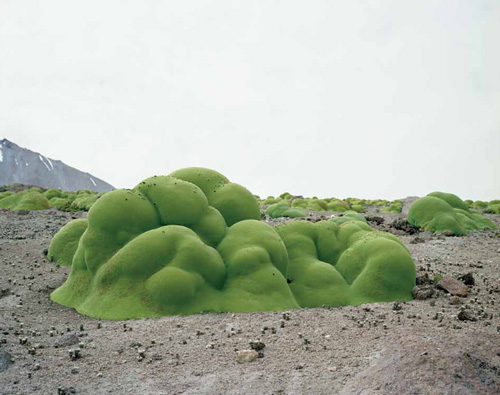
Ever hear of a living thing that has been growing for 3,000 years? Check the picture below. Or how about a 13,000-year-old eucalyptus tree?

At Brain Pickings. Maria Popova writes, “For nearly a decade, Brooklyn-based artist, photographer, and Guggenheim Fellow Rachel Sussman has been traveling the globe to discover and document its oldest organisms — living things over 2,000 years of age.

“Her breathtaking photographs and illuminating essays are now collected in The Oldest Living Things in the World … beautiful and powerful work at the intersection of fine art, science, and philosophy, spanning seven continents and exploring issues of deep time, permanence and impermanence, and the interconnectedness of life.”

Sussman tells Popova in an interview, “I’ve always considered myself an environmentalist, for whatever that term means, and it’s something that I think, as an artist, was an interesting thing — because for a long time, I don’t think it was particularly acceptable in the fine art world to be doing work about nature. …

“The problem of climate change is so pressing and actually is something of a moral imperative for us all, and I think artists do a tremendous job of engaging the public on different levels … . That’s one of the beauties of being able, as a creative person, to create the parameters of what you want to talk about. The science and the climate science are a very important component of the overall project. …

“The question has been this idea of making portraits of these organisms and thinking of them as individuals. I think one of the most important things to do when dealing with climate science and climate change is to create a personal connection, and to create some relationship. That was my way of trying to forge a relationship to these organisms.” More here.

Llareta, 3,000 years old, Atacam desert, Chile

Read Full Post »

I was all set to blog about Providence PuttPutt, an artist-inspired, Kickstarter-supported pop-up entertainment for kids when I found out it was scheduled to last only for the summer and has just closed. Sigh.

So, sticking to a small-pleasures, quality-of-life theme, we turn once more to Denmark, where biking made a big jump in one year.

 at StreetsBlog Network writes, “For years the bike commuting rate has remained roughly steady at just over a third of trips. Then last year the city’s bike commute mode share increased from 36 percent to 41 percent. Meanwhile, driving declined 3 percent as a share of commuting trips.

“The unexpected increase had a lot of people baffled. But Mikael Colville-Andersen at Copenhagenize thinks he knows what happened …

What has happened is that 17 huge construction sites fell out of the sky all at once. Not something that happens every day. In addition, most of central Copenhagen — between 2012 and 2013 — was under further construction because of the upgrading of district heating pipes under many streets that had to be ripped up. …

Driving was rendered incredibly difficult. Copenhageners, being rational homo sapiens, chose other transport forms. Public transport has increased, too, but the bicycle is clearly the chariot of choice. It’s no surprise at all why cycling is booming.

“There you have it,” Schmitt adds. “If you want to improve cycling in your city, make it an awesome place to bike, sure, but don’t forget make it a terrible place to drive. ”

More here.

Photo: Mikael Colville-Andersen 
Biking in Copenhagen

Read Full Post »

Years ago, when I was expecting, I learned the baby would be a girl. My husband and I went right out and bought a beautiful dollhouse built by a teenage boy we read about in the local paper.

Recently, Nancy Shohet West wrote in the Boston Globe about a new dollhouse show. My husband said, “If you go, see if you can find someone who can repair dollhouses.” (Suzanne’s needs a face lift.)

But we didn’t read the article carefully. The show featured art works from artists contemplating the resonance of “dollhouse.”

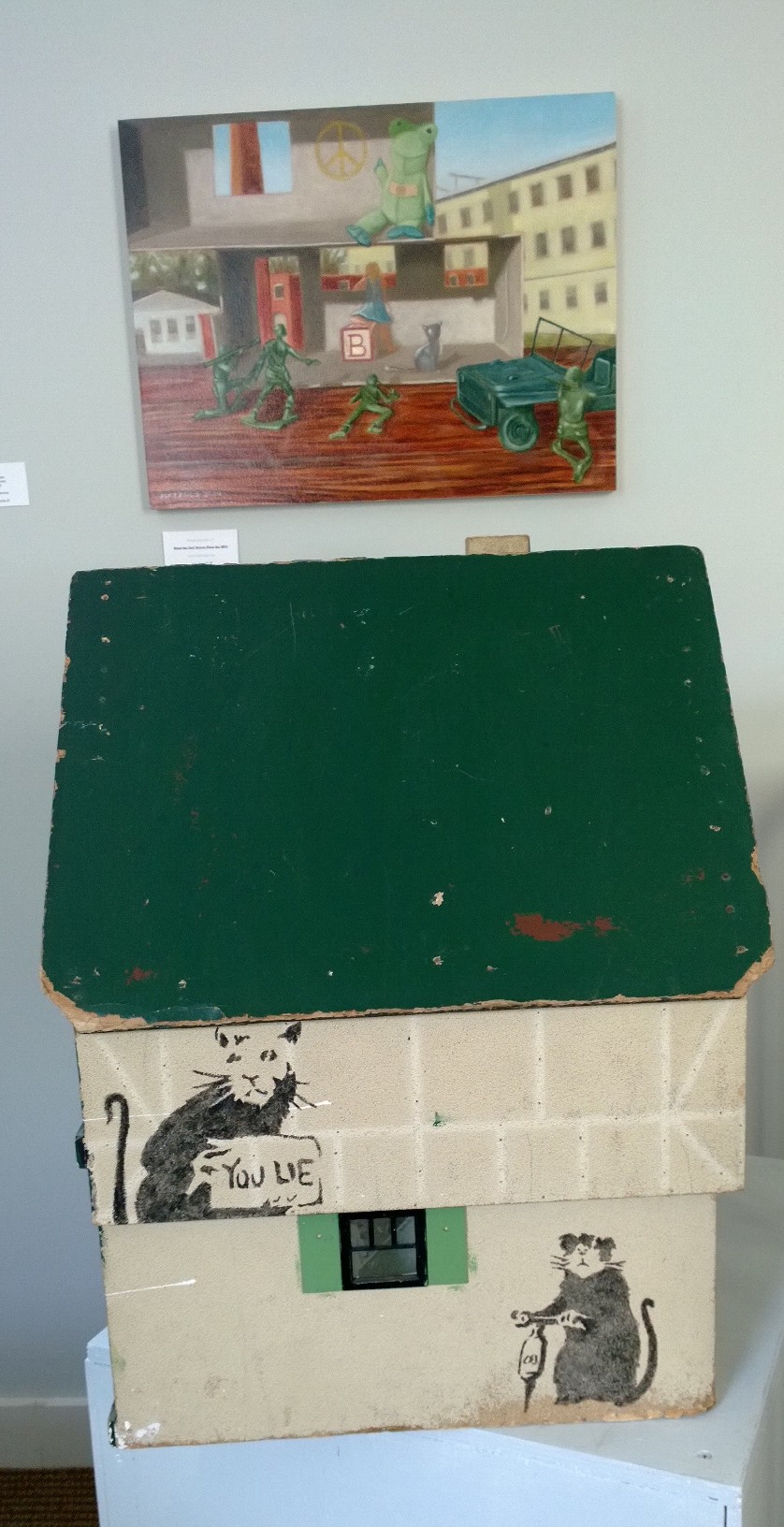
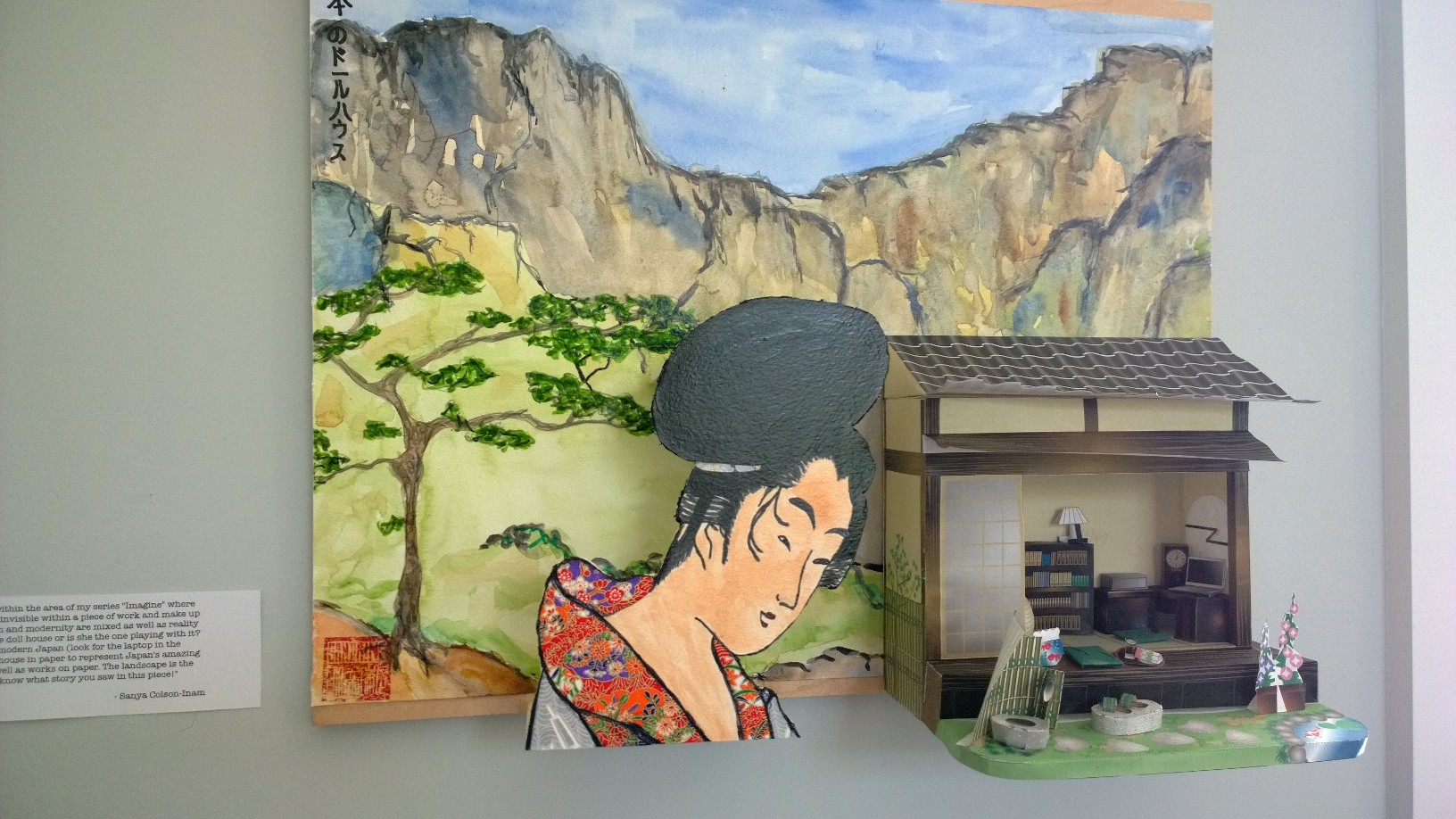
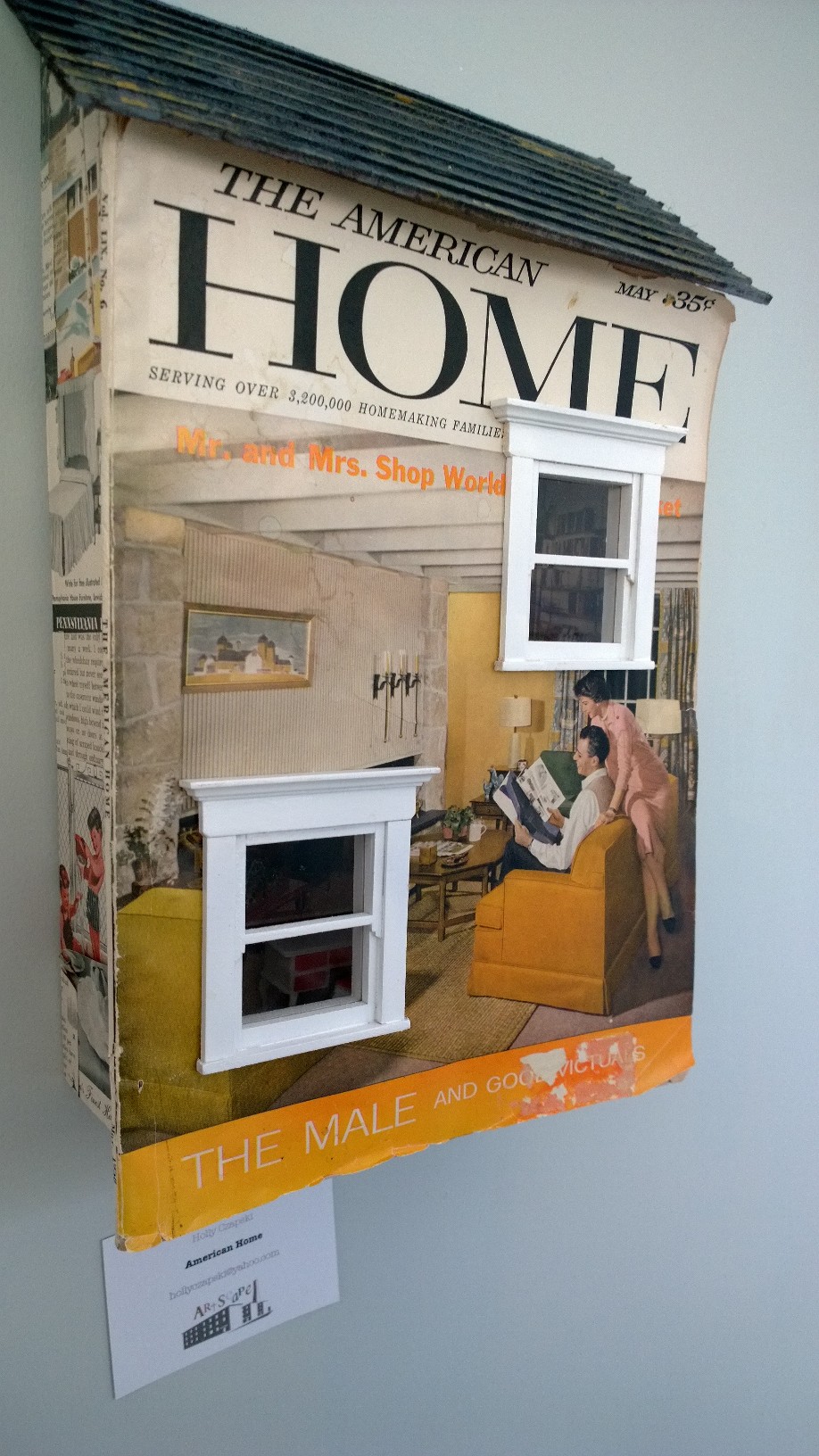
Note the foreclosed house with a Banksy on an exterior wall (above it, the only entry by a male artist, with tiny soldiers), the Japanese-inspired house, and the 1950s domestic fantasy house, below. It was a fine show, but I didn’t find anyone to repair Suzanne’s dollhouse.

The exhibit was in a renovated warehouse where artists have studios and where there also is shared space for entrepreneurs. The business space is called the Wheelhouse, and it features a common area for eating and relaxing, small offices with names on glass doors, small conference rooms — and lots of art.

I was surprised. The last time my husband and I were in that building we were taking a stretch class with a classmate of Suzanne’s, and the Bradford Mill was so rickety one expected the staircase to collapse at any moment. Times change.

The dollhouse show is up until August 28. Read more about it here.

dollhouse-with-a-Banksy


Japanese-dollhouse


1950s-domestic-fantasy

Read Full Post »

Funny how things work out.

If Suzanne hadn’t spoken to a woman speaking Swedish to her little girl after toddler music class, I probably would never have known about the Australian mining community Tom Price and the Chinese opera written about it by the Swedish woman’s American husband. But there you are.

Ben Collins, Vanessa Mills, and Hilary Smale put together a story about the opera for ABC Australia.

“It’s a contender for the most unlikely arts even of all time,” they write, “the story of a small North West Australian iron ore mining town told in Chinese operatic style.

“It’s the attention grabbing work of an American artist called Daniel Peltz, who says he aims to provoke ruptures in the socio/cultural fabric through which new ways of being may emerge. In this case that means Chinese opera in a remote Australian mining town.

” ‘I look at Chinese opera as something that’s embedded in the landscape of China, just as iron ore is embedded in the Western Australian landscape. And I think of the gesture of the piece as a way of extracting this resource from China, digging it up and bringing it to Tom Price to tell a story of the town,’ Mr Peltz says. …

“The opera follows the story of Thomas Moore Price, who is said to have died at his desk just before the deal was completed that led to the mine which the town serves.

” ‘I did find an out-of-print book on Tom Price that was produced by Kaiser Steel which confirmed that component of the narrative. But my aim is not to write historically accurate narrative, it’s actually quite the opposite… I’m really looking at extracting elements of the story of this place and sending them to China to be transformed into this opera,’ Mr Peltz says.

“In the opera, Thomas Moore Price’s only daughter, Shirley, has an encounter with the ghost of her father at the summit of Mt Nameless. A 30 minute film of the opera being performed in China will be presented at the Tom Price Community Centre.

” ‘I’ve done a lot of work to make sure that it’s well subtitled so that people can access the narrative,’ says Mr Peltz.”

Wish I had known all this when Dan and his wife (the artist Sissi Westerberg) brought their daughter to my grandson’s two-year-old birthday party a few weeks ago.

The missed opportunities of life!

Read more here and listen to a clip of the traditional-style Chinese opera.

Read Full Post »

Remember this post on rhubarb batteries? Well, according to radio show Studio 360, there’s no need to draw the line at rhubarb. Especially if you are creative, like photographer and artist Caleb Charland.

Julia Lowrie Henderson writes. “His series Back to Light is inspired by that old science class experiment: if you stick a galvanized nail in one end of a potato and a copper wire in the other, it will become a battery. Charland generates enough electricity from the fruit to power the lights that illuminate his shots. He uses long exposures to take these photographs, but nothing is added digitally to the images.

” ‘My practice as an artist combines a scientific curiosity with a constructive approach to making pictures,’ Charland says. ‘I utilize everyday objects and fundamental forces to illustrate experiences of wonder.’ ”

From the Artist’s Statement on his website: “The way we understand the world relies so much on our ability to measure it. Given that many measurements are based on the proportions of the human body it’s clear we measure stuff to find our place amongst it all and to connect with it in some way.

“By exploring the world at hand, from the basement to the backyard, I have found a resonance in things. An energy vibrates in that space between our perceptions of the world and the potential the mind senses for our interventions within the world. …

“For me, wonder is a state of mind somewhere between knowledge and uncertainty. It is the basis of my practice and results in images that are simultaneously familiar yet strange. Each piece begins as a question of visual possibilities and develops in tandem with the natural laws of the world.”

More here. Click through the pictures. To my mind, citrus makes especially appealing batteries.

Photo:  Caleb Charland
Orange Battery, 2012

Read Full Post »

Zachary Sampson has a nice article at the Globe today. It’s about a project in Boston enlisting passersby to help create a mural.

The mural “was created by artist Ernest McKinley English. He joined with ArtLifting — a Boston organization that works with homeless and disabled artists — to organize the project, which he said was meant to foster collaboration. …

“Liz Powers, cofounder of ArtLifting, said English’s vision dovetails with her organization’s purpose. ‘Both Ernest and ArtLifting have the mission of bringing people together through art, building community through art,’ she said.”

The mural “held a hidden message that would be revealed upon completion. …

“The part-in-a-whole ethic resonated with many of the artists who worked on the piece, both amateur and professional.

“ ‘I think the greatest message,’ [artist Randy] Nicholson said, ‘is as a community, we can accomplish what we can’t as individuals.’ ” More here.

Years ago, Suzanne and John helped paint a beautiful mural about our town for the commuter rail station. Their names were included in the credits and we always felt proud reading them when we passed by.

Photo: Michele McDonald for the Boston Globe
Sisters work on paint-by-numbers mural outside the Prudential Center.

Read Full Post »

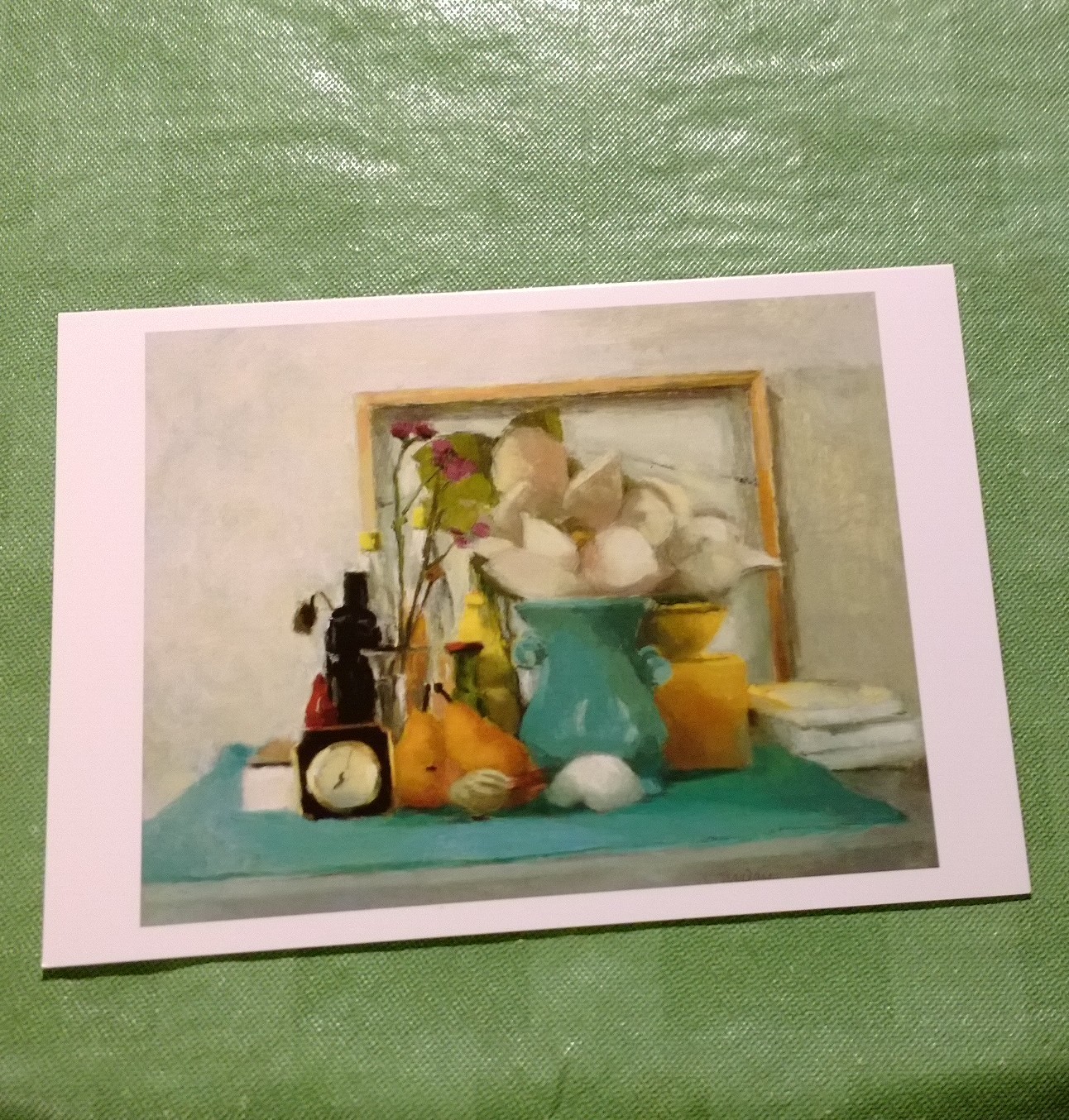
Fyfe-Day-repertoire-with-frame-cardGreeting card of Meredith Fyfe Day’s “Repertoire with Frame.”

Back in the early 1990s, I worked for Meredith Fyfe Day at Harte-Hanks newspapers, where we whipped into shape tottering stacks of press releases of wildly varying literacy.

That was Meredith’s day job. She was also a working artist. My husband and I have long enjoyed her shows, several of which were at the Whistler House Museum of Art in Lowell when Meredith was the artist in residence.

Recently a friend of hers tagged her on Facebook, which was how I learned that the Lowell Sun wrote an article on her latest artistic venture.

Reporter Debbie Hovanasian writes at the Sun, that Meredith “was recently awarded a grant from the Parker Foundation. The result is ‘Making Art with Artists,’ and Fife Day, who teaches painting at Middlesex Community College, couldn’t be more thrilled.

“During her prior experience teaching art to young students,’I could see the kids blossoming, even the tough kids who said they didn’t like art. I would encourage them and it would light a spark. They’d come back with such enthusiasm, and I fell in love with seeing that change in children,’ she said.

” ‘Making Art with Artists’ is a seven-week summer program offered on Tuesdays and Thursdays at no cost at Christ Church United on East Merrimack Street [Lowell, MA] …  with emphasis on fourth- to eighth-graders, she said.

“The program facilitates the teaching of art to under-resourced and under-served children, Fife Day said. The four teachers are experienced, working artists who will make a presentation of their own work to the students in two successive classes. …

“One of the program’s goals is for the children to adapt the techniques of the artists in order to make their own artwork as well as collaborative artwork, using their own and combined imaginations, Fife Day explained. It also aims to give children a positive alternative to high-risk behavior by giving them high quality educational opportunities …

“Fife Day is currently seeking community donors — food or funds — for a lunch program, which she plans to offer free of charge to the budding artists, a cost not covered within the grant.

“The day is structured so that the students work on individual projects in the morning and group projects in the afternoon. There’s also yoga after lunch and free time early morning and late afternoon, during which Fife Day is exploring having musicians and other volunteers willing to donate their time to entertain or supervise the children.

” ‘It’s about giving the children hope and letting them have fun believing in themselves, knowing that the next day can be as much fun as this one,’ she said.” More here.

Photo: Lowell Sun
Art by Meredith Fyfe Day

Read Full Post »

Some posts at Andrew Sullivan I only need to glance at briefly and bells go off: for example, this entry about an artist who works with coral.

Andrew quotes Amelia Urry writing about Courtney Mattison, who became enamored of coral while studying conservation biology at Brown University and moonlighting at the Rhode Island School of Design.

“Mattison’s newest piece, Our Changing Seas III,” says Urry at Grist, “depicts a hurricane-spiral of bleached corals coalescing to a bright center. You can read it as a message of hope or one of impending doom, depending on your disposition …

At the heart of Mattison’s artwork is her desire to inspire real-life changes in how people view and treat the world’s oceans and environments. Similar to the Our Changing Seas series, Courtney Mattison’s Hope Spots collection comprises 18 vignettes, each of which represents a vital marine ecosystem in its ideal form (that is, protected from various threats such as global warming or pollution).” Read more at Grist, here.

Art: Courtney Mattison
“Our Changing Seas III,” a ceramic coral reef

Read Full Post »

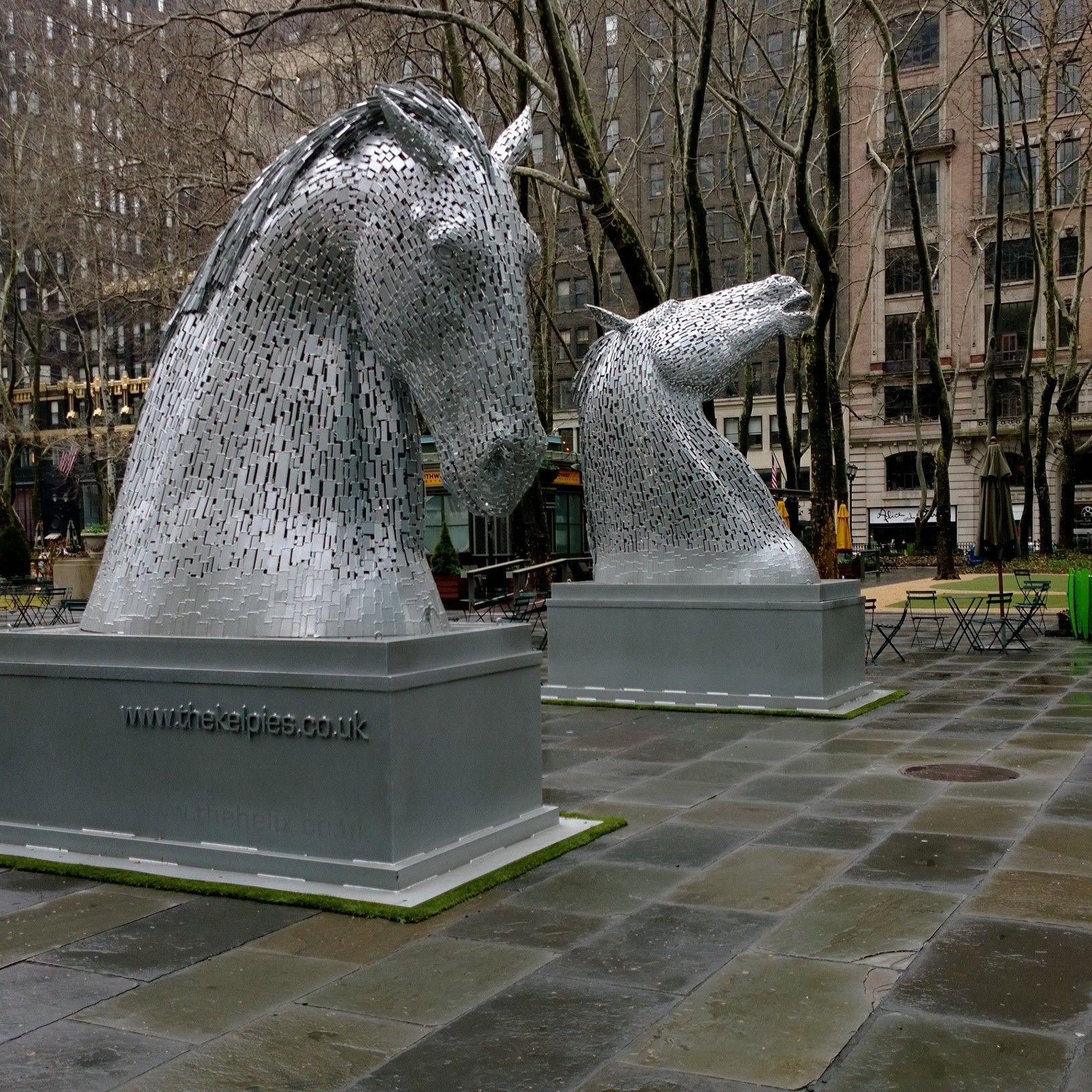
The last tidbit from my recent New York City trip is about the Kelpies on loan in Bryant Park, near the New York Public Library.

Kelpies are water spirits of Scottish folklore, typically taking the form of a horse. Artist Andy Scott was inspired by the legends to create giant ones for Helix Park in Falkirk, Scotland.

The ones in New York are smaller maquettes but still pretty huge.

The artist writes that he came up with an idea eight years ago about “mystical water-borne equine creatures. …

“Since then it has evolved dramatically and in the process the ethos and function has shifted from the original concept. Falkirk was my father’s home town and that inherited link to the town has been one of my driving inspirations. A sense of deep personal legacy has informed my thinking from the outset …

“The mythological associations behind the original brief have been absorbed by other sources of inspiration in the creative processes, and the ancient ethereal water spirits have been forged into engineered monuments. The Kelpies are modeled on heavy horses (two Clydesdales of Glasgow City Council actually served as models in the process), and it is this theme of working horses which captured my imagination and drove the project.”

The website adds that the Kelpies in New York City “were installed by Andy and his colleague Simon Chambers, with the assistance of the American Scottish Foundation, the Bryant Park Corporation, Mariano Brothers freight & cranes, Synlawn matting and the New York City Department of Parks & Recreation. Thanks to Creative Scotland for their funding assistance towards the costs of the transport and install.”

You really have to check out Scott’s website. The full-size sculptures are unbelievable. Click here.

Kelpies-Bryant-Park

Read Full Post »

Something fun from Studio 360: the mystery of the Toynbee tiles.

“For more than two decades, an unknown artist has been leaving a message in the streets of Philadelphia. The message is has been cut by hand into a linoleum tile, and pressed into the asphalt by the weight of passing cars. There are dozens of these around the city; old ones wear away, and new ones appear. The message is the same:

TOYNBEE IDEA
IN Kubrick’s 2001
RESURRECT DEAD
ON PLANET JUPITER

“The Toynbee tiles, as they’re called, have become a thing in Philly — you can even buy a t-shirt (the tiler isn’t getting royalties). For artists, the cryptic message inspires far-out forms of creativity, but perhaps nothing as ambitious as the ten-minute work by the rapper and ‘bedroom composer’ Raj Haldar, who performs as Lushlife.

“The work is in four parts, one for each line of the tiles’ message. By the end, the ‘Toynbee Suite’ has left behind anything resembling hip-hop, going out on a two-minute clarinet solo.

“But what exactly is the Toynbee message? Alfred Toynbee was a historian and philosopher of the 20th century, known for the 12-volume A Study of History. …

“A documentary film speculated that the tiler remained unseen by dropping the tiles from a car with cut-out floorboards.”

More on the mystery here, where you also can listen to the rapper’s tile-inspired music and check out a map showing where Toynbee tiles are located around Philadelphia.

Photo: Kimberly Blessing/flickr
A Toynbee Tile at 9th and Market Streets in Philadelphia, Pa.

Read Full Post »

« Newer Posts - Older Posts »