Feeds:
Posts
Comments

Posts Tagged ‘artist’

Facebook can be annoying, but I guess it does sometimes pay to be on it.

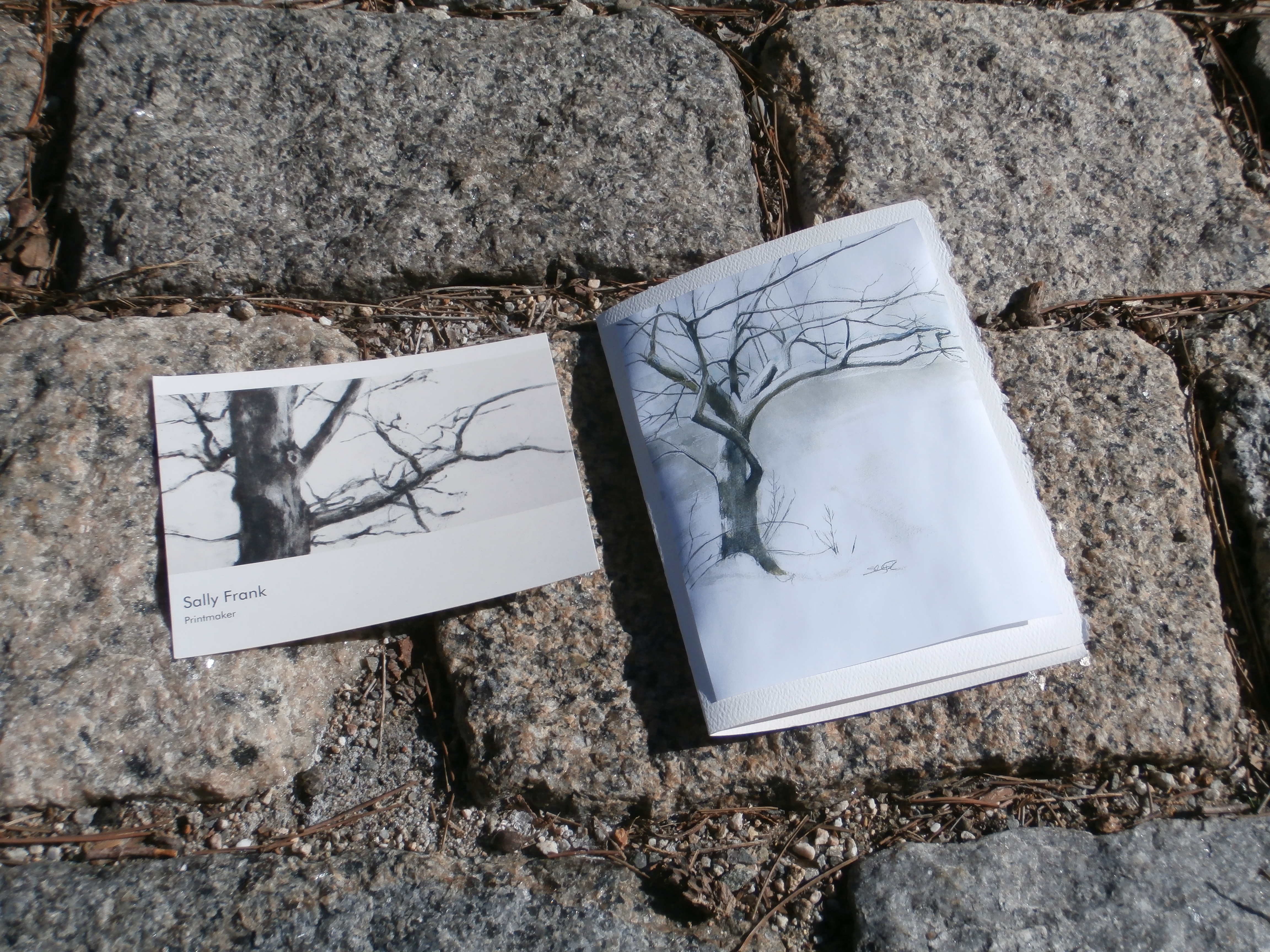
After “liking” a number of my cousin Sally Frank’s nature photos and art over the years, I finally figured out via Facebook that much of her work is on a WordPress blog — and she has had the blog longer than I have had this one.

Trees are a specialty. Often she will start with a photograph like the one below for inspiration. She then turns to printmaking, which you can learn about at her blog.

“Ms. Frank uses centuries-old printmaking techniques like etching and aquatint on copper plates, as well as innovative methods like solarplate intaglio. She says that although her work is grounded in drawing, she finds the unpredictable nature of printmaking inspirational and exciting.” More.

This photo reminds me of the strangler fig that I saw years ago in Costa Rica, a tree that wraps itself around a host and literally loves it to death. The host tree crumbles, and only the strangler is left — with an empty space inside.

Sally’s photo probably has a happier story — perhaps a nymph turned into a tree to escape danger.

Photo called “bound”: Sally Frank

Read Full Post »

Unless you are going to the Danforth Museum of Art, I do not recommend ever going to Framingham (traffic issues, strip mall issues).

But I am very glad I finally made it to the Danforth today because it is a lovely museum with a community outreach effort that I admire.

The exhibit I went to see was described in the Boston Globe by by Sebastian Smee.

“One of the things you notice first in ‘Eternal Presence,’ a terrific career survey of John Wilson at the Danforth Museum of Art, is how attentive Wilson is to the faces of children. From his earliest days sketching his brother to his most recent large-scale drawings in charcoal, the impulse has remained the same: It is an impulse toward clarity, toward truth. He doesn’t sentimentalize or caricature children. …

“What you notice later is the high number of pictures showing children in the arms of adult men and women. … Wilson is after something elemental and profound. But the resulting image is not just another mother and child, or dad with young kid. There is instead, each time, something tender and hard-won about what you are looking at. A hope, a promise, a lament all in one.

“Wilson, 90, is one of Boston’s most esteemed and accomplished artists. He was born in Roxbury, the son of parents from British Guiana (now the nation of Guyana), was admitted to the School of the Museum of Fine Arts in 1939 after developing a natural aptitude for art at the Roxbury Boys Club, where he attended classes taught by SMFA students.”

Smee goes on to describe Wilson’s long career, including a stint in France, his interest in the Mexican muralists, and his sculptures of Martin Luther King Jr. (one is in the Capitol rotunda).

Amazing that the artist is around and will be giving a talk at the museum. Try to go. The show is up until March 24. And you may enjoy as much as I did the African American sculptures by Meta Vaux Warrick Fuller from the permanent collection and the joyful Harlem watercolors of Richard Yarde.

More at the Globe.

Lithograph by John Wilson

Read Full Post »

Suzanne says I have an art esthetic. That makes me laugh.

My esthetic, as far as I can tell, is mostly a preference for painting that is wavy: Charles Burchfield, Virginia Lee Burton, Grant Wood, Marsden Hartley, Kate Knapp, Edvard Munch, Reginald Marsh.

A massive mural by one of my wavy favorites, Thomas Hart Benton, has recently been rescued from storage. Carol Vogel has the story in the NY Times.

“On New Year’s Day 1931, a new and radically different building opened amid the town houses of West 12th Street: Joseph Urban’s International-Style New School for Social Research, with one room in particular as a star attraction. Thomas Hart Benton, the American realist painter, had lined the third-floor boardroom with nine panels of what would be a 10-panel mural, ‘America Today,’ depicting a panoply of pre-Depression American types, from flappers to farmers, steel workers to stock market tycoons. Lloyd Goodrich, a prominent art historian, pronounced it a breakthrough that heralded a new approach to mural painting, ‘of actually taking reality and making mural art directly out of it.’

“Eight decades later, ‘America Today,’ now considered one of the most important and famous examples of American scene painting, is languishing in storage. That will change, however, because AXA Equitable, the insurance company that bought it nearly 30 years ago, has decided to donate it to the Metropolitan Museum of Art. …

“The only problem,” writes Vogel, “is that the museum is so squeezed for space that the mural’s first public appearance after the handover won’t be until at least 2015, when the Met takes over the Whitney Museum of American Art’s landmark Marcel Breuer building on Madison Avenue (after the Whitney’s move to the meatpacking district).” More.

Something to look forward to in 2015.

Photograph: The Metropolitan Museum of Art, New York

Read Full Post »

Every day, no matter what else is going on around the world, artists are thinking of new ways to express beauty.

Henry Grabar writes an Atlantic Cities “postcard” about two Belgian designers’ insight that plates lit from the inside could make something wonderful out of discards — while saving a tree from being cut down for Christmas.

The resulting “tree” of broken cups and plates glows ethereally and was selected for display in the town square of Hasselt, Belgium.

” ‘We decorated the tree with objects which would otherwise have remained invisible,’ MOOZ designers Inge Vanluyd and Stefan Vanbergen wrote in their DesignBoom submission.” Not just invisible, I would add, but thought to be useless.

More.

Photograph: MOOZ, via DesignBoom (an independent publication dedicated to architecture and design)

Read Full Post »

At first, Suzanne and Erik thought the chair backs attached to tree stumps on Blackstone Boulevard must have been the work of a conservancy-type organization. The boulevard’s broad, shaded medial strip for walkers, runners, and baby carriages is always well maintained and welcoming.

But it turns out that a “guerrilla good deed campaign” is behind the tree-stump art. Erin Swanson, of Providence’s East Side Monthly, tracked down a vigilante known as Johnny Chair Seed.

“Last summer,” Swanson writes, “a few friends were having themselves a little stroll down Power Street when they stumbled upon a broken chair, discarded on the sidewalk. A few footsteps further, they happened upon a tree stump. ‘It started as just a random idea. We figured someone got drunk and broke the chair,’ says the anonymous mastermind behind the array of stump chairs now scattered throughout the East Side. ‘I hear people have started calling me Johnny Chair Seed,’ he says with a devilish smile. ‘I kind of like it.’

“With the help of two friends (two of the ‘select few’ who know his true identity), Johnny has constructed a total of ten stump chairs including those on Hope, Rochambeau, Blackstone, Elmgrove and Larch, among others.” The full article is here.

Makes me want to do a stealth project again. It’s been too long. I have something in mind involving poetry. Stay tuned.

Photograph: East Side Monthly

Read Full Post »

She doesn’t do only trees, but she knows trees inside and out.

Katherine Pacchiana has a nice update in the Daily Voice, a newspaper in North Salem, New York.

Sally Frank was in the middle of the Maine woods as she talked, via cell phone, about her collection of tree art, now on display at the Ruth Keeler Library.

“ ‘Most of what I do is make prints,’ she explained. ‘Unfortunately, I have a day job, but I like to do monotypes which are spontaneous and don’t take a long period of time.’ Monotypes are a form of prints, dating back to the 17th century. Each is made individually.

“Frank has been drawing all her life and has trained in many places, including Simon’s Rock in Great Barrington, Mass., and Long Island University, where she earned a master’s in fine arts. At the age of 19, she was apprenticed to Tom Bostelle, the American painter and sculptor who was a colleague of Andrew Wyeth.

“ ‘I’ve always drawn trees and the natural landscape. I went from focusing on the architecture of a tree – its sturdy trunk and the strong presence it has on the landscape – to what is left when a tree dies away and leaves forms behind.

“ ‘I’m fascinated by the texture and light that trees create, the  patterns – a tree’s essence.’ ” Read more.

Today I happened to be in Great Barrington for a work conference on affordable housing in rural areas. It was my first visit since Sally’s parents’ wedding, which I remember as being in a Unitarian church. I was hoping to get a picture I could post, but I saw only St. Peter’s and the Congregational church.

The Red Lion Inn in Stockbridge looked vaguely familiar, and I wondered if that was where we were staying when my father, as best man, realized he’d forgotten the wedding ring and raced back to fetch it while Uncle Jim paced anxiously, muttering words I recall as, “He always does this”!

Read Full Post »

I liked Jacki Lyden’s story at National Public Radio about some unusual artists in the 1960s.

“If you traveled by way of Florida’s Route 1 in the 1960s, you might have encountered a young, African-American artist, selling a lushly painted oil landscape from his car. They weren’t allowed in galleries during Jim Crow segregation — but motels, office buildings and tourists would buy their vivid works.

“Together, they formed a loosely associated band around Fort Pierce, Fla., that came to be known as The Highwaymen. At $20 a painting, they made their way out of agricultural jobs like citrus-picking and defined the cultural look of an era.

“Their paintings departed from an earlier tradition of landscape painting in Fort Pierce. A.E. ‘Beanie’ Backus, considered the father of the landscape movement there, caught the clouds and savannahs and inlets that were falling to developers in the mid-century. He would teach many youngsters who came to his studio, including the teenage Alfred Hair, leader of The Highwaymen.

“These artists would take off in their own direction. But success has brought enduring tensions on their home turf, raising questions about art, race and cultural legacy. …

“The who’s who of The Highwaymen can be tricky. (A curator named Jim Fitch coined the name in the ’90s and it stuck.) Gary Monroe, author of The Highwaymen, Florida’s African-American Landscape Artists, counts 26 original painters — 18 of whom are still living. That’s how many were inducted into the Florida Artists Hall of Fame in 2004.”

Lots more.

Photograph: Gary Monroe
Alfred Hair (left) and Robert Lewis

Read Full Post »

Jim Dwyer writes lovely human-interest stories for the NY Times. On September 5, he wrote about a guy who plays music by the Hudson River for an audience of birds, fish, and whatever friends or strangers wander by.

On Tuesday morning, Jose Modesto Castillo, retired from a job in a plastics factory, walked just about as far west in northern Manhattan as it is possible to go, to the end of a long pier fingering into the Hudson River at Dyckman Street. A harmonica rigged to his head was just a breath away from his lips. Lashed to his hands with hair ties were 17 miniature percussion instruments made from items like a Snapple cap, the lid of a prescription bottle, a Spider-Man figurine, the shells of plastic eggs that once held toys from supermarket vending machines.

“Strike up the one-man mambo band.

“Mr. Modesto’s mouth danced across the harmonica, and his fingers made rhythm out of junk. He played and he bobbed. At the end of the nameless number, he raised his arms as if waving to the Palisades on the far shore. Suddenly, he noticed that he was being watched, and called out, ‘Hello señor,’ and burst into a laugh.

“It was the Tuesday after Labor Day, the first day after the spiritual end of summer, though not yet the true beginning of autumn. At the pier and tiny cove on Dyckman Street, calendars were beside the point. Mr. Modesto, 66, comes every day to play, even if only the birds and fish are there to hear him.”

Some artists can get joy even if no one is around. As a musician, Modesto sees potential in bottle caps and plastic eggshells the way a painter might see it in clouds or the sun on the subway stairs.

Read more.

Photograph: Marcus Yam for the NY Times

Read Full Post »

Indiana University’s Strategic National Arts Alumni Project (SNAAP) reports that artists generally seem to be happy with a life in the arts.

From the blog ArtsJournal.com: “According to SNAAP’s survey of 36 000 creative arts grads, their unemployment rate is half that of the national average and 71% of bachelor’s degree holders in the arts and 86% of those with an MA are working or have worked as professional artists.” More at the Snaapshot site.

Having seen La Bohème and read George Gissing’s 1891 novel New Grub Street (and having accepted every word as Gospel), I believe that a life in the arts can be difficult. But I do think if you can work in a field that lets you use your creativity — or one that provides time to do art  part time — you will be happier. Everyone, in fact, should have a creative outlet, I’d say.

Would love your comments.

Photograph of Timothy Callaghan by Mary Ann Hall, Quarry Books editor

Read Full Post »

On mornings when I don’t walk in my neighborhood or in the Greenway near work, I’m more likely to walk around the emerging waterfront district than the Public Garden, the approach to which involves too much waiting at street lights.

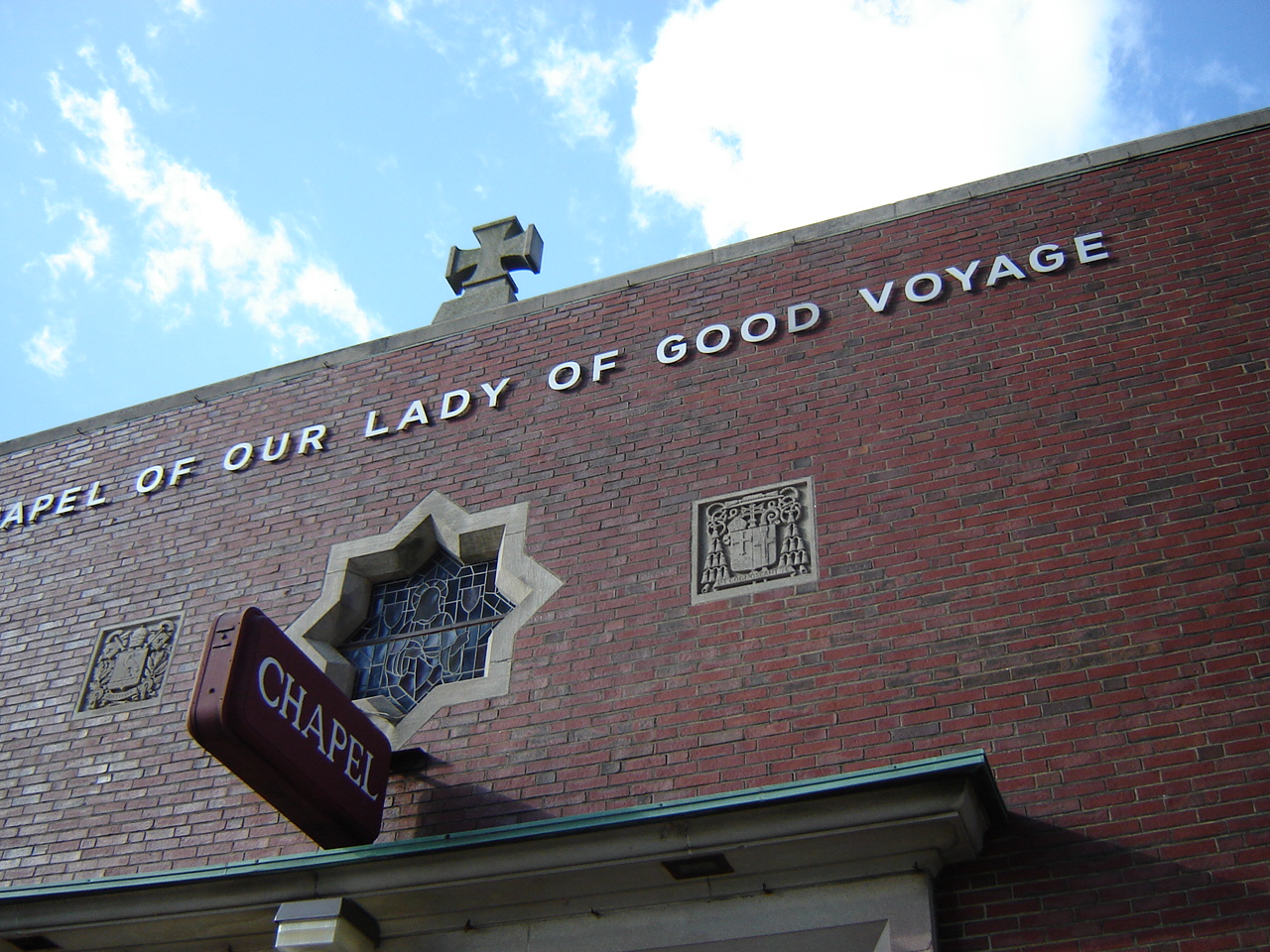
The area near Seaport Boulevard and the harbor, though booming with construction today, still wears the remnants of its formerly neglected status: vistas of pitted parking lots, streets that end ­­­­­­in chain-link fences, highway underpasses filled with brown grass and fast-food wrappers. Then there is the Chapel of Our Lady of Good Voyage.

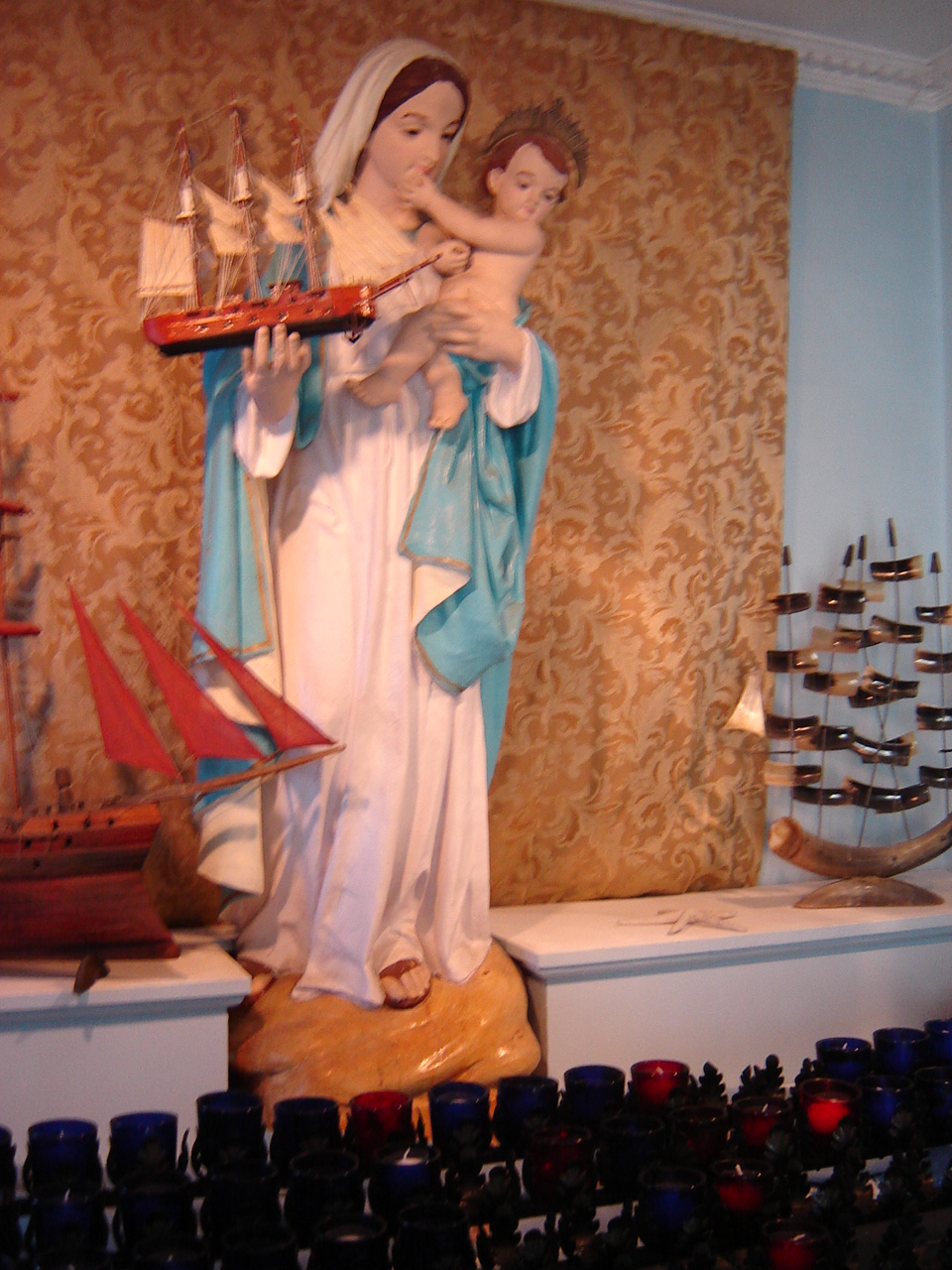
Unlocked, empty, and trusting, the tiny chapel has a basket for donations to the food pantry. Under a statue of Mary holding her infant in one hand and a ship in the other are votary candles. Someone in charge must think – or know – that no traveler seeking blessings will steal alms for the poor in front of Mary unless desperate. In which case, perhaps he will be welcome to it.

I picture Ishmael coming to a place like this (different denomination and in New Bedford) to hear the sermon on Jonah and the Whale before his ill-fated voyage with the obsessed Captain Ahab.

I wonder if sailors really go to the chapel nowadays and what will happen to it as the area develops at its rapid pace. Along the water, the mayor’s prized Innovation District is gathering steam. In the other direction, the Fort Point Channel area is bursting with restaurants, arts, and artists.

Less than 20 years ago, I visited one artist, the son of friends, who was squatting with other artists in the abandoned Fort Point warehouses where doors had no locks, broken boards and pipes littered the floors, and loose wires hung from the ceilings.

The chapel is part of that earlier world, when lighting a votary candle might have seemed like one’s best chance for making it until tomorrow.

Read Full Post »

A couple Sundays ago, it was so hot that all we could do was sit. When we came to ourselves, we said: Who has air conditioning besides the supermarket? Where can we go to see something interesting or entertaining without wilting?

The deCordova Sculpture Park and Museum is a place of wonder. It’s true that sometimes the wonder takes the form of “What the heck?!” But more often it provokes pondering and admiration. The piece below was both lovely to look at and food for thought. The artist filmed people moving obscurely behind ice. The work suggested ideas to me beyond the idea of ice (although ice itself was worth focusing on that day).

Ice often makes an appearance in art. I think of the First Night (New Year’s Eve) sculptures in Boston.  And I remember a whole ice wonderland in St. Paul one January when we lived in Minnesota. Then there is the ice story by a native of that city, F. Scott Fitzgerald.

Fitzgerald apparently wanted to cut his ties with his hometown, but St. Paul had other thoughts, naming the theater where “A Prairie Home Companion” plays just for him, and conducting a posthumous reading of “The Great Gatsby” in his honor.

Fitzgerald’s short story “The Ice Palace” is about a southern girl who tries to adjust to the culture of her betrothed’s wintry landscape. She becomes lost and terrified in an ice palace that somehow reflects his family and his nature, and she decides her future should unfold back home in the South. I read that a long time ago, but I recall many meanings for ice in it.

Meanwhile, at the deCordova, the “Ice Cave” video seems to be about the limits of perception, about seeing through a glass darkly.

What are the people doing? we wonder. Even if we knew, would we know what it meant?

Please share your ice images with the blog.

Image from Daniel Phillips’s Ice Cave video is at the Dodge Gallery in New York.


Read Full Post »

For an artsy, literary treat, take a look at the Project Gutenberg version of painter Marsden Hartley‘s out-of-print book, Adventures in the Arts: Informal Chapters on Painters, Vaudeville, and Poets, dedicated to Alfred Stieglitz.

Hard to resist an introduction like this:

“Sometimes I think myself one of the unique children among children. I never read a fairy story in my childhood. I always had the feeling as a child, that fairy stories were for grown-ups and were best understood by them, and for that reason I think it must have been that I postponed them. I found them, even at sixteen, too involved and mystifying to take them in with quite the simple gullibility that is necessary. But that was because I was left alone with the incredibly magical reality from morning until nightfall …

“I was constantly confronted with the magic of reality itself, wondering why one thing was built of exquisite curves and another of harmonic angles. It was not a scientific passion in me, it was merely my sensing of the world of visible beauty around me, pressing in on me with the vehemence of splendor, on every side. …

“It is because I love the idea of life better than anything else that I believe most of all in the magic of existence.”

(Thank you, Ellen Levy, for sending me the link.)

Art:  Marsden Hartley

Read Full Post »

I love artists. They come up with the wackiest ideas. And often the ideas have bypassed the rest of us because they are in fact so incredibly sane.

In the July 27, 2012, Boston Globe, Stephanie Steinberg writes about two such artists.

Carla “Repice, 40, and Geoffrey Cunningham, 37, who met while studying at Lorenzo de’ Medici school of art in Italy, started the performance art project Office of Blame Accountability [in 2007] while working on a separate project in California. The two artists, now self-proclaimed ‘blame accountants,’ were frustrated by the lack of accountability by the media, government, and individuals. …

“Repice had recently purchased a red 1920s telephone at a flea market. As they sat on a bench outside Cal State Fullerton Grand Central Art Center in Santa Ana discussing whom to blame for personal and countrywide problems, Repice brought up the idea of the phone representing an emergency call.

“ ‘We were talking about blame accountability, and there was this red phone, and we thought, “OK, let’s create an office. . . . Let’s place a desk on the sidewalk and facilitate a space where people can engage this idea of blame and accountability,” ’ ” she said.

“Within an hour, they set up a desk and placed a typewriter, mock blame forms, and, of course, the telephone on top. They then started asking random passersby, ‘Do you have any blame to place?’ ”

The lovely part is that the “blame accountants” also ask people to consider their own role is the thing they are blaming on others. The results can be quite touching. Read more.

Photograph: Tisha Kawcak

Read Full Post »

John and two college friends rented a motor boat in Fort Point Channel Friday to see the sights of Boston Harbor. But first they motored near my building so I could wave as they passed under this piece of public art.

The Mystic Scenic Studios site explains the art:

“A designer named Peter Agoos approached Mystic Scenic Studios with the idea of creating two life-sized human figures made of aluminum to hang above the Fort Point Channel in Boston.

“Mystic Metal’s, Mike Onischewski, fabricated the figures from an aluminum sheet; [they] were then covered with refractive dichroic film with the help of David Forshee, also of Mystic Scenic Studios.

“The piece was installed on July 2, 2012, with a team of 12 volunteers who worked from a small boat on the water and a scissor lift on land. The piece was strung from a 300-foot yellow tightrope between the Samson Post structure on Summer Street and the counterweight tower on Congress Street. The life-sized figures were counterbalanced on the rope and inspired by a classic articulated wooden artist’s manikin.”

Photograph: Mystic Scenic Studios

Read Full Post »

Sunday evening I went over to Concord Academy to hear Seán Curran talk about how he creates choreography. Betsy, one of the dancers from his company, did a beautiful job of demonstrating what he meant.

As a little boy growing up in Watertown, Seán said, he waited eagerly for the mail that brought Look magazine. He liked to cut out pictures and make collages with them.

He says that his approach to choreography is similar. He arranges many snippets or dance phrases in different ways. His challenge is to edit down the many ideas so that the choreography doesn’t topple from too much weight.

I make collages, too. I have always liked the idea of taking a bunch of random things people have said and trying to make a play out of them, for example.

I also make collage greeting cards. I keep a box of promising pictures, cut from magazines and gallery postcards. I go through the whole pile and set aside maybe 20 items that somehow remind me of the person for whom I am making the card. Then I edit them down to the few pieces that will be best for the particular occasion.

All that happens before I cut the shapes and decide on how to arrange them. Sometimes I do a cutout of a cutout and put something else in the space: for example, I cut a vista out of a painting of a window and put a girl in the space (bottom right).

Here are examples.

Read Full Post »

« Newer Posts - Older Posts »