Feeds:
Posts
Comments

Posts Tagged ‘england’

Photo: Simon Buckley
Grandad, an artist who has experienced homelessness, is one of 33 people behind the “Doodle on Ducie Street” mural, part of the International Arts and Homelessness Festival and Summit in Manchester, UK. The event used art as part of a holistic approach to tackling homelessness.

So many initiatives to address the world’s problems feel like a drop in the bucket, but I have to believe that the bucket can be filled — even if it’s only one drop at a time, even if some drops spill out along the way and have to be replaced. Little things mean a lot if they hit a person just at the moment of receptivity.

In England, a homelessness summit last fall tested the potential of art to spark conversations between haves and have-nots and also to give homeless people a reason to get up in the morning. Helen Lock has the story at the Guardian.

“Two armchairs are facing each other in the Whitworth art gallery in Manchester. Denise Harrison, a mental health blogger with past experience of homelessness, is sitting in one of them, waiting for questions.

“A member of the public sits down opposite her, and tentatively asks if she thinks it’s OK to give money to people on the street, as charities discourage it. ‘It’s down to personal choice – you shouldn’t feel bad if you do or if don’t,’ replies Harrison. ‘Some worry it’s enabling addictions, but it’s also providing someone with the option to pay for shelter. On the street, someone can end up with several free McDonald’s burgers but nowhere to sleep that night.’ …

“Dialogues are part of a performance artwork called Are You Sitting Comfortably? by the artist Emma Turner, who felt the public were becoming inured to homelessness in Manchester. The official number of rough sleepers was 278 in 2017, a 41% increase on the previous year, but the true number of its homeless people – counting those in temporary accommodation – is likely to be much higher.

“As Harrison says of her time suffering with alcohol addiction and sofa surfing after the breakdown of her marriage: ‘It’s scary how quickly a situation that was so abnormal became normal, my new normal. It can happen to anyone.’

”The work was part of the inaugural International Arts and Homelessness Festival and Summit, running 12-18 November [2018], which explored a potentially contentious idea: the role of arts and culture in tackling homelessness.

“Manchester was chosen for the event because the city council’s homelessness strategy for the next five years explicitly includes a commitment to increasing access to arts, and because of how the city’s cultural sector has stepped forward to provide support for the council’s plan. …

“Third sector organisations began working together to approach the council, consulting businesses, universities, cultural organisations and the faith sector, as well as people with experience of homelessness. Their findings underpinned the new Manchester Homelessness Charter. … Officials will now work towards what is described as a jigsaw of homelessness support approaches, rather than focusing exclusively on immediate needs such as shelter and healthcare. This includes the chance to meet people, build skills and have fun. …

“But how would this approach work in practice when the crisis is so severe? Beth Knowles, an adviser on homelessness for the mayor’s office, reiterated that the call for a more holistic approach came from homelessness services themselves – even frontline providers such as the night shelters.

“ ‘I’ve spoken to some about trialling the jigsaw approach,’ she said, ‘and while it might not seem the most immediate thing when you’re trying to find beds, some see the value in maybe having some singing or photography sessions on site, because it’s worked well.

‘Of course, not every council officer is going to see this as a priority. But to do something, it doesn’t have to be a priority. It’s part of a whole package. It’s about what that individual needs and offering it.’

“[According to Amanda Croome, chief executive of the Booth Centre, a day facility for people who are homeless or at risk,] ‘We find that if you put someone into a flat and they have no support network, no interests and nothing to do, then very often in six months they’ll be back on the street. What the arts do is give people a new perspective.’

“Lawrence McGill has become an avid gardener since first becoming a regular visitor to the Booth Centre, filling salvaged containers with soil and seeds. He has also written poetry, and a song, ‘Spinning Plates,’ about juggling life’s hardships. ‘My life started the day I stepped into this place.’ ”

Read about other aspects of the festival, including a description of the “immersive opera” Man on a Bench, here.

Read Full Post »

Although black history is not a one-month-a-year-thing, having a dedicated month does seem to turn up stories that might not otherwise be heard. I got this one from the BBC television show Our Classical Century, “a celebration of the most memorable musical moments from 1918 – 2018,” which focused on broadening the audience for classical music.

In this episode, Sir Lenny Henry expressed admiration for forgotten black composer Samuel Coleridge-Taylor.

“I have been enthralled and captivated by the story of a man from Croydon in south London who died more than 100 years ago and who wrote one of the biggest musical hits of the 20th century. He was a total genius – a bit like Prince, but for late 19th-century London rather than 1980s California – and his name was Samuel Coleridge-Taylor. …

“Young Samuel was brought up by his mother and her extended family in Croydon. He never met his doctor father, Daniel Peter Hughes Taylor, who was originally from Sierra Leone and had come here to study medicine in London. …

“The family clubbed together to pay Samuel’s fees at the Royal College of Music, which he entered at 15 as a violin scholar. But the violin was set to one side and composition took centre stage and he was taken under the wing of the composer and conductor Charles Villiers Stanford. … For two years running, Coleridge-Taylor won the RCM’s Lesley Alexander composition prize and was championed by Edward Elgar, who recommended the talented young composer for a major commission – an orchestral work for the Three Choirs festival, his Ballade in A Minor, opus 33.

“The thing I like about Coleridge-Taylor is that he fought adversity to reach the top. He suffered racial abuse at school – apparently he even had his hair set on fire – but remained dignified. His compositions are dynamic, bold, incredibly melodic and immediately accessible. I was blown away. And I wasn’t the only one. He was known as the ‘African Mahler’ and his success stretched far and wide.

“In the US, he was a household name in his lifetime, and travelled there by invitation of the Samuel Coleridge-Taylor Choral Society of Washington DC in 1904, and again in 1906 and 1910. The US marines band were engaged for his first performance and 2,700 people were in the audience, two-thirds of whom were black. He went on to compose Twenty Four Negro Melodies and Five Choral Ballads after that visit. He became interested in interpreting African American melodies, writing: ‘What Brahms has done for the Hungarian folk music, Dvořák for the Bohemian, and Grieg for the Norwegian, I have tried to do for these Negro melodies.’ When success hit, he used it to tell stories about his racial origins in a musical way that might uplift others.

“His best known work, ‘Hiawatha’s Wedding Feast, part of the cantata trilogy ‘The Song of Hiawatha,’ premiered in 1898 to huge acclaim, and went on to play, with the other two parts in a semi-staged version, at the Royal Albert Hall for a fortnight in June every year for almost 30 years in the interwar years. …

“But Coleridge-Taylor never got to enjoy his success – he died tragically young, aged 37, of pneumonia in 1912 – illness said to have been brought on by overwork. Nor did his family enjoy the financial fruits of Hiawatha’s success – the composer had sold the publishing rights to it to Ivor Novello’s company for a low flat fee.

“[My family] never went to a concert hall, and I didn’t see any black musicians. When I finally heard a live orchestra as an adult, it hit me like lightning. … Perhaps it’s time for everyone to take a fresh look at classical music and put aside the stereotypes. … This is our music – it’s music for everyone.”

More here.

Photo: Hulton/Getty
The multitalented 19th-century British composer Samuel Coleridge-Taylor was best known for “Hiawatha’s Wedding Feast.”

Read Full Post »

12801

Modern reusable nappies are available in cotton, bamboo, and hemp and have more designs than the diapers of old.

When John and Suzanne were babies, disposable diapers weren’t very reliable, and I rarely used them. I chose a diaper service that delivered clean ones every week and picked up dirty ones. I not only thought cloth diapers worked better, but I thought I was doing something good for the environment. It was only later that I realized that all the hot water and bleach the diaper service used wasn’t good for the environment either. My four grandchildren all used the Pampers/ Huggies type of diaper.

In England, where they called diapers “nappies,” Tess Reidy explains at the Guardian that reusables are coming back. But the change involves doing your own washing.

“If the idea of cloth nappies conjures images of towelling squares loosely held by a large safety pin, think again. Modern versions have come a long way and are now available in bright colours and a variety of materials, including cotton, bamboo, microfibre and hemp.

“Growing consumer concern over plastic waste, and a more pragmatic desire to save money, means boom times for the reusable nappy industry.

“ ‘There is increased awareness of the impact of disposable nappies – they are a single-use plastic. It started with coffee cups, then disposable wipes, and the jump from wipes to nappies is clear,’ said Wendy Richards, director of UK online provider The Nappy Lady. She says the number of people using the service has grown by 80% in the past year. The business has doubled its staff since the start of  2018.

“About 25% of a disposable nappy is plastic and three billion nappies a year end up in landfill. Some councils in Britain now give new parents vouchers worth up to £55 [$72] to help pay for a set of reusable nappies. …

“Data from Nottinghamshire county council’s nappy project finds that using real nappies and washing them at home saves £200 a year compared with buying disposables. ‘This could help UK parents save as much as £360m a year, while helping us move towards a zero-waste society,’ said Amelia Womack, deputy leader of the Green party. …

“Social media platforms have also helped spread the word. Kasia Reszel has a two-month-old son, Julian. …’ We do one wash a day and it’s pretty easy. You rinse before putting on a longer cycle and wash at 60C [140F].’ …

“Upfront costs can, however, be a deterrent. With full nappy starter kits ranging from £100 to £350, some low-income parents are wary. …

“According to Charlotte Faircloth, sociology lecturer at University College London, it is often socially aware middle-class parents who have the luxury of worrying about natural styles of parenting. ‘Other people are more concerned about meeting bills,’ she said.” More at the Guardian, here.

I got curious to know whether safety pins were still used. Not necessarily! Look at the array of new fasteners here.

Read Full Post »

Photo: BBC
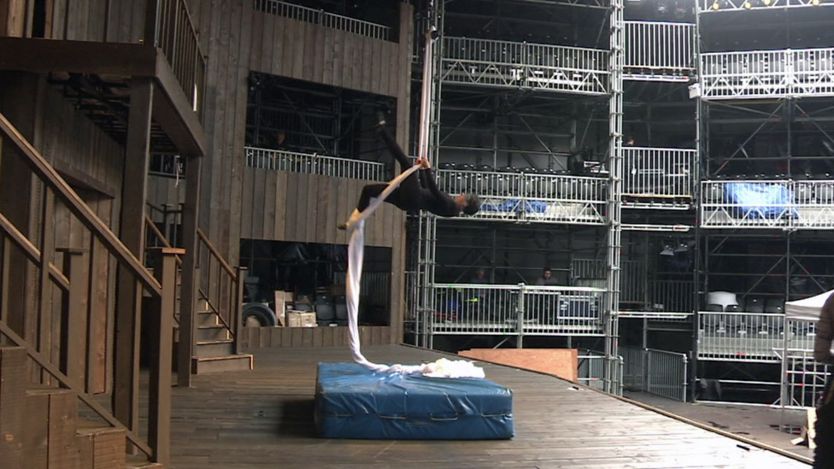
An aerial performer rehearses on stage at Shakespeare’s Rose, a pop-up theater in York, England.

You’ve heard of pop-up libraries, pop-up gift stores, and pop-up restaurants. Now here comes a pop-up Shakespeare theater in York, England.

Ian Youngs writes at the BBC, “Shakespeare’s Rose, which [opened in April] and has cost £3m, is Europe’s first ‘pop-up’ Shakespearean theatre. …

“The temporary theatre has been built in a car park in 28 days to a circular design, similar to those erected on Bankside in Shakespeare’s day.

“It will stage four of his plays with a cast including [TV actor] Alexander Vlahos, who will play Romeo in Romeo and Juliet, and Catesby in Richard III.

“As well as the audience members standing in the centre, a further 660 will watch from seats on three levels around the edge.

“Shakespeare and his contemporaries would recognise the design and ‘tricks’ like trapdoors and flying, which have hardly changed over the past 400 years, according to [producer James] Cundall.

” ‘They’d find everything they had in their theatre — they just probably wouldn’t recognise [Layher] scaffolding,’ he says. ‘Each length [of scaffolding] is probably about the same size as a standard oak beam, so that’s how Shakespeare’s oak became German scaffolding. …

“There was an actual Rose theatre in London in the Bard’s time, which was recreated for the 1999 film Shakespeare in Love. …

“Professor Judith Buchanan of the University of York, who has advised on the pop-up theatre, said: ‘Shakespeare’s Rose Theatre is not a historical reconstruction of the early modern Rose playhouse on Bankside, nor of any other early modern playhouse. It is an approximate and suggestive architectural allusion to the idea of the early modern playhouse.’

“The creators of the York theatre will hope that their venue doesn’t replicate some other aspects of the original Rose — which had to be closed occasionally due to riots or the plague, and which had one cast member who killed the other in a duel.”

Read more at the BBC, here, and at the Independent, here.

Read Full Post »

Photo: Thierry Bal
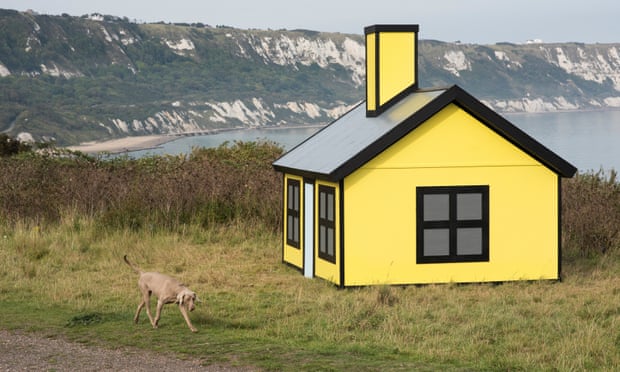
Artist Richard Woods’s cartoon-like fake bungalows, installed for Folkestone Triennial, are a commentary on the surge in second homes along the coast.

An English artist who favors cartoon-like architectural constructions has created six bungalows for a Folkestone Triennial installation called Holiday Home.

Kathryn Bromwich interviewed him for the Guardian. “Born in Chester in 1966, Richard Woods graduated from the Slade School of Art in 1990. … [For the triennial] Woods has created six colourful bungalows, situated in unexpected locations around the town.”

According to the interview, the artist is trying to reflect general concerns about who gets housing. People who can afford a second home? Immigrants from Calais across the Channel?

” ‘I was in Folkestone 18 months ago and got given this strange leaflet saying, “Have you thought about turning your property into cash?” – basically, “give up your house so someone can buy it as a second home”. The idea grew out of that: to make six identical bungalows and install some in very desirable locations, some not, but keeping it very open-ended. There’s been equal [numbers of] people coming up to me and discussing the second home issue, and immigration. …

” ‘There’s one house in the harbour, floating around – somebody heard through gossip in the town that it was going to be floated to Calais and back again. Some people are genuinely interested in whether “boat people” will move into the houses. But then lots of people in the town completely get the project.’ ”

The interviewer asks, “What can Folkestone tell us about wider trends across the country?

” ‘It’s a compressed version of the UK: all those issues that are prevalent everywhere are kind of heightened. On a clear day we can see Calais … Folkestone has very broad, different economic groups and because of its proximity to London people are moving here wanting a second home. People have asked if the homes are going to be available for local residents or just people from London.’ ”

The exhibit runs until November 5. More at the Guardian, here.

I’m sitting in my second home as I write this. There is no question that second homes in resort areas make housing extremely difficult for year-round residents. That’s one reason I support efforts to build affordable housing with subsidies, but I’m afraid it’s just a drop in the bucket.

Read Full Post »

Read Full Post »

Photo: Sara Teresa
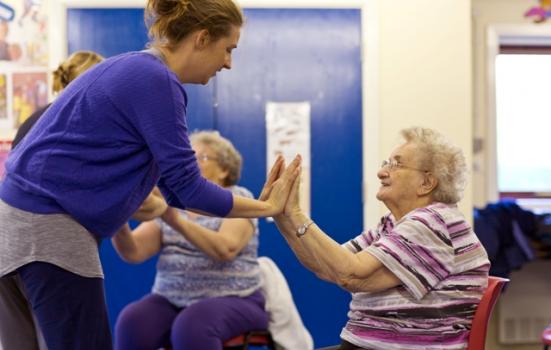
The rollout of a dance-based falls prevention programme in the UK by arts and health charity Aesop will see 1,000 older people benefit.

About 15 years ago, after breast cancer treatment, I joined a hospital-based class called “I Hope You’ll Dance.” I used to call it Cancer Dance Class because anyone who was being treated for cancer or had been treated could join. It happened to have only women during the time I was a participant although men were welcome.

The dance routines were very simple, but there was something pleasant about doing them with women you didn’t know but with whom you shared something as big as cancer. I also liked the music selections, which ranged from the playful “Diamonds Are a Girl’s Best Friend” to numbers that were more moving, like “You Raise Me Up” and “I Pray You’ll Be All Right.”

I thought of the mysterious comfort that class provided when I read about a dance program for the elderly in England and Wales. Christy Romer described it at Arts Professional, a UK-based website.

“The rollout of a dance-based falls prevention programme by arts and health charity Aesop will see 1,000 older people benefit from a new £2.3m investment.

“The programme will run for two years from October 2017, during which time 63 interventions will take place across England in Wales. These will be delivered in collaboration with health and social care providers, and arts organisations including Yorkshire Dance and Birmingham Royal Ballet. …

“Previous Aesop research showed how the Dance to Health programmes could address a problem that costs the NHS £2.3bn a year, as the rates of completion for dance-based alternatives to NHS exercise courses are 55% higher.

“An evaluation of the Dance to Health pilot programme in February 2017 also concluded that dance artists could be trained to deliver classes which were an enjoyable artistic challenge, faithful to healthcare objectives, and would deliver measurable reductions in loneliness for participants. …

“The expanded programme will receive support from ‘Dialogue Partner’ organisations, including Age UK and NHS England, and collaborate with eight Arts Council England-funded dance organisations. …

“A formal evaluation of the programme will be conducted in 2019, ahead of an anticipated national rollout in the coming years.” More at Arts Professional, here.

Romer mentioned the effort to address loneliness through the dance classes, but I imagine that the way physical motion improves thought processes is a big piece of the health benefit. And what about improving balance? That’s a concern for me, and a reason I take both tai chi and Essentrics when I’m not on vacation.

But I’m on vacation. So I’ll sign off now and go practice standing on one foot.

Read Full Post »

Art: Simon Roberts
Simon Roberts was the “election artist” for the 2010 general election in the United Kingdom. He chose 24 images — one for each day of the campaign — to reflect the geographical breadth of the trail
. Cornelia Parker is the election artist for 2017.

Not long ago, my husband pointed out a story about official “election artists” in England. That was a new idea for me.

An article in the Economist offers background.

“Many were bemused by the announcement on May 1st that Cornelia Parker was to be the official artist of the 2017 general election. Not as a comment on Ms Parker’s credentials — she is widely considered to be one of Britain’s most exciting contemporary artists — but to discover that such a post exists.”

Parker is the first woman chosen since the post was established in 2001 and the first conceptual artist.

“Jonathan Yeo, the inaugural artist, created a triptych oil painting of the main party leaders where the size of their portrait correlated to their portion of the vote. In 2005, David Godbold produced Hogarthian satirical illustrations on scraps of election ephemera such as manifestos, letters and flyers. In 2010 Simon Roberts photographed the quiet lanes and doorstep conversations of day-to-day campaigning …

“Ms Parker is using an Instagram account (@electionartist2017) to offer an eclectic commentary: so far she has posted pictures of road signs, homeless people and newspaper headlines. One image, captioned ‘The election contenders,’ shows a group of waving garden gnomes.

“Two further stipulations come with the role. First is that the artist must remain politically impartial. … The second is that they must produce a final work — one that can be put on display, or contain elements that can be displayed — which will eventually join the parliamentary art collection.”

I searched the web but couldn’t find Parker’s piece for the permanent collection. Maybe a reader will find it for me. It’s hard to envision what an artist known for “detonated sheds, cut-up shotguns and squashed instruments” would come up with, even if she is currently focused on instagram.

The Economist story is here, the Guardian‘s here and the New Yorker‘s here.

Read Full Post »

Photo: British Pie Awards
One of Britain’s most traditional pies is the Melton Mowbray pork pie. It was granted protected European Union status. (Can that protection last post-Brexit? The Law of Unforeseen Consequences strikes again.)

My husband loves learning about the origins of language. He recently sent me an article about English pies and pie-related expressions.

Norman Miller at the BBC explained, “Every March, St Mary’s church in the Leicestershire town of Melton Mowbray becomes a cathedral of pies: it fills with tables bearing more than 800 pastries.

“Some recipes are particularly offbeat. While the quirkiest entry in this year’s Speciality Meat category was a cricket pie, one celebrated past winner was Phil Walmsley’s squirrel pie in 2014. Walmsley told me that it has medieval origins, but still sells out at Market Harborough’s twice-monthly farmers’ market. ‘They’re also a great way to deal with a pest,’ he laughs. …

“Even in their early days, pies served different purposes for the rich and poor: as show-off delicacies for the former and portable food for the latter.

“So while wealthy feasts might include pies containing anything from game birds to mussels, the less well-off used simpler pies as a way to have food while doing outdoor work or travelling – the crust both carried and preserved the tasty filling. …

“Pies have been adding rich flavour to the English language for centuries. Even Shakespeare got in on the act, writing in his 1613 play Henry VIII that ‘No man’s pie is freed from his ambitious finger’, giving English the phrase ‘a finger in every pie’. …

‘Eating humble pie’, meanwhile, comes from medieval deer hunting, when meat from a successful hunt was shared out on the basis of social status.

“While the finest cuts of venison went to the rich and powerful, the lower orders made do with the ‘nombles’: a Norman French word for deer offal. Anglicisation saw ‘nombles’ pie become ‘humble’ pie. …

“One gigantic 16th-Century royal pie concealed a gaggle of musicians who began playing when the pie was cut, while another trick saw people burst out of a pie to recite poetry. Concealing live birds was also popular – hence the ‘four and twenty blackbirds’ in the nursery rhyme Sing a Song of Sixpence.”

Be sure to read about some great English pastries here, especially the traditional pie with sardines gazing up from the crust that commemorates a 17th century fisherman who saved his village from starvation.

As for squirrel pie, if Erik doesn’t find a way to keep a local squirrel from getting into the bird feeder, I fear that scalawag’s fate is sealed. Hungry, anyone?

Photo: Aubrey K. Huggins

Read Full Post »

Famed physicist Stephen Hawking has ALS and has to talk using an electronic voice substitute. Recently, as part of a skit for the antipoverty charity Comic Relief’s Red Nose Day fundraiser, he pretended to audition a bunch of well-known actors to be his newest voice.

Erin Jensen reports at USA Today, “A new, highly sought after role might not win actors any Oscars or BAFTAs, but that’s not stopping Hollywood’s elite from auditioning.

“In the clip, Hawking, who has ALS and communicates with synthesized speech, reviewed tapes from the self-described ‘intelligent … kind of’ Anna Kendrick and Rebel Wilson, who got a hard no from the physicist. Hawking also wasn’t persuaded by The Theory of Everything stars Felicity Jones and Eddie Redmayne or the ‘soothing, calming voice’ of Gordon Ramsay.

“Hawking wasn’t Taken with Liam Neeson’s voice either, despite the actor’s opinion that it possessed ‘a tinge of … physics.’ ” More.

For the true story behind Hawking’s voice, read this Wired article. Joao Medeiros details the many iterations of the technology underlying Hawking’s ability to communicate, but he notes Hawking likes his original “voice” and has stuck with it.

“His voice had been created in the early ’80s by MIT engineer Dennis Klatt, a pioneer of text-to-speech algorithms. He invented the DECtalk, one of the first devices to translate text into speech. He initially made three voices, from recordings of his wife, daughter and himself. The female’s voice was called ‘Beautiful Betty’ the child’s ‘Kit the Kid’, and the male voice, based on his own, “’Perfect Paul.’ Perfect Paul is Hawking’s voice.”

Photo: http://www.hawking.org.uk/

Read Full Post »

A while back, I wrote about Lata, which teaches older folks around the world to create street art with spray paint. I follow Lata on Instagram and can confirm that the results of senior graffiti are a hoot.

Now Vicky Thornton writes at Arts Professional about starting a modern dance troupe for people over 60. There’s hope for us all.

She writes, “DANCE SIX-0 started in response to a visit to the Elixir Festival at Sadler’s Wells that included a performance by the Company of Elders, a contemporary dance company for people aged over 60. Judith Bossano, Meg Edgar and Philippa Heseltine were inspired to establish a similar opportunity for contemporary dance in Salisbury and sought my advice and support.

“I was overwhelmed by their effervescence in describing what they had seen, their enthusiastic response and a very clear directive that ‘we need this’. Judith spoke passionately and eloquently about why at the age of 80 she felt it absolutely necessary to keep moving and dancing and experience the joy she feels when performing. …

“Meg felt this was something needed in Salisbury, recognising that dance brings many physical, social and emotional benefits that are so important for overall wellbeing. She identified Salisbury Playhouse as an ideal venue, considering its location, facilities and audience base.

“Salisbury Playhouse enthusiastically recognised the project’s potential, offering support to trial the idea. We were keen to emphasise that it cater for anyone over 60 with varying levels of mobility. The playhouse facilitated three taster workshops with three professional dance practitioners …

“The high demand for places resulted in two open classes and we held an audition for our inaugural performance company, selecting nine women and three men. …

“At the Wiltshire Public Health Awards in April we won our category of ‘Tackling Health Inequalities in the Community’ for our work with people aged over 60. We hope this award reflects our commitment to offering opportunities but also in challenging stereotypes of what older people can and should do.”

I’m down with that. Read more at Arts Professional, here.

Photo: Adrian Harris/ArtsProfessional
DANCE SIX-0 is a contemporary dance company for the over 60s in Salisbury, UK.

Read Full Post »

Photo: Prezi
Something Shakespeare didn’t have to worry about: expensive energy for productions and emissions that increase global warming.

Christy Romer over at the UK website Arts Professional recently posted on the money British arts groups are saving by cutting their energy emissions — a win for them and a win for the environment.

“Arts Council England’s National Portfolio Organisations (NPOs) have saved £8.7m by cutting greenhouse gas emissions since 2012/13, according to a major new report by environmental charity Julie’s Bicycle. …

“The report draws on data submitted via an online reporting tool, an evaluation survey and case studies, ultimately concluding environmental action is making the sector more financially resilient.

“Compared to doing nothing, the reduction in energy emissions has saved £8.7m since 2012/13. The report predicts that if the 4.5% annual decrease continues until 2019/20, emissions will be 46% lower than in 2012/13 and £54m will have been saved in energy costs.

“Alongside a fall in the overall emissions output, and a fall in the amount of electricity and gas used, there has been a 210% growth in the generation of on-site renewable energy since the project started in 2012/13. …

“Julie’s Bicycle pledges to develop Arts Council England’s (ACE) approach to environmental sustainability at the operational, planning and policy development levels. …

“Darren Henley, Chief Executive of ACE, added: ‘Our collaboration with Julie’s Bicycle is introducing us all to new ways of working. … We all believe that art and culture can make the world a better place; this programme shows how our actions can make a real difference.’ ”

More at Arts Professional, here.

Read Full Post »

Our friend Mika is back in Hokkaido these days, after several years in New York working in restaurants and perfecting her “house” dancing. But every once in a while she ventures out to help on a street art project. Here is her friend Florence Blanchard’s mural for CBM Network (Crossing Biological Membranes) at the University of Sheffield in England.

At her WordPress site, Florence explains what the art represents, “I am delighted to present my newest mural here – a collaboration with CBMNet at the University Of Sheffield, in conjunction with Festival Of The Mind 2016 / Fear of the Unseen: Engineering Good Bacteria.

“The ‘Crossing Biological Membranes Network’ is composed of scientists working to understand the mechanisms by which substances are transported into, within, and out of cells. Their ultimate aim is to produce knowledge which will enable the development of new technologies in the Industrial Biotechnology and Bioenergy sector (eg: producing biofuels using E coli bacteria).

“My role in this collaboration has been to translate the CBMNet area of work into a large outdoor mural located within the university campus. For this occasion I have presented my interpretation of a detail of a cell membrane as seen under an electron microscope, having undergone a cryofracture.

“A cryofracture is a procedure in which the sample is frozen quickly and then  broken with a sharp blow so you are able to study its structure in very close detail – Imagine breaking a bar of chocolate with hazelnuts, this way you can see how hazelnuts are positioned inside the bar.”

“For an online animation of a biomembrane cryofracture follow this link: http://www.sciencephoto.com/media/530082/view.”

Check out the WordPress post.

Photo: Florence Ema Blanchard
Blanchard’s street art is tied to a scientific quest: “Engineering Good Bacteria.”

Read Full Post »

In case you missed it, the NY Times had a great story on the discovery of ancient fragments of the Quran (or Koran) in Birmingham, England, of all places, where they had been long overlooked.

Dan Bilefsky writes, “The ancient manuscript, written on sheep or goat skin, sat for nearly a century at a university library, with scholars unaware of its significance.

“That is, until Alba Fedeli, a researcher at the University of Birmingham studying for her doctorate, became captivated by its calligraphy and noticed that two of its pages appeared misbound alongside pages of a similar Quranic manuscript from a later date.

“The scripts did not match. Prodded by her observations, the university sent the pages out for radiocarbon testing.

“[In July], researchers at the University of Birmingham revealed the startling finding that the fragments appeared to be part of what could be the world’s oldest copy of the Quran, and researchers say it may have been transcribed by a contemporary of the Prophet Muhammad.

” ‘We were bowled over, startled indeed,’ said David Thomas, a professor of Christianity and Islam at the University of Birmingham, after he and other researchers learned recently of the manuscript’s provenance.”

The manuscript fragments are estimated to be at least 1,370 years old.

Lots more here.

Video: BBC, by way of Youtube

Read Full Post »

ArtsJournal.com is a great source of leads from around the world, which is why I sometimes come up with stories from far away places like Belarus. The ArtsJournal blog covers art, theater, film, books, dance, music, media — and interesting creativity tidbits from the world of psychology.

Recently a link to the British publication The Stage highlighted a story about UK policymakers taking steps to build the next generation of artists.

Nicola Merrifield writes that the national strategy, Building a Creative Nation, “is calling upon the UK’s 107,000 creative sector employers to each recruit a person aged 16 to 24 by 2016.

“The initiative is designed to ensure that young people are able to gain paid jobs in arts organisations. It will urge employers to join organisations such as the Royal Opera House and Ambassador Theatre Group in signing up to the Fair Access Principle, which encourages responsible recruitment practices.

“As part of the campaign, Creative and Cultural Skills, the sector’s leading body for skills development, will create 5,500 apprenticeships, paid internships and traineeships across the UK by 2016.

“This is part of CC Skills’ £15 million Creative Employment Programme launched earlier this year to combat unpaid internships in the arts sector, which aims to subsidise 6,500 training schemes for people aged 16-24. This scheme, which was financially supported by ACE, has seen employers take on 1,000 unemployed people so far.

“Industry leaders including former Royal Opera House chief executive Tony Hall, ticket provider Live Nation’s international chief operating officer Paul Latham and Dirty Dancing founding co-producer Michael Jacobsen are backing the Building a Creative Nation strategy.

“Pauline Tambling, joint chief executive of CC Skills, said: ‘We’re looking to build upon the work that our supporters have been doing to help young people into work across the creative industries, which has already achieved so much.’ ”

More.

Photo: Tristram Kenton
Laura Evelyn in “Once Upon A Christmas” by Look Left Look Right in Covent Garden Piazza

Read Full Post »

« Newer Posts - Older Posts »