Feeds:
Posts
Comments

Posts Tagged ‘immigration’

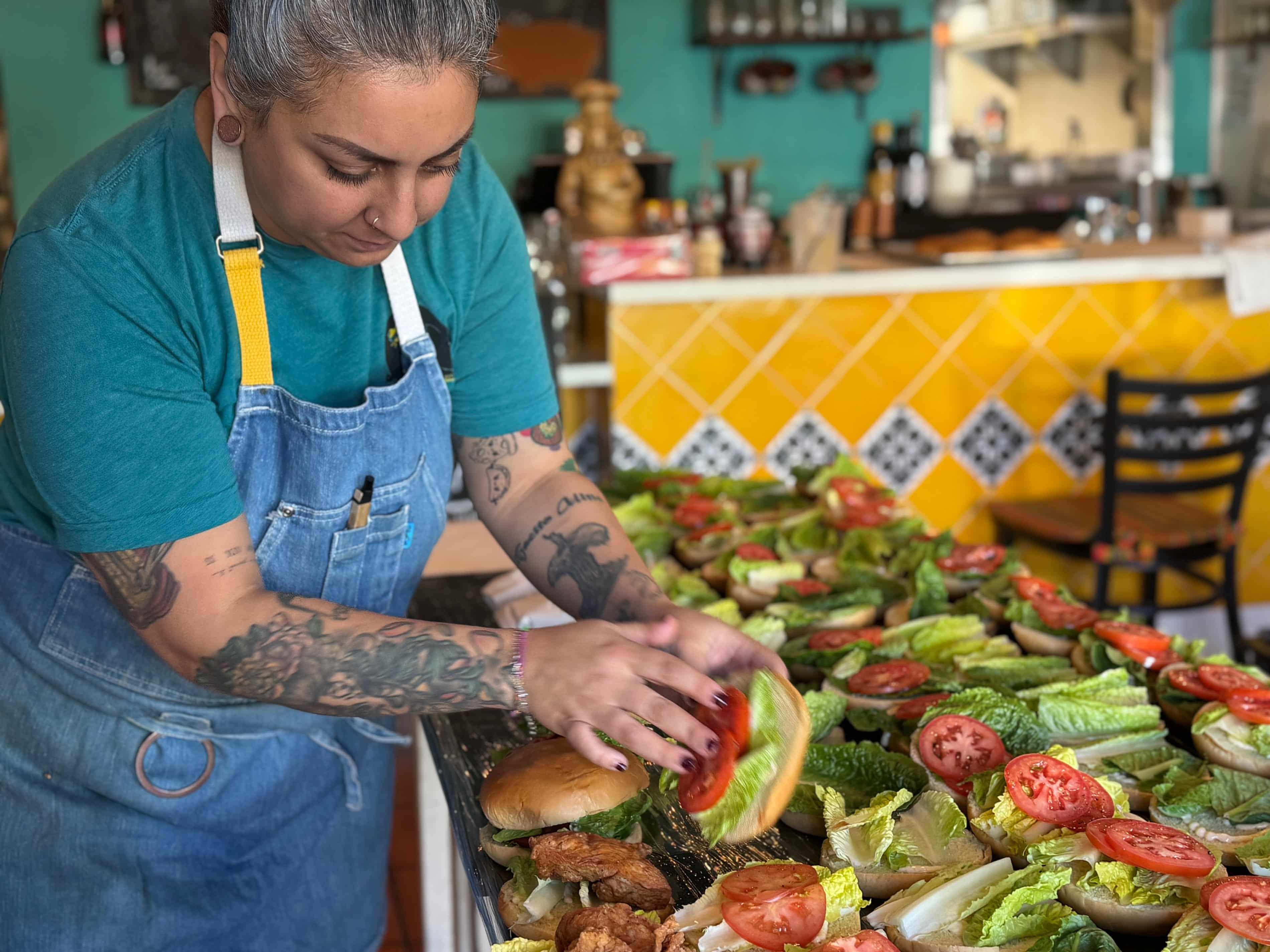
Photo: Danielle Duran Zecca/Amiga Amore.
Danielle Duran Zecca, co-owner of Amiga Amore in Highland Park, Los Angeles. 

Well, in one way, this is a time of great opportunity. There are endless opportunities in the US to meet the growing needs. Endless opportunities to practice charity in daily life.

A chef in Los Angeles knew opportunity as soon as she saw it. The revealing moment took the form of government officers in masks snatching people off the streets.

Victoria Namkung reports the story at the Guardian.

“When Danielle Duran Zecca saw military-style immigration raids and people being snatched off the streets and put into unmarked vehicles in her native Los Angeles earlier this summer, she was in disbelief. …

“Duran Zecca, a James Beard Award nominated chef and co-owner of Amiga Amore in Highland Park, a historically Latino neighborhood in north-east LA [said] ‘I didn’t know what to do, but I knew how to feed people and love on people because that is exactly how I was brought up in my family.’

“When several of Duran Zecca’s workers expressed fear about coming into the restaurant, the chef had a realization.

“ ‘If they didn’t want to leave their homes, how many others were like this and how many weren’t eating,’ she said. Earlier in the year, Amiga Amore received donations that allowed the Mexican-Italian restaurant to give meals away to those affected by the LA wildfires, but this time she would need a different approach, one that made people feel safe.

“Duran Zecca began personally delivering free meals to 25 to 30 people every other Sunday in nearby Boyle Heights. …

“Since ICE began to infiltrate LA in June, once-bustling neighborhoods have become quiet. Vendors locked up stalls in the flower district. Popular taco stands and fruit carts are closed and some restaurants sit empty. Although it is unknown exactly how many people are staying home due to Ice’s aggressive arrests, immigration sweeps at restaurants, farms, Home Depots and even car washes have created a chilling effect on businesses that rely on immigrant labor.

Restaurants such as Amiga Amore and other groups from the food and hospitality industry are stepping in to help people in their community who have nowhere to turn – even while their own businesses are suffering economically. …

” ‘Latinos are not only the backbone to our industry, they are the industry,’ said Duran Zecca. ‘Behind every chef are Latino line cooks ready to make magic happen. All they want to do is work, make a living and feed their families.’

“To make her deliveries twice every month, Duran Zecca receives logistical support from her good friend Damián Diaz, the co-founder of No Us Without You, an LA-based non-profit that provides food security for undocumented people, including back of the house staff from bars and restaurants.

“ ‘The administration has been doubling down on making it much more difficult for the families in the community and also small grassroots organizations like us to really be impactful,’ said Diaz. In the past, No Us Without You had drive-through lines for food distribution, but stepped-up enforcement made that impossible, so they pivoted to working with a coalition of restaurants to serve up to 40 families every fortnight so they can shelter at home.

“ ‘This environment of fear in light of increased enforcement, and really excessive enforcement, is causing folks to miss out on some very key necessities such as doctor’s appointments and going to the grocery store,’ said Rita Fernández director of immigration policy project at UnidosUS, a Latino non-profit advocacy organization. …

“This summer, Congress allocated $170.7bn in additional funding for immigration and border enforcement … creating what some critics call a ‘deportation-industrial complex.’ …

“That’s why many others in the restaurant and non-profit industry have also been mobilizing to bring groceries to immigrants who are in hiding. The Oaxacan-Mediterranean restaurant X’tiosu in Boyle Heights, one of the US’s most heavily Latino-populated neighborhoods, packed 150 bags of fresh produce, dried pasta and other goods that were delivered to people in need by local Oaxacan youth in June and they have continued to support undocumented families. The student-led group, Raíces Con Voz, coordinated food and care package deliveries to more than 200 families, and Aquí Para La Comunidad, which operates throughout southern California, has a growing waitlist.

“Vanny Arias decided to host an impromptu food drive in front of the Offbeat Bar in Highland Park, where she’s a bartender, after realizing people staying home were likely in need of groceries. … Arias organized with other community activists and volunteers to start dispensing basics.

“Once she launched an Instagram account, she started hearing directly from desperate families. ‘People said: “My husband got arrested” or “We’re afraid to leave the house and my kids haven’t eaten in days,” ‘ said Arias. ‘When you’re on the ground you see the hurt and pain in their eyes and hear it in their voices.’

“Since July, Arias’s Nela Food Distribution has grown to deliver free groceries to 150 people in and around Highland Park with the help of community donations, two local food warehouses, a bakery and a team of volunteers. ‘We’re a bunch of people who love their community,’ said Arias. ‘I don’t care what color you are, we’re freaking humans and I’m here for you. You’re not alone.’ ”

More at the Guardian, here. The Guardian is free, but please consider donating to them.

Read Full Post »

Photo: Girl Scout Troop 6000.
Girl Scouts of Greater New York’s Troop 6000 is a first-of-its-kind program designed to serve families living in temporary housing in the New York City shelter system.

Kindness and compassion are not dead. You just need to know where to find them.

Consider New York’s Girl Scout Troop 6000, which reaches out to migrant children.

Sara Herschander reports for the Chronicle of Philanthropy, “Once a week in a midtown Manhattan hotel, dozens of Girl Scouts gather in a spare room made homey by string lights and children’s drawings. They earn badges, go on field trips to the Statue of Liberty, and learn how to navigate the subway in a city most have just begun to call home.

“They are the newest members of New York City’s largest Girl Scout troop. And they live in an emergency shelter where 170,000 asylum seekers and migrants, including tens of thousands of children, have arrived from the southern border since the spring of 2022.

“As government officials debate how to handle the influx of new arrivals, the Girl Scouts — whose Troop 6000 has served kids who live in the shelter system since 2017 — are quietly welcoming hundreds of the city’s youngest new residents with the support of donations. Most of the girls have fled dire conditions in South and Central America and endured an arduous journey to the U.S.

“Not everybody is happy about the evolution of Troop 6000. With anti-immigrant rhetoric on the rise and a contentious election ahead, some donors see the Girl Scouts as wading too readily into politically controversial waters. That hasn’t fazed the group — or their small army of philanthropic supporters. Amid city budget cuts and a growing need for services, they are among dozens of charities that say their support for all New Yorkers, including newcomers, is more important than ever.

“ ‘If it has to do with young girls in New York City, then it’s not political,’ said Meridith Maskara, CEO of the Girl Scouts of Greater New York. ‘It’s our job.’ …

“Last year, Troop 6000 opened its newest branch at a hotel-turned-shelter in Midtown Manhattan, one of several city-funded relief centers for migrants. Though hundreds of families sleep at the shelter every night, the Girl Scouts is the only children’s program offered. …

“Last January, the group began recruiting at the shelter and rolled out a bilingual curriculum to help scouts learn more about New York City through its monuments, subway system, and political borders. …

“With few other after-school opportunities available, the girls are ‘so hungry for more’ ways to get involved, says Giselle Burgess, senior director of the Girl Scouts of New York’s Troop 6000.

“Seven years ago, Burgess, a single mother of six, built Troop 6000 from the ground up after losing her rental home to developers. While living in a hotel-turned-shelter, she got the idea of creating a troop for girls like her daughters. It was the height of ‘NIMBYism,’ she says, the not-in-my-backyard movement opposed to local homeless shelters.

“At the time, she asked: ‘Who’s gonna give us a chance?’

“As it turns out, ‘the donations started pouring in,’ she says. A New York Times profile lead to a groundswell of philanthropy. … So, when the mayor’s office floated the idea of starting a troop at the Midtown shelter, the Girl Scouts were ready. …

“Troop 6000 employs bilingual social workers and a transition specialist versed in supporting children who’ve experienced trauma. But otherwise, it operates much like any other Girl Scout troop. Most importantly, says Maskara, the troop offers a glimmer of consistency to children who often must pack up, move homes, and switch schools in the middle of the academic year. Scouts are encouraged to continue participating even when their families move. …

“ ‘Keeping the girls connected is what matters the most for us right now,’ says Burgess. ‘There’s a lot of emotion, frustration, and hurt.’ Around 50 scouts who have left the shelter participate in a virtual troop. ‘We want to be able to encourage the girls and let them know it’s not over,’ she says. ‘We’re still here.’ “

More here.

Read Full Post »

Photo: Dominique Soguel.
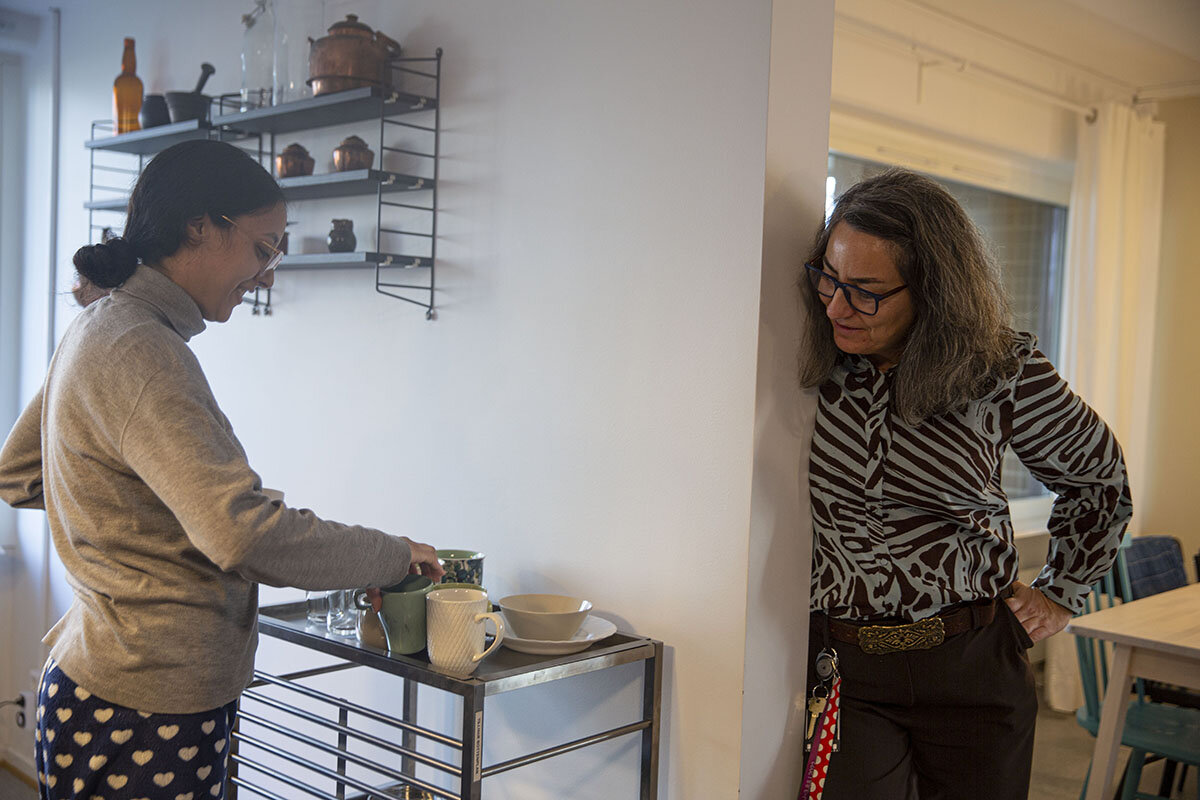
Young migrants who arrive in Sweden alone become part of a “big family” with older people in this unusual living arrangement.

You may have heard of anti-immigrant sentiment rising in Sweden, a country that historically has been welcoming to victims of war and persecution. But no story is the whole story.

At the Christian Science Monitor Dominique Soguel reports about the ongoing generosity of many Swedes.

“It was when his older Swedish neighbors threw him a high school graduation party that Afghan native Zia Sarwary finally felt a sense of belonging in this picturesque seaside city [Helsingborg].

“ ‘It meant everything to me,’ says Mr. Sarwary, who at the age of 13 arrived alone in Sweden during the 2015 refugee crisis. ‘That was the beginning of feeling at home.’

“Mr. Sarwary is one of dozens of tenants living in Sällbo, a shared-living project mixing elder Swedes and young adults, some of them from Sweden, others – like him – from the Middle East or Afghanistan. The six-story building with 51 apartments helps counter both the loneliness of advanced-age Swedes and the integration difficulties facing migrants who arrived as unaccompanied minors.

“Tenants of Sällbo have found common ground within these colorful walls, which they attribute to the cumulative impact of courtesy, kindness, mutual curiosity, and understanding.

“ ‘The whole goal was to show that even if you are different and even if you are people who would not usually socialize, you would do so if there is a safe environment where you know who is in the house,’ says Dragana Curovic, the project manager for Sällbo. ‘After three years, we can say that it worked.’

“Had they not moved under the same roof, the older Swedes and young migrants living here would almost certainly not have mingled. Fear and misunderstanding would have been major obstacles. Older Swedes’ impressions of young migrants draw heavily on negative press reports linking them to crime.

“As for the immigrants, their interactions with Swedes had largely been limited to asylum center officials – authority figures who set the initial tone for the newcomers’ experience, but weren’t focused on building bonds with them.

“Sällbo attempts to overcome that by getting tenants engaged with each other.

To move in, tenants must agree to socialize at least two hours per week.

“That can happen in shared kitchens, activity rooms, or cozy living areas. Each floor boasts three common areas, ranging from puzzle and scrapbooking rooms to libraries and film-screening rooms to carpentry workshops. Sun-kissed kitchens are set up for mingling, growing herbs, pickling, and baking. Artwork decorates the hallways. …

“Young and old concur that the pandemic helped strengthen the bonds that bind them. Younger residents did grocery shopping for the elders, who returned the favor by helping those with low computer skills keep up with their classes online.

“Now a logger working night shifts, Mr. Sarwary wishes he had even more time to spend with his older neighbors and feels bad when he needs to cut conversations short to catch his bus. After all, elders are treated with deference in Afghanistan. He believes curiosity feeds residents’ capacity to find common ground across cultures and age groups.

“ ‘People try to understand each other,’ he says. ‘I know you have your differences. I have mine. But we can meet in the middle ground and do something together that is good for both of us. There is a positivity in everything. That is the best part.’

“ ‘Sometimes you do things that are not correct,’ Mr. Sawary continues. ‘Instead of people coming in scolding you, they come in and they’re like, “Oh, you could do it this way.” ‘ …

“It helps that people understand that he had a tough background and approach him with an open mind to learn about his headline-grabbing, war-torn homeland.

“ ‘They would always ask instead of just judging. “OK, is this true about your country?” ‘ he says. …

“Jan Gustavsson, a retired provider of security systems, says he like helping young people from Afghanistan and other parts of the world integrate. ‘We can see in … Stockholm and Gothenburg, there’s a lot of problems. … I think it will help if these people live together with Swedish people.’ …

“Anki Andersson oversees scrapbooking activities on Tuesdays. Her husband, Kalle, helps fellow seniors do seated workouts. ‘Sällbo is the perfect place if you are mobile and seeking to socialize,’ says Ms. Andersson. ‘People here are so alike in a way. It is hard to explain. We click together very well, both the older and young residents. …

“ ‘If we have something we need to do or heavy things to carry, they give as a hand. We are a big family.’ “

More at the Monitor, here. No firewall. Nice pictures.

Read Full Post »

Photo: Amy via Louisiana Radio Network.
Do you know where to find the “Strawberry Capital of the World”?

When I was volunteering last spring with the Ukrainian media team, we often chatted by text when work was slow, and Leilya happened to mention that Louisiana was the strawberry capital of the world.

She said the strawberries started in February! This year’s Ponchatoula Strawberry Festival is scheduled for April 14 to 16, so you still have time to get down there.

The festival website says, “Since 1972, the Ponchatoula Strawberry Festival has attracted visitors from near and far to celebrate our local strawberry farmers, non-profits, and our special community, flourishing into the largest free harvest festival in the state of Louisiana.”

Events seem to include non-strawberry events, such as rides, an egg toss, and a ceremony for fallen heroes: “Join us in Veterans Square, commonly referred to as the Strawberry Parking Lot, to witness history as we support our Fallen First Responders and Wounded Veterans from 9/11. The Ponchatoula Strawberry Festival is proud to bring the Tunnel To Towers Foundation’s 9/11 Never Forget Mobile Exhibit to Louisiana for the first time! This high-tech exhibit will sit among local Veteran booths, representatives from our country’s Military Forces, and the ‘Spirit of Louisiana’ Fire Truck.”

To learn more about the actual strawberries, I turned to the Strawberry Marketing Board, here: “Louisiana’s strawberry industry dates back to the 1800s when the Great Economic Migration brought a wave of Italians and Hungarians to America with hopes of finding work. Many moved to Louisiana and began strawberry farms in the warmer weather and rich soil.”

“The Louisiana State University (LSU) Ag Center, here, adds, “Tangipahoa Parish is still the leading strawberry-producing parish, growing 75% of the total acres in Louisiana and accounting for 79% of the state’s total gross farm value. Louisiana strawberries can be found in grocery stores, farmers markets and roadside stands as early as November, December and January.

“Early fall is the time to plant strawberries. Home gardeners can successfully grow strawberries with even a small area, plenty of sun and some TLC. … Strawberry plants are typically sold in local garden centers as bare-root plants, but they also can be found as transplants. Plants can be purchased online, too.

“In Louisiana, we need to plant short-day or day-neutral strawberry varieties. Short-day plants begin to produce flowers when the days shorten during fall and winter. They initiate flower buds when there is 14 hours of daylight per day or less. Day neutral means day length doesn’t affect flower production. These strawberries will blossom and set fruit no matter how long or short the days are.”

There was also a piece at Fox News, here.

Every year there are signs that spring is on its way. One of the earliest comes on Feb. 27 when National Strawberry Day is observed.

“While the industry has shrunk over the decades, Southeast Louisiana still holds a strong presence in the strawberry industry with most of the production concentrated in the eastern part of the Florida Parishes.”

The state’s marketing board website, also notes, “The crop peaked in 1931, with Tangipahoa Parish becoming the most important center of distribution as farms along the City of New Orleans rail line could ship as far north as Chicago and even by commercial truck on Highway 51. The activity was so heavy in the area that there was a boom of people moving into the area to farm and experiment with the fertile soil and temperatures to create new breeds of berries.

The Klondyke strawberry was cultivated in Tangipahoa Parish around the Independence area and the name was given to reflect how the growing industry at the time was like the ‘gold rush’ that occurred in the American west and Alaska just prior to the Civil War.

“Today, most Louisiana farms are small and independently run and some allow the public to come to pick their own berries to buy on-site.”

“The Louisiana radio network noted in February that the crop did not get the ideal weather this year.

“As we approach the peak of strawberry season, Springfield strawberry farmer, Trey Harris said it’s been a tough year so far weather-wise. He said production is down from this time last year, but the current unseasonably warm temps are speeding things up.

“ ‘But I see a lot of blooms, a lot of green fruit coming really strong right now. We’ve just to … hope that we can get some really sunny days like today and cold nights so we don’t just get overflooded with berries right now,’ said Harris.

“Harris said highs in the 80s and lows in the 70s are causing a growth spurt among strawberries. And while you might assume strawberry farmers welcome rain, Harris said they are able to control water consumption, and too much water and fog at this point can affect the taste of strawberries.

“ ‘We really don’t want rain at all, we don’t want any rain on the strawberries because it’s going to make them taste like water,’ said Harris. … He said its vital residents support locally grown berries now more than ever.

“ ‘That’s why it’s very important that the people in Louisiana buy strawberries from all of us local farmers. We only have a few Louisiana strawberry… maybe 15 farmers left.’ ”

Read Full Post »

Photo: Wen-hao Tien.
Taiwan-born artist Wen-hao Tien (left) started inviting people from around the world to teach her songs from their homelands as part her exhibit on immigration experiences at the Pao Arts Center in Boston, Massachusetts.

Singing a new language can be a good way to learn that language, but even if you are not trying to learn it, you can experience the emotion in it. Consider all the choruses around the world learning the Ukrainian national anthem these days. Who is not moved by the feeling of solidarity, whether you are a Ukrainian, a singer, or a listener?

It may take an artist, perhaps an immigrant artist like the one in this story, to explore the mysterious, emotional side of the phenomenon.

As Patrick Cox reports at Public Radio International’s the World, “Opera divas sometimes have to sing in languages that aren’t their native tongue. So do popular singers. The Beatles sang in German in their early years. Today, BTS sings in Japanese as well as their native Korean.

“Is it easier to sing than speak in a foreign tongue? And what is the difference between singing and speaking?

“Taiwan-born artist Wen-hao has put that to the test as part of her exhibit ‘Home on Our Backs,’ about the immigrant experience, at Boston’s Pao Arts Center.

“Tien, who has lived in the US for 33 years — much of that time in Boston — wanted to explore the sound of homelands as part of the exhibit.

So, she started inviting people from around the world into the exhibition space to teach her songs from their places of origin.

“Among the musical numbers she learned: a Dutch Indonesian song, a Sanskrit chant, a Shaker hymn, a French song, and the ‘Happy Birthday’ song sung in Brazilian Portuguese (which Tien now considers far superior to any other version).

“For Tien, learning to sing these songs — even when she didn’t fully understand the lyrics or the cultural context — was a highly emotional experience.

“That didn’t surprise William Beeman, emeritus professor of anthropology at the University of Minnesota. He said singing is ‘enhanced communication.’ …

“He knows this in a personal way [as] Beeman was an opera singer for a time. He said that learning to sing can be a bit like becoming a young child again — and it often sparks childhood memories. 

“ ‘The first thing that a teacher has to do in order to be able to get a person to sing is to kind of regress to the time when they were 4 or 5 years old,’ he said. That is usually a time when people can sing ‘freely and openly without any inhibition.’ 

“Which is also what Wen-hao Tien taps into with her ‘Teach Me a Song’ project. The songs tend be old ones — learned at a young age. …

“Tien’s exhibit also features her artwork, including an elaborate dress made of red plastic bags. The inspiration sprang from a family visit and a clutch of red plastic bags from a grocery store nearby to the exhibition space, where her parents always shopped. 

“ ‘My parents used to visit me from Taiwan,’ Tien said. ‘The first thing they would do when they arrived is to take the subway and go to Chinatown.’ They’d go to a grocery store in Boston’s Chinatown and buy a ton of food. Tien remembers the last time they did this was not long before her father died.

“ ‘I was in my apartment and it was getting dark,’ she recalled. ‘I looked out the window and saw two old people. Both were carrying as many bags as they could possibly hold.’  She knew it was her parents because of the bags. …

“ ‘That’s my last memory of my parents visiting me from far away,’ she said. ‘The image of them carrying many, many red plastic bags.’ … 

“Tien filed this in the back of her mind for years until these memories eventually resurfaced. She decided to make a dress out of about 35 of those bags, stitched and branded together in the style of a ball gown. …

“Tien has made a second dress out of red plastic bags. She hopes to give that one to Boston’s new mayor, Michelle Wu. Like Tien, Wu was born to Taiwanese parents.

“For more on Tien’s ‘Teach Me a Song’ project, check out ‘Subtitle,’ a podcast about languages and the people who speak them.” More at the World, here.

Read Full Post »

Photo: L’Artisan Café and Bakery
This Providence eatery, founded by immigrants, has created jobs in two Rhode Island cities. I especially love the tea at l’Artisan and the takeout food.

The idea that most immigrants take jobs away from other people in this country makes no sense to me. Some immigrants may take some jobs, but when you consider all the immigrant-founded companies, large and small, that create jobs for Americans, there is no comparison.

Here is an op-ed from an immigrant who, as an economist, has studied the issue in depth.

Dany Bahar writes at The Hill that calling the thousands of immigrants who, like him, have come here via the diversity visa lottery “the worst of the worst” shows a lack of understanding of the facts.

“I’ve been privileged enough to have accomplished many things since winning a green card, such as having completed doctoral studies at Harvard and joining a highly respected think tank. I did all of this while paying my fair share of taxes.

“My story is not unique, and, as a researcher on the economics benefits of migration, I can say that most other migrants actually are good people, work hard, pay taxes and often create jobs even at a higher rate than natives.

“Take David Tran, who in 1978 arrived in California as a refugee from Vietnam. Two years later, he founded Huy Fong, a company that produces and exports a highly popular version of Sriracha sauce.

“Huy Fong, named after the refugee vessel on which Tran came to the U.S., earns millions in sales year and employs hundreds. Tran’s tale is just one of many that illustrate how first- or second-generation migrants have shaped the U.S. economy. …

“For the most part, migrants (low- and high-skilled) compete with other incumbent migrants, not with natives. In fact, [one] study shows that, between 1990 and 2006, immigration had a small positive effect on the wages of American-born workers, as the presence of migrants encourage natives to specialize in better jobs. …

“Migrants are highly entrepreneurial and create jobs. While immigrants represent about 15 percent of the general U.S. workforce, they account for around a quarter of this country’s entrepreneurs and a quarter of inventors. …

“Immigration and diversity foster economic growth. More diverse countries perform better economically and migrants create business networks with their home countries that foster trade and investment. …

“Subsequent generations of migrants contribute considerably to the economy, thus offsetting the cost of absorbing first-time migrants. While the average fiscal burden of each immigrant is about $1,600, second- and third-generation migrants create a net positive fiscal contribution of $1,700 and $1,300, respectively.

“In addition, migrants and their families also eat, wear clothes, consume housing and all sorts of other goods and services, which contributes to economic growth.”

I know I’m biased. My daughter-in-law’s parents were immigrants from Egypt years ago, and my son-in-law is an immigrant who now holds citizenship in both the United States and his home country, Sweden. My husband and I feel lucky.

More at The Hill.

Read Full Post »

Photo: Thierry Bal
Artist Richard Woods’s cartoon-like fake bungalows, installed for Folkestone Triennial, are a commentary on the surge in second homes along the coast.

An English artist who favors cartoon-like architectural constructions has created six bungalows for a Folkestone Triennial installation called Holiday Home.

Kathryn Bromwich interviewed him for the Guardian. “Born in Chester in 1966, Richard Woods graduated from the Slade School of Art in 1990. … [For the triennial] Woods has created six colourful bungalows, situated in unexpected locations around the town.”

According to the interview, the artist is trying to reflect general concerns about who gets housing. People who can afford a second home? Immigrants from Calais across the Channel?

” ‘I was in Folkestone 18 months ago and got given this strange leaflet saying, “Have you thought about turning your property into cash?” – basically, “give up your house so someone can buy it as a second home”. The idea grew out of that: to make six identical bungalows and install some in very desirable locations, some not, but keeping it very open-ended. There’s been equal [numbers of] people coming up to me and discussing the second home issue, and immigration. …

” ‘There’s one house in the harbour, floating around – somebody heard through gossip in the town that it was going to be floated to Calais and back again. Some people are genuinely interested in whether “boat people” will move into the houses. But then lots of people in the town completely get the project.’ ”

The interviewer asks, “What can Folkestone tell us about wider trends across the country?

” ‘It’s a compressed version of the UK: all those issues that are prevalent everywhere are kind of heightened. On a clear day we can see Calais … Folkestone has very broad, different economic groups and because of its proximity to London people are moving here wanting a second home. People have asked if the homes are going to be available for local residents or just people from London.’ ”

The exhibit runs until November 5. More at the Guardian, here.

I’m sitting in my second home as I write this. There is no question that second homes in resort areas make housing extremely difficult for year-round residents. That’s one reason I support efforts to build affordable housing with subsidies, but I’m afraid it’s just a drop in the bucket.

Read Full Post »

Here’s a nice story by NY Times reporter Dan Bilefsky about a British Muslim bake-off contestant who is a winner on many levels.

Bilefsky writes, “Prime Minister David Cameron praised her coolness under pressure. Bookmakers monitored her performance as they do election candidates.

“Television watchers admired her raspberry mille-feuille and soda-flavored cheesecakes — along with her blue chocolate peacock, and a mountain of éclairs in the form of a nun.

“The victory of Nadiya Jamir Hussain, a petite 30-year-old, head-scarf-wearing mother of three from northern England, in a wildly popular reality show called ‘The Great British Bake Off’ on [Oct. 7] has been greeted by many in Britain as a symbol of immigration success …

“Ms. Hussain’s popularity, bolstered by her self-deprecating humor and telling facial expressions, helped the final episodes of the baking program, in which contestants vie with one another to make a variety of desserts, attracting well over 10 million viewers per show, according to news reports. She has also become a darling of social media, with more than 63,000 followers on Twitter as of [Oct. 8]. …

“Ms. Hussain’s triumphant final dessert, a ‘big fat British wedding cake,’ offered a multicultural message of sorts by fusing her Bangladeshi and British identities. The lemon drizzle cake was decorated with jewels from her own wedding day in Bangladesh and was perched on a stand covered with material from a sari in red, blue and white, the colors of the Union Jack.”

More here.

Photo: Mark Bourdillon/Love Productions, via BBC
Nadiya Jamir Hussain, the winner of “The Great British Bake Off.” 

Read Full Post »

Here’s what I did on my day off from work.

First I went with Erik and my husband to see my middle grandchild take a swimming class. The class is held at an assisted-living facility, and Erik thinks it’s ideal because they keep the water warm, something babies appreciate as much as old folks.

Along the side of the pool is a long window that gives a view of the Seekonk River through the trees.

Then we went to watch Erik become a citizen. I have been to one other naturalization ceremony, which I blogged about here, and I feel qualified to say that they are moving. Today we had 32 new citizens from 19 countries.

The administrator who delivered the citizenship oath was surprised that there were two Swedes, unusual in Rhode Island. One was Erik. The other, an acquaintance as of today, may come with his family to tomorrow’s Santa Lucia at the home of a Swedish friend Suzanne met through the baby music class.

catch-me-Papa

121213-diving


Read Full Post »

Portland, Maine, has a reputation for being welcoming to immigrants and refugees. As a result, newcomers have been giving back, taking seriously their training in how to start a business, for example, hiring people, and boosting the city’s economy.

In this story by Jess Bidgood at the NY Times, we learn about Portland’s “class intended to help immigrants from warm countries cope with the cold.”

Bidgood writes about newcomers “squeezed into a plain conference room at the city’s center for refugee services … to be schooled in a central piece of Portland’s cultural curriculum for its growing population of new arrivals, many of whom are asylum-seekers from Central Africa: the art of handling a Maine winter.

“The instructor, Simeon Alloding, a human services counselor here, sat at the front of the room, ticking off winter’s many perils as clip art images of a penguin and an elephant decked out for cold weather hovered in a PowerPoint presentation behind him. ‘Everyone here has fallen, right?’ Mr. Alloding asked as he began a discussion on how to navigate the city’s icy sidewalks. ‘You don’t walk too fast, you don’t take long steps.’ …

“On this slushy morning, there were more attendees than could possibly find seating, and late arrivals clustered around the entrances to the room, many still wrapped in winter coats and hats despite the stifling heat of the room.”

The refugees help each other with translation, but some questions are hard to answer, like how to know what tomorrow’s weather might be.

“Miguel Chimukeno, from Angola, rose to ask a question in Portuguese, which another student translated to French, which the French interpreter, Eric Ndayizi, posed to Mr. Alloding.

“ ‘He’s low income — zero income — and you said they should watch TV and know some information. How does he get TV?’ Mr. Ndayizi asked.

“ ‘There’s nobody that’s going to issue out TV’s,’ Mr. Alloding said. ‘My only suggestion is that you talk to your neighbors.’ ”

More.

Photo: Craig Dilger for The New York Times

Read Full Post »

I liked a Nov. 19 editorial in the NY Times: “Day Laborers, Helping Hands.” It shows that attitudes about immigration can be affected by circumstances.

“About 50 or so people gathered outside a storm-ruined taco restaurant on Saturday morning in Coney Island, on a backstreet behind the Boardwalk near the Wonder Wheel. They were day laborers, Hispanic men and women who have been spending weekends as a volunteer brigade, helping other people chip away at the mountains of debris and accepting nothing in return except work gloves, face masks and safety information cards from the Occupational Safety and Health Administration. They came from all over the region, including a day labor hiring center in Bensonhurst, Brooklyn, that Hurricane Sandy had washed away.

“It’s not unusual to find day laborers looking for work after a disaster. What was striking was the warmth and gratitude they found. They even had an official welcome, from the local state assemblyman, Alec Brook-Krasny, and two City Council members — Domenic Recchia Jr. of Coney Island and Vincent Gentile of Bensonhurst.

“They thanked everyone for coming and pledged to get the Bensonhurst work center open again. A man from the laborers’ union gave a safety lecture. …  ‘We are all New Yorkers,’ said Mr. Recchia, who had brought a box of masks. An observer used to the anti-Latino screeds of politicians on Long Island, a few miles east, marveled at the sense of community — the feeling that after a disaster, immigration status didn’t matter, only a willingness to help.”

Although I took this photo in downtown Boston, the union mural seemed fitting, suggesting the importance of keeping fairness in mind after the crisis has passed.

Read Full Post »

Suzanne knows what sorts of stories would be good for this blog. I love one that she passed along at Thanksgiving.

It’s by Elizabeth Rau at East Side Monthly, and it’s about a charitable effort to help refugees acclimate to a new life while working.

“The holidays are upon us. What to do?” asks Rau. “You can drop a ten-spot on useless things … or you can buy a bag of granola made here in Little Rhody.

“This wholesome, mostly organic granola is irresistible: It tastes good and is lovingly whipped up by refugees trying to start over in a country that can be intimidating and tough to figure out.

“The Providence Granola Project was founded by Keith Cooper and Geoff Gordon during a deep talk one night about how to help people who come to America with nothing more than a suitcase.

“Keith, a Yale graduate and former campus minister who lives with his family on the East Side, had one of those aha moments. He’d been making granola for years in his kitchen. Why not turn his hobby into a business and mobilize refugees too? The two friends shook hands. A company was born.

“That was five years ago, and Providence Granola is still going strong. In rented space at the Amos House soup kitchen in South Providence, the company makes 1,000 pounds of granola a month.  …

“For years, Keith worked at the International Institute of Rhode Island, settling refugees here. … Keith was moved by what he saw at the institute — dignified and hard working men and women who want to succeed. With so many obstacles in their way — no money, language barriers, a different culture — you’d expect them to give up. But they don’t.”

Granola has given many of these people a new start. Read more here. And here. Read especially about Zaid Wadia, a 35-year-old Iraqi refugee, determinedly upbeat and grateful despite a very tough past life.

Photograph: image by Ryan T. Conaty

Read Full Post »

I usually try to get to an event or two at the annual Concord Festival of Authors, and one year I ended up attending readings by new novelists held at Kerem Shalom temple.

Iris Gomez, an immigration lawyer, was one of them, and I bought her novel Try to Remember. The protagonist’s Puerto Rican/Columbian childhood in Miami was fascinating, but hard for me to relate to. Why, for example, would the family not seek help for a clearly deranged parent? Painful to observe.

I passed the book along to a colleague from the Dominican Republic, who immediately got what Gomez was trying to convey. She said, “Omigosh! This is the story of my life.” When the Latino employee group was looking for speakers, Gomez was chosen to join WBUR radio’s “Con Salsa” host José Massó for a lunchtime presentation.

It was interesting to learn about Gomez’s other life, as an immigration lawyer, and to hear her describe the duality of the immigrant experience. She grew up trying to bridge her family’s world and that of the new country. Today she bridges the worlds of  novelist and a lawyer, in both cases trying to build understanding.

From the website at her day job: “Iris Gomez joined [Massachusetts Law Reform Institute] as an immigration attorney in March 1992, is a nationally-recognized expert on asylum and immigration law, and directs MLRI’s Immigrants Protection Project. Prior to joining MLRI, she was a Senior Attorney at Greater Boston Legal Services. She also worked as a law school lecturer, a public defender, a farm worker lawyer, and has been the Chair of the Board of Directors of the National Immigration Law Center. She graduated from Boston University School of Law.”

José Massó was a dynamic and entertaining speaker. With both humor and seriousness, he told us about his culture shock coming from Puerto Rico to a supposedly liberal college on the mainland and about how he developed his concept of a third way for immigrants, one that takes from the two cultures but makes something new.

Photograph of José Massó: WBUR

Read Full Post »

You might be interested in this article about how Dayton, Ohio, is welcoming immigrants as part of its effort to spur economic growth.

Dylan Scott at Governing magazine writes, “In contrast to some states’ anti-immigration policies, a few cities are actively trying to attract immigrants to boost their own economies. …

“City officials estimate that 10 percent of the Ahiska Turks in the United States have established themselves here in Dayton. But they aren’t alone. There are also immigrants from Mexico, Vietnam, Samoa and elsewhere.

“Watching some of these residents’ difficulty in adjusting to their new surroundings — some encountering language barriers and others struggling to secure housing — convinced city officials they needed to do more to help.

“Dayton’s Human Relations Council, a city department that investigates discrimination complaints, started in 2010 by initiating a study into allegations from Hispanic residents regarding housing discrimination. Around the same time, City Manager Tim Riordan and City Commissioner Matt Joseph resolved to make public services more accessible for those who spoke English as a second language.

“It didn’t take long for Dayton’s leaders to figure out that incremental steps wouldn’t do, that the immigration issue needed a comprehensive solution and the involvement of the entire community.

” ‘It requires a huge partnership. There are only so many things we can do as the city,’ Joseph says. ‘And the big thing is an attitude change. We have to make sure we’re encouraging people to be more welcoming and that the incentives are running the right way. That’s our role.’ …

“Dayton officials seized on a growing academic consensus that embracing immigrants is beneficial to the country as a whole and specifically the economy. A June 2011 Brookings Institution report concluded: ‘U.S. global competitiveness rests on the ability of immigrants and their children to thrive economically and to contribute to the nation’s productivity.’ The U.S. Chamber of Commerce wrote last year that research shows ‘immigrants significantly benefit the U.S. economy.’ ” Read more.

Photograph: Tim Witmer
Sarvar Ispahi, his son Uzeir and their family moved to the United States from Russia in 2005 after Ahiska Turks were granted refugee status by the federal government. They chose Dayton because a refugee community was already forming there.

Read Full Post »

I have always wanted to attend a citizenship ceremony. It turns out the Boston branch of the U.S. Citizenship and Immigration Services performs them every week at historic Faneuil Hall, which was a witness to some of the first rumblings of the American Revolution. It’s an imposing place for a great event.

There were 376 immigrants from 79 countries today (Belarus, Egypt, Sweden, and 76 others). It was moving to think about those 376 people wanting to be citizens and also to think about the United States as a place that can mean hope and opportunity. I did find myself wondering whether some of the new Americans were feeling a little sad, especially refugees and the elderly, who might be thinking about the way their homeland used to be — or could have been.

I saw Ione lining up outside. She looked happy and beautiful. Inside, I was surprised to observe a man I knew through my work also becoming a citizen.

The first announcement made me chuckle:”Is there anyone on the floor who speaks Russian?”

As things got underway, the supervisor from the Boston office of U.S. Citizenship and Immigration Services explained that the order of activities related to the different color packets given out to organize the applicants. (He referred to one kind of packet as “skin-colored,” which considering his experience and the broad spectrum of skin colors in the room, seemed odd.) Staff conducted people efficiently along tables where their papers got checked. Then the judge entered.

When the judge entered, the hall became a courtroom. Becoming a citizen is a judicial process, we were told. A young man sang the national anthem. The judge started out lightheartedly by reading the list of 79 countries, making comments about his visits to a particular country or about the country’s soccer status. (I guess “football” is an international language.)

In the solemn part, everyone took an oath of loyalty to the United States. As the complicated phrases were read aloud, the applicants held up their right hands and repeated the historical words about rejecting monarchs and potentates and serving in the military if required by law.

Finally, the judge asked the small citizen daughter of one new American to lead everyone in the Pledge of Allegiance. It was hard to speak. A wonderful moment.

Read Full Post »

Older Posts »