Feeds:
Posts
Comments

Posts Tagged ‘iraq’

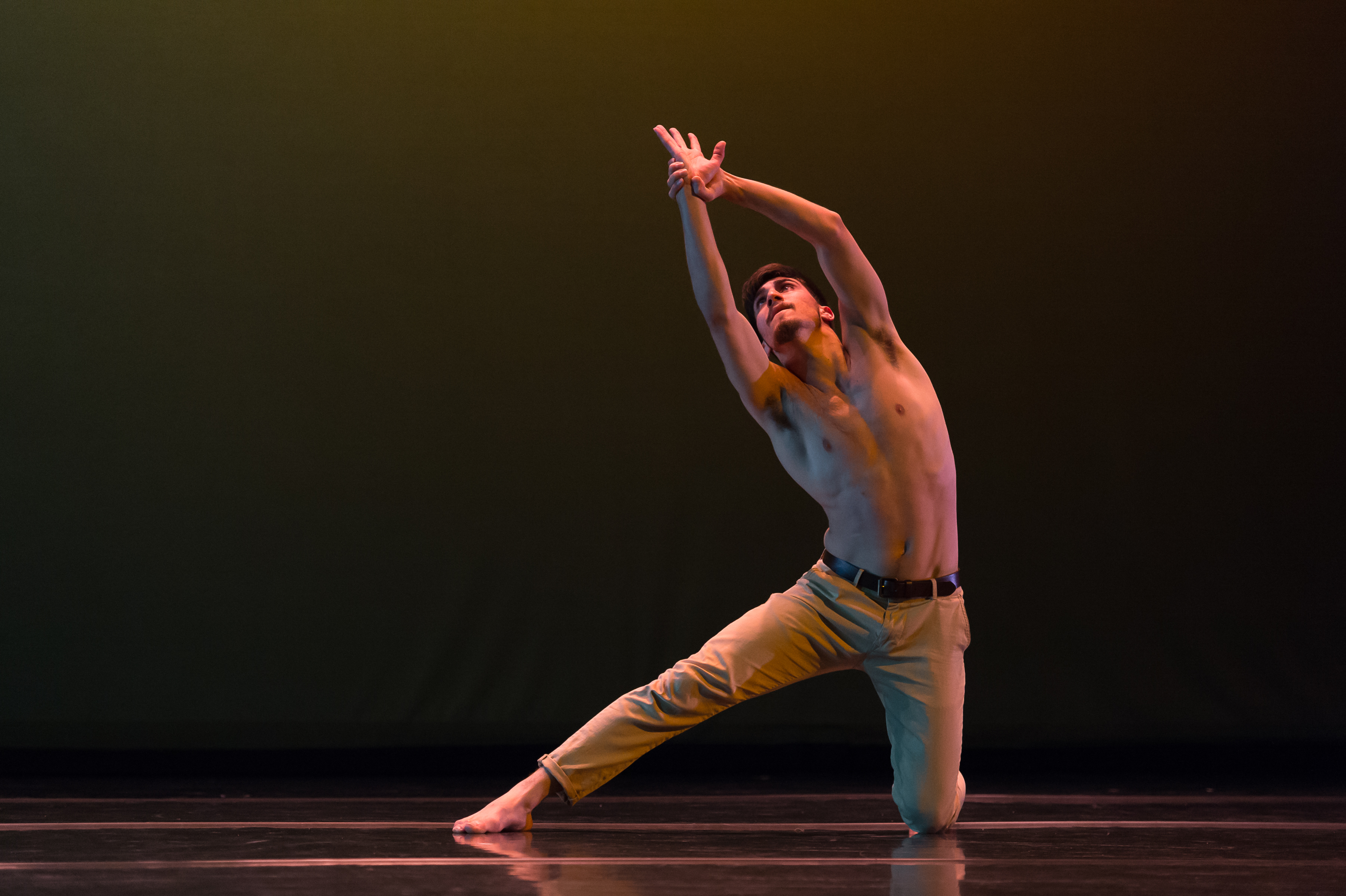
Photo: Dina Litovsky.
Román Baca leads rehearsal on the deck of the Intrepid, the aircraft carrier turned museum on the Hudson River.

The wars that have been fought in my lifetime sometimes seem to have been necessary and inevitable. Most often, not. As the young people head off, I always think about how their lives will have been warped if they get back. It seems so wrong. And right now the services we’ve promised them are being slashed.

Fortunately, there are efforts at healing that forge ahead. One such program involves ballet.

Brian Seibert writes at the New York Times, “When Román Baca was serving as a Marine in Iraq in 2005, he didn’t tell many people what kind of work he had done before the war. He had tried that in boot camp, and it hadn’t gone well. So when his best friend in the platoon asked him why he seemed so interested in local dance practices, he hesitated before admitting the truth: He was a ballet dancer.

“Baca’s friend wasn’t bothered by the revelation. So Baca told him his crazy idea: to translate their wartime experiences into dance.

“Eventually, that crazy idea became Baca’s life. With his wife, Lisa Fitzgerald, he founded Exit12 Dance Company, which makes and performs works about military experience. What started as a way for Baca to deal with his trauma has expanded into a mission to help other veterans deal with theirs — through dance.

“In recent weeks, a group of veterans and family members of veterans, ranging in age and physical ability, has been gathering in the belly of the U.S.S. Intrepid, an aircraft carrier turned museum on the Hudson River. Using various improvisational exercises, they have been creating a dance work [to] perform on May 30 on the ship (on the flight deck, weather permitting). More important than that performance, though, is the process.

“Baca sees the workshops as a corrective for military training. ‘To make a person respond immediately to orders and commit acts of violence, military training changes your identity,’ he said. ‘It removes everything that defines a person’ — your clothing, your haircut — ‘and then it changes you through physical exercises, repetitive motion and powerful brain-body connections.’

“Baca, who has been leading these workshops since 2011, recalled a moment from one: Everett Cox, a Vietnam War veteran who had kept away from everything military for decades, responded to a prompt of action verbs by expertly stabbing and slashing with an invisible bayonet. His long-unused training was intact in muscle memory.

“Another time, Baca was choreographing a military exercise sequence and directed his dancers to yell ‘kill’ with every motion. When Fitzgerald questioned if that creative decision might have been a bit much, Baca explained that he was only being accurate: Coupling all actions with the word ‘kill’ was part of boot camp.

” ‘That’s absolutely needed when you are in uniform,’ he said. ‘But what do you do with that after you get home?’

“The workshops use physical exercises to help restore what Baca, borrowing a term from the philosopher Paul Ricoeur, called narrative identity. ‘You start to tell people who you are and parts of your story and then you listen to others do the same,’ he said.

“ ‘A lot of trauma survivors will say that you never fully heal,’ he added. But as evidence of how the process can work, he pointed to the experience of Cox, who returned from service in Vietnam feeling so guilty and ashamed that he did not consider himself a veteran. ‘I lost my mind in Vietnam’ is how Cox put it to me.

“For nearly 40 years, Cox, who took drugs and attempted suicide, tried to lock away what had happened. He was diagnosed as paranoid schizophrenic; one psychiatrist told him he was incurably insane. Then, in 2010, he attended a retreat for veterans at the Omega Institute, a holistic wellness center in the Hudson Valley. ‘It changed my life,’ he said. For the first time, he began to talk about his wartime experiences, and to write about them, and to cry. …

“ ‘If you’re holding a war in, it takes a lot of energy,’ he said. ‘And if you want to loosen that up, it also takes a lot of energy.’ ”

I so admire Baca, who against what seems to me like very long odds, keeps working hard to bring these damaged veterans back to life.

More at the Times, here.

Read Full Post »

Photo: Battery Dance.
Hussein Smko, a mostly self-taught Kurdish dancer/choreographer whose talent was spotted by Battery Dance over social media in 2014, inspring the company to give him training over Skype.

I love stories of surprising personal journeys, like the one today about a Kurdish boy whose admiration for a soldier’s hiphop move started him on a road to a dance career in the US.

Here’s Brian Schaefer at the New York Times . “When Hussein Smko was 9, the American military arrived in his hometown, Erbil, the capital of Iraq’s Kurdish region. It was 2003, and Smko, already a survivor of the Kurdish civil war, would chase the American Humvees with other kids. One day a soldier beckoned him over and demonstrated a simple, beguiling gesture: He held out a straight arm then made it ripple like water, a classic hip-hop move.

“ ‘I thought it was like a big sparkle,’ Smko, 30, said in an interview. ‘And I was like, How could you break your bones like that?’

“That brief encounter loomed large for Smko, starting him on an unlikely dance journey that eventually brought him to a small, sun-dappled theater in Tarrytown, N.Y., where he was rehearsing with the Swedish choreographer Pontus Lidberg last week: the dance they were preparing, ‘On the Nature of Rabbits. …

“Smko’s path to this moment has been twisting and at times precarious. After his encounter with that liquid-armed soldier, he immersed himself in hip-hop dance, learning Michael Jackson routines through pirated music videos. Finding outlets for dance was difficult. … He was teased and called gay. But he persevered, and at 13 he started the Street Wolves, a hip-hop troupe that helped spread the form in Kurdistan.

“His pursuit of dance brought him to workshops offered by American Voices, a cultural exchange program affiliated with the United States Department of State. That led to a two-month tour of several East Coast cities, including Niagara Falls, N.Y., where he met his future wife, a U.S. citizen. After the tour, he moved in with her, then brought her to Kurdistan in 2013. The next year, ISIS laid siege to the region.

“Smko’s wife returned to the U.S. to give birth to their daughter while he stayed and prepared to fight. But a relative dissuaded him, which sparked a realization.

“ ‘I decided then that I want to fight through art,’ he said. … He applied for a green card and moved to Niagara Falls in 2015. The next summer, he was contacted by Jonathan Hollander, the founder and director of Battery Dance, a New York company that had briefly trained Smko on Skype years earlier. …

“The company quickly absorbed him into its classes and rehearsals, and suddenly Smko was dancing with trained professionals. ‘Hussein came up to that level,’ Hollander said. ‘It was just a miracle.’

“[In] 2020, he found himself at a crossroads. He worked for the Muslim American Leadership Alliance, and at a hotel front desk. He and his wife separated. He went back to Erbil to see his family, his first visit in seven years.

“His prospects improved in 2022, when he was introduced to the dancer and filmmaker Sasha Korbut and cast in the short film Incomplete, alongside Lidberg. ‘Our energies were synced up,’ Lidberg said of working with Smko. ‘It was the most natural thing.’

“That chemistry inspired Lidberg to include Smko in the development of ‘Rabbits.’ … Smko’s contribution to the process proved invaluable. Lidberg, who is used to working with polished, formally trained dancers, appreciated Smko’s raw physicality and unaffected vitality. …

“In 2019, he founded a company, Project Tag, that has shown work at the Battery Dance Festival and other small performance platforms. It is ‘a goal for me to speak about my background and my history.’ “

More at the Times, here.

I liked how Battery Dance described its original connection with the dancer: “Hussein Smko was the Adel Euro Fellow from 2016-2020.  A self-trained Kurdish dancer/choreographer whose talent was spotted by Battery Dance over social media in the summer of 2014, he was subsequently trained via Skype from his home in Iraq connected with Battery Dance practitioners in their studios in New York City. He managed to get to the U.S. in early 2016 and was granted Permanent Resident Status.”

Read Full Post »

Photo: Jastrow at Wikimedia.
Slab with dedicatory Aramaic inscription to the god Salm. Sandstone, 5th century BC. Found in Tayma, Saudi Arabia, by Charles Huber in 1884. Now in the Louvre.

Among the world’s many endangered languages is one cherished today by a branch of Christianity in Iraq, a language close to the Aramaic Jesus spoke.

Sara Hassan reports at PRI’s The World, “In a small church in Baghdad, Iraq, a couple dozen people have gathered for prayers on a sunny Sunday morning. They stand in pews facing a crimson-colored curtain and a podium with a gold Syriac cross on it. The distinctive cross has a total of 12 circles at its points to represent the 12 disciples of Jesus.

“The congregants are reciting their prayers in an ancient language called Syriac. Today, it’s spoken mostly by Christians in Iraq and neighboring Syria. The language traces its roots to Aramaic, which was the script of the original Christian Bible and spoken by Jesus Christ. And it’s part of the family of Semitic languages in the Middle East region.

“The Syriac language is disappearing, with fewer and fewer people speaking it. The official languages of Iraq are Arabic and Kurdish.

“But now, after campaigning by some groups, a newly launched television channel, Al-Syriania, with funding from the Iraqi government, is hoping to change that. The community says it’s a good move toward preserving Syriac and in helping people stay connected with their language and culture.

“The channel has about 40 staff members and can be viewed in Iraq and around the world through satellite networks, such as NileSat and ArabSat. It’s a sister station of Al-Iraqiya, an Arabic television network that was set up in the country after the fall of Saddam Hussein in 2003, which also broadcasts in Kurdish and Turkmen.

“The news bulletins for the new channel are read in classical Syriac, but many of the other programs — which include cinema, art, history, cultural events and music — are presented in a dialect of the language.

“ ‘We have daily segments, like news and morning shows, and also, documentary programs about the history of the church and historical sites,’ said Jack Anwia, the station director. ‘We also play classical Syriac songs and music, the top-100 movies, and we have correspondents reporting from the field.’ …

“In 2003, the country was home to about 1.5 million Christians. Since then, that number has dropped to about 400,000. The war caused many of them to flee to other safer countries. But much of the decline also followed the onslaught of ISIS in 2014, which targeted Christians and other minorities.

“Many of the families settled down in other countries around the world, and younger generations have tried to adopt the languages of their host countries to assimilate better, losing touch with Syriac unless it’s spoken at home. …

“[Father Qasha Shamoun, a priest at the Ancient Church of the East in Baghdad] said the security situation has improved in Iraq over the past several years, but the Christian community is so small that it’s hard to bring people together for programs. … He added that Al-Syriania has been good for providing Syriac programming and that people in his community have told him they like watching it.

“Hundreds of Syriac books and manuscripts have still survived decades of war and migration. In fact, right before ISIS fighters captured large parts of northern Iraq in 2014, the Chaldean Catholic archbishop of Mosul, Najeeb Michaeel, rescued a collection of centuries-old Syriac manuscripts as he fled.

“Now, many of them are preserved at the Digital Center for Eastern Manuscripts in Erbil, the capital of the Kurdish region, which is supported by UNESCO, USAID and the Catholic Dominican Order.

“Back at the news station, Anwia said that it’s important not to lose Syriac. ‘It is one of the oldest languages of Iraq,’ he said. ‘And it needs to be protected from extinction.’ ”

More at The World, here.

Read Full Post »

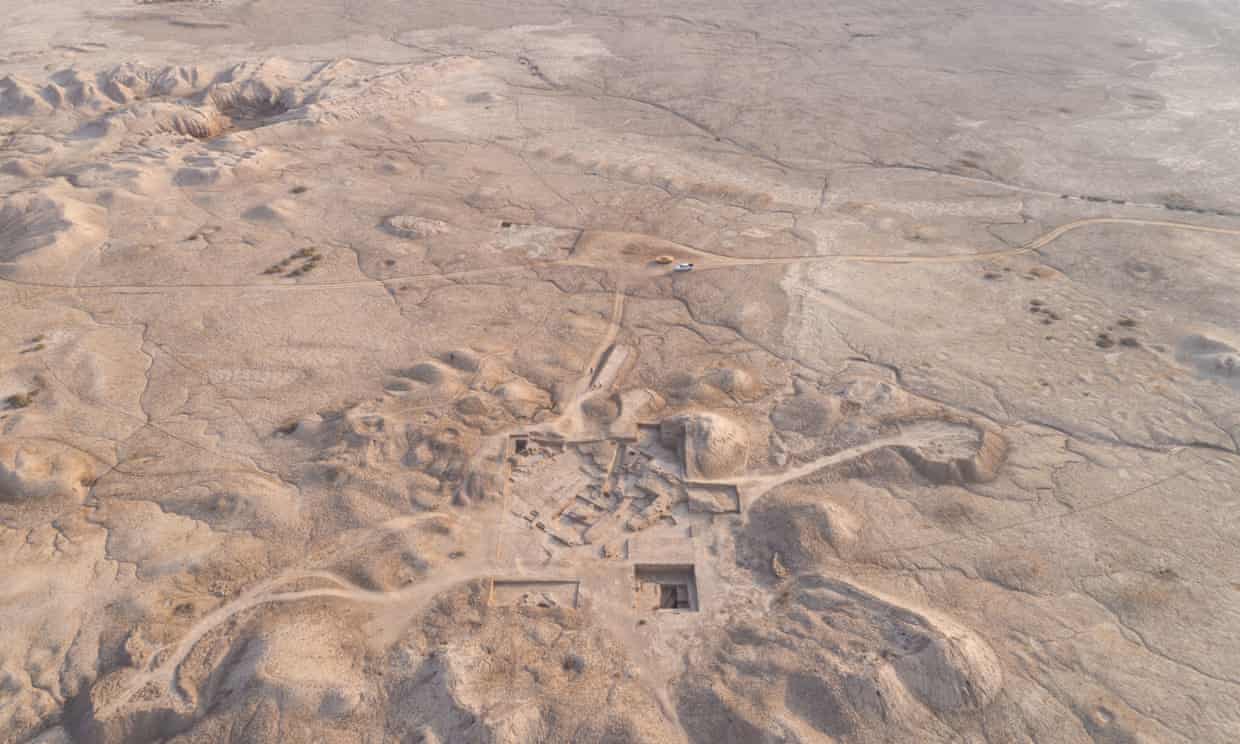
Photo: British Museum.
An aerial view of the ancient city of Girsu in Tello, Iraq. The Sumerians inhabited the ancient eastern Mediterranean region of Mesopotamia. 

Today we have more archaeology for people who love stories about newly discovered ancient places — particularly stories about archaeologists no one believed.

Tobi Thomas reports at the Guardian that “the archaeologist who led the discovery of a lost Sumerian temple in the ancient city of Girsu has said he was accused of ‘making it up’ and wasting funding.

“Dr Sebastien Rey led the project that discovered the 4,500-year-old palace in modern-day Iraq – thought to hold the key to more information about one of the first known civilizations.

“The Lord Palace of the Kings of the ancient Sumerian city Girsu – now located in Tello, southern Iraq – was discovered during fieldwork last year by British and Iraqi archaeologists. Alongside the ancient city, more than 200 cuneiform tablets were discovered, containing administrative records of the ancient city.

“Rey said that when he first brought up the project at international conferences no one believed him. ‘Everyone basically told me, “Oh no you’re making it up you’re wasting your time you’re wasting British Museum UK government funding.” ‘ …

“Girsu, one of the earliest known cities in the history of humankind, was built by the ancient Sumerians, who between 3,500 and 2,000 BC invented writing, built the first cities and created the first codes of law. The ancient city was first discovered 140 years ago, but the site has been the target of looting and illegal excavations. …

“Alongside the discovery of the palace and the tablets, the main temple dedicated to the Sumerian god, Ninĝirsu, was also identified. Before this pioneering fieldwork, its existence was known only from ancient inscriptions discovered alongside the first successful excavation of the ancient city.

“The project follows the Iraqi scheme first funded by the British government in response to the destruction of important heritage sites in Iraq and Syria by Islamic State. Since its establishment, more than 70 Iraqis have been trained to conduct eight seasons of fieldwork at Girsu. …

“The Sumerians inhabited the ancient eastern Mediterranean region of Mesopotamia, and were responsible for many technological advancements, including measurements of time as well as writing.

“According to Hartwig Fischer, the director of the British Museum, the site of the ancient city in southern Iraq was ‘one of the most fascinating sites I’ve ever visited. …

” ‘The collaboration between the British Museum, state board of antiquities and heritage of Iraq, and the Getty represents a vital new way of building cooperative cultural heritage projects internationally. … While our knowledge of the Sumerian world remains limited today, the work at Girsu and the discovery of the lost palace and temple hold enormous potential for our understanding of this important civilization, shedding light on the past and informing the future.’

“The ancient Sumerians may not be as well known a civilization as the ancient Egyptians or Greeks, but according to Dr Timothy Potts, the directory of the Getty Museum, Girsu is ‘probably one of the most important heritage sites in the world that very few people know about. … This innovative [Girsu Project] provides critical support for the uniquely important archaeological site of Girsu, through the training of Iraqi specialists entrusted with its development for sustainable archaeology and tourism.’

“Iraq’s culture minister, Ahmed Fakak Al-Badrani, said: ‘The British archaeological excavations in Iraq will further unveil significant ancient eras of Mesopotamia, as it is a true testimony to the strong ties between the two countries to enhance the joint cooperation.’ ” More at the Guardian, here.

The Guardian adds the “explainer” below is case your memory of the Sumerians is as fuzzy as mine.

“The Sumerians were the inhabitants of Sumer, which is the earliest known civilization in the historical region of Mesopotamia, located in modern-day southern Iraq. According to archaeological evidence, they built about a dozen city-states in the fourth millennium BC.

“Girsu, which is located in Tello, Iraq, was first discovered 140 years ago, and was significant in that it first revealed to the world the existence of the Sumerian civilization, as well as bringing to light some of the most vital monuments of Mesopotamian art and architecture.

“The Sumerians were ancient pioneers, having advanced the craft of writing, writing literature, hymns and prayers. They built the first known cities as well as creating the first known code of law. They also perfected several existing forms of technology, including the wheel, the plough and mathematics.

“The epic of Gilgamesh, considered the world’s oldest surviving piece of literature, derives from five Sumerian poems.

“They were also notably one of the first civilizations to brew beer, which was seen by the ancient people as a key to a healthy heart and liver.”

Read Full Post »

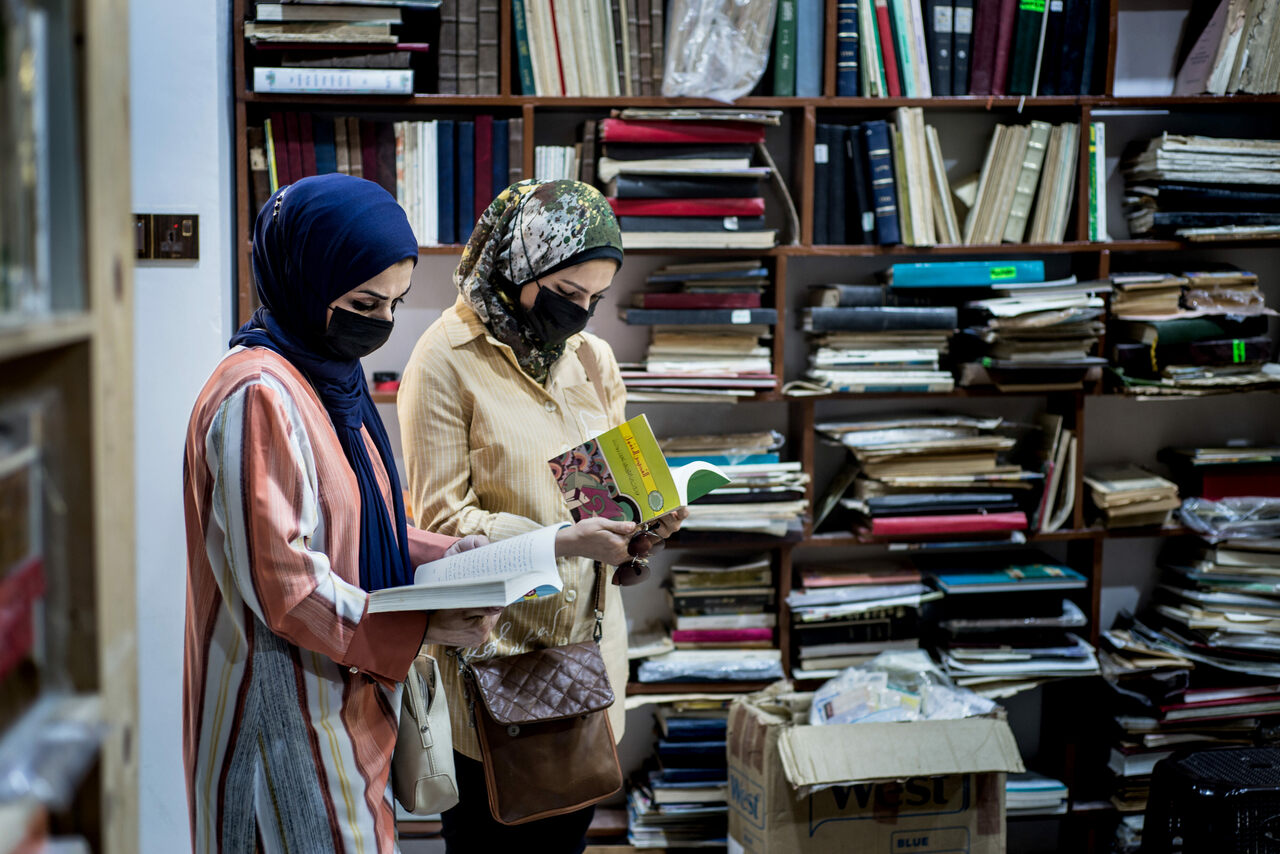
Photo: Lina Malers.
Customers return to Maktaba al-Sham in Mosul’s Old City. Isis kept residents from books, but books won out.

Today’s story honors people who embody the human spirit: rebuilders, booksellers, and book readers. Even in the darkest days of Mosul, Iraq, when Isis believed it could control people’s thoughts, readers hungered for books, and booksellers supplied them. Today one bookseller is rebuilding in the rubble of Mosul’s Old City, on a street once famous for bookshops.

Pesha Magid reports at Atlas Obscura, “Tucked into an alleyway off Najafi Street in Mosul’s Old City is a small red and gold sign advertising a bookstore: Maktaba al-Sham. Not long ago, it was one of countless bookstores along the wide avenue lined with arched windows and doorways. Since the early 1900s the street has been a bustling cultural hub where intellectuals meet to sip tea, debate friends, and buy books.

“But today Najafi Street is in ruins, burned by the ISIS fighters who occupied Mosul and bombed by a United States-led coalition in an effort to liberate the city. The airstrikes destroyed many of the buildings, leaving only pits in the ground. Others are broken, their wire and concrete innards twisted and exposed. The elegant arched building entrances that remain lead to empty, dark spaces. Inside the shell of one former shop, you can still see the outlines of books set aflame by ISIS preserved in ash. Four years after the liberation of Mosul in 2017, Maktaba al-Sham is the first, and so far the only, bookshop to return to the street.

“Daud Salim first opened Maktaba al-Sham around 2001. The now-49-year-old man with silver hair and a hummingbird’s constant energy has loved books since childhood, and he found a natural talent for selling them. He started with used copies of novels by famed authors such as Agatha Christie and Victor Hugo, as well as some history titles.

“Salim kept the store open when ISIS took over in 2014, but on December 5, 2016, as the battle between ISIS fighters and liberation forces began to advance toward the Old City he realized the only way he could survive was by closing the store and sheltering in his home on the other side of the city. During the final battles in 2016 and 2017 ISIS took refuge in the maze-like warren of small streets in the Old City, blowing up the bridges behind them and trapping civilians there as human shields.

“When Salim returned to Najafi Street in March 2018, almost a year after liberation, the Old City was still a dangerous place. The streets were littered with broken pieces of concrete, and ISIS had booby trapped houses with explosives. … Despite the devastation, Salim decided to reopen Maktaba al-Sham. “This bookstore has big memories for me. I spent more than 20 years here. So I remember every place, I remember who went where and who did what, and I longed for it,” he says.

Also, he says the rent was cheaper in the rubble.

“Maktaba al-Sham is a small sliver of a shop, its interior hardly bigger than a closet and its walls fully obscured by books. But this tiny store’s return has outsized meaning to Mosul residents who feel they lost a key part of their city’s heritage in the battle. After the conflict Mosul became like two cities divided by its river. The Left Side of the city, where fighting and airstrikes were less intense, is again full of bustling avenues, restaurants, cafés, and residential neighborhoods, while life has returned more slowly to the Right Side, where the Old City is located. New cafés and markets on the Left Side sell books and attempt to fill the gap that the destruction of Najafi Street left behind, but hundreds of years of history cannot be easily replaced.

“ ‘Any person who loves books in Mosul, if you ask him what street he loves, he will immediately answer Najafi Street,’ says Imad Abdul Azizi, a professor of history at the University of Mosul. … ‘I was so joyful when Maktaba al-Sham came back to Najafi Street.’ …

“ ‘After the fall of [Saddam Hussein’s] regime, people were excited to get to know books,’ [Salim] remembers. ‘It was so open, nothing was forbidden.’ … But when ISIS came to Mosul in 2014, they banned works that did not fit their strict religious guidelines, which Salim says included almost all non-religious books. …

“Books became contraband. Salim hid the majority of his stock in a storage unit near his bookshop and secretly met customers in alleyways.

He would pass [customers] copies of novels in black plastic bags. The most popular works during those years were anti-authoritarian novels like 1984. …

“Bookselling was dangerous. Salim says ISIS kidnapped a bookshop owner named Dhaker Ali for selling law books and they burned his shop on Najafi Street. … ISIS came for Salim’s books as well. In the summer of 2015, during the Muslim holy month of Ramadan, fighters found the storage unit where he had hidden 5,000 books. … ‘They believed the books I brought from Egypt on society and philosophy were a violation…so they started the fire,’ says Salim. …

“But he continued to acquire books. Because he could not travel to get new titles, he bought used books from people’s home libraries and sold them to loyal customers. …

“Coming back to the Old City [after liberation] was a risk to his business. He says when he initially opened he lost money, but the impact he made on the community encouraged him to keep going. Sometimes, people with memories of Najafi Street come to take pictures of him and his shop on the street of bookstores. ‘People gave me the bravery to stay,’ says Salim.”

More at Atlas Obscura, here.

Read Full Post »

Photo: Book Aid International
The first shipment of books for the University of Mosul’s library arrives in Iraq for Alaa Hamdon’s Book Bridge campaign.

It’s a good thing that humans are like ants in one regard because as soon as a community is destroyed, people begin the work to build it back up. That is what is happening in Mosul, Iraq, a city that was overrun by the culture-hating forces of Isis not that long ago.

Olivia Snaije writes at Publishing Perspectives, “Since the destruction of the University of Mosul’s library, momentum is building for Book Aid International’s efforts to coordinate and enable publishers’ contributions to rebuilding. …

“Most news accounts date the main destruction of the University of Mosul library to 2015, following the start of the Islamic State group’s occupation in June 2014. … The library had been one of the most important in Iraq and the Middle East, a repository of information on the cultures, religions, and ethnicities that make up the region. The destruction of thousands of books, many of them precious, was a tragic addition to the country’s list of tremendous cultural losses in recent years.

“Used by up to 40,000 students, the library was, in the words of Alaa Hamdon at the London Book Fair, ‘an icon for the university, a lighthouse for students and the community, a shining light at the heart of the university.’ Hamdon is the founder of the Mosul Book Bridge campaign to rebuild the library. …

“When Mosul was liberated from ISIS in 2017, Dr. Hamdon decided to establish the Mosul Book Bridge effort to rebuild the university’s library, and contacted Book Aid International. The British charity works with more than 100 publishers in the UK and reports sending up to 300,000 books to countries worldwide.

“Traditionally, Book Aid’s service area has been mostly in Africa. But [Alison Tweed, chief executive, said] that reports of the deliberate cultural and intellectual destruction in Iraq were so moving that she offered to partner with Hamdon’s Mosul Book Bridge campaign.

“ ‘We have infrastructure and logistics,’ she said, ‘and it seemed like a wonderful partnership. … We like a challenge. We made a selection of books and put them onto trucks. They sat in Bulgaria for a few weeks and then limped across the border. The situation is volatile and ever-changing, but the books got there.’

“When the first shipment of 3,750 or so books arrived in Mosul in March 2018, Hamdon said he and his colleagues danced in the street. Tweed said that her colleagues danced in the office. ‘That appreciation is everything for us, it makes our work worthwhile.’

“What made Book Aid’s coordination and contribution especially valuable was that they delivered new books that the University of Mosul had specifically requested, said Mehiyar Kathem, whose Nahrein Network helps people across the Middle East to ‘reclaim their ancient heritage as local history, putting it to constructive use for their communities.’ …

” ‘I visited Mosul in January,’ Kathem said. ‘I’d like to stress how important it is to have the physical books there because the Internet doesn’t work well. These are brand-new important books, because you also have out-of-date books donated, like a book on electronics from the 1980s.’ …

“Hamdon said that rebuilding the library can help ‘give hope to everyone living there, that culture is back. People will feel reassured about their education and their future.’ ”

More here.

Read Full Post »

Photo: Thomas Stanley
Hadi Jasim was an Iraqi translator for the US military. Now he’s a “global guide” at the Penn Museum in Philadelphia.

As you know, I’m a fan of immigration and of welcoming refugees to this immigrant-built country. It’s not usually easy for immigrants once they get here. They are required to find a way to support themselves within a few months, and, if language is a barrier, they must learn English as soon as possible.

Some immigrants start their own business. Some — even if they are highly skilled — take jobs that don’t need English. I know a Haitian immigrant who, for example, was a physician with years of experience who nevertheless took a kitchen job and was grateful to find work.

Once in a while I read a story like the following, in which some wise boss or institution finds a really creative way to employ an immigrant.

Emma Jacobs reports at Public Radio International (PRI), “At the University of Pennsylvania Museum of Archaeology and Anthropology, Moumena Saradar directs a group of visitors to a glass case containing an enormous gold headdress and beaded shirt — the burial garments of Queen Puabi, who died around 2550 BCE. They’re a highlight of the museum’s Middle East gallery, reopened in April after a $5 million renovation.

“ ‘Queen Puabi’s burial jewelry is one of my favorite objects in the gallery,’ says Saradar, who goes on to explain that in Syria today, people still save up for gold jewelry for their wedding. She shows pictures of packed jewelry shops in Damascus, walls glittering from floor to ceiling.

“Saradar is among the museum’s new tour guides — immigrants and refugees from Syria and Iraq who can make connections between the ancient artifacts and the present-day cultures.

“Saradar and her family arrived in Philadelphia as refugees in 2016, and she now works as a medical interpreter during the week and gives tours of at the gallery on weekends. …

“As a guide, Saradar went through intensive training to prepare her to give detailed historical tours and respond to visitors’ questions. She says she practiced on her five children.

“According to Kevin Schott, the Penn Museum’s education programs manager, Saradar and the other guides offer something local docents can’t.

“ ‘At some point in almost every tour somebody will say, “What about today? Do they still eat these things today?” Or, “Is this place still a place people go?” And I’m like, “I don’t know. I can’t answer your question.” ‘

“These guides are expressly trained to weave their own personal stories and memories into their tours — things they would feel comfortable talking about over and over again.

“Another guide, Hadi Jasim, spent his summers as a child at his grandfather’s house in southern Iraq, near the source of many of the objects in the gallery: the ruins of the ancient city of Ur.

“ ‘Sometimes we used to take the soccer balls and play’ because it was an open area, Jasim says. ‘Sometimes we used to play like other games like seek and hide, you know, kids’ games.’ …

“Fresh out of college near the beginning of the Iraq War, Jasim became an interpreter for the US-led coalition forces in 2004. He went on to work for the UN in Iraq doing communications and anti-trafficking work. In 2017, he finally received permission to come to the United States on a Special Immigrant Visa for Iraqis who worked with the US military.

“Now, Jasim has a job in food service at a local hospital. He says the museum work has become more than a second income.

“ ‘Sometimes, even if I don’t have tours here, I just show up to work, go through the Middle East gallery, go and see the clay tablets and see the carvings,’ he says. ‘It just brings my memories back.’ …

“ ‘Being close to your heritage is something that makes you feel like okay, now I’m back. You know, I don’t feel like I’m a stranger [any] more.’

“Jasim will have more colleagues joining him at the museum in the future. The Penn Museum plans to hire guides for all of its global galleries.” More at PRI, here.

I find many things to love about this story, but if I had to choose one thing, do you know what it would be? It would be the look on these two guides’ faces. A look of peace.

Photo: Idil Demirdag
Penn Museum global guide Moumena Saradar came to the US as a Syrian refugee two years ago.

Read Full Post »

2251

Photos: British Museum
Tello in Iraq is the site of one of the oldest cities on earth. After the fall of Saddam, looted treasures ended up in London and, thanks to archaeological detective work, have been returned. Today the site is protected by both Iraqi archaeological police and a local tribe.

When you think something is lost forever, hold on to hope. If looted archaeological fragments that have been smuggled to another country can be identified and returned, you can find the family heirloom you put in a too-safe place. You can find the delight you once took in simple things back when you were too young to read the news.

Maev Kennedy reported for the Guardian in August, “A collection of 5,000-year-old antiquities looted from a site in Iraq in 2003 after the fall of Saddam Hussein, and then seized by the Metropolitan police from a dealer in London, will be returned to Baghdad this week.

“It comes after experts at the British Museum identified not just the site they came from but the temple wall they were stolen from.

The eight small pieces had no documentation of any kind to help the police, but the museum experts could literally read their origin.

“They included cone-shaped ceramics with cuneiform inscriptions identifying the site as Tello, ancient Girsu in southern Iraq, one of the oldest cities on earth recorded in the earliest form of true written language.

“The inscriptions named the Sumerian king who had them made almost 5,000 years ago, the god they were dedicated to, and the temple. And by an extraordinary coincidence the museum had an archaeologist, Sebastian Rey, leading a team of Iraqi archaeologists at the site, uncovering the holes in the mudbrick walls of the temple they were torn from, and the broken pieces the looters had discarded. …

“Iraqi ambassador Salih Husain Ali [said] the protection of antiquities was an international responsibility and praised the British Museum and its staff ‘for their exceptional efforts in the process of identifying and returning looted antiquities to Iraq.’ …

“St John Simpson, the assistant keeper at the Middle East department of the museum, said: ‘Uniquely we could trace them not just to the site but to within inches of where they were stolen from. This is a very happy outcome, nothing like this has happened for a very, very long time if ever.’ …

“The site of the Eninnu temple at Tello is now protected, not just by the reformed Iraqi archaeological police, but by a local tribe. …

“With no apparent way of tracing their origin, they sat in police stores until some of the antiquities cold cases were reopened with the reforming of the Met’s art and antiquities squad, and brought to the museum earlier this year. …

“The museum experts hope their methodology could be used to create maps of specific sites and types of antiquities, making the work of looters much more difficult.”

More at the Guardian, here. Wouldn’t you like to reach across time and tell the craftsman of the sweet little bull below that people in 2018 are still enjoying it?

Treasures looted from the site of an ancient city in Iraq include a tiny marble amulet of a bull.

1793

Read Full Post »

Photo:  Diana Markosian / Magnum Photos
Yazidi refugee children are overcoming fear of the water in Germany.

One reason I was interested in the following story is that I have worked with Yazidi refugees from Iraq like these. One of the people in the family I know actually has relatives in Germany, where the story takes place.

Philip Oltermann writes at the Guardian, “When Hanan Elias Abdo looked over the side of the rubber boat into the deep blue sea, she could make out two large shapes, moving at speed. Were those dolphins? Or sharks? ‘Did you see the fishes?’ she shouted at her siblings.

“Six-year-old Sulin, the youngest, … was lying on top of a thin patch on the boat’s floor and could feel the water moving underneath her. At home, in the Sinjar mountains in Iraq, she had never more than splashed through an ankle-deep brook. What if the floor gave way and she got pushed into the bottomless depths? What, she thought, if the fishes started nibbling at her feet?

“That was in September 2015. Two and a half years later, Sulin stands atop a starting block in northern Germany, takes a two-step run-up, waggles her arms and legs mid-air, before landing in the 2-metre-deep turquoise water and splashing her giggling sisters who are paddling near the edges. Surfacing, she pulls a funny face at the man with the white beard and white slippers applauding her from the side of the pool. ‘That’s it!’ says Günter Schütte, Germany’s first swimming instructor to specialise in helping to cure refugees’ fear of water.

“Schütte is a teacher with 40 years’ experience teaching politics and sport at schools in Wolfsburg, and a passionate swimmer since he was 13. Throughout his career, he says with pride, he made sure that by the end of the school year there was never a non-swimmer in any of his classes. …

“When Schütte realised that many refugees who arrived in Wolfsburg were families from countries with little open water, and that many children had been traumatised by the journey across the Mediterranean, he decided that swimming could become a tool for better integration.

“From October 2015, he booked a two-hour slot every Sunday at a municipal swimming pool and handed out flyers advertising the course at asylum seekers’ shelters in the area. …

” ‘We take our time,’ he says, ‘because when you are scared, time-pressure is the last thing you need.’

“The purpose of the course was to help the new arrivals ease into an unfamiliar element – in a metaphorical sense, too. ‘By learning how to swim, refugees are no longer shut out from the sports lessons at school,” Schütte says. ‘Some of them also get a head start on their German peers – they have a sense of achievement.’ …

“Sinjar province, where Hanan, Helin and Sulin, now nine years old, grew up, is a traditional stronghold of the Yazidi minority who were declared infidels by al-Qaida and actively targeted by Isis in 2014. Helin, now 12, recalls a phone call late that summer from her grandmother, who lived in the next valley along: Isis fighters were approaching and the villagers had run out of ammunition. …

“There was no time to wait any longer. Their mother, the six siblings and a neighbouring couple all piled into a single car and headed for the Turkish border, leaving behind the two family goats and the cherry and orange trees in their garden. Months later, after crossing the Mediterranean and seven different countries, someone sent Helin a photograph of their village. ‘The war had flattened everything,’ she says. …

“For now, the pool can suspend the pressures bearing on them outside. … Hanan wants to go a step further and get the rescue swimming badge in silver, for which she has to take a jump from a 3-metre board, swim 25 metres underwater in one breath, and rescue a drowning person with pull stroke. Asked what she wants to do when she grows up, she doesn’t take long to come up with an answer. ‘I want to become a sports teacher.’ ”

More here.

Read Full Post »

Photo: Hartford Courant
Former US Marine Roman Baca
develops ballets that help veterans heal and help audiences gain empathy. For his Fulbright Fellowship, he’s creating a new version of Igor Stravinsky’s
Rite of Spring tied to WW I.

Not long ago, Suzanne’s friend Liz found a piece of antique weaponry and asked instagram friends how it might be used in an art project or something else positive.

I said to “beat it into plowshares.”

In their own way of beating weapons into plowshares, war veterans may continue to serve the country after their time in the military. They may run for Congress like Seth Moulton of Massachusetts or establish a nonprofit like Soldier On, which treats veterans suffering from addictions.

And then there’s the Marine who became a choreographer to tell stories that enlighten and heal.

Candice Thompson writes at Dance Magazine, “When Roman Baca returned home from active duty in Iraq in 2007, he found himself having a tough time transitioning to civilian life.

” ‘I remember a couple of instances where I was mean and angry and depressed,’ says Baca. [His wife] suggested Baca return to his roots in dance. ‘She asked me, “If you could do anything in the world, what would you do?” ‘…

“Baca had to broker his transition back into dance. Earlier, he had trained at The Nutmeg Ballet Conservatory in Connecticut and spent a few years as a freelance dancer before feeling compelled, like his grandfather had, to serve his country. ‘I walked into the recruiter’s office and said, “I want to help people who can’t help themselves.” ‘ Baca reveled in the rigor of the Marine Corps, which seemed like a perfect analog to classical ballet. …

“Baca served as a machine gunner and fire team leader [in Fallujah]. And while his job was one of looking for insurgents and intelligence, Baca also ended up doing humanitarian work, bringing water and school supplies to those in need. The transition from violence to aid helped him meet his original desire to defend the vulnerable.

“In 2008 … he reached out to his mentor Sharon Dante from The Nutmeg Ballet Conservatory. He had dabbled in choreography before joining the Marines and had begun to write while overseas. Dante suggested [that he] focus his writing and choreography on his experiences in Iraq. The exploration led Baca to form Exit12 Dance Company, a small troupe with a goal of inspiring conversations about the lasting effects of violence and conflict. …

“When a theater in the UK reached out to him in 2016 about creating a new Rite of Spring — one that would explore the connections between the creation of this famous ballet and the outbreak of World War I, in commemoration of the war’s centennial, as well as touch on today’s veterans and current events — he knew immediately it was a project for [him].

” ‘One percent of our population serves in the military, and an even smaller number serves in war,’ explains Baca of one of the central questions motivating this new commission. ‘How do we take all of this remote and little understood experience and inspire the audience to positive action?’ ”

More at Dance Magazine, here.

Read Full Post »

There are so many interesting cultures in the world! For example, when I was editor of a magazine about lower-income issues in New England, I heard for the first time about the Karen from Burma (Myanmar). Who? Soon after, I managed to acquire an article on Karen refugees in Waterbury, Connecticut, so I was able to learn something along with my readers.

Recently, I heard of another new-to-me minority, members of which are being resettled in Massachusetts. They are called Mandeans, and their pacifist religious beliefs had subjected them to persecution in Iraq and Iran for millennia.

Here is what Brian MacQuarrie writes about them at the Boston Globe.

“The Mandaeans have found safety and acceptance since they began arriving [in Worcester] in 2008, freely practicing a monotheistic religion that predates Christianity and Islam. But they still do not have a temple — a ‘mandi’ for baptisms, marriages, and birth and death rituals — and whether one is built could determine if they continue to call Worcester home.

” ‘Work is not the anchor, living in an apartment is not an anchor, the mandi is the anchor,’ said Wisam Breegi, a leader of the Mandaean community. …

” ‘It really is a culture that is in danger of disappearing,’ said Marianne Sarkis, an anthropology professor at Clark University. ‘If you don’t have a way of preserving the culture and traditions and even the language’ of Aramaic — what a temple helps provide — ‘it is not going to survive very long.’ …

“ ‘We really don’t have the expertise, the know-how, the connections,’ said Breegi, who also has founded a scientific firm that is developing a low-cost, disposable, neonatal incubator for use in developing countries.

“To help forge the religious connections, Breegi and Sarkis are preparing an application for a nonprofit organization to help raise money for the temple. Worcester Mayor Joseph Petty said in an interview he is willing to help the project where he can.

“ ‘They’re all doing what everyone else is trying to do — working hard and getting their kids a good education.’ …

” ‘It’ll just help make Worcester stronger in the long run,’ Petty said of his city’s embrace of Mandaeans and other immigrants. ‘You can’t build walls between people.’ ”

Worcester held a ceremony of welcome in April that “represented the first time — anywhere, at any time — that Mandaeans had been recognized as a valued, important minority group, Sarkis said.” Wow.

More here.

Photo: Craig F. Walker/Globe Staff
The Kalmashy family (left to right) Lilo, and her husband Mahdi and their daughters and Sura and Sahar, shared lunch at their home in Worcester.

Read Full Post »

In a recent NY Times article, art critic Holland Cotter expressed skepticism that a show of new artists lumped together as “Arab” could work. (Some artists declined to participate for the same  reason.)  The artists in the New Museum exhibit are from “Egypt, Iraq, Jordan, Kuwait, Lebanon, Morocco, Saudi Arabia, Syria, Tunisia and the United Arab Emirates, not to mention Europe and the United States.”

But in the end, he was thrilled with the opportunity to see the new works.

“It’s a big show, intricately pieced together on all five floors of the museum, and starts on the street-level facade with a large-scale photograph of an ultra-plush Abu Dhabi hotel. The image was installed by the cosmopolitan collective called GCC, made up of eight artists scattered from Dubai to London and New York who make it their business to focus on the preposterous wealth concentrated in a few hands in a few oil-rich countries on the Persian Gulf.”

Cotter goes on to describe many of the pieces in detail, here, and concludes with some advice for visitors.

“To appreciate this show fully, a little homework can’t hurt. But really all you need to do is be willing to linger, read labels and let not-knowing be a form of bliss. In return, you’ll get wonderful artists, deep ideas, fabulous stories and the chance, still too seldom offered by our museums, to be a global citizen. Don’t pass it up.”

The show will be up until September 28.

Photo: Ruth Fremson/The New York Times

“Here and Elsewhere” show at the New Museum

Read Full Post »

In “Resurrecting the Book Market of Baghdad” at Narratively, Aditi Sriram writes that Baghdad’s Al-Mutanabbi Street once “appeared to be made of books: they littered the sidewalks, waved from tables and carts, sat on shelves inside bookstores, and peeped at passersby through the windows.”

In 2007, a bomb destroyed the street, and far away in San Francisco, bookseller Beau Beausoleil read about it.

“My bookstore would have been on that street,” he says.

He didn’t raise money. Instead he energized his contacts and their contacts in the literary and artist community to make broadsides and art about what had happened, give poetry readings, and spread awareness.

In addition, writes Sriram, “after several years of trying, Beausoleil finally got through to the director of Baghdad’s national library—which he described as a ‘gigantic moat around a public figure’—and was delighted when Dr. Saad Eskander immediately understood his hope to take the Iraqi people’s suffering ‘into ourselves and acknowledge it, and respond to it.’

“Beausoleil’s voice lightens as he recalls Eskander’s positive reaction. ‘He said, “I want these broadsides for the national library, for the archive. I think it’s important that the Iraqi people see this work.” ‘ …

“The 130 broadsides [will] start to be exhibited at the national library in Baghdad in late 2016 and anniversary readings [will] take place every year all over the U.S. and U.K.”

More here.

Photo: AP/Khalid Mohammed
Iraqi men look at books displayed on Al-Mutanabbi Street in December 2007, nine months after a bombing.

Read Full Post »

Maria Di Mento writes in The Chronicle of Philanthropy about a new fund to help military families.

“Three affluent families are forming a fund with the purpose of raising $30 million to support programs that serve military veterans, the Iraq and Afghanistan Veterans of America announced [in July].

“The families have donated more than $1 million and plan to seek contributions especially from other wealthy people, including those without personal connections to any service members.

“Philip Green, president of PDG Consulting, a health-care consultancy,  and his wife, Elizabeth Cobbs, chief of geriatrics at the Veterans Affairs Medical Center in Washington, D.C., joined with their friends Glenn and Laurie Garland and with the Jim Stimmel family to create the fund, Mr. Green said in an interview with The Chronicle.

“The money raised for the new Veterans Support Fund will be funneled to five nonprofits that help returning service members and their families.” Read more.

I think it’s interesting that the donors are reaching out to those who have not been personally touched by the wars to solicit funds. On a blog at work we were just discussing the fact that so many men and women were risking their lives, their families’ stability, and their mental health for the last ten years while so many of the rest of us were mostly untouched.

Hats off to these philanthropists! It’s one thing to see the unequal contributions of Americans. It’s another to do something about it.

Photograph: Sarah Conard/Reuters/File
Sgt. Audrey Johnsey (left) greets Sfc. Joshua Herbig (right), who she served with in Afghanistan, during the Welcome Home Heroes Parade in St. Louis in January.

Read Full Post »

The happy faces say it all. The circus is good for Baghdad.

An article by Michael S. Schmidt and Zaid Thaker in today’s NY Times describes the scene. “There were not any tigers because the animals were stuck in Egypt. There were dogs, however, but they were not [the promised] poodles. And the big snake, well, the snake had become sick and had to be evacuated …

“A circus coming to town may be a routine event in most cities. But in battered Baghdad, even if it was not the Greatest Show on Earth, the arrival of the circus was yet another small step in this city’s efforts at building a more normal life. …

“There is not a commanding ringmaster. What it does have, though, are dancers jumping rope, a woman swinging from a trapeze (without a net, but with a harness), and a grand finale of a man clad in an Iraqi flag plunging swords down his throat.  …

“Faisil Falleh, 56, who took his family to the circus on a recent night, said, ‘I haven’t seen anything in my life like this.’  …

“Promoter Jasim Mohammed Saeed said,  ‘Nobody is working in this business in Iraq. It is just us.’ ” Read more here.

If you want to go, it’s $12 for adults, $6 for teens, and free for children. The cotton candy — “lady’s hair” in Arabic — is $1.

Read Full Post »