Feeds:
Posts
Comments

Posts Tagged ‘opera’

Photo: Amy O’Neil.
Amy O’Neil, the Digital Content Marketing Manager for the Dallas Opera, has earned the organization a new following thanks to her quirky, fun, and innovative videos that explain everything.

Many people adore opera, but there are also many who are sure they wouldn’t like it, even though they’ve never tried. So how is Dallas Opera attracting new, younger audiences?

Bethany Erickson at D magazine interviews the brains behind the change.

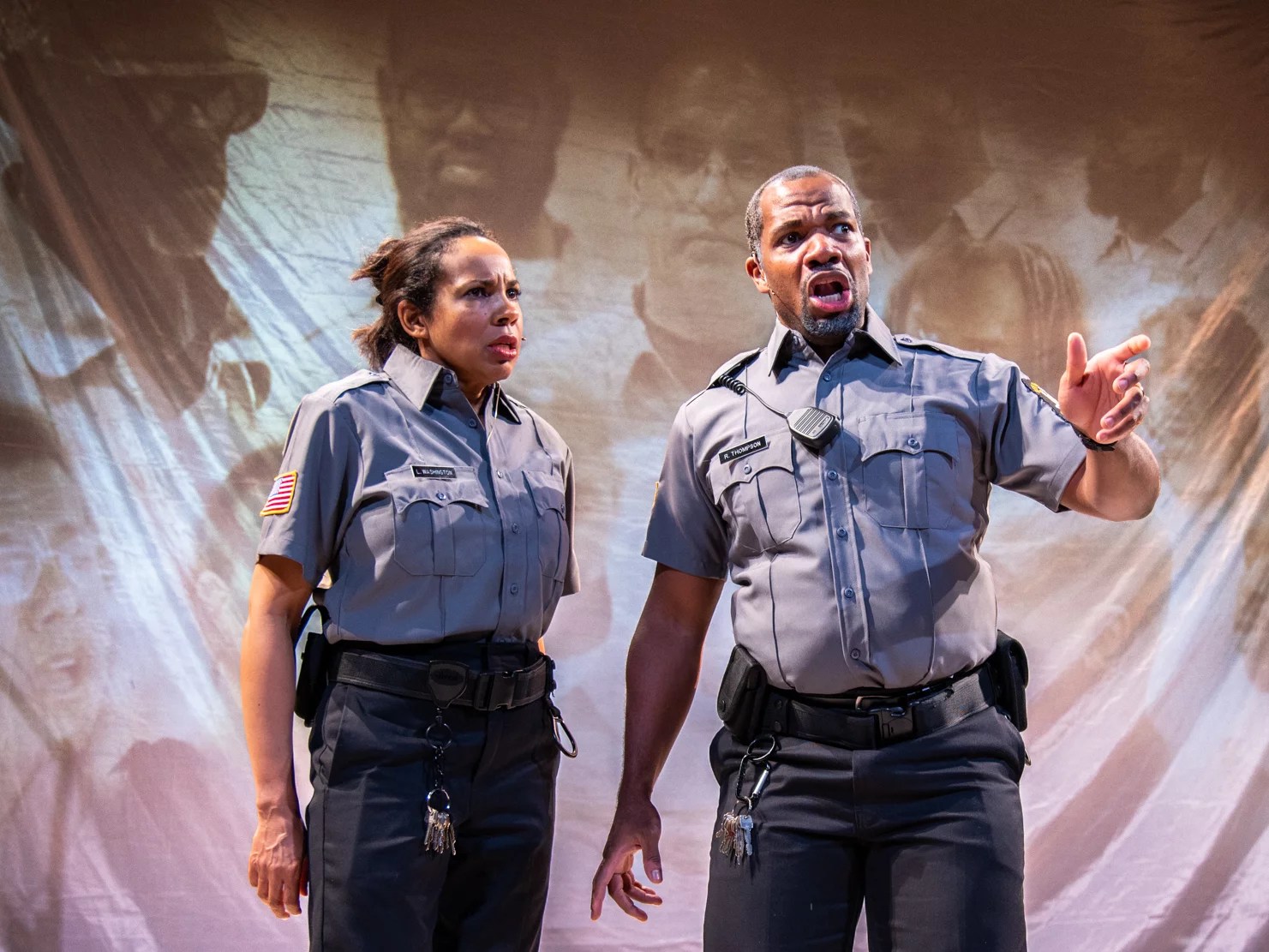
A few of the Dallas Opera orchestra’s musicians were ready to leave after practice, but a handful were still milling around their rehearsal space in the Winspear Opera House. Some of them were gathered around a machete-wielding percussionist as he attempted to mimic the sound a guillotine makes as the blade descends to chop off someone’s head. 

“After tries with other instrument combinations yield OK but not spectacular results, he stands next to a metal pole, then slides the machete against it, the metal-against-metal action creating a ‘snick’ and then a long, slicing ‘hiss’ as the machete descends, followed by a heavy thunk at the end. …

“On hand to capture the behind-the-scenes work for the season’s second production, Dialogues of the Carmelites, [Dallas Opera social media guru Amy O’Neil] says she’s not sure exactly what she’ll use the footage for, but she wasn’t going to miss filming it.

“That sort of infectious creativity has made O’Neil’s work for the Dallas Opera a must-watch. From her fun, punchy synopses of upcoming productions to her award-nominated series ‘Don’t Look Under the Wig,’ she says her work is aimed at making the opera feel more accessible. …

“O’Neil has been with the Dallas Opera for more than six years, starting in group sales before convincing her employer that her talents might just attract a new wave of opera buffs. A UNT graduate, she studied business, music, and communications, and then spent time abroad studying, among other things, classical music and opera history in Vienna. She also does improv and is a musician. …

“O’Neil and I sat down at a table overlooking the Winspear’s expansive lobby to talk about her work. What follows has been edited for clarity and brevity.

Bethany Erickson
“I told my coworkers to check out the Dallas Opera social media feed because it was so fun.

Amy O’Neil
“Oh my god, I have so many more things about to come out that are more me, just telling our audience things, because time and time again, that’s what performs well. Like, they just want to see me as a goofy regular person, going, ‘Can you believe this? She’s cursed and on a random island,’ and whatever.

Erickson
“So take me back in time to when you first started.

O’Neil
“I started in ticketing, and then I did group sales, and then I was social media, and now I’m, like, all things digital. … They were coming to me and saying, ‘We want you to do a program or whatever you want where you’re doing makeup stuff,’ and that’s where ‘Don’t Look Under the Wig’ came in. And that really opened the door to not only show the company, ‘Oh, hey, I can do all these other crazy things,’ but also to test how I did with the people out there. …

“The first time I did a synopsis, it was because we didn’t have any ready-to-go assets, and I was like, ‘I’ll come up with something.’ … I wrote it, filmed it, and edited it all within like 2 1/2 hours. And I mean that’s, like, my shortest synopsis, like a minute and a half, so it’s not like impressive or anything. It took off, and then it was like, ‘Oh, well, maybe I should do this for the next opera.’ …

Erikson
“I don’t envy you having to figure out the tone for the Dialogues of the Carmelites synopsis. …

O’Neil
“It’s interesting because we were talking about this recently. I wanted it to be unbelievably clear that Dialogues of the Carmelites is based on a real story about real nuns who were really beheaded and persecuted for their religion and died martyrs. … I can make housewife jokes about Don Carlo, but not about Dialogues of the Carmelites. … I want to do the Dialogues of Carmelites and still have it be a fun video, but not at the cost of disrespecting the art. It’s just a fine line. …

“One of my favorite things that happened last season was when I was just walking around before a show in the hall, taking pictures and whatever. And these two girls ran up to me. And they were like, ‘Oh my god, you’re the reason we’re here.  We just had to tell you because you’re the reason we’re here. When we saw you, we had to tell you.’ ”

More at D Magazine, here. Note that long before Dallas explained opera, both Looney Tunes and Disney took it on. Check out Bugs Bunny, here, and Willie the Whale, here.


Read Full Post »

Photo: Ahmed Gaber for the New York Times.
“I figured I was probably winding down,” the soprano Lucy Shelton said of her career. “But then I got wound up again.” Shelton’s latest opera is Lucidity, about identity and dementia.

Today’s story is about an 80-year-old opera singer whose career took a new lease on life. I’m always impressed by things like that, especially as I know that memory starts playing tricks. In fact, today I nearly posted a story that I posted a couple weeks ago. Of course, I’ve been blogging every day for about 13 years, getting older all the time. Bound to repeat a post by accident.

Back to the opera singer. Corinna da Fonseca-Wollheim reports at the New York Times, “When the soprano Lucy Shelton opened a recital at Merkin Hall in 2019 with ‘Adieu à la vie,’ a song by Rossini, she was about to turn 75. And though she was not bidding farewell to life as the song’s title suggests, she felt she was done with performing. For decades, she had been one of the most sought-after interpreters of contemporary vocal music. But she had reached a point where ‘I couldn’t sing the things that I used to sing,’ she said in an interview. …

‘It’s kind of a riot,’ she said. ‘It probably thrills everybody else more than it thrills me.’

“Today [last November], Shelton, 80, takes center stage at the Abrons Arts Center in the world premiere of Lucidity, an opera about identity and dementia, composed by Laura Kaminsky, with a libretto by David Cote. With a score that calls for a multitude of expressive registers, including floated lyricism and sprechstimme, musically notated recitation, the work is tailored to Shelton’s undiminished dramatic strengths. It’s also a testament to her continuing dedication to her craft. …

“After five decades making her name primarily on the concert scene, Shelton finds her engagement calendar increasingly filled with opera. In 2021, she performed in the critically acclaimed premiere of Kaija Saariaho’s Innocence in Aix-en-Provence, France. Next season, she will reprise the role at the Metropolitan Opera, making her house debut at 82. ‘It’s kind of a riot,’ she said. ‘It probably thrills everybody else more than it thrills me.’ …

“One challenge of staged roles is memorization, which can be made harder by age. In discussing Lucidity with Kaminsky, she raised her concerns that she might not be able to perform the whole show from memory. In this production, she will always have either a newspaper or sheet music to hold (her character is an aging musician), so that she has all her lines at hand. …

“Opera, though, was never the focus of Shelton’s ambitions. Growing up in Claremont, Calif., she developed a love for playfully experimental singing at home with her siblings and parents, who had met in an amateur choir. ‘We would do crazy things with our rounds or Christmas carols or Bach chorales,’ she said. ‘We might slide from tone to tone and wait until everybody got to the chord and then hold it and slurp around.’ Along the way, she said she developed a taste for ‘the thrill of dissonances.’

“She was drawn into contemporary music when she studied with Jan DeGaetani, a champion of the avant-garde known for her virtuosic facility with unorthodox techniques. Among those was DeGaetani’s dramatic use of sprechstimme in Schoenberg’s Expressionist chamber drama Pierrot Lunaire, which would also become a signature role for Shelton.

“Working primarily in contemporary music, Shelton developed an instrument that prized rhetorical impact and sound color over the high gloss favored by opera. She often performed with a microphone (including in Saariaho’s Innocence), saving her voice from the strain of projecting full-throttle to the last row of a large auditorium.

“She worries that concentrating too much on opera can stymie young singers’ curiosity about the full spectrum of expressive colors in their voices. She said she often reinvented her technique to match the dramatic demands of a given piece. By contrast, an aspiring opera singer hustling for work is forced into a loop of preparing for and performing at auditions. ‘That’s not making music,’ Shelton said. ‘It’s making an impression.’ …

“Still, Shelton knew she needed help with her singing when her 75th birthday came and went and the invitations to perform kept coming. She had lost some of her upper extension, and struggled to keep her tone even across her range. Her intuitive approach to technique no longer served her.

“For the past two years, she has been taking lessons from Michael Kelly, a baritone she met at the Tanglewood Institute when she was his mentor. He remembers being in awe of her. ‘She was probably the vocalist who had collaborated with the most composers ever,’ he said in a video interview. …

“Kelly said that aside from helping Shelton unlearn some habits that had crept into her technique in reaction to physical changes, there was a psychological dimension that had to be addressed. ‘Not being able to do what she could do at one point in her career made her hesitant,’ he said. ‘A lot of it was getting her out of her head about it and saying: “You don’t have to sing this the way you would have when you were 25 years old. This is the voice you have which is still very beautiful and capable.” ‘ “

More at the Times, here.

Read Full Post »

Photo: South China Morning Post composite/Zhihu.
“Teeth Playing” is one of China’s most terrifying, and difficult, forms of folk art. Performers manipulate up to 10 wild boar tusks at a time with their mouths. 

At Halloween in the US, children often think it’s fun to be vampires and go trick-or-treating with scary wax fangs in their mouths. But the fake dentures soon come out and go in a pocket because they are so uncomfortable.

In China, there’s a performance art that involves singing with actual boar tusks in the performer’s mouth. Talk about uncomfortable! At the South China Morning Post, you can see a photo of the damage that tusks are causing a young performer.

Zoey Zhang reports on the strange art of “teeth playing.”

“A performer with a fierce makeup conceals the tusks of several wild boars in their mouth, flipping them up and down with their tongue and teeth. Throughout this process, they need to sing, read and dance.

“It could well be the most terrifying, and most difficult, folk art in China. It is called shua ya, which literally means ‘teeth playing.’

“Shua ya is a stunt used in traditional Chinese opera designed to portray the dark, dangerous and complex psychology of villainous characters.

“The tusks of male wild boars that it uses are polished and disinfected and usually reach the length of an adult index finger.

Performers need to manipulate four to 10 tusks in their mouths, using their lips, teeth, and breath to make them move, conveying the emotions of characters.

“Lowering the tusks indicates relaxation and satisfaction, while shaking them vigorously indicates anger. …

“Shua ya has a history spanning over 400 years and is a distinctive feature of opera performances in Ninghai, a county located in Zhejiang province in eastern China.

“The most classic shua ya performance is Jinlian Slays Jiaolong. Jiaolong, or the Chinese water dragon, diverges from the auspicious portrayal of Chinese dragons, causing chaos and bringing misfortune to people. Artists portraying Jiaolong need to master shua ya to perform the part of a villain.

“The stunt is recognized by the government as an intangible piece of cultural heritage. Due to the arduous training process, the art form is on the brink of extinction. Its exponents must keep sharp tusks in their mouths at all times, except when eating or sleeping, until they can speak clearly. It typically takes over a decade of practice to fully master.

“Xue Qiaoping, 41, from Zhejiang province, is a sixth-generation inheritor of China’s shua ya art and one of its few female performers.

“She told China Central Television: ‘When training with eight tusks in my mouth because they are very hard, my entire gums were worn out. I couldn’t eat or drink for a week, only relying on intravenous drips for nutrition.’

“When she reached 10 tusks, Xue needed to use both hands to open her mouth wide enough to fit in all the teeth. Her mouth cracks after each performance.

“Meanwhile, Li Yi, 19, from Henan province in central China, is a shua ya artist with 1.4 million followers on Douyin. He has been practicing this stunt for eight years.

“ ‘My mouth has torn and ulcerated more than 70 times, my jaw muscles enlarged, my teeth were ground down and my appearance changed dramatically,’ Li said. ‘But I am willing to devote my youth entirely to traditional culture.’ “

More at South China Morning Post, here. No paywall.

Read Full Post »

Photo: BBC/Sarah Rainsford.
Culture has had to move underground in Kharkiv, to hide from Russian drone and missile strikes.

I want to tell you about a beautiful initiative to move culture underground in Kharkiv, Ukraine. But you know that in a county at war, plans are made with the knowledge that they may go off track at any time. What matters most about the story is the indomitable spirit of the Ukrainian people and how they always strive to get things back on track no matter what.

The BBC’s Eastern Europe correspondent Sarah Rainsford wrote about the initiative in March.

“If you want to go to a concert in Kharkiv these days, you have to know who to ask. In Ukraine’s second city, just 40 kilometres [~25 miles] from the Russian border, mass gatherings have been banned since the start of Russia’s full-scale invasion. Most cultural events that do take place are not advertised to make sure they do not get shelled.

“But after two years of near-silence, the Kharkiv National Opera and Ballet is about to burst back into sound — underground.

” ‘We want to bring life back to Kharkiv, including cultural life,’ the theatre’s general director, Ihor Touluzov, explains. ‘Demand for any kind of cultural event here is really high.’

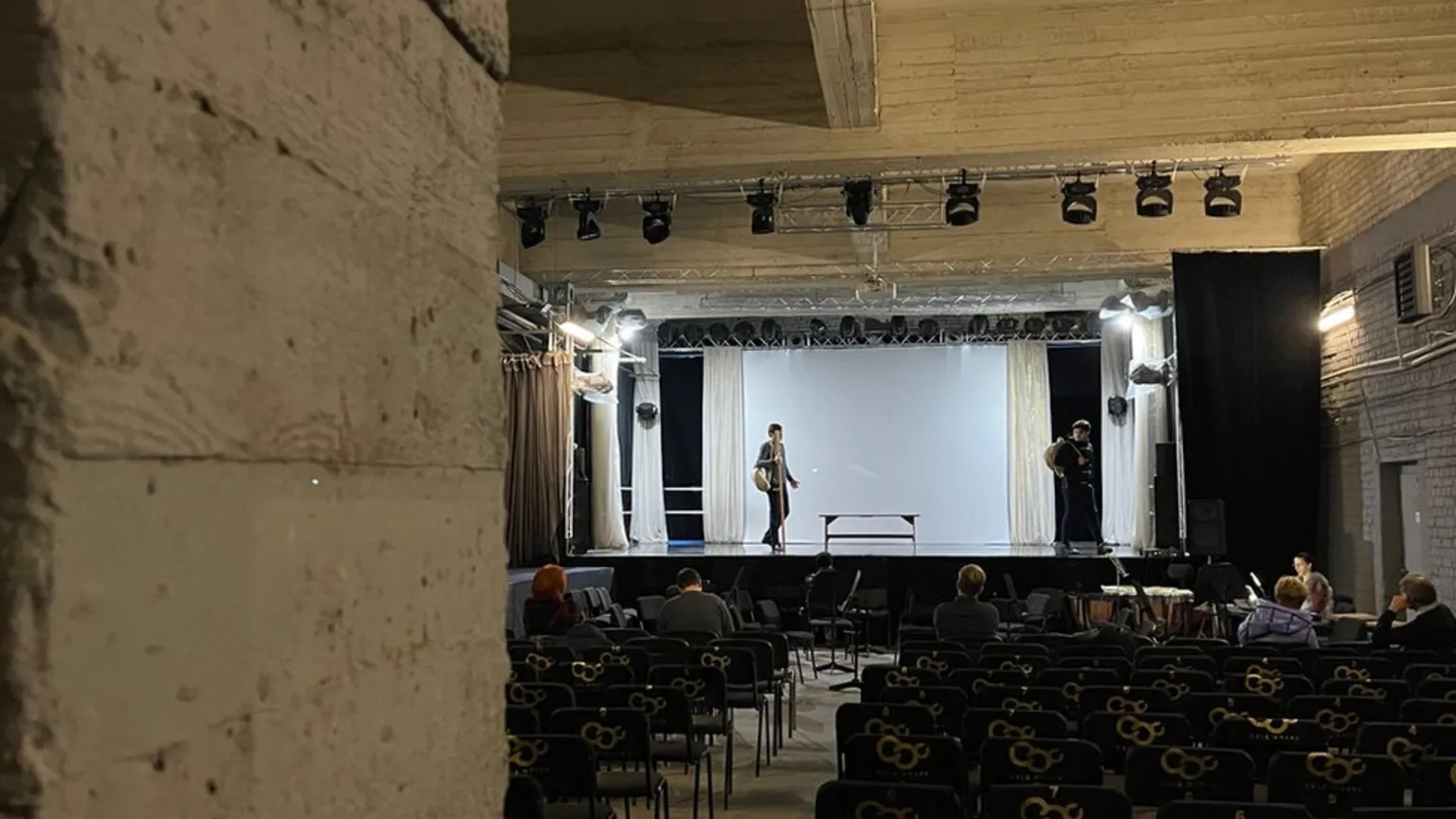
“The bunker theatre is being prepared beneath the main auditorium, down several flights of stairs.

“It has no dress circle, chandeliers or champagne — and a lot of grey concrete. But follow the sound of music and it leads to a raised stage with spotlights and rows of seats. Most importantly, there’s a company of singers, dancers and musicians desperate to perform before a proper audience again.

” ‘We really miss our big hall, the feeling of being on a big stage with lots of people watching,’ violinist Natalia Babarok explains. …

“In the first weeks after the full-scale invasion, when Russian troops were closest and the shelling most intense, a missile landed near to the theatre. Chunks of stone were torn from the side of the building and windows blown out. The roof caught fire several times, but staff managed to extinguish the flames before they took hold. The risk to life remains. …

“When the main theatre closed in February 2022, Volodymyr Kozlov did not stop singing. Thousands of Kharkiv residents were living on the metro then, staying underground away from the explosions. So Volodymyr and a group of fellow artists would tour the stations, performing three concerts a day, a mixture of classical music and popular tunes.

“When he was not singing, Volodymyr was helping to evacuate residents from the areas under heaviest fire or delivering food and other supplies.

” ‘It was impossible to stop, because if you did then the thoughts [of danger] would enter your head, and you couldn’t let them,’ the baritone explains. …

“Volodymyr is performing alongside his wife, Yulia Forsyuk, a soprano soloist who plays the lead role in the Ukrainian opera, Natalka Poltavka. …

“Now the pair are rehearsing to perform for Kharkiv residents again, safely beneath the city streets. But it’s not just the surroundings and acoustics that are different. … One man was killed fighting on the frontline and several more have been mobilized; others are scattered as refugees.

“For those who have stayed in Kharkiv, everything is being adjusted to their reduced new reality.

” ‘Our director adapts the score to feel like everyone’s still there,’ Natalia Babarok describes the changes for the orchestra.

” ‘My husband plays the trombone, but he’s told to play the bassoon and the horn parts too. As a violinist, I might also play the part of the flute. You have to play for yourself, and for someone else.’ “

The long, beautiful article is at the BBC, here. No paywall.

Alas, last Friday: “KYIV, May 10 (Reuters) – Russian forces launched an armored ground attack on Friday near Ukraine’s second city of Kharkiv in the northeast of the country and made small inroads, opening a new front.”

Read Full Post »

Photo: Carrie Shepherd/Axios.
The Lyric Opera of Chicago’s SoundShirts use “patterns and pulses” to make opera more accessible for the deaf.

It used to be that, for people with a disability, there were certain experiences they knew they would probably never access. With technology, that is changing. Consider how “feeling” the music in new, more subtle ways is helping those with hearing loss.

Michael Andor Brodeur reports at the Washington Post about the SoundShirt.

“Opera is everything all at once: music and drama, poetry and dance, grandeur and intimacy, spectacle and sound. This all-encompassing aspect makes it one of the most accessible art forms yet one of the most challenging to make accessible.

“For audience members who are deaf or hard of hearing, or who are blind or have low vision, attending an opera can be a deeply frustrating experience.

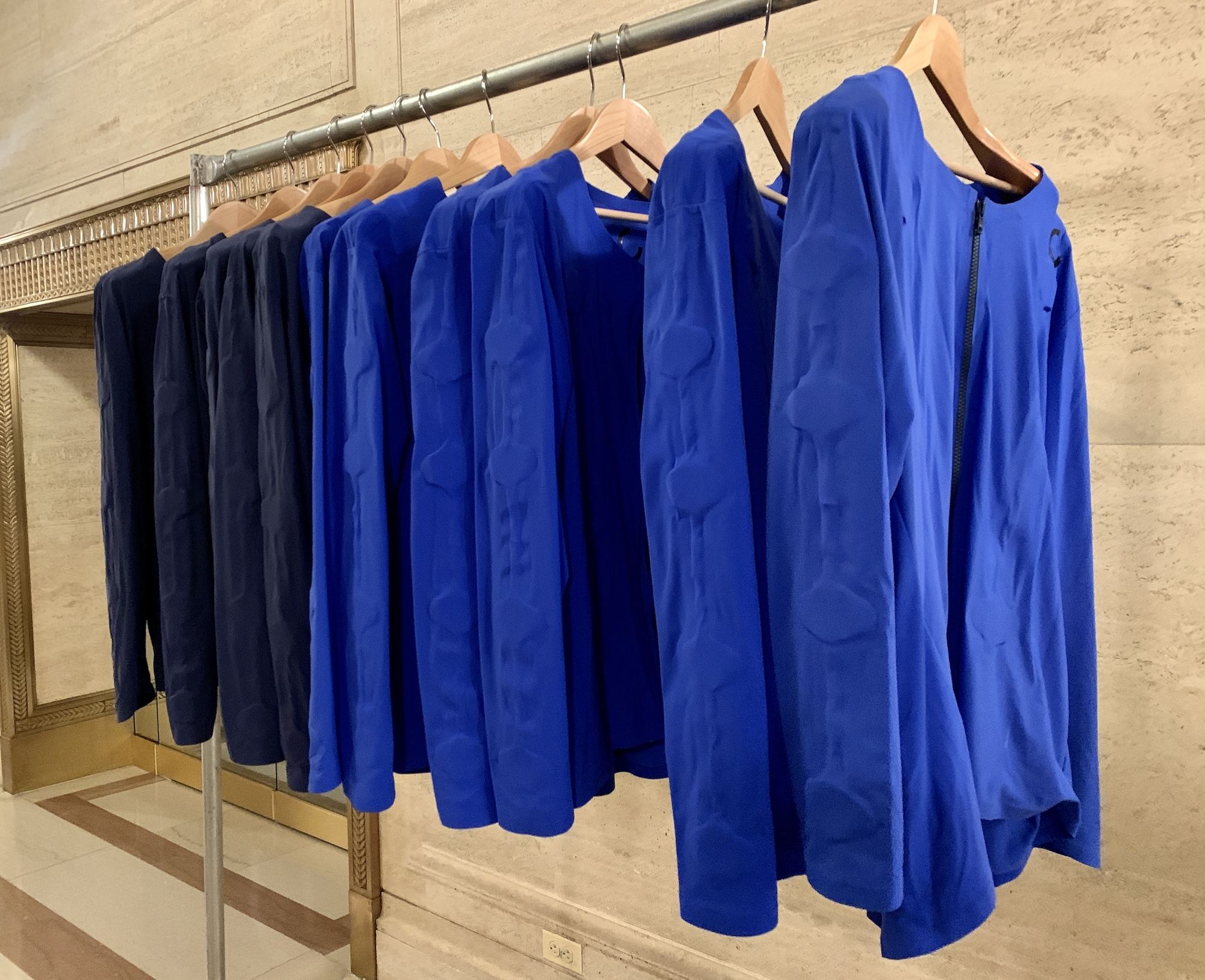
“A pilot program at the Lyric Opera of Chicago is trying on a new approach for deaf and hard-of-hearing people to experience opera: the SoundShirt, a jacketlike garment equipped with 16 haptic actuators* that transmit sound from the orchestra and stage into pulses, vibrations and other forms of haptic feedback in the shirt itself. …

“In addition to accommodations for mobility disabilities such as ramps and wheelchair seating, like many opera houses, the Lyric offers performances with American Sign Language interpretation, projected subtitles, and assisted listening devices for deaf and hard-of-hearing patrons. For blind people and those with low vision, the Lyric provides Braille and large-print programs, audio-described performances, high-powered glasses and pre-performance ‘touch tours,’ allowing audience members to feel various props, costumes and surfaces before the curtain rises.

“The SoundShirt, though, is cut from a different cloth than most accessibility technology, providing a mediated experience of the music that registers as physical and personal.

‘It doesn’t re-create the experience of listening to music,’ [director of digital initiatives Brad Dunn] says. ‘It’s its own thing.’

” ‘It translates the music into a different sensory experience that can be felt by people. And what I’ve seen through all of the early testing that we did is that audiences who are deaf or hard of hearing have responded very viscerally to it.’ …

“For attendees at a Lyric production of West Side Story earlier this year, input from the SoundShirt didn’t just help provide additional detail to the performance — it also illuminated the musical spaces in between, the interludes and interstitial passages of music, the overtures overloaded with crucial cues. Dunn recalls one tester’s eyes welling up with tears after the performance. …

“Lyric’s SoundShirt project was launched in partnership with the city of Chicago’s Mayor’s Office for People With Disabilities (MOPD), but the garment itself was designed by CuteCircuit, a London-based wearable technology design firm. …

“At the Lyric, an array of microphones positioned over various sections of the orchestra feeds audio information to a central computer. Dunn and his crew adapt the software to respond to the specific instrumentation of a given piece. … Those audio signals are divided across seven channels, each mapped to one of 16 different ‘zones’ on the SoundShirt, where motifs and melodies register as patterns and pulses across the garment’s 16 actuators.

“Thus, for a production of The Flying Dutchman, the violins and cellos are assigned to trigger haptic feedback along the right and left shoulders and upper arms. Timpani and bass, meanwhile, are sent down to the lower torso and hips. Wagner’s mighty horns are split across the upper arms like goose bumps, while vocals register at the wrists like a pulse. …

“Rachel Arfa is a longtime disability advocate and civil rights attorney who serves as commissioner of MOPD. As a deaf person who wears bilateral cochlear implants, the issue of accessibility has been close to her heart for a long time. … But while expanding accessibility is her life’s work, Arfa also knows that good intentions can often pave the road to nowhere.

“ ‘When Lyric approached me with this shirt, I was highly skeptical,’ Arfa said via email. [But she] agreed to test the SoundShirt at a recent Lyric production of West Side Story. Arfa was surprised to find the shirt actually felt like a good fit for the problem it is trying to solve. …

“ ‘I began to understand that the haptics on the SoundShirt vibrated in conjunction with the orchestra sounds. One example is when string instruments were played, the haptics followed the pitch and rhythm. A second example is when a singer was singing a long melody, the haptics picked up on this and I could experience this through the vibration. I am not able to hear this sound, but I could feel it. It was such a surprise and a thrill.’

“Tina Childress, an audiologist who lives in Champaign, Ill., is a late-deafened adult who wears cochlear implants and works as an advocate for accessibility in the arts. … Childress appreciated the haptic feedback at the wrists to indicate dialogue, and the way the shirt clarified the various elements of the score. After intermission, she lent the shirt to another audience member to try out. ‘I didn’t realize how much I was using it until I didn’t have it.’ ”

More at the Post, here. Axios Chicago has still more, here.

* haptic actuators are gizmos that provide localized bodily sensations and tactile effects

Read Full Post »

Photo: Met Opera/Karen Almond via National Catholic Register.
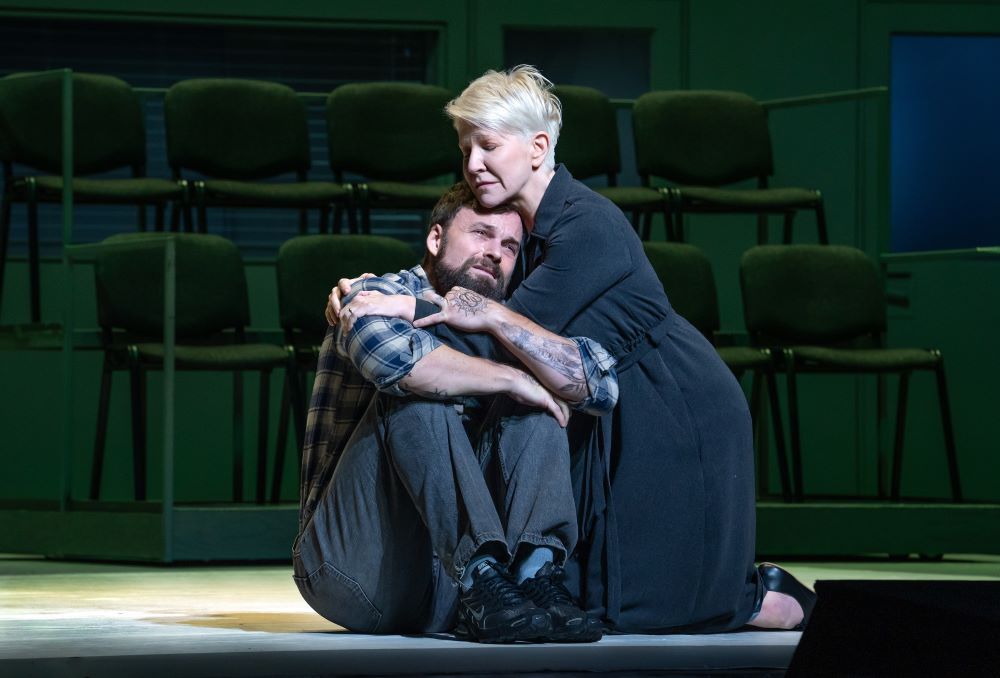
Ryan McKinny portrays inmate Joseph De Rocher and Joyce DiDonato portrays Sr. Helen Prejean in Jake Heggie’s opera Dead Man Walking.

My new friend Lynn S. is an opera lover. I met her when I was asked to interview someone for the newsletter at our current residence. She told me about attending a breathtaking Met opera broadcast in a local movie theater, Dead Man Walking. You may know the true story of the nun and the death row inmate.

As Javier C. Hernández reports for the New York Times, the opera generated an extra level of intensity when the Met took it to Sing Sing prison for a special performance.

“One by one, the inmates filed into a chapel at Sing Sing Correctional Facility in Ossining, N.Y. — past a line of security officers, past a sign reading, ‘Open wide the door to Christ.’ Under stained-glass windows, they formed a circle, introducing themselves to a crowd of visitors as composers, rappers, painters and poets. Then they began to sing.

“The inmates had gathered one recent afternoon for a rehearsal of Dead Man Walking, the death-row tale that opened the Metropolitan Opera season [in September]. Together, they formed a 14-member chorus that would accompany a group of Met singers for a one-night-only performance of the work before an audience of about 150 of their fellow inmates.

Michael Shane Hale, 51, a chorus member serving a sentence of 50 years to life for murder, said that he often thought of himself as a monster. 

“ ‘I feel like I’m at home,’ said a chorus member, Joseph Striplin, 47, who is serving a life sentence for murder, as the men warmed up with scales and stretches. ‘I feel I’m alive.’

Dead Man Walking, based on Sister Helen Prejean’s 1993 memoir about her experience trying to save the soul of a convicted murderer at the Louisiana State Penitentiary in Angola, has been staged more than 75 times around the world since its premiere in 2000.

“But the opera, with music by Jake Heggie and a libretto by Terrence McNally, had never been performed in a prison until last week at Sing Sing, which is home to more than 1,400 inmates.

“There were no costumes or props. Chorus members, who were dressed in prison-issued green pants, had to be counted and screened before entering the auditorium, lining up by cell block and building number. …

“Yet the opera, with its themes of sin and redemption — and of the pain endured by victims’ families — resonated with inmates.

“Michael Shane Hale, 51, a chorus member serving a sentence of 50 years to life for murder, said that he often thought of himself as a monster. In the 1990s, prosecutors sought the death penalty in his case. (New York suspended the practice in 2004.) Hale said the opera, which portrays the friendship between Sister Helen and Joseph De Rocher, a death-row prisoner, had taught him to see his own humanity. …

“Not everyone at Sing Sing, a maximum-security prison about 30 miles north of New York City, was enamored. Some prisoners declined to take part in the opera because of concerns about its dark themes, including the portrayal of a prisoner’s death by lethal injection. …

“The idea for bringing Dead Man Walking to Sing Sing emerged several years ago when an inmate promised the renowned singer Joyce DiDonato, who plays Sister Helen in the Met’s production, that the men could sing the chorus parts. …

“Paul Cortez, 43, who is serving a sentence of 25 years to life for murder, worked with [Bryan Wagorn, a Met pianist] to learn the score and held Saturday night rehearsals with small groups of prisoners at Sing Sing. Some were initially hesitant, unsure if the opera advanced prisoners’ rights and fearing they ‘might be exploited,’ he said, but eventually more people started showing up.

“ ‘It was daunting at first,’ said Cortez, who majored in theater in college. ‘I did not know how I was going to get the guys in shape. But they were so diligent. They took it seriously.’

“[In September] DiDonato, joined by Sister Helen, 84, visited the prison to work through the music and to get to know the participants. They discussed life in prison, morality, shame and stigma, as well as Sister Helen’s efforts to abolish the death penalty. Some inmates, saying they were still consumed by guilt about their crimes, asked about seeking forgiveness.

“DiDonato and Sister Helen returned [two days] after opening night at the Met, joined by singers and staff from the Met and Carnegie Hall. … The Met singers introduced themselves, taking pains to remind the inmates that they were only pretending to be prison guards and police officers. (‘Clemency!’ a prisoner shouted, after the bass Raymond Aceto announced he was playing the role of a warden.)

“Sister Helen, standing among the inmates, said that there was love and trust in the room. ‘This is a sacred gathering,’ she added. ‘There is no place on earth at this time that I’d rather be. We’re going to create beauty today, and you’re going to feel it.’

“For more than five hours, the men worked with the Met artists, under the conductor Steven Osgood, practicing rhythm, diction and dynamics in three sections that feature the chorus.

“They stomped their feet and clapped their hands in ‘He Will Gather Us Around,’ a spiritual that opens the opera, which is typically performed by women and children. And they sang with fiery intensity as De Rocher confesses his murder, shortly before his execution. …

“Then, around 6:30 p.m., an audience of inmates and corrections officials took their seats in the auditorium, adjacent to the chapel.

“ ‘The most beautiful thing in the world is a human being that does something and is transformed,’ Sister Helen said in introducing the opera. ‘Everybody’s worth more than the worst thing they ever did.’ ”

More at the Times, here. And there is no paywall at the National Catholic Register, here, where there’s an interview with Sister Helen. Really interesting!

Read Full Post »

Art: Mo Willems.

One day in spring, the school that two of my grandchildren attend had a dress-as-your-favorite-character day. The school principal wore a Mo Willems T-shirt that warned, “Don’t let the Pigeon drive the bus.”

Did you love that book series? Now that all four grandkids are reading advanced books, I feel a certain nostalgia for the Pigeon days. Fortunately, I can still see Pigeon at the opera.

David Allen writes at the New York Times, “Do you know the words to the Queen of the Night’s stratospheric showcase from ‘The Magic Flute’? Maybe the Duke’s famous tune from ‘Rigoletto’? Carmen’s Habanera?

“No, not those words. The other ones: the words, at least, as they are now known to my 6-year-old daughter and the hundreds of children who took grown-ups like me to the Kennedy Center here recently for the premiere of ‘The Ice Cream Truck Is Broken! & Other Emotional Arias,‘ an experiment, including a short new work by the composer Carlos Simon, in what it might mean to draw a very young and impossibly demanding audience into a life in opera.

“See, you might think that Carmen is relating her views on love, but no. Listen closely, and you’ll find that the singer should have shared her cotton candy with her friends, and absolutely will … tomorrow. ‘La donna è mobile’? That’s about how milk squirts out your nose if you happen to laugh at exactly the wrong time. The Queen’s aria? That’s still about anger, but it now invokes something far worse than the vengeance of hell.

“ ‘This bicycle,’ it begins, in a fit of preschool pique, ‘is such a poo-poo vehicle.’

“Opera’s great composers have a new librettist, and he is almost certainly the only person who could induce an institution like the Kennedy Center to do something like this, let alone get Renée Fleming to join him in hosting it; inspire a quintet of young singers to ham their way through it; and persuade Simon, one of the busiest composers around, to crown the show with a 20-minute piece that gives an attention-seeking, picture-book Pigeon the prima donna spotlight it has surely always craved.

“The writer for it all? Mo Willems, who, it turns out, really loves opera! …

“ ‘It’s big emotions. … It’s direct communication. It’s interior dialogue. It’s self-discovery.’ …

“Willems has always been a broader artist than just a writer of picture books, though that task alone is such that he calls it ‘as easy as describing the history of Byzantium in three words.’ Some of his most celebrated characters — who include a venturesome plushie called Knuffle Bunny, the on-and-off best friends Elephant and Piggie, and that insatiable, inimitable Pigeon — had already starred in musicals that he had written before he formalized his long association with the Kennedy Center in 2019, when he became its education artist in residence. That three-year position coincided with the pandemic, to which he responded with invaluable ‘Lunch Doodles‘ videos, but it still let him explore a range of genres, including symphonic music, which he said ‘has always been important to me.’

“ ‘Beethoven’s Fifth is the easiest example,’ he explained, ‘but it’s basically the arc of an episode of television, or a movie: “Ba-ba-ba-baaam,” oh, it’s exciting — and then you take the theme, you take the theme, and then you build with it. So when I was writing a show called “Codename: Kids Next Door,” which is a silly sort of action comedy, I would literally write to the symphony.’

“For the National Symphony Orchestra, Willems painted giant abstractions to accompany a cycle of Beethoven’s nine symphonies, and he worked with the musician Ben Folds to adapt one of his books, ‘Goldilocks and the Three Dinosaurs,‘ for the concert hall. Hearing plans for ‘Goldilocks’ led Tim O’Leary, the general director of the Washington National Opera and a Willems-reading father of three, to inquire about a commission. …

“The author quickly sent him a copy of an Elephant and Piggie book — ‘I Really Like Slop!‘ — with the inscription ‘Tim, this book really sings.’ By their second encounter, Willems had the libretto in his head, a sketch of the characters in concert dress and a title: ‘SLOPERA!

“ ‘Obviously, once it was called the “SLOPERA!” we had to do it,’ O’Leary said.

“ ‘SLOPERA!’ could only be performed live outdoors on account of the pandemic, but an indoor recording, with piano accompaniment, was shown virtually to more than 300,000 schoolchildren. Piggie gets Gerald the Elephant to try slop, a stinky green delicacy among porcine foodies. He does, after his initial refusals upset his companion, and he endures the consequences in something like a bel canto mad (or death) scene. He recovers, though, and tells Piggie that while he might not like her food, he still likes her. …

“Willems said, reflecting on what writing his first libretto taught him, aside from the importance of placing consonants carefully. ‘If you look at a picture book manuscript, and you can understand it, it has too many words. If you look at just the illustrations, and you can understand it, the drawings are too detailed. They both have to be incomprehensible. It’s very similar with writing an opera, that the words that you’re using have to be dependent on the music, but the music has to be dependent on the words, and either of them shouldn’t really be able to stand alone.’ …

“[Oznur] Tuluoglu, a young soprano whose most recent prior role was Barbarina at the Annapolis Opera, took on the title character. ‘When you train, you have to be able to sing Mozart, you gotta be able to be a pigeon.’ “

More at the Times, here.

Read Full Post »

Photo: Carlin Stiehl for the Boston Globe.
Belarusian opera singer Ilya Silchukou rehearsing with pianist Pavel Nersessian. Silchukou and his wife, a mezzo-soprano, “fled their native Belarus after Silchukou publicly sided with protesters following the 2020 election,” reports the Globe.

If you live near Boston, check out a concert tonight at First Church. Not sure what is more impressive — the baritone’s voice or the backstory about defying the totalitarian regime of Belarus. To see what Ukraine would be like if Russia’s invasion succeeded, look no farther than the puppet government on Ukraine’s northern border.

Malcolm Gay reported at the Boston Globe, “By the time Ilya Silchukou performed upon the steps of the Bolshoi Theatre of Belarus in Minsk, more than 6,000 protesters had already been detained.

“It was August 2020, one tumultuous week after President Alexander Lukashenko, often described as ‘Europe’s last dictator,’ had claimed victory in a widely disputed election. His opponent had already fled the country. The government had briefly severed Internet service, as police fired rubber bullets and beat demonstrators who’d clogged the streets to protest.

“Silchukou, one of the country’s best-known opera stars, had already publicly renounced three awards he’d received from Lukashenko.

“And now he was prepared to use his most powerful tool to support the cause, channeling his rich baritone to sing ‘Kupalinka,’ a beloved song that had become an anthem of the protests.

‘Two years later, Silchukou, his wife, Tatsiana, and their three children live a quiet life in a rented house in [Wayland] west of Boston, where Silchukou tends the owner’s garden of eggplants. Their furniture is entirely donated, and Silchukou, once a star soloist at the Minsk Bolshoi who sang at opera houses across Europe, now teaches music at Star Academy, a private K-8 school, as he seeks to establish a stage career in the United States.

“ ‘It’s going to be hard,’ said Silchukou, who remains all but unknown to US audiences. ‘On the other hand, I’ve found so many new friends who support us and help us. I look forward with optimism.’

“Among those new friends is renowned Russian pianist Pavel Nersessian, who will perform a concert of songs and arias with Silchukou on Saturday at First Church Boston in Back Bay.

“Nersessian only recently met Silchukou, but during a recent rehearsal at Boston University, he described the singer’s voice as ‘multicolored,’ capable of subtly expressing the full spectrum of human emotion. …

“Silchukou joined the Bolshoi Theatre when he was just 23, making a name for himself as a soloist with leading roles for baritone, such as Tchaikovsky’s Eugene Onegin and Marcello in Puccini’s La Bohème. He traveled abroad frequently for singing competitions, winning the 2011 Hans Gabor and Helicon prizes at the prestigious International Hans Gabor Belvedere Singing Competition, among others. …

“He walked a fine line: He quietly disapproved of Lukashenko’s grip on power, but as an employee of the national opera, he was often called upon to perform at official functions. …

“In the months following the 2020 election, however, Silchukou felt compelled to take a stronger stance. He signed an open letter calling for an end to the violence and an election recount. He publicly supported other artists who’d been fired for speaking out, and he indicated his support from the stage, flashing the ‘victory’ sign as performers received red and white bouquets from the audience, a sign of resistance. …

“That October, Silchukou collaborated with other artists in a video calling for a national strike. He was fired within days, his working card stating he’d committed ‘an act of immorality.’

“Stuck at home with COVID-19, Silchukou decided to play his last card: a highly produced video he’d recorded of ‘Mahutny Bozha,’ a hymn that has become an anthem of the anti-Lukashenko movement.

“ ‘That video was in my pocket,’ Silchukou said of the searing indictment that would go on to rack up more than 500,000 views. ‘I’d been afraid to publish it because I was still working in the theater, but then I said, we have nothing to lose.’

“The family fled the following summer. …

“ ‘I dream to see Belarus free,’ he said. ‘I belong to that land.’ ”

When you think of asylum seekers, remember that most would give anything not to have had to leave their home.

Tickets at https://silchukou.eventbrite.com/ and at the door. More at the Globe, here.

This is courage.

Read Full Post »

Photo: Robert Kato Lionel/New York Public Library.
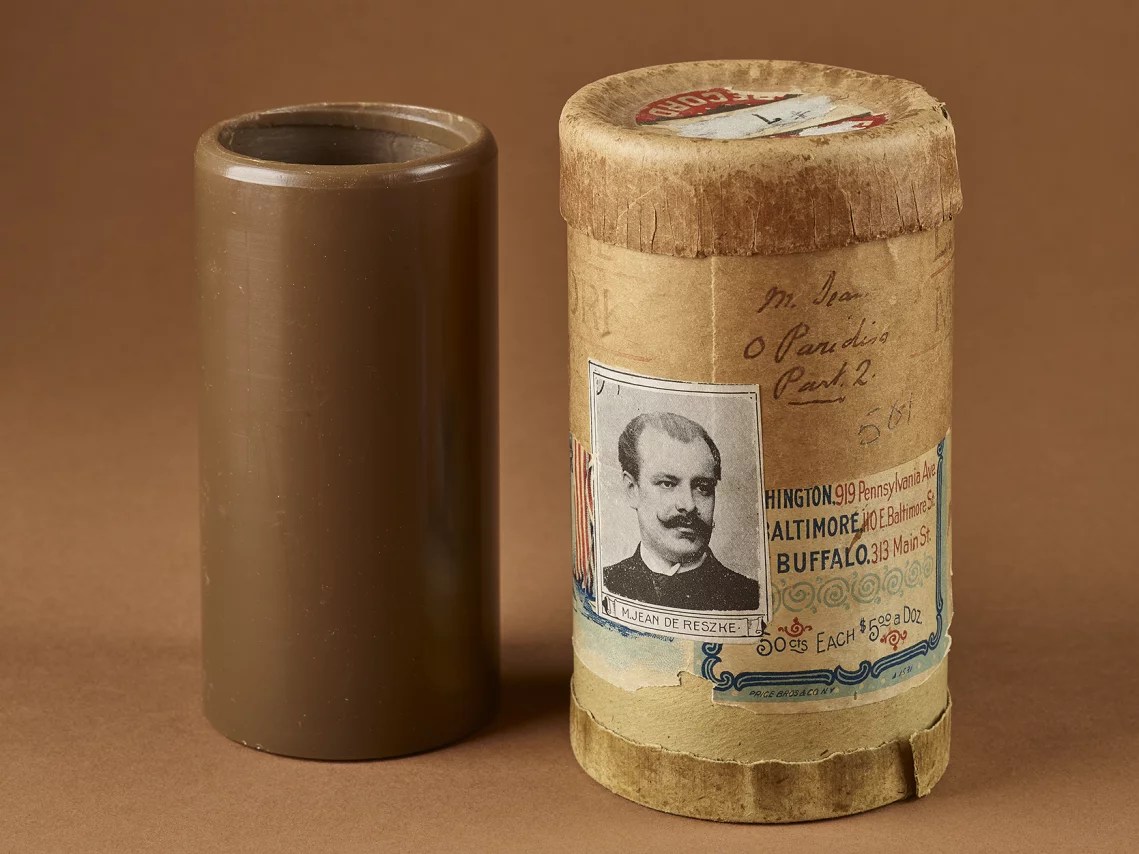
Early opera recordings on wax cylinders 1900–1904, recorded by Lionel Mapleson.

I recently finished reading an excellent biography of Margaret Wise Brown, the author of Goodnight, Moon and many other delightful children’s titles you probably would recognize. At the end of a life cut short by a blood clot in a foreign hospital (her dates are 1910 to 1952), she was experimenting with a wire recorder to make records of her stories and poems.

That took me back, for sure, as my father also was experimenting with a wire recorder around that time. All I have left of his experiments is a record, transferred years later to a cassette tape, called “The Birth of Willie” — me with a squeaky voice and an unfamiliar accent and my first brother, also squeaky, responding to the news of a new sibling. What a miracle that wire recorder once seemed!

It wasn’t the first such device, though. In today’s story we learn about recordings once made on wax.

Jennifer Vanasco reports at National Public Radio, “Before audio playlists, before cassette tapes and even before records, there were wax cylinders — the earliest, mass-produced way people could both listen to commercial music and record themselves.

“In the 1890s, they were a revolution. People slid blank cylinders onto their Edison phonographs (or shaved down the wax on commercial cylinders) and recorded their families, their environments, themselves.

“When I first started here, it was a format I didn’t know much about,’ said Jessica Wood, assistant curator for music and recorded sound at the New York Public Library for the Performing Arts. …

‘It became my favorite format, because there’s so many unknowns and it’s possible to discover things that haven’t been heard since they were recorded.’

“They haven’t been heard because the wax is so fragile. The earliest, putty-colored cylinders deteriorate after only a few dozen listens if played on the Edison machines; they crack if you hold them too long in your hand. And because the wax tubes themselves were unlabeled, many of them remain mysteries. …

” ‘They could be people’s birthday parties,’ Wood said. … ‘I really hope for people’s birthday parties.’

“She’s particularly curious about a box of unlabeled cylinders she found on a storage shelf in 2016. All she knows about them is what was on the inside of the box: Gift of Mary Dana to the New York Public Library in 1935.

“Enter the Endpoint Cylinder and Dictabelt Machine, invented by Californian Nicholas Bergh, which recently was acquired by the library. Thanks to the combination of its laser and needle, it can digitize even broken or cracked wax cylinders — and there are a lot of those. But Bergh said, the design of the cylinder, which makes it fragile, is also its strength.

” ‘Edison thought of this format as a recording format, almost like like a cassette machine,’ Bergh said. ‘That’s why the format is a [cylinder]. It’s very, very hard to do on a disc. And that’s also why there’s so much great material on wax cylinder that doesn’t exist on disc, like field recorded cylinders, ethnographic material, home recordings, things like that.’

“One of those important collections owned by the library is … a collection recorded by Lionel Mapleson, the Metropolitan Opera’s librarian at the turn of the last century. Mapleson recorded rehearsals and performances — it’s the only way listeners can hear pre-World War I opera singers with a full orchestra. …

“[Bob Kosovsky, a librarian in the music and recorded sound division] said that some of the stars sing in ways no contemporary opera singer would sing. ‘And that gives us a sort of a keyhole into what things were like then. … It’s a way of opening our minds to hear what other possibilities exist.’

“It will take the library a couple years to digitize all its cylinders. But when they’re through, listeners all over the country should be able to access them from their home computers, opening a window to what people sounded like and thought about over 100 years ago.”

More at NPR, here.

Read Full Post »

Photo: Russ Rowland/Heartbeat Opera.
Professional opera singers Kelly Griffin and Derrell Acon perform with incarcerated singers for Heartbeat Opera’s production of Fidelio in a dress rehearsal at New York’s Metropolitan Museum of Art.

Positive things happen when punishment for people who have committed crimes doesn’t negate their basic humanity. That’s why I like posting stories about enlightened systems (see Norway’s successful rehabilitation process, here) and programs that bring the arts inside the walls.

Anastasia Tsioulcas reported recently at National Public Radio (NPR) about an unusual production of Beethoven’s opera Fidelio, the story of a man who has been imprisoned for political reasons.

“A group of enterprising artists has found a way to bring Fidelio, quite literally, into today’s incarceration system — and to bring the voices of those men and women to the stage.

“In this updated version of Fidelio staged by New York City’s Heartbeat Opera, the main character is Stan, a Black Lives Matter activist who has been thrown into solitary confinement. His wife, Leah, tries to rescue him. The music is still sung in German, but the spoken parts are in English.

“In person, this production is small: there’s just a handful each of instrumentalists and singers on stage at New York’s Metropolitan Museum of Art. … But this production is a much larger effort, notes Ethan Heard, who is a co-founder and artistic director of Heartbeat Opera.

” ‘I revisited the story and was just so struck by the idea of a wrongfully incarcerated man and this amazing woman, his wife, who infiltrates the prison where she believes he’s been kept. And it felt like an opera we could really update for a contemporary American version,’ Heard says.

“Heartbeat first staged its version of Fidelio in 2018 [then updated it] to reflect certain events of the past couple of years, from the nation’s racial reckoning to the Jan. 6 insurrection at the Capitol.

“Stan has been jailed by the corrupt prison governor Pizarro [who exhorts] his cronies to ‘stand back and stand by’ as he plots Stan’s murder. A senior guard, Roc — who is Black himself — comes to wrestle with his position in the system. …

“The emotional apex of any version of Fidelio is a scene in which the prisoners are allowed a brief outing into the fresh air, exulting in a passing moment that feels just a little bit like freedom.

“In thinking about that scene, Heard and co-musical director Daniel Schlosberg hit upon a much larger idea that spoke to what they really wanted this production to address: mass incarceration in America.

“They connected with an old friend of Schlosberg: Amanda Weber, a prison choir director in Minnesota. She in turn helped put them in touch with other such groups. As a result, in Heartbeat’s production, singers from six prison musical groups — a mix of over 100 men and women who are incarcerated as well as about 70 community volunteers — are the ones singing the ‘Prisoners’ Chorus.’

“The groups are the Oakdale Community Choir in Iowa; KUJI Men’s Chorus, UBUNTU Men’s Chorus and HOPE Thru Harmony Women’s Choir in Ohio; East Hill Singers in Kansas; and the group Weber leads, Voices of Hope in Minnesota. …

“Schlosberg says that this moment in the opera [is] some of the most gorgeous music ever written for chorus in an opera, and that is the center, both emotionally and musically. Everything about this piece kind of comes from there.’

“In order to make this collaboration happen, the Heartbeat team had to earn the trust of the singers in prison. Michael Powell is one of those chorus members; he’s also known by the name Black. He was formerly incarcerated in Ohio, at Marion Correctional, and sang in the KUJI Men’s Chorus there. Above all, Black says, they didn’t want to be used as a prop. …

‘When Danny and Ethan came in, it was like the quick feel-out process — let’s see what’s going on there because we don’t want to feel exploited in any way. We already get exploited enough.’

“Derrell Acon is the associate artistic director of Heartbeat. In Fidelio, he sings the role of Roc. Acon says that opera can be a great vehicle for addressing and reflecting social movements. …

” ‘I’m someone who has been impacted by the carceral system. I have a sibling who was incarcerated. … This is not actually a mechanism for justice, but rather revenue,’ Acon continues, referring to the use of privatized prisons. ‘It sits on the backs of Black and brown people.’ …

“Black, the singer from the KUJI men’s chorus, was released from prison in 2020. He’s now the director of outreach and new initiatives for a small non-profit in Columbus, Ohio, Healing Broken Circles, which works with people touched by the justice system. …

” ‘If you really want to try to impact lives or if you care anything about prison justice reform or any of those things,’ Black says, ‘support the arts going into those prisons and support the community coming out of prison.’ ” More at NPR, here.

Music heals. And in case you missed it, see also what music can do for people in a bomb shelter, here.

Read Full Post »

Photo: Warner Brothers.
Bugs Bunny.

My husband was watching the Met’s Götterdämmerung around 4:30 this morning, so naturally I was reminded of Looney Tunes. Really. Bugs Bunny and the gang provided the best introduction to opera anywhere.

An article by Jaime Weinman at the Walrus (excerpted from his book Anvils, Mallets and Dynamite: The Unauthorized Biography of Looney Tunes) reflects on the durability of the Warner Brothers series.

“I grew up in a period when it seemed normal that a child born in 1976 would prefer to spend his Saturday morning watching cartoons from the 1940s and ’50s. A lot of the people I know enjoyed the same experience. Why did several generations watch old Looney Tunes alongside new work and actually prefer the stuff made before they were born? It was partly a historical accident caused by television’s demand for endless material at a relatively high cost. …

“Every television station required was a supply of preexisting content, something that might cost money to run but not to produce. The broadcasting rights for pre-1948 Warner Bros. cartoons weren’t very expensive, and the show was far better than most of the programming available for the same price.

“So part of Looney Tunes’ enduring success reflects the simple power of money. They were made for the big screen, and while they weren’t lavishly budgeted compared to the cartoons of Disney, they had much more time and per-unit money than television cartoons. On television, the Looneys were up against shows that had to turn out twenty-two minutes per week and looked like it. … Looney Tunes seemed edgier and freer than the new material. …

“However much kids loved watching Looney Tunes, the cartoons never got the credit they deserved. There hasn’t been much mainstream film criticism about them. When they were being made, they were almost totally ignored by all but two critics: James Agee and Manny Farber. Later, after the cartoons started appearing on TV, younger critics got interested. …

“The case has sometimes been made for the great Looney Tunes characters as underdogs, but it’s never a convincing case because the characters aren’t actually struggling against anything. They seldom have to try hard: as long as it’s funny, they can produce a weapon out of nowhere, and the most horrific acts of violence cause them no stronger reaction than irritation. In a more serious comedy, the characters feel an exaggerated version of what we might feel in their shoes, whether anger, fear, or determination. We can’t usually identify much with a Looney Tunes character because we know that nothing has consequences for them. …

“Bill Scott, who co-wrote cartoons at Warner Bros. for several years and then moved to [United Productions of America, the cartoon studio usually considered the most artistic and ambitious] said that ‘the kiss of death at UPA was to be considered a Warner Brothers writer.’ Looney Tunes writers, he added, were dismissed as ‘clothesline gag’ writers, for whom a story was just a cheap, insubstantial way to support the gags.

“That description wasn’t exactly wrong. If Warner Bros. creators have a choice between telling a joke and giving the film a consistent style, they’ll almost always choose the joke. …

“Warner Bros. cartoons had arguably the best soundtracks in American film comedy. Mel Blanc, who voiced all the important recurring characters except Elmer Fudd, was so essential to the studio that he became the first voice actor ever to get credit for short cartoons; composer Carl Stalling, who essentially invented the art of animated movie music when he worked for Disney, spent most of his career at Warner Bros., working closely with the directors (and sound effects wizard Treg Brown) to set a tempo for all the animated action and make sure that the sounds and movements complemented each other perfectly. The result of all this is a series where the dialogue has the wise-guy tone and fast pace of radio comedy, the music is funny, the animation is funny, the sound effects are funny, and none of them ever do something that’s redundant. …

“Like music, the laughs come from timing and rhythm. The gag is divided into three basic beats: Bugs hands the firecracker to the parrot; the firecracker explodes; the smoke clears, showing the ashen but otherwise unharmed bird. This all happens in just a few seconds, but each of these beats is held just long enough for it to play properly.” More at the Walrus, here.

To return to where I started today, here are a few online reviews of the Looney Tunes opera themes.

On “What’s Opera, Doc?” … “Elmer Fudd becomes the hero of Siegfried as he woos Brunhilde (played by Bugs Bunny in drag–if a rabbit can be in drag). This is a classic animated feature with full orchestration. It integrates the eternal effort of Elmer to kill the wabbit while repeatedly falling for the smart alecky rodent. The singing, of course, is quite horrible, but great credit to Mel Blanc for carrying on and staying in tune. What a remarkable talent Blanc was!”

On “Long-Haired Hare” … “Here Bugs takes his revenge on an opera singer named Giovanni Jones and does so with hilarious consequences. The last few minutes are absolutely priceless and one of my all time favourite endings in a Looney Tunes cartoon. Mel Blanc is brilliant as Bugs and Nicolai Shutorov gives a bravura singing performance as Giovanni.”

On “The Rabbit of Seville” … Bugs and Elmer “wander on to an opera stage and continue their combativeness to the music of the Barber of Seville. Apparently, there was a time when the average citizen had a thing for opera and these cartoon presentations fed into that. Anyway, the pacing is masterful. Elmer is about as gullible as he can be, and Bugs takes advantage at every turn. The pacing of the famous musical piece works very well and our two heroes find their way to a masterful conclusion.”

Read Full Post »

Photo: Bettina Hansen/Seattle Times.
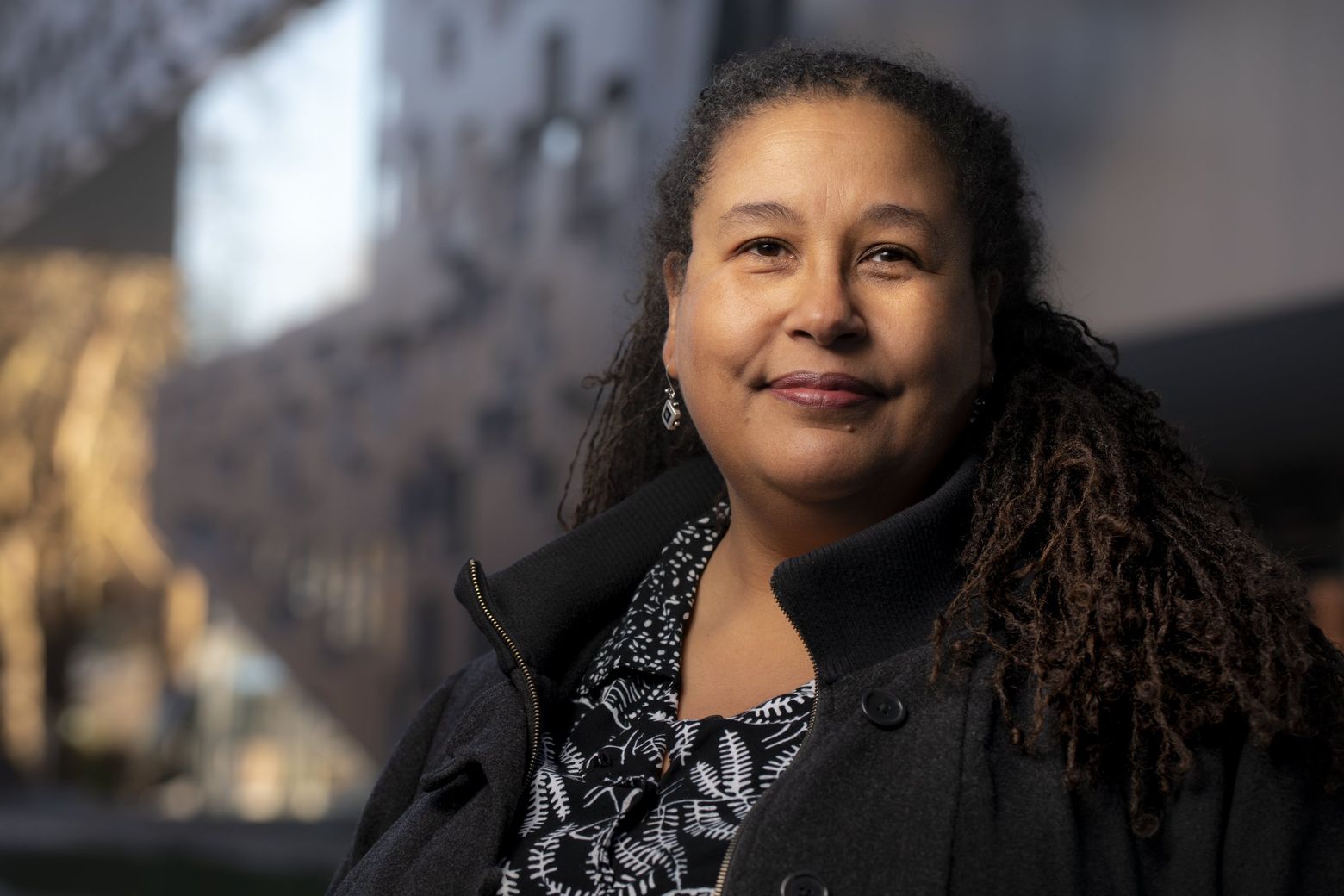
Naomi André, Seattle Opera’s scholar in residence, is passionate about sharing her love of opera and making the art form welcoming to a wide range of people, reports the Seattle Times. “I feel that everybody can find something to relate to in opera,” she says.

In March of this year, Naomi André gave a virtual talk at Vermont’s Bennington College on opera and her role as the Seattle Opera’s first scholar in residence. She was appointed right before the pandemic to share her enthusiasm for opera with a new and more diverse audience.

Here’s some background on the opera company’s pathbreaking appointment from Gemma Alexander at the Seattle Times.

“A week before Naomi André’s panel [in February 2020] on Black representation in the arts, Seattle Opera closed registration for attendance. The number of online reservations had hit the 300-person capacity of the Opera Center auditorium for the first time since the building opened in late 2018. At least in local opera circles, André’s name had buzz.

“André is Seattle Opera’s inaugural scholar in residence. It is a role the company created specifically for her and may be the only job of its kind in American opera. As scholar in residence, André acts as an adviser to help Seattle Opera become more inclusive, both for audiences and behind the scenes. …

‘There’s a kind of joy in going to the opera and seeing it live. Unfortunately, opera has an elitist reputation,’ said André, a professor at the University of Michigan, where she has taught courses on 19th-century Italian opera as well as classes on race and gender. …

“Her personal experience as a Black woman in the opera field led to her most recent book, Black Opera: History, Power, Engagement, which examined African American and Black South African participation in opera.

“ ‘I feel that everybody can find something to relate to in opera. This is not a genre that should go away,’ André said.

“To help Seattle Opera become a place where everyone can find their something, André advises on issues of race and equity both in their internal operations and in contextualizing the works they produce for audiences. One of her first acts as resident scholar was a response to the death of pioneering African American soprano Jessye Norman.

“ ‘There were a lot of pieces being written, but they were all so white! No one wrote about what she meant to Black fans. So I suggested that and they said, “Great! When can you have it ready?” ‘ André said with a laugh. ‘I was so impressed that this isn’t contentious.’ The piece she wrote is posted on the Seattle Opera blog.

“André first came to the attention of Seattle Opera when she participated in a forum on race and gender sponsored by the Glimmerglass Festival, a summer-season opera company in central New York state known for producing rare and new works. Called Breaking Glass, the panel visited Seattle in tandem with the 2018 production of Porgy and Bess. Impressed by André, Seattle Opera brought her back for 2019’s Carmen. In a forum called Deconstructing Allure, André and a panel of academics and artists — all women of color — explored representations of women and ethnic minorities in art. They considered the responsibility of contemporary arts organizations toward both classic works of art and the people who may be misrepresented by those art works.

“ ‘Some people would view that as a pretty radical conversation in the opera space,’ said Alejandra Valarino Boyer, Seattle Opera’s director of programs and partnerships. The event was so successful that Seattle Opera designed the new position of scholar in residence to formalize an ongoing relationship with André.

“[André] has recorded an episode of Seattle Opera’s podcast and contributed essays for program booklets. But her most visible role involves a series of free, public community conversations that invite audiences to question problematic social themes and portrayals of marginalized communities in opera while appreciating the artistic elements that continue to hold up.

“On Feb. 13, 2020, she [moderated] the Black Representation in the Arts community conversation at the Seattle Opera Center with speakers Theresa Ruth Howard, curator of the Memoirs of Blacks in Ballet symposium, and Bridgette Wimberly, librettist of Charlie Parker’s Yardbird.”

For her 2021 talk at Bennigton, André provided this preview: “In this talk, I outline some of the larger frameworks from my book Black Opera: History, Power, Engagement (2018) and take them further to include a quick mention of Beyoncé’s Homecoming (2018), and three operas on Black topics that debuted the summer of 2019 (Terence Blanchard and Kasi Lemmons, Fire Shut Up in My Bones, Opera Theater of St. Louis; Anthony Davis and Richard Wesley, The Central Park Five, Long Beach Opera; and Jeanine Tesori and Tazewell Thompson, Blue, Glimmerglass Festival).

“I quickly contextualize Fire Shut Up in My Bones and The Central Park Five and then spend the most time with Blue. I have been fortunate to see all three operas and got to know Tesori and Thompson through several panels in the Breaking Glass series (run by Glimmerglass Opera Festival). From the legacy of minstrelsy and the frequent negative portrayal of Blackness in opera, this talk outlines a shadow history and explores how opera can be relevant for today and a space of liberation.”

More at the Seattle Times, here, and at Bennington College, here.

Read Full Post »

gordon-stewart
Photo: Victory Hall Opera.
Miriam Gordon-Stewart (above), artistic director of Victory Hall opera in Charlottesville, Virginia, and music director Brenda Patterson had the original idea for deaf opera.

Right before the pandemic, a cutting-edge company in Virginia put on an opera with deaf performers. The company is still going strong. Undaunted by Covid, it claims it was made for this moment and is offering a roster of outdoor performances for its 2021-2022 season.

An example of the company’s creativity was the deafness project. Thomas Floyd wrote the report for the Washington Post.

“Alek Lev understands that he’s not exactly a member of the deaf family, but he feels comfortable enough calling himself an ‘in-law.’ As a student at Wesleyan University, he took a sign-language class on a whim and subsequently dated a deaf person. Over the past two decades, the writer, director, actor and American Sign Language interpreter has largely worked in the deaf community on films and stage productions.

” ‘As someone who is fluent in sign language and has done this for such a long time, just seeing people sign onstage isn’t particularly thrilling now,’ Lev says. ‘It needs to be thrilling for some other reason.’

“One such reason arose in 2018, when Miriam Gordon-Stewart and Brenda Patterson of the boundary-pushing Victory Hall Opera in Charlottesville pitched Lev on a production of Francis Poulenc’s 1957 opera Dialogues of the Carmelites, but with deaf performers.

“The concept came about after Gordon-Stewart, Victory Hall’s artistic director, and Patterson, the music director, read Andrew Solomon’s 2012 nonfiction book Far From the Tree, about how families accommodate children with disabilities. The book mentioned ASL’s roots in French Sign Language, dating to the deaf community of 18th-century Paris. They then drew parallels to Dialogues of the Carmelites, which follows a convent of Carmelite nuns pressured to renounce their vocation during the French Revolution.

” ‘Within the deaf community, there are a lot of similar issues that come up,’ Gordon-Stewart says. ‘There’s a pressure to assimilate with hearing culture, for example, which is intensely political. These things worked together for us into the idea of a production of Dialogues of the Carmelites that would be set in a deaf convent.’

“Victory Hall Opera [took] a step toward making the production a reality with a workshop Feb. 27 [in 2020, featuring] three sopranos singing alongside three deaf actors. …

” ‘There’s something about the challenge of figuring out how to do this and why to do this each time that is just more exciting to me than putting on yet another version of a play that’s been put on several times. … I like that we have a whole new problem now. We have sign language. We have deaf actors. We have hearing actors who don’t know sign language. I love the puzzle.’

“ ‘I’ve done a lot of workshops and productions that include hearing and Deaf actors, but the fascinating thing about those experiences is that it’s never the same,’ [Sandra Mae Frank, who in 2015 played the lead role of Wendla in Deaf West Theatre’s Tony-nominated revival of Spring Awakening on Broadway] writes in an email. …

“Most of the roles in that Spring Awakening production were doubled by a deaf actor, who used sign language, and a hearing actor, who simultaneously performed the vocals. Although that has become a common template for deaf theater, the [Victory Hall] team wants its performers to complement one another in an artistically innovative way. … The deaf actors act out the plot while the singers serve as spiritual guides, representing women who have endured similar oppression.

” ‘If we’re going to create an art form out of this, then we need to push the concept one step further than it’s been pushed before,’ Gordon-Stewart says. ‘There’s a potential for the result being a marriage between two art forms, rather than just the two art forms being simultaneously performed. You bring a potentially heightened physicality to both ends of that equation, making it a more visually compelling art form for the deaf performance, and making it a more heightened experience for the hearing audience.’ ”

More at the Washington Post, here.

Read Full Post »

Photo: Clive Barda.
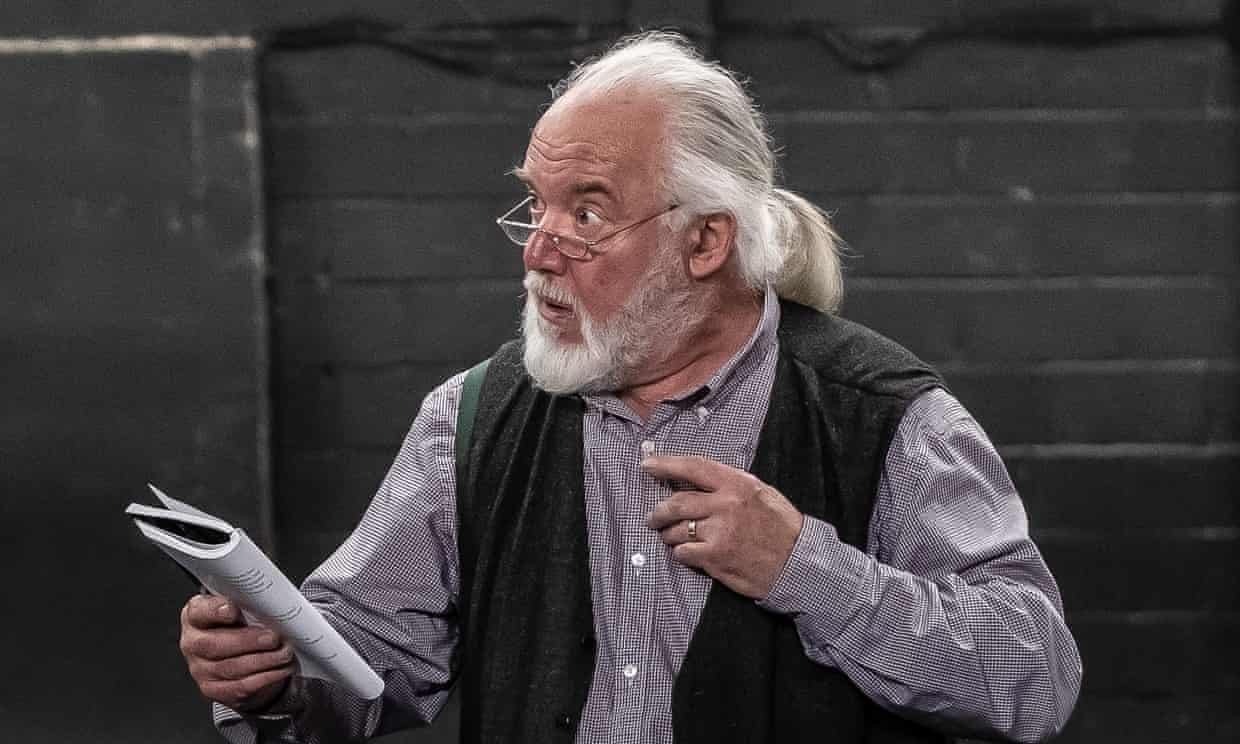
Opera singer John Tomlinson rehearses
King Lear. 

I remember once watching an Aida on television with staging that made my skin crawl. Here was Aida, here was her true love — both knowing they were dying — singing to each other from opposite sides of the cave, no touching. Really? You can’t always blame opera singers for bad acting when it’s the director’s staging that makes no sense.

Today I have a story for all the people who like to listen to opera but hate unnatural staging and acting. Turns out, there are singers who have longed for a chance to show what they can really do with drama.

Michael Billington writes at the Guardian, “I had coffee recently with King Lear and Goneril. To be more precise, with John Tomlinson and Susan Bullock, who play these roles in a brand new production of Shakespeare’s tragedy – one to be staged at the Grange festival in Hampshire [in July] with a cast exclusively drawn from the world of opera. …

“Its director, Keith Warner, says it started with him, Tomlinson and Kim Begley (ex-RSC before turning to opera) planning a two-person version called Lear’s Shadow. Word quickly spread and a reading of the whole play was mounted in Warner’s house. The result is a full-scale production with a dream cast. ….

“Talking to Tomlinson and Bullock, I am struck by their passion for theatre. At college, Bullock played Helena in A Midsummer Night’s Dream and became an ardent fan of Manchester’s Royal Exchange. ‘Seeing Uncle Vanya there with Albert Finney,’ she says, ‘made me think: “This is what I want to do.” When people ask me if I’ve ever acted before, I tell them I’ve been doing it all my life. You don’t get to play Brunnhilde or Electra without being able to act – and singing a Schubert song is a drama in itself.’

“Tomlinson, who made his stage debut at the age of six as a panto sultan, was equally turned on by Manchester theatre and recalls the excitement of going to drama, dance and improv classes when a student at the Royal Northern College of Music. Both are theatrical animals as well as singers – but is there a radical difference between working on an opera and a Shakespeare play?

“ ‘There are a lot of similarities,’ says Tomlinson. ‘You start with understanding the text, letting your imagination flow and working alone before joining the cast. The big difference is that in opera, we are used to emotions being sustained for a long time and underpinned by the music. In a Handel aria you might sing “I love you” for 10 minutes on end. In a play, particularly in Lear where the king is so mind-changing and capricious, you have to be more nimble and quick-thinking.’

“Bullock concurs, pointing out that in opera the drama inevitably starts in the orchestra pit.

‘What is so liberating about a play,’ [opera singer Bullock] says, ‘is that tempo and rhythm are in the hands of the actor, rather than the composer or conductor, and can vary hugely from one night to the next. I am loving the freedom and flexibility this gives me.’

“There is still a popular canard that opera singers are inferior actors: that, at best, they stand and deliver or deploy a limited number of traffic-cop gestures. It is a myth Tomlinson especially can’t wait to demolish. … ‘I’d say that in the UK from the 1960s to the late 1990s, singers were generally very good actors. But I admit that in the last couple of decades, operatic acting has often been stymied by hi-tech design and concept-driven direction that treats the singer as one item in a visual scheme.’ …

“What have Bullock and Tomlinson discovered in rehearsal? ‘That Goneril,’ says Bullock, ‘is not a figure of undiluted evil. She is a complex woman who has suffered from a dictatorial father, who knows that Cordelia is Daddy’s darling and who, quite reasonably, asks why he needs a train of 100 knights.’ …

“For Tomlinson, the whole play is a voyage of discovery. ‘Lear begins,’ he says, ‘as a brutally authoritarian figure but gradually becomes aware of poverty, homelessness, cruelty and injustice. The last is a subject he never stops talking about. … Lear, whose relationship with the Fool is a bit like that of Boris Godunov and the Simpleton in the Mussorgsky opera, also acquires a boundless curiosity. By the end he is not so much morally redeemed as spiritually enlightened.’ “

More at the Guardian, here.

Read Full Post »

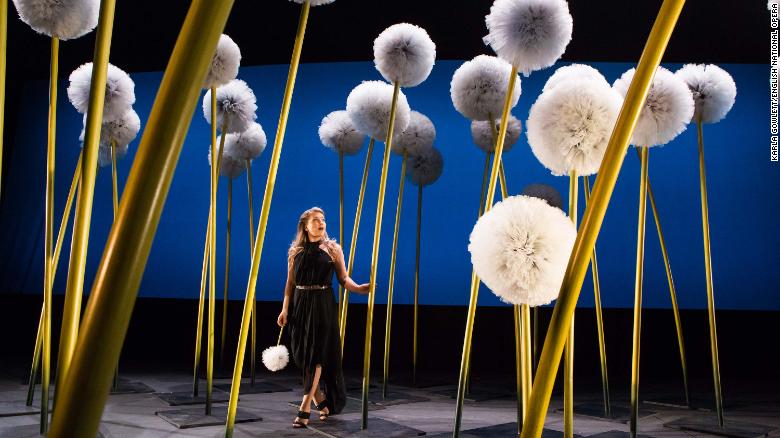
Photo: ENO via CNN.
Australian soprano Alexandra Oomens singing for a English National Opera (ENO)
program that works on singing, breathing and well-being for recovering coronavirus patients.

Who has a story that could happen only in a pandemic? Today I have one silly one that involves me and one serious one that involves opera singers helping Covid patients.

Silly story first. Because I haven’t been going to stores since the pandemic started, I haven’t collected any five-dollar bills to give as tips to delivery people. So I write $5 checks to “cash.” Well. Twice now, a woman I have never met in a nearby town has rescued a muddied check I wrote from her driveway and mailed it back to me. We must have the same milkman, one who is careless with his tips. Meanwhile, I’m gaining a penpal!

Andrew Dickson writes at the New York Times, “On a recent afternoon, the singing coach Suzi Zumpe was running through a warm-up with a student. First, she straightened her spine and broadened her chest, and embarked on a series of breath exercises, expelling short, sharp bursts of air. Then she brought her voice into action, producing a resonant hum that started high in a near-squeal, before sinking low and cycling up again. Finally, she stuck her tongue out, as if in disgust: a workout for the facial muscles.

“The student, Wayne Cameron, repeated everything point by point. … Though the class was being conducted via Zoom, it resembled those Zumpe usually leads at the Royal Academy of Music, or Garsington Opera, where she trains young singers.

“But Cameron, 56, isn’t a singer; he manages warehouse logistics for an office supplies company. The session had been prescribed by doctors as part of his recovery plan after a pummeling experience with Covid-19 last March.

Called E.N.O. Breathe and developed by the English National Opera in collaboration with a London hospital, the six-week program offers patients customized vocal lessons: clinically proven recovery exercises, but reworked by professional singing tutors and delivered online.

“While few cultural organizations have escaped the fallout of the pandemic, opera companies been hit especially hard. … The English National Opera, one of Britain’s two leading companies, has been trying to redirect its energies. …

“In a video interview, Jenny Mollica, who runs the English National Opera’s outreach work, explained that the idea had developed last summer, when ‘long Covid’ cases started emerging: people who have recovered from the acute phase of the disease, but still suffer effects including chest pain, fatigue, brain fog and breathlessness.

” ‘Opera is rooted in breath,’ Mollica said. ‘That’s our expertise. I thought, “Maybe E.N.O. has something to offer.” ‘

“Tentatively, she contacted Dr. Sarah Elkin, a respiratory specialist at one of the country’s biggest public hospital networks, Imperial College N.H.S. Trust. It turned out that Elkin and her team had been racking their brains, too, about how to treat these patients long-term. …

“Twelve patients were initially recruited. After a one-on-one consultation with a vocal specialist to discuss their experience of Covid-19, they took part in weekly group sessions, conducted online. Zumpe started with basics such as posture and breath control before guiding participants through short bursts of humming and singing, trying them out in the class and encouraging them to practice at home.

“The aim was to encourage them to make the most of their lung capacity, which the illness had damaged, in some cases, but also to teach them to breathe calmly and handle anxiety — an issue for many people working through long Covid.

“When Cameron was asked if he wanted to join, he was bemused, he said: ‘I thought, “Am I going to be the next Pavarotti?” ‘

“But Covid-19 had left him feeling battered.. … ‘Everything I did, I was struggling for air,’ he said.

“He added that even a few simple breathing exercises had quickly made a huge difference. ‘The program really does help,’ he said. ‘Physically, mentally, in terms of anxiety.’ Almost as important, he added, was being able to share a virtual space and swap stories with other sufferers. ‘I felt connected,’ he said. …

“And how was Cameron’s singing now? He laughed. ‘I’m more in tune,’ he said. The program had helped him reach high notes when singing along in the car, he added. ‘Having learned the technique, you can manage much better,’ he said. …

“It wasn’t just patients and clinicians that had benefited, Mollica said: E.N.O. Breathe had also given musicians and producers at the company something to focus on during a bleak time. ‘Everyone’s found it really motivating,’ she said. ‘It’s fantastic to realize that this skill set we have is useful.’ ”

More at the New York Times, here.

Read Full Post »

Older Posts »