Feeds:
Posts
Comments

Posts Tagged ‘radio’

Photo: Emily Mesner/Anchorage Daily News.
Lenora Ward, general manager at KOTZ radio station, listens to a 2022 dog-sled musher interview while on-air at the station in Kotzebue.

Few places in the US rely more heavily on public radio than Alaska. That is why people who care about Alaska rushed to bridge the gap after the current Congress decided public radio is not needed.

Iris Samuels reports for the Anchorage Daily News, “An Alaska fund has raised $3.5 million as it seeks to replace federal funding rescinded by Congress for public radio and television stations.

“Amid fundraising efforts, station leaders say they are already beginning to cut some programming. …

“Congress in July voted to rescind $1 billion in federal funding for public media across the country. … Two of Alaska’s three-member congressional delegation voted in favor of the rescission, which eliminated roughly $15 million intended for more than two dozen stations in Alaska. …

“Sen. Lisa Murkowski was one of a few Republicans in Congress who attempted to salvage the federal funding that Congress members themselves had approved last year, pointing to its importance in alerting Alaskans to natural hazards like tsunamis, earthquakes and fires.

“In a recent call hosted by a coalition of Alaska public radio and television stations, PBS President Paula Kerger said that Alaska is at the forefront of national fundraising efforts intended to — at least temporarily — supplant federal funding with money from private donors and foundations. …

“Kerger said she was ‘deeply grateful to Sen. Murkowski, who really fought for us more than any other member of Congress.’

Alaska stations banded together in the days following the July rescission vote to, with the Alaska Community Foundation, establish the Voices Across Alaska Fund, which in its first two months raised more than $3.5 million.

“The funds came from 80 donors, which include individuals, corporations and foundations in Alaska and in the Lower 48, according to Alaska Community Foundation spokesperson Ashley Ellingson. The funds will be disbursed to stations [based] on stations’ needs, Ellingson said. …

“Alaska Public Media President Ed Ulman said that since the rescission, new donors have begun giving, or existing donors have upped their contributions. …

“Funds will be distributed to Alaska stations, which are also independently fundraising, several station managers said in recent days. Even as they have pivoted to fundraising efforts, the station managers reported making several targeted cuts to their programming in response to the loss of federal funding.

“Alaska Public Media, the state’s largest public station, has paused Alaska Insight, a television news program that was broadcast across the state. Ulman said Alaska Public Media has also cut its education programming and is considering cutting Debate for the State, a program that features candidate forums for statewide offices. …

“Gretchen Gordon, general manager of KUAC, a station serving Interior Alaska, said the station has cut overnight broadcasting, eliminated some national radio programs and lost television service in Nenana in response to the federal funding cut. Gordon said KUAC is ‘determined to find ways to restore lost programs and services.’

“Kristin Hall, general manager at KYUK, which serves Bethel and the Yukon-Kuskokwim Delta, said the station lost $1.2 million in federal funding, and could eliminate more than half its staff by the end of the calendar year.

“Justin Shoman, president and general manager of KTOO, said the Juneau-based station may need to adjust its coverage of the Legislature. Gavel Alaska, a live-streaming service for legislative hearings, press conferences and trial hearings, costs more than $1 million annually to run and receives no state funding, Shoman said. Until the rescission, federal funding made up more than a third of KTOO’s annual budget. …

“The federal funding cut comes after a yearslong refusal by Gov. Mike Dunleavy to spend state dollars on public media. Starting in his first year as governor, he repeatedly vetoed funding intended for public radio stations. This year, the Legislature did not fund the grants for public radio in the budget. …

“ ‘It’s not lost on many of us that the Legislature has every single year put in funding, in particular for rural public radio,’ said Ulman. ‘And yet, there is one individual who has the power of the veto who exercises that veto and goes against — I’m just going to say it — the will of the people.’

“When Begich, Alaska’s lone U.S. House member, voted in June to claw back federal funding for public media, he reasoned that public broadcasting was no longer essential because Alaskans now use ‘pervasive cellular, satellite, and wireline technologies.’

“But Gordon, with KUAC, said many Interior residents do not have access to broadband internet. … ‘Our lawmakers need to understand that a little better,’ she said.”

Will the new fundraising levels last? Only time will tell. More at the Anchorage Daily News, here. And do read about how an Alaska public radio station saves lives, here.

Read Full Post »

Photo: Nieman Labs.
Volunteers reading the newspaper for radio listeners who are not able to read for themselves.

I’d like to say a word for radio. Every time a new, shiny technology comes along, we hear that the old ones are dead. Especially radio. Radio is dead more often than than theater.

But I love radio, and I’m not the only one. I love it for news without pictures, because pictures alter the story. I love it for interesting stories that are not news. I can find those online, too, but the human voice is the part that means most to me. I like it better than podcasts, which seem to overdramatize, as if I need scary music to understand the next bit might be important.

In today’s story, from Nieman Labs, Neel Dhanesha reports on a little-known radio service that means the world to a particular audience.

“A few years ago the staff at Aftersight, a nonprofit radio service based in Boulder, Colorado, got an angry call from a man whose child was trying to watch Barney on PBS Kids.

“ ‘All we can hear is you guys reading the paper!’ the man said.

“His child had accidentally switched the audio channel on their TV, and the family had stumbled onto a form of broadcasting that, for the most part, remains hidden away by design: They had discovered a radio reading service.

“When color television arrived in the United States, [it] was the product of many technological breakthroughs, but the one most relevant to our story is the sideband, or subcarrier: a modulated radio wave that can, in essence, carry more information on the same frequency. Color TV worked by sending a black and white picture in the main band of a frequency and a color picture in the sideband, and the two bands would then be recombined in the tubes of a color TV.

“Radio reading services work on the same premise, except instead of pictures they transmit a radio broadcast. Where color TV brought more vibrant pictures to living rooms around the country, radio reading services, which are also called audio information services, have almost the opposite audience: every day, across the country, hundreds of volunteers read newspapers, magazines, and books on the radio for thousands of listeners with blindness or vision loss, bringing them access to local, national, and international news around the clock.

“ ‘I always tell folks we’re on super-secret radio stations,’ said Bekah Jerde, executive director of Radio Talking Books Service, a reading service based in Omaha, Nebraska. She’s also the vice president and treasurer of the International Association of Audio Information Services (IAAIS) a collective of 39 audio information services that are mostly based in the U.S. (and one in Australia). The stations are ‘super-secret’ because they are designed to be used by people with vision impairments and other disabilities that can make reading or turning pages difficult. Thanks to a provision in copyright law, copyrighted materials like books, magazines, and newspapers can be reproduced for free for the sake of accessibility.

“The first radio reading service debuted in Minnesota in 1969 as a side-channel on KSJR — the birthplace of Minnesota Public Radio. That first ‘Radio Talking Book’ schedule included two hours of the Minneapolis Tribune newspaper in the morning and two hours of the Saint Paul Dispatch in the evening, with readings from magazines and books in the intervening hours. More than 50 years later, the live morning newspaper reading — now from the Minnesota Star Tribune and St. Paul Pioneer Press — remains the service’s most popular programming.

“Today there are 79 of the services across the country. … In the past, listeners who wanted to tune into those super-secret stations would have to send in an application for a radio that could pick up their signal or, as the man in Colorado learned, switch their audio language on certain TV channels. But streaming has come for the radio reading services, just as it has for TV.

“ ‘We went online three years ago, which did wonders for our listenership,’ said Michael Benzin, executive director of the Niagara Frontier Radio Reading service in Buffalo, New York. ‘The big restriction we always had was that our listeners needed one of our radios, so we were managing a large inventory of radios, picking them up and dropping them off all the time. But now anybody with an internet connection can play our live feed on a tablet or a cell phone or a computer.’

“The majority of the listeners for these services are over the age of 65 and have aged into vision loss or other disabilities that prevent them from reading the news on their own, Jerde told me. That means they often don’t know how to use technology like screen readers, which don’t play well with many websites anyway. The radio reading services provide their listeners with an experience that’s hard to replicate with a computer: reading a newspaper or magazine from cover to cover, including comics and grocery ads. …

“For many people, especially in rural areas with poor internet access, the reading services’ radio and TV broadcasts are essential lifelines to the outside world. Some of the services even allow people to listen by dialing a phone number.

“ ‘Part of our goal is to go out in different parts of the state, especially the rural areas, and ask how people are getting their information,’ said Kim Ann Wardlow, executive director of Aftersight and president of the IAAIS. ‘We’re trying to figure out if there are other things we should be reading to best serve folks who are seeking hyperlocal information that isn’t necessarily in the traditional newspaper anymore.’ Both Aftersight and the Niagara Frontier Radio Reading Service have started offering programs in Spanish. ….

“Every service in the network is tiny, often run on a shoestring (usually) nonprofit budget: Benzin, in addition to making programming decisions, told me that part of his job as executive director includes mowing the lawn, vacuuming, and washing the windows at the Niagara Frontier service’s office. IAAIS has a program share, similar to the Public Radio Exchange, that allows member stations to share content to help fill the schedule. And while each has its own ways to raise funds, Wardlow, Benzin, and Jerde all told me one thing is the same across the country: the volunteers are incredibly committed to their work.

“ ‘I’ve got volunteers who’ve been coming in every week for thirty years,’ Benzin told me. ‘I’ve been working in the nonprofit world for going on 40 years, and I’ve never had a volunteer base this dedicated.’ ”

I’m thinking of other groups that could benefit: English language learners and people who simply never learned to read. I wish there were more publicity for this service.

More at Nieman Lab, here.

Read Full Post »

Photo: Lee Hedgepeth, Inside Climate News via Living on Earth.
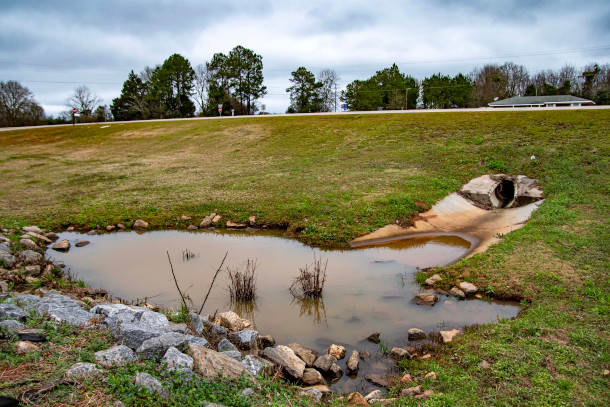
These highway drainage pipes send water directly toward homes in Shiloh, Alabama — homes  that Black landowners have maintained since the Reconstruction era. Other neighborhoods benefit from drainage that runs parallel to roadways.

“Climate injustice” is not a term favored by the billionaire class, but removing out-of-favor words doesn’t make the realities they represent go away. Whether injustices occur on purpose or by accident, they happen. But around the world, ordinary people do what they can to fight back.

Paloma Beltran, associate producer of environmental radio show Living on Earth, has written that recent government decisions “will have a ripple effect across communities that have been pushing back against the impacts of industrial pollution for years. On this week’s show, we spoke with Patrice Simms, the Vice President of Litigation for Healthy Communities at Earthjustice, about the federal government’s role in protecting people from environmental discrimination. … Here’s some of what he said:

“ ‘Really significantly for me, what continues to motivate me is my tremendous respect and appreciation for the people on the front lines of pollution and exposures. I work really closely with communities across the country who are in very real ways, fighting for their lives, fighting for their families, fighting for their well-being, and fighting for their communities. And these aren’t people who are getting paid to do this. These are people who are doing this because they have to. They’re doing this because they’re watching their children get sick. They’re doing this because they’re watching their communities die. And there’s nothing more motivating than understanding and knowing the members of these communities. … It’s an honor and a privilege to get to work with them and beside them and for them, and that keeps me going every day.’

“So it feels like an opportune time to highlight a few environmental justice leaders who have shared their stories with us:

  • “Sharon Lavigne is a former school teacher who has become a fierce environmental defender out of love for her community. She’s from Cancer Alley, an eighty-five-mile stretch of the Mississippi River, from Baton Rouge to New Orleans. Slave plantations once lined this part of the river, and many descendants of former slaves still reside in that area. In the 1960s, petrochemical plants began flooding the area, in part due to the river allowing trade, transportation and the disposal of waste in an unseen and cheap way. Most of these plants are in close proximity to predominantly Black communities, exposing them to toxic emissions. According to a 2023 study published in Environmental Challenges, toxic emissions in Louisiana are 7 to 21 times higher in communities of color compared to white communities, and chemical manufacturing is the largest contributor to this disparity. Sharon Lavigne … co-founded Rise St. James, a faith-based grassroots organization fighting against the proliferation of chemical industries in St. James Parish, Louisiana. In 2021, Sharon won the prestigious Goldman Environmental Prize for her activism. For more, take a listen to our conversation. ….
     
  • “Nalleli Cobo grew up within 30 feet of an oil well — one of more than 5,000 oil and gas wells across Los Angeles, California, 700 of which are currently active. Like much of her community, Nalleli suffered from chronic headaches, nosebleeds, stomach pain, and asthma, and at the age of 19, she was diagnosed with cancer. Following treatment, Nalleli is now cancer free, but unable to have children. In March 2020, she joined a coalition of environmental justice organizations and successfully sued the city of Los Angeles for environmental racism and violation of CEQA, which is the California Environmental Quality Act. AllenCo Energy was forced to close down its well located near Nalleli’s home. … Tune into my interview with her here.
     
  • “Andrea Viduarre is another environmental justice advocate who organized her community and convinced the California Air Resources Board to adopt transportation regulations that limit trucking and rail emissions. (However, the state withdrew these rules [after the 2024 presidential election.] Southern California’s Inland Empire serves as a the hub for logistical infrastructure and is home to a predominantly Latino population. A staggering 40% of all US goods move through the area, a lot of which is transported through diesel trucks which emit toxic pollutants linked to cancer, asthma and premature death. Andrea Viduarre’s work has made huge strides in getting pollution out of her community. … You can learn more about in our discussion here.
     
  • “Robert Bullard is known to many as the father of environmental justice. He ran the first study on eco racism in 1979, and found that toxic facilities in Texas were disproportionately located in Black communities. His research was used in the Bean v. Southwestern Waste Management Corporation lawsuit, the first case to use civil rights law to challenge environmental racism. He’s the founding director of the Bullard Center for Environmental and Climate Justice, as well as Distinguished Professor of Urban Planning and Environmental Policy at Texas Southern University. He’s been advocating on behalf of the predominantly Black community of Shiloh, Alabama, whose homes have been repeatedly flooded since a nearby highway was widened in 2018. Dr. Bullard joined us back in 2024 to talk about this case.”

It has always lifted my spirits to see everyday people doing what they can where they are. Public radio’s environmental show Living on Earth will lift your spirits.

PS. Join me on Mastodon? @DudeShoes.

Read Full Post »

Photo: First Dibs.
Above, a restored 1938 Zenith radio. Stars such as James Dean, Jack Klugman, Martin Landau, Lee Marvin, Walter Matthau, Steve McQueen, Anthony Perkins, Jerry Stiller, Martin Balsam performed on the television version of The Big Story, a show that started on radio in 1947.

The other day, my husband heard a Richard Strauss tone poem that brought back a memory he had of a true-crime show he liked. The Big Story started on radio and later transferred to television, where it attracted an impressive array of guest stars.

I didn’t know The Big Story, but as I learned more, it got me thinking about what a great service radio was — and still is. (When Suzanne and John were little, I had a show of my own at WGMC, a community station in Greece, New York.)

I turned to Wikipedia.

The Big Story is an American radio and television crime drama which dramatized the true stories of real-life newspaper reporters. … Sponsored by Pall Mall cigarettes, the program began on NBC Radio on April 2, 1947. With Lucky Strike cigarettes sponsoring the last two seasons, it was broadcast until March 23, 1955. The radio series was top rated, rivaling Bing Crosby‘s Philco Radio Time.

“Produced by Barnard J. Prockter, the shows were scripted by Gail Ingram, Arnold Pearl and Max Ehrlich. Tom Vietor and Harry Ingram directed the series. … The theme was taken from Ein Heldenleben (‘A Hero’s Life’), a tone poem by Richard Strauss.

“Prockter was inspired to create the program after hearing about a man who was freed from a life sentence in jail by the work of two newspaper reporters in Chicago. Most of the stories in the show dealt with stories about closed cases. Ross Eaman, in his book, Historical Dictionary of Journalism, wrote that the program was ‘originally intended to honor reporters ignored by Pulitzer committees.’ Jim Cox also cited that plan in his book, Radio Crime Fighters: More Than 300 Programs from the Golden Age.

“Each week the program recognized the reporter who wrote the story on which that episode was based and the newspaper in which the story appeared. The reporter received $500, was interviewed on the air and was acknowledged in the introduction, as in this example:

” ‘Pall Mall, famous big cigarette, presents The Big Story, another in a thrilling series based on true experiences of newspaper reporters. Tonight, to Russ Wilson of the Des Moines Tribune goes the Pall Mall award for The Big Story. Now, the authentic and exciting story of “The Case of the Ambitious Hobo.” ‘

“The radio series was adapted for television where it debuted on NBC on September 16, 1949. The series continued to air on NBC until June 28, 1957, after which it appeared in syndication until 1958. The half-hour program was hosted by Robert Sloane, Norman RoseBen Grauer, and, finally, Burgess Meredith. …

“The theme music was two of the main themes from the tone poem ‘Ein Heldenleben’ (‘A Hero’s Life’) by the German composer Richard Strauss. The series was nominated for a Primetime Emmy Award in 1953.”

Now I’m thinking of some of my earliest memories of radio. I had a babysitter who love to listen to a morning show that opened with the song “Pack up your troubles in your old kit bag, and smile, smile, smile.” I know it’s a WW I song, but it was still in use when I was a kid.

I also remember that once when I was trying to fall asleep, I heard a radio drama someone had left playing and was too scared even to get up and turn it off!

What are your radio memories?

More at Wikipedia, here, and at Old Time Radio Downloads, here.

Read Full Post »

image

Photo: Raidió Teilifís Éireann (RTÉ ), Ireland’s National Public Service Broadcaster.
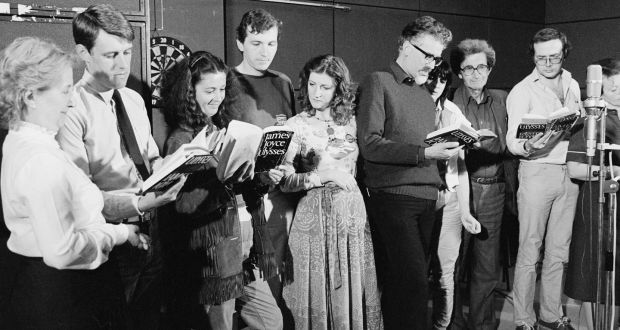
RTÉ Players recorded James Joyce’s mammoth work
Ulysses in 1982 for the Joyce centennial. It was rebroadcast today. Still going.

I didn’t know this before, but apparently many Irish people didn’t initially love James Joyce. They didn’t understand his writing any more than you or I did. But when a radio production brought his characters to life, they realized they knew these guys.

Denis Staunton has the story at the Irish Times.

“Britain had just defeated Argentina in the Falklands, Israeli forces were shelling Beirut. … But Dublin’s mind was elsewhere on June 16th, 1982, as the city celebrated the centenary of James Joyce’s birth with a mammoth Bloomsday festival. …

“Joyce’s words were everywhere in the city that day because from 6.30 am until the following afternoon, RTÉ Radio broadcast a complete reading of Ulysses lasting almost 30 hours.

“Listening on transistor radios and Walkmans, many Dubliners who had long been intimidated by the book found that they not only understood it but enjoyed it and recognised themselves in it. …

“The Irish Times [wrote], ‘The voices of the RTÉ readers became the medium for Joyce’s living words. The writer’s poor sight and fondness for singing surely must have affected the conspicuous musicality of his prose: he wrote to be listened to rather than read, so that Ulysses in its radio shape was shown to be an epic ballad.’

The recording, … broadcast in full on RTÉ Radio One Extra from 8 am [today and] available on rte.ie/ulysses, includes every word in the novel. But it is as much a dramatisation as a reading, with 33 actors playing more than 400 parts.

“As a 20 year-old actor in the RTÉ Players when the company spent most of 1981 on the project, I played a number of small parts including Ned Lambert and Lyster, the Quaker librarian and various voices that ensured I was at most of the rehearsals and recordings. …

“The director was Willie Styles, a former actor from New Zealand who had trained at London’s Royal Academy of Dramatic Art (Rada) before moving to Dublin … He was RTÉ’s most talented radio drama director by a distance and one of the most accomplished in the world, winning a succession of international awards as he embraced each technological advance. He worked on Ulysses with Marcus McDonald, a sound engineer who shared both his fastidiousness and his appetite for experimentation in sound.

“The textual adviser was Roland McHugh, an entomologist whose interest in the acoustics of grasshoppers led him to become an expert on Finnegans Wake. McHugh’s first challenge was to go through the text working out which words should be spoken by whom, with some chapters involving multiple narrators as well as characters. He decided that the Sirens chapter, which is set in the Ormond Hotel, should have four narrators.

“ ‘If you listen to it, the thing starts with Miss Douce and Miss Kennedy talking and you’ve got a narrator for them. And that goes on for about four pages, I think, and then you switch to Bloom, and he gets a separate narrator. So we’re jumping backwards and forwards between those two narrators until we get about halfway through the thing, and then a third narrator comes in and mostly says short things about the coach that Blazes Boylan is travelling in. And then towards the end there’s a fourth for the piano tuner. Those four narrators seemed to me to make a lot more sense of the thing,’ [McHugh] said. …

“Laurence Foster, an actor in the company who later became an energetic and innovative head of radio drama at RTÉ, says the medium makes specific demands on an actor.

“ ‘You have to get inside your own head – it’s a very selfish medium. You have to believe what you’re saying. You have to see through the mind’s eye and you have to bring up an incredible energy that converts the voice into painting pictures. The voice has to get a dynamic and a colour and a resonance and a rhythm,’ he says.

“ ‘You don’t play to the other person. The microphone is the audience and the audience’s ear. And when you get that into your head that you’re whispering into their ear, you don’t need a huge amount of voice.’ …

“It will now be available free online to listen to any time you want. But as The Irish Times observed after the first broadcast, listening to the entire book continuously is an experience of a different order entirely.

“ ‘When the seamless broadcast ended, many listeners must have discovered withdrawal symptoms,’ the editorial said.” More here.

Glad I read the book last year, so I sort of know what we’re talking about.

Read Full Post »

nahkofinal2

Photo: Michael Pierce
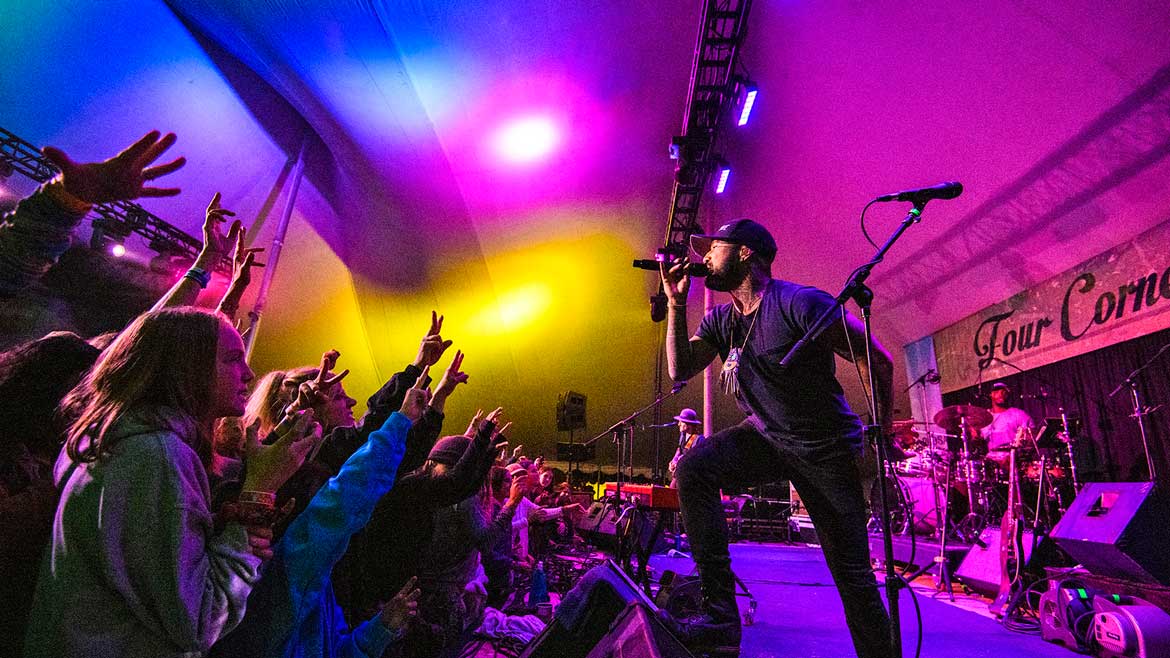
Nahko & Medicine for the People performs at the Four Corners Folk Festival in 2018. Recently, a local radio station agreed to take ownership of the festival.

There’s an Allen Ginsberg poem I love to the effect that sometimes things mysteriously appear just when they are needed. I thought of that poem when I read about a small radio station in Colorado’s Four Corners area taking on live shows it never imagined it could afford.

Braeden Waddell wrote about this at Current last summer.

“Public radio station KSUT in Ignacio, Colo., will assume ownership of two annual music festivals Sept. 30 as part of an agreement with local nonprofit organization FolkWest.

“No money will change hands as part of the arrangement. KSUT Executive Director Tami Graham said that the transfer of the Four Corners Folk Festival and the Pagosa Folk N’ Bluegrass Festival, both three-day events held in Pagosa Springs, Colo., was ‘an incredible donation’ to the station.

“The organizations had developed a relationship through a partnership of more than two decades, with KSUT sponsoring FolkWest in exchange for live studio sessions featuring artists playing for the festivals.

“ ‘My biggest goal with the acquisition of the festivals is just to maintain a really high level of production quality and a great experience for the musicians as well as the attendees,’ Graham said. …

“The decision was made after FolkWest Executive Director Crista Munro took on a new position heading the Sisters Folk Festival in Sisters, Ore. …

“ ‘It was a bittersweet moment for me, knowing that my chapter at the helm of FolkWest would be ending,’ Munro said in a post on KSUT’s website. ‘KSUT always seemed like a natural choice to take over our events. They do an amazing job with everything they produce, and Tami Graham brings a ton of live music production experience to the table.’ …

“Munro told Current that KSUT ‘believed in the vision’ she and her husband had for the festivals. ‘If it were anyone else taking this on, I would be a lot more nervous,’ she said. …

“In an interview with the Colorado Bluegrass Music Society, Munro said that the Folk N’ Bluegrass festival brings in about 2,000 attendees per day and the Four Corners Folk Festival draws nearly double that. …

“KSUT does not plan to make any ‘significant changes’ to the festivals but does aim to expand FolkWest’s Pagosa Folk N’ Bluegrass Jam Camps, which provide three days of music classes for adults and children.

“ ‘There’s a lot of grant funding available for music education … to support bringing in world-class stringed instrument musicians, for example, that want to want to teach and work with adults and youth,’ said Graham. … ‘This is just a perfect fit.’ ”

More here.

Read Full Post »

190402-erika-hernandez-micop-community-leader-radio-indigena-dj-se-206p_6f4e8705eeab07bbf03092d2680ed931.fit-1240w

Photo: Arcenio Lopez
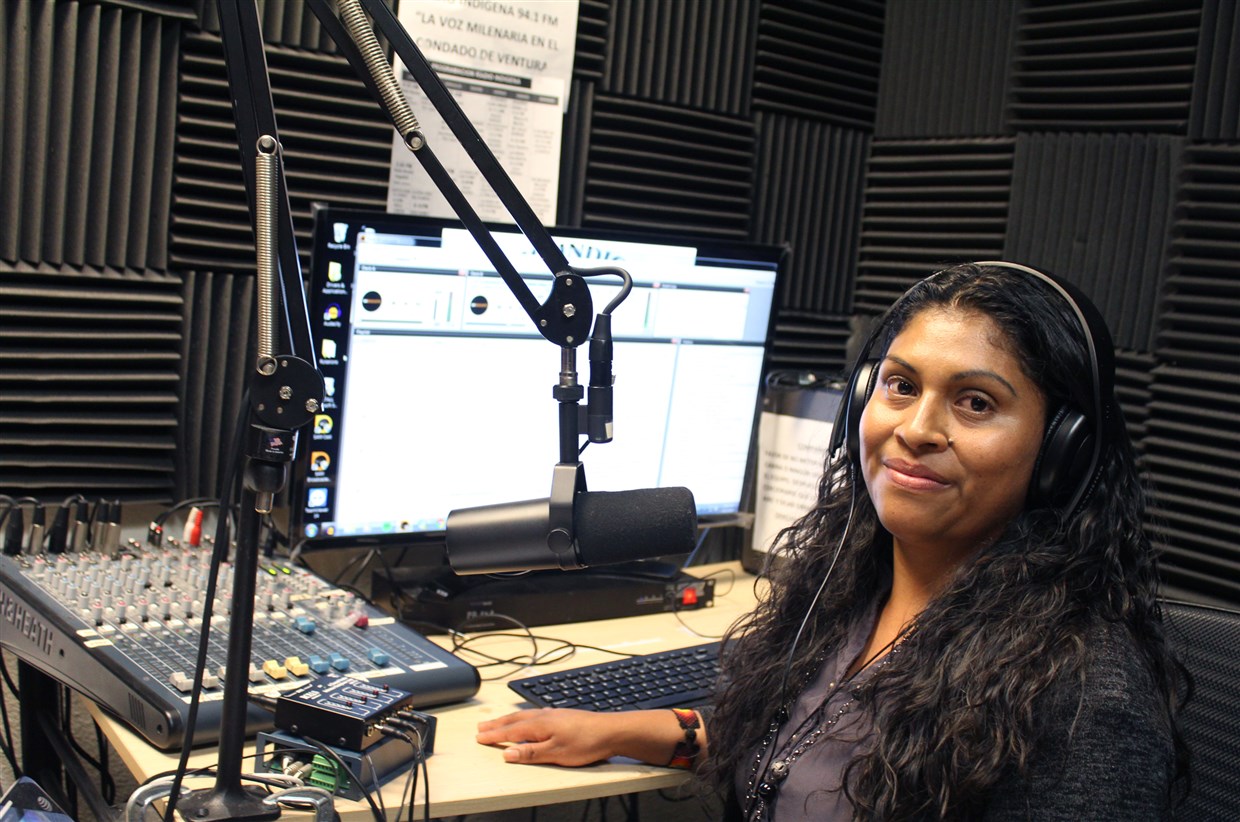
Erika Hernandez, of the Mixteco Indígena Community Organizing Project in California, is a Radio Indigena DJ.

As languages spoken by small communities disappear, overwhelmed by other languages, it’s encouraging to read that the digital media that’s part of the problem is also part of the solution. As is radio.

Ludwig Hurtado has the story at NBC News. “Josefino Alvarado, a California farm worker, describes his typical morning picking blueberries at a Ventura County farm.

“As the sun beats down on him and his fellow workers, a crackle of static hums at their feet. ‘Hola mi gente,’ (Hello, my people) a voice calls out from the radio’s speakers in Spanish. Then, ‘tanìndíí,’ which means ‘good morning’ in Mixteco.

“On this farm and most of the farms nearby, workers have their radios tuned into the same station: 94.1, Radio Indígena. … The community-run station boasts 40 hours of original programming every week, broadcasting music and talk shows in a handful of indigenous languages, as well as Spanish programming too.

“The station is a welcome cultural lifeline for thousands of farm workers who speak Mixteco or other indigenous Central American languages.

“ ‘Listening to it is a point of pride,’ Alvarado, who is a frequent listener, said. While he only understands Spanish and Mixteco, he often will listen to some of Radio Indígena’s shows in Zapoteco, Triqui, and Nahuatl. Even if he doesn’t understand them, he said he’s proud to hear the languages being kept alive on the airwaves.

“Alvarado, who moved to the U.S. in 1997, was born and raised in the city of Oaxaca in central Mexico, where he and his family learned Mixteco as their first language. Although Mixteco has come into the national spotlight thanks to the Academy Award-winning film, Roma, the language is still virtually unknown to the general population. …

“Due to economic and cultural pressure in Mexico, many Mixtec communities are shifting to Spanish. UNESCO considers almost half of Mixteco’s 50 dialects to be either severely endangered or at risk of endangerment.

“According to the 2010 census, over 685,000 Latinos in the U.S. identified themselves as American Indian, up from around 400,000 in 2000. But experts agree that the actual number of indigenous Latinos in the U.S. is much higher than estimated because many don’t report to the census due to stigma and immigration status. …

“ ‘There’s a lot of radio stations in Oxnard, but they just play music,’ said Roberto Jesús, who listens to the show every morning as he drives to work, getting informed about the news and about his legal rights as an immigrant. … In the U.S., Mixtecs face barriers because of their limited English and sometimes limited Spanish. This leaves many of them vulnerable to exploitation and discrimination.

“Radio Indígena is hosted and run by the Mixteco Indígena Community Organizing Project (MICOP), a nonprofit organization formed to provide health outreach, humanitarian support and language interpretation to this underserved and often unnoticed community. …

“Radio Indígena started when organizers saw a void in the city of Oxnard, but [Arcenio Lopez, executive director of MICOP and Radio Indígena] said that the station has listeners from all over the country and world, since the episodes are available to stream online. …

“Delfina Santiago and Carmen Vasquez co-host a show on Radio Indígena every Sunday from 10 a.m. to 1 p.m. Even though they don’t get paid for their work, the two spend lots of time during the week preparing for their program, ‘Al Ritmo De Chilena,’ which is an educational program that delves into the history of different indigenous cultures for each episode.

Santiago and Vazquez say that the digital age has played a role in keeping their language alive and keeping folks connected to one another, in a world where they might otherwise feel alone. Indigenous Mexican music can be found on YouTube and SoundCloud. …

“ ‘We’ve already lost three languages in Oaxaca,’ Santiago lamented. ‘They’re gone.’ ”

More here.

Read Full Post »

mukhtar_20190213_frost_2

Photo: Evan Frost/MPR
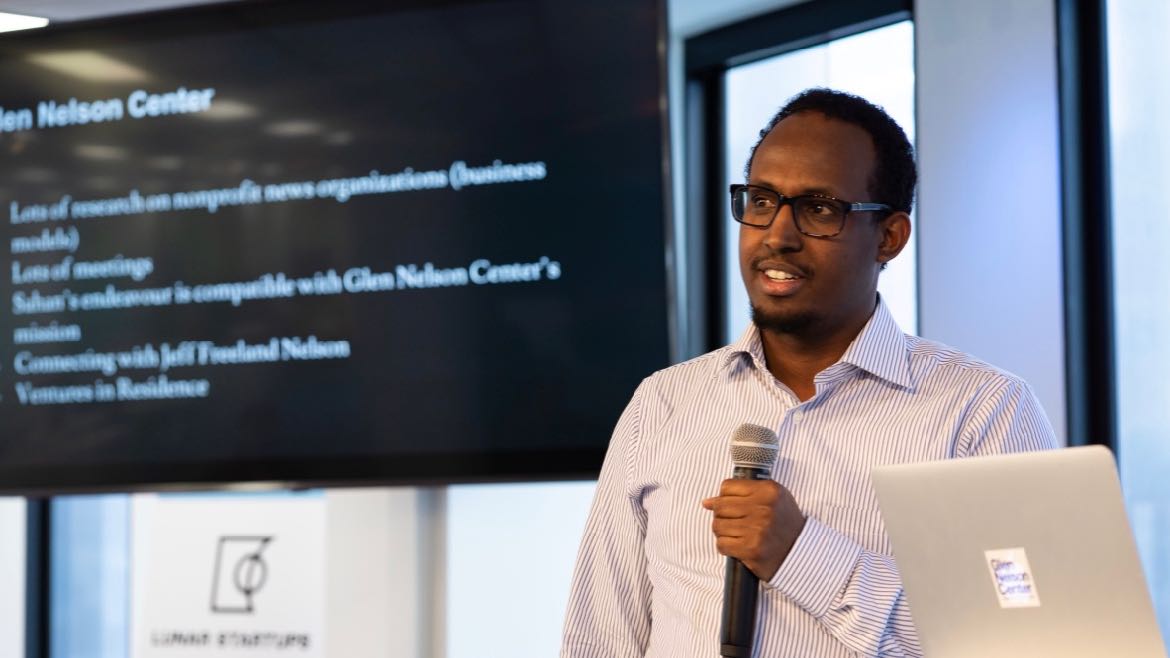
Mukhtar Ibrahim gives a presentation about Sahan Journal at the Glen Nelson Center in Minneapolis.

When we lived in Minneapolis, we got to know a Somali-American who worked at our apartment building’s front desk and later ran for mayor. He was a friendly, curious man, who enlightened me a good bit about Islam and Africa. As a child in Somalia, he played soccer games interrupted by camels, and he loved to get news from around the world on the radio and then study the map to see where the news was happening.

Today the large immigrant community in his new country has a different way to get news.

Andrew Lapin reports at the Current, “Support from Minnesota Public Radio is enabling a website covering the state’s immigrant communities to expand into a full-time venture for its founder.

Sahan Journal is the brainchild of Mukhtar Ibrahim, who began his career as MPR’s first Somali-American reporter before joining the Minneapolis Star-Tribune. He has returned to MPR as a full-time network employee focusing exclusively on Sahan, with the network also providing a content-sharing agreement and other material support.

“Ibrahim said he wants Sahan to be ‘a one-stop shop for all things immigrant in Minnesota.’ …

“Ibrahim began the project in 2013 as a side venture, two years after earning his undergraduate degree from the University of Minnesota’s journalism school. The name ‘Sahan’ comes from the Somali word for ‘pioneer’ and traditionally refers to a group of respected men from a community who are chosen by village elders to embark on exploratory expeditions.

“Recruiting other writers of the Somali diaspora, Ibrahim published news and information related to East African politics and culture on the Sahan website. He tapped an influential network of contributors. One of Sahan’s former writers, Mustafa Muhummed Omer, was recently appointed acting interim president of the Somali Regional State in Ethiopia, one of the country’s nine governing regions divided by ethnicity.

“ ‘People were really hungry for that kind of content,’ Ibrahim said, adding that English-language news sources for young professional Somalis were hard to come by.

“As Ibrahim started a family and devoted more time to his day job, Sahan Journal fell by the wayside. … Ibrahim knew he wanted to return to Sahan Journal and broaden its focus to capture more of the state’s immigrant population, including Hmong and Liberian residents. After earning a master’s in journalism at Columbia University with the aid of a leadership fellowship from the Minnesota-based Bush Foundation, he redirected his attention to his passion project.

“Ibrahim found a willing partner for Sahan Journal in his former employers at MPR. Reaching the state’s immigrant communities is ‘the number-one priority for me,’ said MPR News Executive Editor Nancy Cassutt. …

“Cassutt said MPR aims to republish five stories a month from Sahan Journal, edited by an MPR News editor. She also said MPR would like to see Sahan Journal cover immigrant communities across the entire state of Minnesota, not just the Twin Cities. …

“Ibrahim also hopes to make mentorship and journalism education a part of his site’s mission. … By encouraging more immigrants to become reporters, Ibrahim said, the community will benefit. ‘We say there’s a lack of diversity in the newsrooms, but in the beginning we don’t even give people a chance,’ he said. ‘So this newsroom will be a place where people can run, can fail, can experiment with journalism.’ ”

More here.

Read Full Post »

Radio Lifeline for Syria


Photo: Amandas Ong
An Alwan radio producer in the station’s recording studio. The broadcast lifeline to Syria is located in an apartment complex in Turkey.

Where people struggle to carry on their lives in the midst of war, radio can provide comfort and hope. This is a story about Syrians in exile who broadcast news and normalcy to people back home.

Amandas Ong writes at Slate, “I push my way out of the metro station in southwestern Istanbul where Sami — not his real name — and I have agreed to meet. …

” ‘It’s not far from here,’ he says, directing me down an overhead bridge through a number of serpentine streets. …

“The hive of activity inside forms the Istanbul operations of Radio Alwan, (Alwan means ‘colors’ in Arabic) an independent Syrian news station broadcasting into that devastated country every day. Alwan provides much-needed news updates to information-starved Syrians and also runs popular entertainment programs and controversial discussions. …

“Three bedrooms have been converted into a meeting room, a recording studio, and an office. … Most of the staff had no prior training in radio journalism before joining Alwan. Sami describes himself as having ‘come from a regular, boring HR job in Dubai.’ …

“ ‘The point of Alwan,’ he had told me in a prior conversation over FaceTime, ‘is not just to report the news. Radio is also a form of activism, and through our programs, we try to do our part by encouraging people to engage with civic organizations within Syria, and to inform them on what’s really happening both around the country and outside of it.’ …

“A law student named Ahmad al-Qadour started Radio Alwan in 2014 in the northern Syrian city of Idlib. … They decided to relocate Alwan’s central office to Istanbul after a series of threats from Islamic radical groups such as the al-Nusra Front, which had been part of the Syrian wing of al-Qaida before splitting from the group in 2016. …

“A typical day at Alwan begins at 6 a.m. in the Istanbul office, where the team of about 15 staff members assembles for a variety of Syrian and international news segments, followed by talk shows and short radio skits, some educational, others comedic. …

“Sami is especially proud of Oh, Grandma, a program presented by a woman from Idlib who is identified by her initial, N. She has a day job as a teacher, but in her role at Alwan, she visits the houses of women in the city and interviews them about their lives, their daily struggles, and discusses salient issues with them, such as the legal age for marriage for Syrian women. …

“Maram, a 24-year-old in a slouchy sweater and jeans, comes to talk to me. She graduated from a media school in Damascus and decided to come to Turkey to seek better job opportunities, before stumbling upon an open position at Alwan. …

“I ask her what she likes most about Alwan, and she doesn’t hesitate: ‘I learn a lot every single day, but most of all, it’s taught me so much about how to deal with uncertainty.’ …

“Sami [has] a philosophical approach to the objective of radio itself.

“ ‘We have a program called Acute Angle,’ he says, ‘that encourages people to accept the idea that there is no such thing as true fact. In each segment, we talk about different personalities like Michael Jackson, Ataturk, and even Walt Disney, and how these people have been represented both positively and negatively. I want our listeners to know that there are no taboos, and also no perspective on any one issue or narrative that should be taken for granted.’ …

“[It’s staff member] Dima who has perhaps the most poetic vision of her work at Alwan. ‘What I’ve learned is that the people who listen to us aren’t just suffering day in and out. They want to live, love, dance, laugh. Sometimes we draw courage from them, other times they are comforted by us, hundreds of miles away,’ she says. ‘That’s the beauty of radio: It has soul.’ ”

More here.

Unhappy Update, Dec. 29, 2019, here.

Read Full Post »

Photo: Jason Margolis
Solar Holler founder Dan Conant, foreground, observes a solar roof installation in Lewisburg, West Virginia.

As warehouse and distribution jobs proliferate and meet a need for lower-skilled employment, I’m beginning to accept that companies like Amazon that destroy traditional industries have some redeeming social virtues. After all, times change.

Perhaps no American workers feel the changing times more deeply than do those in the coal industry. But displaced workers who are open to new opportunities seem to be emerging from the disruption OK.

Jason Margolis provided a coal-country report for Public Radio International’s excellent 50 States series.

“Tanner Lee Swiger graduated from high school in Wayne County, West Virginia this spring,” writes Margolis. “His father and grandfather both worked in West Virginia’s coal industry. But not Swiger, or any of his high school classmates.

“Nobody from his graduating class is working in coal, says Swiger. ‘[They’re] working in fast food or not working at all.’

“Not Swiger. He has a job installing rooftop solar panels. He says his family is delighted with it. …

“Swiger is working as an apprentice with Solar Holler, which was founded four years ago by 32-year-old Dan Conant. Conant doesn’t see solar energy and coal at odds with each other.

“ ‘The way I think about it, as a West Virginian, is that West Virginia has always been an energy state, and this is just the next step. It’s the next iteration,’ says Conant. …

“He left his job at the US Department of Energy to start Solar Holler, to try to help slow his state’s economic slide. By many metrics, West Virginia is one of the poorest states in the country. …

“ ‘We need to find new things,’ says Conant. ‘It’s not going to be the coal industry of the past.’ …

“Solar may be an energy of tomorrow, but … coal mining jobs in West Virginia typically pay more than twice the starting wages for solar. But those jobs are increasingly hard to find, and Solar Holler, and other solar installers, need workers now. …

“Solar Holler is partnering with a non-profit called the Coalfield Development Corporation. They own the building. Beyond solar jobs, Coalfield Development is teaching former coal workers skills like woodworking and farming.

‘Apprentices with Coalfield Development work 33 hours, spend six hours a week at a community college, and three hours engaged in ‘life-skills mentorship.’ Nearly 90 people have entered the program. ”

More at “50 States: America’s place in a shrinking world,” here, where you can listen to the story or read it.

Read Full Post »

Photo: Current, News for People in Public Media
Truck driver Finn Murphy, author of The Long Haul.

It shouldn’t be a source of wonder that anyone who drives a lot in the US should listen to National Public Radio, given that the stories are longer than other radio stations’ stories and are repeated less monotonously. So nothing but unconscious bias can account for my surprise about truckers who tune in.

Alan Yu, a producer at WHYY, reported at Current, “In July last year, long-haul truck driver Stephanie Klang got a rare speeding ticket because she was too engrossed listening to public radio.

“ ‘It’s okay, I only get a speeding ticket about once every 10 years,’ she said. ‘… It was worth it for the story.’

“She told the state patrolman that yes, she knows listening to the radio is not a valid excuse, then proceeded to tell him all about the radio show that took her mind off her speed — an episode of BackStory about the history of taxes in the U.S. after the country had just broken away from England.

“Klang has been a truck driver for 37 years, going through all 48 contiguous states, and she listens to public radio all the time. She said she used to have a small booklet listing all the public radio stations in the country, which she got as a gift for pledging support.

“ ‘I used that book until it absolutely fell apart, and I wish I’d ordered two of them now,’ she said. …

“She’s not the only truck driver who listens to NPR — far from it, according to Finn Murphy, who has been a long-haul trucker for more than 30 years.

“ ‘Every single driver I’ve ever talked to listens to NPR,’ said Murphy.

“He recently published The Long Haul, a book about his experiences. ‘If I can, I’ll schedule my driving to catch Fresh Air with Terry Gross,’ Murphy wrote. …

I’ve got a little crush on Terry, actually. It’s probably because I’ve spent more time with her than anyone else in my life.’ …

“Murphy writes that even if truckers ‘may not like the slant, if there is one,’ they still listen to public radio. …

“Fred Manale, a 55-year-old trucker from Louisiana, said he listens to public radio, though he finds it ‘disturbing.’ For example, he said NPR should not be blaming President Trump for having a connection to Russia. …

“Ray Hollister discovered public radio when he was a long-haul truck driver for a year in 2002. Now the general manager of an IT company, Hollister said the network needs to ‘speak more to the flyover states. … Do stories that affect more people than just the coast.’

“ ‘Truck drivers come from across America,’ he said. ‘They’re a pretty decent cross section of America. I knew a ton of white, black, Asian, Hispanic truck drivers, and the only thing we had in common was that we were all truck drivers.’ ”

More here.

Read Full Post »

Allison Keyes at American Public Media Marketplace reported recently on an unusual kind of cruise line — one that is looking for passengers who want a little altruism along with their fun.

“Carnival Corporation’s new brand, Fathom Travel,” she writes, “is seeking to tap into a growing market with its social impact cruises to the Dominican Republic and cultural immersion cruises to Cuba. …

“Its Social Impact cruises are now regularly bringing visitors who want to help out on humanitarian projects to the Dominican Republic.

“In the village of El Cupey, in the mountains above Puerto Plata, Maria Vargas sits on her porch with her family and a neighbor. The 43-year-old and the others are learning to speak English from passengers on Fathom’s cruise. Through an interpreter, Vargas explains that the weekly classes are giving them a chance to improve their lives, and the opportunity to get out of poverty.

“ ‘I want (my) family … to get a new opportunity for a job with this,’ Vargas explained. ‘It has been a big benefit.’

“Along with the English classes, Fathom’s social impact cruises allow passengers to do everything from laying cement floors in homes and planting trees to combat deforestation, to building ceramic water filters in a nation where more than 3 million people don’t have access to safe, piped water.”

Says Josh Elliott, international program director at Wine to Water, which “has built and distributed 316 water filters with the help of Fathom passengers since the cruises began, ‘Fathom came to us with the idea and has really provided us with not only filters from volunteers working alongside us in the Dominican Republic, but it’s also given us an amazing platform … We’re inspiring people to give back when they go home and get off the ship.’ …

“But for Fathom to be successful,” cautions Keyes, “it must attract more passengers like Florida native Ken Maida, who said this is different from the 20 previous cruises he’s taken.

“ ‘This one is more for humanity,’ Maida said. ‘This one’s more about volunteerism and giving back to the community, to people who don’t have as much as we do.’ ”

If it sounds a little superficial, it at least helps travelers to see another side of life and think about longer-term service projects.

More here.


Read Full Post »

There’s always something fun over at PRI’s environmental radio show Living on Earth. Here’s a story that ran in March about the unique bird species isolated in Northeastern Australian rainforests.

Bob Sundstrom wrote up the audio report of BirdNote‘s Mary McCann: “The Eastern Whipbird hangs out in the dense understory. It’s dark, crested … nearly a foot long and emerald-green with white spots. … The large, pigeon-like Wompoo Fruit-Dove … feathered in a stunning combination of green, purple, and yellow, [is] clearly named for its voice.

“Pig-like grunting on the forest floor tells us we’re in the company of the largest bird on the continent – the Southern Cassowary. On average, the female weighs 130 pounds and stands around 5 feet tall, looking like a giant, lush, black hairpiece on thick legs. A helmet called a casque makes it look as much like a dinosaur as any living bird.” Five feet tall? I think I know a one-year-old who would like to try riding it.

The bird sounds on the radio show were provided by The Macaulay Library of Natural Sounds at the Cornell Lab of Ornithology. Hear them all here, where you can also enjoy the equally far-out pictures.

Photo: Jan Anne
Southern Cassowary

Read Full Post »

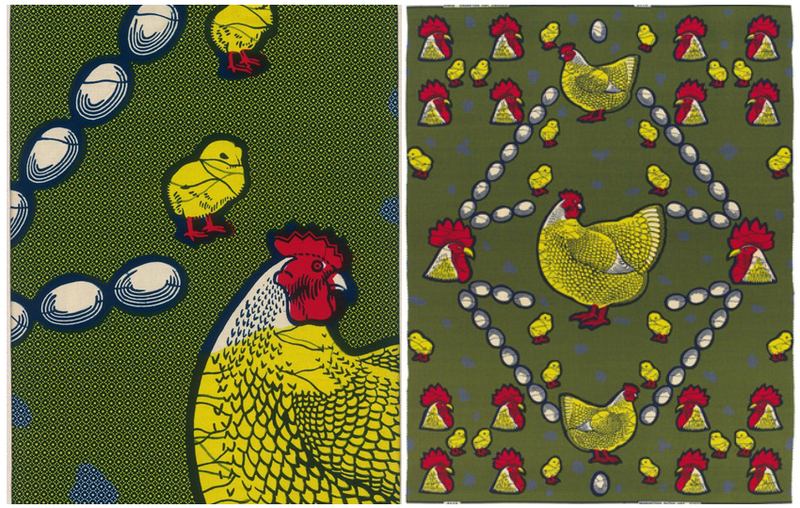
I had to share a delightful report from the radio show Studio 360 in which Khrista Rypl looks at the cultural aspects of African textiles.

She writes, “African textiles are distinctive for their vibrant colors, bold patterns, and batik dyes that give the fabric a unique crackled texture. But I had no idea that some of the trendiest of these prints are actually designed and produced in the Netherlands by a company called Vlisco.

“Inge Oosterhoff wrote a wonderful deep dive into the history behind the Vlisco textile house, and explained how their designs have remained hugely popular in Africa since the late 1800s. But Vlisco doesn’t just make fabric; they’re known for their printed designs. … Some patterns are designed with different countries in mind, while others are distributed widely around the continent. As the patterns catch on among shopkeepers and consumers, many of them get colorful names like ‘Love Bomb,’ ‘Tree of Obama,’ and ‘Mirror in the Sun.’ …

“Many patterns are sold widely in Africa, and different countries and cultures adopt different meanings and associations. [A swallow] print is a perfect example. The fabric was used for airline uniforms in Togo, so there the pattern is commonly referred to as ‘Air Afrique.’ The pattern also symbolizes asking for a favor, like the hand of a woman in marriage. In Ghana, the swallow refers to the transience of wealth, and the pattern is referred to as ‘Rich Today, Poor Tomorrow.’ It has a similar connotation in Benin, where it’s referred to as ‘L’argent vole,’ where it could either be interpreted as ‘Money Flies’ or ‘Stealing Money.’ ”

More designs and more of Studio 360 report, “Textiles Tell a Cultural History,” here.

Photos: Vlisco

Read Full Post »

I love listening to Worcester-based WICN (jazz radio). Bonnie Johnson had an especially good show yesterday, opening with Cynthia Scott and 3rd, 4th & 5th graders of PS32 in Brooklyn, NY, singing “Dream for One Bright World.”

“There is a new day dawning
“The time is now
“The world is ready for a change …

“Let’s teach out children to care
“To help one another
“And mend broken hearts
“So many children in the world
“Have never had a chance
“Their time has come …

(More lyrics here.)

You can listen to WICN online at wicn.org. Bonnie Johnson’s program is described at Colors of Jazz. “Bonnie Johnson is host of Colors of Jazz on Sunday afternoon from noon-4 pm. If you asked the Worcester native how she found jazz, she would tell you that jazz found her. As an undergraduate student at Howard University in Washington, DC, Ms. Johnson became a fan of the Quiet Storm featured on the college station WHUR-FM. …

“Ms. Johnson appreciates the diversity and the evolution of music. As a self-taught electric bassist, she has enjoyed many years of playing various types of music with her daughter and close friends in a family band. Growing up, she sang in the St. Cecilia Girl Choir at All Saints Worcester. …

“Ms. Johnson holds B.A. in Liberal Studies and M.S. in Communications and Information Management degrees from Bay Path College. She believes the future of jazz is in our children, stating, ‘Music and the arts is one area that gives young people an outlet and release of creative energy. While there are many children exposed to music through lessons and attending live performances, there are too many more that are not.’ One of Johnson’s primary goals as host at WICN is to reach youth in creative ways through community engagement.”

That’s something to think about on Martin Luther King’s birthday — and maybe to act on, too.

Bonnie Johnson, host of WICN radio’s Colors of Jazz 

Read Full Post »

Older Posts »