Feeds:
Posts
Comments

Posts Tagged ‘refugee’

good-chance-dome_calais

Photo: Good Chance Theatre
A group that was founded to dramatize the plight of refugees in Calais, France, is now performing internationally.

Theater can often bring out the empathetic and compassionate side of audience members and lead to positive change in the world. As Amelia Parenteau writes at American Theatre, a play called The Jungle that grew around a refugee camp in Calais, France, may be helping viewers to see asylum seekers as people like themselves — and motivating them to take action.

“Good Chance Theatre was started by two Brits, Joe Murphy and Joe Robertson, when, in 2015, they passed through Calais, France, on their way to Germany and they saw the makeshift refugee camp that had formed there.

“Many theatremakers might feel the need to share the refugees’ story with the world, but first Murphy and Robertson wanted folks in the camp to have ‘a platform to express themselves,’ explained Dina Mousawi, Good Chance’s creative producer.

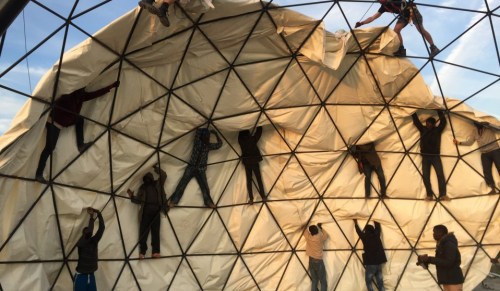
“So they decided to construct a theatre there in the shape of a geodesic dome, which has since become Good Chance’s signature pop-up venue; they spent seven months there in total.

“Vincent Mangado, a Théâtre du Soleil company member who joined their effort, described that first dome as a place ‘where everything could be spoken, a place of peace, a nerve center of the jungle, where you can share stories or throw a party, not just a theatre.’

“Upon returning to the U.K., Murphy and Robertson were commissioned to write a play about their experience in Calais, which grew up into the international hit The Jungle (now at the Curran Theatre in San Francisco through May 19). They traveled around the U.K., leading workshops with migrants and asylum seekers to continue gathering material. And cast members: The Jungle’s ensemble comprises of actors of 11 different nationalities, including some people Murphy and Robertson met in Calais who had since emigrated to Britain.

“The action of The Jungle is set in an Afghan restaurant that was built in Calais, and is staged with such an immersive aesthetic that audience members feel as though they are fellow diners at the restaurant. Along with the café, makeshift mosques, churches, shops, and other restaurants were constructed in Calais, despite extremely limited resources (just two water spigots and two porta-potties).

“Mousawi joined Good Chance in September 2018, though she had been doing similar work for years both on her own and with Complicité. In fact, she led the first Good Chance workshop in the dome in Calais with 35 Sudanese men in Arabic.

“Raised in Iraq, Mousawi left during the war to move to England, but returned to the Middle East during the height of the conflict in Syria, feeling called to help by making theatre. There she worked with Syrian women to produce work telling their stories, which only strengthened her conviction that theatre is for everybody, and should be radically inclusive. …

“ ‘Theatre can act as a tool for so many things, and one of the ways we use it is to encourage integration in areas where there might be tension.’ …

“To those audiences moved by The Jungle, Mousawi recommends reaching out to migrants recently arrived in your local community to see what you can do to make them feel welcome. ‘That’s what Good Chance is all about,’ she said. ‘Making people feel welcome, not alienated.’ ”

More here.
Read Full Post »

Photo: Brian Peterson
Hmong writer Kao Kalia Yang with her father, Bee Yang. The daughter’s lyrical book about Bee Yang’s unconsciously artistic storytelling,
The Song Poet, will be turned into a youth opera in Minnesota.

When I was working at a magazine that focused on the concerns of lower-income communities, I sometimes tried to get the voices of immigrant authors in there. One such author was Kao Kalia Yang, a Minnesota Hmong writer whose work I greatly admired.

Yang spent her early childhood enduring the privations of a refugee camp in Thailand but eventually moved with her family to St. Paul, where poverty and a strange new culture made life difficult in whole new ways.

One of Yang’s lyrical memoirs focuses on her father and the way he sang stories about life in the old country that brought other Hmong immigrants to tears. Now it’s being turned into an opera for young people.

Jenna Ross writes at the Star Tribune, “Author Kao Kalia Yang’s father has been a farmer, a refugee, a machinist. But in a book about his life, Yang elevated his true vocation — poet. Soon, his story will be an opera.

“The Minnesota Opera announced [in April] that it’s creating a youth opera based on ‘The Song Poet,’ Yang’s acclaimed 2017 memoir about her father, Bee Yang, who composed and sang songs about life and politics, love and family.

“It’s the first time a Hmong story will be translated to the operatic stage, Yang said. … The book follows a young boy [Yang’s father] whose father dies, who grows up in a warn-torn country, who tries to find the place his father was buried. The tale begins in Laos, moves to a refugee camp in Thailand, then makes its way to Minnesota. …

“For its Project Opera, a youth vocal training program, the Minnesota Opera is scouting for stories that connect with young audiences and reflect the Twin Cities community, said Jamie Andrews, the company’s chief learning officer. When he sat down with ‘The Song Poet,’ he knew it would make an incredible opera.

“ ‘Kalia’s writing is just so lyrical and beautiful — so singable,’ Andrews said. … ‘The Song Poet’ becomes the third opera commissioned for Project Opera, which will premiere it at the Lab Theater in Minneapolis in 2021. …

“Bee Yang has performed traditional song poetry, or kwv txhiaj, since he was 12 years old, becoming a keeper of Hmong history. ‘When I began singing song poetry, I discovered I could share our stories of hurt and sorrow, of missing and despair, of anger and betrayal,’ he said in the book.

“This daughter’s telling of his story — and how it shaped her own — won the Minnesota Book Award for memoir and creative nonfiction. The 39-year-old author and Harding High School graduate is best known for her 2008 book ‘The LateHomecomer: A Hmong Family Memoir,’ which nabbed two Minnesota Book Awards. After graduating from Carleton College, Yang earned an MFA in creative nonfiction at Columbia University. …

“To ensure that the cast is diverse, the opera company will reach into the Hmong-American community, Andrews said. It’s working with the Saint Paul Music Academy and talking with Theater Mu, an Asian-American troupe. ‘It’s not just a Hmong cast,’ Andrews said. ‘But we’re doing some strategies already now for 2021, to build those connections and find those kids.’ …

“When Yang was young, she took the occasional field trip to the Ordway or the Guthrie. ‘You’d go in knowing that you’d be entering into a different culture,’ she said. ‘I couldn’t have imagined, as a child, walking into a place and seeing something from the Hmong story represented.

“I hope that for those young Hmong people who get to see this, it opens up possibilities for them. Not just Hmong — but all refugee children.’ ” More.

I highly recommend Yang’s memoirs. Maybe some of you will check them out.

Read Full Post »

Photo: UNHCR
Shukria Rezaei, an Afghan Hazara refugee in the UK, with Kate Clanchy, writer-in-residence at Shukria’s school.

Years ago, my husband’s company ordered his department to move to Dallas from upstate New York. We decided not to go, which was a big no-no in the corporate world at that time. Other wives got a laugh when I said, “I don’t transplant well.” That’s probably true of many people who get used to their place. When I think of the thousands of migrants leaving home now, I know they are not doing it just for fun but because there is no other choice. Most people love their home.

The young Afghan refugee in this story longs to go home someday. In the meantime, she is learning all she can, including how to write poetry in a new language.

Caroline Brothers reports for the UN Refugee Agency (UNHCR) that a few years ago “no one, not her family, her teachers, nor any of her 900 schoolmates, was more surprised than Shukria Rezaei herself, when she was judged the best poet in her year. A shy, 15-year-old Afghan girl, who was still grappling with an adopted language.

“Oxford Spires Academy, a secondary school whose catchment area includes deprived localities, had just run a poetry competition to discover what talent might lie hidden in a student body speaking 54 different languages.

“ ‘Everyone was shocked, even myself,’ said Rezaei, now 20 and a scholarship student at the University of London, recalling the moment when Kate Clanchy, the school’s writer-in-residence and the competition’s judge, announced Rezaei had won first prize.

“Less than a year before, Rezaei and her mother – Hazara refugees – had arrived in Oxford from Quetta, Pakistan, which hosts a large population of displaced Afghans. The two were reunited in 2011 with Rezaei’s father, who had been granted asylum in the UK, after a three-year separation.

“Rezaei, for her part, was still struggling to master a language whose barest bones she had learnt at Afghan primary school and refugee school in Pakistan. As a child in the Afghan province of Ghazni, she awoke to the tap-tap of sheep trooping past on their way to the fields; a few hours later, she would set off through the mountains with a dozen other girls.

“ ‘School was two mountains away, and it snowed a lot,’ Rezaei told UNHCR, the UN Refugee Agency. ‘We went on a rocky mountain path and it took an hour and a half.’ …

“In England, in the thick purple jumper of a strange school uniform, she was struggling to keep up.

“ ‘I could only understand what was written down,’ Rezaei said of her first year. She survived, she said, by reading rather than speaking, copying everything she saw on the blackboard: ‘I just did as much as I could.’

“With the poetry prize, however, things shifted. From feeling invisible, Rezaei suddenly had an identity within the school. Clanchy, meanwhile, invited her to join a poetry group she had formed on a hunch that the quiet foreign girls at Oxford Spires might in fact have something to say.

” ‘At the beginning, I couldn’t talk,’ said Rezaei. But seated among 15 or 20 aspiring poets, she began to express herself. …

“Since then, Rezaei has had work published in Oxford Poetry, the emblematic literary journal that has showcased many of the country’s greats. She will be included in an anthology, England, to be published by Picador in June; one of her poems, ‘Homesick,’ has already been translated into German. …

“Like many children of refugees, Rezaei is acutely aware of how much hope her parents have invested in her. Even in the bleakest moments, amid profound dislocation, giving up was never an option, either for them or for her. …

“Rezaei is finding her feet in London, another major adjustment after Quetta and Oxford. Having won a scholarship to Goldsmiths College, she is studying politics, philosophy and economics, which she hopes to convert into a law degree.

“She still misses aspects of her Afghan childhood, but for now her hopes are firmly focused on England. She recently passed her driving test, and is exploring the creative writing scene.

“ ‘Afghanistan is still dear to my heart,’ she said, ‘but I have a lot more to achieve here before I go back.’ ”

Here is one poem.

I want a poem
with the texture of a colander
on the pastry

A verse
of pastry so rich
it leaves gleam on your fingertips

A poem
that stings like the splash of boiling oil
as you drop the pastry in …

I’d really like to copy the whole lovely thing, but you better click through to read it.

Hat tip: Beautiful Day on Instagram.

Read Full Post »

Photo: Getty Images
Two suburban moms learned that asylum seekers lack even the minimal protections of refugees and decided to do something to help them.

Although there are not many refugees coming through at the moment, those that do have official government status and a range of support services when they arrive. Asylum seekers have nothing, and if they don’t have someone to stay with until their case is heard, they are likely to be held in jail, unable to get working papers and start supporting themselves.

Two women in a Boston suburb decided they had to do something to help.

Betsy Levinson reported at the Concord Journal, “Helping asylum-seekers is a two-way street, say the two Concord women who founded a nonprofit in 2014 to offer housing and emotional support to a vulnerable population.

“ ‘Our guests have become our friends,’ said Sharon Carlson, who founded Dignity in Asylum (DIAS) with Andrea Hewitt. …

“The main mission of DIAS is to pay for transitional housing, since asylum-seekers are not eligible for any government support while they go through the lengthy and arduous process of gaining a work permit. …

“ ‘They are so vulnerable,’ said Carlson. ‘They fled persecution and had to escape to save their lives.’

“Without any contacts or resources in the area, they can wind up in homeless shelters or ‘sleeping in stairwells,’ Carlson said.

“Referrals to DIAS come from two sources — the Boston Center for Refugee Health and Human Rights and Political Asylum Immigration Representation. Once they get a referral, they send out an application for housing, followed by a meeting to assess the individual need.

“Though many are highly skilled professionals in their home countries, they usually end up in low-level jobs to earn enough to transition from DIAS-supported housing to independence. But [the DIAS founders have] never heard a word of complaint.

“ ‘There is such dignity, such gratitude, such optimism,’ said Hewitt. ‘We feel lucky and grateful. They are lovely people.’ …

“Guests stay free until they get on their feet, and stay connected to the organization after they become independent.

“The outpouring of support [has] been unexpected and overwhelming, the women say.

“ ‘The attitude is so welcoming,’ said Hewitt. ‘The business community has been so supportive.’ The organization has received grants from area churches and the community chest, among other funding sources. For more information, visit dignityinasylum.org.”

More at the Concord Journal, here. I have met these women. To me, they are glowing examples of both personal morality and how a truly civilized country could show compassion for people who take initiative against overwhelming danger. Asylum seekers, managing to get themselves here despite extraordinary obstacles, show the courage and spunk that is needed in society.

Read Full Post »

refugee-chocolate-hiring-20190216

Photo: Andrew Vaughan / The Canadian Press
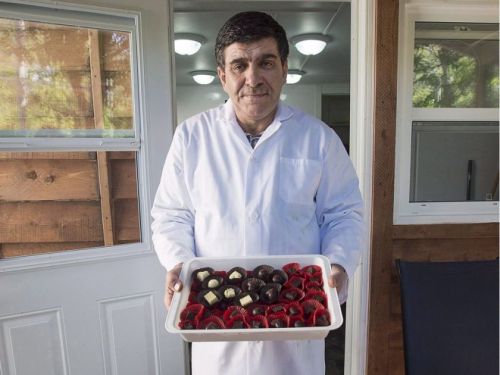
A former refugee who founded the Nova Scotia chocolate company Peace by Chocolate has committed to hiring 50 refugees by 2022 and to mentor 10 refugee-run start-ups over the next few years.

Refugees that a country takes in are often the most grateful people on the planet. Most are highly motivated to succeed and not be a burden. Some start their own businesses, and then, as soon as they get established, look for ways to give back to others.

The Canadian Press reports on one example. “A one-time Syrian refugee who founded a thriving Nova Scotia chocolate company has announced plans to hire and mentor other refugees. Peace by Chocolate of Antigonish, N.S., has committed to hiring 50 refugees by 2022, and to mentor 10 refugee-run start-ups over the next few years.

“The now-famous company was founded by the Hadhad family, who fled their home in war-torn Damascus in 2012. They arrived in Nova Scotia with next to nothing in 2016. …

“Tareq Hadhad, CEO of the company, said Peace by Chocolate aims to give back to the country that welcomed his family when so many nations were closing their borders to the Syrian plight. Now he plans to expand on that vision by giving back to other refugees looking to start new lives — as Canadians did for his family when they needed it most. …

“Hadhad said in an interview, ‘Being a refugee is not a choice, it’s not a decision, it’s not a life goal. These people are fleeing their homes because of war, because of persecution.’ …

“Hadhad’s father, Assam, ran a chocolate business in Damascus for decades but it was destroyed in a 2012 bombing.”

Another article, by Fadila Chater at the National Post, notes that the “chocolate company founded by Syrian refugees has produced its first chocolate bar — and given it an Indigenous name. [Its] new milk chocolate and hazelnut bar is to be called Wantaqo’ti (pronounced Wan-tahk-oo-di), the Mi’kmaq word for peace. …

“Founder Tareq Hadhad said via email … it is his company’s mission to translate the family’s concept of peace to all Canadians, starting with the Mi’kmaq of his home province. … Other versions of the bar will be sold using the Arabic, French and Mandarin words for peace.

‘Peace is beautiful in every language,’ Hadhad said. …

“ ‘When we came here as newcomers to this country, we really wanted to support this country to grow and prosper,’ he said.”

The Peace by Chocolate bars are available online, here.

Read more at the National Post, here and at the Canadian Press, here.

Read Full Post »

refugee-moo-paw-with-vegetables
Photo: Sean Powers
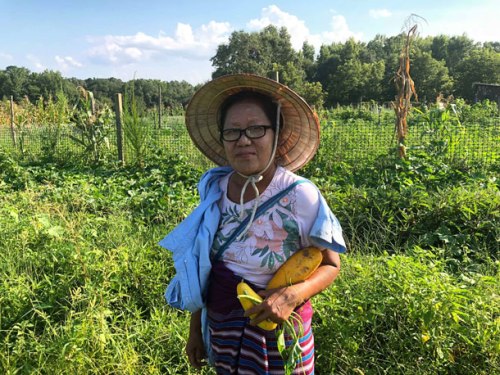
Karen refugee Moo Paw shows the vegetables she’s grown at the Neighbor’s Field in North Carolina.

I’m always interested in what Karen refugees from Myanmar (Burma) are doing as they adjust to new lives in the United States — especially as I know Mia, a Karen woman in one of the Rhode Island English classes where I volunteer.

At the radio show Living on Earth (LOE), there’s an interesting Karen farming story from producer Sean Powers of Georgia Public Broadcasting and the Bitter Southerner podcast.

“BOBBY BASCOMB [LOE managing producer]: The United States has long been a place for political refugees to seek safety and put down roots, in some cases literally. In Comer, Georgia, a community garden called the Neighbor’s Field is helping refugees work through their trauma by working the land. …

“POWERS: It’s a hot Saturday afternoon in Comer, Georgia. Moo Paw is feeding her chickens, hens, goats, and ducks. There’s even a donkey. You could say they’re kind of like her babies. She is one of the many refugees at the Neighbor’s Field, who fled violence and persecution in Myanmar. That’s the country formerly known as Burma. …

“She says Burmese soldiers kidnapped her father, and used him as a porter to carry food for them. After leaving Myanmar, Moo Paw lived in a refugee camp in Thailand before moving to the United States with her husband and children. They relocated to the Atlanta area, before settling here in Comer. Her son, Tahay Than, says moving to Comer was to satisfy Moo Paw’s green thumb.

“TAHAY: My mom, where she lived in Burma or Thailand, she always liked to plant. You know, working the farm. So, when she farms, that makes her feel like she is home or something, like in a home country, mother country or something. So that’s why she moved to Comer. …

“PAW: My garden. Here vegetables. Here grass. Me planted the cucumbers this year. Here sweet potato. Very beautiful.

“POWERS: It’s that beauty that takes Moo Paw back to memories of her family. She and her son Tahay say in Myanmar, farming for their family was a way of life.

“PAW: My grandmother planted rice, peanuts. Chili, corn.

“TAHAY: Most of the time, everybody who lived in Burma, they would plant in order to survive.

“POWERS: And that makes this garden all the more meaningful. The vegetables growing here, they don’t look like your typical produce that you would find at most supermarkets in the United States. That’s because the seeds come from Myanmar and Thailand. …

“POWERS: The flavors growing in Moo Paw’s soil are just a small part of the pie. There are two-dozen plots of land at the Neighbor’s Field that are being rented by refugees from Myanmar. For a large plot, it’s a hundred dollars a year. Rebecca Smith [who versees the day-to-day operations at the Neighbor’s Field], says it’s been incredible to see how working the farm helps build community. …

“SMITH: They’re just amazing foragers, they can figure out how to cook everything and make it taste good, and it’s just stuff that we think are weeds. Like sometimes people will be out here just butchering a pig for a celebration or Moo Paw’s out here feeding her chickens and people in the garden and you just feel like you’re in a different world, not Comer, Georgia.”

More at Living on Earth, here. In North Carolina, too, there are Karen refugees working on farms. Read this at Transplanting Traditions.

Read Full Post »

Photo: Ryan Donnell/Sesame Workshop
Grover from “Sesame Street” in a Rohingya camp in Bangladesh. The Lego Foundation will provide $100 million over five years to the makers of “Sesame Street” and their partners for a program for refugee children.

Most of what we know about the situation of Rohingya refugees — expelled from Myanmar (Burma) for their Muslim beliefs — is pretty dire. But here and there we see positive efforts to lessen the pain of living in overcrowded camps in Bangladesh, especially for children. Read about this partnership among humanitarian relief organizations, Sesame Street, and Lego.

Karen Zraick writes at the New York Times, “Can play help refugee children heal from trauma?

“That’s the belief behind a new partnership formed by the Lego Foundation, Sesame Workshop and organizations working with Syrian and Rohingya refugees. In its first major humanitarian project, announced [in December], the foundation will provide $100 million over five years to the makers of ‘Sesame Street’ to deepen their work with the International Rescue Committee in the countries around Syria, and also to partner with the Bangladeshi relief organization BRAC.

“The aim is to create play-based learning programs for children up to age 6 in Lebanon, Jordan, Iraq and Bangladesh. The programs will teach basics like the alphabet and numbers, but will also emphasize social and emotional development to counter the effects of stress and suffering. They will be offered both to displaced children and to some of their potential friends in host communities.

“Officials at the organizations involved said that helping children’s brains develop during their first years — when they are absorbing information like sponges — is crucial to helping them become healthy and successful later in life, and that play is an excellent way to do it.

“ ‘We know from child development research that the best way for children to learn is through exploring their world and play,’ said Sarah Smith, the senior director for education at the International Rescue Committee. …

“The families’ needs are great. In addition to basics like adequate food and shelter, children need to foster ties with nurturing caregivers to heal from what they have witnessed and endured, said Hirokazu Yoshikawa, a director of Global TIES for Children, a research center at New York University that will conduct testing and evaluation for the program.

‘Part of the magic of human development is that very few experiences doom a child to ruin,’ Dr. Yoshikawa said. ‘But we have to address the risks early. This is particularly critical in these first years.’ …

“Erum Mariam, a program director for BRAC, said that many of the 240 play labs the organization has created for refugees were built by the children’s fathers and painted and decorated by mothers and children.

“ ‘We place a lot of emphasis on culture and on strengthening community engagement,’ she said. Within those centers, trained facilitators focus on providing enough structure to make children feel safe, while allowing for spontaneous joy.

“ ‘When a child enters the humanitarian play lab, we want the child to feel very happy and very connected to their culture and heritage,’ she said.” More here.

You may recall I wrote about Sesame Street helping Syrian refugee children, here.

Read Full Post »

Photo: Barbara Crossette/PassBlue
Fathiah Zakham studied tuberculosis in Yemen until a bomb destroyed the university where she was working. Through the Scholar Rescue Fund, she received safe haven in Helsinki, Finland, to study.

Scholars and scholarship are generally endangered in authoritarian countries and in war zones. Fortunately, there are activists determined to keep the search for truth alive among all nationalities. The Scholar Rescue Fund was established to place refugee scholars in safe institutions where they can continue their work. Even in today’s isolationist America, refugee scholars are getting a future.

Deborah Amos reported on international placement efforts at National Public Radio (NPR) last fall.

“Around the globe, more scholars are now threatened and displaced than since World War II began. In response, U.S. universities have sponsored endangered scholars and recently created a consortium that offers a broader academic community to refugee scholars threatened by war and authoritarian governments.

” ‘There is a moral obligation to do something,’ said Arien Mack, a psychology professor at New York City’s New School for Social Research, who launched Endangered Scholars Worldwide in 2007 to draw attention to the threats facing academics. She now oversees the New University in Exile Consortium, which will bring exiled scholars together over the next two years for seminars, workshops and conferences. The New School has recruited 10 other universities to the consortium, and is urging more to join. …

” ‘We are trying to nurture intellectual capital, we are saving brains,’ Mack said at a Sept. 6 event in New York City to launch the project. ‘Even when [refugee scholars] are safe, what is painfully absent is that they don’t get integrated, they are isolated, they suffer from estrangement.’ …

“Syrian academic Mohammad Alahmad, a specialist in Arabic literature, had to negotiate with Islamist radicals to continue teaching at Al-Furat University’s campus in Raqqa. In 2014, the militants declared Raqqa the capital of the Islamic State. …

“He escaped the city with his family, smuggling them across a dangerous border into Turkey after ISIS shut down his university. He was awarded a fellowship by the Institute of International Education’s Scholar Rescue Fund, an organization that helps arrange emergency placement and funds for academic figures at risk. He was matched with Georgetown University where he is now a lecturer at the Center for Contemporary Arab Studies. …

“The Scholar Rescue Fund, established in 2002, has helped more than 700 scholars find academic placements in 43 countries. About 40 percent have been placed in American educational institutions.

“Indian activist and academic Binalakshmi Nepram says her work advocating for gender rights and a women-led disarmament movement in her home state of Manipur, in northeast India, led to threats and intimidation. … Now she is a visiting scholar in residence at Connecticut College.

” ‘We have all left everything behind,’ she said. … Her placement in Connecticut is a lifeline. She has continued her activism, giving a recent lecture on how the women of Manipur state worked together to confront violence in a decades-old armed conflict between insurgents and the Indian military.

‘Before I got this job, [American] people told me I could be a bartender or a babysitter,’ she said. ‘Every job has its dignity, but we have our skills.’

More at NPR, here.

Read Full Post »

Photo: Rebekah Welch, Missoulian
Two refugee children hurry to watch a soccer game at Fort Missoula in Montana.

I’m back volunteering with refugees and other immigrants, and it feels great. I took a hiatus to rethink my schedule after my sister was diagnosed with brain cancer. Now I’ll be doing only one day a week instead of three, assisting at a morning ESL class in a Providence resettlement agency and an afternoon class down the street. It makes me feel like I’m doing something worthwhile in retirement.

In today’s story, volunteers and staff at some unusually stable refugee programs in Montana feel the same. The article reminds me that my ignorance of much of the country has kept me from appreciating how every state has people with similar values.

In October, Kim Briggeman wrote at the Missoulian, “Montana’s lone resettlement office is just big enough to dodge the ax lowered by the [administration’s] slashed refugee cap, but small enough to escape the staff reductions others face.

“ ‘In Salt Lake City we were staffed to serve 600 arrivals (per year). Well, when you get half of that, you start losing staff,’ Patrick Poulin said in Missoula last week.

“Poulin is acting regional director of 13 International Rescue Committee [IRC] offices in seven Pacific Northwest states, and serves as executive director of the one that opened in Missoula two years ago. …

“The U.S. State Department has ‘pretty much told resettlement agencies’ that offices serving fewer than 100 refugees a year will be shuttered, Poulin added.

“Missoula’s IRC office received 115 refugees in fiscal year 2018, which ended Sept. 30. Poulin said that was up from 78 in the first full year, and included a welcome but unexpected rush of 26 Congolese in July and another 23 Congolese and Eritreans in August. Those represent the top two months for refugee arrivals since the IRC began receiving them in August 2016. …

“The U.S. Secretary of State [announced] in mid-September a proposal to lower the number of refugees allowed into the country from a maximum of 45,000 to 30,000 for fiscal-year 2019. Both are fractions of the 110,000 set by President Barack Obama in his final months of office in 2016, a cap that was ratified by Congress. …

“ ‘This is not only the lowest goal in the history of the U.S. program — the average has been 95,000 — but puts U.S. resettlement, as a proportion of population, well behind Sweden, Canada, Australia and the United Kingdom,’ noted a guest commentary co-authored by Helena mayor Wilmot Collins that appeared last Monday in The Hill. Collins [is] a refugee from Liberia. …

“Missoula Federal Credit Union (MFCU) … donates roughly 7.5 percent of its annual net income to community programs like these. …

“[Mary Poole of volunteer-reliant Soft Landing Missoula] said it was another reminder of how Missoula Federal and its president, Jack Lawson, have supported local refugee resettlement from the start.

“ ‘We’ve had, I think, three or four meetings with Jack where he’s asking, “What’s next? What can we do beyond money to help?” And of course there’s always an answer for that,’ she said.

“The IRC works with schools and organizations to set up classes such as English language and computer literacy courses to help refugee families integrate into the community. In the credit union’s case, it’s financial literacy support. …

“[Gwen Landquist of Missoula Fed] said a ‘fantastic’ family of Congolese has agreed to be taken under the wing of a financial mentor from MFCU for a year.

“ ‘The husband and wife met at a refugee camp and moved here in July with their three children and one of their mothers,’ she said in an email. …’ The husband speaks about seven languages, including English, and his kids are learning Spanish in school. He has taken some prep classes to prepare for attending school. He is currently employed and is eager to get a car so they can get to church and work.’ …

“A study that came out in July found that the 4,600 refugees and other immigrants in the Missoula region generate more than $26 million in tax revenue each year and contribute disproportionately to goods produced and services provided.”

More at the Missoulian, here.

Read Full Post »

elelwa-cake

I lifted this from Beautiful Day, an organization I’d like you know about if you don’t already.

Founder Keith Cooper writes, “A couple months ago a guy named Scott Axtmann brought a great group of interns from his church (Renaissance) to visit our kitchen facility at Amos House. We did the things we usually do — greeted the trainees, chatted with our chef and other staff, then sat out in the dining hall to talk more about mission and share thoughts about resettlement, the job market, and being a part of positive change in our city.

“This is an aside — but if you live in driving distance of Providence and are interested in our work, you should stop by for this kind of tour. Plan to come after 5 on Tuesday, Wednesday or Thursday. If possible give us a couple weeks warning. A tour doesn’t take long, but seeing something with your own eyes usually takes the strangeness out of it. I know we are intense and painstaking about the way we make granola, but making granola is still not rocket-science. Neither is job training. What I always find mysterious in our kitchen (though I know we’ve also been painstaking about creating this atmosphere too) is the laughter shared by a group of trainees and staff who don’t even share a language. This is always the thing that reassures me that we are doing something right. But please take this as an open invitation. These tours are part of our mission to connect more people with refugees. Our organization may lack a lot of things, but we’re rich in relationships with former refugees and would love to share our wealth with you.

“Anyway, during that tour Scott challenged me in the style some faith leaders have perfected—encouragement that leads to self discovery. In this case, he created space for me to say something I hadn’t intended to say. The gist went something like this:

Scott (to the interns): Keith writes a [something flattering here] blog for Beautiful Day about immigration and refugee resettlement.

Me (grimacing): Oh thanks Scott. Actually I’ve hardly been writing anything this year.

Scott: Really? Why not? You should be. [Then, to the interns, some thoughts about how critical it is for people of faith to welcome refugees and what a privilege it is. Scott has a contagious enthusiasm about our city that I love.]

Me: Honestly, I feel like I’ve lost my voice over this last year. I’m really struggling with it.

Scott: You had better get it back.

“Then suddenly we all had to go.

“That was back in July and I’ve been chewing on this ever since. I’m pretty sure I intended to answer his question by complaining about how busy I am, how many hats I need to wear. These things are true and I say them all the time. Saying I lost my voice instead provoked me to think about what’s happening to or in me. Beautiful Day works with marginalized people who, for the most part, are hidden and voiceless — most obviously because they don’t speak English and don’t yet understand much about American culture, but also because they’ve had experiences of being chased away, silenced, discarded, warehoused. We live in a country that has welcomed them, yet is also growing more ambivalent and sometimes openly hostile to them. I believe we all have something critical to learn from these voices.

“So how can I possibly advocate for voiceless people if I don’t have a voice myself?

“And another thought: isn’t saying I’m voiceless another way of saying I’m afraid. What am I afraid of?

“But, okay, Scott. Thank you both for the compliment and the invitation to think. Here’s my idea. I’ll try to start writing more often. I know I need to do this right now if only because we are heading into the holiday season when we hope (need!) to sell about 75,000 dollars of granola in 3 months. These sales are vital to our training program, so I need to be connecting and resonating with our customers.

“(And, a sideways invitation here: as part of this sales initiative, we are currently launching efforts to increase traffic to our website. Part of what helps attract traffic is interaction, so if you appreciate anything in this blog and what Beautiful Day is doing, please speak up and comment either here or on our Facebook or Instagram feeds. It’s okay if you disagree as a long as you’re not trolling. A voice isn’t very real until it’s in dialogue.)

“Along the way, maybe I can try to figure this out by writing it out. I know one of my fears is that I just can’t write an Inc-style business post where I try to play the confident hipster entrepreneur and wax eloquent on how great our product is, how well we are doing, how hard we work, and which fancy apps we use. Something about who I am and about working with voiceless people makes that impossible. Nor can I promise that it will be consistent or coherent or polished. It will need to just come out of what’s in my head at that moment with what time I’ve got available. But I’ll give it a try. Maybe I’ll rely on some of the internet’s favorite formats like top 10 lists. But I’ll try to let it be a real voice. I suspect I’m not the only one trying to retrieve theirs these days.”

Read Full Post »

merlin_141970665_3226dcb4-ae59-4f88-aa9e-53ad5880d80e-jumbo

Photo: Lisa Marie Summer for the New York Times
A German opera company invited current refugees to be part of its production of “Moses,” lending immediacy to the story of exile.

Powerful stories from any century speak to the human condition in any other century. Thus, for example, the story of exile in the opera “Moses” speaks to the sense of dislocation that today’s refugees experience. To drive home that point, an opera company in Germany has invited current refugees to participate in a production.

Joshua Barone reports at the New York Times, ” ‘We tell the story of Moses because it is actually our story,’ one teenager, a refugee from Afghanistan by way of Iran, said in the Hazaragi dialect to the German-speaking audience at the Bavarian State Opera here on a recent Sunday evening.

“Others chimed in: ‘The story of Moses is also my story,’ they said in French, Kurdish, Greek and Arabic.

“They were the cast of ‘Moses,’ a feel-good yet sobering new production by the Bavarian State Opera’s youth program, written for refugees, children of immigrants and born-and-raised Bavarians.

“In the opera, a mixture of new music by Benedikt Brachtel and adapted excerpts from Rossini’s “Mosè in Egitto” [“Moses in Egypt”], the teenagers tell the story of Moses — common ground for followers of the Bible, Torah and Quran — with Brechtian interludes about refugee experiences and current events.

“The director Jessica Glause, who created the libretto based on interviews with refugees in the cast, has concocted a blend of humor, horror and youthful energy that hardly feels like a didactic documentary about Europe’s refugee crisis. Behind the scenes, ‘Moses’ has provided a way to learn German and make friends — in short, to make the process of migration a little less painful. And audiences have responded favorably. …

“Theater about the refugee crisis has proliferated in Germany since migration into the country reached its peak in 2016. But rarely has the hot-button issue — which continues to threaten Chancellor Angela Merkel’s power and fuel the rise of the far-right party Alternative for Germany, or AfD — entered the realm of opera, much less children’s opera. …

“Ms. Glause, who had volunteered on boats in the Mediterranean, also wrote the libretto for ‘Noah,’ after interviewing many of the same young refugees who are in ‘Moses.’ She described the process — hearing stories of loss, danger and fear from teenagers — as acting as both an artist and a counselor.

“Among the people she spoke with were Ali Madad Qorbani, a young man from Afghanistan who fled to Iran, then Europe, after his father had disappeared; and Zahra Akhlaqi, also from Afghanistan, whose mother came to Europe first while she and her sister waited in Iran, where, she said, they were forbidden from going to school but would dress up like students at home and play pretend.

“Now, their lives are slightly more stable, though just as precarious as any refugee’s. …

“There are still monologues of how and why some of the cast members came to Europe, but much of the material is about reconciling their faiths and cultures with those of Germany — including one humorous passage about trying German beer for the first time. But they also describe how they don’t always feel welcome, such as a scene in which the plagues in Moses’s story give way to one person describing signs near Munich that say refugees overrun Germany like locusts. …

“In interviews, [youth program director Ursula Gessat] and Ms. Glause were quick to say that their job is to reflect the world around them, and that it would be irresponsible to ignore the refugee crisis. Indeed, Ms. Glause said that conservative politicians may change their minds if they met the cast of ‘Moses.’

“ ‘I would tell them to come see this show,’ she said. ‘Come hear these stories.’ ”

More at the New York Times, here.


Read Full Post »

shmds7f6uui6rb4spbyzc5zfb4

Photo: Katherine Frey/The Washington Post
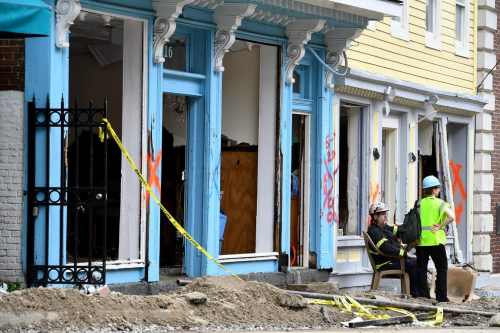
Stores along Main Street in the refugee-welcoming town of Ellicott City sustained severe damage after flooding in May. Grateful refugees were determined to help out after all the kindness shown them.

Not only do refugees contribute to both the US economy and the budget, but many are eager to return kindnesses shown to them when they were first finding their way in an unfamiliar land. In this article, Syrians did some fund raising for a small, flooded town that had welcomed them. Terrence McCoy reported the story for the Washington Post.

“The first time Majd AlGhatrif saw this historic mill town of colonial buildings at the confluence of the Patapsco and Tiber rivers [in Maryland], he thought of Syria.

“The structures, built of gray stone, and the history they evoked, reminded him of the timelessness and architecture of his hometown, Sweida, in southern Syria. He soon bought a house here, in 2013, then opened Syriana Cafe & Gallery, in 2016, and came to view everything about Ellicott City’s people — their kindness and decency — as an antidote to the fear others were expressing over Syrian immigrants like him.

“So when floods again ripped through here in May, killing a Maryland National Guardsman, closing businesses up and down its historic district and producing images of destruction recalling the floods of 2016, he vowed to do anything he could to help a community that had become his own.

“The result of that vow came to fruition [September 22] at Syriana, where he presented the city with a check for $10,000, which he had raised from Syrian Americans from all over the country who had seen the destruction and wanted to show their gratitude not just to Ellicott, but also to the United States for accepting them.

We wanted this to be a payback from Syrian Americans to a generous America,’ said AlGhatrif, a physician at Johns Hopkins Bayview Medical Center, handing an oversize check to community leaders.

“The check was a rare bit of good news in a city that has survived 246 years but is now reckoning with its own mortality — one more town grappling with existential questions, as the globe warms and natural disasters increase in frequency and ferocity. …

“The community is considering a sweeping $50 million plan to mollify future damage from flooding, but it would require the demolishment of as many as 19 buildings, cleaving out a piece of history in a city whose livelihood to a large degree depends on that very history.

“What we have to realize is that if we don’t do something, the town will die,” said Howard County Executive Allan Kittleman (R). … After the last flood, he said, ‘the calculus changed.’

“AlGhatrif witnessed that firsthand. … He knew that the community meant a lot not just to him, but also to other Syrian immigrants and refugees. His cafe employed several who, after years of fear during the Syrian war, had come to feel safe in Ellicott City.

“One was Safa Alfares, 17. She was born in Aleppo, whose scenes of war and bodies still dominate her thoughts. [She] had arrived expecting to face Islamaphobia. …

“But as she learned English, in which she became fluent in less than two years, and after she found a job at Syriana, her sense of foreboding gave way to something she had not experienced since the beginning of the war: calm.”

This is such a touching story. Read more here.

Hat tip: @bostonmigration ‏on twitter.


Read Full Post »

pssikk5

Photo: Kurdistan 24
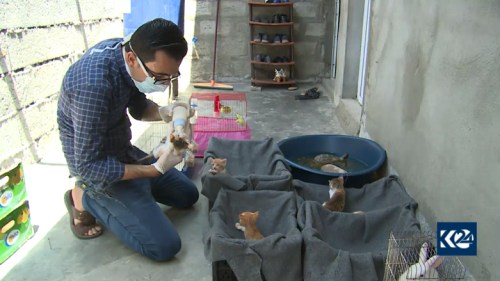
There are many strays in the Kurdistan Region, with few resources available for animal care and protection. In a refugee camp, a young man whose veterinary education was cut off by war does what he can with what he’s got.

Although it’s true that some refugees are crushed by loss and dislocation, others face up cheerfully to the way things are. A story from Kurdistan24, a television station, provides a moving example.

With contributions from Chiman Adil, Nadia Riva reports from Erbil, “A young Syrian Kurdish refugee has been appealing for other animal-lovers to help in bettering the fate of stray animals in the Kurdistan Region while running a veterinary clinic in a camp.

“Ayaz, a Syrian Kurd living in the Kawergosk camp near the Kurdistan Region’s capital of Erbil, fled the civil war which has been plaguing his country for nearly eight years.

“Before popular Syrian protests erupted across Damascus and other cities, Ayaz was a fourth-year student at the Faculty of Veterinary Medicine. The conflict, however, prevented him from completing his studies, with universities closing down and violence spreading. …

“Ayaz sought refuge in the Kurdistan Region, as hundreds of thousands of other Syrian Kurds have done, but did not let his situation affect his care of animals. … He has called for the promotion of animal rights at the camp, hoping to raise awareness and change the culture among the newer generation toward animals. … Ayaz has rescued cats, birds, turtles, and rabbits, which he keeps in his shelter at the Kawergosk camp.”

On twitter, Glenn Greenwald has been trying to raise money for this cash-strapped operation. You may remember that I wrote about Greenwald’s own animal-welfare efforts last month in a post describing how he hires homeless people to care for stray dogs.

More here.

Read Full Post »

Photo: Daniella Cheslow/NPR
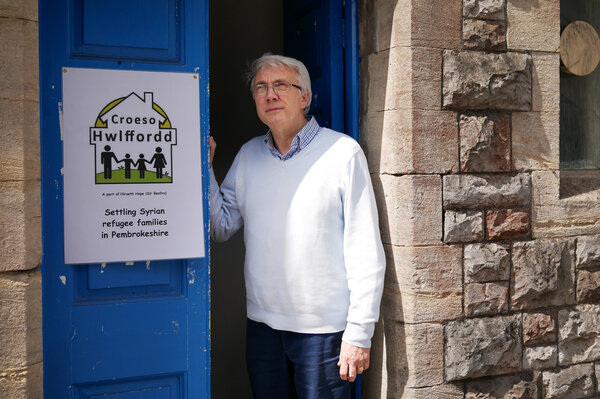
Jeff Britten stands in the doorway of the Baptist chapel in Haverfordwest, Wales, where he meets regularly with other members of his group sponsoring a refugee family. The name of the group is Croeso Hwlffordd, or Welcome Haverfordwest in Welsh.

What can I say? There are kind people everywhere. This story is about the efforts of residents of a small village in Wales to welcome refugee families from Syria. It’s not necessarily an easy thing to do — there are so many differences in experience and culture. But these people knew it was the right thing to do.

Daniella Cheslow writes at National Public Radio, “Back in February, Jeff Britten sent a description of Haverfordwest, his town of 13,000 people in southwestern Wales, to a family of Syrian refugees living in Jordan.

” ‘I ran around town and took pictures of the castle, the best bits, the River Cleddau,’ Britten says. ‘I produced a map which showed the location of the house, and that everything was in walking distance, supermarkets, schools, a mosque. It was all there for them.’

“He hoped the family, whom he contacted with the help of the Home Office, which controls U.K. immigration, would come live in Wales. At that stage, he knew little about them, only that they were Syrians recognized as refugees by the United Nations.

“Britten is 71 and retired from the pharmaceutical industry. The idea to reach out to Syrian refugees came in late 2016, when he heard that two other Welsh villages had adopted refugees from the country, and he called a meeting in a Baptist chapel in his own town to inspire his neighbors to do the same. …

“The refugees have come to Wales as part of a community sponsorship program that began in the U.K. in 2016. A group of British citizens can commit to providing refugees help with housing, navigating schools and doctors, language and the job search.

“Twenty-five Syrian refugee families have arrived and been settled so far in the U.K. via community sponsorship; of those, six families went to Wales. …

“In Haverfordwest, about 30 residents answered Britten’s call and signed up to sponsor the newcomers. … Jenny Blackmore had worked with Syrian refugees in the nearby town of Narberth and noticed that housing was often a stumbling block to fulfilling the government’s conditions. Landlords had to keep their homes open while the Home Office processed the resettlement application, and the government paid a lower rental rate than the market could offer.

“Blackmore’s mother had recently died and left her an inheritance. She invested it in a three-bedroom, two-story rowhouse in the center of Haverfordwest, with the aim of housing a refugee family.

” ‘I decided it would be a sort of fitting legacy, really, to my mum and dad’s memory, to do something — yeah, it’s an investment for my family, but it’s also a kind of investment in people’s lives,’ she says.”

More here.

Read Full Post »

Photo: Josh Reynolds for The Boston Globe
Volunteers try to find housing and employment opportunities for asylum seekers in Arlington, Cambridge, and Somerville, Mass. Refugees have government-approved supports. Asylum seekers have nothing.

In the last couple years, since I’ve been volunteering in ESL classes, I have learned there is a differences between refugees, who arrive in this country fully vetted and eligible for official support, and asylum seekers.

Asylum seekers are generally fleeing persecution and danger. One woman I heard about knew that the government in her country intended to arrest her after disappearing her husband for his vocal opposition. When she arrived here, she had nothing.

Numerous groups of US citizens are now organizing to help such people.

Zipporah Osei reports at the Boston Globe, “With more attention than ever on the crisis and issues of immigration, Fowkes knew what he needed to do was to effect direct change. …

“Said Fowkes, “I wanted to do more than just mail a check to an organization. I wanted to have a hand in changing someone’s life.’

“Fowkes and his wife joined ArCS Cluster, a group of volunteers helping refugees and asylum seekers in Arlington, Cambridge, and Somerville. The group started in the spring of 2016 as an arm of the Malden-based nonprofit Refugee Immigration Ministry, with a mission of helping through person-to-person connection

“Asylum seekers come to the United States to escape issues such as war, persecution, or domestic violence. Once here, they must apply for asylum and then wait at least five months to apply for a work permit.

“While they wait to be approved, individuals can lack access to medical care and face housing insecurity and social barriers that make the process even more difficult. The group attempts to make the transition as smooth as possible. …

“The cluster, which has over 250 members with roughly 50 active volunteers, provides services to asylum seekers from countries including Saudi Arabia, Libya, Liberia, and Rwanda. It is the first explicitly LGBT-friendly cluster in the Refugee Immigration Ministry. Although the cluster was formed out of First Parish Unitarian Universalist of Arlington, all volunteers are welcome whether or not they are affiliated with any religious organization. …

“For many of the volunteers, the connections made with asylum seekers are long-lasting.

“ ‘I have so enjoyed forming relationships with these people. We develop friendships together,’ said [Sarah Trilling, co-coordinator]. …

“The cluster helps the asylum seekers in seemingly small ways as well. After finding out that one of their guests was uncomfortable taking the bus late at night, volunteers took turns driving her home from appointments.

“ ‘They support me morally and financially. This is a blessed group,’ she said of the coordinating team. ‘I love them for all they do.’

“Fowkes and his wife, who live in Medford, have been members of First Parish for more than 20 years. He recently retired and felt he had more time to invest in charity work. The experience of housing an asylum seeker has also had a positive impact on him.

“ ‘This kind of work suits me,’ said Fowkes. ‘You can do a small thing for a great many people or you can do a huge thing for one person, and I just know I’m making a tremendous impact on someone’s life.’

“The couple took in an asylum seeker who had been living on the street. The guest has been living with the pair for more than a year now. The three have dinner together every night, and the couple has introduced him to his family and friends. Fowkes said they have formed a deep connection.

“ ‘He introduces me to people as his American dad,’ said Fowkes.”

More.

Read Full Post »

« Newer Posts - Older Posts »