Feeds:
Posts
Comments

Archive for the ‘Uncategorized’ Category

Photo: Nathanael Coyne, Flickr, CC BY-NC-ND 2.0.
Native tribes have wonderful stories about relations with animals, including “man’s best friend.”

This morning I got a kick out of talking to Stuga40 in Sweden about my post on dog research and the entertaining corroboration that Hannah sent. So I decided to continue the theme with something from the radio show Living on Earth.

“BOBBY BASCOMB: Many Native American communities belong to a clan which identifies with an animal. There are bear, deer, and loon clans to name a few. Those animals are featured in their traditional stories. So, to hear some of them I called up Joe Bruchac. He is a storyteller and musician with the Nulhegan Abenaki tribe of Vermont and Upstate New York. And Joe carves and plays traditional flutes. …

“JOE BRUCHAC: We say that the flute came to be when a woodpecker made holes in the hollow branch of a tree that was broken off at the end and the wind blew over it and created that first flute music. So when we play the flute, we try to keep in mind, it’s a gift of the trees and the wind, and the birds. A flute could be played for pleasure or to keep yourself from feeling lonely. …

“BASCOMB: I hope to hear some more of your flute music a little later in this segment. But first, can you get us started with a story? I understand you’re going to tell us a traditional story about dogs.

“BRUCHAC: That’s right. They say that long ago, the one we call Gluskonba, the first one in the shape of a human being was walking around. This was the time before the people came to be on this land. Now one of the jobs Gluskonba had been given by the Creator was to make things better for those humans when they got here. And so he thought, I wonder what the animals will do when they see a human being for the first time. I better ask them.

“And so Gluskonba called together a great counsel of all the animal people. And then as he stood before them, he said, ‘I want each of you to come up and when I say the word for human being, tell me what you will do.’ Now the first one to step forward was the bear. In those days bear was so large, he was taller than the tallest trees. His mouth was so huge, he could swallow an entire wigwam. And when Gluskonba said the word ‘alnoba,’ which means human being, the bear said ‘[bear grunt] I will swallow every human being that I see!’

“Gluskonba thought about that. He thought to himself, ‘I do not think human beings will enjoy being swallowed by bears, I’d better do something.’ And so he decided to use one of the powers given to him by the Creator, the power to change things, a power that we human beings also have and often misuse. Gluskonba said to the bear, ‘You have some burrs caught in your fur, let me comb them out with my fingers.’ And so the bear sat down in front of him, and Gluskonba began to run his fingers along the bear’s back and as he did so, combing out those burrs, he also made the bear get smaller and smaller, until the bear was the size that bears are to this day.

“And when Gluskonba said to him, ‘And now what will you do when you see a human being?” that bear looked at itself and said, ‘[bear grunt] I will run away!’ Which is what bears usually do to this day.

“Now the next one to come forward was one we call Kitschy moose: the big moose. Moose by the way, is one of our Abenaki words, it means the strange one, and that moose back then was really strange. It was so large that his antlers were bigger than the biggest pines, they were sharper than the sharpest spears, and when Gluskonba said the word ‘alnoba’ that moose said, ‘I will spear every human being I see, spear them on my horns and throw them over the tree tops, and stomp them with my hooves until they’re as flat as your hand!’

“And again Gluskonba thought, ‘I do not believe human beings will feel much pleasure at being speared and flattened by moose. I’d better do something.’ So he said to that moose, ‘Nidoba, my friend, you appear to be very strong. Let us have a contest, I will hold up my hands and you will try to push me backward.’ The moose agreed, it leaned forward, putting its nose in one of Gluskonba’s hands, its huge horns in the other, and began to push, and push. But Gluskonba did not move. And that moose’s horns got smaller and rounder and the moose itself got very, very, very much smaller than it was before and also his nose got all smushed in. And the moose looked at itself when Gluskonba said, ‘And now what will you do when you see a human being?’ the moose said, ‘Uhh, I will run away.’ Now one after another Gluskonba talked to many animals. There’s almost for everyone a separate story. … But finally, just one animal was remaining.

“It sat there in front of him wagging its tail. It was of course the dog, and Gluskonba said to dog, ‘Nidoba, my friend, are you going to do something to harm the human beings when they arrive here?’ And the dog shook its head and said, ‘No, I’ve been waiting for human beings to come! I want to be their best best friend, I want to play with their children, I want to go hunting with them, I want to live in their houses with them and share their food and even climb in bed with them, I want to be their best best best best friend!’

“And Gluskonba looked at that dog, and he saw that dog’s heart was good. He said ‘Nidoba, my friend, you will be the best friend that human beings will ever have, a better friend than some of them deserve; and so we will know you by this name: Aalamos, the one who walks beside us.’ And so it is that to this day, it is the dog who walks beside us, our best best friend.”

For other delightful animal stories and some Abenaki flute music, click at Living on Earth, here.
Read Full Post »

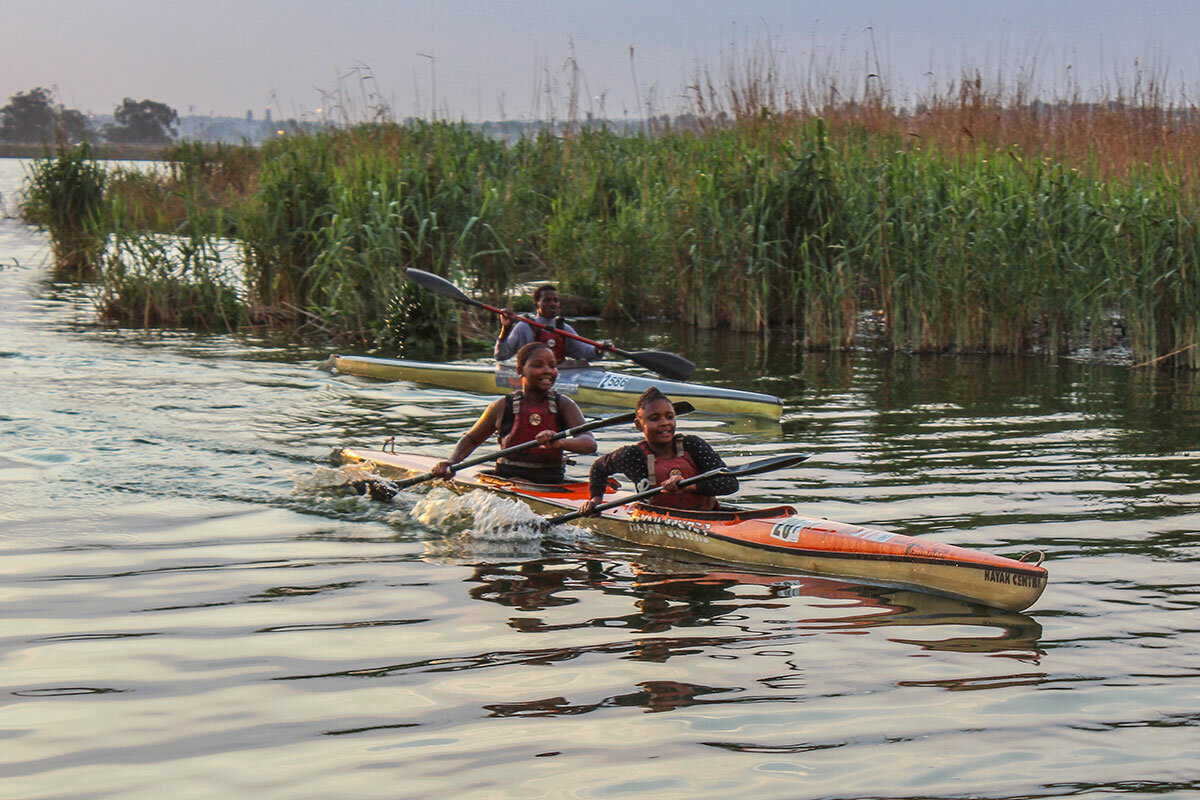
Photo: Ryan Lenora Brown/The Christian Science Monitor.
Juliet Mzibeli (front) is 12 and has been kayaking with the Soweto Canoe and Recreation Club (SCARC) since she was nine.

Every story I share here comes bundled with Covid-era caveats. You know: are the people still doing on Saturday what was reported on Friday? I’m counting on the thought that Omicron having peaked in South Africa, the kids in this article are back to enjoying their sport.

Ryan Lenora Brown reported from Soweto for the Christian Science Monitor, “As a kid growing up in South Africa, Nkosi Mzolo and his friends had a front-row seat each summer to Africa’s largest river kayak race, a 75-mile endurance paddle over bone-rattling rapids.

“But as he sat on the banks of the Msunduzi River near Durban watching the paddlers stream by in a rainbow of bright spandex, he couldn’t imagine being in their shoes. ‘I thought that was a sport for white people,’ he says.

“But Mr. Mzolo happened to grow up straddling a revolution. When he was born, in 1988, Black South Africans like Mr. Mzolo couldn’t vote or live in most parts of the country, let alone play sports with white people. By the time he was 12, though, paddling was changing in post-apartheid South Africa.

“A local Black kayaker invited Mr. Mzolo to learn the sport. … Now Mr. Mzolo runs a canoe club that trains Black paddlers, opening up a world to them, just as it opened to him.

“ ‘Canoeing pulled my life off the course it was on and put me on a different one,’ he says.

“Today, he coaches more than 75 young, Black kayakers in Soweto, near Johannesburg, hoping the sport, known to South Africans as canoeing, might do the same for them. ‘I want to give them something in their lives to look forward to,’ he says.

“In a sports-mad country still wrestling with the legacies of segregation and colonialism, integration in sports is a deeply political issue. During apartheid, South Africa was banned from international competitions like the Olympics for refusing to send racially mixed teams. Today, there are controversial racial quotas for the national teams in most major sports. But Mr. Mzolo’s paddlers are part of a generation that grew up thinking they could play whichever sport they chose.

“The club Mr. Mzolo now leads, the Soweto Canoe and Recreation Club (SCARC), was started in 2003 by Brad Fisher, the advertising executive and paddler who sponsored Mr. Mzolo’s education. He later hired Mr. Mzolo, who was working as a gardener in Johannesburg, as one of the club’s early coaching recruits.

“Since then, the club has trained some of the country’s top Black paddlers. Mr. Mzolo himself has gone on to finish the Dusi Canoe Marathon, the long-haul race he watched as a boy, 17 times. But more importantly for coaches like Mr. Mzolo, the club has given thousands of kids a passion they might never have otherwise found.

“ ‘My talent is in the water,’ says Chwayita Fanteni, who is 16 and has been paddling for three years. ‘I like the energy I get from winning.’ … 

“ ‘My goal is to go to Russia. For the Olympics,’ says Nhlamulo Mahwayi, who is 12 and has been training with SCARC since he was nine. So far, he’s only been as far as Cape Town, which he rates as ‘so fun and so clean. I saw people surfing.’

“Like many of the young paddlers here, when Mr. Mahwayi joined the club in 2018, he didn’t know how to swim.

“ ‘Ninety-five percent of these kids, I would say, they come here not knowing how to swim at all,’ says Mr. Mzolo. That too is a legacy of apartheid, which barred Black South Africans from most pools and beaches. Today, many parents never teach their kids how to swim because they themselves don’t know how to.

“New recruits to SCARC, then, often spend months in a nearby public pool before they ever dip a paddle in the water. …

“Mr. Mzolo comes here when he can, when he isn’t working a night shift as a firefighter and paramedic, or sleeping one off. … It’s exhausting, he says, but nowhere near the worry he felt last year when the club was closed for five months during South Africa’s coronavirus lockdown.

“During those months, he spent his days rushing COVID-19 patients to hospitals, and his nights wondering how his athletes were doing, many attempting to do homeschooling with no internet, computers, or even sometimes electricity. Some lived in informal settlements with no reliable water or power. Many of their parents had lost their jobs.

“With public facilities like parks and dams closed, the club couldn’t train. Mr. Mzolo went door to door visiting his athletes and bringing food parcels to their families – just as he often did before the pandemic. … On a recent afternoon, the coaches arrived in a minibus loaded with heavy bags of cornmeal, rice, tinned beans, and oil, enough for every athlete to take home a share.

“ ‘Looking at myself, I started where these kids are,’ he says. ‘Now I’m trying to be part of their journey.’ ”

More at the Monitor, here.

Read Full Post »

Your Bilingual Dog

Photo: Raúl Hernández.
Kun Kun has been participating in tests to tell if dogs can distinguish one language from another. Here is Kun Kun taking a break from the MRI machine.

Anyone who has ever been attached to a dog, talking to the dog and studying its reactions, must have wondered what dogs understand and how they understand it. Among the studies that have been done on the question is a recent one about being able to understand different languages.

Alejandra Marquez Janse and Christopher Intagliata present the story at National Public Radio.

“Imagine you’re moving to a new country on the other side of the world. Besides the geographical and cultural changes, you will find a key difference will be the language. But will your pets notice the difference?

“It was a question that nagged at Laura Cuaya, a brain researcher at the Neuroethology of Communication Lab at at Eötvös Loránd University in Budapest.

” ‘When I moved from Mexico to Hungary to start my post-doc research, all was new for me. Obviously, here, people in Budapest speak Hungarian. So you’ve had a different language, completely different for me,’ she said.

“The language was also new to her two dogs: Kun Kun and Odín.

” ‘People are super friendly with their dogs [in Budapest]. And my dogs, they are interested in interacting with people,’ Cuaya said. ‘But I wonder, did they also notice people here … spoke a different language?”

“Cuaya set out to find the answer. She and her colleagues designed an experiment with 18 volunteer dogs — including her two border collies — to see if they could differentiate between two languages. Kun Kun and Odín were used to hearing Spanish; the other dogs Hungarian.

The dogs sat still within an MRI machine, while listening to an excerpt from the story The Little Prince. They heard one version in Spanish, and another in Hungarian. Then the scientists analyzed the dogs’ brain activity.

“Attila Andics leads the lab where the study took place and said researchers were looking for brain regions that showed a different activity pattern for one language versus the other.

” ‘And we found a brain region — the secondary auditory cortex, which is a higher level processing region in the auditory hierarchy — which showed a different activity pattern for the familiar language and for the unfamiliar language,’ Andics said.

“This activity pattern difference to the two languages suggests that dogs’ brain can differentiate between these two languages. In terms of brain imaging studies, this study is the very first one which showed that a non-human species brain can discriminate between languages.

“They also found that older dogs brains’ showed bigger differences in brain activity between the two languages, perhaps because older dogs have more experience listening to human language. Their findings were published this week in the journal NeuroImage.

“Amritha Mallikarjun is a researcher at the Penn Vet Working Dog Center in Philadelphia. She wasn’t involved in this study, but has been working on similar research about dogs and language. … While this work relied on brain imaging, Mallikarjun said it would be worth investigating whether dogs could differentiate between languages in behavioral studies, too…. ‘Because often with neural studies, you can find differences that don’t play out in the behavior.’ ” More at NPR, here.

Being curious about the choice of The Little Prince for the text, I went to the original study: “Our linguistic material consisted of a recording of the XXI chapter of The Little Prince written by Antoine de Saint-Exupéry read by two different native, female speakers, with similar timbre, and vocal characteristics [one] in each language. … The text, as well as the speakers were unknown to all dogs and the text was recorded with a lively, engaging intonation.”

So then I looked up the passage, finding it described at a website call Shmoop: “The little prince tells the fox that he is unhappy and asks him to come play with him; but the fox says he cannot because he is not ‘tamed’ (21.8). He explains that ‘to tame’ means ‘to establish ties’ (21.16). Through the process of taming, they will come to need each other, and will become special to one another. The fox requests the little prince to tame him.”

Read Full Post »

Photo: Walter Siegmund via Wikimedia.
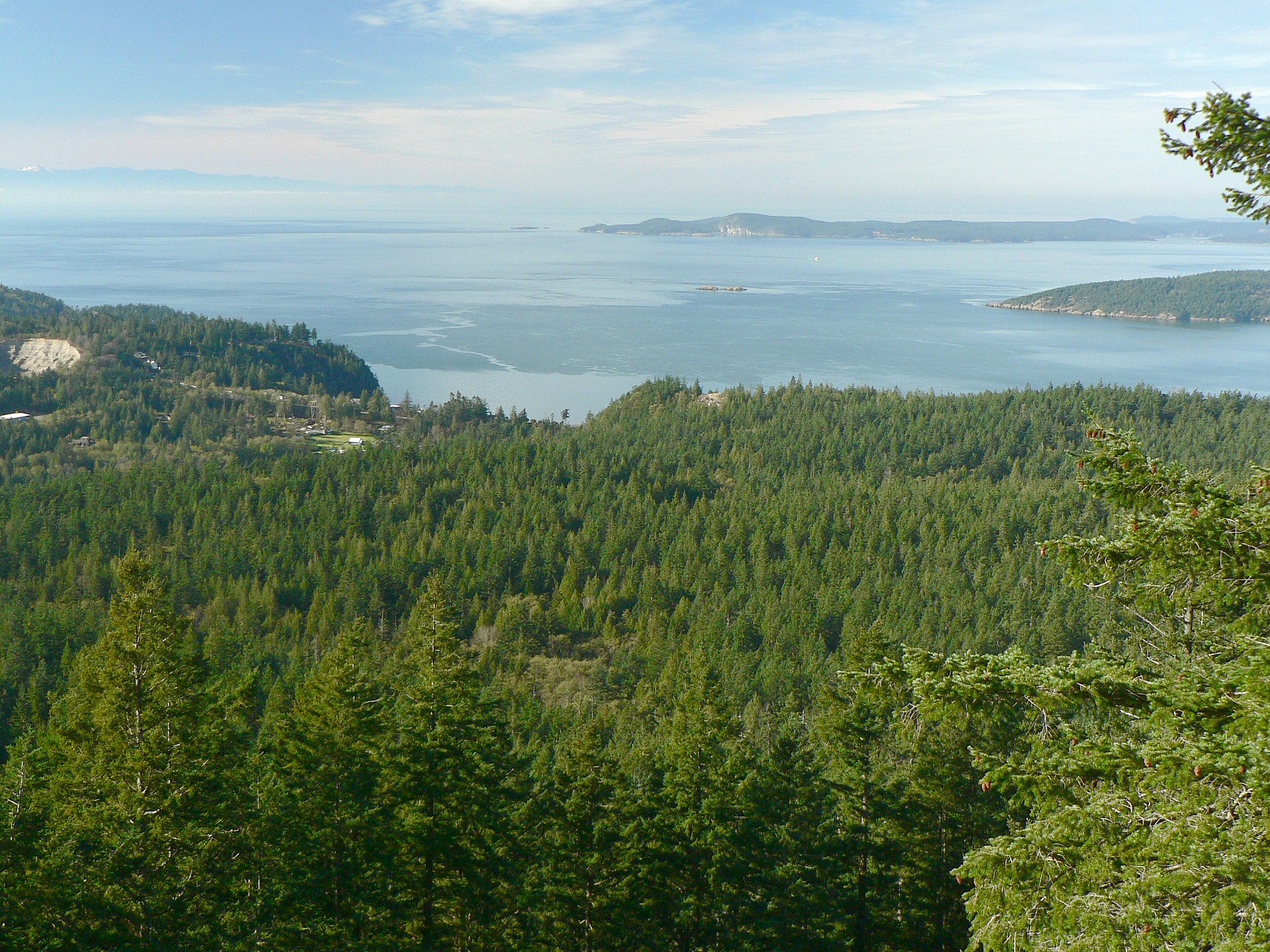
The forested western slopes of Washington State’s Fidalgo Island overlook the Strait of Juan de Fuca.

The pandemic may have distracted you and me from the environmental crisis, but many indigenous tribes have tackled Covid while also keeping their eye on the ball. In this article from the Washington Post, Jim Morrison explains that for the Swinomish people, it has something to do with their holistic world view.

“For 10,000 years,” he writes, “the Swinomish tribe has fished the waters of northwestern Washington, relying on the bounty of salmon and shellfish not only as a staple of its diet but as a centerpiece of its culture. At the beginning of the fishing season, the tribe gathers on the beach for a First Salmon ceremony, a feast honoring the return of the migratory fish that binds the generations of a tribe that calls itself the People of the Salmon.

“At the ceremony’s conclusion, single salmon are ferried by boat in four directions — north to Padilla Bay, east to the Skagit River, south to Skagit Bay and west to Deception Pass — and eased into the water with a prayer that they will tell other salmon how well they were treated.

“In recent years, though, the tribe’s harvest, diminished by vanishing habitat and warming waters fueled by climate change, hasn’t been sufficient to feed the hundreds of people who come to pay homage to their ancestors and to the fish that sustained them.

“ ‘We don’t have that abundance anymore,’ said Lorraine Loomis, an elder who has managed the tribal fishery for 40 years. ‘To get ceremonial fish, we buy it and freeze it.’

“For the Swinomish, perched on a vulnerable, low-lying reservation on Fidalgo Island, the effects of a warming world have been a gut punch.

“The tribe has responded with an ambitious, multipronged strategy to battle climate change and improve the health of the land and the water and the plants, animals and people who thrived in harmony for generations. In 2010, the Swinomish became one of the first communities to assess the problems posed by a warming planet and enact a climate action plan. An additional 50 Native American tribes have followed, creating climate strategies to protect their lands and cultures, ahead of most U.S. communities.

“The Swinomish see the tasks beyond addressing shoreline risk and restoring habitats. They look at climate adaptation and resilience with the eyes of countless generations. They recognize that the endangered ‘first foods’ — clams, oysters, elk, traditional plants and salmon — are not mere resources to be consumed. They are central to their values, beliefs and practices and, therefore, to their spiritual, cultural and community well-being.

“Loomis is 80. Every member of her family, from her grandfather to her nine great-grandchildren, has fished the tribe’s ancestral waters. She has watched over the decades as the salmon disappeared and her family turned to crab, geoduck and sea cucumbers. She’s seen the salmon season drop to only a few days per species from the eight months — May through December — of decades past in order to protect populations. The Skagit River is the last waterway in the continental United States that’s home to all five species of Pacific salmon.

“Progress has been slow; some researchers say it could be 90 years before the salmon recover. Loomis is taking the long view. ‘If I didn’t believe we would recover [the fishery], I guess I wouldn’t still be working on this,’ she said.

“In recent years, the tribe has fostered salmon recovery through a variety of projects. It has restored tidelands and channels, planted trees along streambeds to cool warming waters, and collaborated with farmers to increase stream setbacks to improve water quality.

“Restoring salmon populations is just part of an ambitious climate action plan to blunt the effects of increased flooding, ocean acidification, rising river temperatures, more-destructive storms and habitat loss.

“The Swinomish are rebuilding oyster reefs for the native Olympia oyster. They’re planning the first modern clam garden in the United States on the reservation’s tidelands, reviving an ancient practice. They’re monitoring deer and elk populations through camera traps to understand the climate change pressures and to inform hunting limits. And they have ongoing wetland restoration projects to explore preserving native plants and to help naturally manage coastal flooding.

“ ‘They’re doing really innovative climate adaptation,’ said Meade Krosby, a senior scientist with the Climate Impacts Group at the University of Washington. ‘They were way ahead of the curve.’ …

“Their plans merge traditional and academic resources. When looking at ways to protect wetlands, Todd Mitchell, the tribe’s director of environmental protection, discovered that knowledge about traditional plantings passed down through the generations was lost. So he turned to the University of Washington, which had archived notes by ethnographers and anthropologists who had interviewed tribe elders in the 1950s and 1960s.

“A tribal member who earned a geology degree from Dartmouth College and a master’s degree at Washington State University, Mitchell returned to work for the tribe 20 years ago. ‘I think the missing piece [is] how to take this straight-up science in the academic sense and put it together with traditional knowledge.’ …

“Jamie Donatuto, the tribe’s environmental health officer, and Larry Campbell, a 71-year-old tribal elder, have created a tool, Indigenous Health Indicators, that goes beyond typical morbidity and mortality measures and considers ecosystem health, social and cultural beliefs, and values integral to a community. …

“Seen through that lens, restoring ‘first foods’ is important not just for diet and nutrition but for nourishment of the soul. Living somewhere for a long time fosters a sense of place, and a sense of place fosters stewardship.

“ ‘It’s a different worldview,’ said Donatuto, who has a doctorate in resource management and environmental sustainability from the University of British Columbia. ‘The salmon and the crabs and the clams are relatives. They’re living relatives. They’re not just resources. And so you treat them with a symbiotic respect. They feed you because you take care of them. It’s a very different way of thinking about why these areas are important.’ ”

More at the Post, here.

Read Full Post »

Photo: Chris Bell/The Culture Trip.
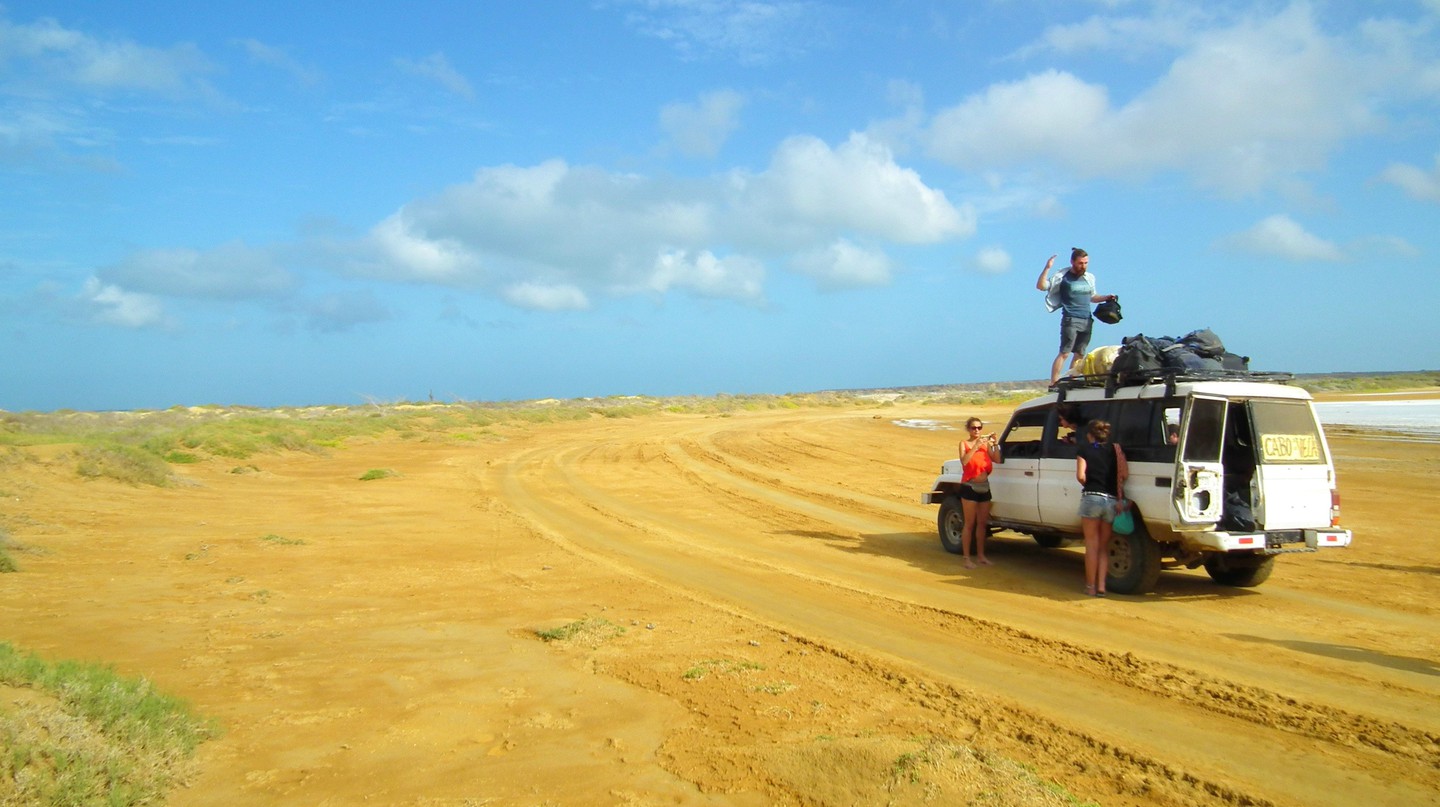
Tourists in La Guajira, a remote part of Colombia. Nowadays the focus is on a vaccine outreach to wary indigenous residents.

John assures me that pandemics always peter out as variants emerge weaker and weaker. I hope he’s right. Meanwhile, some experts are saying we won’t be done with Covid until we vaccinate the whole world.

Samantha Schmidt at the Washington Post wrote recently about an effort to reach a remote corner of Colombia — one step in vaccinating the whole world.

“The vaccination team had spent an hour bouncing and bucking down a dirt road and over train tracks when the van driver issued a warning. The toughest part of the drive was still to come. The two women gripped their seat cushions as the van jolted, climbed a mound of dirt and fishtailed in the slick mud. Driver Toto Girnu honked at passing goats as he followed a path blazed only by tire tracks. In the distance, he spotted dark, menacing clouds.

“If the group was lucky, the drive through this remote desert would take four or five hours. If it rained, as it did when Girnu made this trip a few days earlier, it could take more than 10.

“But this was the only way to reach the Indigenous families who live in this arid swath of land in the northern department of La Guajira, where there are no paved roads, no electricity, no running water and no other access to the vaccines that would protect their communities.

“Travel is only part of the challenge confronting the team, one of many contracted by the Colombian government to deliver vaccines to some of the country’s remotest peoples. There is also a lack of information about the coronavirus, hesitation around vaccines and a general mistrust of authorities.

“The van, ‘Route of Hope’ written across the windshield, came upon a roadblock. Adults and children here string ropes across the road, to be lifted only in exchange for water, food or cash.

“ ‘Are you vaccinated?’ vaccine team coordinator Katherin Gamez shouted to a young man. Girnu gave the man a fist bump, tossed him a small bag of water and translated the question into Wayuunaiki, the language of the local Wayuu Indigenous people.

“ ‘For what?’ he asked.

“Across the Andes, a region that has reported some of the world’s highest covid-19 death rates, teams are traversing deserts, mountains, rainforests and rivers to vaccinate isolated communities.

“Such teams are particularly active in Colombia, a country of more than 48 million people, where about 16 percent of the population lives in rural areas that were often neglected by the government during more than five decades of armed conflict. …

“About 35 percent of Colombia’s population has been fully vaccinated, according to the Health Ministry. More than half of residents in major cities — 62 percent in the capital of Bogotá — have received at least one dose.

“But in La Guajira, home to the country’s largest Indigenous population, only 38 percent have received at least one dose. … Years of government abandonment and mismanagement have caused many Wayuu residents to mistrust the health system. Only 4 percent of Wayuu people here have access to clean water, Human Rights Watch reported last year; 77 percent of Indigenous households are food insecure. In Alta Guajira, where the largest number of Wayuu people live, there is only one hospital, and it offers only basic care. …

“ ‘By the time a lot of them get to care, they’re so near death … there’s this perception that maybe the care didn’t help,’ said Shannon Doocy, an associate professor of international health at Johns Hopkins who co-wrote the Human Rights Watch report. …

“ ‘We’re getting close,’ Girnu told Gamez and Eliana Andrioly, the team’s Indigenous leader. They sped down a salt flat, their view miles of sand and the distant bay. …

“A team of nursing assistants and a doctor were waiting. The providers spend 15 days at a time living in a dormitory next door, sleeping in hammocks and showering with buckets of water, to stage daily medical missions to the surrounding communities.

“The organization, IPSI Palaima — ‘land of the sea’ in Wayuunaiki — was founded in 2007 by an Indigenous woman who grew up in the area. It is one of the only providers in Alta Guajira with a permanent vaccine refrigerator, in a medical center powered by solar panels.

“The team member in charge of shots this week was Daniela Vergara, a 21-year-old nursing assistant who had never been to AltaGuajira before she applied for the job. Each day, Vergara aims to vaccinate at least 10 people — a modest goal that often requires a massive effort.

“On this Monday, she had not yet reached her target. She packed her cooler — a blue backpack filled with vials of the single-dose Johnson & Johnson shot that has been a godsend to rural vaccine teams — and set out for a community across the bay. [Then] they drove to a gathering place where they hoped to meet people interested in the vaccine.

“ ‘There’s no one here,’ Vergara said. ‘We got here too late.’

“A local leader suggested they go house to house. As darkness fell, the team members asked anyone who looked 18 or older if they wanted the vaccine. Soon a woman recounted a rumor they had heard many times: Outsiders were pushing a vaccine that was sickening members of the Wayuu community.

“The woman, a teacher who spoke some Spanish, knew what was at stake. She had contracted the virus a few months earlier, after a trip to the town of Uribia. For a month, she suffered chest pains, headaches, an intense cough and the loss of taste and smell. … She worried about a 66-year-old neighbor who had no interest in getting a shot.

“ ‘Many people are dying from this disease,’ Juan Larrada, a Wayuu doctor in the group, said in Wayuunaiki. He said the vaccine could have side effects, but it would protect them from serious illness. He asked Amaita Uriana why she did not want it.

“ ‘Because I was afraid of getting sicker,’ she said. ‘I really feel very sick. I carry pains in my body. That’s why I refused when a girl came here for the same reason. Besides, she was very pretentious. And we had already heard about the experiences of other Wayuu who had been vaccinated and become ill.’

“ ‘The vaccine can have those effects,’ Larrada agreed. ‘Fever, muscular pains, that’s normal.’

“Understanding the doctor as he spoke to her in her own language, Uriana assented. She closed her eyes; Vergara emptied the syringe into her arm.”

Read about the many Wayuu who cannot be persuaded and why that is, here. The photos in the article are terrific, but I can’t share them because they’re blocked. If you have a subscription, you are in luck.

Read Full Post »

Photo: Kurt Stüber.
Some amaranth species are cultivated as leaf vegetables, says Wikipedia. The Guardian adds, “The plant is indigenous to North and Central America but also grown in China, India, Southeast Asia, West Africa and the Caribbean.”

Here are a couple stories on plants that may hold the potential to feed the world. One is the amaranth; the other is a bioengineered wheat grass called kernza. Pretty sure that one will not go over well with the non-GMO crowd.

Cecilia Nowell reports on amaranth at the Guardian, “Just over 10 years ago, a small group of Indigenous Guatemalan farmers visited Beata Tsosie-Peña’s stucco home in northern New Mexico. In the arid heat, the visitors, mostly Maya Achì women from the forested Guatemalan town of Rabinal, showed Tsosie-Peña how to plant the offering they had brought with them: amaranth seeds.

“Back then, Tsosie-Peña had just recently become interested in environmental justice amid frustration at the ecological challenges facing her native Santa Clara Pueblo – an Indigenous North American community just outside the New Mexico town of Española, which is downwind from the nuclear facilities that built the atomic bomb. Tsosie-Peña had begun studying permaculture and other Indigenous agricultural techniques. Today, she coordinates the environmental health and justice program at Tewa Women United, where she maintains a hillside public garden that’s home to the descendants of those first amaranth seeds she was given more than a decade ago. …

“Tsosie-Peña and her guests spent the day planting, winnowing, cooking and eating them – toasting the seeds in a skillet to be served over milk or mixed into honey – and talking about their shared histories: how colonization had separated them from their traditional foods and how they were reclaiming their relationship with the land.

“Since the 1970s, amaranth has become a billion-dollar food – and cosmetic – product. Health conscious shoppers embracing ancient grains will find it in growing numbers of grocery stores in the US, or in snack bars across Mexico, and, increasingly, in Europe and the Asia Pacific. As a complete protein with all nine essential amino acids, amaranth is a highly nutritious source of manganese, magnesium, phosphorus, iron and antioxidants that may improve brain function and reduce inflammation.

“ ‘This is a plant that could feed the world,’ said Tsosie-Peña. …

“ ‘Supporting Indigenous people coming together to share knowledge’ is vital to the land back movement, a campaign to reestablish Indigenous stewardship of Native land, and liberation of Native peoples, Tsosie-Peña said. ‘Our food, our ability to feed ourselves, is the foundation of our freedom and sovereignty as land-based peoples.’ …

“Amaranth is an 8,000-year-old pseudocereal – not a grain, but a seed, like quinoa and buckwheat – indigenous to Mesoamerica, but also grown in China, India, south-east Asia, west Africa and the Caribbean. Before the Spanish arrived in the Americas, the Aztecs and Maya cultivated amaranth as an excellent source of proteins, but also for ceremonial purposes. When Spanish conquistadors arrived on the continent in the 16th century, they [feared] that the Indigenous Americans’ spiritual connection to plants and the land might undermine Christianity. …

“Although the Spanish outlawed amaranth when they arrived in Central America, Mexico and the south-western United States, Indigenous farmers preserved the seeds – which grew with remarkable resilience. …

“While amaranth is no longer banned, Tsosie-Peña says ‘planting it today feels like an act of resistance.’ Reestablishing relationships with other Indigenous communities across international borders is part of a ‘larger movement of self-determination of Indigenous peoples,’ she says, to return to the ‘alternative economies that existed before capitalism, that existed before the United States.’ …

“Every year … farmers with [a Guatemalan agricultural community called Qachuu Aloom, or ‘Mother Earth’] have traveled to the United States to share their knowledge of amaranth with predominantly Indigenous- and Latino-led gardens. … In 2016, when Tsosie-Peña and her colleagues at Tewa Women United broke ground on their public garden in Española, Qachuu Aloom was there to plant amaranth once again. …

“Tsosie-Peña says that this exchange between North and Central American farmers isn’t just about amaranth as a crop; it’s also about reconnecting to ancient trade routes that have been disrupted by increasingly militarized borders.

“Maria Aurelia Xitumul, a member of Qachuu Aloom since 2006 who has traveled on exchanges to California and New Mexico, echoes Tsosie-Peña.

‘The goal is to share experiences, not necessarily generate income, like capitalists. What we want is for the whole world to produce their own food. … For the seeds, distance doesn’t exist. Borders don’t exist.’ …

“The week before the emergency declaration of the pandemic Tsosie-Peña was in Guatemala. When international borders began closing, she had to rush home to the United States. But a few months ago, after vaccines were widely distributed in the US, she and a handful of delegates from each of the farms that had begun planting Qachuu Aloom’s seeds traveled back to Guatemala. With them, they brought seeds from the amaranth they had each grown in their home gardens … to plant in a shared plot: a kind of solidarity garden.

“ ‘We’ve always viewed our seed relatives as relatives and kin,’ says Tsosie-Peña. ‘We have co-evolved with them as fellow Indigenous peoples of this place.’ ”

More at the Guardian, here.

Meanwhile another plant that’s supposed to feed the world was described recently at the Washington Post. Sarah Kaplan reported on kernza, “a domesticated form of wheatgrass developed by scientists at the nonprofit Land Institute. … A single seed will grow into a plant that provides grain year after year after year. It forms deep roots that store carbon in the soil and prevent erosion. It can be planted alongside other crops to reduce the need for fertilizer and provide habitat for wildlife.” More on kernza here.

Read Full Post »

Photo: Peter Aaron/OTTO.
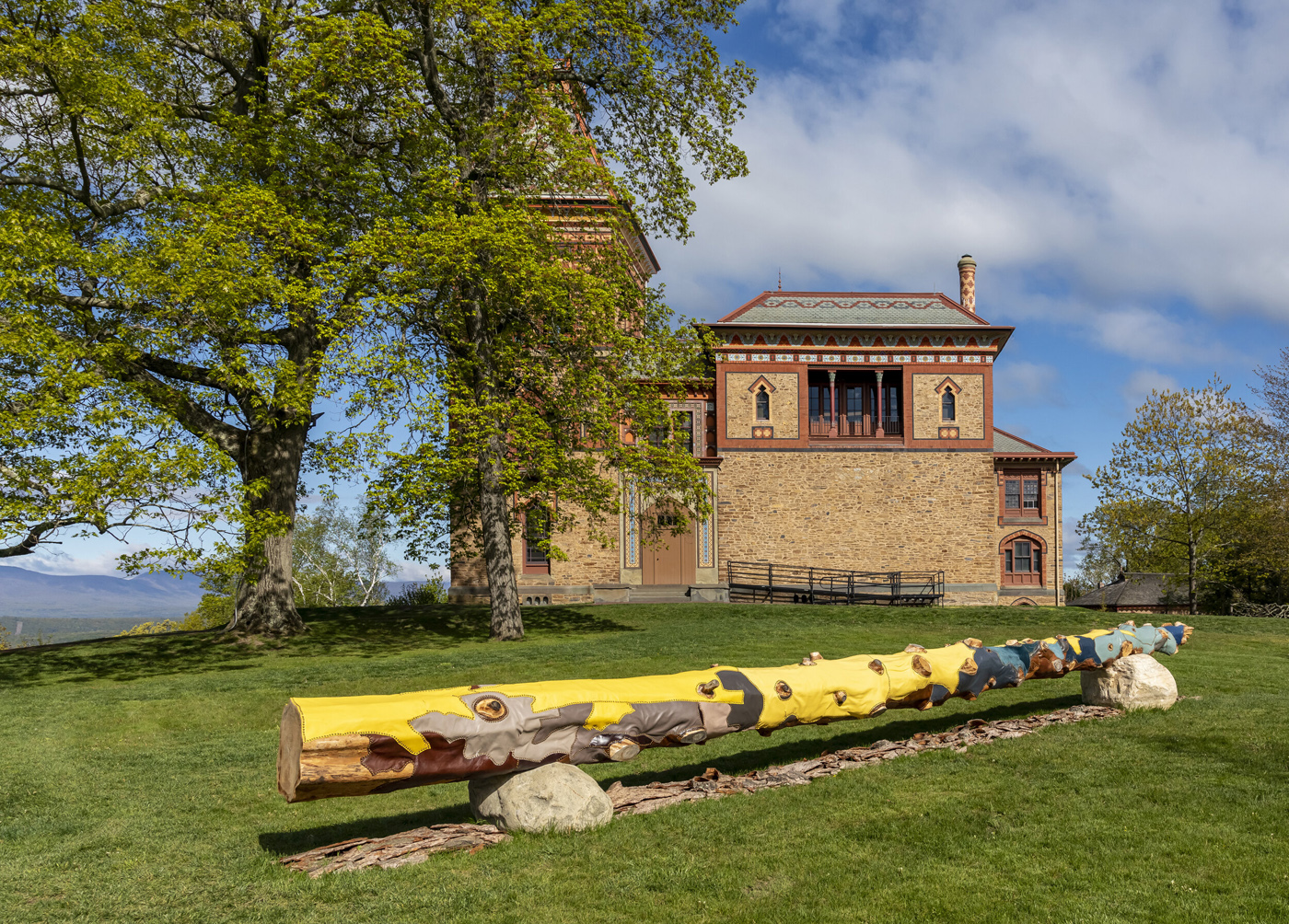
Jean Shin’s installation “FALLEN” at the Olana State Historic Site, part of the recent “Cross-Pollination art show.

I don’t know if growing up near the Hudson River has anything to do with it, but I’ve always loved the monumental nature paintings of the Hudson River School. In recent years, different kinds of art have made the region famous, including art shown at Dia Beacon and the offbeat Visitors film screened at the ICA in Boston and elsewhere. (That’s the one with the Icelandic musicians playing haunting music in the bathtubs and salons of a ruined Hudson River mansion.)

Not far from Rokeby, the ruin in question, another mansion has been turned into a museum called Olana, and today’s post is about putting its classic paintings together with more modern conceptions of nature.

Sarah Rose Sharp wrote at Hyperallergic last October about Cross Pollination, “a collaborative exhibition that spans institutions and centuries, to put artists in conversation with each other on the topic of ecology — and hummingbirds.

“The exhibition is organized between the Olana Partnership at the Olana State Historic Site (once the home of Frederic Church), the Thomas Cole National Historic Site, and Crystal Bridges Museum of American Art in Arkansas. The historic presentations include 16 paintings from a series of hummingbirds and habitats — The Gems of Brazil (1863-64) — by naturalist and painter Martin Johnson Heade (1819-1904).

“This Audubon-like survey of Brazilian hummingbirds — and the resulting writing on the artist’s part to protest the overhunting of their populations — serves as the aesthetic and philosophical inspiration for a series of new works commissioned for the exhibition. The exhibition also includes paintings by Thomas Cole and Frederic Church, as well as botanical works on both paper and porcelain by Emily Cole, Cole’s daughter, and Isabel Charlotte Church, Church’s daughter. This generational affair also features some highlights from natural specimens collected by Thomas Cole and Frederic Church, including items from the Church family’s extensive collection of bird eggs.

“The exhibition is presented simultaneously at both Olana State Historic Site in Hudson, New York, and the Thomas Cole National Historic Site in Catskill, New York.

“With these 19th-century collections that focused so intently on natural systems as their inspiration, a cohort of 21st-century American artists present works in response. The contemporary artists are known to take on issues of biodiversity, habitat protection, and environmental sustainability, and contributions include new works by Rachel Berwick, Mark Dion and Dana Sherwood, Lisa Sanditz and Emily Sartor, and Jean Shin.

“On location at the Thomas Cole Site, ‘The Pollinator Pavilion’ is a public artwork by Mark Dion and Dana Sherwood created for the exhibition, where pollinators and humans can share the same space. Jean Shin used the remains of a fallen hemlock tree at the Olana site to create a memorial artwork in its memory, titled ‘FALLEN’ (the tree died of natural causes). …

“Ironically, though Heade, Cole, and Church advocated for the preservation of natural spaces, the fad of biological specimen collections like the ones being presented fueled a market for hunting the birds that Heade idealized. Even these days, as evidence of our excess mounts in flaming piles on land and sea, it seems we can still hardly even agree that the planet is a finite resource, let alone determine who is entitled to take any little piece of it that catches their eye. Perhaps this exhibition [holds] the seeds of change within it.”

More at Hyperallergic, here.

The video below did a pretty good job of educating me, but it’s painful. The “10-Minute” professor doesn’t ultimately shy away from our destruction of nature and native tribes.

Read Full Post »

Photo: Netflix/Lupin.
“The French mystery thriller Lupin became the most-watched non-English series on Netflix and is also the platform’s most popular series of 2021; it’s been lauded for its seamless translations,” reports Zocalo.

I’ve spent many months plowing my way through The Magic Mountain mainly because I’d read about the challenges Thomas Mann’s first English translator, Helen Tracy Lowe-Porter, faced. I was curious. If characters suddenly start speaking French, how do you show they aren’t speaking German anymore? One character is a real Mrs. Malaprop. In German. What do you do? If a different character purposefully makes a play on words, how do you translate that and still make sense?

Most people are exposed to this sort of thing when they read subtitles on foreign films. Although I like having subtitles on all films (British accents can be hard to understand; Americans mumble), if I know a bit of a foreign language being badly subtitled, I find it really distracting. There’s an art to translating well.

Recently, translator David Buchanan wrote about subtitling at Zocalo Public Square. “If you don’t notice my work,” he says, “it means I’m doing my job properly.

“I’m an audiovisual translator, which means that I — and others like me — help you understand the languages spoken on screen: You just click that little speech bubble icon in the bottom-right corner of your preferred streaming service, select the subtitles or the dub, and away you go. …

“I decided to become an audiovisual translator because it allows me to combine cinema and French culture, my two favorite things. But there is also something about the anonymity of the work that appeals to me, which is the name of the game for our craft. As Bruce Goldstein, director of repertory programming at New York’s Film Forum, put it in The Art of Subtitling, ‘Good subtitles are designed to be inconspicuous, almost invisible.’

“Of course, it’s impossible to be truly invisible. Translating film and TV always involves some form of compromise. … Whether working (as I do) from French into English, from Spanish into German, or Japanese into Swedish, the process is always the same: We pay close attention not only to the meaning of the words, but to the actors’ emotions, the cadence of their speech, their body language, the themes and narrative structure of the script, the historical period, and the social context. Together, these cues provide a host of tiny hints, all of which add extra layers of meaning and must be accounted for in the translation.

Translating all these layers is a bit like solving a Rubik’s Cube — it’s easy to do one side, but what about all of the others?

“Say I’m dubbing a ghost story set in a bourgeois Parisian household in the year 1850. The French grandmother stands in a doorway and whispers, ‘A tout de suite, mon petit.‘ How would you dub that into English? I might try, ‘See you in a minute, my darling,’ but that doesn’t sound stuffy enough for the 19th-century bourgeoisie. It needs to be more uptight, more formal. So what about, ‘See you in a moment?’

“The issue there is the cinematographer has lit the scene so the actor casts a sinister shadow into the room. She’s not just standing there, she’s lurking, and if I were a grandmother trying to lurk in a doorway, I wouldn’t say, ‘See you in a moment.’ However, I might say ‘See you soon.’ That could work — especially when you consider the spooky quality about the alliterative s’s and the ghostly ‘ooh’ in ‘soon.’

“ ‘See you soon, my darling’ perfectly fits the atmosphere of the scene. Except this introduces a new dilemma: ‘my darling’ doesn’t sync with the actor’s lip movements. Her mouth is closed for the ‘p’ in ‘petit,’ whereas the ‘d’ in ‘darling’ would require it to be open. In dubbing, the end of a sentence is one of the most important parts to get right: If the last word is poorly lip-synced, it sticks out like a sore thumb. …

“In an ideal world, I’d find a new term of endearment that syncs with ‘mon petit.’ … In this case, a compromise is necessary. At the end of the day, a loose translation is less distracting than bad lip sync.

“At times, I also must compromise when it comes to personal taste. For example, I might be subtitling a rapper renowned for Eminem-style punchlines, like: ‘C’est le retour de la légende de Jimmy, même si j’peux craquer à tout moment comme Djibril.‘ With these lyrics, they’re making a tasteless joke, comparing themselves to Djibril Cissé, a French footballer who has broken both of his legs. I don’t find broken legs especially funny, nor is it a joke that I would ever make myself. Still, this sick humor is a key element of their controversial persona, and the English-speaking audience deserves to understand what they’re saying so they can make up their own minds. A translator must never censor the source material: I must put my own opinion to one side and render the translation as faithfully as possible. It’s a challenging task, but also an instructive one.

“In this case, since most Americans are unlikely to have heard of Cissé, I start by ‘translating’ his name into that of another famous sportsman, a popular figure that an American audience would recognize by name. In order for the punchline to work, I need someone who would have suffered some kind of terrible injury. A fairly gruesome Googling session suggests the late basketball player Kobe Bryant, who died in a helicopter crash. Now I need to reverse-engineer the scenario. At first, the rapper pretends to be arrogant (légende), then undercuts themself by admitting they’re scared of failure (craquer… comme Djibril). After looking for an arrogant-sounding phrase that rhymes with ‘Bryant’ —eventually settling on ‘rap giant’ — I must find a way to describe Bryant’s accident that also acts as a metaphor for failure. … The offensive punchline leaves a bad taste in my mouth, but because it leaves the same bad taste as the original French, it feels like a faithful translation. …

“These days, though there are more films and TV from around the world than ever before, in many countries (such as the UK, where I live, or Spain, where my colleagues assure me the situation is even tougher), rates are falling and deadlines are getting tighter. This has inevitable repercussions on quality, not to mention our livelihoods. It can be hard to publicize our achievements because we usually sign non-disclosure agreements, and more often than not, filmmakers regard us as an afterthought, something to be rushed through at the distribution stage. Thankfully, many of the best filmmakers realize how important the translation stage is and are closely involved in the subtitling and dubbing process. They also pay fairly, so that we can take our time getting it just right.

“It’s possible for subtitles and dubs to be so seamless that they feel invisible without pushing audiovisual translators ourselves out of sight. I’m proud of what I do, and I want the world to know how much care and consideration I, and thousands like me, put into our work. That being said, there is still a certain satisfaction in being the hidden conduit between cultures, the solitary name that appears in a film’s credits after everyone has left the cinema. …

“Translation is about helping people to understand each other, and it feels good to be able to do that on a daily basis.”

More at Zocalo Public Square, here.

Read Full Post »

Photo: Andy Nelson/Special to the Christian Science Monitor.
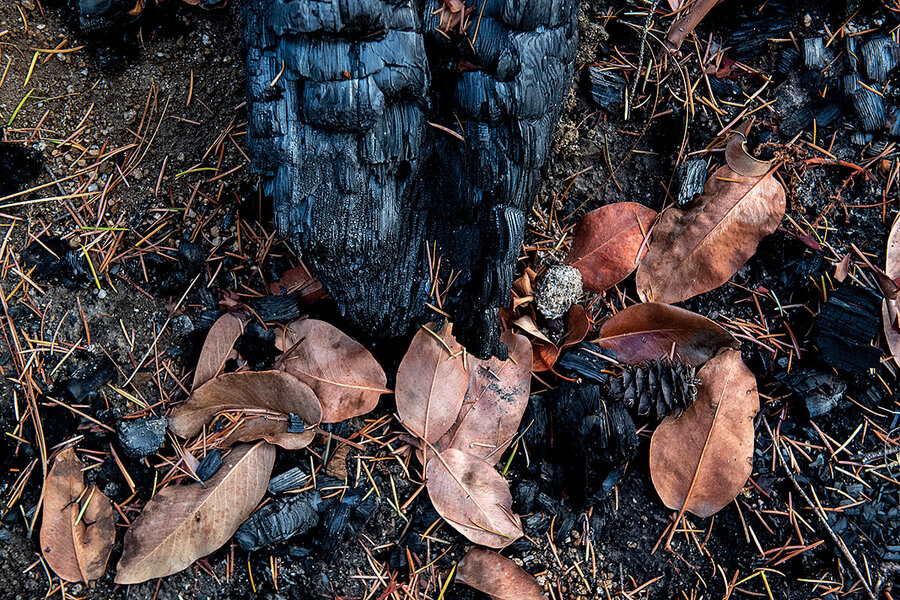
On a hiking trail in Ashland, Oregon, signs of a controlled burn. Says Brian Hendrix, who works for an outreach program that helps homeowners protect their properties from wildfires, “We try to help residents see that their own safety is linked to their neighbor’s safety.”

When Martin Kuz interviewed residents of Ashland, Oregon, for the Christian Science Monitor, he found that the shared determination to prevent wildfires tamped down ideological fires.

He reports, “A municipal water tank built into the forested hills above Ashland offers postcard views of the mountain valley town on clear days. This warm September morning is not, alas, such a day. Wildfires burning elsewhere in Oregon and to the south in California have blurred the blue skies, turning the city into a soup bowl of ash-gray smoke.

“Standing atop the storage tank, Chris Chambers points toward Hald Strawberry Park, visible through the haze about a half-mile away and encircled by homes. Drought has browned its grass and many of its pine and madrone trees. The parched land presents a fire threat to the town’s 21,000 residents – and, he explains, another chance to better protect them from the flames.

“ ‘I want to burn that whole thing. It’s an island of fuel,’ says Mr. Chambers, the wildfire division chief for the city fire department. … ‘There’s a choice: We can burn the land on our terms, or we can let nature burn everything – and we won’t like the effects.’

“The prospects for his plan appear bright in a town that over the past quarter century has emerged as a leading light in the American West for its sustained, communitywide approach to wildfire prevention. Since the late 1990s, acceptance among Ashland’s residents of the need for collective vigilance has grown in tandem with the number, scale, and intensity of infernos across the region. …

“ ‘Calling these huge fires of recent years natural disasters – they’re very much not natural disasters,’ says Mr. Chambers, who joined the fire department in 2002. …

‘We have to think of these fires and climate change as human-made disasters and realize we can unmake them. And, really, we have to if we want to live in the West.’

“This summer delivered more proof of that charred reality. … Propelled by ferocious winds, the Almeda Fire gutted the neighboring towns of Talent and Phoenix, leveling 2,500 homes. The calamity brought into tragic focus the principle of shared responsibility that Mr. Chambers and other fire safety officials promote as they seek to lower wildfire danger and enhance forest health.

“The emphasis on collaboration has drawn together the city, U.S. Forest Service, and conservation groups to restore the town’s watershed, a heavily forested area that slopes down from the 7,500-foot peak of Mount Ashland. The innovative initiative has enabled the partners to treat 13,000 acres of land through prescribed burning, selective logging, and brush clearing.

“Local officials have cultivated broad support in recent years to strengthen homebuilding and landscaping standards to improve wildfire safety. Fire Adapted Ashland, an education and outreach program, works with homeowners to safeguard properties and distributes small grants to individuals and neighborhood groups to replace flammable vegetation and trim trees.

“The culture of solidarity in the former timber town, now best known for hosting the Oregon Shakespeare Festival, has attracted fire safety officials from other Western states and as far away as England and Spain. They learn that an informal policy to persuade rather than dictate guides the city’s strategy. …

“The bitter struggle over clear-cutting and spotted owl habitat in Oregon, Washington, and California resulted in tight logging restrictions on federal lands as popular sentiment shifted toward saving old-growth forest. 

“In the ensuing decades, the ban on most timber operations – along with the enduring practice of extinguishing wildfires as quickly as possible – has deepened the crisis of ailing forests. The added impact of climate change and drought has burdened Western states with an estimated 6.3 billion standing dead trees. The competition for water and sunlight in clogged forests stunts the growth of young trees and diminishes the capacity of older, more fire-resistant trees to withstand flames and disease.

“ ‘The bias for a lot of the public is that any tree is a good tree,’ [Kit] Colbenson says. ‘But what you end up with is a forest that has more fuel and is more susceptible to big fires.’ …

“Forest Service and city officials raised the idea of restoring the 15,000-acre watershed through brush removal, controlled burning, and limited tree thinning to reduce fire danger and preserve the town’s sole water source at the time.

“The initial discussions elicited angry opposition from critics who suspected a Forest Service plot to revert to clear-cutting. Masked protesters stormed the agency’s local office in 1996. …

“Years of meetings followed as federal and city officials sought input from environmental groups and timber interests to forge solutions. A mutual willingness to keep talking dissolved the distrust that prevailed at the outset, and by 2001, the Forest Service and Ashland had agreed to rejuvenate 1,500 acres in the watershed. …

“The collaboration has won praise as a national model and subdued the town’s memories of the timber wars by striking a rare balance between ecology and economics. Environmentalists have come to accept that selective logging and brush thinning can increase the watershed’s resilience to fire while sustaining ample habitat for wildlife, and the funding has benefited timber companies that work under [Lomakatsi Restoration Project] supervision.

“ ‘I won’t ever say we’ve got it all figured out,’ says Mr. Chambers, who envisions expanding the project area and treating portions of the land on a 10-year rotating basis. ‘But there’s been a commitment to finding common ground.’ ”

More at the Monitor, here.

Read Full Post »

Photo: Kenneth K. Lam/Baltimore Sun.
Harold Morales, left, an associate professor at Morgan State University, loads boxes of vegetables with help from Troy Costner, center, and Artar Isreal, right, at Plantation Park Heights Urban Farm to deliver to a community center.

In a time of wintry weather and a return to isolation, it’s nice to think of warmer days and communities working outdoors together. Today’s story is about an urban farm in Baltimore that is providing healthful food where it’s needed most.

Stephanie Garcia writes at the Baltimore Sun about Plantation Park Heights Urban Farm.

“The lot at the corner of Springhill and Cottage avenues in Baltimore used to be vacant. Today, it’s home to one of the top 10 innovative farms in the country, according to the American Farm Bureau Federation.

“Known as Plantation Park Heights Urban Farm, it was founded eight years ago by Richard Francis, affectionately known as Farmer Chippy, who was looking for a community from the Caribbean diaspora in Baltimore and wanted to grow food for — and with — Park Heights residents.

“The farm has grown beyond Park Heights, with farmers aiming to grow 250,000 pounds of food across 30 city-owned vacant lots, all leased by the Plantation. … Collectively, these farmers and others in Baltimore plan to build the city’s first AgriHood, or a marketplace and community-shared agriculture and training resource institute. …

“Francis [has] secured partnerships with the University of Maryland, Coppin State University and Holistic Wellness and Health, which offers fresh plant-based cooking classes.

” ‘We’ll be positioned and ready to serve our youngest citizens, those who are at risk in Park Heights,’ Francis said. ‘The institute is going to put agriculture in the classroom and following through with our children so that they can become farmers and chefs before they become scientists, doctors and lawyers.’ …

“Francis said the farm’s name is intentionally provocative. ‘We wanted to remind children of the colonizers, that this is where it all started,’ Francis explained. ‘One group produces and the other group developed a thriving economy. Today, we say equal rights and justice for all on the Plantation. Let’s include those who were left out.’

“Agriculture is found across Baltimore, with over 20 urban farms and 100 community gardens, according to the Baltimore Office of Sustainability. It is a hotbed for art and community service, hosting poetry open mics and bringing quality produce to Maryland correctional institutions. [The Plantation] also has connected families with resources beyond farming and agriculture, helping dozens of neighbors with energy-saving grants and other services to help prevent eviction and homelessness.

“One community partner is the Morgan State University Center for the Study of Religion and the City. … Harold Morales, an associate professor of philosophy and religious studies at Morgan State, usually visits the urban farm on Thursday afternoons. He can be found pulling weeds, planting, harvesting and distributing one of the 300 free food boxes donated weekly through a U.S. Department of Agriculture program. Morales also helps with grant writing and research for the Plantation. …

“Park Heights Renaissance, a nonprofit organization focused on land and economic development, awarded the Plantation a $25,000 grant to support agriculture in classrooms across four public elementary schools in Park Heights. Children ages 5 to 15 are learning how to grow, harvest and package nutrient-dense foods for families in the community.

“Morales refers to the Plantation as a little piece of the Caribbean in Park Heights, where land, food and community come together. ‘Shovel, rakes, soil. Those are the things you need to survive in the urban context, but that’s not what people usually think,’ Morales said.

“Francis has seen plenty of similarities to his native Trinidad and Tobago. ‘Park Heights is like a Third World city. It has been neglected, it is heavily populated with Black and Brown people,’ he said. ‘It has a port, and it has a thriving economy happening outside of the poverty. We have an amazing educational system in the Caribbean, just like here with Johns Hopkins and the likes. But we are still unable to retain our talent, because most of these people graduate and go outside for opportunities.’ …

“Caribbean crops like sugar cane, sweet potatoes and Trinidad scorpion peppers are grown at the Plantation. Youth farmers learn that plantain leaves have healing properties for bites or stings and can be used like a bandage. …

“ ‘What’s often referred to as food deserts more appropriately should be called food apartheid,’ Morales said. … Francis echoes that sentiment and wants to transform Park Heights from a food desert into a food oasis. AgriHood Baltimore is key for this vision to come to fruition. ‘It is the close of the summer season for us, and we’re getting ready for next year,’ he said. ‘We’re coming bigger, better, faster and stronger.’ “

More at the Baltimore Sun, here.

Read Full Post »

Photo: World Housing.
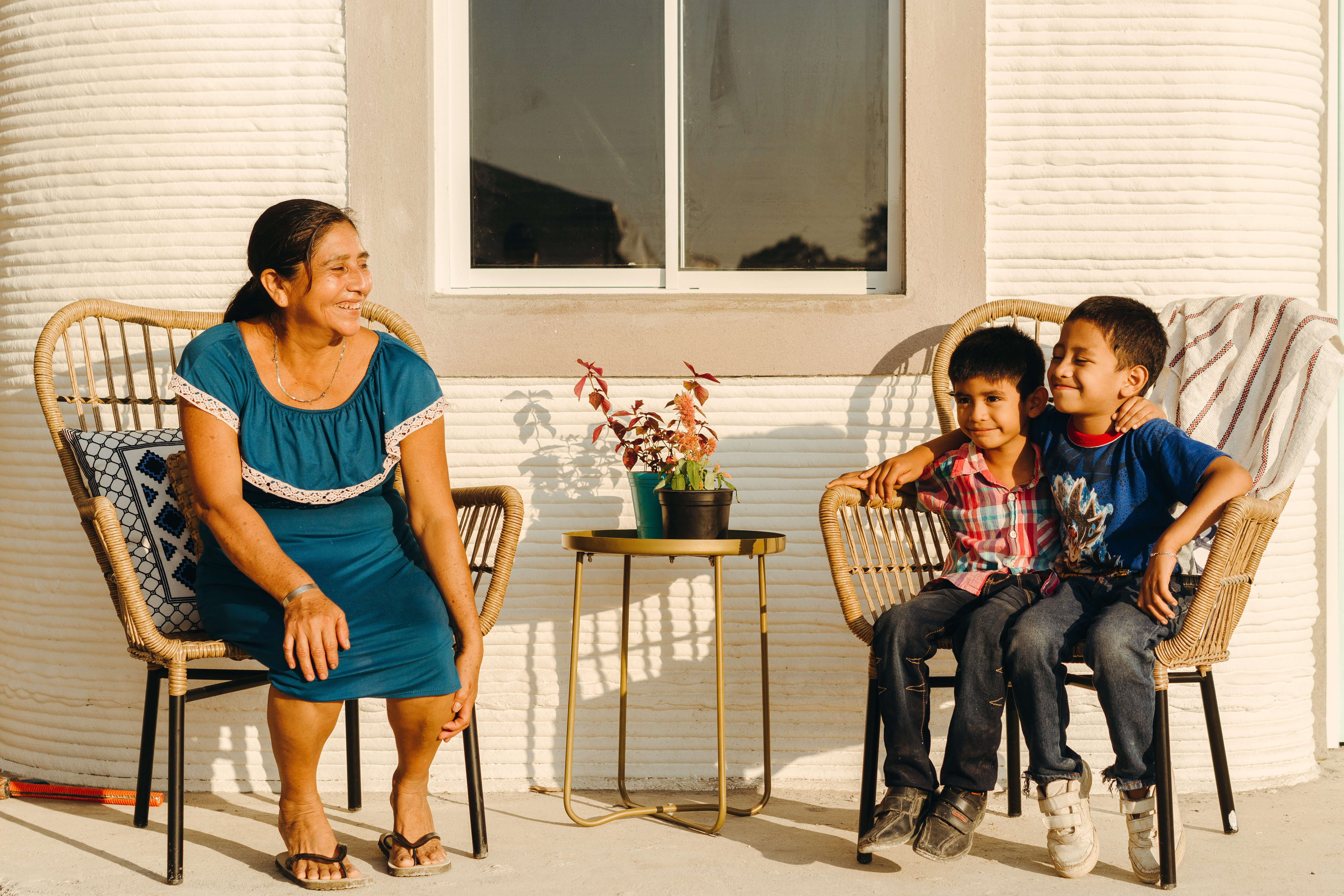
In a tiny village on the outskirts of Nacajuca, Mexico, builders are creating new homes using an oversize 3-D printer.

Pop-up temporary cabins, 3-D-printed buildings: whether such super-cheap housing is a good idea or not, it’s probably the wave of the future because we are so far behind providing shelter for all. Typhoons, floods, entrenched poverty, opioid devastation. All require new solutions to homelessness.

First, let’s take a look at 3-D homes in Mexico.

Debra Kamin reports at the New York Times, “Pedro García Hernández, 48, is a carpenter in the southeastern Mexican state of Tabasco, a rainforest-shrouded region of the country where about half of the residents live below the poverty line.

“He ekes out a living making about 2,500 pesos ($125.17) a month from a tiny workspace inside the home he shares with his wife, Patrona, and their daughter, Yareli. The home has dirt floors, and during Tabasco’s long rainy season, it’s prone to flooding. Dust from his construction projects coats nearly everything in the home, clinging to the bedroom walls, the pump toilet and the counters of his makeshift kitchen.

“But that will soon change. In a matter of months, Mr. Hernández and his family are moving to a new home on the outskirts of Nacajuca, Mexico: a sleek, 500-square-foot building with two bedrooms, a finished kitchen and bath, and indoor plumbing. What’s most unusual about the home is that it was made with an 11-foot-tall three-dimensional printer. …

“And now, the era of the 3-D printed community has arrived. Mr. Hernández’s home is one of 500 being built by New Story, a San Francisco nonprofit organization focused on providing housing solutions to communities in extreme poverty, in partnership with Échale, a social housing production company in Mexico, and Icon, a construction technology company in Austin, Texas.

“When New Story broke ground on the village in 2019, it was called the world’s first community of 3-D printed homes. Two years and a pandemic later, 200 homes either are under construction or have been completed, 10 of which were printed on site by Icon’s Vulcan II printer. Plans for roads, a soccer field, a school, a market and a library are in the works.

“Single-family homes are a good testing ground for the durability of 3-D printed construction because they are small and offer a repetitive design process without much height, said Henry D’Esposito, who leads construction research at JLL, a commercial real estate firm.

They can also be constructed to tolerate natural disasters: Nacajuca sits in a seismic zone, and the homes there have already withstood a magnitude 7.4 earthquake. …

“ ‘We know that being able to build more quickly, without sacrificing quality, is something that we have to make huge leaps on if we’re going to even make a dent on the issue of housing in our lifetime,’ said Brett Hagler, New Story’s chief executive and one of four founders.

“The organization was started in 2015, shortly after Mr. Hagler took a trip to Haiti and saw families still living in tents years after the 2010 earthquake there. Across the globe, 1.6 billion people live with inadequate housing, according to Habitat for Humanity. …

“Speed is only one factor in bringing a village to completion — New Story has teamed up with local officials in Tabasco to bring sewage services, electricity and water to the community.

“Mr. Hernández, who has plans to expand his construction business to a larger space in his new home, said he was not focused on a move-in date. He cares about the long-term impact the home will have for his daughter, who is studying to become a nurse.

“ ‘When we receive the house, my daughter will be able to rely on it,’ he said. ‘She won’t have to worry anymore.’ ”

Meanwhile in Boston, construction crews have been working on a pop-up, temporary community to relieve the pressure at a trouble spot known locally as Mass and Cass.

Milton J. Valencia reports at the Boston Globe, “The crews had already built new pop-up cabins over the last two weeks. And on this day, they were digging through concrete to connect to water and sewer lines, putting the finishing touches on a new, makeshift cottage community to house people who are homeless.

“The pop-up community — which could be fully operational by Monday — is just one piece of what state and city officials hope will be the solution to a sprawling tent encampment at the intersection of Massachusetts Avenue and Melnea Cass Boulevard, what has become the epicenter of the region’s opioid crisis.

Photo: Suzanne Kreiter/Globe.
An inside view of one of the temporary cottages on the grounds of the Lemuel Shattuck Hospital campus.

“Seventeen sleeping cabins, ranging in size from 64 to 100 square feet, are lined up in two rows. At one end is a courtyard. And at the front of the village is a 500-square-foot structure that will serve as a common room, where those living there can gather for meals or counseling. Other services — to help treat addiction or mental illness — will be available at the site. And at the end of the day, those living there can retire to their own personal sleeping space. …

“As city officials and social workers push people to leave their tent encampments near the Mass. and Cass intersection, they invite them to the new cottage community, marketing it as a temporary but appealing option that could serve as a warmer, safer transition to long-term housing.”

Will there, in fact, be safer, long-term housing? That is the question.

More on 3-D homes at the Times, here, and on Boston’s pop-up community at the Globe, here.

Read Full Post »

Photo: Shaniqwa Jarvis/Glamour.
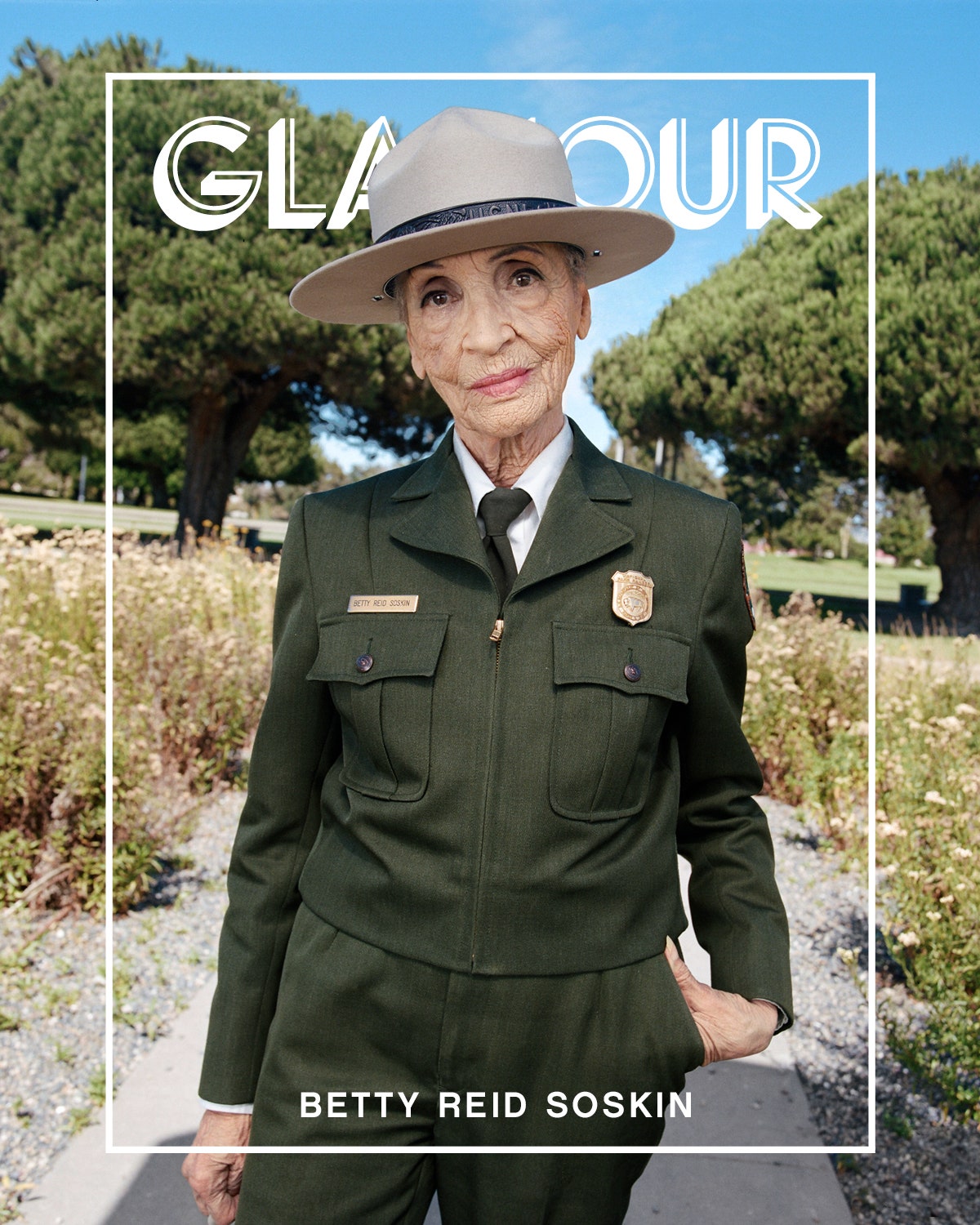
Betty Reid Soskin works at the Rosie the Riveter World War II Home Front National Historical Park in Richmond, Calif. Soskin is the oldest active ranger in the National Park Service.

In a fascinating September article at the Washington Post, Sydney Page interviewed a no-nonsense park ranger who was in her 80s when she heard a call to improve on the way US history is told. Here’s her story.

“When asked how it feels to be 100 years old, Betty Reid Soskin [said]: ‘The same way I felt at 99.’

“But she’s not just any centenarian: Soskin is the oldest active ranger in the National Park Service. …

“When it comes to sharing her story, Soskin is not shy. As a park ranger at the Rosie the Riveter World War II Home Front National Historical Park in Richmond, she spends her days recounting her rich and complicated history, in the hope that her firsthand account will resonate with people, and encourage them to share their own stories.

“ ‘I think everyone’s story is very important. There is so much diversity,’ Soskin said. ‘It’s in that mix that the great secret of a democracy exists.’

“It wasn’t until 21 years ago, though, that Soskin truly started telling her own tale — and it happened by coincidence. While working as a field representative for a California assemblyman, Soskin attended a meeting with planners from the National Park Service.

“They were organizing the development of the Rosie the Riveter WWII Home Front National Historical Park, created in 2000 to honor Americans on the home front, who worked in various industries across the country to bolster the war effort.

“The park paid homage to Rosie the Riveter, a pop-culture icon, symbolizing civilian women who worked in shipyards and factories — assuming the vacated jobs of men — during the war. But the depiction of a red-bandana-wearing White woman didn’t speak to Soskin’s own experience on the home front as a Black woman in segregated America, she said. During the war, Soskin worked as a file clerk in a segregated union, Boilermakers Auxiliary 36.

“ ‘Black women were not freed or emancipated in the workforce,’ she said in a 2015 interview with the Washington Post. ‘Unions were not racially integrated and wouldn’t be for a decade. They created auxiliaries that all Blacks were dumped into. We paid dues but didn’t have power or votes.’

Sitting in that meeting with the National Park Service planners as the only Black person in the room, she realized something: ‘The history, as I had lived it, was nowhere in sight — not one minute of it.

“Soskin decided to change that. She became a consultant to the park in 2003, and a park ranger in 2007 at the age of 85. Sharing her story with as many people as possible, she decided, was her way of reclaiming her history, and that of countless others whose tales have gone untold.

“She’s become known for saying: ‘What gets remembered is determined by who is in the room doing the remembering.’ So she made it her mission to stay in the proverbial room — which, in her case, was in the park’s visitor center. …

“Tom Leatherman, the park’s superintendent, said Soskin has had a profound impact on the park.

“ ‘She has been fundamental to us being able to tell a more complete story,’ he explained. … Soskin has propelled the park, Leatherman added, to seek other stories of people who have been marginalized and ensure that they are heard — including voices that are Latinx, Native American, Japanese American and LGBTQ. …

“The content of her presentations is dictated, in large part, by what visitors want to know. Often Soskin speaks of her upbringing in a tightknit Cajun-Creole family and her experiences with racial discrimination growing up in Oakland, Calif. …

“Over the years, Soskin — who has four children, five grandchildren and one great-grandchild — wore many hats: mother, musician, civil rights activist, antiwar advocate and finally, park ranger. Her most recent role is what pushed her into the national spotlight.

“Just like that, ‘someone dropped a uniform on the life that I was already leading,’ Soskin said. … Wearing it, she said, feels right.

“ ‘Little girls that see me in uniform see possibility. They have a feeling there’s an option open to them that they wouldn’t have known otherwise,’ she said. …

“Since becoming a ranger, Soskin was awarded the Silver Service Medallion by the National WWII Museum; she was presented with a commemorative coin from President Barack Obama; and she has written a memoir called ‘Sign My Name to Freedom,‘ which is being made into a documentary. …

“Her most recent accolade came just in time for her 100th birthday: A middle school was renamed after her.

“ ‘I didn’t know that would mean so much, except that it does, because I think that it means that I will go forward into history along with all the other people,’ she paused to wipe a tear, ‘who have tried to make a difference.’ ”

More at the Post, here. You might also like the 2018 article about Soskin at Glamour, here.

Read Full Post »

Photo: Ramona Peters.
Called “All Four Points,” this piece refers to the points of the compass. Ceramacist Ramona Peters, a member of Massachusetts’s Mashpee Wampanoag tribe, has helped revive 1600s Wampanoag traditional forms in clay.

I was reading about indigenous ceramics in New England at the Tomaquag Museum’s blog when I got interested in the origins of that remarkable institution and its plans for a new home near the University of Rhode Island campus.

First the ceramics post.

“My name is Haley Johnson and I am a Mashpee Wampanoag Ceramicist. I have a BFA in Ceramics from Rhode Island College.[As] an Education Intern at the Tomaquag Museum, I am dedicated to teaching about the past and advocating for the future of Indigenous arts and artists. …

“The Northeast is unique in its ceramic practices as can be seen in the color and textures of the clay, the shapes of our vessels, and the patterns and designs on finished work. … The natural clays that come from the Northeast are rich in minerals and sediments that lend to its bright oranges and deep reds upon firing. These colors then become signifiers of where the clay, and by extension, the vessel is from. …

“Traditionally in the coastal Northeast, cone shaped bottoms and wide mouths indicate cooking vessels. These pieces were designed specifically to heat food like soups and stews evenly. Ramona Peters (Mashpee Wampanoag) is a contemporary potter who creates with a similar shape language. [But usually] she makes the bottom of her vessels flat so that they are more easily displayed.. …

“Pottery adornment is also popular amongst Native ceramicists. By dragging and pressing tools into wet clay, patterns similar to those seen on Southern New England woven splint basketry can be made. Peters does this in her work.”

For a legend explaining how Maushop, creator of Noepe, or Martha’s Vineyard, and his taste for whale meat created the colors of the local clay, click here.

Now for the plan to create a bigger Tomaquag Museum. Nancy Burns-Fusaro at the Westerly Sun writes, “Rhode Island’s first and only indigenous museum is preparing to soar grandly into the 21st century.

“The Tomaquag Museum, which began inside the small Ashaway home of anthropologist Eva Butler more than 60 years ago, will move to an expansive, 18-acre site off Ministerial Road in South Kingstown, on the very land where ancestors of the Niantic and Narragansett tribal nations lived and worked for millennia prior to the arrival of European settlers.

” ‘We are so excited and so thankful,’ Executive Director Lorén Spears said [as] she discussed plans for the new museum and research center, which is scheduled to open in 2023. The plans include four new buildings and plenty of room for exhibits, area hikes, property tours, visitor parking, gardens full of native plants, medicinals, berries and herbs, new classrooms, performance space, a fully functional kitchen, gift shop, restaurant, pavilions, sculpture gardens, a replica of an early Native village, and a long house. …

“For Spears, a Narragansett tribal member who has worked tirelessly to educate the public on Native history, culture, the environment and the arts for more than a quarter of a century, the project is a dream come true.

” ‘It’s an exciting time,’ said Spears, who has taught at Brown University, the University of Rhode Island and in the Newport Public Schools and continues to teach classes and workshops designed to promote thoughtful dialogue about indigenous history. …

“Spears said the museum staff and members of the board of directors have been searching for the right location for years  now, and this piece of land, steeped in history and owned by the University of Rhode Island, is more than ideal. …

“Spears said the new site is visible yet rural, centrally located and accessible by car, foot and bicycle, but ‘the cherry on the top’ was the existence of viable public transportation.  

‘It’s accessible by public transportation,’ said Spears. “[Buses] run by all day and all night. It’s accessible from the north, south, east and west.’

“The property, which lies just south of Route 138 and north of Route 1, is a few miles away from the Kingston train station and adjacent to the South Kingstown bike path. …

” ‘Tourists will be able to find us,’ Spears said with a small laugh, noting that the museum’s current location is not as accessible. …

” ‘It’s a game changer,’ said Elizabeth Francis, executive director of the Rhode Island Council for the Humanities. The new facility, she said, will allow the museum to more fully share its programming, collections and archives, will help usher in a new era and help introduce a new generation to all the museum’s ‘wonderful material.’ …

“The project, ‘is a testament to how current and present Rhode Island’s indigenous community is,’ Francis added. ‘They  are not locked away in a distant past … they are not static but are here and essential.’ …

“Constantly praising the museum’s staff, board members and collaborators, Spears also pays tribute to her ancestors, especially the women who founded the museum. 

“In 1958, she said, Mary E. Glasko, better known as Princess Red Wing, Narragansett/Pokanoket-Wampanoag, founded Tomaquag Museum, Rhode Island’s first and only Indigenous Museum, with the help of a friend and colleague, anthropologist Eva Butler. When Butler died in 1969, Tomaquag moved to the now-legendary Dovecrest Restaurant, owned by Ferris and Eleanor Spears Dove, the matriarch of the Narragansett Tribe who died in 2019 at the age of 100. After Dovecrest closed, Tomaquag moved to its current quarters in Exeter.

“But now, Spears said, it’s time to focus on the future.”

More on the new museum at the Boston Globe, here, the Providence Journal, here, and the Westerly Sun, here.

Read Full Post »

Photo: Warner Brothers.
Bugs Bunny.

My husband was watching the Met’s Götterdämmerung around 4:30 this morning, so naturally I was reminded of Looney Tunes. Really. Bugs Bunny and the gang provided the best introduction to opera anywhere.

An article by Jaime Weinman at the Walrus (excerpted from his book Anvils, Mallets and Dynamite: The Unauthorized Biography of Looney Tunes) reflects on the durability of the Warner Brothers series.

“I grew up in a period when it seemed normal that a child born in 1976 would prefer to spend his Saturday morning watching cartoons from the 1940s and ’50s. A lot of the people I know enjoyed the same experience. Why did several generations watch old Looney Tunes alongside new work and actually prefer the stuff made before they were born? It was partly a historical accident caused by television’s demand for endless material at a relatively high cost. …

“Every television station required was a supply of preexisting content, something that might cost money to run but not to produce. The broadcasting rights for pre-1948 Warner Bros. cartoons weren’t very expensive, and the show was far better than most of the programming available for the same price.

“So part of Looney Tunes’ enduring success reflects the simple power of money. They were made for the big screen, and while they weren’t lavishly budgeted compared to the cartoons of Disney, they had much more time and per-unit money than television cartoons. On television, the Looneys were up against shows that had to turn out twenty-two minutes per week and looked like it. … Looney Tunes seemed edgier and freer than the new material. …

“However much kids loved watching Looney Tunes, the cartoons never got the credit they deserved. There hasn’t been much mainstream film criticism about them. When they were being made, they were almost totally ignored by all but two critics: James Agee and Manny Farber. Later, after the cartoons started appearing on TV, younger critics got interested. …

“The case has sometimes been made for the great Looney Tunes characters as underdogs, but it’s never a convincing case because the characters aren’t actually struggling against anything. They seldom have to try hard: as long as it’s funny, they can produce a weapon out of nowhere, and the most horrific acts of violence cause them no stronger reaction than irritation. In a more serious comedy, the characters feel an exaggerated version of what we might feel in their shoes, whether anger, fear, or determination. We can’t usually identify much with a Looney Tunes character because we know that nothing has consequences for them. …

“Bill Scott, who co-wrote cartoons at Warner Bros. for several years and then moved to [United Productions of America, the cartoon studio usually considered the most artistic and ambitious] said that ‘the kiss of death at UPA was to be considered a Warner Brothers writer.’ Looney Tunes writers, he added, were dismissed as ‘clothesline gag’ writers, for whom a story was just a cheap, insubstantial way to support the gags.

“That description wasn’t exactly wrong. If Warner Bros. creators have a choice between telling a joke and giving the film a consistent style, they’ll almost always choose the joke. …

“Warner Bros. cartoons had arguably the best soundtracks in American film comedy. Mel Blanc, who voiced all the important recurring characters except Elmer Fudd, was so essential to the studio that he became the first voice actor ever to get credit for short cartoons; composer Carl Stalling, who essentially invented the art of animated movie music when he worked for Disney, spent most of his career at Warner Bros., working closely with the directors (and sound effects wizard Treg Brown) to set a tempo for all the animated action and make sure that the sounds and movements complemented each other perfectly. The result of all this is a series where the dialogue has the wise-guy tone and fast pace of radio comedy, the music is funny, the animation is funny, the sound effects are funny, and none of them ever do something that’s redundant. …

“Like music, the laughs come from timing and rhythm. The gag is divided into three basic beats: Bugs hands the firecracker to the parrot; the firecracker explodes; the smoke clears, showing the ashen but otherwise unharmed bird. This all happens in just a few seconds, but each of these beats is held just long enough for it to play properly.” More at the Walrus, here.

To return to where I started today, here are a few online reviews of the Looney Tunes opera themes.

On “What’s Opera, Doc?” … “Elmer Fudd becomes the hero of Siegfried as he woos Brunhilde (played by Bugs Bunny in drag–if a rabbit can be in drag). This is a classic animated feature with full orchestration. It integrates the eternal effort of Elmer to kill the wabbit while repeatedly falling for the smart alecky rodent. The singing, of course, is quite horrible, but great credit to Mel Blanc for carrying on and staying in tune. What a remarkable talent Blanc was!”

On “Long-Haired Hare” … “Here Bugs takes his revenge on an opera singer named Giovanni Jones and does so with hilarious consequences. The last few minutes are absolutely priceless and one of my all time favourite endings in a Looney Tunes cartoon. Mel Blanc is brilliant as Bugs and Nicolai Shutorov gives a bravura singing performance as Giovanni.”

On “The Rabbit of Seville” … Bugs and Elmer “wander on to an opera stage and continue their combativeness to the music of the Barber of Seville. Apparently, there was a time when the average citizen had a thing for opera and these cartoon presentations fed into that. Anyway, the pacing is masterful. Elmer is about as gullible as he can be, and Bugs takes advantage at every turn. The pacing of the famous musical piece works very well and our two heroes find their way to a masterful conclusion.”

Read Full Post »

Photo: Angel Valentin/The Guardian.
“Puerto Rico imports 85% of its food,” the Guardian reports. The three farms of Güakiá Colectivo Agroecológico in Dorado “seek food sovereignty and climate solutions.”

The UK-based Guardian has some of the best coverage of North America to be found anywhere, and it’s free. Readers are asked to contribute, and I recommend doing so if you want to support good journalism.

A few days ago, the Guardian posted this update on an agricultural movement in Puerto Rico that, if taken up elsewhere, could make a big difference to the planet.

Nina Lakhani wrote, “Puerto Rico was once a thriving agricultural hub thanks to its tropical climate, rich biodiversity, and sustainable farming traditions. Today, less than 2% of the workforce is employed in agriculture and tens of thousands of acres of arable land sit idle. Meanwhile 85% of the food eaten in Puerto Rico is imported, grocery prices are among the highest in the US and last year two in five people experienced food insecurity.

“ ‘Unemployment is brutal, prices are brutal, migration from the island is brutal,’ said Denise Santos, who runs Puerto Rico’s food bank.

“Puerto Rico, a mountainous Caribbean archipelago, is also one of the places in the world most affected by extreme weather such as storms, floods and droughts. In 2017, Hurricane Maria devastated the islands and people went hungry as ships were unable to dock at the damaged ports.

“In the face of so many challenges, a new wave of interest in food and farming among younger Puerto Ricans is flourishing, as part of a wider movement demanding political, environmental and social justice. Small scale sustainable farming known as agroecology is driving a resurgence in locally grown produce that chefs, farmers, entrepreneurs and researchers argue can help revitalize the local economy, improve food sovereignty and both mitigate and adapt to the climate crisis.

“Agroecology is low impact agriculture that works with nature and local conditions to produce food sustainably so as to protect biodiversity and soil quality while drawing carbon out of the atmosphere.

  • “It involves a set of farming principles and practices that can be adapted to any ecosystem, microclimate and culture – a way of life practiced for thousands of years by indigenous people and peasant farmers. Farmers often integrate crops, livestock and trees (agroforestry) in order to maximize ecological conditions, such as a fruit orchard that aids water retention and provides shade for crops and grazing animals who in turn fertilize the earth to improve the yield.
  • “Crop rotation and crop cover are fundamental to this holistic approach, that takes into consideration the well-being of the Earth, those who produce the food as well as the local communities who eat it. …
  • “Advocates say agroecology offers locally driven solutions to a myriad of interconnected crises including food insecurity, biodiversity loss, environmental degradation and global heating.
  • “Agroecology is a social and political movement seeking to influence public policies so that sustainable farming benefits from government support (tax breaks, subsidies, and bailouts) currently propping up the dominant industrial agriculture system which is a major cause of biodiversity loss and accounts for more than a quarter of global greenhouse gases.”

The Guardian goes on to profile “three agroecology farms striving to change what and how Puerto Ricans eat by challenging the political, economic and agricultural status quo.” Here is one.

Güakiá Colectivo Agroecológico “is the collective brainchild of four graduates from [the Josco Bravo project] whose main objective is to improve access to healthy affordable food for vulnerable local communities. The farm is located off a highway in Dorado, an economically divided municipality with both multimillion dollar beach homes and families living hand-to-mouth in houses without indoor plumbing.

“The land belongs to a New York-based order of nuns who agreed to rent them 11 acres in 2017 for a symbolic amount ($1 per acre per year) after they’d almost given up hope of finding somewhere affordable. Back then it was a mess, having been used for years as an unauthorized rubbish dump, and they were still cleaning up when Maria struck, leaving many without work, shelter, food or clean water.

By the beginning of 2018, they were able to share the first crop – plantain, beans, yuca and papaya – with families going hungry.

” ‘Agroecology has always been a form of resistance against colonial capitalism, and here we are trying to rescue collective working and reject individualism by reconnecting people to the land and food, and building trust and solidarity,’ said Marissa Reyes-Diaz, 32, a biology graduate who also works for the nonprofit El Puente: Latino Climate Action Network. (All four members of the collective have second jobs.)

“Agroforestry is a big focus here, and there are fragrant fruit trees growing alongside a variety of crops, which has created multiple small ecosystems that help keep precious nutrients and rainwater in the ground. (Diversity enhances a farm’s resilience, as different crops are vulnerable and resistant to different pests, climate extremes and soil deficiencies.)

“So far the orchards have helped them survive two very dry spells, but it’s not enough to sustain and grow the farm, even with rainwater tanks and water from a neighbouring farmer. They’re trying to raise $40,000 to build a well connecting to the underground aquifer as water remains the biggest obstacle to long term success.

“But Güakiá is not just a farm, it’s also a community hub where neighbors come to enjoy the green spaces and try unfamiliar produce such as beets, turmeric roots and wild basil, as well as taste tomatoes fresh from the vine.

“Some locals volunteer, others exchange their food waste (needed to make compost) for vegetables, and prices remain accessible. They’ve hosted festivals with live music, art exhibitions, self defence classes, yoga and dominos — a very popular Caribbean pastime — and have built an emergency shelter fitted with solar panels ready for the next climate catastrophe. Reyes-Diaz said: ‘Agroecology has never been just about producing food, it’s also about sustaining our physical and mental health and spiritual well-being.’ ”

More at the Guardian, here.

Read Full Post »

« Newer Posts - Older Posts »