Feeds:
Posts
Comments

Jubilant Feet

foot_chart1_small

Photo: Wikimedia
People who practice reflexology believe that stimulating different zones of the foot improve the function of different organs of the body.

In tai chi, we’ve learned to get the circulation going in our feet by kneading so-called pressure points and massaging from sole to calf. Although I am not sure I buy into the ancient Chinese view that massaging different zones on the foot affect particular organs and improve overall health, I certainly think that stimulating the blood flow in feet is a good idea, especially if you have circulation issues.

Recently, I decided to try a local reflexology place and see if my feet felt happy afterward.

They did.

I had experienced this treatment only once before, in 2007, when my husband was working in Shanghai and I was visiting. Walking around the French Quarter, I came upon a sandwich board outside a storefront. It said “foot massage.” I thought, “Why not?” I was shown along a dark corridor lined with cubicles, not quite sure what I was getting into. In one cubicle, I sat back and took off my shoes and socks. I remember a window. A young woman who spoke no English got to work, first soaking my tired tourist feet. The massage involved her really pressing hard on the pressure points. We communicated with sign language and friendly smiles, and I think we each found the other rather exotic. My feet liked the experience.

My recent experience was both the same and different. The staff spoke a little more English, but not a lot more. The cubicles were dimly lit and comfortable. A bucket of hot water for the feet started off the relaxation process. Soft music played. At first it sounded Chinese, then morphed into “Danny Boy.” I think I dozed off. The pressure that the young woman applied to my feet was gentler than in Shanghai. Very nice. My husband summed it up with an apt quote: “Be jubilant my feet!”

You can read up on the theory behind reflexology at Wikipedia, here. Far be it from me to question ancient Chinese medicine, but whether or not different parts of your sole improve the functioning of kidneys, liver, digestion, etc., I’m pretty sure that, first, reflexology does no harm.

Art: Tomihiro Hoshino

For more than 30 years, a woman from Hokkaido, Japan, who stayed at our house while studying the local PTA has been sending me magnificent calendars.

The calendars are from a talented artist and former athlete whose paralysis led him to master holding a brush in his mouth. His name is Tomihiro Hoshino.

An article at AccessibleJapan reports, “Tomihiro Hoshino was an experienced 24-year-old gymnastics teacher with a real passion for the sport. An active mountain climber and gymnastics instructor, his life changed completely as he was demonstrating a double somersault technique to a group of junior high school students. Hoshino unfortunately injured his neck during the maneuver and since that day he has been completely paralyzed from the neck down.

“The accident was a serious blow to this extremely active person who was forced to lay motionless for nine years in a Gunma orthopedic Hospital where he was kept under heavy surveillance for respiratory problems and complications as a result of the injury. He and his family never gave up hope that his physical condition would stabilize and improve. Although it took nine years, and he came close to death many times, there was always hope for the future.

“Many say that this hope came two years after his accident. In 1972 one of the patients that had stayed in the same room as Tomihiro Hoshino was being transferred into a different hospital. He asked that the staff, as well as all of the people that stayed with him, to sign a card as a memento of his time in the hospital. Tomihiro couldn’t come up with a solution as to how he would be able to sign his name for the man but with the help of his mother he was able to hold a pen in his mouth and eventually sign Tomo. This would be the beginning of how Tomihiro would begin his career in writing and painting.

“The second event that produced real inspiration for Tomihiro Hoshino was a time that a friend brought him flowers and left them in the window. …

“He was moved to start expressing what they meant to him. He began to gradually draw flowers and eventually became an adept painter with his mouth. …

“Tomihiro Hoshino has successfully produced hundreds of pieces of artwork, many of his essays and poems have been published and his work is displayed in permanent exhibitions at the Tomihiro Hoshino Museum. …

“If you are interested in Tomihiro Hoshino’s works, you can purchase them on Amazon or visit his art gallery in Gunma, Japan.”

More at AccessibleJapan, here. Read about his museum here. Those who read Japanese may click here.

I feel lucky to have had this decades-long friendship with a woman in Hokkaido. Although we haven’t seen each other since the 1980s, her daughter, Mika, came to visit while living in New York. Mika helped decorate our Christmas tree that year. Nowadays, I never do the tree without thinking of her.

Image: Tomihiro Art Museum

Photo: Kate Holt for the Guardian
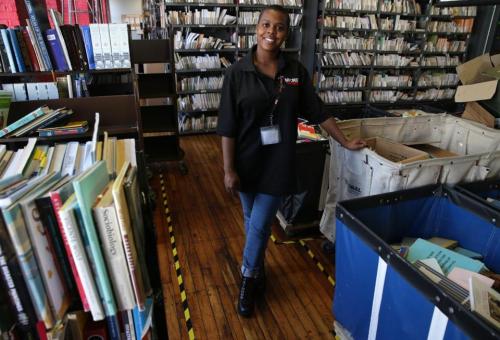
Juma’a Ali, 34, centre, a Christian from the Nuba mountains in Sudan, who fled to Malakal in South Sudan. Here, he is pictured in his bookshop in Malakal’s camp. 

Sometimes refugees take it upon themselves to improve life in the camps where they hope to live only temporarily. I have read in the past about adults who teach the children who are missing out on school. In fact, I once met a man who did that in a Nepalese camp in India. In this story, a refugee offers books.

Ben Quinn writes at the Guardian, “Juma’a Ali glances fondly at the ceiling-high stacks of titles in his makeshift bookshop, a collection that ranges from Virginia Woolf to Canadian Tax Law (1995 edition).

“Just over three years ago, carrying as many books as he could bring, he sought refuge in war-torn South Sudan following the persecution that he says he experienced as a Christian, across the border in Sudan’s Nuba mountains.

“The books were gathered along the way in Sudan and South Sudan. Most are second-hand copies from libraries in South Sudan and donations from abroad. He wasn’t a bookseller in his home country; he worked with his local church. …

“He sells the books at the camp for very small amounts of money, and is fiercely proud of his role as the bookseller of Malakal. His little shop stands as a source of education and distraction from the often unbearable conditions the camp’s residents live with on a daily basis. …

“Among the most sought-after titles by the more than 33,000 residents of the camp are the Bible and the Oxford English Dictionary, although collections of love poems also find takers. ‘Whenever there is conflict or war, people are reading books about politics and religion. When there is peace, there is also more love,’ says Ali…

“Some day, he says, he wants to leave the camp, adding: ‘Europe is a place I think about, but how to get there? It’s locked up and is closed off to us. I want to be positive and I hope for peace here some day. The problem is how to bring people together after so much has happened.’ ”

Although this story was published as recently at January 4, even more recent news about impending famine in South Sudan has me fearful for Ali and those he serves with his books. I will try to find a follow-up story.

More here.

The Poetry Project

Photo: Ted Roeder

I wonder if poetry is going to see an upsurge in our time. Better than any other form of communication, poetry can get to the heart of the matter, expressing important truths and feelings obliquely.

Recently I read about poets who gather annually on New Year’s Day in New York City to share their unique statements. The event is part of what is known as “The Poetry Project.”

“There are three things to consider when the New Year’s Day Poetry Marathon sweeps you into its gracefully uncouth embrace,” says the website, “what it is, what it was, and who you will be when it’s over. An untamed gathering of the heart’s secret, wild nobility — over 140 poets together revealing not just that a better life could exist, but that it already does, sexy and wise, rancorous and sweet, big hearted and mad as hell. …

“Since Anne Waldman gathered 31 poets at the very first marathon on January 2, 1974, countless forward-facing luminaries have thrown their voices into the cauldron — among them Eric Bogosian, William S. Burroughs, Spalding Gray, Jackson Mac Low, Ed Sanders, Pedro Pietri, Helen Adam, John Cage, Joe Ceravolo, John Giorno, Ted Berrigan, Yoko Ono, Amiri Baraka, Gordon Matta Clark, Jim Carroll, Bernadette Mayer, Alice Notley, Steve Cannon, Hannah Weiner, Kathy Acker, Arthur Russell, Gerard Malanga, Suzanne Vega, Allen Ginsberg, Patti Smith, and Philip Glass. The list grows every year …

“Whether you stay for a little while or for the long haul, whether you’re part of the standing room only experience at sunset or with the handful of diehards as the final poet reads her last word in the predawn sanctuary, you will be transformed for the year to come. Your presence helps launch a great flare into the otherwise impenetrable darkness of the 21st century night. …

“The Project receives many requests to perform in the Marathon, and we feel fortunate that so many people want to help us meet our fundraising goals. We only have about 150 spots and a seemingly unlimited artistic community to draw from. [Click here for] some basic information about our selection process. …

“Reading is just one way of participating in the event. There are volunteer opportunities (about 100 are needed) to help sell books, food and drink, assist in checking in readers, etc. It’s also an opportunity to meet or catch up with other writers/artists and support the Project’s mission. …

“For photo galleries of past New Year’s Day Marathons, please visit photographer Ted Roeder’s website.”

More about the annual event and how poems get selected, here.

Photo: Deborah Amos/NPR
Elias Kasongo, from Congo, came as a refugee in 1994. Marc Schulman, president of Eli’s Cheesecake, hired him to wash cake pans and, over the years, promoted him to purchasing manager.

See what I mean? I can hardly keep up with all the stories of Americans who help refugees (and refugees who give back). I feel a kind of duty to let you know about them in case they aren’t part of your daily fare.

National Public Radio’s Deborah Amos reported this next story about refugees working in some surprising Chicago businesses.

“In Chicago,” she reports, “war refugees have a hand in the city’s most famous handmade cheesecake.

” ‘People who come as refugees have great skills,’ says Marc Schulman, the president of Eli’s Cheesecake, which has sold cheesecakes and other baked desserts since 1980. One-third of adult refugees arriving in the U.S. have college degrees, according to the Migration Policy Institute in Washington, D.C., a think tank that tracks the movement of people worldwide. And refugee employment is a successful model for finding skilled workers for a food business that has become high tech, says Schulman.

“A cheesecake at Eli’s is still based on the simple recipe of the founder, the late Eli Schulman, Schulman’s father, who served his famous confections to political leaders and Hollywood stars. Marc Schulman wears the Cartier watch that Frank Sinatra — a regular customer — sent his father in 1987. …

“The mixing and baking are computerized, so the 220 employees have to be highly skilled. Schulman recruits about 15 percent of the workforce from refugees resettled in Chicago. The employee list reflects the waves of flight from war-torn countries — Iraq, Bhutan, Kosovo, Congo, Myanmar.

“Elias Kasongo began working at the bakery in 1994 after fleeing unrest in the Democratic Republic of Congo. …

” ‘I’ve been here at Eli’s for the past 22 years. It’s my home; it’s a beautiful thing,’ says Kasongo, who is now a U.S. citizen. The job was all he had when he was starting his new life in America. Today, he’s a homeowner. …

“Schulman’s hiring strategy is used at other well-known companies in Chicago, including Tyson Foods and Trump International Hotel & Tower.

[!]

” ‘Every major hotel works with a refugee agency,’ says Sean Heraty, manager of workforce development at RefugeeOne. ‘Job retention is through the roof.’

“Employers have ‘awakened to the potential of refugees,’ says Kathleen Newland, at the Migration Policy Institute. That’s because they are hardworking and loyal and tend to stay on the job longer than American-born workers, she says.”

More here.

Refugee Boy Scouts

Photo: Thomas Peipert/AP
Leaders of this Colorado Boy Scout troop say the group helps refugee kids adjust to American culture while providing a safe place where they can be themselves.

It may be surprising, given the news that grabs our attention these days, but stories about ordinary people showing kindness to refugees are everywhere. I can hardly keep up. Consider this KidsPost about a Colorado Boy Scout troop published in the Washington Post January 2, 2017.

“Boy Scouts Jean Tuyishime and Moise Tuyikunde sit around a campfire under a canopy of stars in Colorado’s Rocky Mountains, joking and teasing each other as teenage brothers often do. Only 2½ years ago, they were a world away, living at a crowded camp in the central African nation of Rwanda (pronounced ru-WAHN-duh).

“The brothers were born in the Gihembe refugee camp after their parents fled violence in 1996 in what was then known as Zaire (zah-EER). They relocated with their family to the Denver area in 2014, and they gradually became a part of their new surroundings, learning to speak enough English to get by and signing up for a typical American experience — Boy Scouts.

“But the troop Jean, 15, and Moise, 12, joined is not like many others in the United States. Troop 1532 is composed almost entirely of refugees who hail from faraway places such as Burma, Rwanda and Nepal.

“At campouts, such traditional American food as hot dogs and trail burgers is replaced by fish head stew, fire-roasted corn and chatpate, a popular street snack in the Asian country of Nepal. Dessert, however, still includes s’mores. …

“Troop 1532, formed in 2014, could be a model for other Boy Scout groups looking to welcome young refugees. [Justin] Wilson and P.J. Parmar, a doctor who started the troop, say the kids’ backgrounds present challenges that other troops don’t face. Members come and go, which makes it hard to focus on earning merit badges and advancing in rank. …

“Many of the parents have little money and work long, odd hours, which makes it hard to plan meetings. Parmar said the scouts often can’t get to meetings, so he decided to gather only for camping trips. …

“Jean’s father, Jean Batacoka, a 37-year-old housekeeper with five children, says the efforts of Wilson and Parmar have helped his kids.

“ ‘What they do down there is not just leadership, because they learn discipline, how to behave, how to respect people who are older than them,’ he said through a translator. ‘I think it’s a really good thing for them, and I can see something is happening.’ ”

I have nothing but admiration for the men who organized this. Any scout troop requires a big commitment from adult leaders, as some readers of this blog know. The time and energy Troop 1532 leaders give to the unique challenges of refugee Scouts is especially remarkable.

More at the Washington Post, here.

For better or worse, no movement ever dies out completely. The hippies and Rainbow Children of the 1960s seem to have morphed into something called the Rainbow Family of Living Light, a “disorganization” that has annual, playful camp-outs in the wild. (The Wikipedia editors say the entry on the group, here, needs work, but I think it gives you an idea.)

Jessica Rinaldi at the Boston Globe took a lot of photos at the July 2016 gathering in Vermont.

Here’s what she says about the event: “Each year, for a few weeks in summer, a loose confederation of like-minded souls called the Rainbow Family of Living Light quietly converts a site in a public forest somewhere in the United States into a communal living space for thousands.

“Campsites are established, latrines are dug, and an elaborate water filtration system is erected to bring water from nearby streams. While the group’s origin is a bit cloudy, it’s generally accepted that the first ‘official’ gathering of the Rainbow Family was in Colorado in 1972. For the summer of 2016, they gathered in Mt. Tabor.”

Is this the escape you’ve been looking for?

Rinaldi’s photos are available at the Boston Globe, here.

Photo: Jessica Rinaldi/Globe Staff
The Rainbow Family gathering draws free spirits from across the country, including this man dressed as a tree-like Ent from “The Lord of the Rings” at the 2016 event, held on public land near Mount Tabor, Vermont. Great array of photos to be found here.

At the Eric Carle Museum

knight1

Art: Hilary Knight
Eloise was a favorite of mine back in the day. Art and artifacts related to her history are on display until June 4, 2017, at the Eric Carle Museum of Picture Book Art in Amherst, Mass.

I drove out to Amherst yesterday to meet up with Asakiyume at the Eric Carle Museum of Picture Book Art and have lunch in town. The museum is modern and attractive and features several nice displays, a gift shop, and a studio where kids can do arts and crafts.

If you don’t have another reason to be in the area, as I did, it’s a little far from the Boston suburbs. However, I got a kick out of my tour with Asakiyume, especially because one exhibit was on Hilary Knight, the artist behind the mischievous girl who lives in New York’s Plaza Hotel with her nanny, her pet dog, and her turtle. The display even featured copies of the doll I still have and my Eloise Hotel Emergency Kit.

We saw art by Brinton Turkle and, of course, by Eric Carle. It’s the 50th anniversary of Carle’s book Brown Bear, and it was fun to see all the ways it had been translated. Asakiyume knew how to read the Japanese.

She also picked up a flyer for me about the museum’s “Making Art” blog, which turns out to be loaded with ideas about crafts for kids. Something to check out in addition to Pinterest when brainstorming. In one project example, here, we see how a student intern went about creating a delightful day for both children and adults using feathers in art.

Photo: Eric Carle Museum of Picture Book Art
The Art Studio’s J-Term Intern, Tory Fiske, a senior at UMass Amherst, designed a Special Sunday project for museum guests.  She planned the event, sorted and prepared the materials, and introduced visitors to the project throughout the day.

finefeatheredfriends5

Here’s a bonus post for you, Dear Reader, from blogger Misty Meadows. Good timing as the snow melts and you think about starting your garden. The eggshell planters are adorable! Love, SuzannesMom

Misty Meadows Homestead & more!

About this time, every year, my heart starts to tire of the winter weather I cherish so much–I doubt there are many who appreciate snow as much as I do.  It’s still a little early for starting seeds, at least here in USDA Plant Hardiness Zone 8a.  Having grown in zones 8b & 5-6, we are very excited to see what this new zone has in store for us.

Over the past few weeks, our mailbox has been filling up with a delightful assortment of seed catalogs.  They are always so much fun to look through.  My favorites are Territorial Seeds and Baker Creek Seeds.  The Baker Creek Catalog is gorgeous and is more like a coffee table book.

If by chance you are ready for spring, over the next few weeks, we will be giving you some tips to get your 2017 garden off to a great start!…

View original post 1,112 more words

Crafts for a Cause

I’ve followed countertenor Terry Barber’s Artists for a Cause for several years. He lines up musicians who, like him, believe in the importance of sometimes donating their talents to a worthy cause. I heard him perform in Rhode Island (check this 2011 post).

Lately, I stared wondering whether other sorts of artists and craftsmen were doing this sort of thing. So I Googled “crafts for a cause” and discovered that someone had used those very words to name a website:

“In 1975, Hetty Friedman first traveled to the Highlands of Guatemala to learn back strap weaving from a Mayan weaver. After that time, Guatemala entered a period of intense political unrest. Thirty two years later, Hetty was able to return. In partnership with Asociación Maya de Desarrollo, a Fair Trade Weaver’s Coop, she is designing unique woven products, training weavers and leading tours. Together they produce a line of hand dyed, hand woven items that are being marketed in the USA.”

Regarding her tours: “Adventurous travelers are provided with a unique exploration of the Guatemala Highland pueblos, Antigua, a Unesco World Heritage City, and visits to various artists and fair trade jewelry and weaving co-ops. Join Hetty on an intimate tour of Guatemala’s fabulous cultural heritage. Lots of guacamole gets eaten.

“Small group travel for women. Meet Mayan artisans, visit Antigua, a Unesco Heritage site, and travel on Lake Atitlan. Great food, wonderful hotels and good company.

“Call 617-512-5344 or email hetty.friedman@gmail.com for details. Contact us to get put on the list for 2018 travel.”

From the nonprofit that Hetty is supporting, “The objective of Asociación Maya de Desarrollo is not to just provide an income for families in post-conflict communities. Asociación Maya also aims to provide an opportunity for women harmed by the war to become leaders in the cooperative, their homes, their communities, and of the Mayan tradition.”

I am filled with admiration.

More at Hetty Friedman Designs, here.

Photo: Hetty Friedman Designs
Weaver Hetty Friedman says, “It all started at age 13 when I took a weaving class at summer camp. It was like a miracle to me.”

Photo: Montgomery County, Maryland, Library

Do you attend a congregation where the children’s “sermon” is given in front of the adults? My husband was recalling the other day how the pastor at our former Rhode Island church was really great with children’s sermons. He was both funny and straightforward. Where we go in Massachusetts, the children’s sermon sometimes plays to the adults too much. But other times it works — especially when the children get to use props and act it out.

I kind of liked this one about different ways of seeing. I’d be interested in what you think.

*******

Whose Reality Is It Anyway?
By Orlanda R Brugnola

It was not a city. It was not a large town. But it was not a small town. It was — just average, you might say. Except for one thing. There was a Storyteller in the town.

That’s Storyteller with a capital S. The Storyteller had arrived one day without advance notice (or as some people would put it, without warning.) There had been no invitation, no request.  The Storyteller just showed up, rented a small house that had been empty for two years and put up a sign inviting people to come and listen to stories.

Mind you, that was not so easy for people in the town.  They were nervous about it and wanted to know wanted to know if the Storyteller was qualified. They wanted to know if the Storyteller was accredited. They wanted to know if the Storyteller was male or female. The children didn’t care of course. … On any afternoon you could be sure that most, if not all the children in town were at the Storyteller’s house.

And so the Storytelling began. The Storyteller might say: “In the smoking tiger’s time” …

“Wait a minute! What do you mean?!”

“Oh, that’s just the way stories begin in Korea: ‘In the smoking tiger’s time’ is just a way of saying: ‘Long, long ago’ ” … And the Storyteller would continue …

All the children and youth listening to the stories wanted to listen forever because the stories made them feel amazed and happy.  And they wanted to share their amazement and happiness with the rest of their families, so they asked the Storyteller if they could take part of the story home with them and the answer was always “Yes, of course!” and so they did.

[Here the children act out taking wondrous things home and finding that the tiger, the mossy rock, the mountain, etc. make their parents apprehensive.]

The children [said] to the Storyteller, “Our moms and our dads won’t let us bring anything home from the stories. … Can you do something?” …

And then something began happening in the town that got everybody talking. Things started showing up in unexpected places — sometimes very unexpected places. A big tree right in the middle of the street.  And then a tiger in front of a garage. And a huge blue mountain at the front door of a house. …

Because the mayor was up for election in a week or so, he said, “I will personally take care of this immediately!” And he marched right over to the Storyteller’s house and knocked on the door.  …

“This has got to STOP!” said the mayor. … “All these things that are showing up everywhere … Today I couldn’t even get into my own house because there was a mountain in front of the door!”

“Why don’t you just go through it? … It’s a story-mountain. … All you have to do is enter the story,” [said a voice.] …

“Maybe I should talk to an expert about this!” [the mayor] thought.  He liked experts.  …

“Why don’t you tell, me about it,” the [expert] said. And so the mayor did. …

“Why did you decide not to enter the story as the Storyteller suggested?” …

“I got angry and didn’t want to. … I’m kind of afraid, though I don’t know what I am afraid of.” …

“New things are unsettling and most of us are reluctant to jump in.”…

“How do we know we will like how the story ends?” [asked the mayor].

“Well, that’s really in our hands.  All of us who enter the story decide how it will turn out.” …

“The mayor thought about it some more and decided that maybe the [expert] was right and that he ought to go back to the Storyteller and find out how to get into the story after all.”

*******

We often joke that our dear UUs explain everything too much. But this sermon must be the exception that proves the rule. See the full children’s story at the UUA website, here.

Maria Toorpakai is the top-ranked female squash player in Pakistan. Toorpakai is coached by retired Canadian squash star Jonathon Power, pictured here.

WBUR’s Only a Game is great at searching out fascinating sports stories that few media channels cover. Here is one about a female squash player bucking the odds in a conservative part of Pakistan, where girls just don’t do this kind of thing.

Karen Given reports, “There are places in this world where games aren’t just games and where sports heroes have the power to be more than just pixels on a television screen.

“One of those places is Waziristan, part of Pakistan’s tribal region. That’s where Maria Toorpakai grew up. Her sport was squash, and her hero was Jonathan Power — a Canadian who, in 1999, became the first North American squash player to become No. 1 in the world.

“From an early age, Toorpakai wasn’t like the other girls.

” ‘When I was two years old, I could see the happiness in boys’ faces and more glow. But most of the women are just no one, you know? …

” ‘I thought maybe it’s the differences because boys have different clothes than girls. So then I took all my girly dresses and I took it to the backyard and I burnt them, and I was four-and-a-half. I saw my father and he didn’t say anything but when I looked at him he just smiled and said, “Well, I guess I have a fifth son now.” ‘

“Toorpakai’s father allowed her to masquerade as a boy and play sports. But when she discovered squash at the age of 12, the family’s secret began to unravel.

” ‘There’s a proper squash academy and he took me there. And he asked what we should do for squash, and my son wants to play squash. The director of the squash academy, he said definitely we will give membership to this kid. You have to bring the birth certificate first. My father got a little nervous.’

“Maria Toorpakai tells her story In Her Own Words. To hear the full story, click [this page] the play button below the headline at the top of the page. Toorpakai’s book is called ‘A Different Kind of Daughter.’ ”

I really recommend becoming familiar with WBUR’s Only a Game, here. It’s syndicated nationally, and non-sports fans love it as much as sports fans.

Longtime host Bill Littlefield is an unusual sports maven. An English professor, he covers football but especially how it hurts athletes, and he has instituted an approach to interviews (like Toorpakai’s) in which a talented interviewer (like Karen Givens) asks probing questions that enable interviewees to tell their own story. The interviewer’s voice doesn’t appear. I love this idea. It sounds so natural.

The Accidental Caregiver

After 46 years of marriage, I can say I have a husband who is the same guy he always was, just with more life experience. But among my small circle of friends, including my blog friends, many women are dealing with extraordinary changes.

It may be true that, overall, women are as likely to develop dementia as men (see study) and present their husbands with unexpected caregiving challenges, but so far those stories are not the ones I’m hearing.

A college friend married to a brilliant scientist who has known for some time he was developing Alzheimer’s recently told me, “I finally realized he is completely dependent on me.” She is biting the bullet, reaching out for more helpers and planning an altered future.

Another friend whose husband has dementia made the decision to leave behind all her East Coast activities and relocate to Minnesota, where there is a network of family members. She intends to keep her husband in their new home, which has become a safe place in his mind. When her husband no longer recognizes anyone at all, she says, she will get full-time care, move herself out, and come visit him.

I reconnected last month with a high school friend who suffered a bitter divorce decades ago. She told me her ex’s wealthy girlfriend has been able to provide high-quality care for him for the 15-plus years since he was diagnosed with dementia. Although the divorce is still raw enough that there are topics my friend can’t discuss with her children, she goes to the Alzheimer’s facility regularly to read to her ex. She wants to become a better person.

Dementia has not been the only challenge for women I know. In one case, after a relative discovered her husband’s multiyear dalliance with a blackmailing call girl (and he then suffered a physical and emotional collapse), the wife made heroic efforts to rebuild the shattered relationship. A year later, they are both enjoying life together a little more every day.

Then there is the friend whose husband’s rare disease progressed to the point that he can no longer be left alone. She has had friends come in for an hour or two so she can shop for groceries and walk the dog, but the cost of a few hours coverage from a trained home-health-care aide has to be parceled out frugally as this friend has lost one income, is trying to build a home-based career, and needs to pay for two children’s colleges.

I can’t say enough about how much I admire these women who are rising to meet unanticipated disruption despite their sorrow and fear.

Art: William Utermohlen
In 1995, U.K.-based artist William Utermohlen was diagnosed with Alzheimer’s disease. He created a series of self-portraits over five years, before his death in 2007. (Caution: This is the first in the series. The others may be painful.)

alzheimers-disease-self-portrait-paintings-william-utermohlen-1

Photo: SWNS
Annis Lindkvist, right, and her younger sister, Emma Åhlström, with Jimmy Fraser, a homeless Scot they invited for Christmas in Sweden. 

I have never been sure how to react to someone who is homeless, but I have learned smiling is better than walking past, head down.

Mother Teresa said to smile. A woman who runs an excellent Rhode Island homeless agency told me she doesn’t give anyone money but talks to people and tries to see if she can help with a referral or something to eat. A formerly homeless veteran told me he always talks to veterans and tells them where to find veterans services. Once he took in a stranger overnight. Some people will buy a sandwich or a cup of coffee.

Last week as I was talking to an employee of a refugee agency, I became curious about how he was led to his current work. He said, “One day I stopped walking past people.”

He didn’t initially look for refugee work, but he landed there after launching his personal outreach to homeless people and a subsequent stint in Americorps. He used to talk to people on the New York City streets, asked what they needed and delivered food, socks, and as many of their needs as he could.

So many good people out there showing kindness one person at a time!

This Guardian story about a Swedish tourist in Scotland who not only befriended a homeless man but invited him for Christmas with her family (and sent him airfare) is really over the top.

Libby Brooks writes, “A homeless man from Edinburgh has described the ‘incredible act of kindness’ of a tourist who invited him to spend Christmas at her family home in Sweden.

“Jimmy Fraser was begging on George Street in the city centre when Annis Lindkvist and her sister Emma, from Sagmyra in central Sweden, asked him for directions.

“They struck up a friendship and swapped numbers at the end of the trip, staying in touch by text before Lindkvist offered to pay for his flights so he could spend a week with her family over the festive period.

“Fraser, who became homeless following his divorce 13 years ago, said: ‘It’s weird, I know. I was begging on George Street and these two women came up to me and the next thing I knew I was in Sweden. People promise you things all the time on the street but they never materialise.

” ‘But I thought I’m going to go for it as it’s once in a lifetime. I couldn’t believe it anyway at first. People tell you “see you tomorrow, I’ll get you a drink” and then nothing happens. But this did happen, actually, so it was really weird.’

“The 54-year-old former security guard, who went to an ice hockey match, Christmas markets and midnight mass with his host’s family and friends, told the BBC News website: ‘It was a beautiful experience.’ …

“Lindkvist described her own doubts about issuing such an open invitation to a stranger. ‘We give money to charity every month but we have never done anything like this before,’ she said. ‘There were friends and family who thought I was really crazy, but I just opened my home to him and said everything that is ours was his too.’

“The 37-year-old, who works with dementia sufferers, said she had invited Fraser back to stay with the family again over the Easter break, and that he was ‘part of the family now.’ ”

More here.

Free Ballet for Boys

Photo: Sean Scheidt
Boys in Baltimore are being given an unexpected opportunity and are giving back to the school that makes it possible.

Something unusual is happening in Baltimore. Boys offered free ballet are loving it.

Gabriella Souza reports at Baltimore Magazine, “The audience seated in folding chairs stares curiously at the dancers in front of them. Perhaps, the performers aren’t what these families and elderly couples think of when they hear the word ‘ballet.’ After all, there are no tutus or pink-ribboned shoes in sight. Instead, seven boys of varying heights, ages, and races stand before them on the carpeting, barefooted and wearing khakis and bold-colored T-shirts. …

“ ‘What are we in for?’ the audience seems to be wondering this day in April. When the boys begin to move, it all makes sense. Their motions are controlled, graceful, and musical, and their bodies appear weightless as they fly through the air or lift high up onto their toes. Their artistry combines strength, vivacity, and masculinity. …

“The dancers are part of the Estelle Dennis/Peabody Dance Training Program for Boys, which gives young men ages 9 to 18 tuition-free admission to Peabody Dance, the after-school dance training program that is part of the community school affiliated with the lauded Peabody Institute. …

“In 2009, as a way to attract boys to the program, advisers and instructors decided a scholarship program could encourage families who couldn’t afford training, or who otherwise might be hesitant. The small proportion of boys to girls in ballet has been noted nationally, and though statistics on the subject are hard to find, for years teachers have reported that they often only have a single boy in their classes, if any.

“ ‘There has always been this underlying thought from fathers — and mothers, too — that they didn’t raise their boys to be ballet dancers. It still exists to some degree, but much less,’ says Barbara Weisberger, who is Peabody Dance’s artistic adviser. ‘This program is helping to remove that stigma, because these boys are wonderful talents. They’re a joy to watch.’ …

“Barbara Weisberger still remembers the first auditions she oversaw for the Estelle Dennis program in May 2009. Walking into The Mount Royal School and Roland Park Elementary/Middle School that day, she drew her breath in amazement as she saw dozens of boys, 60 total, who were black and white and of all ages, waiting to show her what they could do.

“Though most of them were hip-hop dancers, it didn’t matter to Weisberger — their enthusiasm was contagious — and it didn’t seem to matter to the boys that she was showing them a completely different style of dance. They were just excited to move. ‘They enjoyed themselves so much. They were so musical, they were such fun.’ …

“ ‘There’s a different, masculine culture that they’ve brought,’ says [Melissa Stafford, Peabody Dance director and department chair], who became director and department chair in 2013. … ‘When you step out for a five-minute rehearsal break, you’ll come back to the boys doing three pirouettes and trying to outdo each other in a friendly, competitive way. That camaraderie they have with the other guys has changed the energy of the school.’ More here.

No question that ballet is demanding and athletic enough to satisfy many boys. Case in point: this football player’s comment, “Ballet is harder than anything else I do”!