September 28, 2016 by suzannesmom
Upscale housing developers used to advertise tennis courts, pools, or golf courses as desirable amenities. Today they are increasingly likely to tout farmland.
Amy Hoak writes at MarketWatch about a family in suburban Chicago, where neighbors’ lawn chemicals have killed off pollinators. She reports that the Faheys are moving to a community that offers more opportunity for growing vegetables.
“Set in Hampshire, Ill., about 50 miles from downtown Chicago, Serosun Farms is a new home-conservation development, restoring wetlands, woodlands and prairie, and preserving farmland throughout. Already, the frog population has grown exponentially from the conservation work done onsite, and monarch butterflies are also on the rebound, said Jane Stickland, who is working on the project with her brother, developer John DeWald. Their efforts also are boosting the bee population. …
“Serosun plans to incorporate about 160 acres of working farmland, making farm-to-table a way of life for residents through regular farmer’s markets. The community also offers eight miles of trails, an equestrian center and fishing ponds: 75% of the development will be reserved for farming and open space. …
“The concept isn’t new, but ‘agrihoods’ are gaining in popularity, said Ed McMahon, senior resident fellow for the Urban Land Institute, an organization that focuses on land-use issues. He tracks about 200 agrihoods, where residential development coexists with farmland. …
“ ‘We started to realize you could cluster houses on a small portion of a farm and keep the farm working,’ he said. People were often drawn to the open spaces. More recently, however, there has been a huge interest in locally grown food. ‘All of a sudden, agrihoods have become a hot commodity in residential development,’ McMahon said.” More here.
This concept is not only for upscale developments. In urban neighborhoods without access to a local grocery or healthful food, affordable housing combined with community gardens and sales outlets are moving along without much fanfare. In Providence, for example, West Elmwood Housing Development Corporation‘s new Sankofa Apartments partner with the Sankofa Initiative, an outlet for homegrown food and handmade crafts from many countries. The initiative is satisfying to residents on a personal-development level and as a way to meet neighbors and build community.
Photo: J. Ashley Photography
Serenbe farmers’ market.
Posted in Uncategorized | Tagged amenities, community, conservation, development, farmland, housing, neighborhood | 2 Comments »
September 27, 2016 by suzannesmom
Here’s a new idea. A couple of young entrepreneurs have found a way to convert sign language into audible speech with their prize-winning electronic gloves.
National Public Radio has the story.
“For years, inventors have been trying to convert some sign language words and letters into text and speech. Now a pair of University of Washington undergraduates have created gloves called SignAloud. Sensors attached to the gloves measure hand position and movement, and data is sent to a computer via Bluetooth and is then converted into spoken word and text.
“Theirs is one of seven inventions recently awarded a Lemelson-MIT Student Prize, with awards ranging from $10,000 to $15,000.
“Inventors Navid Azodi and Thomas Pryor, both college sophomores, say the gloves will help create a communication bridge between deaf and hearing communities. The gloves, they say, will help deaf people better communicate with the rest of the world without changing the way they already interact with each other.
“However, the invention has been met with criticism that the bridge they want to create goes only one way — and it’s not necessarily one the deaf community has been clamoring for. …
“Azodi says he and Pryor are moving beyond their prototype and are working closer with those who use American Sign Language to develop new versions. They’re also working on better understanding ASL, which is more than just hand movements; it also uses facial expressions and body language to convey meaning.” Read more.
I don’t know much about the culture of the deaf community, but I do remember reading about resistance to cochlear implants a few years ago. It’s hard for people who can hear to understand that some people really don’t mind deafness and prefer their own ways of dealing with the world. But kudos to all inventors anyway, especially young ones open to continuous revision!
Photo: Conrado Tapado/Univ of Washington, CoMotion
SignAloud gloves translate sign language into text and speech.

Posted in Uncategorized | Tagged CoMotion, Conrado Tapado, deaf, gloves, hearing, inventor, lemelson, mit, Navid Azodi, postaday, sensors, signaloud, signing, speech, text, Thomas Pryor, translate, university of washington | 2 Comments »
September 26, 2016 by suzannesmom
There are so many interesting cultures in the world! For example, when I was editor of a magazine about lower-income issues in New England, I heard for the first time about the Karen from Burma (Myanmar). Who? Soon after, I managed to acquire an article on Karen refugees in Waterbury, Connecticut, so I was able to learn something along with my readers.
Recently, I heard of another new-to-me minority, members of which are being resettled in Massachusetts. They are called Mandeans, and their pacifist religious beliefs had subjected them to persecution in Iraq and Iran for millennia.
Here is what Brian MacQuarrie writes about them at the Boston Globe.
“The Mandaeans have found safety and acceptance since they began arriving [in Worcester] in 2008, freely practicing a monotheistic religion that predates Christianity and Islam. But they still do not have a temple — a ‘mandi’ for baptisms, marriages, and birth and death rituals — and whether one is built could determine if they continue to call Worcester home.
” ‘Work is not the anchor, living in an apartment is not an anchor, the mandi is the anchor,’ said Wisam Breegi, a leader of the Mandaean community. …
” ‘It really is a culture that is in danger of disappearing,’ said Marianne Sarkis, an anthropology professor at Clark University. ‘If you don’t have a way of preserving the culture and traditions and even the language’ of Aramaic — what a temple helps provide — ‘it is not going to survive very long.’ …
“ ‘We really don’t have the expertise, the know-how, the connections,’ said Breegi, who also has founded a scientific firm that is developing a low-cost, disposable, neonatal incubator for use in developing countries.
“To help forge the religious connections, Breegi and Sarkis are preparing an application for a nonprofit organization to help raise money for the temple. Worcester Mayor Joseph Petty said in an interview he is willing to help the project where he can.
“ ‘They’re all doing what everyone else is trying to do — working hard and getting their kids a good education.’ …
” ‘It’ll just help make Worcester stronger in the long run,’ Petty said of his city’s embrace of Mandaeans and other immigrants. ‘You can’t build walls between people.’ ”
Worcester held a ceremony of welcome in April that “represented the first time — anywhere, at any time — that Mandaeans had been recognized as a valued, important minority group, Sarkis said.” Wow.
More here.
Photo: Craig F. Walker/Globe Staff
The Kalmashy family (left to right) Lilo, and her husband Mahdi and their daughters and Sura and Sahar, shared lunch at their home in Worcester. 
Posted in Uncategorized | Tagged aramaic, burma, clark university, connecticut, iran, iraq, Kalmashy, karen peple, mandeans, mandi, Marianne Sarkis, massachusetts, Mayor Joseph Petty, minority, myanmar, pacifist, postaday, refugee, religion, resettlement, temple, Waterbury, Wisam Breegi, worcester | 4 Comments »
September 25, 2016 by suzannesmom
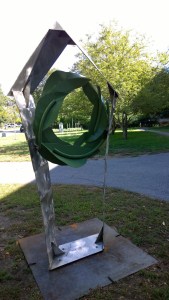
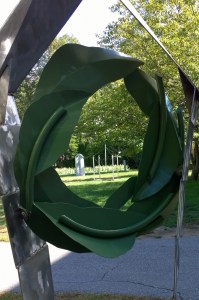
Among the sights I’ve wanted to photograph in the last few weeks is a sculpture outside the Umbrella Community Arts Center. It invites you to look through and focus on an aspect of the view.
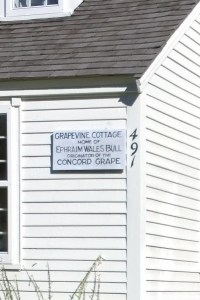
Next up, the old house where Ephraim Bull developed the Concord Grape. Another sign there told me that there was a “Sale Pending.”
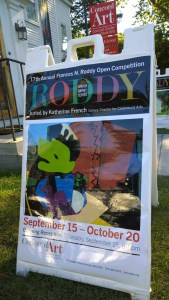
My friend Meredith is a featured artist at Concord Art’s new juried show. She has done several treatments of her fica plant, but the one in the show is a lovely collage of painted paper.
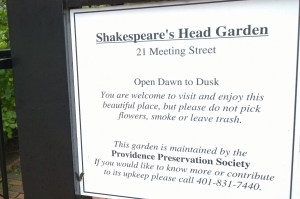
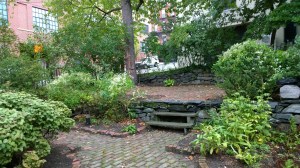
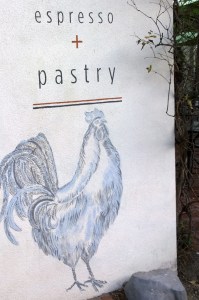
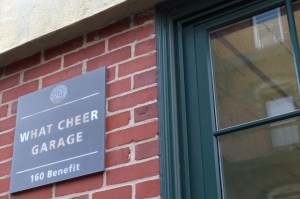
I recently discovered on a morning walk that the Providence Preservation Society has generously opened its multilevel garden to the public during certain hours of the day. What a peaceful place to just sit and think! Not far away is the What Cheer Garage (I like the name). Across Providence, you can discover a fine-looking hen on the wall of Olga’s Cup and Saucer, and a street art stencil recommending Speak no evil, See no evil, Hear no evil.
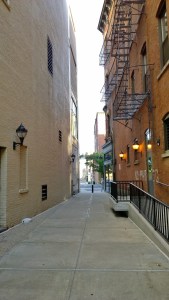
I also like the alley alongside the Providence Performing Arts Center and a hilly street that looks more like Europe than New England.

Posted in Uncategorized | Tagged alleys, art, concord, concord grape, garden, massachusetts, new england, photos, postaday, providence, providence preservation, rhode island, sculpture, see no evil, signs, stencil, street art, umbrella arts center | 6 Comments »
September 24, 2016 by suzannesmom
Although Ginia Desmond had been writing scripts for 12 years, she had never made a movie. Now at 74, she has risen to the challenge.
Johanna Willett writes at the Arizona Daily Star, “Ginia Desmond had a decision to make. Buy a house. Make a movie. Buy a house. Make a movie. She made a movie.
“The 74-year-old has been writing scripts for a dozen years, but ‘Lucky U Ranch’ is her first feature-length film to make it to the big screen.
“That’s because she funded it.
” ‘I consider myself the writer,’ she says of the low-budget film, which so far isn’t readily available for viewing. ‘I wrote the script, and I wrote the checks.’
“Writing screenplays is not Desmond’s first career — or even her second. This act follows others that starred Desmond as a mother and wife, professional artist and businesswoman. …
“For almost 30 years, she imported goods such as furniture and baskets to sell in her Tucson store Sangin Trading Co. on Sixth Avenue. She sold the business in 2003. …
“ ‘Ginia is an interesting combination of very creative and very practical,’ says Victoria Lucas, a Tucson screenplay consultant with a 20-year career in Los Angeles.
” ‘She has that sense of the big picture and how a business is run, and with her writing skills and talent, she has the ability to understand characters. … Very few writers write visually so that when you read the script, it’s like you have seen the movie. … Ginia writes like that. She has a real gift for getting under the skin of characters and making the reader or audience understand them. … She is a treasure for Tucson.” Read more here.
Thank you, Cousin Claire for posting the story on Facebook. Like Desmond, Cousin Claire lives in Tucson, and she has at least one script stored away somewhere about an adventurous female ancestor. I read it. And I know for a fact she is under 74, so …
Photo: Kelly Presnell/Arizona Daily Star
Ginia Desmond, 74, is reflected in her movie poster’s glass.

Posted in Uncategorized | Tagged age 74, Arizona Daily Star, film, filmmaker, Ginia Desmond, Johanna Willett, movie, postaday, Sangin Trading Co., script, scriptwriter, tucson, Victoria Lucas | 4 Comments »
September 23, 2016 by suzannesmom
Missing the excitement of the summer Olympics? As these Vermont farmers show, any determined and organized group can have their own “Olympics” and have a lot of fun.
Jessica Rinaldi writes at the Boston Globe, “With the world’s attention focused on the Olympic Games in Brazil, a decidedly different type of competition was held in a small corner of New England, as farmers took to the field for the second annual Farmer Olympics in Vershire, Vt.
“After taking part in warm-up events that included a hay bale toss, the crowd gathered for an opening ceremony where a quartet performed the Olympic theme song on kazoo. When the competition began, 60 farmers sprinted up a hill, empty bins and shovels in hand, for the manure relay. The event was sponsored by the Northeast Organic Farming Association of Vermont. In the end it was a team from Cedar Circle Farm in East Stepford who took the gold. Their team’s name? Soil’d.“
Click here for a terrific collection of photos from the second annual Farmer Olympics.
Photo: Northeast Organic Farming Association of Vermont
Competing in the Farmer Olympics, Vershire, Vermont.

Posted in Uncategorized | Tagged agriculture, Cedar Circle Farm, East Stepford, farm, farmer olympics, Jessica Rinaldi, manure relay, new england, Northeast Organic Farming Association, organic, postaday, Vermont, Vershire | 2 Comments »
September 22, 2016 by suzannesmom
To me it’s tragic that languages are disappearing and, with them, unique cultures.
Small, determined efforts can bring attention to the problem, as I noted this morning when the filmmaker behind Marie’s Dictionary retweeted this from North Carolina’s Pilot Mountain Elementary School (@pilotMtnElem).
Third grade students are learning about Marie’s Dictionary and endangered languages. @goproject #scsed #pmespirates @UNESCO
Excellent. Third graders are sure to spread the word.
Recently, I came across an article on another threatened language, Hawaii Sign Language.
“In 2013, at a conference on endangered languages, a retired teacher named Linda Lambrecht announced the extraordinary discovery of a previously unknown language. Lambrecht – who is Chinese-Hawaiian, 71 years old, warm but no-nonsense – called it Hawaii Sign Language, or HSL.
“In front of a room full of linguists, she demonstrated that its core vocabulary – words such as ‘mother,’ ‘pig’ and ‘small’ – was distinct from that of other sign languages. …
“The last-minute arrival of recognition and support for HSL was a powerful, almost surreal vindication for Lambrecht, whose first language is HSL. For decades, it was stigmatised or ignored; now the language has acquired an agreed-upon name, an official ‘language code’ from the International Organization for Standardization, the attention of linguists around the world, and a three-year grant from the Endangered Languages Documentation Programme at the School of Oriental and African Studies in London. …
“An initial estimate of up to 280 surviving HSL signers was soon revised down to 40, then down to just 10 or so old-timers still likely to be competent in HSL. ASL had made deep inroads even among these signers, but there was evidence, especially from Lambrecht’s signs, that HSL was distinct, and lay close enough to the surface to be recovered. Spoken languages such as Basque, Welsh, and Hawaiian have come back from the brink of extinction – could HSL be the first sign language to do it?”
The article is from the Guardian by way of the blog Arts Journal. Read it here.
Photo: Eugene Tanner Photography, LLC
Linda Lambrecht, left, teaches Hawaii Sign Language. 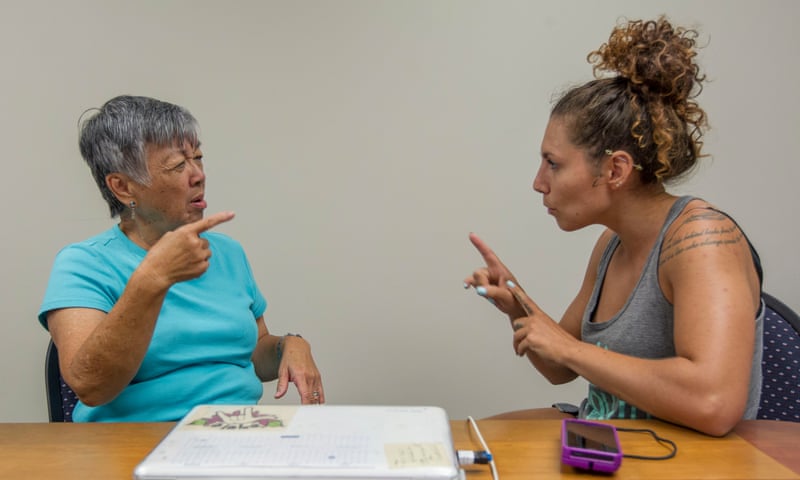
Posted in Uncategorized | Tagged endangered language, Endangered Languages Documentation Programme, Eugene Tanner, hawaii sign language, hsl, International Organization for Standardization, Linda Lambrecht, linguist, london, marie's dictionary, north carolina, Pilot Mountain Elementary School, postaday, School of Oriental and African Studies | 4 Comments »
September 21, 2016 by suzannesmom
Here’s something fun from a BBC blog called “News from Elsewhere.” It’s about new, playful street signs in Sweden.
“A town in northern Sweden is encouraging pedestrians to hop, skip and even play air guitar like Chuck Berry as they cross the road, with a series of new street signs.
“Haparanda Council says it’s part of a scheme launched last year to rejuvenate the town centre. …
“Therese Ostling, who runs the Town Makeover project, tells Swedish TV … ‘They have got more attention than I thought — I see people taking photos of them every day, and sometimes they follow the instructions to jump, leap or whatever else the sign suggests.’
“The idea came from local woman Nadja Lukin, who … wrote to the council, as ‘Haparanda has always dared to try something new,’ and officials responded enthusiastically with signs depicting jive dancing and Monty Python’s Ministry of Silly Walks.
“The makeover, which includes rebranding the centre as the Old Town, has brought new business into the once-rundown area and will continue for another year, but the most important impact of the signs has been to ‘make people smile,’ says Ms Ostling.” More.
Without doubt, if everyone did silly walks across the street, the world would be a better place, a place full of laughter.
Photo: Swedish TV
Swedish TV asks, “Why stroll across the street when you could ‘duck walk’ like a rock’n’roll icon?“
Posted in Uncategorized | Tagged air guitar, chuck berry, duck walk, economic development, Haparanda, jive, local business, Ministry of Silly Walks, monty python, nadja lukin, postaday, rejuvenate, revitalization, rock'n'roll, sweden, Swedes, swedish tv, Therese Ostling | 4 Comments »
September 20, 2016 by suzannesmom
Roma families (also called gypsies, tinkers or travelers) have a hard life in Europe. Recently, Elisabetta Povoledo wrote at the New York Times about some Roma women who are hoping to build a better life for their families by starting food businesses.
“On a muggy July evening, a handful of Italian hipsters milled around a food stand at an alternative music festival in Rome, trying to decipher some of the exotic offerings: mici, sarmale and dolma.
“These Balkan delicacies — barbecued meatballs, cabbage wraps and stuffed peppers — are the basic ingredients of an entrepreneurial scheme cooked up by a group of Roma women looking to better their lives and leave the overcrowded and insalubrious camp in Rome where they currently live.
“They call themselves the Gipsy Queens.
“ ‘Cooking? I’ve been cooking practically since I was born,’ said one of the chefs, Florentina Darmas, 33, a mother of three, who is originally from Romania. …
“Nowadays she is trying to break down some of the barriers faced by her traditionally marginalized group using the universal language of food. …
“ ‘We realized there was unexpressed potential in the community, especially on the part of women,’ said Mariangela De Blasi, a social worker with Arci Solidarietà Onlus, a Rome-based nonprofit organization that works with marginalized people and manages the burgeoning catering business. …
“If their entrepreneurial plans pan out, the Gipsy Queens hope to buy a food truck or rent a kitchen on a more permanent basis — foundations for steady work that will bring in rent money.
“ ‘Getting out [of the camp] is my first priority,’ said Hanifa Hokic, 31, a divorced mother of five children between 8 and 12 years old, who is originally from Bosnia. …
“Maria Miclescu, a 20-year-old mother of two, agreed that to give her children ‘a better future,’ she had to leave. Her husband is trying to establish a small-appliance repair business …
“The oldest member of the group, Mihaela Miclescu, 49, who is a grandmother, was happy to join the Gipsy Queens.
‘I wanted to show Italians that we are not bad people, that we want to work, not to beg.’
More here.
Photo: Gianni Cipriano for the New York Times
Maria Miclescu, left, and Codruca Balteanu at a food stand run by the Gipsy Queens during a music festival in Rome. 
Posted in Uncategorized | Tagged Arci Solidarietà Onlus, bosnia, camp, Codruca Balteanu, cook, Elisabetta Povoledo, entrepreneurial, Florentina Darmas, Gianni Cipriano, gipsy queens, gypsy, Hanifa Hokic, italy, marginalized, Maria Miclescu, Mariangela De Blasi, Mihaela Miclescu, postaday, roma, romania, rome, Via Candoni | 2 Comments »
September 19, 2016 by suzannesmom

Photo: Suzanne Kreiter/Globe Staff
A stage in the back of a U-Haul (paid for in part by Fresh Sound Foundation) allows the Grammy Award-winning Parker Quartet to perform anywhere.
Classical musicians who believe their music will bring a blessing to whoever hears it have been presenting in offbeat locales in the Greater Boston area. Tomorrow, too. Malcolm Gay has the story at the Boston Globe.
“The 17-foot U-Haul truck sat parked in an empty field, ringed by trees. With the touch of a button, a roof-mounted winch whirred into action, unspooling cable as a fan-shaped stage lowered like a drawbridge from the rear. The U-Haul’s modified rear doors acted as a band shell, flanking the stage to project sound, and a custom-made sail, supported by deep-sea fishing rods, projected as a visor from above.
“Fifteen minutes later and the vehicle, dubbed the Music Haul, was a fully functioning stage — a 21st-century gypsy caravan that will bring live performances to the streets and schools of Greater Boston, Sunday through Tuesday.
“ ‘It really is more boat than truck,’ said Catherine Stephan, executive director of the Yellow Barn music center. ‘We got to know RV dealerships really well.’ …
“ ‘It’s supposed to be as close to magic as possible,’ said architect John Rossi, one of the traveling venue’s principal designers. …
“Its creators say the Music Haul’s main mission is to bring world-class concert performances to the most unlikely of places: schools, underserved neighborhoods, hospitals, perhaps even prisons.
” ‘We exist in the world as musicians that is in a way so finely controlled and tuned,’ said Yellow Barn’s artistic director, Seth Knopp. ‘Music Haul removes some of the ceremony, which can be a barrier for people who are not often exposed to that world. There’s an element of taking something out of its accustomed place and allowing it to take people by surprise.’ ”
What a good thought! Reminds me how you can suddenly start seeing the pictures on your walls again if you move them to a new location in the house.
Read more about this enchanting initiative here.
Posted in Uncategorized | Tagged 5th Grade, architect, Catherine Stephan, classical music, designer, Fresh Sound Foundation, gypsy caravan, hospitals, John Rossi, magic, malcolm gay, music, music center, music haul, musician, parker quartet, pop-up, postaday, prisons, schools, Seth Knopp, Suzanne Kreiter, u-haul, underserved neighborhoods, Vermont, Yellow Barn | 2 Comments »
September 18, 2016 by suzannesmom
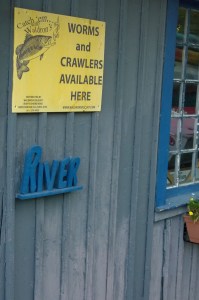
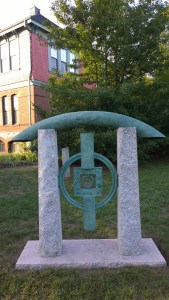
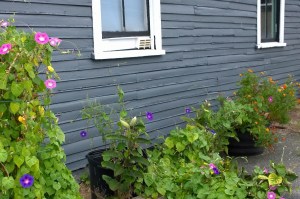
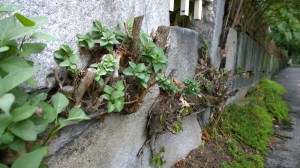
I’m starting to notice that my photos (all taken on my mobile phone) have recurrent themes. Today’s nine pictures reflect a few of those interests: words on signs, shadows, plants, nature, art. Either I’m in a rut, or I’m going to get really good at a few themes.



Posted in Uncategorized | Tagged art, nature, photo, photograph, postaday, shadows | 5 Comments »
September 17, 2016 by suzannesmom
I learned about Open Doors for Refugees from my friend Anne, who for many months helped me guest blog at the Providence Granola Project. I miss her so much. She died a couple weeks ago in a freak biking accident. From now on, whenever I post about refugees, I will think of Anne.
This refugee-outreach story comes from the Wisconsin State Journal. Samara Kalk Derby writes, “Raphael Al Rubaye left Iraq for Madison eight months ago with his wife and two young daughters and has found a welcoming community here.
“He served with the U.S. Army in Iraq for six years in the American-led war against al-Qaida and the Taliban. He was brought to this country by Lutheran Social Services and now works as a case manager for the organization, helping in the resettlement of other refugees.
“His life in Iraq was ‘fun, terrible, dangerous, scary, happy, worried, everything,’ he said. ‘Just like any life.’ …
“Al Rubaye and his daughters were among about 200 people who took part in a community celebration, picnic and fundraiser hosted by the local group Open Doors for Refugees held [August 7] at the Olin Park shelter. …
“Open Doors for Refugees, a group dedicated to supporting the resettlement of refugees in the Madison area and welcoming them into the community, was started by Israeli native Efrat Livny. …
“ ‘One of the best things that’s happened to us is that we’ve gotten to be friends with Syrian families, which as an Israeli has been a little touchy,’ Livny said about herself and husband, Ken Baun. ‘But, oh my God, it’s been incredible.’
“It all started when she got the book ‘Soup for Syria: Recipes to Celebrate our Shared Humanity,’ and began making soup for her monthly lunches at [a business and community space she founded]. She would dedicate the meal to the welfare of Syrian refugees.
“She soon realized she needed to do more and began bringing in speakers and holding discussion circles. During those discussions, Livny asked people about their feelings. ‘How can we sit back when this is happening?’ she said.” More here.
People certainly bond over food. That is one reason the Providence Granola Project got into food as a way to give some refugees US workforce skills. I mentioned several refugee-based food businesses in a June post I wrote for the Providence Granola Project here.
Photo: Samara Kalk Derby
Parachute game at Sunday picnic hosted by Open Doors for Refugees in Olin Park, Madison, Wisconsin.
Posted in Uncategorized | Tagged Al Rubaye, Efrat Livny, Israel, Ken Baun, Open Doors for Refugees, opening hearts, postaday, providence granola project, refugee, Samara Kalk Derby, Soup for Syria: Recipes to Celebrate our Shared Humanity, syria, Wisconsin State Journal | 6 Comments »
September 16, 2016 by suzannesmom

Art: Maurice Sendak
From Kenny’s Window, Sendak’s first children’s book
Maria Popova recently posted about the importance of play, commencing her review of Diane Ackerman’s book Deep Play with an anecdote from her own life.
“One July morning during a research trip to the small New England island of Nantucket, home to pioneering astronomer Maria Mitchell, I had a most unusual experience.
“Midway through my daily swim in the ocean, my peripheral vision was drawn to what at first appeared to be a snorkel. But as I looked directly at the curious protrusion, I realized it was the long glistening neck of a stately bird, gliding over the nearly waveless surface a few away.
“By some irresistible instinct, I began swimming gently toward the bird, assuming it would fly away whenever my proximity became too uncomfortable.
“But it didn’t. Instead, it allowed my approach — for it was deliberate permission that this majestic bird gave me, first assessing me with a calm but cautious eye, then choosing not to lift off or even change course as this large ungraceful mammal drew near. I came so close that I could see my own reflection in the bird’s eye, now regarding me with what I took to be — or, perhaps, projected to be — a silent benevolence. …
“In this small act ablaze with absolute presence, I felt I had been granted access to something enormous and eternal.
“The experience was so intensely invigorating in part because it was wholly new to me, but it is far from uncommon. It belongs to the spectrum of experience which Diane Ackerman, one of the greatest science storytellers of our time, describes in Deep Play … a bewitching inquiry into those moods colored by ‘a combination of clarity, wild enthusiasm, saturation in the moment, and wonder,’ which render us in a state of ‘waking trance.’ …
The more an animal needs to learn in order to survive, the more it needs to play … What we call intelligence … may not be life’s pinnacle at all, but simply one mode of knowing, one we happen to master and cherish. Play is widespread among animals because it invites problem-solving, allowing a creature to test its limits and develop strategies. In a dangerous world, where dramas change daily, survival belongs to the agile not the idle. We may think of play as optional, a casual activity. But play is fundamental to evolution. Without play, humans and many other animals would perish. …
“It is hardly happenstance,” adds Popova, “that the word ‘play’ was central to how Einstein thought of the secret to his genius — he used the term ‘combinatory play’ to describe how his mind works. Ackerman considers what it is that makes play so psychologically fruitful and alluring to us …
Above all, play requires freedom. One chooses to play. Play’s rules may be enforced, but play is not like life’s other dramas. It happens outside ordinary life, and it requires freedom.
More.
Posted in Uncategorized | Tagged children's book, combinatory play, deep play, diane ackerman, einstein, experimenting, freedom, maria popova, maurice sendak, playing, postaday, science | Leave a Comment »
September 15, 2016 by suzannesmom
Because I lived there for a few years, I can never resist a story about Minnesota, land of 10,000 surprises. Here’s one story from a Wall Street Journal reporter.
“Winona, MN, is home to just 27,500 people,” writes Judith H. Dobrzynski at Real Clear Arts, a blog at ArtsJournal, “but it has an art museum worthy of a much bigger city.
“The Minnesota Marine Art Museum … was the brainchild of a local collecting couple named Bob Kierlin and Mary Burritcher. They knew nothing about art when they started collecting …
“But today they, with the help of others, have created something very worthy. For them, marine art includes any work with enough water to ‘float a boat.’ And so the museum – which has beautiful, spacious galleries, is filled with works by many great artists.
“It has been expanded twice, and most of it is filled with works on loan from the couple. They include Turner’s 1841 watercolor Heidelberg With a Rainbow, Gauguin’s Still Life with Onions, Heade’s The Great Florida Sunset and View From Fern-Tree Walk, Jamaica, Beckmann’s “Dutch Landscape with Bathers” plus paintings by Monet, van Gogh, Picasso, O’Keeffe, Hartley, Cole, Bierstadt and Homer.”
Read more here. Just scroll down.
Photo: Minnesota Marine Art Museum
A Winona treasure chest.

Posted in Uncategorized | Tagged art, Beckmann’s “Dutch Landscape with Bathers, Bob Kierlin, Gauguin’s Still Life with Onions, Heade’s The Great Florida Sunset and View From Fern-Tree Walk, Heidelberg With a Rainbow, Judith H. Dobrzynski, Mary Burritcher, Minnesota Marine Art Museum, postaday, real clear arts, Turner, winona | 2 Comments »
September 14, 2016 by suzannesmom
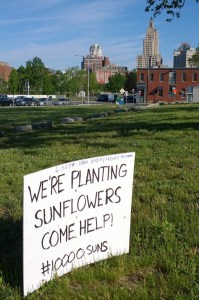
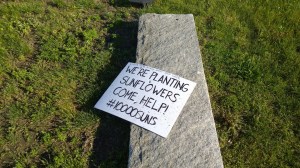
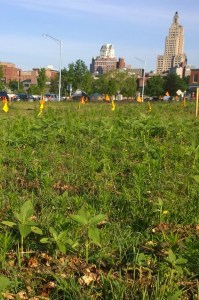
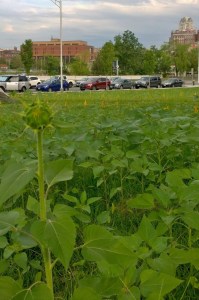
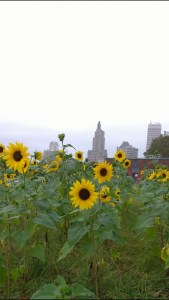
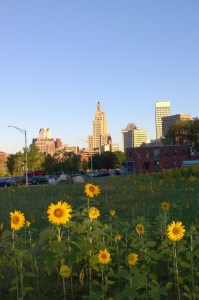
For the longest time, it looked like nothing at all, this art installation of 10,000 sunflowers where route 195 once polluted the soil.
Adam E. Anderson, the brains behind the community-building project, writes on his website, “Ten Thousand Suns is a summer-long botanical performance in which over 10,000 sunflower seeds have been planted and being nurtured over the course of the summer months, on land that until recently sat under a highway, with high compaction, low-organic material, and embedded with toxicity. …
“Rather than using high maintenance and energy intensive large swaths of turf grass, the installation uses the bio-accumulating (removes toxins) and habitat creating properties of Helioanthus (aka, Sunflower) planted in rows in a series of large circles, leaving paths in-between for intimate exploration.
“The project will create a spontaneous and unique cultural identity for the citizens of Providence and its visitors during the summer months.”
With little rain all summer, the project looked like a hopeless cause for many weeks. Until it didn’t.
In celebration of the cheery results, I want to share a few lines of a poem about a goldfinch loving a sunflower. Because who wouldn’t love a sunflower?
From poet Ross Gay‘s “Wedding Poem”
Friends I am here modestly to report
seeing in an orchard
in my town
a goldfinch kissing
a sunflower
again and again
dangling upside down
by its tiny claws
steadying itself by snapping open
like an old-timey fan
its wings
again and again
until swooning, it tumbled off
and swooped back to the very same perch …
Read more about the project at Adam Anderson’s site, here, and on Facebook, here. Click on my photos to check the dates.

Posted in Uncategorized | Tagged #10000suns, 10000 sunflowers, adam anderson, art project, botanical performance, community, environment, Helioanthus, high compaction, installation, low-organic material, postaday, providence, restoration, ross gay, route 195, soil remediation, sunflower, toxicity, wedding poem | 4 Comments »
« Newer Posts - Older Posts »


