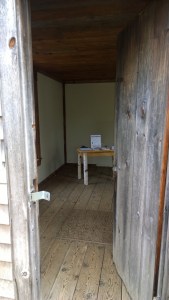
Here is an idea whose time has come. Aux armes! We need to remove the barriers to napping!
Olivia Vanni at BostonInno explains the revolutionary new Sleepbox concept.
“Sleepbox, a startup that’s recently set Boston roots, is making our wildest dreams come true: You will soon be able to sleep soundly and safely in any public place conceivable. As the name implies, the company has developed cozy, technologically decked-out cabins that can be set up just about anywhere — in airports, offices or downtown metropolitan areas — and rented by folks looking to catch some Zs.
“How did this visionary venture come about? According to Mikhail Krymov, CEO of Sleepbox and research fellow at MIT, he and his business partner Alexey Goryainov started it as a theoretical side project for their architecture firm Arch Group. The two professionals travel a lot for work and were constantly subjected to flight delays and layovers where all they could do was wish for a comfortable, private place to rest. From their personal experience, they created an initial design for Sleepbox. But it was meant only as a concept, at first.
” ‘It was just a design idea, but then it was published — it was actually published quite a few times — we started receiving requests and orders from all over the world,’ Krymov told me. …
“There are some customers who are buying them for noncommerical uses — say, companies installing them in their offices for employees to use for free. However, there are clients who buy them with the intention of charging people to rent them, like airports and municipalities. …
” ‘I really want people to be more happy, productive and healthy by having enough sleep, and hope that our solution will help,’ Kyrmov said.”
Tim Jonze wrote a funny story at the Guardian about hiring a therapeutic opera singer to deal with his anxiety about becoming a father.
“The soprano reaches a dramatic climax, demonstrating impressive lung power as she sustains the dizzying peak note, before bringing Quando me’n’ vo’ to its close. It is a powerful, emotionally draining performance, and one that seems to resonate around the room for some time after she has finished. Which is why I get up off the sofa and ask her if she would like a cup of tea.
“This, as you might have guessed, is not your typical night at the opera – and not only because it’s only just gone 11 am. It is called Opera Helps, and is a project dreamed up by the artist Joshua Sofaer. The gist is this: contact the Opera Helps phoneline with a personal problem, and they will endeavour to send a singer to your house. Said singer will briefly discuss the issue with you, select a suitable aria that addresses it, then perform it for you while you relax in familiar surroundings: on a comfortable chair, for instance, or even in bed.
“It’s not therapy as such – in fact, they are very keen to stress that their singers are not trained therapists – but the project does aim to help you look at your problem from a new perspective and, hopefully, experience the healing power of music.
“ ‘It’s about giving someone the space for reflection, the same way having a chat with a friend might give you fortitude to carry on,’ says Sofaer, who found success running the project in Sweden before bringing it to the UK. …
“ ‘In my experience, you either respond to the music or you don’t – I don’t think it is based on your musical education or what class you’re from or how much money you’ve got, which is the common perception. The idea that opera needs an expert audience is a complete misnomer.’ ”
Recently I read that there is a 5,000-year-old tree at a location in the United States that rangers won’t reveal for fear of too many curiosity seekers. Is that even possible to know — 5,000 years?
At National Geographic, Beth Moon has published photographs of other trees that are old, if not quite that old, and they look amazing.
Becky Harlan provides some background.
“Over three trillion trees live on planet Earth, and yet we know so few of their stories. Of course all trees play an important role—purifying the air, hosting the feathered and the furry, teaching kids (and kids at heart) how to climb—but some have spent more time doing these things than others. Quiver trees, for example, can live up to 300 years, oaks can live a thousand years, and bristlecone pines and yews can survive for millennia.
“In 1999, photographer Beth Moon took it upon herself to begin documenting some of these more seasoned trees. Specifically, she sought out aged subjects that were ‘unique in their exceptional size, heredity, or folklore.’ …
” ‘I am always amazed at the way trees have the ability to endure and adapt to severe conditions. Some ancient trees hollow out as they age as a survival technique. The tree will send an aerial root down the center of the trunk, which will continue to grow from the inside out.’
“In her book Ancient Trees: Portraits of Time, she explains that these ancient individuals ‘contain superior genes that have enabled them to survive through the ages, resistant to disease and other uncertainties.’ …
“Many of the real trees represented, however, face hard times ahead. ‘Quiver trees are dying from lack of water in Namibia. Dragon’s blood trees are in decline and on the endangered list, and three species of baobab trees are currently listed as endangered on the IUCN Red List,’ says Moon. …
“She hopes sharing her wonder will begin a conversation about the conservation of these arboreal treasures.”
Click here to read more and see magical photographs of ancient trees in Cambodia, Wales, Yemen, England, Madagascar, Florida, and Namibia.
Photo: Beth Moon
Rilke’s Bayon, Tetrameles nudiflora, in Ta Prohm, Siem Reap Province, Cambodia
I read a silly headline today. It said that books are “in” again.
I’m pretty sure that for a lot of people, they were never out. But maybe the timing is particularly good for the new, roaming branch of independent bookstore Parnassus Books.
Alexandra Alter reports at the NY Times, “Nashville’s newest bookstore is an old van. The bright blue bookmobile, which hit the road [in March], is a roving offshoot of Parnassus Books, a popular independent bookstore. It will roam around town, stopping at food truck rallies, farmers’ markets and outside restaurants.
“The arrival of a bookstore on wheels is a fitting evolution for Parnassus, which is co-owned by Karen Hayes and the novelist Ann Patchett. The store’s name comes from Christopher Morley’s 1917 novel ‘Parnassus on Wheels,’ about a middle-aged woman who travels around selling books out of a horse-drawn van.”
[We will pause here to note that Morley, 1890 -1957, is a Haverford College grad, as are two members of my family.]
“Since Parnassus opened in 2011, Ms. Hayes has wanted a traveling bookstore of her own. She looked at taco trucks and ice cream trucks and felt envious of their freedom to take business wherever people gathered, she said.
“ ‘A bookmobile made so much sense, because food trucks work so well in this town,’ Ms. Hayes said by telephone. ‘It’s a great way to get our name out there, too. It’s a rolling advertisement.’ …
“ ‘One of my hopes is that we’ll be able go into some of the outlying suburbs and cities that don’t necessarily have a bookstore,’ said Grace Wright, a Parnassus bookseller who will manage the bookmobile. ‘There’s nothing like a good bookstore.’ ” More here.
Speaking of bookstores, I’ve been trying to patronize my local indy routinely, even though Amazon delivers. When I lived in Minneapolis, Amazon got an independent women’s bookstore called Amazon to relinquish the name it had had for years, and I had a sense at the time that it was only the first step in the online behemoth’s march across the globe. Didn’t realize how much more than a bookseller it would become.
Photo: Nathan Morgan for The New York Times Karen Hayes is a co-owner of a Nashville bookstore named after Christopher Morley’s 1917 novel “Parnassus on Wheels,” about a middle-aged woman who travels around selling books out of a horse-drawn van.
There’s always something fun over at PRI’s environmental radio show Living on Earth. Here’s a story that ran in March about the unique bird species isolated in Northeastern Australian rainforests.
Bob Sundstrom wrote up the audio report of BirdNote‘s Mary McCann: “The Eastern Whipbird hangs out in the dense understory. It’s dark, crested … nearly a foot long and emerald-green with white spots. … The large, pigeon-like Wompoo Fruit-Dove … feathered in a stunning combination of green, purple, and yellow, [is] clearly named for its voice.
“Pig-like grunting on the forest floor tells us we’re in the company of the largest bird on the continent – the Southern Cassowary. On average, the female weighs 130 pounds and stands around 5 feet tall, looking like a giant, lush, black hairpiece on thick legs. A helmet called a casque makes it look as much like a dinosaur as any living bird.” Five feet tall? I think I know a one-year-old who would like to try riding it.
The bird sounds on the radio show were provided by The Macaulay Library of Natural Sounds at the Cornell Lab of Ornithology. Hear them all here, where you can also enjoy the equally far-out pictures.
Erik’s sister and family are off on their five-month European sailing trip. The three children have homework to do during the first part of the trip, when they would ordinarily be in school. All five family members are contributing to a WordPress blog they call Burning Cloud. Four write their posts in English; the youngest sometimes writes in Danish. The entries are a lot of fun to read.
Here is the oldest child’s May 11 post:
this is a word for word conversation.
Klara : the first qustion is, why are we not moving
Klaus: because we are waiting for our gear to come back from the repair shop
Klara : the second question is: when are we going to move?
Klaus: on Friday
Klara: the third question is: what is wrong with the motor?
Klaus: the gear is leaking a bit of oil.
Karl-Oscar: how will they fix the gear?
Klaus : it will be repaired in Køge with some spare parts that are cominng form Gottenburg.
written by Axel.
Join the fun at Burning Cloud Blog. You can follow the route on maps the family posts periodically along with other entertaining pictures. (Don’t miss the photo of everyone making sushi on shipboard.)
Radio show Living on Earth did a segment in February on new technology to store and release solar heat. Here is host Steve Curwood on his outing to MIT to learn about the breakthrough.
“A team of researchers at MIT has come up with a chemical that would let windshield glass directly store solar energy and then release it on demand as heat to melt the ice. … The same chemical could be woven into clothing fibers to capture the sun’s energy and then give you some added warmth when you ask for it, even days later.
“I paid a visit to the lab where the MIT team has been working on this breakthrough and met up with researchers David Zhitomirsky and Eugene Cho, who work in the lab of professor Jeffrey Grossman.”
To Curwood’s question about the difference between the familiar electrical, battery-enabled solar technology and the MIT lab’s chemical version, Zhitomirsky replies,”We use these molecules that can absorb UV light and instead of generating charges, what they do is that they change shape, and by changing shape, they can store chemical energy …
“CURWOOD: OK, so sunlight hits this molecule, it changes shape and can storage its energy. And how do you get the energy out?
“ZHITOMIRSKY: So you can figure the material in several ways. One way is to add a small amount of heat, and the material will release more heat than you add in. The other methods are triggering it with light or you can apply an electrical field to the material. …
“The way we envision using it is to integrate into fibers that you then make clothing out of.” More here.
Release solar heat from my coat in a blizzard? Where do I sign up?
Photo: Helen Palmer Living on Earth host Steve Curwood, right, in the MIT lab with Eugene Cho and David Zhitomirsky.
Never underestimate the wisdom of the pachyderm. Here’s one that would make an undetectable spy.
Jeffrey Gettleman writes at the NY Times, “Elephant experts in Kenya were excited recently by some rare good news: An elephant had crossed into Somalia — and survived.
“Somalia, one of the world’s most war-torn nations, used to be home to thousands of elephants, but they were wiped out during the 1980s and ’90s as the country descended into chaos.
“For the first time in decades, researchers said, there is now anecdotal evidence that a small elephant population still exists in Somalia, a finding based on the unusual migration of one big bull named Morgan who journeyed stealthily across the Kenya-Somalia border, most likely to look for a mate.
“Fitted with a GPS tracking collar, Morgan was found to have traveled more than 130 miles, demonstrating an uncanny sense of direction — and self-preservation. He moved mostly by night. During the day, he rested in thick bush.
“ ‘This is extreme behavior adapted to survive the worst known predator on Earth: man,’ said Iain Douglas-Hamilton, one of the scientists closely monitoring Morgan. ‘His behavior was a bit like an S.A.S. patrol: Hide by day, keep out of sight and, at night, travel fast,’ he added, referring to the British special forces. …
“He surmised that Morgan, who is in his mid-30s, had made a similar journey years ago and that a faint memory of the route was lodged somewhere deep in his elephant brain.” More here.
Photo: Save the Elephants, via Agence France-Presse — Getty Images Morgan, a male bull in his 30s, was fitted with a tracking collar in Kenya’s coastal Tana River delta around December.
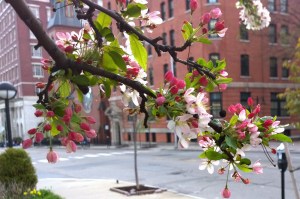
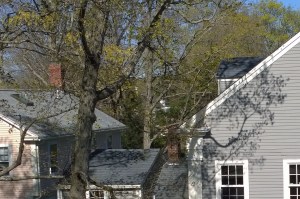
Happy Mother’s Day to all mothers! This mother is indulging her interest in photography today (the simple kind: pointing and shooting with a phone). So here are a few recent pictures and explanations for the less obvious.
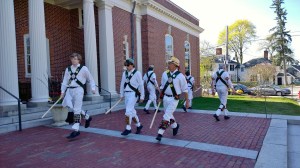
For example: I went out for a walk one evening and was surprised to encounter Morris Dancers on the steps of the library. They seemed to be practicing, not performing. Where would Morris dancers be performing in late April, after Patriots Day? That was a mystery. Another mystery to me was how young men and boys get drawn into performing Morris Dance. I’m sure it’s good exercise, but …
I include shots of a clay bird’s shadow on my wall and hedge shadows on a sidewalk. The fence with the stage coach and other old timey images painted along the railings is in Providence — easy to overlook when walking past.
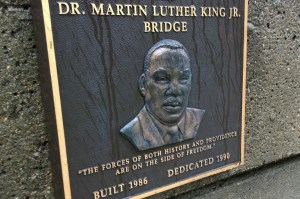
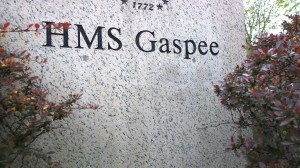
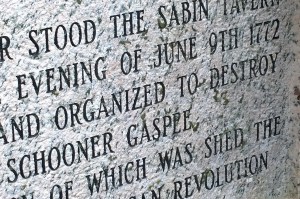
Providence plaques and memorials. The one of Martin Luther King Jr. is on a bridge with a view of Water Place. The monument to an event Rhode Island celebrates as the real first engagement of the American Revolution — the colonists’ clash with Brits on the HMS Gaspee — is partly obscured by bushes.
Little old Rhode Island gets no respect. It was also the first colony to sign on for independence, May 4, 1776. Who knew?
You may have heard that Rhode Island launched a state-branding campaign this spring that garnered too much ridicule to survive more than a couple weeks. Although the Ocean State’s leadership decided to keep the cheery sailboat logo, it ditched the “Cooler and Warmer” slogan, which had generated a tidal wave of spoofs.
Then the state began casting a wider net to gather ideas, with a focus on residents’ stories about why they love Rhode Island. I went to one event on Wednesday.
Here’s how Channel 10 described the initiative: “The Rhode Island Commerce Corporation is inviting residents to share what they love most about the Ocean State as part of its second attempt to market the state this year. …
“The failed rollout made national headlines because a promotional video included a clip from Iceland. It also led to the resignation of the state’s chief marketing officer, Betsy Wall. …
“‘ Make It Yours.’ A temporary pop-up storefront, located at 250 Westminster Street in Providence, invites Rhode Islanders to write down what they love about the state. People are also encouraged to share video clips and pictures on social media using the hashtag #MyRIstory.
” ‘The material that we really love — it’s, “Oh my God, this one’s fantastic,” we’re going to reach out to people and ask — “Can we use this in the state’s advertising campaign because it’s a perfect way to tell the story of Rhode Island?” ‘ Seth Goldenberg, interim chief marketing officer for the Commerce Corporation, said. …
“The ideas jotted down at the studio will be shared with the state’s local tourism bureaus.”
I think I missed some opening words at the lunchtime event I attended, and that may be why I found it a little confusing. I could see that lots of people had previously written ideas on cards and posted them on a wall, and I heard introductions of guest speakers Doors Open RI founder Caroline Stevens and DesignxRI co-founder Lisa Carnevale (but I didn’t hear who the MC was).
Even though I thought that with people continuously dropping in late, repeated explanations — of who the speakers were, what was being done and why, and what the arts and crafts on the tables were for — would have been good, there is no doubt that crowdsourcing of ideas is a concept whose time has come, and I hope lots of Rhode Islanders will attend the pop-up events.
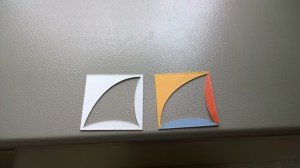
I took home cute logo templates that were on a crafts table and will investigate how they were to be used.
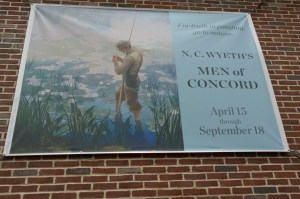
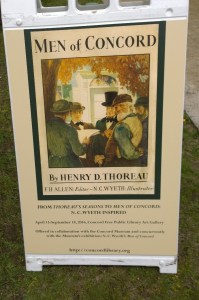
If you can get to the N.C. Wyeth exhibit at the Concord Museum by September 18, I think it will be worth your while.
You’re familiar with the family of painters, the Wyeths, right? Best known are Nathaniel C., his son Andrew, and Andrew’s son, Jamie. Perhaps you have been to the Brandywine Museum in Chadd’s Ford, Pennsylvania, which got its start with generations of Wyeth art.
The Concord Museum and the Concord Library are each hosting exhibits related to the book, but if you like N.C.’s art, the museum exhibit is the one to see. It’s small but informative and lovely to look at.
N.C. was known for heroic illustrations of classics like Treasure Island, and his characters’ facial expressions and body postures always tell a story. That might be too literal for some art lovers, but I like it. I like the looks on the faces of three men Thoreau described in his journal as “slimy.” I like the watchful, coiled bodies of the muskrat hunters on the river, and the youthful innocence of N.C.’s Thoreau — a quality I have never associated with the writer.
One fanciful painting with bluebirds in a bubble of light like angels over Thoreau’s head seems like hagiography. It’s not my favorite work here, but it’s an intriguing summary of the writer’s interests. And people do make a religion out of Thoreau and Transcendentalism, so maybe it’s not surprising. The whole Concord gang — including Bronson Alcott and Ralph Waldo Emerson — is in the show, minus most of the brilliant women, of course.
One thing I learned was that N.C. had his pencil sketches converted into glass slides, and then he projected them onto the Renaissance board he favored so he could work directly on the enlarged sketch.
Pigeons are often associated with pollution underfoot, but in London, pigeons are being harnessed in the fight against another kind of pollution.
Melissa Breyer reports at TreeHugger that the ubiquitous birds are being “outfitted with light-as-a-feather backpacks that collect air pollution data and tweet back live info in an effort to track air quality.
“Putting pigeons to work was the brainstorm of Pierre Duquesnoy, creative director at the global marketing and technology agency DigitasLBi. He entered the curious concept into the #PoweredByTweets competition which was launched last year in conjunction with the London Design Festival.
“Currently there are 120 stations monitoring air pollution in London but they are in fixed locations. ‘That means there are blind spots,’ Duquesnoy tells the Evening Standard. ‘The stations are really accurate but only for the immediate vicinity, so scientists don’t have a clear idea of what is happening elsewhere.’ …
“Pigeon Patrol was one of six winning entries that was built and exhibited – and now, the patrol is actually patrolling. [They will] measure levels of nitrogen dioxide and ozone, the main gases behind harmful urban air pollution …
“For the project Duquesnoy worked with Plume Labs, a tech firm that helps citizens track their exposure to air pollution.” More here.
Sam Borden at the NY Times had a cool story yesterday about a jack-of-all-trades performer who never got much attention — until his ability to mimic the sounds of nature turned him into an overnight sensation.
According to Borden, Gennady Tkachenko-Papizh, 52, finally got attention in March.
“That was when, while sitting at a cafe [in Berlin] checking his smartphone, he saw that Miss Arab U.S.A. — who is a 22-year-old Brooklyn-born Syrian named Fabiola al-Ibrahim — had, for some reason, posted to her Facebook page a video of Mr. Tkachenko-Papizh competing on a talent show in the former Soviet republic of Georgia. ‘This will take you to another world!’ she promised of the link, which leads to about three minutes of Mr. Tkachenko-Papizh vocalizing the sounds of crickets, bird wings rustling, water dripping and hyper-dramatized operatic chanting.
“The show, ‘Georgia’s Got Talent,’ is about what you might expect from spectacles like this anywhere … Yet Mr. Tkachenko-Papizh’s performance, which he began by solemnly intoning, ‘Let us try to feel what the Mother Earth wants to tell us,’ resonated more deeply. …
“The video on Miss Arab U.S.A.’s page has logged more than 70 million views and inspired more than 102,000 comments — mostly unbridled encomiums.”
Despite the change in Tkachenko-Papizh’s life, says Borden, he is not becoming a prima donna. “He lives here with his wife, Larissa Porkhimovich, who is a financial auditor, and their two young children (he also has an older son from a previous relationship), and he said that he is most interested in simply harnessing ‘this gift I have, which has a magical effect.’
“It has taken some adjustment for his wife. ‘I think he really likes testing, trying things,’ she said. ‘It can be a little strange — sometimes I am in the house and I will just hear sounds, like a bird flying, but it is inside. But that is who he is.’ ”
I liked this story from the radio show Studio 360. It explains how recordings of whales making music were used by Judy Collins and others to draw attention to the plight of our biggest mammals.
“If you hear whale songs today, you might be getting a massage or a facial. Some recordings of humpback whales feature slow melodies soothing enough for spa soundtracks. But in the 1970s, whale songs ignited the passions of music listeners and animal activists.
“Biologist Roger Payne still thinks whale songs are the most evocative sound made by any animal. But he may be biased — he discovered them. In 1966, Payne got a recording from a sound designer doing research for the military on undersea dynamite explosions. Caught on the tape were some of the first recordings of sounds made by humpback whales.
“Payne became obsessed with the recording, and made a startling discovery: the sounds were repeating. That means that they weren’t just sounds, they were technically songs — arguably the most complex songs made by any animal. Unlike birds or crickets, the whales’ songs were ten minutes or longer and repeated without a break.
“At the time, whales were being hunted to near-extinction, and Payne saw the discovery of whale songs as a call-to-arms. …
“Over the following years, Payne pressed the recordings on musicians, composers, and singers, including Judy Collins. ‘This tall man walked backstage,’ Collins recalls. ‘And he handed me this little package’ with a tape of the humpbacks. ‘It was very emotional. …
“In 1970, Collins used the recordings on her album “Whales and Nightingales”, which went gold and introduced millions to whale song. … Collins devoted the royalties of those songs to Payne’s conservation work. … Just as Payne hoped, these strange, evocative sounds inspired the growing Save the Whales movement, and by 1972 the US had banned whaling and whale products.”
A week ago, I went to a cheerful ribbon cutting enlivened by smiling faces and Woonsocket’s own Marching Milkman Band.
Local, state and federal officials, residents, nonprofits such as NeighborWorks Blackstone River Valley and Rhode Island Housing, businesses such as the Federal Home Loan Bank, Bank of America and Navigant Bank — and a long list of equally important partners — were celebrating the conversion of the rundown Mulvey’s Hardware into a range of new community uses.
Sandy Seone has the story at the Valley Breeze newspaper.
“A downtown building that sat dormant for more than a decade was declared officially revived this week as NeighborWorks Blackstone River Valley celebrated the grand opening of 40 South Main St.
“The $3.3 million renovation project began in 2014 and has resulted in the complete conversion of a former hardware store into six, [one-bedroom] apartments; a meeting space; a rooftop patio; a basement rental area for small businesses; and a kitchen ‘incubator’ space, which will provide top of the line appliances to small-time local cooks and bakers looking for a chance to sell their wares. …
“The six housing units in the building have all been rented – three men and three women are slated to move in soon – and the building has a waiting list of additional potential tenants. The one-bedroom apartments cost $700 per month, and include some 750 square feet of modern space with a kitchen, living room and bathroom.
“Secretary of State Nellie Gorbea was among a small group to tour the two-story building at a ribbon-cutting ceremony on [April 25].
“ ‘Those who have concerns about affordable housing can look at this and see how wonderful the right kind of development truly is,’ Gorbea noted. …
“The construction project is believed to have supported more than 25 local small businesses, and NeighborWorks officials said that the housing units should generate $100,000 annually in consumer spending.”
Members of the Marching Milkman Band perform at the opening of the latest NeighborWorks Blackstone River Valley (NWBRV) development. According to NWBRV Executive Director Joseph Garlick, band members Emily Lisker and Bill Calhoun have played a key role in building the arts community in Woonsocket.