Consequently I have not become jaded about air travel.
I still think it is astounding that we can soar — inside an extremely well-engineered tube of aluminum — into the sky and then gaze down upon planet earth.
Every time I leave the ground in an airplane I experience a mixture of astonishment and bliss.
How does this enormous chunk of metal rise higher and higher and higher until we are above the clouds?
I know it has to do with the shape of the wings and different amounts of air pressure above and below them.
According to the web site How Stuff Works, “as air speeds up, its pressure drops. So the faster-moving air going over the wing exerts less pressure on it than the slower air moving underneath the wing. The result is an upward push of lift. In the field…
Adele Peters writes at FastCoExist that some schools, “like Ward Elementary in Winston-Salem, North Carolina, are starting to fill classrooms with exercise bikes, so students can work out while they learn.
“The Read and Ride program at Ward began five years ago. One classroom is equipped with enough exercise bikes for a full class of students, and teachers bring students throughout the day to use them. As they ride, they read. The combination burns calories, but it turns out that it also helps students learn better. As the elementary school analyzed testing data at the end of school year, they found that students who had spent the most time in the program achieved an 83% proficiency in reading, while those who spent the least time in the program had failing scores–only 41% proficiency.” More here.
The concept, which I learned about at Andrew Sullivan’s blog, is interesting. I hope most such efforts are in addition to recess, not instead of, but I know from experience that physical motion can helping with learning. And if the kids like it, so much the better.
I’ve told the story of “Goldilocks and the Three Bears” many times to my oldest grandchild and was delighted that he responded with a wide grin when I later used — in a completely different context — the phrase “It was just ri-ight.” Everybody in the world seems to know those words from the Grimms’ fairy tale.
So when the audience heard the phrase Sunday in a locally flavored skit to benefit the island medical center, the line got a laugh. One of many.
In this case, the familiar plot points (porridge too hot, door not locked, trespassing girl) had been repurposed into the trial of Gold E. Locks, whom the Three Deer accused of bad manners for the usual (entering uninvited, eating the porridge all up, breaking the chair, sleeping in the bed).
Citigroup Chairman Richard Parsons played the judge and Christopher Walken’s wife, Georgianne, was the jury foreman. (“You’re not the foreman!” declared an indignant deer on the jury. “You’re just a Walk-in.”) But many of the biggest laughs were garnered by those who are famous only locally.
The story really had to be about deer because one of the biggest challenges the medical center has today is diagnosing and treating disease borne by deer ticks. (Three deer introduced to the island in the 1950s multiplied into a major problem. Lots of jokes about the people responsible.)
As unpolished as the entertainment was, the packed house was hugely supportive. In fact, the audience joined the fray. When the honorable counsel for the Locks family charged that the deer home with the open door and fragrant porridge was an “attractive nuisance,” a man in the back shouted, “Do you charge by the minute or the hour?” The answer: “I charge the same rate I charge in Manhattan.”
OK. Maybe you had to be there. The main story I took away was how many people wanted to donate to the medical center and how indulgent and open that made them. And yes, I laughed at all the jokes.
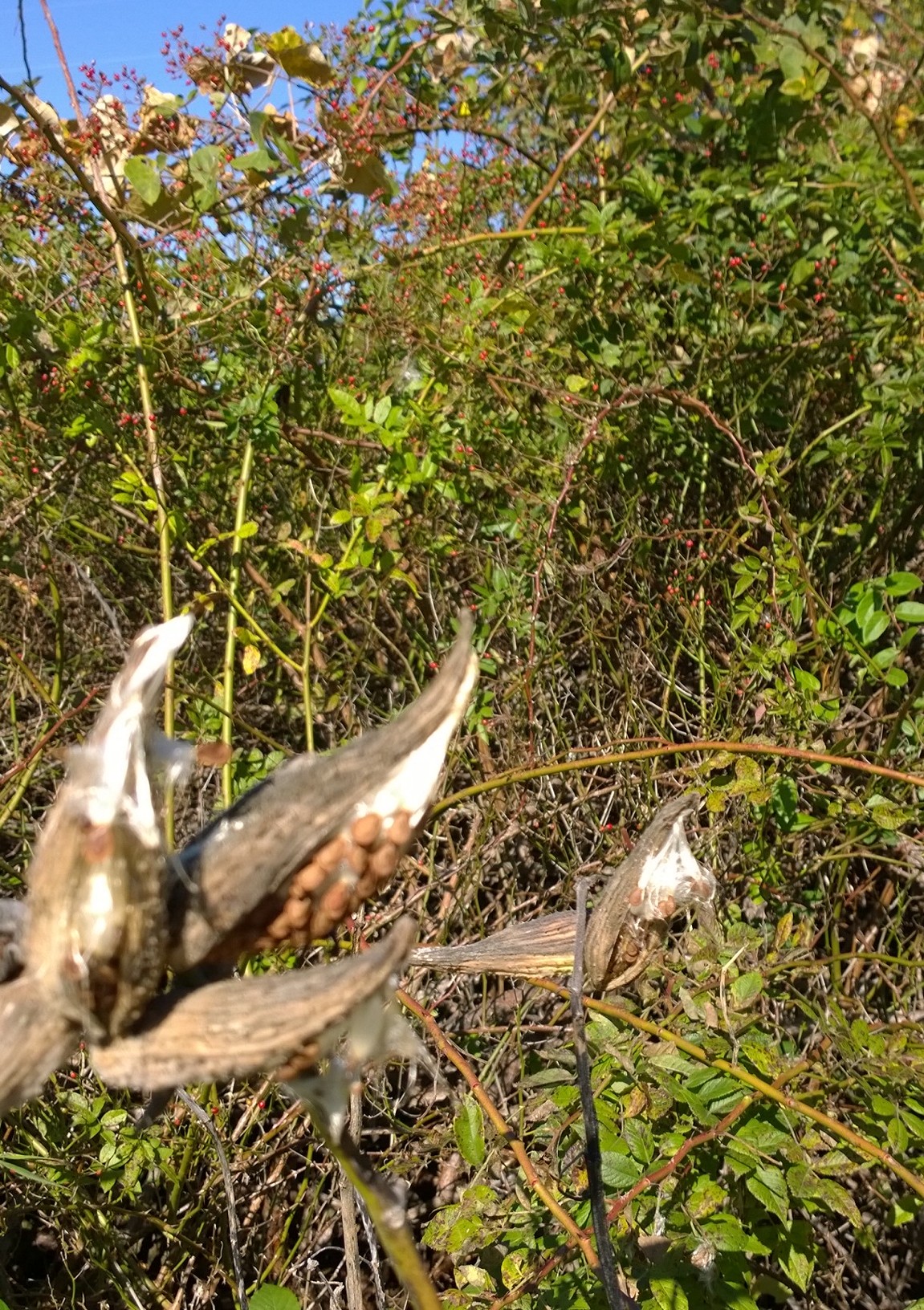
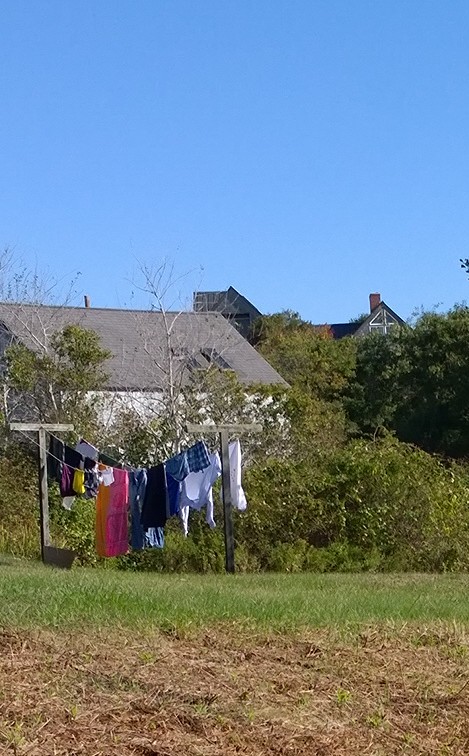
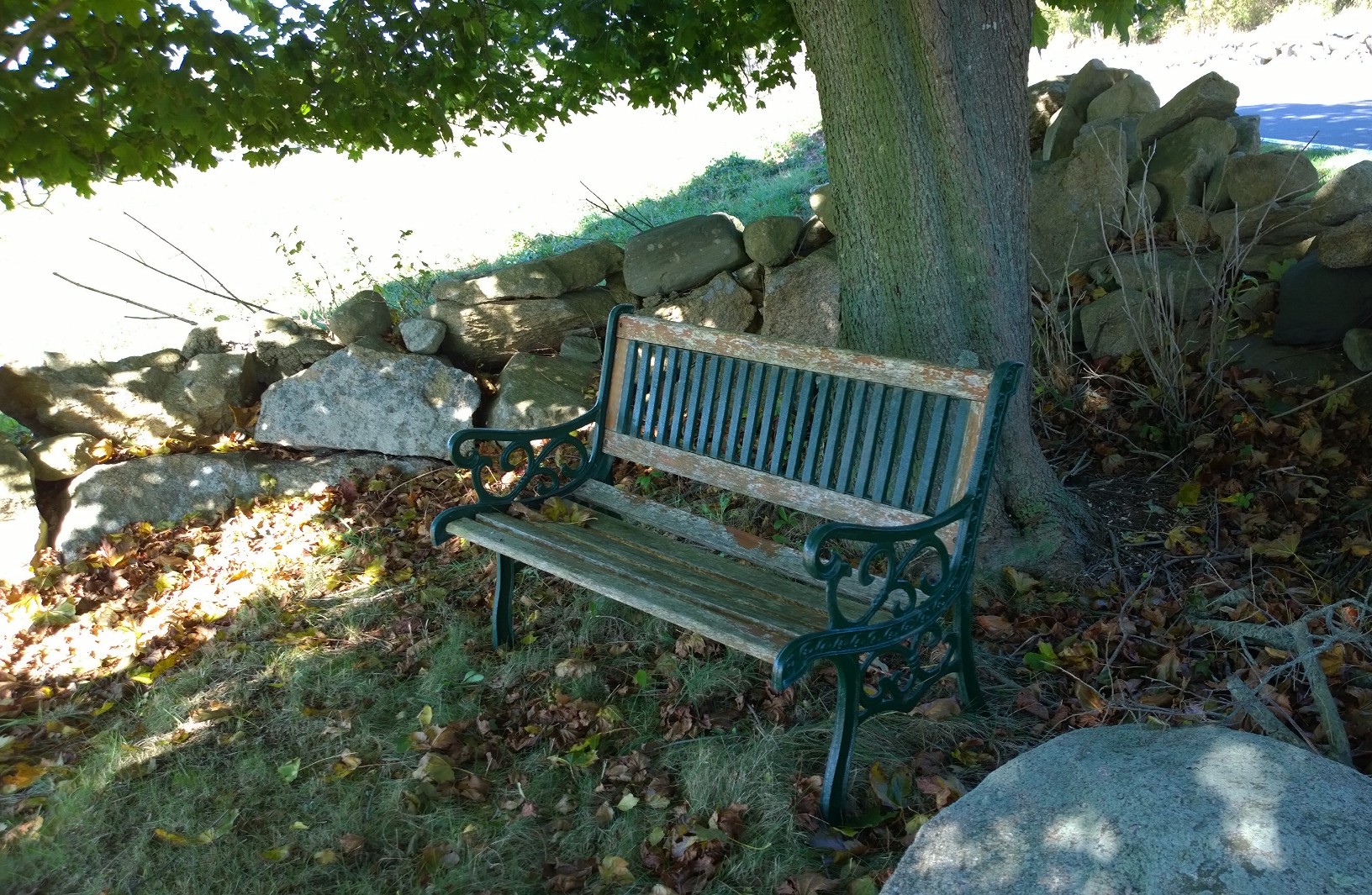
Here are a few autumn photos from the island. The lotus on the left is indifferent to having looked prettier in the summer. It’s still interesting.
I include milkweed about to sow itself to the four winds, clothes drying on a line, a chair that sat on a houseless property all summer, yellow bittersweet with red winterberry, a neighbor’s shed, and leaves collecting by a bench.
Here’s an interesting start-up by a couple of entrepreneurs who love to eat. The two women decided to build a business around helping travelers find truly authentic cooking.
According to Aashi Vel and Steph Lawrence’s website, “Traveling Spoon believes in creating meaningful travel. We are passionate about food, and believe that by connecting people with authentic food experiences in people’s homes around the world we can help facilitate meaningful travel experiences for travelers and hosts worldwide.
“To help you experience local cuisine while traveling, Traveling Spoon offers in-home meals with our hosts. In addition, we also offer in-home cooking classes as well as market tours as an extra add-on to many of the meal experiences. All of our hosts have been vetted to ensure a safe and delightful culinary experience.
“Traveling Spoon currently offers home dining experiences in over 35 cities throughout Bangladesh, Cambodia, China, Hong Kong, India, Indonesia, Japan, Singapore, South Korea, Sri Lanka, Taiwan, Thailand, Turkey and Vietnam, and more countries are coming soon!” More here.
I have no doubt that Traveling Spoon is also boosting international understanding. What a good way to use an MBA! Business school is not all about becoming an investment banker, as Suzanne and Erik would tell you.
Photo: Traveling Spoon
Traveling Spoon founders Aashi Vel and Steph Lawrence met at the Haas School of Business.
A nonprofit book service in Portland, Oregon, has recognized that “people living outside” are as likely to enjoy a book as people who live indoors.
Kirk Johnson writes in the NY Times, “A homeless man named Daniel was engrossed in a Barbara Kingsolver novel when his backpack was stolen recently, and Laura Moulton was determined to set things to right.
“Ms. Moulton, 44, an artist, writer and adjunct professor of creative nonfiction, did not know Daniel’s last name, his exact age, or really even how to find him — they had met only once. But she knew the novel, ‘Prodigal Summer,’ and that was a start. So, armed with a new copy of the book, off she went. Such is the life of a street librarian.
“This city has a deeply dyed liberal impulse beating in its veins around social and environmental causes, and a literary culture that has flourished like the blackberry thickets that mark misty Northwest woods. It is also one of the most bike-friendly, if not bike-crazed, urban spaces in the nation, as measured by commuters and bike lanes. All three of those forces are combined in Street Books, a nonprofit book service delivered by pedal-power for ‘people living outside,”’ as Ms. Moulton, the founder, describes the mission. …
“ ‘It’s not just a little novelty act — “Oh, that’s so Portland and cute,” ’ ” says Diana Rempe, a community psychologist. “Taking books to the streets, she said, sends the message that poor and marginalized people are not so different from the ‘us’ that defines the educated, literate mainstream of the city, whether in its hipsters, computer geeks or bankers.”
Photo: Thomas Patterson for The New York Times Laura Moulton and Matt Tufaro in Portland, Ore. Ms. Moulton founded Street Books, a nonprofit book service for “people living outside.”
When you drop your cellphone on the subway tracks, who ya gonna call?
In New York City, you call the pick-up crew.
According to Matt Flegenheimer in the NY Times, the need for these finders is increasing as travelers seem more distracted than ever.
“The requests trickle through the bowels of the New York City subway system, funneled to workers more accustomed to calls about tunnel fires or ceiling leaks. A problem is reported at Columbus Circle one recent afternoon. A passenger could be in great distress. Delays are minimal, but movement on the tracks has perhaps never been slower.
“So would a crew mind collecting its helmets and hauling its mechanical claw to rescue the turtle — fumbled by a rider — currently plotting its very methodical getaway from Midtown train traffic?
“ ‘It’s a big city,’ a transit worker, Vinny Mangia, had said a day earlier, reciting a mantra of his office. ‘Somebody’s going to drop something.’
“And somebody, if the item is sufficiently treasured, is going to try to pick it up. These are the fishermen of the subway system, cobbling together homemade instruments to pluck items from the tracks and release them to a grateful city.
“Workers have returned a bag of hospital-bound blood and corralled a collection of artificial body parts, scooped engagement rings from the rails and reunited children with stuffed animals. …
“There is the occasional aggrieved passenger, chafing at the response time if a crew is traveling from another call at a far-off station. But almost universally, riders are appreciative. A few have tried to tip the workers, though they say they have never accepted.
“ ‘A little hug, we take,’ Leonard Geraghty said. ‘I usually tell them, if it’s a man: “Take your wife out. Have a good time on us.” ‘ “
Recently, I found myself trying to remember the Middle English opening to Chaucer’s Canterbury Tales, several lines I had to memorize in college. I did memorize them back then, but my professor wasn’t crazy about my pronunciation even though I tried hard to imitate the Middle English record he assigned.
I wish I could remember why I wanted to resurrect Chaucer this week. It might have been that Karl Ove Knausgaard mentioned him admiringly in My Struggle: Book Two, which I’m currently reading.
No sooner had I begun working on “Whan that Aprille with his shoures soote” (“When April with his showers sweet”) than John, all unaware, sent me a John Skelton Middle English video about a parrot.
It’s hard to figure out the words, but the sound of them is lovely. And I do understand the meow, which apparently is a source of anxiety to the parrot.
If you can tell me more about the words, please do. (There is also some Latin and French, to keep us all on our toes.)
As usual, John has a pretty good idea of the kind of story that really floats my boat. Mysterious green balls washing up on the beaches of Australia, Anyone?
The Science Alert website reports that on the weekend of September 20, “thousands of peculiar green balls appeared on Dee Why Beach near Sydney in Australia. About 6 centimetres in diameter, these squishy little spheres are living organisms – seaweed balls known as ‘marimo’.
” ‘They’re actually a really unusual growth form of seaweed, because seaweeds mostly grow on the rocks but occasionally they get knocked off and rolled around in the ocean forming these beautiful little balls,’ Alistair Poore from the University of New South Wales explained to 7News.’It’s quite an unusual phenomenon, it’s only been seen a handful of times around the world.’
“First discovered in the 1820s by Austrian botanist Anton Eleutherius Sauter, and named by Japanese botanist Tatsuhiko Kawakami in 1898 (‘marimo’ roughly means ‘bouncy play ball’ in Japanese), colonies of these little balls have only been seen off the coast of Iceland, Scotland, Japan, Estonia and now Australia.”
Art: Vita Wells
‘Flights of mind,’ 2007. Book, hair, lights, fan, key, screws, hinges, glue.
Maria Popova’s website, Brain Pickings, is a never-ending source of inspiration, and my only regret is that when her e-newsletter arrives each week, there never is enough time to savor it.
In a recent one, she was a reviewed Art Made from Books: Altered, Sculpted, Carved, Transformed, which she got at the library. The pictures are terrific and remind me of other items we’ve featured. (Remember the lead from Asakiyume about the stealth artist in Scotland who made sculptures from books and left them in libraries? I wrote about that here.)
“As a fervent lover of papercraft, book sculpture, and creative repurposing of physical books,” writes Popova at Brain Pickings, “I was instantly taken with Art Made from Books: Altered, Sculpted, Carved, Transformed (public library) — a compendium of extraordinary artworks from the around the world, using the physical book as raw material for creative contemplation and cultural commentary.
“Sensual, rugged, breathtakingly intricate, ranging from ‘literary jewelry’ to paperback chess sets to giant area rugs woven of discarded book spines, these cut and carved tomes remind us that art is not a thing but a way — a way of being in the world that transmutes its dead cells into living materials, its cultural legacy into ever-evolving art forms and creative sensibilities.”
Read more here, and be amazed by the other pictures of book art.
Art: Jennifer Khoshbin
“Prove It,” 2009, cut book.
I like the radio show “Studio 360” for its kooky interviews. Comedienne and multifaceted creative force Jenny Slate provided an especially fun one this weekend.
Jenny, now 32, graduated as valedictorian from Milton Academy in Milton, Mass., and suffered through the dubious distinction of being hired and fired by “Saturday Night Live” at a young age. The daughter of a poet and a ceramic artist, she is creative enough to keep reinventing herself.
Just for no reason, she made an oddball video that went viral, “Marcel the Shell with Shoes On,” which her husband filmed using stop-motion. It’s about an extremely awkward and self-deprecating snail.
You can read more about Jenny at wikipedia, here. Listen to the interview at Studio 360, here, and look for Jenny’s “Catherine” series on YouTube. It’s even more offbeat than “Marcel the Shell.”
And speaking of schools that develop a love of the natural world, check out this story from the radio show Living on Earth.
“On the other side of the world, in the tourist paradise of Bali, there’s a school that the U.S. Green Building Council named the greenest school on Earth for 2012. It’s called the Green School, and it educates some 300 students from 25 different countries. Living on Earth’s Bobby Bascomb went to check out what’s so green about the school.”
Among the people he spoke with was Charis Ford, director of communications for the Green School.
“BOBBY BASCOMB: It rains a lot in Bali. Humidity and bugs typically destroy a bamboo structure in about 4 years, but the Green School buildings should survive 20 years or more.
“CHARIS FORD: We use treated bamboo, but it’s been treated with salt essentially. We heat water and we submerge the bamboo poles into the saltwater and it makes the bamboo unpalatable to termites and mold and funguses and other things that would biodegrade the bamboo. …
“FORD: All the building companies that he spoke with were like well, ‘You have to have walls. All schools have to have walls,’ and John [Hardy, a Canadian jewelry designer who moved to Bali in the 1970s and founded the school] said, ‘Why do they have to have walls?”’ They rubbed their chins and scratched their heads and said, “’Well, where are the kids going to hang the art?’ As it turns out, you don’t have to have walls. And we don’t have walls and we’re quite happy about it.
“BASCOMB: Just outside the classroom, a chicken wanders through a patch of green beans. Gardens are everywhere, integrated throughout the campus. They mimic a natural forest ecosystem using edible plants, a design called permaculture.
“FORD: When you wander around Green School’s campus, you might think it looks kind of like it’s wild, but then as you tune in and look at the plants that you’re around, you’ll see that that’s a bean trellis, and that’s a guava tree, and that’s ginger. Even though it looks like a jungle setting, you get a little closer and you see that’s chocolate — cacao pods — hanging from a tree next to you.” Lots more here. You also can listen to the recording of the radio interview.
Photo: Mark Fabian
On extremely hot days a canvas envelope can be pulled around a wall-less Green School classroom so cool air can be piped in to keep kids comfortable.
As a kid of 10 or so, I played in the woods, frequently all alone. It was magical.
As an adult, I wonder if it’s no longer considered safe. I don’t ever hear of children playing in the woods. That’s why I was interested to read about a growing movement called Forest Schools.
Siobhan Starrs writes for the Associated Press, “In the heart of north London lies the ancient Queens Wood, a green forest hidden away in a metropolis of more than 8 million residents. The sounds of the city seem to fade away as a group of children plays in a mud kitchen, pretending to prepare food and saw wood.
“These aren’t toddlers on a play date — it’s an unusual outdoor nursery school, the first of its kind in London, following a trend in Scandinavia, Germany and Scotland. It allows local children to learn, and let their imagination run free, completely surrounded by nature. …
“Each morning a group of children gather at the Queens Wood camp, which the nursery team prepares each morning before the children arrive. A circle of logs provides a place to gather for snacks, stories and songs. The mud kitchen provides an opportunity to make a proper mess and have a sensory experience, a rope swing provides some excitement and a challenge, and several tents are set up for naps and washing up.
“In a clearing in the woods, a fallen tree trunk can be transformed by imagination into a rocket train, calling at the beach and the moon, with leaves for tickets.
“A 2-year-old, Matilda, finds a stick — but in her mind it’s not a stick. It’s a wand. She says she is a magic fairy who can fly. Then suddenly the stick has become a drum stick, and a gnarled tree stump her drum. She taps away contentedly, the rhythm all her own.” Read more here.
Speaking of fallen tree trunks, I particularly remember a big tree that fell in the forest after a storm and the fun a friend and I had making up stories on it.
Photo: Matt Dunham/AP
Forest schools are increasing in popularity in the United Kingdom.
According to the website Days of the Year, today was Custodial Worker Day. I learned this by following a link at an Andrew Sullivan post.
Andrew quotes Megan Garber at the Atlantic, who writes, “Micro-holidays, which teeter somewhere in the center of the continuum between universality and irrelevancy, are political. They do what all holidays will, in the end: convene our attention around a cause. But they are different from official holidays in one crucial way: They are opt-in. …
“They’re about finding communities of like minds within the social chaos of the Internet. Every year, people will discover delightfully nerdy new ways to celebrate National Grammar Day – and they will do that in part because they are self-identified grammar nerds. Who are sharing a thing with other self-identified grammar nerds. … It says something, also, about what they want to share as people.”
By the way, Friday is Boyfriends Day, Virus Appreciation Day, and two other special days. Saturday has six micro-holidays, including World Card Making Day, Ship in a Bottle Day, and Taco Day.
You can sign up here to be notified about what each new day brings to celebrate.
John found a sweet little video clip of the 1955 Danny Kaye film The Court Jester featuring my favorite lullaby.
I often sing “I’ll Take You Dreaming” to my grandchildren, and I sang it to John when he was a baby and to Suzanne. (A pre-verbal Suzanne used to make a squeaking noise when I came to the word “dreaming,” and I finally figured out she thought the word was “screaming.”)
The YouTube video refused to embed, try as I might, and as I poked around the web for another video, I came on some information about Danny Kaye, who was hilarious in that movie. I never saw my mother laugh so hard. The lullaby was one of the few quiet places.
“Danny Kaye left school at the age of 13 to work in the so-called Borscht Belt of Jewish resorts in the Catskill Mountains. It was there he learned the basics of show biz. From there he went through a series of jobs in and out of the business. In 1939, he made his Broadway debut in Straw Hat Revue, but it was the stage production of the musical Lady in the Dark in 1940 that brought him acclaim and notice from agents.”
Oh, boy, I saw a production of Lady in the Dark in the 1980s at the Boston Conservatory. What a show!
“Samuel Goldwyn had been trying to sign Kaye to a movie contract for two years before he eventually agreed. Goldwyn put him in a series of Technicolor musicals, starting with Up in Arms (1944). His debut was successful, and he continued to make hit movies such as The Secret Life of Walter Mitty (1947) and The Inspector General (1949). In 1954, he appeared with Bing Crosby in White Christmas (1954), which was based on the Irving Berlin song of the same name. In 1955, he made what many consider his best comedy, The Court Jester (1955). …
“He also worked tirelessly for UNICEF.” More at IMDb.
You can find the lullaby scene on YouTube. I thought the sound quality was best here.
Studio publicity photo of actor and comedian Danny Kaye.








 Suzanne's Mom's Blog
