My friend Ronnie is a former broadcaster, a poet, and a food maven, who lived in France for years and later wrote a book called Eat Smart in France. Recently Ronnie interviewed the mystery writer Cara Black for a blog called My French Life. Black writes about Paris. Her latest novel is Murder in Pigalle.
Ronnie asks, “What drew you to this part of town?
Black: “There are two worlds in Pigalle. The world of the day with families and people who work in the shops, and the world of the night, where people work in the clubs. …
“I really like Pigalle. I discovered so much I didn’t know. [But] I get intrigued by different districts, their flavor and feeling. If I ever figure them out, I’ll probably stop writing about them.” More of the interview here, including a observations on the German occupation of Paris during WW II.
For a wonderful, unusual book with the occupation of Paris as a setting, I recommend Léon and Louise. It’s an odd love story taking place over many decades in France, written by a Swiss and translated into English. I haven’t read many books by Cara Black, but if you like novels that teach you something about a different part of the world in a rather fanciful way, I recommend Léon and Louise, by Alex Capus.
Before Suzanne met Erik, she lived for a few years in Lugano, Switzerland. When I visited her, I took in the art museum and remember being exposed to the work of Austrian painter Egon Schiele for the first time.
Today Andrew Sullivan had a post about Museo d’Arte di Lugano, and naturally I zeroed in.
Andrew quotes Andy Cush on the museum’s latest exhibit: “36 ventilators, 4.7m3 packing chips, a new installation from the Swiss artist Zimoun … The artist filled a space inside Switzerland’s Museo d’Arte di Lugano with lots and lots of polystyrene packing peanuts, and uses 36 fans to whip them into a stormy frenzy.”
Watch the video of crashing packing-popcorn waves at Andrew Sullivan’s blog, here.
Lugano is a charming, Italian-speaking city. I passed through there as a teenager, with no premonition of my future connection to the place, just astonishment at palm trees in snow-capped Switzerland. Funny how things turn out.
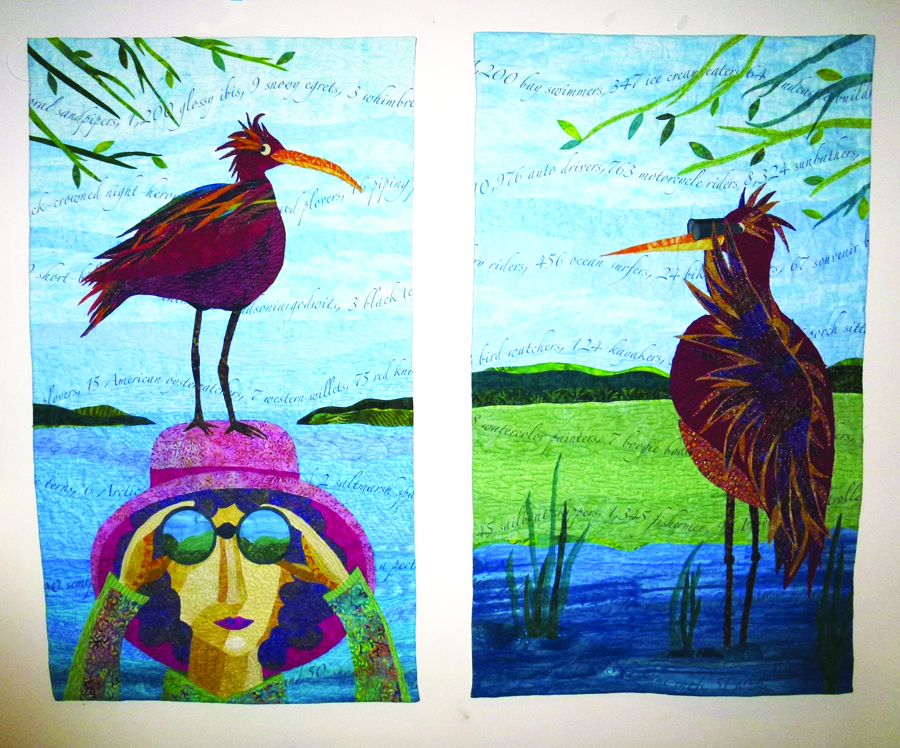
Although I have known Julie Weinstein mostly as a graphic designer, I learned from many conversations over the years that she has experience in a variety of fields. Lately she has been concentrating on quilting.
I went to see the delightful pieces below at the Emerson Community Arts Center’s Earth Month exhibit, “Life on the Edge.” Completely charming. The panels were inspired by seeing birdwatchers and wondering if the birds watch the watchers. In one panel a woman is birdwatching with binoculars. In another, a bird lifts binoculars to study the woman.
The Umbrella website says, “This year’s theme, ‘Life on the Edge,’ invites us to consider those experiences and places where people and habitats intersect. Also called ecotones, liminal or transitional zones, these points of intersection can spawn collaboration, conflict, beauty, chaos, change, and more.” The show is up until May 5. More details here.
Interesting to see the word “liminal” used for the intersection of people and habitats. At Asakiyume’s blog, her literary readers use liminal and the word “interstitial” to refer to places between worlds and ways of being. Like the platforms where Harry Potter catches a train that ordinary people can’t see.
Come to think of it, that is not so different from the intersection of the natural world and the developed one the art show describes. It’s a place where you might see three large wild turkeys sashaying down the middle of a downtown street, as my husband and I did on a recent Sunday morning.
Vanessa Gould, the sister of one of Suzanne’s elementary school buddies, is a documentarian. A while back, she made a Peabody-winning film about makers of advanced origami called Between The Folds. More recently, she was given unheard-of access to the New York Times obituary desk.
Her parents just sent an e-mail about the resulting movie and what Vanessa has been up to in general.
“Vanessa recently worked on Showtime’s Years of Living Dangerously, a nine-part series tackling the challenges of climate change. … Vanessa was a producer on several of the stories and did additional cinematography on others. You can see most of her work in episodes three (“Super Storm Sandy”) and nine (“Chilean Andes”). Episode three, “The Rising Tide” with Chris Hayes, airs tonight, Sunday, April 27, at 10 pm on Showtime. … Here are links: http://www.yearsoflivingdangerously.com and https://www.facebook.com/YearsOfLiving. …
“Soon after making Between The Folds, one of the artists in the film passed away. Vanessa alerted the Times of his death, aware that it was unlikely they would run an obituary. And yet – somewhat amazingly – they did, and she assisted them in the unusual process of putting together an editorial obituary. Only three or four such obituaries are written by the NYT staff each day. The whole story of how these obituaries are selected and written, as well as the social history they tell, became her fascination. Hence OBIT will be her next film. Check out these links: http://www.obitdoc.com, http://www.greenfusefilms.com, and www.vanessagould.com.”
I wonder if OBIT will show to what extent the obituaries of famous people are written before they shuffle off this mortal coil. Come to think of it, do any newspapers let people submit their own obit in advance? I recently read a hilarious one that a small paper accepted from the deceased at the insistence of his grandson. It revealed a guy with a terrific sense of humor — not a bad tribute.
Funny thing about memory. I went on Google to find a children’s book my mother liked to read to the children. I thought it was called Gabriel Churchmouse, but in fact it was Peter Churchmouse. It was the churchkitten who was called Gabriel.
Other people on the Internet had similarly fuzzy memories. One person thought the phrase “I could listen and listen and listen” referred to words that one character heard another say, but I am reasonably sure the phrase was what Gabriel said to Peter when the churchmouse played the organ (or maybe when Peter sang; a picture comes back to me of Peter raising his eyebrows when he sang).
Amazon describes the book thus: “Cute story about Peter, a churchmouse who was so hungry he ate the hymn books. A cat was brought to get rid of him as he was thought to be a rat. When Peter found out the cat was a kitten and the kitten found out the rat was a mouse they grew into a close friendship!”
Peter was eating hymnals to alert the parson to the existence of a hungry churchmouse. He knew that every parson loves a churchmouse. But Parson Pease-Porridge, who was given to exclaiming, “I’ll be twitched!” and was in need of decent glasses, thought the large bites must belong to a rat.
Here’s a description from an Amazon customer: “Beautifully illustrated, tenderly told stories about a soft-hearted, near sighted, sleepwalking parson, a Churchmouse (not rat!), church kitten and (puppy) dog all learning to live with, and despite, each other. The stories will teach tolerance to young children, and are amusing and witty, too, for older readers, including adults. I read these stories to my daughter 30 years after my mother read them to me and I suspect my daughter will be reading them to her children as well.”
Well, that would be if she can find a copy. The series, by Margot Austin, is out of print. Read about Austin (1907-1990) on Wikipedia, here.
An animated 1944 short film about another book in the series, Gabriel Churchkitten, lacks Austin’s adorable illustrations, but has the benefit of reminding me that Gabriel had a thinking cap and that there was a churchpuppy called Trumpet.
Photo: Masaki Miya et al. Wikimedia Creative Commons
Anglerfish use bioluminescence to attract their prey in the darkest depths of the ocean.
When John was little, he liked a book called Fish Do the Strangest Things. Strangeness is a great focus for a nature book, because everyone likes offbeat critters.
Steve Curwood, founder of the radio show Living on Earth, recently interviewed the author of a book that focuses on the strangeness of ocean life.
CURWOOD: “In an engaging new book called The Extreme Life of the Sea, biologist Steve Palumbi and his novelist son Tony deepen our understanding of how strange sea life has managed to survive against all odds. … Why did you write this book. Why now?
PALUMBI: “Well, the real reason is that we’re trying an experiment: can you take the narrative style and approach that a novelist would use and combine it with what a scientist would do? … You don’t really care about the plot until you care about the characters, and so we wanted to write a book that made you care about the characters.
CURWOOD: “Now, you write about the extreme life of the sea, the oldest, the hottest, the shallowest, to name a few. Why did you choose this approach?
PALUMBI: “Because it was a way of getting people’s attention to the really sort of amazing things that these critters do. Organisms in the sea live in some of the hottest places, they live in some of the coldest places, and how they do that is something marine scientists have paid a lot of attention to. So it was really a way to make it more engaging, more fun, and to let us move credibly between different kinds of organisms all in the same chapter. …
CURWOOD: “You had one extreme that you called immortal.
PALUMBI: “That’s an amazing jellyfish called turritopsis, and it has the remarkable ability to age in reverse. So when the environment is bad, this animal can essentially go from its adult body form back, back, back to its larval form, and then start all over again. … It’s called transdifferentiation. It’s the only critter known to be able to do that.”
More here, where you can read the rest of the transcript and listen to the recording. It’s all pretty amazing.
Photo: Eddie Welker, Flickr Creative Commons 2.0) Clownfish
One of the great things about going for a walk is that your mind just wanders off on its own. You never know what it will bring back.
Today as I was walking, a phrase popped into my head that I haven’t thought of in decades: gooper feathers. As a very little girl, I liked to watch my father shave. When he was done, he would show me how soft his cheek was. He would say, “See: gooper feathers.”
I have no idea why I thought of that today. But I had to go to Google and see what I could learn. Here’s all I found about gooper feathers: “The fuzz from peaches, according to an Amos ‘n’ Andy phonograph record from the late 1920s or thereabouts.”
Two other old-timey things got looked up today. After I said to Bob, who was getting into the up elevator when he wanted to go down, “Wrong-way Corrigan,” he looked the guy up.
You can click on the NY Times and Wikipedia learn about Corrigan. Here’s Wikipedia: “an American aviator born in Galveston, Texas. He was nicknamed ‘Wrong Way’ in 1938. After a transcontinental flight from Long Beach, California, to New York, he flew … to Ireland, though his flight plan was filed to return to Long Beach. He claimed his unauthorized flight was due to a navigational error … He had been denied permission to make a nonstop flight from New York to Ireland, and his ‘navigational error’ was seen as deliberate.”
That train of thought led me to One-Eyed Connelly. My father used to call a rather bold pigeon of his acquaintance One-eyed Connelly because the bird would alight on the deck and sashay into the house through any open door. The original One-eyed Connelly was a famous gate crasher. A former bantam weight boxer from Boston, Connelly began crashing events in the early 20th century, sometimes pretending to be a deputy sheriff. Read that character’s story in the 1953 Milwaukee Journal.
Late Sunday night, Kevin, a colleague who is a bicyclist, completed the Midnight Ride.
It’s an event that started a few years ago when one guy suggested to some fellow bikers that they bike the Boston Marathon route the night before the big event.
Stacey Leasca of the Los Angeles Times has the story.
“For the last six years, the Midnight Marathon Bike Ride has covered the Boston Marathon course the night before the race, as a way for more Bostonians to take part.
” ‘It was a way for me, who is not a runner, to connect with Boston, to connect with all this marathon energy,’ said Greg Hum, the ride’s originator.
“Although the Boston Athletic Assn., which oversees the Boston Marathon, has never officially sanctioned the ride, it has become a celebrated tradition to help kick off Marathon Monday.
“The night before the 2013 race, the Massachusetts Bay Transportation Assn. even provided riders with a special commuter train to get them to the start of the route.
“This year, however, race officials and the Massachusetts Emergency Management Agency asked that the ride be canceled, and the MBTA did not offer its Midnight Marathon train. …
“But the Midnight Marathon had momentum that he and the agencies could not derail.
“Once word spread that there would be no train from downtown Boston to the starting line, riders began organizing carpools, vans, trucks and even a few buses via social media to help get them to the start.”
Kevin said Hum really wasn’t an organizer, just a guy whose idea grew, and he didn’t know any way to call it off. So it happened. There were people cheering along the route, even that late. Kevin got home at 2 a.m., exhilarated. His toddler woke him bright and early on Patriots Day, the day closely associated with another midnight ride.
It may get colder, but there’s no turning back now. It’s spring for sure.
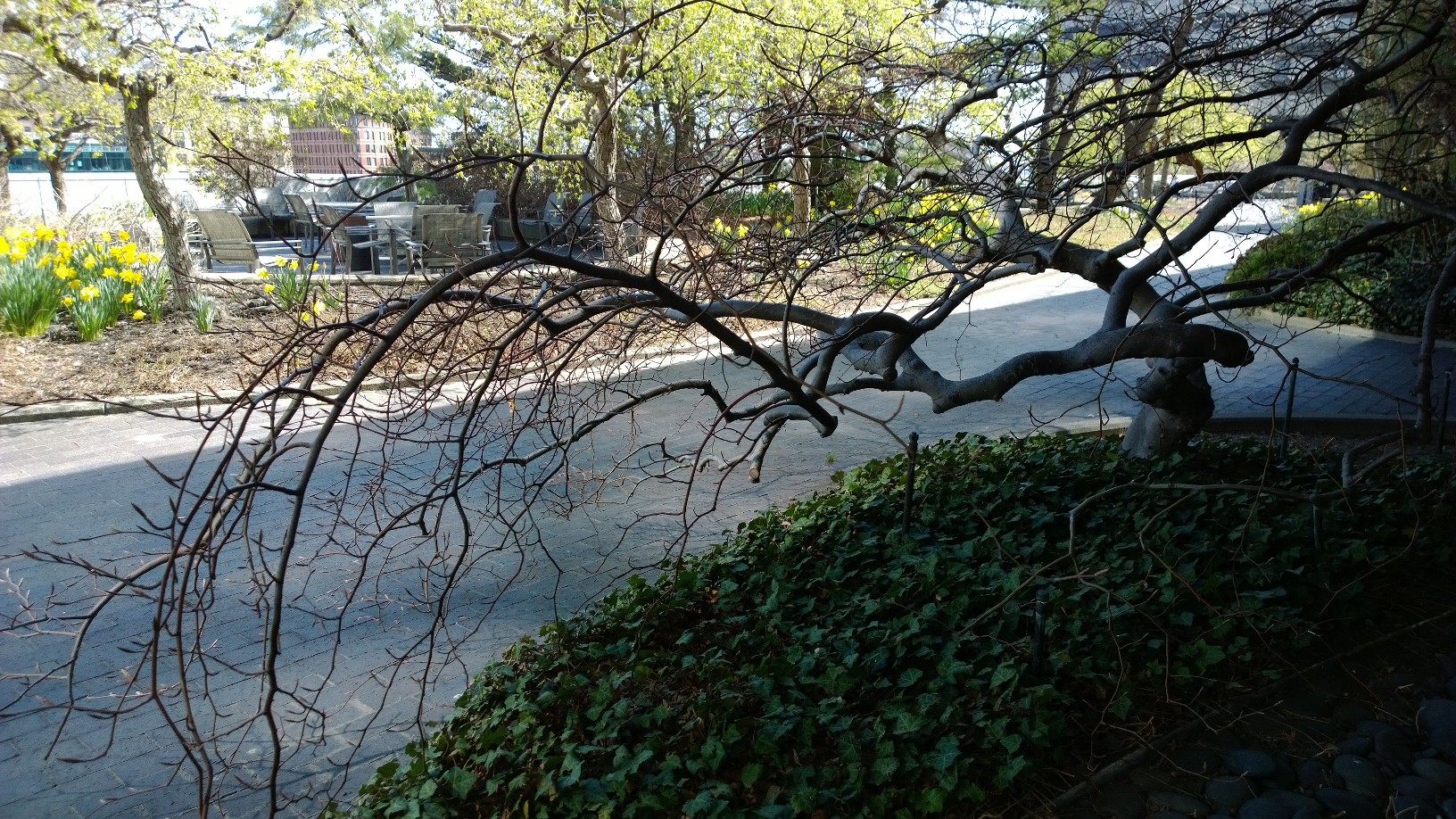
Here is a greening-up roof garden maintained by a brilliant landscaper at work. The tree in the foreground is my second favorite of his twisty trees. The first favorite is behind glass, and when I try to snap it, I just get a picture of Suzanne’s Mom taking a picture.
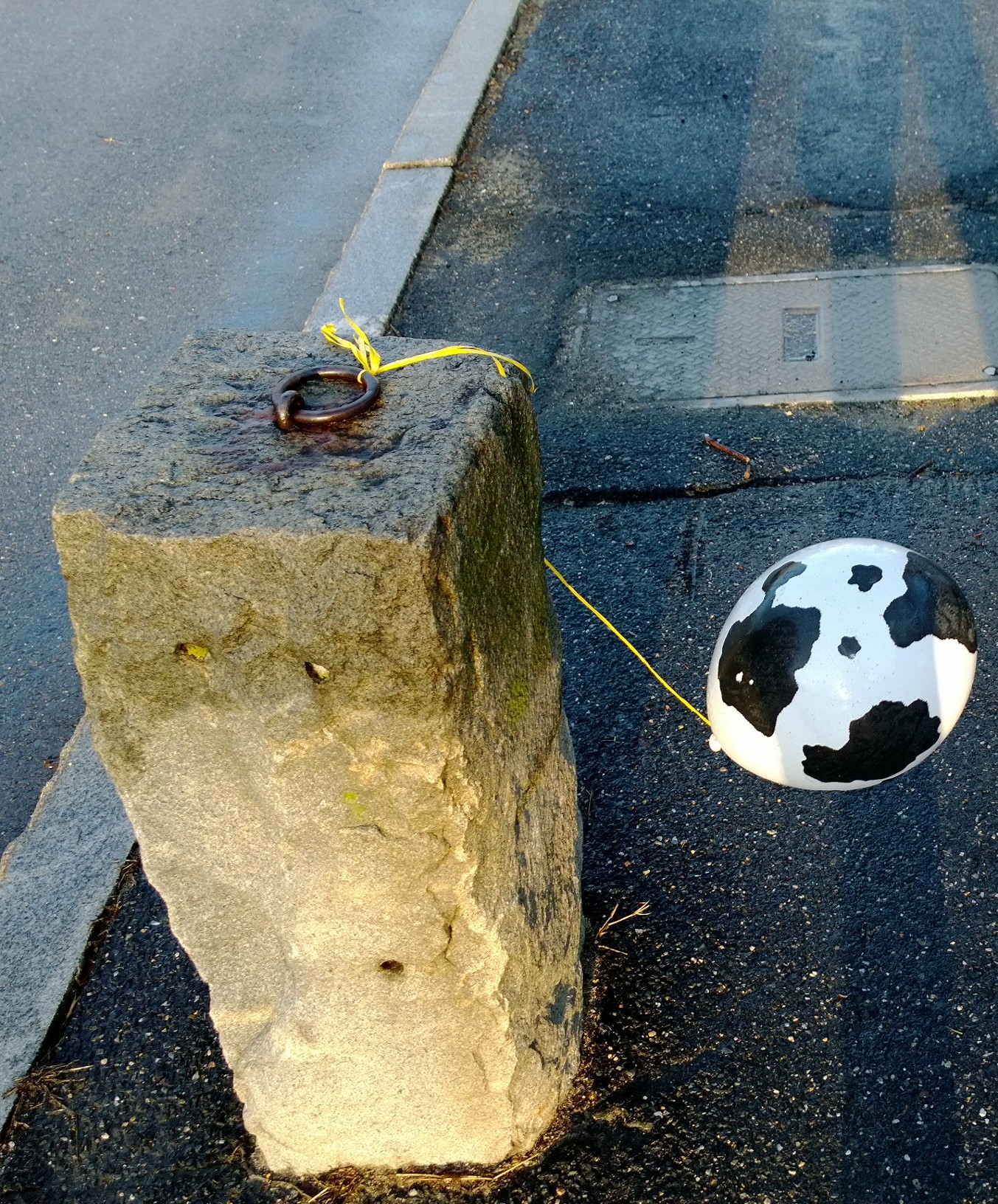
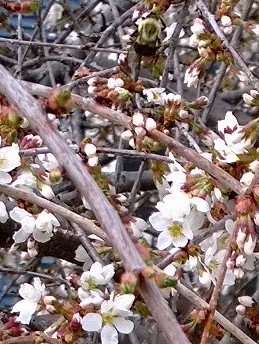
In other photos: The wind was causing a cow balloon to pull against its tether. A bumblebee was one of 20 in my neighbor’s weeping cherry. See it at the top of the picture.
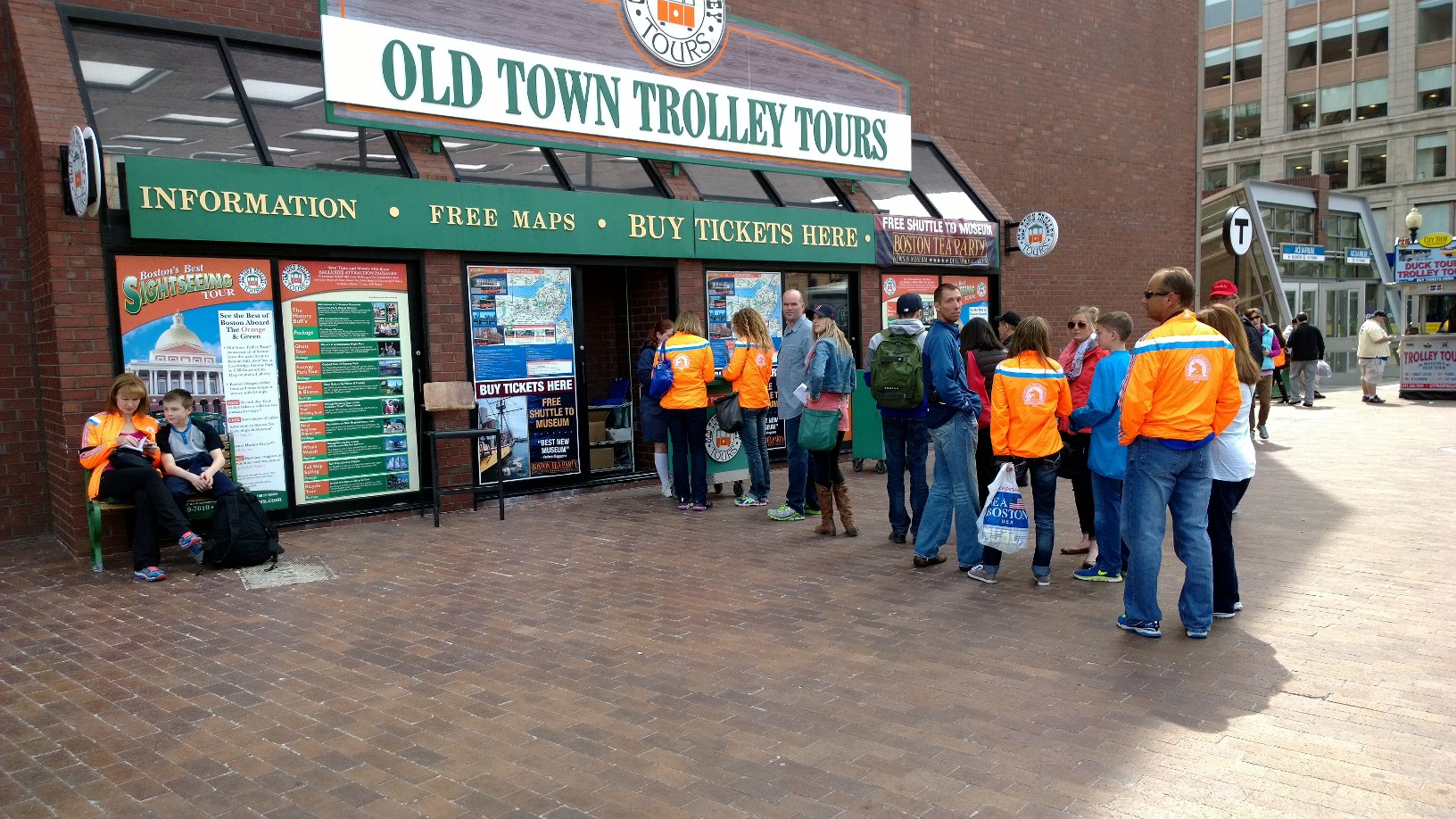
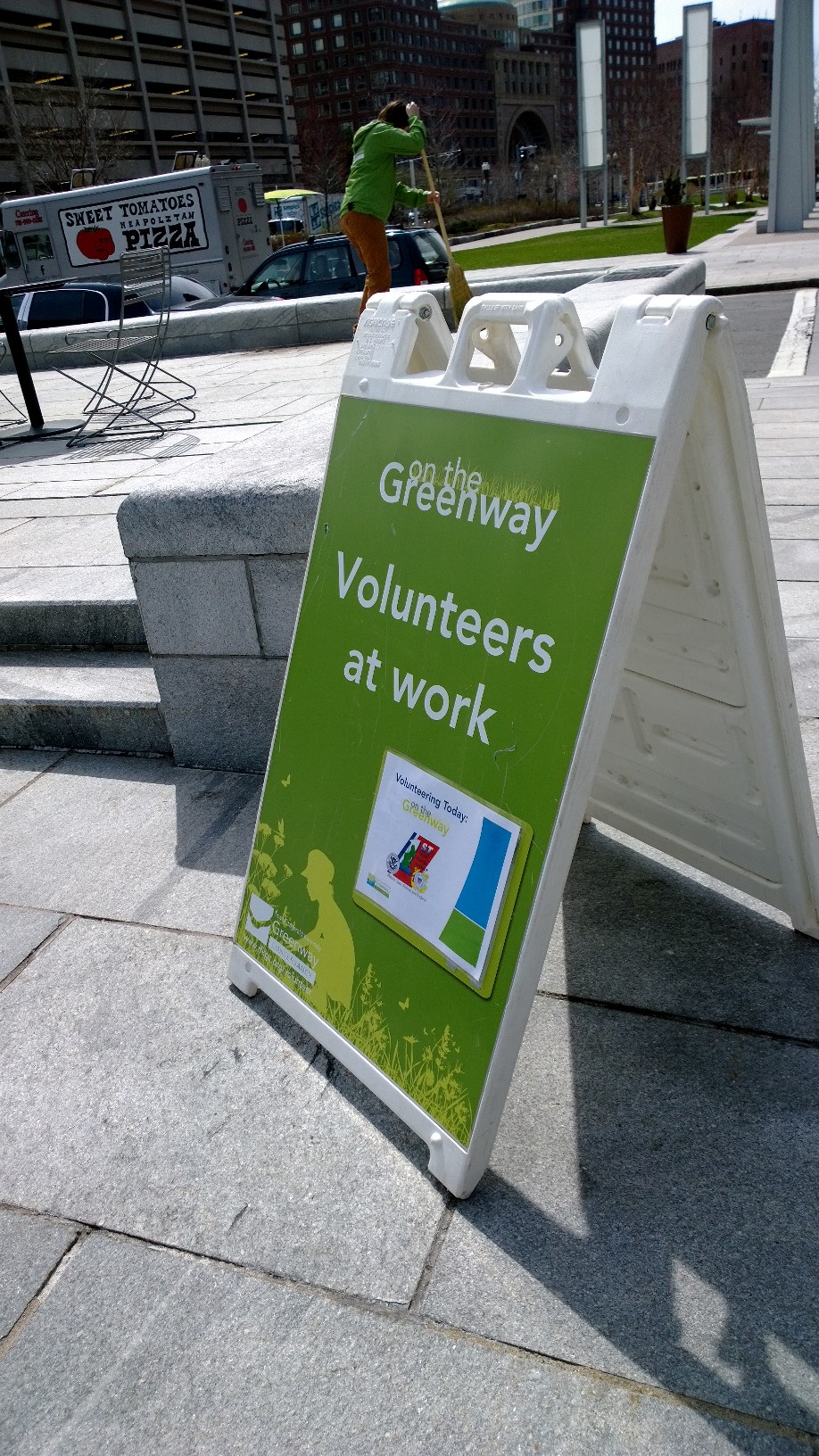
Orange jackets from yesterday’s happy Boston Marathon were lined up for a city tour. And in the Rose Kennedy Greenway, several organizations, including the Coast Guard and Life is good were volunteering for clean-up duty as part of Earth Day.
And speaking of Earth Day, you can enjoy a genuine earthy-crunchy Earth Day celebration in Concord on Saturday. The parade is always a hoot. Check out details here.
There is a constant drumbeat in the news these days about the cost of college. Of course, it’s not really news. Families have struggled to pay for generations, and there have always been students who worked their way through (Suzanne’s dad, for one). And there have always been a few institutions seeking ways to help them.
Lisa Rathke writes in the Boston Globe about today’s “work colleges,” which believe that working your way through has many advantages, especially if all students are in the same boat.
She writes, “After college, many students spend years working off tens of thousands of dollars in school debt. But at seven ‘Work Colleges’ around the country, students are required to work on campus as part of their studies — doing everything from landscaping and growing and cooking food to public relations and feeding farm animals — to pay off at least some of their tuition before they graduate.
“The arrangement not only makes college more affordable for students who otherwise might not be able to go to school, it also gives them real-life experience while teaching them responsibility and how to work together, officials said. …
“With rising college costs and a national student loan debt reaching more than $1 trillion, ‘earning while learning’ is becoming more appealing for some students. But the work-college program differs from the federal work-study program, which is an optional voluntary program that offers funds for part-time jobs for needy students.
“At the seven Work Colleges — Sterling College, Alice Lloyd College in Pippa Passes, Ky., Berea College in Berea, Ky., Blackburn College in Carlinville, Ill., College of the Ozarks in Lookout, Mo., Ecclesia College in Springdale, Ariz., and Warren Wilson College in Asheville, N.C. — work is required and relied upon for the daily operation of the institution, no matter what the student’s background.” Read more.
Photo: Sterling College via Associated Press At the seven Work Colleges, it’s not optional: Students must hold jobs during their undergraduate careers and pay off some of their tuition before they graduate.
Even though it was a bit chilly early on, the flowering trees and sunshine suggested that spring isn’t going back on us.
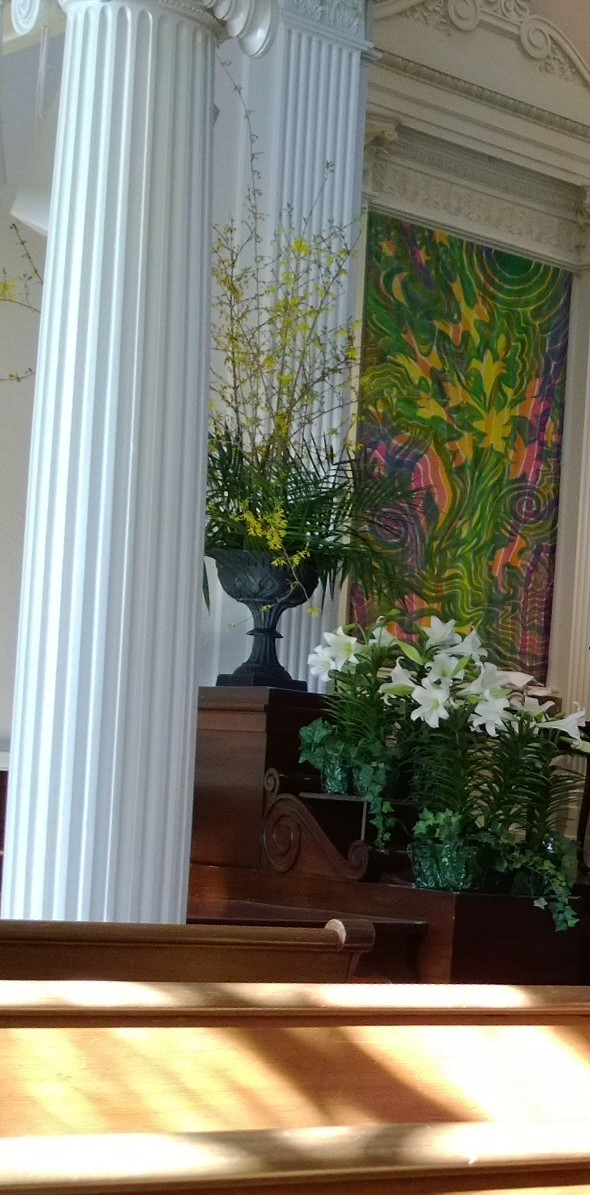
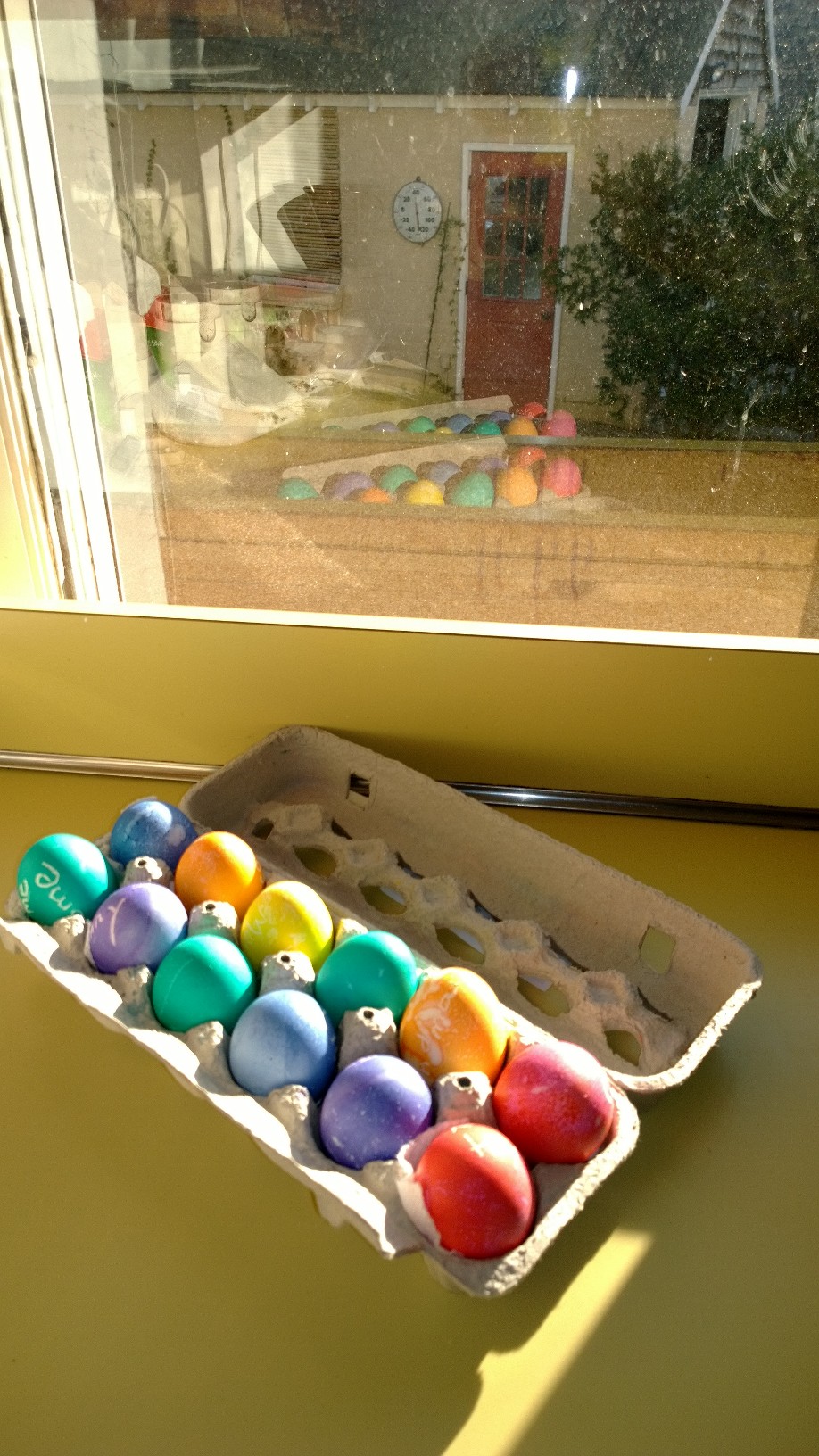
After church, we had a lively, chaotic Easter egg hunt and marching band with grandkids who are 1, 2, and 4 and very funny.
Then came a leisurely brunch with a beautiful fruit salad from my daughter-in-law, and new recipe for egg strata that turned out very well.
My husband and I got a little bonus time with Suzanne and Erik as the three of us tried to tire out the two-year-old in the playground before his car ride back home.
Suzanne is always up for an Easter egg hunt. In fact, Liz, her roommate, used to do the honors for her back in college. Liz sent Suzanne a text this year to make sure that everyone’s Easter was being taken care of.
Whatever you celebrate, I hope you had a sunny weekend.
A Syrian actor who visited a refugee camp, felt compassion for the children, and returned to help them put on a play decided to start at the top. Only the best playwright would do.
From the Zaatari refugee camp in Jordan, NY Times reporter Ben Hubbard describes the scene: “On a rocky patch of earth in this sprawling city of tents and prefab trailers, the king, dressed in dirty jeans and a homemade cape, raised his wooden scepter and announced his intention to divide his kingdom. His elder daughters, wearing paper crowns and plastic jewelry, showered him with false praise, while the youngest spoke truthfully and lost her inheritance.
“So began a recent adaptation here of King Lear. For the 100 children in the cast, it was their first brush with Shakespeare, although they were already deeply acquainted with tragedy. All were refugees who had fled the civil war in Syria. …
“ ‘The show is to bring back laughter, joy and humanity,’ said its director, Nawar Bulbul, a 40-year-old Syrian actor known at home for his role in ‘Bab al-Hara,’ an enormously popular historical drama that was broadcast throughout the Arab world.
“Last year, he and his French wife moved to Jordan, where friends invited him to help distribute aid in Zaatari. …
“Children he met in the camp made him promise to return, and he did — with a plan to show the world that the least fortunate Syrian refugees could produce the loftiest theater. …
“The mere fact that the play was performed was enough for the few hundred spectators. Families living in nearby tents brought their children, hoisting them on their shoulders so they could see. …
“The crowd burst into applause, and a number of the leading girls broke into tears. Mr. Bulbul said they were overwhelmed because it was the first time anyone had clapped for them.”
More here, at the NY Times, where you can also see a slide show and watch a video about the refugee-camp theater initiative.
Winter seems to be hanging on, so it’s not too late to blog about the Apostle Islands and the sea caves in winter.
My husband and I visited the Apostle Islands 16 years ago, almost to the day. We stayed in a pleasant B&B that had a waitress who, my husband recalls, acted like one’s sojourn there “was the experience you had been waiting for your whole life.” We drove around and tried to keep warm. I’m looking at a pottery pitcher with an apple on it that we bought in a little shop.
At the New Yorker, Siobhan Bohnacker introduces a slide show on the sea caves, calling them “Cathedrals of Ice.”
“This past February, thanks to an unusually cold winter, the sea caves along the Apostle Islands National Lakeshore, in northern Wisconsin, were accessible by foot for the first time in five years. Visitors were able to walk two miles over the thick ice of Lake Superior to see the ice formations that run up the coastline. Erin Brethauer, a photographer living in North Carolina, visited …
“Describing the trek to the caves, Brethauer told me, ‘A steady stream of people cut a colorful line on the horizon. More than a hundred and thirty-eight thousand people visited the ice caves this winter, up from twelve thousand seven hundred in 2009.’ …
“The shorelines along the Apostle Islands have been slowly shaped by the movement of the water of Lake Superior, and by its annual freezing and thawing. Sea caves, which resemble honeycombs, are sculpted in the course of centuries by waves breaking onto cliffs. This impact creates what are called reëntrants, or angular cavities that tunnel into cliffs. When reëntrants join behind the cliff face, sea caves result. When water is trapped in the caves and cavities, and freezes, dramatic ice formations occur.
“Brethauer said, ‘We were struck by the size and coloring of the ice along the coastline. Some ice was a pale blue, while other formations were yellow or reddish, depending on the sediment the water collected when it was freezing. … I loved watching how people interacted with the caves and ice, climbing or taking pictures. They provided such scale and added to your feeling of wonder. And then, stepping inside one of the caves, looking up, and listening to the silence or the ricochet of sound, it felt like being in a cathedral.’ ”
It’s been surprisingly cold this April week, but at least we have had some sunshine. What if we lived in Norway, where people go for months without the sun? How would we manage? For that matter, how do Norwegians manage?
Suzanne Daley writes in the NY Times about one Norwegian town that got fed up with light deprivation and decided to try something new.
“Yearning for sunlight has been a part of life in [Rjukan, a] quaint old factory town in central Norway for as long as anyone can remember. Here, the sun disappears behind a mountain for six months of the year.
“It is worse for newcomers, of course, like Martin Andersen, a conceptual artist who arrived here 12 years ago and would find himself walking and walking, searching for any last puddle of sunshine to stand in. It was on one of these walks that he had the idea of slapping some huge mirrors up against the mountain to the north of town and bouncing some rays down on Rjukan.
“The town eventually agreed to try, and last fall, three solar- and wind-powered mirrors that move in concert with the sun started training a beam of sunlight into the town square. Thousands of people turned out for the opening event, wearing sunglasses and dragging out their beach chairs. And afterward, many residents say, life changed.
“The town became more social. Leaving church on Sundays, people would linger in the square, talking, laughing and drinking in the sun, trying not to look up directly into the mountain mirrors. On a recent morning, Anette Oien had taken a seat on newly installed benches in the square, her eyes closed, her face turned up. She was waiting for her partner to run an errand, and sitting in the light seemed much nicer than sitting in a car. ‘It’s been a great contribution to life here,’ she said.” More here.
Daley writes the article like a folk tale. You could imagine your own ending.
Photo: Kyrre Lien for The New York Times In winter, the town square of Rjukan, Norway, is illuminated by sunlight reflected from three computer-controlled mirrors on a mountain overlooking the town.
G. Willow Wilson, a convert to Islam, has created a female Muslim superhero for both educational and entertainment purposes. Abraham Riesman interviewed her at Vulture.com.
“G. Willow Wilson,” he writes, “has done something even Superman never bothered to do: create a female Muslim superhero and turn her into an overnight marketing sensation.
“Wilson writes Ms. Marvel, a monthly Marvel Comics series that debuted in February. It stars Kamala Khan, a 16-year-old child of Pakistani immigrants living in Jersey City …
“Kamala is a hero in the Peter Parker tradition: dweeby, self-doubting, unpopular. Like so many of today’s teen geeks, she spends her nights resenting her parents and writing fan fiction for online forums. A bizarre incident leaves Kamala with shapeshifting powers. …
“Born in New Jersey herself, Wilson was a white kid with no religious upbringing, but converted to Islam during the height of the War on Terror. She’s lived in Egypt, done foreign correspondence for the New YorkTimes, penned a memoir, written an acclaimed novel, and labored in relative obscurity within the mainstream comics industry for years.”
Riesman asks Wilson, “What’s unique about writing a female Muslim superhero in 2014, as opposed to 10 or 20 years ago?”
Her response: “If we had written Ms. Marvel ten years ago, Kamala’s religion would probably have to be an even bigger part of the conversation than it is today, because closer to 9/11, there was a lot more scrutiny placed on the actions of everyday American Muslims. But today, now that there’s a bit of distance — particularly for the younger generation, for whom 9/11 happened when they were small children — there’s a greater desire to see more well-rounded stories. Being a Muslim is really only one part of her overall arc, her overall journey. …
“I write about real life as it is lived by the young American Muslim women that I’ve had the pleasure of meeting throughout the course of my travels as a writer and being able to speak in different places and meet different people at signings and things.”
Read more at Vulture, here, where you can also see a few panels from the comic strip.








 Suzanne's Mom's Blog