Feeds:
Posts
Comments

Posts Tagged ‘black’

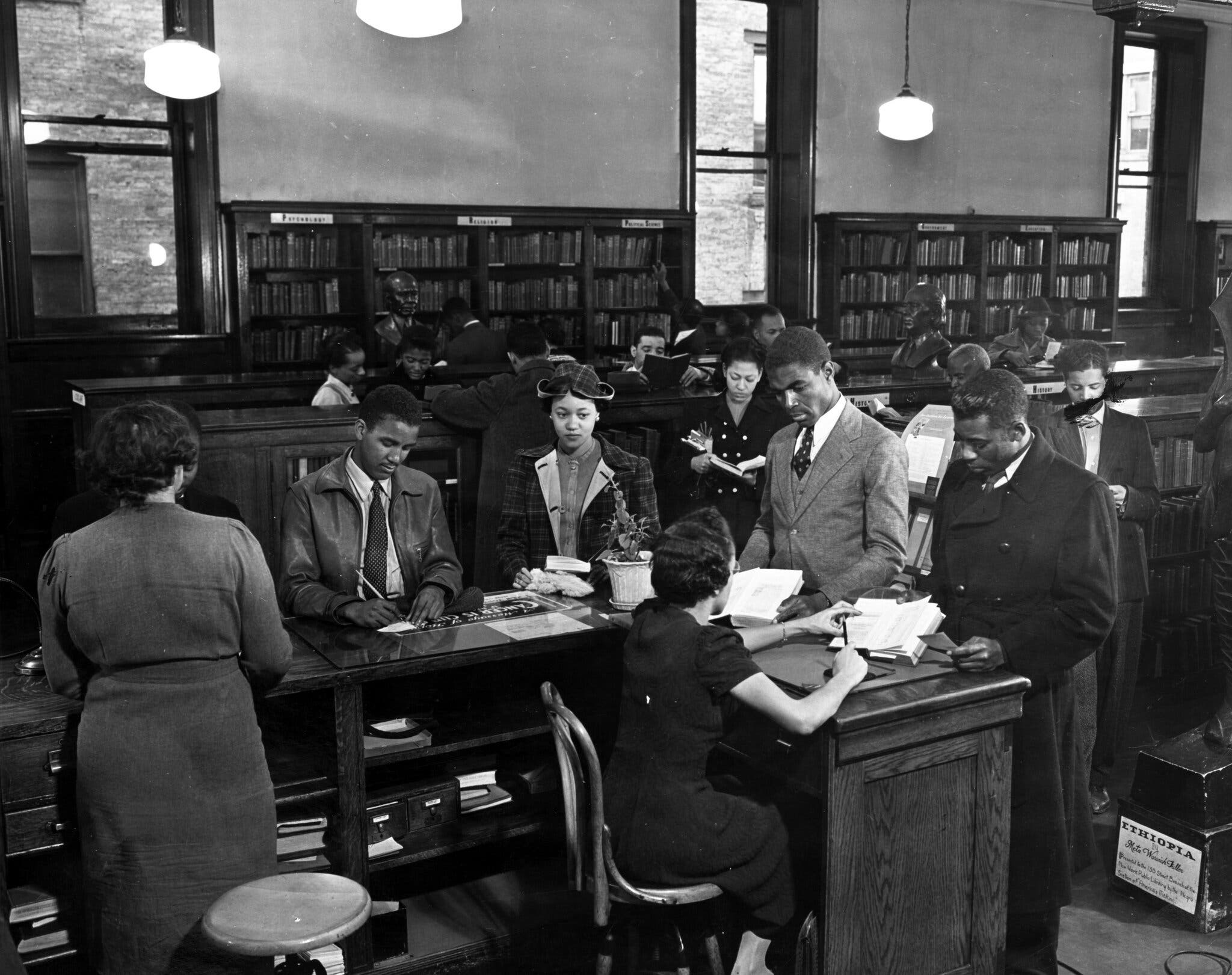
Photo: New York Public Library.
In 1925, the New York Public Library system established the first public collection dedicated to Black materials at its 135th Street branch in Harlem, now known as the Schomburg Center for Research in Black Culture.

I have read numerous accounts of what a public library has meant to poor children with insatiable curiosity. The most recent was the autobiography Up Home by future intellectual and university president Ruth J. Simmons. She grew up in a desperately poor Black sharecropper’s family in Texas. Books and encouragement from Black teachers meant everything.

Meanwhile in Harlem, Black librarians meant everything to generations of Northern children.

Jennifer Schuessler reports at the New York Times, “It was a banner day in the history of American libraries — and in Black history. On May 25, 1926, the New York Public Library announced that it had acquired the celebrated Afro-Latino bibliophile Arturo Schomburg’s collection of more than 4,000 books, manuscripts and other artifacts.

“A year earlier, the library had established the first public collection dedicated to Black materials, at its 135th Street branch in Harlem. Now, the branch would be home to a trove of rare items, from some of the earliest books by and about Black people to then-new works of the brewing Harlem Renaissance.

“Schomburg was the most famous of the Black bibliophiles who, starting in the late 19th century, had amassed impressive ‘parlor libraries’ in their homes. Such libraries became important gathering places for Black writers and thinkers at a time when newly created public libraries — which exploded in number in the decades after 1870 — were uninterested in Black materials, and often unwelcoming to Black patrons.

“Schomburg summed up his credo in a famous 1925 essay, writing, ‘The American Negro must remake his past in order to make his future.’ In a 1913 letter, he had put it less decorously: The items in his library were ‘powder with which to fight our enemies. …

“Today, figures like Schomburg and the historian and activist W.E.B. Du Bois (another collector and compiler of Black books) are hailed as the founders of the 20th-century Black intellectual tradition. But increasingly, scholars are also uncovering the important role of the women who often ran the libraries, where they built collections and — just as important — communities of readers.

“ ‘Mr. Schomburg’s collection is really the seed,’ said Joy Bivins, the current director of the Schomburg Center for Research in Black Culture, as the 135th Street library, currently home to more than 11 million items, is now known. ‘But in many ways, it is these women who were the institution builders.’

“Many were among the first Black women to attend library school, where they learned the tools and the systems of the rapidly professionalizing field.

On the job, they learned these tools weren’t always suited to Black books and ideas, so they invented their own.

“At times, they battled overt and covert censorship. … But whether they worked in world-famous research collections or modest public branch libraries, these pioneers saw their role as not just about tending old books but also about making room for new people and new ideas.

“ ‘These librarians were very tuned in and understood that a cultural movement also needs a space,’ said Laura E. Helton, a historian at the University of Delaware and author of the recent book Scattered and Fugitive Things: How Black Collectors Created Archives and Remade History. …

“In the 1920 census, only 69 of the 15,297 Americans who listed their profession as librarian were Black. Many cities in the segregated South had no library services at all for Black citizens. And even in the North, those branches that did serve them often had few books geared to their interests, and sometimes no card catalogs or reference collections at all.

“That started to change, if slowly. In 1924, in Chicago, Vivian Harsh became the first Black librarian to lead a public library branch there. [But] no place captures the transformations of the era more than Harlem, where, starting in 1920, a white librarian named Ernestine Rose hired four young Black librarians at the 135th Street library. …

“The poet Arna Bontemps (who himself later became a librarian) recalled visiting the 135th Street library after his arrival in Harlem in 1924. ‘There were a couple of very nice-looking girls sitting at the desk, colored girls,’ he said. ‘I had never seen that before.’ …

“Other ‘girls’ at the branch fostered the neighborhood’s artistic ferment in different ways. Among them was Regina Andrews, a young librarian from Chicago (where she was mentored by Harsh) who came to New York City on vacation in 1922 and decided to stay. She … soon settled into an apartment at 580 St. Nicholas Avenue with two friends who worked at Opportunity, a new magazine that aimed to capture the creative ferment bubbling up in Harlem. Nicknamed Dream Haven, the apartment quickly became a salon and crash pad for some of the most celebrated figures of the period.

“It was there that Alain Locke held some planning meetings for the special issue of the Survey Graphic magazine that later grew into his landmark 1925 anthology The New Negro. And it was there that many Black artists and writers who attended the 1924 Civic Club dinner now recognized as an opening bell of the Harlem Renaissance gathered.”

Read more at the Times, here.

Read Full Post »

Photo: Rainbow Skateland.
Roller skating — often in the street — has been part of African American culture for years.
Today it’s really an art form.

The world of roller skating is a world I know nothing about. The one time I tried it at a kid birthday party, I was mostly frozen. But wait till you hear about the expertise of today’s Black roller skating world!

James Thomas reports from Atlanta for the New York Times, “To parse the different regional roller skating styles in metro Atlanta rinks, watch the traffic patterns.

“Sparkles Family Fun Center in Smyrna, Ga. on a recent Thursday night offered a case study: Locals skating in the hometown style churned the floor’s edge, punctuating their synced steps with hand claps that rose from the shoulder. Skaters in the New York-New Jersey-style bobbed steadily and pivoted in tight circles at the center of the crowded rink. A critical mass of skaters doing Chicago’s brand of fluid, James Brown-inspired footwork, or JB skating, carved a jet stream between the crowds.

“It was the warm-up party for the Jivebiscuit Skate Family Reunion, one of the longest-running national gatherings of Black roller skaters. The 17-year-old event, held in February, is one of several annual parties that have made Atlanta a skating hub, bolstered by a steady, decades-long influx of Black residents from other cities.

“ ‘It’s definitely like the Great Migration meets the skate migration,’ said Reggie Brown, 40, a JB skater and music producer who grew up in Chicago. Though he now lives in New York, Brown visits Atlanta frequently to skate. …

“That commingling has Atlanta’s stalwart skaters concerned about keeping their distinctly energetic and percussive style alive. They say Atlanta’s newer skaters, who have wide access to regional variants, increasingly practice a hybridized type of skating that’s not rooted in any one tradition.

“ ‘If you don’t understand the foundation, you have the potential to lose it altogether,’ said Vaughn Newton, the skating choreographer for the 2006 coming-of-age movie ATL. Newton, 58, is a respected bridge between the city’s younger and older skaters. …

“On any given night in Atlanta — certainly on a destination party night — a D.J.’s song choices can activate or chill the various pockets of culture swirling the floor. So when D.J. Arson played ‘Presha‘ by 2 Chainz and Lil Wayne, a standout of the trap subgenre, on the second night of Jivebiscuit at Stone Mountain Skates in Stone Mountain, Ga., the Atlanta-style skaters took their cue.

“Paul Antonio Johnson led a procession along the perimeter, his high knees evoking a drum major in a marching band. He called out routines; the skaters behind him clapped and matched cross slides to the pounding beat. The maneuver is a foundational element of the Atlanta style, where a skater crosses feet laterally in sync with the music. Though known by different names across regions, Atlanta skaters in the 1970s first termed it the crisscross. Younger generations smoothed it out, lifting their skates for a cross-body step they called the cross slide.

“ ‘If you know what you’re looking for,’ says Newton, ‘you’ll see the crisscross. And that’s what everything is built on.’

“Arson stayed in trap mode for the next half-hour before shifting smoothly out of the simmering, drum-heavy hip-hop into mid-tempo R&B with muscular grooves and few lyrics. The Atlanta skaters slowed down and cycled off the floor while the JB skaters took over, swaying and lunging, arms high. They had buoyancy and finesse.

“Atlanta style embodies ‘a lot of energy, showmanship, ugly face. It’s real hype,’ said Kenneth Anderson, known as Kojak. He and his wife, Tijuana Anderson, or Lady Tee, 61, are pillars of the Atlanta skating community. ‘It’s like riding a motorcycle on 285 and just letting your hair down,’ Kojak, 62, said. ‘It’s a real aggressive style.’ …

“When Joi Loftin moved to the area from Detroit in 1988, synth-funk and early hip-hop were prevalent. In 1995 she and other transplanted Detroit skaters, who were used to up-tempo R&B, began to pool their money each week. ‘We would rent Golden Glide rink just so we could play the music that we wanted to skate to,’ she said. ‘That session is still going on to this day.’

“Loftin soon developed relationships with other rink owners, D.J.s and skaters. She and John Perkins, a transplant from New York, started Sk8-a-Thon in 1996, one of the first recurring national parties that showcased Black roller skating styles. Their first event drew 836 skaters from around the country to the Golden Glide in Decatur, six miles east of downtown Atlanta. Over the years it grew to accommodate thousands in multiple rinks over four days, making a Labor Day trip to Atlanta a Black roller skating ritual Loftin hopes will continue now that she’s held her last Sk8-a-Thon in 2023.

“ ‘It’s a beautiful thing,’ said Terron Frank, 34, who traveled from Portsmouth, Va. for Jivebiscuit. ‘You can pretty much see every style you’d want to see in Atlanta.'”

More at the Times, here. Great photos.

Read Full Post »

Photo: Jingnan Peng/Christian Science Monitor.
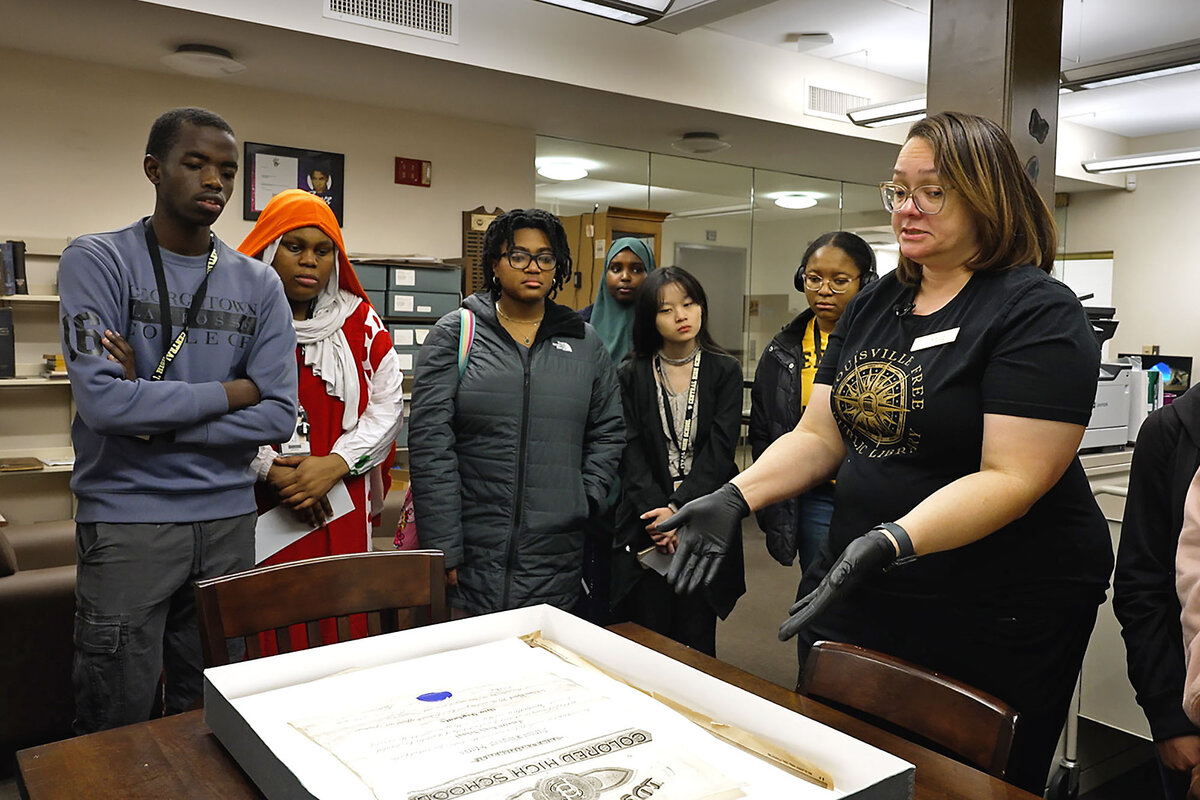
On a tour of Louisville’s Western Library, librarian Natalie Woods (right) shows a 1911 diploma of Louisville’s Central High School. Its former principal, Albert Meyzeek, helped create the oldest Black public library in the U.S. still independently run today.

It is often the case that people in a marginalized group excel in delivering badly needed services that others take for granted. Consider America’s oldest Black library and the man who started it.

Jingnan Peng writes at the Christian Science Monitor, “Thirty minutes into the library tour, Louisa Sarpee wants to work there. History is so close to her. One block away from her high school, the small library she had never set foot in laid the foundation of African American librarianship. What is more, the library was created by a former principal of her own school. Its archives even house a diploma of her school from the time the word ‘colored’ was still in the school’s name.

“ ‘Is there any way to volunteer at the library?’ the ninth grader asks Natalie Woods, the librarian giving the tour. …

“ ‘Say no more, girlfriend,’ Ms. Woods replies, beaming. ‘We’re gonna talk.’

“For Ms. Woods, the manager of Louisville’s Western Library, the gasps coming from the group of 18 students learning about its history is no surprise. She meets Louisvillians every day who know nothing about Western. The library under her care is the oldest public library in the United States independently run by and for African Americans. It was also the earliest training ground of Black librarians from around the South. It is a legacy that has changed Ms. Woods’ life, and preserving it has become her vocation. …

“The ‘Western Colored Branch’ of the Louisville Free Public Library system opened in 1905, in an era when Black communities across the South were building institutions in the wake of emancipation, says historian Tracy K’Meyer at the University of Louisville. …

“The segregated library was considered an experiment, says Ms. Woods. Its first manager, the Rev. Thomas Fountain Blue, had no formal schooling in library science – because there were no library schools open to Black people.  

“Blue not only ran a successful library … he also started the first training program for Black library workers. The course became the prototype for the first degree program in library science for African Americans, which opened in 1925 at Hampton Institute in Virginia. …

“Ms. Woods remembers Blue’s cursive handwriting. The first time she held his papers, they changed her life. She never learned about Western’s history when she grew up in Louisville. The child of a Black father and a white mother, she became a page at Louisville’s Shawnee Library. There, she would hear mentions of Western’s history.

“In 2008, while working as a library clerk and attending college at night, Ms. Woods lost the vision in her left eye due to complications from surgery. She couldn’t perceive distance properly and had to relearn basic activities, such as picking up a pencil, by repetition. It was a struggle to finish college, she says, and she gave up the idea of pursuing a master’s degree in library science.

“Then, one day, a supervisor brought Ms. Woods a folder of documents to transcribe. They were the papers of Thomas Fountain Blue. 

“On lined sheets, the cursive hand discussed circulation methods, library cards, and a library’s role in educating the public. 

“ ‘I knew of him, but I didn’t know how deep and intentional he was in everything he did,’ Ms. Woods says. ‘And it just gave me a new love and desire to go to library school.’ She obtained her library degree at Florida State University. She became Western’s manager on March 6, 2016: Blue’s 150th birthday.

“When Ms. Woods started at Western, she found that many people living near Western did not even know the library exists.

“The library’s archive, which includes Blue’s papers and a wealth of material on Black Louisville history, was disorganized. There was no indexing, and the room was not even locked down, Ms. Woods says.

“So she started giving tours of the library, which she still offers about once a week. In 2018, she obtained a $70,000 grant to index and digitize Western’s archive. 

“It is an important archive that sheds light on ‘how Black librarians, in real time, were trying to imagine what a library to serve a Black community should look like,’ says David Anderson, a professor of English at University of Louisville. …

“A child of formerly enslaved parents, Blue attended college and seminary in Virginia and ran a Louisville YMCA before starting at Western. He died in 1935, after being denied medical care for a treatable infection, says Annette Blue, his granddaughter. ‘He died from Jim Crow laws,’ she says in a Zoom interview from her home in California. …

“Ms. Woods says she does her work in honor of Blue and her parents. She tries to embody Blue’s commitment to ‘the betterment of his people.’ Her parents, who faced much opposition to their relationship as an interracial couple, taught her to ‘treat people the way you want to be treated.’ “

More at the Monitor, here. No firewall. Subscriptions are reasonable.

Read Full Post »

Art: Ernie Barnes.
Photo: Ernie Barnes Estate, Ortuzar Projects and Andrew Kreps Gallery.
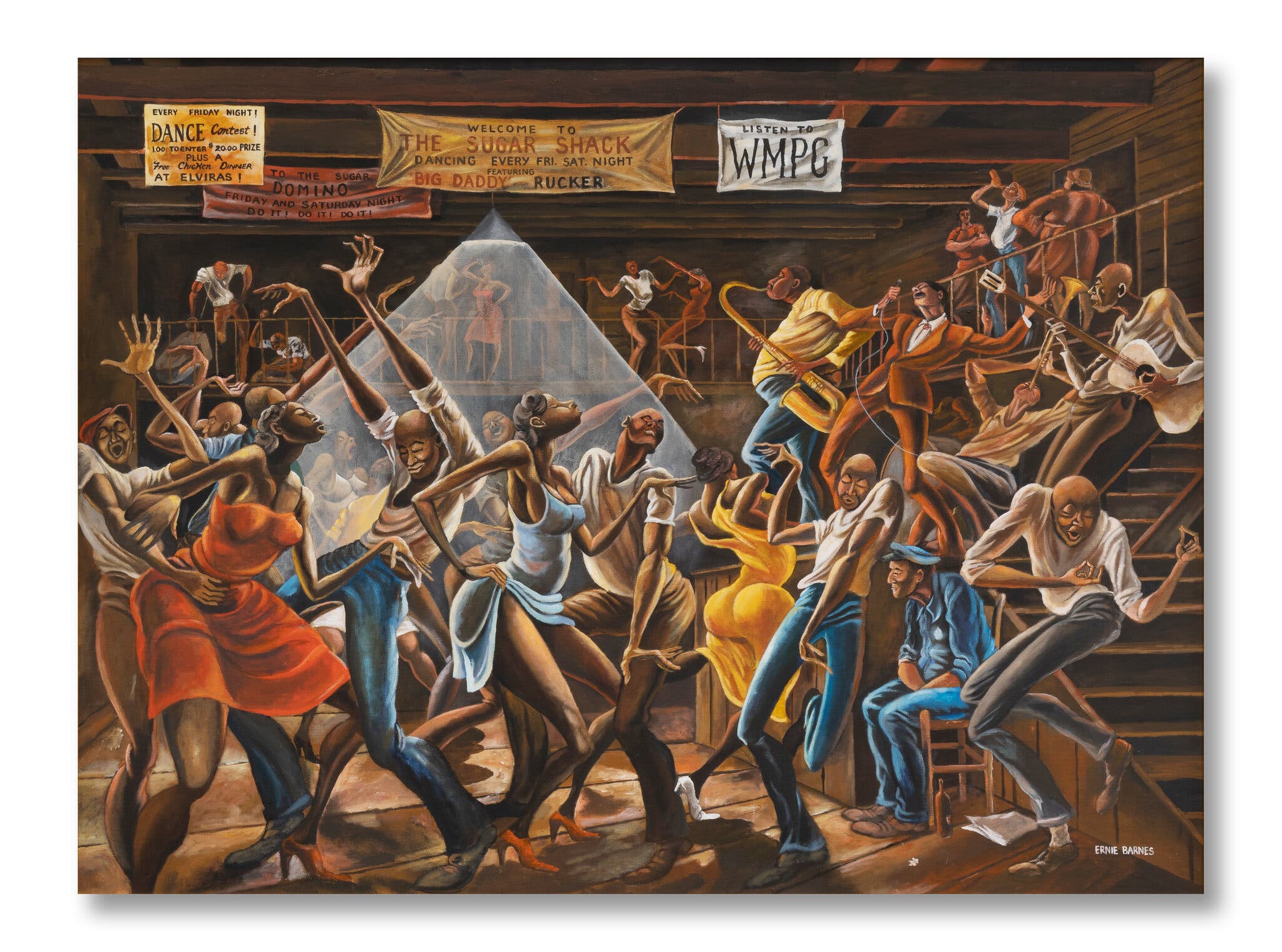
Ernie Barnes’s “The Sugar Shack” (1976) sold well above its estimate at a Christie’s auction in 2022.

I’ve been thinking about artists whose popularity often seems to put them beyond recognition by the “academy.” Can they be taken seriously by serious people if they are popular? If their works are deliberately priced to be affordable, does that mean they are not valuable?

Adam Bradley writes at the New York Times about the long underappreciated artist Ernie Barnes, who is having “a moment” now that he has died.

Bradley writes that “in the 1970s, buying a print of Ernie Barnes’s ‘The Sugar Shack,’ the iconic 1976 dance club painting that adorns the cover of Marvin Gaye’s album released that spring, ‘I Want You,’ and appears in the credits for the classic sitcom Good Times (1974-79), required nothing more than mailing a $20 check to the artist’s West Hollywood studio.

“In 2022, the second of two originals — inspired by a childhood adventure of sneaking into a famed dance hall to watch couples drag and sway to the live performances of Clyde McPhatter or Duke Ellington — came up for auction at Christie’s, selling for $15.3 million. The buyer was the Houston-based energy trader and high-stakes gambler Bill Perkins, 54, who won a bidding war against 22 other prospects. This vast divergence of price belies a convergence of spirit: The countless individuals hanging inexpensive prints on the walls of bedrooms and barbershops share with Perkins (and no doubt with the other wealthy collectors who bid the painting up to more than 76 times its high estimate) an ineluctable desire for the nostalgia and affirmation that Barnes’s work conveys.

“Barnes, who died in 2009 at 70, left a paradoxical legacy. He was an artist of the people — most especially of Black people — selling reproductions at prices that enabled everyone to own something beautiful. He was also an artist to the rich and famous; he sold many of his original works to athletes, movie stars and musicians, from Kareem Abdul-Jabbar to Grant Hill, Diana Ross to Bill Withers, Harry Belafonte to Sylvester Stallone. He was among the most visible artists of the ’70s, with millions seeing his paintings on television each week; yet his work was excluded from major museum collections.

“The unprecedented price paid for ‘The Sugar Shack,’ Barnes’s most recognizable work, has changed everything — and nothing at all, inviting a wider (and whiter) audience to revisit an artist whose reputation among Black Americans is unassailable. More than a dozen years after his death, Barnes, long a popular painter, has become an important one, with all that term entails: a hot global market for his work (pricing out many of Barnes’s original collectors); newfound interest from museums; and, most immediately, a major gallery exhibition scheduled for next year at Ortuzar Projects in New York, which will invite a deeper look at Barnes’s varied career.

“Ernest Eugene Barnes, Jr., was born in Durham, N.C., in 1938, and grew up in a segregated neighborhood known as the Bottom. His father was a shipping clerk for Liggett & Myers Tobacco Company and his mother worked as a domestic.

“In his 1995 memoir, From Pads to Palette, Barnes recalls using sticks as a child to sketch undulating lines ‘in the damp earth of North Carolina.’ By the time he was in high school, Barnes had grown close to his full height of 6 feet 3 inches and finally gave in to the football coach’s entreaties for him to play offensive lineman.

“By 1956, he had 26 college scholarship offers; he enrolled at the historically Black North Carolina College (now North Carolina Central University), where he studied art. Though Barnes found support for his artistic endeavors on campus (he sold his first painting, ‘Slow Dance,’ a precursor to ‘Sugar Shack,’ for $90, to the recent alum and Boston Celtics guard Sam Jones), he often faced bigotry beyond it, and this led him away from art. The Baltimore Colts selected Barnes in the 1960 N.F.L. draft, and he played for four other teams in a six-year career before leaving the game because of the physical toll of injury and the psychic toll of delaying his true calling as a painter. …

“Barnes worked for a short period in the off-season as a door-to-door salesman, and as a construction worker building crypts. Then, with the endorsement of the business mogul and San Diego Chargers owner Barron Hilton, Barnes crashed the American Football League owners’ meeting to make a pitch to become the first official painter of a professional sports franchise. Many of the owners ignored him; one heckled him.

“But another, Sonny Werblin of the New York Jets, offered to pay him a player’s salary to become the team’s official painter. After a year, Barnes had built up enough of a portfolio for Werblin to sponsor Barnes’s first solo show, at the famed Grand Central Art Galleries in Midtown Manhattan. Barnes was 28. His work, which rendered football as modern-day gladiatorial spectacle, was stylized and dramatic. One could see within it the stirrings of his mature aesthetic: his loose and gestural handling of human form, his passion for portraying bodies in motion.

“His athleticism was far from incidental to his art. … Barnes understood the human body not from the outside in, in the studied manner of a draftsperson, but from the inside out, through his knowledge of how bone, muscle and ligament move in concert. …

“Barnes’s 1966 New York show might have marked his triumphant emergence into the artistic mainstream. Instead, it was greeted with indifference. ‘It was a shock to me,’ Barnes said decades later. If the art world was going to reject him, then he would reject it. ‘When I found out that I didn’t have to belong, really, to that world, he said, ‘that was much more assuring to me as a human being.’ …

“He expanded his subject matter to suit a broader audience, directing his eye for physicality toward everyday life. What does it look like to walk down the street with swagger, to hoist a heavy bag at day’s end, to jump double Dutch? Inspired in part by the Black Is Beautiful movement of the photographer Kwame Brathwaite and others, Barnes began producing works that would comprise a show titled ‘The Beauty of the Ghetto. It opened in 1972 at what was then known as the California Museum of Science and Industry and traveled the country for seven years. …

“In 1973, he met with the television producer Norman Lear, who was preparing a new program provisionally titled The Black Family. Lear was so taken with Barnes that he proposed not only using Barnes’s paintings on the show but also making the family’s eldest child, J.J. (who’d be portrayed by the actor Jimmie Walker), an artist himself. …

“ ‘His work is really about joy and positivity,’ says Ales Ortuzar, 47, who along with Andrew Kreps co-represents Barnes’s estate. ‘Those are two things that have traditionally been dismissed in the art world.’ Indeed, irony has no place in Barnes’s artistic worldview. His canvases are domains of earnestness and striving, of unalloyed celebration and pride. …

“ ‘There are a number of folks who will say, “Oh, his work has a $15 million price tag on it,” ‘ says [Derrais Carter, 39, a professor of gender and women’s studies at the University of Arizona and the curator of the Barnes exhibition at Ortuzar Projects]. ‘ “Let me pay attention to it.” And I’m like, “Well, Black folks never needed no $15 million to own that work.” It’s been in dens, college dorm rooms, on faded album covers, the whole nine. These [paintings] are like talismans, anchors of home.’ ”

More at the Times, here.

Read Full Post »

Photo: Harlem Honeys and Bears.
Formed in 1979, the Harlem Honeys and Bears Swim team teaches seniors ages 64 and over, how to survive in the water, as a therapy for chronic illness, and to promote health and wellness in general.  

Reading today’s story about water ballet in Harlem, I am remembering how much I enjoyed the synchronized swimming class I took a long time ago. I still find the move called skulling useful in the water.

Laure Andrillon reports at the Washington Post about a senior group in Harlem that uses the practice for both socialization and health.

“Monica Hale recently turned 69,” writes Andrillon, “but she says she still feels like a youngster every time she dives, swims upside-down or practices the ‘barrel,’ a sophisticated move she usually attempts with a trusted synchronized swimming partner.

“Hale, who is Black, became fascinated with synchronized swimming as a child while watching the champion swimmer and movie star Esther Williams, a White woman, perform in water musicals on television. ‘She would do these fabulous turns and come up at the surface like a flower,’ Hale recalls. ‘I remember thinking, I want to do this one day. But you never saw Black people doing this. You never saw Black people very much in the water at all.’

Today, Hale is the proud captain of the Harlem Honeys and Bears, a synchronized swimming team for seniors 55 and older, whose current members are between 62 and 101 and almost exclusively Black.

“Like Williams, the Honeys and Bears create and perform what used to be called ‘water ballet’ — synchronized choreographed routines accompanied by music — in addition to competing in traditional swim races. But instead of Hollywood, Harlem is their home, and part of their mission is teaching younger Black swimmers. …

“It is a survival skill still deeply lacking in the African American community. … At their biweekly practices, Hale spends most of her time in the shallow end of the pool, teaching basic skills to recruits, some of whom don’t know how to swim when they join the team. She holds their hands while they submerge their faces in the water and cradles them while they learn to float on their backs. …

“The Honeys and Bears also hold monthly meetings to share ideas about how to spread the message that swimming can be learned by anyone, at any age. They find purpose in trying to bridge the racial gap that makes Black people of their generation less likely to swim than White seniors.

“Team members say synchronized swimming takes care of the body and the mind, and being part of a close-knit team is a way to work out and socialize at the same time. Their impressions are borne out by research, which finds that swimming offers a full-body workout that’s easy on injured or arthritic joints — a common problem for older people. It also de-stresses and burns calories, and it’s good for the heart.

“The Honeys and Bears perform at local pools, in other boroughs of New York and even out of state. Since the early 2000s, they have also traveled as a team to race individually during the state and national Senior Games, always sporting matching red sweatsuits. Some use a cane or a walker to access the pool deck, and sometimes employ a lift to slip into the water. But once they float in what they nickname their ‘fountain of youth,’ they feel more capable than when on land.

“The Honeys and Bears started gathering at the ‘bathhouse,’ an old name for what is now called the Hansborough Recreation Center, in 1979. … It was their way, they say, of reclaiming the swimming pool, a place where many team members did not feel welcome or comfortable for most of their lives.

“Some migrated to Harlem from states where interracial swimming was not allowed until the Civil Rights Act outlawed segregation in public spaces in 1964. Others grew up in New York, where pools were not officially segregated, but ‘a de facto racially segregated use was in place,’ historian Jeff Wiltse writes in Contested Waters: A Social History of Swimming Pools in America.

“ ‘When I was a little girl, my brother and I would go to the pool on colored days,’ explains Rasheedah Ali, 87, a member of the team who lived in Cincinnati before moving to Harlem in 1967. …

” ‘Of course, we need to remember our past,’ she says. ‘But we should also tell the story of whom we became — a bunch of joyful Black elders who thrive in the water.’

“Born and raised in Harlem, Gerterlyn Dozier, 89, remembers swimming in the late 1930s at what was then called Colonial Park on 146th Street, instead of the Thomas Jefferson pool on 111th Street, just a few blocks from her building. ‘If you had dark skin, it was too dangerous for you to wander’ near the closer pool, she says, because of hostile White neighbors. …

” ‘[Today] we make it a party,’ says Dozier with a burst of youthful laughter. ‘Hopefully, our kids will feel like they belong in this space and this sport. And by the time the next generation comes, the statistics will have changed.’ ”

More at the Post, here, and at Columbia Community Service, here.

Read Full Post »

Photo: Artist unknown/Historical Society of Pennsylvania.
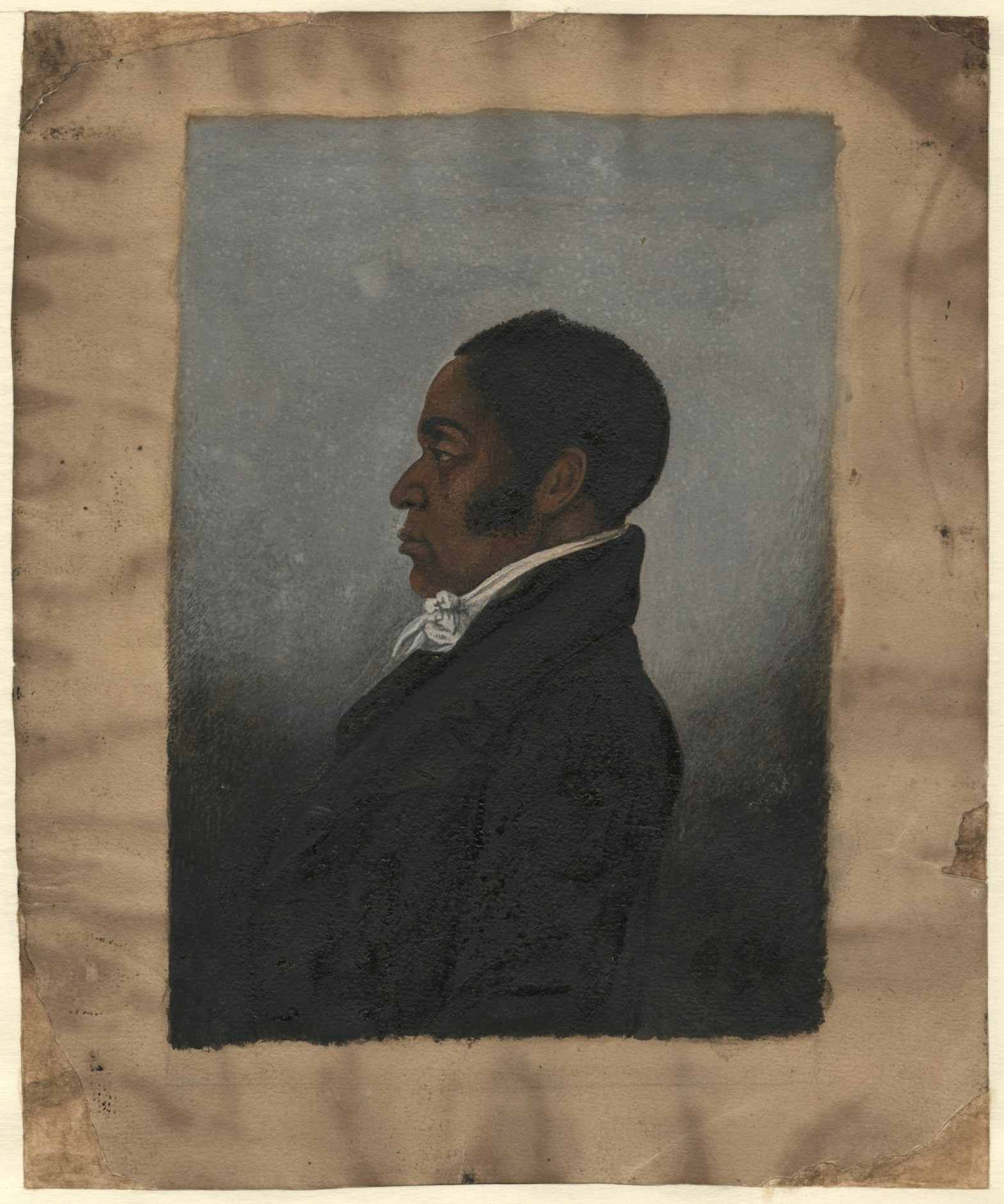
Portrait of James Forten (c. 1834), oil on paper, from the Leon Gardiner collection of American Negro Historical Society records.

The US likes to designate a month for neglected groups to be honored, which is OK, I guess, but accomplished women are interesting even when it isn’t Women’s History Month, as are people who identify as Latino/a when it isn’t National Hispanic Heritage Month or African Americans when it isn’t Black History Month in February. I like to post the stories year round. So it’s August, and here’s a bit of Black history.

At Hyperallergic, Xenobia Bailey offers research on 19th century fiber craftsman James Forten.

Bailey begins, “That I, a quiet, radical, African-American fiber artist, raised in a nautical lakeshore Black community in the Pacific Northwest, would find the book A Gentleman of Color: The Life of James Forten by Julie Winch, about a free-born, quiet, radical, elite African-American fiber craftsman, living in North America from 1766 to 1842 — the most prosperous and philanthropic sailmaker, born in Philadelphia during the turbulent period of the Revolutionary War — was truly a cosmic alignment. … I saw this book steps from the Schomburg Center for Research in Black Culture in Harlem, on the table of a street vendor and book dealer, Brother Mustafa. …

“James Forten’s miraculous life, and its role in shaping a prominent African-American history, is one of my greatest inspirations. Unknown to me, I opened my fiber arts studio in Philadelphia blocks away from where Forten’s sailmaking loft was located at Penn’s Landing on the Delaware River. It was my research into Forten’s life that bridged my wild, aquatic childhood, along Seattle’s Lake Washington, with my present fiber arts practice, which focuses on the evolution of African-American domestic textiles before and after emancipation.

“Looking back, it was fulfilling growing up in a lakeside ‘redlined’ Black community in Seattle’s Central District, with a pack of rambunctious children from the neighborhood. We played in the ponds and wooded area around our homes, venturing through Washington Park’s Arboretum to a now gentrified and forgotten area of natural bodies of shifting sand and clay mounds. They would emerge and disappear with the tides that created patches of land we claimed and named as our islands.

“We’d play pirate captains, patterning ourselves on the rowdy Seafair Pirates who opened the citywide Seafair summer festival of parades, hydroplane boat races, and carnivals every year. We built three-walled log cabins with open roofs and gathered floating logs for rafts from the fallen trunks, broken roots, branches, mud, and stones, and as our furniture we used the beautiful, organically sculpted driftwood that was scattered along the edge of the lake.

“Like James Forten’s community, ours was an unfamiliar story of the African-American experience. Our playground was the shoreline, with a backdrop of flying sea hawks, seagulls, rowboats, motorboats, and houseboats. And, like Forten, we were mesmerized by the majestic sails on the sailboats. …

“As with young James Forten in the mid-1700s, we too had the inquisitiveness and freedom of imagination of childhood — characteristics that continue to serve us as adults. We were aware of the community activism, cultural revolutions, and Black Power Movement happenings of the 1960s. In our imaginations, this was our private utopia. We’d make believe whatever we wanted. …

“James Forten and my siblings and I also share the experience of having a father who was an intuitive and knowledgeable maker. The senior Forten was a master sailmaker who repaired worn sails and prepared raw materials for sewing the strong textiles into tents for surveyors and sails for large-sail ships. …

“My father was a self-taught manipulator of electrical wiring. He purchased an abandoned van for about $100 and a broken floor buffer for $25 from a local junkyard and rewired them, which allowed him to start our family’s janitorial business.  This upcycling practice was common in our underserved yet sustainable community in an otherwise booming industrial Seattle. 

“Mrs. Forten, a ‘fierce’ homemaking mother, refused to give birth to children until she was able to buy her freedom at age 42; this was followed by her birthing two free, healthy children whom she groomed into outstanding adults. One of my fierce homemaking mother’s many gifts was enriching our home with vintage crocheted Afghans and quilts that she would purchase from the Goodwill Store and then elegantly drape and tuck the handmade textiles over our secondhand furniture.

“Forten was an abolitionist. His benevolent service to both free and enslaved Black people during the unsettling times of the Fugitive Slave Acts (passed by the US Congress in 1793 and 1850), the American Revolution, and the state of affairs before Emancipation is deeply admirable. 

“Forten learned his discipline starting at the age of seven, from going to work with his father when an apprentice was absent, at the sailmaking loft near their home. This is the same loft young Forten would buy for his future successful sailmaking business, from Robert Bridges, the man who employed his father.

“At his prestigious sailmaking loft, Forten employed Black, White, and Indigenous men who were supported by his engineering a unique suite of sails and a device I am currently researching allowed his commissioned ships to outpace British war ships during battles and sea pirate ships searching for booty.”

Read about Forten’s connection to Paul Cuffe and the Back to Africa movement at Hyperallergic, here. No firewall.

Read Full Post »

Map: Surveyed by Charles Blaskowitz and published by William Faden, 1777.
When the future composer Occramer Marycoo was brought to America as a slave, he landed in Newport, Rhode Island. Today his achievements are getting belated attention.

It isn’t rewriting history to discuss slavery in America or the life of slaves. It’s resurrecting history. As one website admonishes, “To build a more just and equitable future, we must face our history in all its complexity.”

Today’s article, from Early Music America, is about an 18th century African who suffered the horror of slavery and is now being honored as the first published Black composer in America.

Sophie Genevieve Lowe writes, “In January 2023, Sotheby’s held an auction for a Chippendale chest of drawers, estimated to sell for almost $800,000. Part of its unusually high value derived from the original owner, which Sotheby’s advertised as the ‘Important Lieutenant Colonel Caleb Gardner’ — a hero of the American Revolution and friend to George Washington. Sotheby’s omits that Gardner helped enslave some 3,912 human beings, one of whom was Occramer Marycoo, perhaps the first Black African to have music published in America and the first Black musician to be recognized by the white American community as a professional musician.

“Occramer Marycoo’s story commences and concludes in Africa. … Based on the spelling of his name, it is likely that Marycoo was from an Akan language people group from the Gold Coast of Africa, specifically Ghana.

“Marycoo was forcibly transported to the American colonies, possibly on the 1764 voyage of the ship ‘The Elizabeth,’ owned by sea captain Caleb Gardner.  Records from the Transatlantic Slave Database show that the ship left Cape Coast, a prison fort in Ghana, with 120 captives on board. Only 89 survived the crossing.

“Although the majority of enslaved people who were brought to Newport, Rhode Island, were eventually shipped to the Caribbean, Gardner kept Marycoo as his own property, renaming him Newport Gardner. He is thought to have been around 14 years old when brought to America and, throughout his life, he would go by both names. …

“It was not long after arriving in Newport that Marycoo displayed his brilliant intellect. He quickly became fluent in English and French and learned the fundamentals of music. He was said to be composing within four years of his arrival in America. There are several theories as to who taught Marycoo, the most prominent being American composer Andrew Law (1749–1821). Law wrote much about music education. …

“There are numerous references to compositions by Marycoo, but his only known surviving work is the crux of Marycoo’s historical place as the first published musical work by a Black person in the nascent United States. Musicologist Eileen Southern, in her 1997 book The Music of Black Americans: A History, theorized that ‘Crooked Shanks,‘ from a collection called A Number of Original Airs, Duetto’s, and Trio’s [sic], published in 1803, was by Marycoo. The piece is credited to a composer with only the last name given, Gardner.

“However, new research seems to indicate that the music had been composed prior to the 1803 publication date. ‘Crooked Shanks’ was also previously published in London under the title ‘The Sea Side‘ by the publisher Bride in Twenty Four Country Dances for the Year 1768, and in the 1770s, as the ‘The Bill of Rights’ by the publisher Thompson.

John Fitzhugh Millar identified both these melodies in his book Country Dances of Colonial America. He also believes that Marycoo wrote this melody and goes as far to hypothesize that Marycoo also listed the dance instructions that accompany the melody. Marycoo’s status as a slave would have certainly been a deterrent to properly credit him at the time — if he indeed wrote the piece. …

“We can gather clues to some of Marycoo’s musical influences. As a composer and teacher, Law dedicated himself to forging an American musical style based on European traditions. That element is found in Marycoo’s short but delightful ‘Crooked Shanks.’ Although more scholarship may uncover earlier published compositions by Marycoo, as of now ‘Crooked Shanks’ stands as the first attributed published piece of music by a Black composer in the European style in the United States.

“Many sources point to Law as the most likely teacher to Marycoo. The problem is that the first known time that Law went to Rhode Island was in 1783, when Marycoo was already in his late thirties. By then, Marycoo had already composed his first known work, an anthem based on text from the biblical Book of Jeremiah, on or before 1764.

“An earlier teacher could have been the composer Josiah Flagg (1737-1794). Flagg was also a publisher and, in collaboration with Paul Revere, published a collection of psalm tunes in 1764, the same year as Marycoo’s anthem. Marycoo’s anthem was used in worship until at least 1940 at the Union Congregational Church in Newport, though it now appears lost. In all likelihood, Marycoo probably had a variety of musical teachers in America.

“As Marycoo approached his own musical identity, he would no doubt have been influenced by African musical traditions. West Africa had a rich history of musical instruments, for example the lute had been in West Africa since the 14th century. There is also the possibility he was a part of the jilikea or ‘singing men.’ These men were from an aristocratic family who were used by royalty to recall history, perhaps similar to the troubadours of Europe.”

How difficult it is to puzzle out these lost histories! I have to admire the people who are committed to doing it.

More at Early Music America, here. No firewall.

Read Full Post »

Photo: Sedat Pakay, Hudson Film Works II.
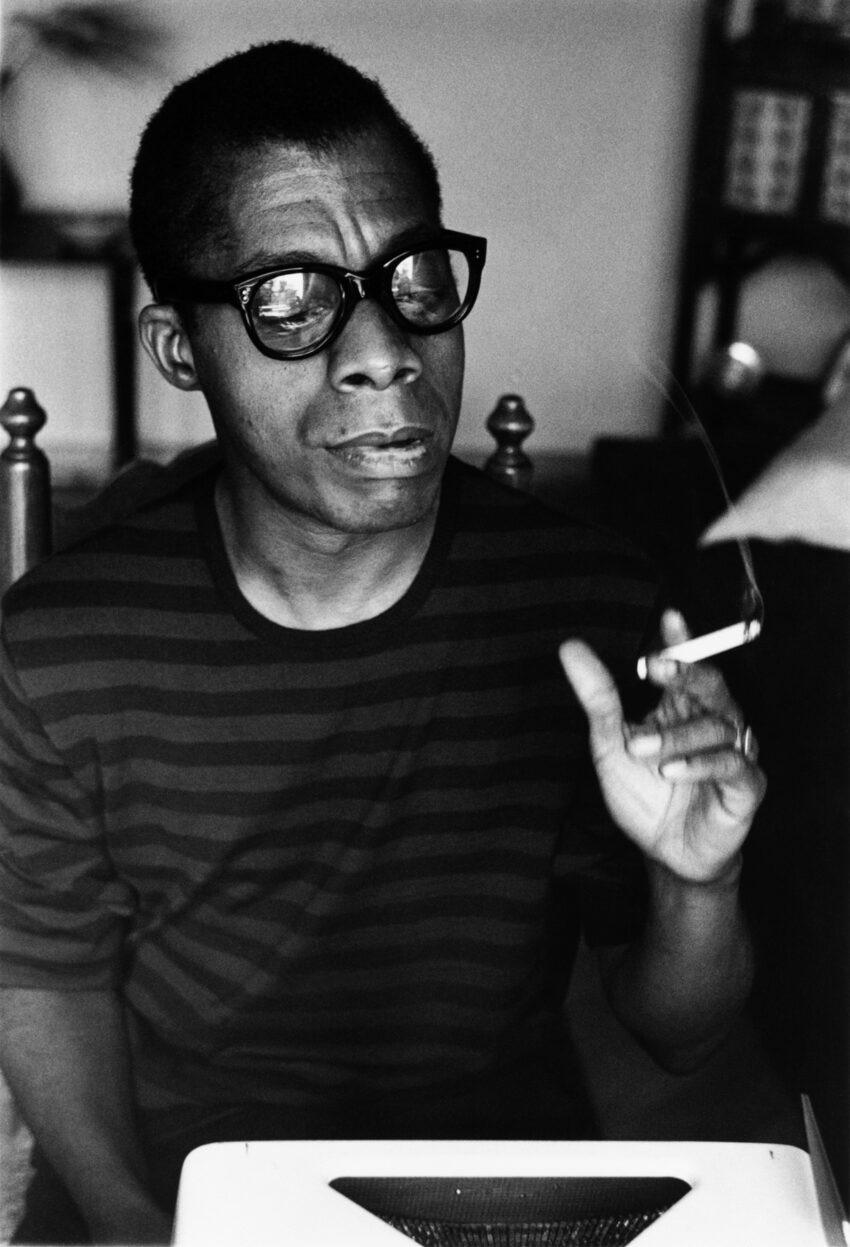
James Baldwin in Istanbul in 1966.

James Baldwin didn’t kid himself about life in America for a gay Black man in the 1960s. He traveled widely and lived for long stretches in countries he found more hospitable. (A 2016 post, here, addresses an effort to preserve a house he bought on the Côte d’Azur.)

I knew about France but not Turkey, which Azareen Van der Vliet Oloomi writes about in the Yale Review.

At the beginning of the “11-minute black and white documentary, James Baldwin: From Another Place, directed by Sedat Pakay and filmed in Istanbul in May 1970, … he turns his back to the cam­era and opens the curtains. A sharp Mediterranean light floods in. Baldwin scratches the small of his back, and we hear him say in voiceover: ‘I suppose that many people do blame me for being out of the States as often as I am, but one can’t afford to worry about that because one does, you know, you do what you have to do the way you have to do it. And as someone who is outside of the States you realize that it’s impossible to get out, the American powers are everywhere.’

“The camera pans over the glittering Bosphorus Strait as American ships glide silently through the passage connecting Asia and Europe.

“Pakay’s film has long been almost impossible to see in the United States, aside from a short clip on YouTube. But in February, it began streaming on the Criterion Channel, and its reappearance is a useful occasion to re-examine one of the most important, and yet relatively unknown, aspects of Baldwin’s career: his time in Turkey.

“At the time Pakay made his film, Baldwin had been living in Istanbul intermittently for almost a decade. He first arrived there in 1961, broke, emotionally spent, and struggling to complete his third novel, Another Country. The Turkish actor Engin Cezzar, who had met Baldwin in New York in 1957 when he was cast as Giovanni in the Actors Studio adaptation of Giovanni’s Room (Baldwin’s sec­ond novel), had given him an open invitation to visit, and follow­ing a demoralizing trip to Israel, Baldwin showed up on Cezzar’s doorstep.

“He quickly made himself at home, and over the next ten years lived irregularly in Istanbul, Erdek, and Bodrum, socializing with the Turkish intelligentsia and a small circle of Black artists and activists who were living in Turkey or passing through.

“Istanbul offered Baldwin a refuge during the tumultuous decade of the 1960s. In a 1970 conversation with Ida Lewis for Essence mag­azine, Baldwin said of his decision to move to the city, ‘It was very useful for me to go to a place like Istanbul at that point in my life, because it was so far out of the way from what I called home and the pressures.’ …

“Baldwin had first left the United States, for Paris, in 1948, and had lived out of the United States for years prior to his arrival in Istanbul. But the clarity and safety afforded by his time there allowed him to more sharply articulate America’s assaultive realities and to give expression to the connections between his personal wounds and the scars of racialized political history. …

“[His] layered inner landscape mir­ror the city’s multifaceted character, with its refusal of neat distinc­tions between tradition and modernity, East and West, Christianity and Islam.

“Istanbul was a liminal space of healing for Baldwin, a writing haven that he saw as having saved his life. As [Magdalena Zaborowska, author of James Baldwin’s Turkish Decade] notes, this may explain why the Baldwin we see in Pakay’s documentary is far more relaxed and at ease than the Baldwin we are accustomed to seeing in American media from that era.

“And yet, Baldwin’s decade in Turkey remains an enigma and a lacuna in our collective imagi­nation. Zaborowska’s is the only book-length treatment of Baldwin’s time there, and even people familiar with Baldwin’s writing are often unaware he ever lived in Istanbul. … What does the warm, vul­nerable, and playful Baldwin captured on film by Pakay tell us about his need to leave America time and again in search of safety?

“The respite Turkey offered Baldwin, combined with Istanbul’s vibrancy and the warmth with which he was received, sparked one of the most prolific periods of his artistic life. In 1961, when he first arrived, he was haggard and exhausted. 

“His trip to Israel had deep­ened his disillusionment with Christianity, and he was still mourn­ing Eugene Worth, a Black socialist and dear friend, who, in 1946, had killed himself by jumping off the George Washington Bridge. In addition, Baldwin had been trying without success to complete Another Country, his courageous and groundbreaking exploration of bisexuality and interracial love.

“Worth’s death, which Baldwin memorializes in Another Country, had devastated Baldwin for years, and he had tried and failed again and again to finish the novel until he was delivered from the strain of severe writer’s block in Istanbul. Baldwin wrote the book’s final sentence while at a party at Cezzar’s house in what he described as ‘the city which the people from heaven had made their home.’ …

“The years Baldwin spent off and on in Turkey coincided with one of the country’s most vibrant and expansive periods. The 1950s in Turkey had been a period of economic decline, ruthless author­itarianism, and iron-fisted censorship, a confluence of negative forces that gave rise to mass mobilization and to student-led pop­ular protests. …

“By 1965, free elections had been restored, and liberal constitutional reform had significantly expanded freedom of speech. The nation’s position as a strategic U.S. ally had been salvaged, but its cultural flowering continued, along with anti-imperialist and anti-capitalist move­ments similar to those that were emerging elsewhere around the world. Baldwin’s work and lived experience spoke directly to the political and aesthetic debates of the time. In Turkey, in a context of cultural ferment, Baldwin was revered as a major American and transnational writer, rather than being put in a position of having to prove his legitimacy over and over.

“Still, even in Turkey, Baldwin could not fully escape America. During the Cold War, relations between the United States and Turkey were founded on military collaboration and cooperation; the United States sent ships to Turkish waters to counter the threat of Soviet expansion, making Turkey a source of anti-Soviet mil­itary aid. As Baldwin said to Sedat Pakay, ‘American powers are everywhere.’ His feelings fluctuated between entrapment, the sense that no matter how far he traveled from the violence in the United States he could not, existentially speaking, ‘get out,’ and the feelings of transcendence and revival that Cezzar’s warm hos­pitality and Turkey itself afforded him.”

More at the Yale Review, here. No firewall.

Read Full Post »

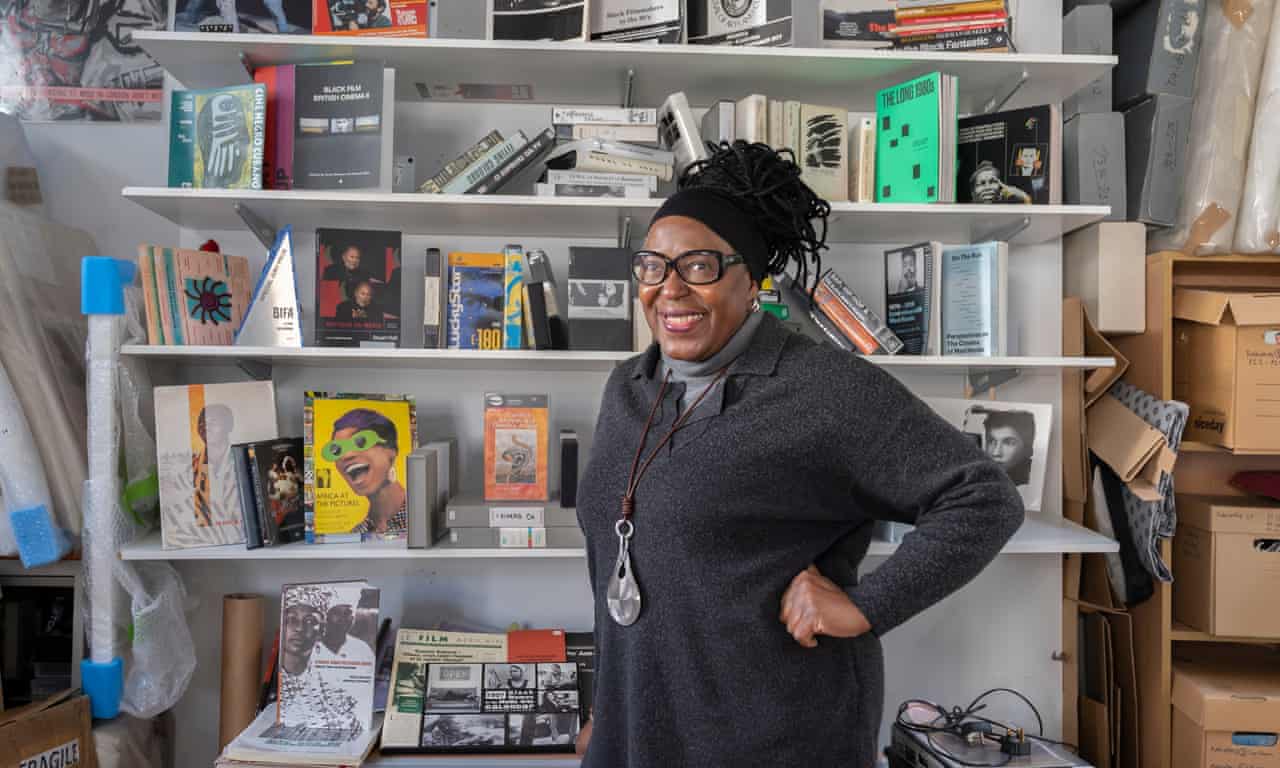
Photo: Amaal Said/JGPACA [June Givanni Pan African Cinema Archive].
From a Mogadishu film week
poster to VHS videos of pioneering art movies, June Givanni has collected a range of Black film artifacts and is now ready to share.

Sometimes people whose childhood struggles involve race-based discrimination grow up to embrace and trumpet the beauty of their heritage. I enjoy stories like that.

At the Guardian, Leila Latif interviews one such person, the founder of June Givanni Pan African Cinema Archive.

Discussing her recent exhibition, “PerAnkh: The June Givanni Pan African Cinema Archive,” Givanni played down the show’s title. Says Latif, “The Black British film curator, activist and archivist who created it is hesitant about positioning herself front and center.

“ ‘I don’t want it to sound like it’s all me, me, me,’ she worries. ‘My name is part of it because I worked as a curator for many years and collected work throughout the non-digital era, which developed into this archive.’

“Though she wants the films, documents, artworks and objects she has preserved to be the focus of people’s attention – from an installation of the earliest audiovisual works by the Black Audio Film Collective to new works by the Chimurenga collective from South Africa – Givanni is more than worthy of the spotlight. When she received the British independent film awards’ grand jury prize in 2021, the organizers said that she had ‘made an extraordinary, selfless and lifelong contribution to documenting a pivotal period of film history.’

Born in British Guiana 72 years ago, Givanni moved to the UK aged seven and was immediately underestimated.

“ ‘They put me with the five-year-olds because I was Black and I’d come from the Caribbean,’ she remembers. ‘My mum went to the school twice before they moved me up to my age range.’

“As an adult, Givanni collaborated with some of the most significant figures and institutions in pan-African cinema and across ‘different territories, different continents.’ She kept adding elements to her collection, she says, ‘because I needed to use them for subsequent programs and as part of building a body of knowledge and a whole series of resources that can be shared with others.’

“Lack of preservation has meant many of pan-African cinema’s masterworks have disappeared. In America alone, it is estimated more than 80% of Black films from the silent era are lost, and technological advances endanger film further. While physical film has a potential shelf life of hundreds of years, digital preservation requires constant migration to keep up with changing technology. …

“Givanni has faced changes in technology, politics and culture since she began in the early 80s. The first film festival she worked on was called Third Eye, inspired by the Latin American Third Cinema movement which set out to challenge Europe and North America’s dominance in film. For Givanni, the festival provided ‘an area to develop our own ideas about representation and taking charge. Pan-African cinema has always been a cinema of resistance. I can’t tell you how inspiring it was that there were all these people out there doing things that really chimed with what I thought should be happening.’ …

“She programmed festivals on five continents; worked for Greater London Council’s ethnic minorities unit and the Independent Television Commission; ran the BFI’s African Caribbean film unit and co-edited Black Film Bulletin, which relaunched in 2021 as a quarterly collaboration with Sight and Sound magazine, and has celebrated the under-sung work of film-makers. …

“The spirit of pan-Africanism was a guiding light, connecting all cultures that originated on the continent without treating them as a monolith. Givanni explains, ‘When I say pan-African, it’s not just the African continent; it’s the entire diaspora. All those significant histories are interconnected and cinema is very much part of that.’

“Choosing how to represent that history at Raven Row, with selections from an archive that now surpasses 10,000 items, was a gargantuan task. But Givanni immediately knew she wanted to include ‘a poster of the Mogadishu film week, given to me at my first attendance at the Fespaco film festival in 1985 by a Somali film-maker. Now people mention Somalia and they don’t picture these vibrant and strategic cultural events taking place there. …

“ ‘At the Havana film festival I bought a collection of silkscreen posters that will be exhibited. Lots of art can be seen digitally, but to see a silkscreen poster, the texture and the color of it – there’s an experience of culture and artifacts that goes beyond digital representation.’

“Beyond allowing the public to admire key objects from Givanni’s collection, the exhibition is structured around a program of films from the likes of Sarah Maldoror and Ousmane Sembène (the mother and father of African cinema). There is also an archive studio and reading room in the spirit of the exhibition’s title, PerAnkh – an Egyptian term for ‘a place of learning and memory.’ “

More at the Guardian, here. No firewall.

Read Full Post »

Photo: Dua Anjum.
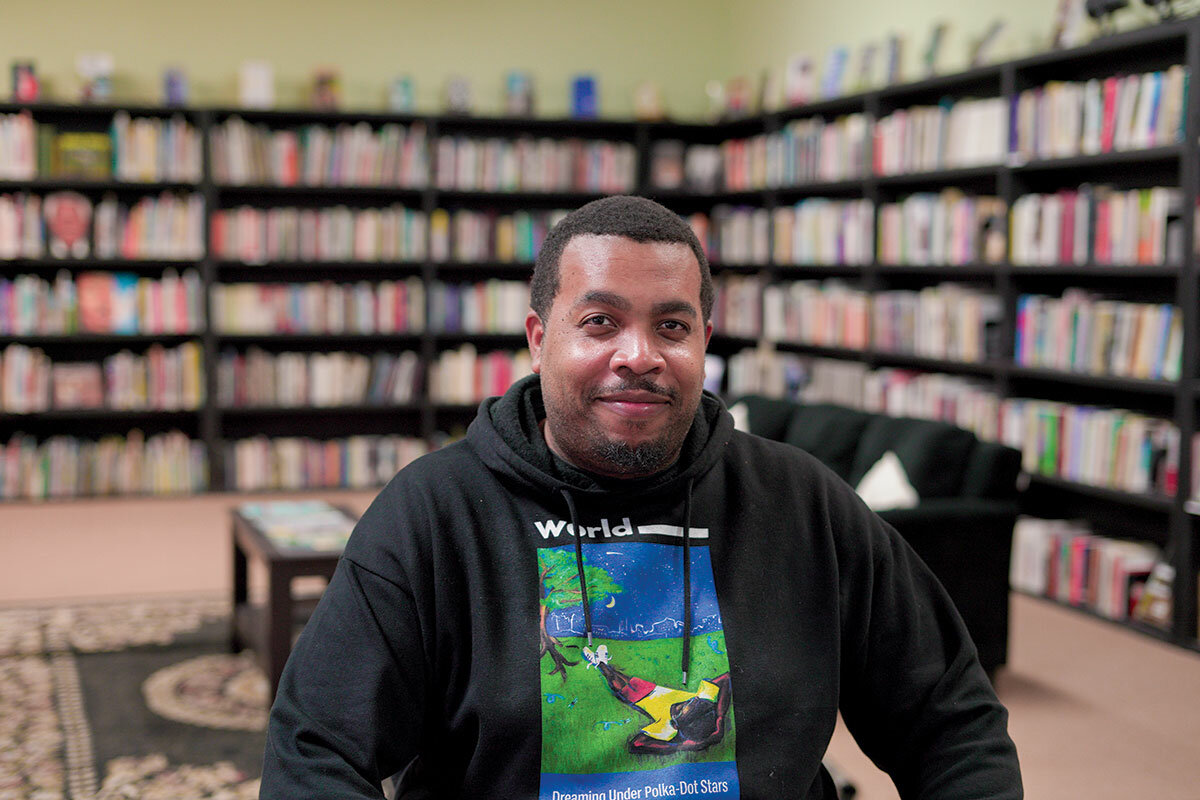
“Poet Hiram Sims,” the Christian Science Monitor reports,” has given poetry a permanent home in his South Los Angeles neighborhood.

This is another story about how the Covid pandemic gave some people a moment of “not much going on” to pursue a dream.

Dua Anjum writes at the Christian Science Monitor, “From Hiram Sims’ earliest memory, poetry defined his inner world – songs of praise at his church choir; the rap lyrics of The Notorious B.I.G., Puff Daddy, and Mase’s ‘Mo Money Mo Problems’; Edgar Allan Poe’s ‘The Raven’ in seventh grade.

“ ‘Poetry’s like a frequency that I can hear above all other frequencies,’ he says. … ‘When I hear that sound, I pay attention.’

“That sound became his favorite form of expression. As a kid, he wrote about candy, his thoughts about God, and a lot of verses for girls at school. In college, while he progressed to mature writing around the Black experience in America and the struggles of being young and broke, witty comic poems remained key to his repertoire. He chuckles recalling a poem comparing Ugg boots to rhinoceros feet. Now, he has published three collections of poetry and frequently writes love poems for his wife.

“While it was clear early that his calling was poetry, Mr. Sims remembers having an anchorless feeling: Poetry sections of libraries were rare, and the poetry scene was a series of countless borrowed spaces in restaurants, cafes, and bars. It felt like ‘poetry is homeless because it’s constantly couch surfing,’ says Mr. Sims, who became a creative writing and composition professor at colleges in the area, including his alma mater, the University of Southern California.

“In 2020, he gave poetry a permanent home in his South Los Angeles neighborhood, founding the Sims Library of Poetry, for reading, writing, studying, and performing poetry. 

“The space has evolved into an indispensable gathering place for anyone looking for inspiration, say poets who live nearby. It whimsically invites the public in: ‘Poetry Lives Here’ is painted on a low concrete boundary. A mural pays homage to the dragon fire that poets spit in words. A ‘Poet Parking Only’ sign peeks from a patch of grass. 

“The spiritual foundation for this landmark came from what Mr. Sims considers a personal triumph: the Community Literature Initiative (CLI), through which he helps poets produce manuscripts ready for publication and connect to presses.  

“ ‘I was at an open mic and I heard all of these amazing poets. After the show, I said, “I’d like to buy a copy of your book,” and none of them had books,’ says Mr. Sims, who has coached poets in publishing now for 10 years in space provided by USC. … Sims Library origin story goes back to a $29.99 suitcase.

After assigning his CLI students to read one book of poetry a week, he realized: They couldn’t afford them, and libraries had slim poetry offerings. 

“So, he fit 80 books from his collection into the purple-brown suitcase, carted it around in his car, unzipped it, and let students borrow poetry collections by living authors, especially local LA poets.

“ ‘One of my students said, “This is the little Sims library of poetry right here.” And I was like, “Wow.” … After that, I put all my energy into building that microcosm of the library that I had in my head.’

“The idea came to life in his garage at a birthday party-turned-library-launch. … Several poets read their own verse. And people brought boxes full of books: The party started with 300 and ended with 2,000. 

“Mr. Sims’ mother, Gwendolyn, who remembers her young son loved to read greeting card stanzas at the Rite Aid, was one of the first to donate money. The library continued to thrive with family, community, and foundation contributions of books, cash, and grants. And CLI class tuition also helped. 

“It was peak pandemic, and the preschool run by his wife, Charisse, closed. The family decided to take over the building as the next iteration of the library. Mr. Sims’ father, Edward, who is a contractor, and his brother Job helped with shelves. Word of another donation drive reached further and book donations came from across the country. …

“The nonprofit offers more than 9,000 volumes of poetry, says Mr. Sims. ‘So many of these books are people that live in LA, you know, people in this community.’ 

“Open until 8 on Saturday nights, the thrum of activity – from book launches, workshops, and open mics – spills into the neighborhood with singing voices, fingers snapping, and the rhythm of rhyme. …

“Mr. Sims says, ‘I think the library represents value for a part of people they don’t often share. So people often bring poems from their shoeboxes and folders. It’s so personal with people.’ …

“ ‘When the first volunteers came in, they expected to come to a library, but then realized, we have to build one,’ says Karo Ska, library manager and a CLI writer. For them, the best part is that the library has books that can’t be found elsewhere – pre-1950s special collections, self-published collections, periodicals, local literary journals, and handmade chapbooks.

“ ‘The idea of giving back to the community is a phrase that a lot of people use but isn’t always manifested,’  says Lynne Thompson, 2021 Los Angeles poet laureate. ‘[Hiram] is as interested in the work of others and facilitating not only the writing of it but the publishing of it as he is in his own work.’ …

“Poet bridgette bianca, who grew up in the neighborhood without a public library nearby, says: ‘We are in an area that’s very much Black, very much brown, very much working class. And that somebody built a library here is just fantastic.’ 

“Now, as a community college professor, she uses the library as a resource, encouraging students to explore the poetry collection and attend events for extra credit.”

More at the Monitor, here. No firewall, but subscriptions are encouraged.

Read Full Post »

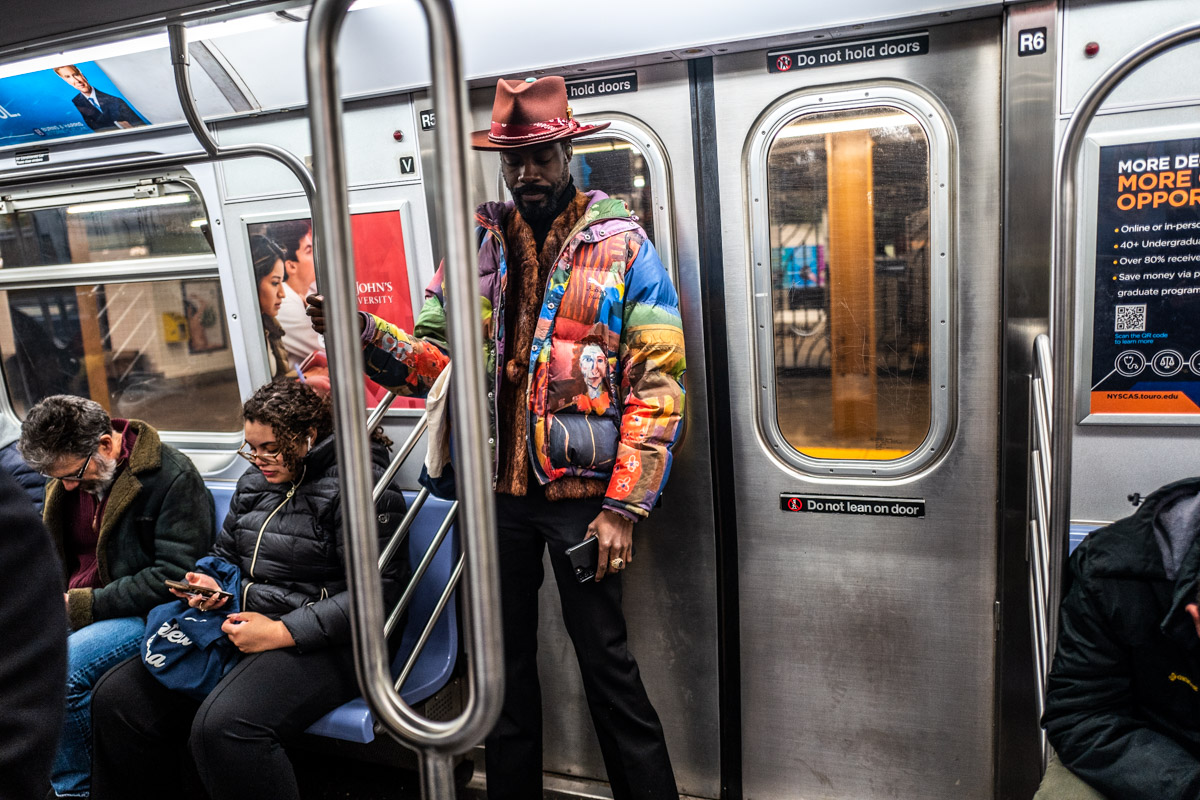
Photo: Francesca Magnani.
Film- and hat-maker Richard Faison on the G train in Brooklyn. A photographer’s chance encounter on the subway led to this story.

Do you notice how very creative people are good in almost any field calling for creativity? I have a friend like that who takes classes in many kinds of art and always does a nice job even if she is never going to make that particular skill her main thing.

Photographer Francesca Magnani wrote recently at the art newspaper Hyperallergic about a filmmaker who became a creative haberdasher.

“One December morning, among the sparse riders waiting for the G train in Brooklyn, New York, I saw a tall Black man with a colorful jacket and a cowboy hat. I took some photos as I introduced myself to Richard Faison. ‘I am also an artist and I actually made this hat,’ he told me. 

“A few weeks later, a friend who was visiting from Florence casually mentioned she wanted to buy a hat while here, and I arranged to see Faison in his lab, which turned out to also be his apartment. The one-bedroom apartment was filled with dozens of hats at various stages of existence and along with my friend Michèle’s green hat, two more were being ‘blocked’ and were drying by the window. On the wall was hanging a shtreimel, the first one that Faison made: these hats, traditionally worn by Orthodox Jewish men, were in fact his specialty.

“Sitting down with Faison on his sofa on that day, and once again more recently, I asked him some questions. Our conversations have been edited and condensed for clarity.

Francesca Magnani: You used to be a filmmaker. How did you become a milliner?

Richard Faison: I went to a small program at NY Film Academy for eight months. I started doing film by carrying around my mom’s video camera and shooting all my friends and my adventures, editing cool videos and creating a series that got pretty popular on Facebook. That led me to make music videos. I went to Toronto after meeting a few artists out there, and I became an editor and cinematographer for short films and documentaries.

“I started making hats legit by coincidence. I was friends with a Hasidic gentleman, Lov, and he came by my place for some drinks with friends. He said, ‘You always wear cool hats, you should work with a guy I sell fur to.’ That’s how I met my mentor and this entire adventure started.

FM: How do the two worlds, film and millinery, work in synergy?

RF: They are similar. You have to have an eye and a certain aesthetic that you want your pieces to have. The vision I see of a hat is like how I used to envision how I wanted certain shots to look like before going out to shoot, and just creating something with a story that people can either relate to or admire.

FM: You started your own business just a few months ago, last September. How did you build your own company, Oliver Lewis Hats?

RF: My mentor helped me: I worked for him in Williamsburg, Brooklyn, for about three years. The day I asked for a second raise, he took me on a long car ride and looked me directly in the eyes. He said, ‘You are a true artist with your hands, but I’ll never pay you what you deserve.’ Those words were the most beautiful and hurtful I’ve heard in one sentence. After that, he got me my first hat body and told me where to get more, and I took off running.

FM: Coming from a background in filmmaking, are there artists and directors you look to for inspiration?

RF: My number one influence would have to be Jimi Hendrix. His style, his grace, the chances he took, how groovy he was, everything! I used to watch his old concerts and get lost in his rhythm and clothing choices. The second is André 3000 of Outkast. I moved to Atlanta in 2003 for high school. I remember getting bullied for wearing tight jeans back then but then I would look at the shirts, pants, and hats André 3000 would wear, and it gave me the confidence to be myself no matter what others thought. …

RF: I reach my customers best through Instagram, where I can show my skills through video reels and also communicate directly with my audience. I have an even number of male and female clients — the age range is usually 30 to 40. …

FM: You said you devised your own gluing technique for shtreimels; you use as ornament some Swiss figurines usually found in ‘Swiss cowboy’ belts, and the name of your business comes from Oliver Lewis, the first Black jockey to win the Kentucky Derby. How do influences from different cultures inform your creations? 

RF: Influences are how I came to be. They’re the essence behind my entire being and work. Growing up in Brooklyn, I had so many cultures surrounding me that would impact me. My dad being from Trinidad and being a huge cowboy lover was one of the biggest for me. I watched Clint Eastwood movies with him and thought cowboys were the coolest people on earth. Then I found out that most cowboys were actually Mexican and Black and that piqued my interest. … I get a lot of inspiration from the Italians in NYC (such smooth style!), Jamaicans, and Hispanic communities. The melting pot in Flatbush helped me create my unique style.”

Need a hat? Or do you “already have all” your hats, as they used to say of the ladies in Boston? Check out Oliver Lewis Hats on Instagram.

More at Hyperallergic, here. No firewall. Lots of cool photos.

Read Full Post »

Photo: Garrett Houston.
Terrance Jackson came to Virginia’s Barter Theatre as an actor and now leads Barter’s Outreach and its Black Stories Black Voices initiative.

I have always loved August Wilson’s plays about the Black families in the Pittsburgh neighborhood where he grew up. I’ve seen most as many were tried out in Boston during Wilson’s lifetime. But there are other Black playwrights achieving success, and today’s article from American Theatre highlights efforts to help still more develop their skills.

Former Barter Theatre director Karen Sabo writes, “Barter Theatre in Virginia isn’t unique in their current position: It is a predominantly white institution that is currently attempting to better serve audiences and artists of color. But the innovative structure of Barter’s new Black Stories Black Voices program … could well serve as a national model for inclusive art-making that embraces and empowers Black communities at mainstream theatres.

“It may seem like a departure, but in some ways it’s also a continuation. When, 90 years ago, Robert Porterfield founded Barter in his rural, mostly white hometown of Abingdon, Va., in the midst of the Great Depression, he brought New York actors to this Appalachian agricultural area to match unemployed — and in some cases, underfed — actors with local farmers struggling to sell goods to people with little money. The price of admission was 40 cents, or an equivalent amount of produce, dairy, or livestock. ‘Porterfield and his partners accepted almost anything as payment,’ according to Encyclopedia Virginia. ‘A pig was worth 10 tickets, while two quarts of milk bought one ticket.’ …

“Full disclosure: I spent six years working as a director and resident actor at Barter in the early 2000s. My immersion in this organization gave me an appreciation for certain aspects of the institutional culture of this rural LORT [League of Resident Theatres] theatre. …

“During my tenure, Barter had an acting company made partly of out-of-towners — big-city pros who landed at Barter and stayed — alongside some home-grown artists. A few particularly talented local performers made their artistic home at Barter, and the Barter Players, the young, non-Equity company, produced many actors who eventually joined the resident acting company.

“While few would deny that the creation of regional theatres in the United States was a positive development, in their early days these organizations often operated with a kind of cultural imperialism, as they attempted to enlighten or elevate audiences by bringing work from the cities to ‘the provinces.’ In an attempt to better serve its Appalachian population, 20 years ago Barter started the Appalachian Festival of Plays and Playwrights. This encouraged writers to tell the stories of the unique region where Barter is located, and while some of these new plays featured characters who were Black, Indigenous, or people of color, they mostly told stories of the majority-white population of the Southern Appalachian Mountains.

“Just before the pandemic, Katy Brown became Barter’s new producing artistic director, only the fourth in the theatre’s 90-year history. Brown herself is a home-grown leader; I remember seeing her first performance 25 years ago with the Barter Players shortly after she finished college. Like many other predominantly white theatres, Barter has begun hiring more people of color, and producing more shows telling stories of Black Americans. They’ve also designated that at least one play in the yearly Appalachian Festival of Plays and Playwrights be written by a Black artist. But in the spirit of Barter’s culture of empowerment, honoring its region, and developing local artists, they’ve also created the program Black Stories Black Voices (BSBV).

“BSBV is the brainchild of collaborative thinking from many on the Barter leadership team. The first public performance under this new initiative was the 2022 Shine project last April 24, which featured professional actors reading new monologues submitted by Black residents of the counties surrounding Barter. …

“The Barter team wanted input from an authority regarding presenting more inclusive stories. They reached out to Dr. William H. Turner, a known expert on Black life in the South and Appalachia, and Turner suggested that rather than just focusing on producing Black plays, they help create Black playwrights.

“ ‘We wanted people who knew nothing about playwriting to get involved, so that’s where the story collection idea came from, and that came through Cathy,’ Brown said, referring to Barter’s resident playwright, Catherine Bush. Bush suggested asking local people to share stories and then hiring Black artists to help turn stories into monologues. At Shine, those monologues were performed by professional actors, and the Barter team intends the next steps to be turning monologues into scenes and eventually full-length plays.

“But to encourage the sharing of stories, Barter needed to strengthen their outreach and build relationships, especially with communities of color. Enter Terrance Jackson, a Florida native who initially came to Barter as an actor, and who now leads both Barter’s Outreach and Black Stories Black Voices.

“ ‘Our statement of intent is to provide a safe space for Black Appalachian artists to share their stories and showcase their work, while also fostering our Black community with a safe space to see theatrical work,’ said Jackson. … ‘I will be reaching out to different groups and different people, not just Black and brown people, but all types of people, and letting them know that they matter at our theatre, and that they have a place here.’ …

“Jackson summed up his experience with the project so far by saying, ‘Barter is a predominantly white institution still, and we are actively doing our best to, not necessarily to change that, but to make it equitable, and to build a space where all people feel comfortable to work and to see plays. We’re not done creating dope Black stuff — we’re just beginning. And hopefully we do work that really matters to Black folks in Appalachia, but also to the entire theatre world and theatre industry as a whole.’ ”

More at American Theatre, here. No firewall.

Read Full Post »

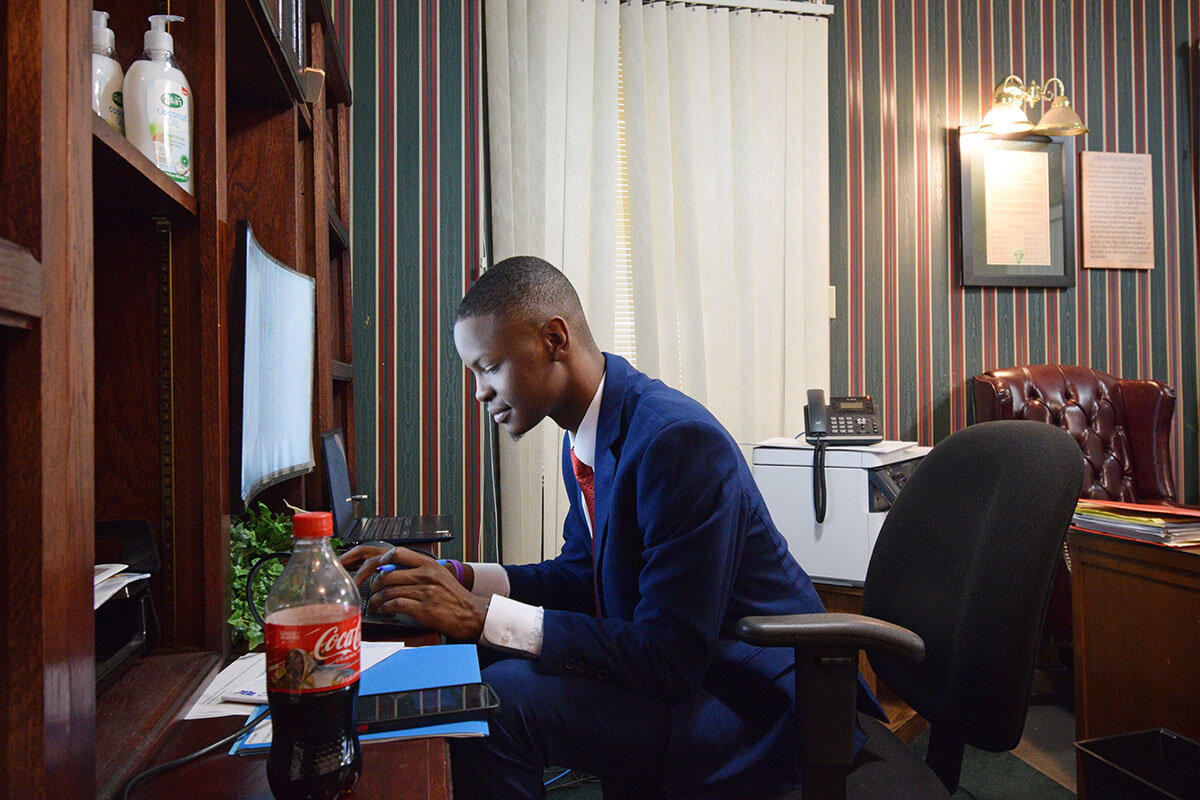
Photo: Sophie Hills/Christian Science Monitor.
Mayor Jaylen Smith prepares for his first City Council meeting in Earle, Arkansas, on Jan. 24, 2023.

Have you noticed how many Gen Z people (born roughly 1997 to 2012) have been running for office? I think it’s a great sign of commitment to a better world — and probably disappointment with what older folks have done to the world.

Here is a teen who just became a mayor in Arkansas.

Sophie Hills reported in January at the Christian Science Monitor, “Many teenagers consider their wardrobes a statement of their identity. For 18-year-old Jaylen Smith, that means a suit instead of jeans and a backpack. Today, the new mayor of Earle, Arkansas, has dressed with special care: a navy two-piece suit, crisp white shirt, and brown dress boots. His tie is red. 

“Tonight, he will call the City Council to order for the first time as mayor. He’s also heading into Memphis – 30 miles away – to buy his own car, a Nissan Altima. …

“If he’s nervous about his big speech, it doesn’t show. … He works with his door open to the street, an invitation to his town. 

“Whether he’s in his office, on the road, or stopping at a parking lot to pick up chicken salad – and pause for a selfie with the guy selling it  – Mr. Smith is always on the phone. Dialing a number, he talks to a woman whose house just burned down. ‘Is there anything we can do for you?’ he asks. He listens to her response, nodding, and promises he’ll call the Red Cross. …

“Mr. Smith is the youngest Black mayor in the country, according to the U.S. Conference of Mayors. He won in a runoff election, pledging to staff police 24 hours a day, tear down derelict buildings, and bring back the supermarket that closed down a few years back. …

“Mr. Smith graduated from Earle High School in 2022. Instead of packing for college and leaving, he spent the rest of the year campaigning door to door and shadowing mayors around the state.

“Perhaps more notable than Mr. Smith’s age is his choice not to leave Earle. As he tells Christopher Conway, his former high school counselor, ‘I always wanted to change my community before moving on to my next phase of life,’ he says. …

“Earle, Arkansas, population 1,800, may seem frozen in time by a lack of money and a declining population. The sense of community buy-in and optimism is clear in the halls of the elementary and high schools, and the well-attended City Council meeting – with an agenda including reports from the police chief and the water and sanitation department, and a debate about zoning. 

“Tucked on the side of Highway 64, Earle boasts three dollar stores and two schools, and a small grocery store that’s been around since 1945. The number of abandoned buildings suggest that Earle has seen better days – that Mayor Smith is pledging to revive. 

“Earle rose out of the post-Civil War timber boom that gave life to so many other small towns dotted along Southern railroads. Today, the town is majority Black. But its painful history includes lynchings and a race riot over school conditions, not to mention its namesake, landowner Josiah Francis Earle, who was active in the Ku Klux Klan.

“Eugene Richards, a photographer, writer, and filmmaker, found himself in Earle in the late 1960s as a member of Volunteers in Service to America. At the time, Earle was separated into white and Black, he says, ‘divided by the classic railroad tracks.’

“Mr. Richards and several VISTA volunteers helped start a paper, Many Voices, which reported on Black political action and the Ku Klux Klan. He was friends with the Rev. Ezra Greer and his wife, Jackie Greer, civil rights activists who led a march protesting segregated schools in 1970. When the marchers were confronted by an angry white crowd, five Black marchers were wounded. … Mr. Richards says, ‘Time went on and things slowly changed.’

“Mr. Richards, who compiled photos and interviews for a 2020 book about the town, says that while the violence of segregation may be in the past, Earle faces new challenges. ‘There’s a weariness – the town is going down very fast,’ he says.

“As student government president for his last three years at Earle High School, Mr. Smith implemented tutoring programs and an advocacy committee for students with learning disabilities. He was also a student advocate for special education students, and dealt with his own learning disability while in school. Those activities taught him how to get resources from the state, he says. After a visit to Washington, D.C., for a mayoral conference, he’s optimistic about receiving more federal grants as well. …

“Between learning the ropes of public office and taking a college course online as he pursues his degree – one class at a time for now – Mr. Smith doesn’t have much free time.

“His phone rings again. This is the part of the job he doesn’t like: being pressured for favors. In this case, he stands his ground over the open clerk position. Every applicant has to turn in an application, he says firmly. …

“Off the phone, he runs down his goals as mayor. He wants to improve public safety, including fully staffing the police department, currently at two full-time and four part-time officers; set up public transportation; and tear down those abandoned houses.

“He’s already spoken with a local business that has agreed to help demolish houses, and he’s confident he’ll find resources to achieve the rest of his goals. ‘They’re there,’ he says. …

“While Mr. Smith, a Democrat, aspires to higher office, he says he isn’t focused on party politics. He attends local Democratic and Republican party meetings to ‘see how they both do,’ he says.

“Mr. Smith opens an envelope and a check falls out of the card inside. He dusts chip dust from his fingers and makes another call: ‘What do I need to do with checks that come in the mail?’

“ ‘I can’t accept money as an elected official,’ he explains after. ‘But I can donate it to the city.’

“Donald Russell, a retired truck driver, was skeptical when Mr. Smith announced his campaign. But after getting to know him, he has ‘high hopes.’ And Mr. Smith ‘has a lot of community support,’ he says. …

“Thirty minutes before the council meeting, Mr. Smith stands up, puts on his suit jacket, locks the door, and crosses the street to the council chamber. People trickle in after him – one asks to take a photo together. Every seat is full, and residents are standing at the back. Mr. Smith opens the meeting, occasionally leaning over to check next steps and procedure with his more experienced companions. Then he stands to deliver his speech, announcing his goals to fully staff all police shifts and institute a neighborhood watch program.

“He ends with a quote from the Bible to nods, murmurs of approval, and applause from the room: ‘Let us not weary in doing well, for a new season we shall reap.’ ”

More at the Monitor, here. No firewall.

Read Full Post »

Photo: Matthew Healey/Boston Globe.
Jeremy Garcia, 22, of Providence takes a break from working on a mural at “The Avenue Concept” in Providence, Rhode Island.

Kids love contributing to community murals. I know because Suzanne and John helped paint one in our town years ago. But that mural — about local history — was bland compared with the passionate work of self-expression and healing by urban youth in Providence.

Alexa Gagosz writes at the Boston Globe, “After setting down her paint brush, Deborah Ndayisaba gazed up at the purple-colored protestors who spread across a section of a new large-scale mural on the exterior of The Avenue Concept’s headquarters.

“A senior at La Salle Academy in Providence, Ndayisaba, 17, said she had her own ‘advocacy awakening’ when the Black Lives Matter movement took off in 2020. She joined the diversity club at school, became involved in PVD World Music, which looks to celebrate and enrich traditional African music and arts, and researched how many of the racial injustices of the Civil Rights era are now still relevant today.

“The protestors, for her, are symbolic. ‘It’s unfair how racial discrimination can touch everything. And activism isn’t just marching on the streets,’ said Ndayisaba, who is applying to colleges to eventually go into the medical field where she hopes to help women of color.

“It’s those kind of personal elements that scatter this newly finished collage mural by local youth who are involved with the Nonviolence InstituteRhode Island Latino ArtsHaus of Codec, and PVD World Music — all Providence-based organizations. The effort was led by The Avenue Concept, a public arts organization, and international community-based public art organization Artolution. …

“The Avenue Concept, which is the state’s leading public art program, was founded in Providence in 2012. Since then, artists from around the world have been commissioned to paint mammoth-sized murals across downtown that are part of the city’s skyline today. …

“A few of the Concept’s most notable works address longstanding community issues, such as ‘Still Here‘ by muralist Gaia, which depicts Lynsea Montanari, a member of the Narragansett tribe and an educator at the Tomaquag Museum, as they hold a picture of Princess Red Wing, a Narragansett elder who founded the museum. In September, Boston-based artists Josie Morway painted a new mural in Warren that addresses sea level rise.

“This new project, which was completed after 10 painting days on Sept. 30, is a pilot for a larger community participation program that was identified in The Avenue Concept’s latest strategic plan. The goal of the program, Thorne explained, was to address representation, neighborhood voice, unique cultural perspectives, and community needs in their upcoming projects.

“ ‘Over the last year, we’ve really tried to listen and better understand the stories that are intersecting in our own neighborhood,’ [Yarrow Thorne, executive director and founder of The Avenue Concept] said. ‘We are looking to do more than just the giant pieces of beautiful art in downtown, but to serve the community that surrounds us.’

“Thorne said the Concept, which is based in the Upper South neighborhood of Providence, selected the four local organizations because of how their work makes an impact across a diverse set of communities. Each organization brought four to five members of their youth communities to learn, connect, co-create themes, and eventually execute the mural with the help of Artolution’s co-founder Dr. Max Frieder.

“Frieder, a Rhode Island School of Design graduate and former classmate of Thorne’s, brings public art projects around the world — including in refugee camps. Frieder said he trains refugee-artists on how they can work with kids who have been through trauma and teach them to express what’s most important to them through art.

“ ‘With this project, we brought four very different community groups together and it has been remarkable to see them come together and reflect on their similarities,’ said Frieder, who has participated in public art installations on all seven continents. …

“Each participant painted a scene in a ‘memory ball,’ which looked like a golden orb with a scene of their choice inside. Some painted themselves playing basketball, another read ‘stop drug abuse,’ and one painted themselves playing a trumpet.

“One memory ball said, ‘You only get one life. It’s your duty to live it as fully as possible.’ It’s a quote inspired by Jojo Moyes, an English journalist and novelist.

“Each participant talked about the issues they and their families face in South Providence today: their communities getting priced out as the cost of living increases. Others have faced racism and homophobia in school. Some say their family’s generational trauma has prevented their own parents from healing.

“For example, Jeremy Garcia, 22, a self-described ‘proud, Black-Latino,’ described the stereotypes of South Providence being considered an ‘urban hood’ where residents are predominantly people of color. Garcia said many of their neighbors have watched cases of police brutality, such as the killing of George Floyd, and are afraid to call the police.

“ ‘These are the people who are supposed to save us and who we should be able to turn to when we are in danger,’ Garcia said. ‘If you can’t turn to the police, where do you turn?’

“Expressing themselves ‘and letting go of their past is the only way we can can heal and move forward,’ said Cedric Huntley, the executive director of the Nonviolence Institute. ‘We need more of this — in Providence and around the world. We all focus so much on the negative, which certainly impacts all of us, but there’s more to it in these young people’s lives.’ ”

More at the Globe, here. Nice photos. For a no-firewall article on the mural “Still Here,” check the Brown University newspaper.

Read Full Post »

Photo: Drew Arrieta | Sahan Journal.
Mary Taris poses with Blended In Or Faded Out, by Colonese M. Hendon, at Strive Bookstore in Minneapolis on July 15, 2022. 

A Black educator and mother in Minneapolis saw a problem. There were few books with characters her students grandchildren could relate to. So she took action. And in the process, helped her own family and many others.

“When Mary Taris was raising her four children in north Minneapolis,” writes Noor Adwan at Sahan Journal, “she knew she needed to give them books more representative of their identity than the ones she’d had as a child. 

“ ‘I always had to spend extra time and money to find books that our Black children could relate to,’ she said. ‘At a certain point, after years of being frustrated, I just decided I needed to do something about it.’ …

“In 2018, Taris founded Strive Community Publishing to carve out space in the publishing world for Black authors. It has published fiction and nonfiction works for adults and children from 20 authors and five illustrators, and recently opened its first store at the IDS Center in downtown Minneapolis.

“Strive Bookstore’s grand opening [July 20 featured] Anthony Walsh, author of Hockey Is for Everybody. …

“ ‘We’re hoping that at the grand opening we can get to know some of the people who live in the downtown community and find out what they would like to see in a bookstore,’ Taris said.

“Taris’ experiences as a reader, educator, and mother all contributed to her aspiration to provide children with culturally relevant books. When she was a child growing up in north Minneapolis, reading was a reprieve from a chaotic home life.

“ ‘I would just be in my room reading anything I could get my hands on,’ Taris, 58, said recently during an interview at Sistah Co-op, the Black-woman focused business collective in the IDS Center where Strive is also located. ‘It was like reading for escape, and wishing I was somewhere else.’

“But she never felt represented in the books she read as a child. … It wasn’t until Taris was in her 20s that she read something that she could see herself in. One of her coworkers, an older Black woman, had stepped in. 

“ ‘Girl, you need to be reading some books by Black folks,’ Taris recalled her coworker saying. She loaned Taris Disappearing Acts, a novel by Terry McMillan. …

“Taris said the straw that broke the camel’s back came during her final few years of teaching. Her school, located in the Robbinsdale school district, had received an arts grant, and she was encouraged to put together an arts-integrated lesson plan.

“At the time, her class of predominantly Black fifth-graders was busy learning about autobiographies and biographies. But there were only a handful of Black biographies in the school’s library.

“To fill that void, Taris planned to have her students pretend to be adults, and write and illustrate their own autobiographies.

She put in a budget request for blank books and markers for her students. Her request was denied.

“ ‘That was it for me,’ Taris said. ‘It’s like, “I’m just gonna start my own business and I’ll spend my money on what I want for our kids.” ‘ … 

“When Taris founded Strive, she was supported by a circle of writers she calls her founding authors.

“ ‘I give them that distinction because they had to go through the learning process with me,’ Taris said. She said she felt fortunate that they trusted her – and Strive – with their stories.

“ ‘One thing that’s key in publishing is to be able to have the trust of the authors, especially authors who are marginalized like Black authors are, because they have been writing their stories for years,’ Taris said. ‘By the time it gets to me, they’re handing over their baby.’

“Donna Gingery, a 61-year-old Black woman and one of Strive’s founding authors, said one of her favorite parts of working with Strive was the support and encouragement she received throughout the writing process.

“ ‘There’s a lot of things I like about Strive Publishing,’ Gingery said. ‘The encouragement of the writer, the respect that you’re getting from the publisher, and not trying to change the narrative of your book. I think that’s really important.’ 

“Taris said that Strive does its best to hire Black editors to look over their books. …

“Taris’ vision for Strive doesn’t end with the IDS Center location. ‘We do have plans for growth and a possible second location,’ she said.

“In the meantime, she wants to focus on serving the downtown community. ‘We’re really striving to connect across cultures,’ she said.

“Part of that, she said, is portraying the Black community and all of its richness and diversity of talent in a positive light. Readers are already responding.

“ ‘This is a cultural exchange,’ Shimelis Wolde, 70, said recently as he browsed the co-op. ‘It’s important for the new generation.’ “

More at Sahan Journal, here. You can also read summaries of five new books available at the bookstore.

Read Full Post »

« Newer Posts - Older Posts »