Feeds:
Posts
Comments

Posts Tagged ‘food’

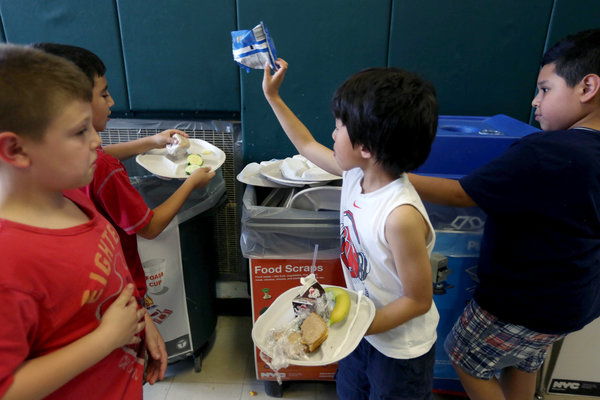
Discouraging as it is to read that many children won’t eat the healthful food schools are now providing, I take heart that at least they are learning to compost.

Al Baker writes at the NY Times, “The sad voyage of fruits and vegetables from lunch lady to landfill has frustrated parents, nutritionists and environmentalists for decades. Children are still as picky and wasteful as ever, but at least there is now a happier ending — that banana-filled bin is a composting container, part of a growing effort to shrink the mountains of perfectly good food being hauled away to trash heaps every year.

“New York City’s school composting program, kicked off just two years ago by parents on the Upper West Side, is now in 230 school buildings in Manhattan, Brooklyn and Staten Island, and is expected to more than double in size and reach all five boroughs in the fall, with an ultimate goal of encompassing all 1,300-plus school buildings. …

“The hope is that by building up composting in school, the city will help the environment, instill a sense of conservation in schoolchildren and, critically, save some money. The city paid $93 per ton in 2013 to dump in landfills, up from $68 in 2004. Composting saves the city $10 to $50 per ton, because the cost is offset by the sale of the end product, according to the Sanitation Department.” More here.

I tend to think kids will eventually eat something nourishing if that’s what’s available and they’re hungry. All I know is my kids eat everything now that they are grown-ups. (Still laughing that John came home from college and said, “How come you never told me I like mushrooms?”)

Photo: Hiroko Masuike/The New York Times

Read Full Post »

I’m grateful to Scott, a former colleague, for putting this cool thing on Facebook. Looking at these healthy, growing plants is especially warming today, now that the temperature has gone back to 15 F.

Tim Blank at Future Growing LLC (which produces vertical aeroponic food farms) writes, “When you hear about a farm that supplies all-natural, sustainable produce, using 90% less water and 90% less land, one that utilizes the most advanced vertical aeroponic technology on earth, you surely would not guess it would be an Amish farm.

“Yet in Topeka, Indiana, you cannot get produce that is more local, fresh, healthy, and sustainable — even in the middle of an Indiana blizzard — like you can get at Sunrise Hydroponics, an Amish farm.

“Sunrise Hydroponics is owned and operated by husband-and-wife team Marlin and Loretta Miller on their rural farm in Topeka. I have had the privilege of working with the Amish community for more than half a decade, and have come to learn that, while their lives seem simple to many outsiders, their homes, farms, and businesses are highly innovative. The Amish utilize cutting-edge and creative forms of technology to improve their lives, while still falling within the guidelines of their belief system.” Read more here.

Greenhouse at Sunrise Hydroponics

Read Full Post »

… turn them into escargots.

Lalita Clozel has a great story at the NY Times today about snails that nobody wanted.

She writes, “On this storm-weathered tip of Mont Saint-Michel Bay, the sweeping tides have washed away the line between land and sea. Fishermen drive their wheeled boats straight into the bay to gather their harvest: an assortment of shellfish prized all over France.

“But now they are finding their nets weighed down by an invasive species: the crépidule, or Atlantic slipper shell, a curious type of sea snail that has spread from the East Coast of the United States.

“Oyster and mussel producers here have watched helplessly as the colony has taken over their beautiful bay, flush with phytoplankton, the micro-organisms that make it a haven for all manner of shellfish and tint the water turquoise.

“Enter Pierrick Clément, a local entrepreneur who looked at the encroaching Atlantic slipper shell and asked an unthinkable question in a town that has built its livelihood on bountiful seafood: Would people eat the insidious creature?

“ ‘As a businessman, I see an opportunity here,’ he said. …

“The community of Cancale now finds itself torn between disgust and relief at Mr. Clément’s project to fish and sell the sea snails for consumption.

“After years of administrative haggling, he has coaxed local municipalities and producers to back his project and begin a campaign to rehabilitate the snail’s image. …

“His pilot factory, among the bustling oyster plants in nearby Le Vivier-sur-mer, ships to a few stores and restaurants in France, Spain and Germany.

“Eventually he hopes to process as much as 100,000 tons of slipper shells per year — enough to offset their growth in the bays.” More here.

This entrepreneur’s adaptability fits with what my father used to say about the French secret of beauty. It was along the lines of Feature what you’ve got.

“If you have a big nose,” he said, “hang a beer can on it.”

Photo: Catalina Martin-Chico for The New York Times

Read Full Post »

Jeremiah Gallardo, a Colorado native, clicked on yesterday’s post, and I thought I’d have a look at his blog, too.

I don’t know much about Colorado. The closest I got to knowing anything at all was having a college roommate from Boulder.

Jeremiah has a nice entry today about a German Christmas market, the Denver Christkindle Market, which he took photos of. He says it runs until December 25.

“The vendors are in little wooden houses,” he writes, “that were built days before the market event.

“My first stop at the market was the hand-blown glass vendor.  I watched him make a glass icicle decoration in a few minutes, right before my eyes. I bought a green glass pickle decoration.

“Why on earth did I buy a green glass pickle? Because it’s linked to a German tradition where you hide a pickle deep inside the tree and the first child to find it gets to open an extra gift.”

You know, if I had a glass pickle, I might just try it myself.

More about the German market’s crafts and food at Jeremiah’s blog, WhiteLiger.net. You will like his pictures. And his enthusiasm.

Photo:

Read Full Post »

I remember many days with Carole on the playground at recess playing house and gathering “grain,” which we pulled off a common weed and sometimes pretended to eat and sometimes buried — in case we might need extra food someday. Carole was a great kid to play with.

Asakiyume, whom I met in adulthood, is the kind of person I would have wanted to play with in childhood. She has a wild imagination that seems to fire on all burners 24/7. And now that she is old enough to carry out some wishes from age 10 or so, she is going right ahead with them.

For example: acorn cake. At Asakiyume’s blog, followers watched her leach the tannin out of her acorns over a period of days, changing the water repeatedly. We kept tabs as she next roasted the acorns, made acorn flour, and finally baked a cake.

“Today I baked an acorn cake,” she wrote on Nov. 3. “I used my ground-up, leached acorns, and a recipe from Hank Shaw (posted here). The body of this cake is equal parts acorn flour and wheat flour.

“And–it tastes fabulous. It has a flavor like molasses with a hint of ginger, and your tongue tingles a little afterward, like when you eat something peppery. …

“It’s a tiny childhood dream come true–feasting on the abundance of acorns! (Okay, helped by honey, oil, and eggs, not to mention that wheat flour, but still.)”

Read more here.

Photo: Asakiyume
Acorn cake with sugar outlining an oak leaf.

Read Full Post »

The Christian Science Monitor recently ran a story by Bryan Kay about an ongoing  community service project.

“Not even the recent furlough of federal workers was enough to snuff out the latest community outreach effort of Masjid al Islam mosque in Dallas.

“On a weekend in early October, the mosque was participating in a national initiative known as the Day of Dignity, an annual event during which mosques feed, clothe, and equip people living in poverty. But federal workers who had been scheduled to attend to speak about the details of the Affordable Care Act …  had been forced to cancel because of a partial federal government shutdown.

“It was a blow to the mosque’s boosters, says Muhammad Abdul-Jami, treasurer of Masjid al Islam and coordinator of the Day of Dignity event. But it didn’t deter them from pursuing the same purpose they have had for the last several years, he says: aiding homeless people … .

“Masjid al Islam is in an area where the homeless are a ubiquitous sight. … Because of the great need every weekend, the mosque seeks to do what the Day of Dignity event, organized in conjunction with the national charity Islamic Relief USA, does on an annual basis. Through its Beacon of Light community center, Masjid al Islam feeds approximately 300 individuals in need on Saturdays and Sundays each week, Mr. Abdul-Jami estimates. That’s more than 15,000 meals per year, paid for with donations from individuals and other mosques and served by volunteers, he says. …

” ‘There are millions of Muslims in this country who are very regular people, people who [other] Americans might consider much like them,’ Abdul-Jami says. …  ‘These events help us showcase that we are concerned about the rest of humanity, not just wanting to help Muslims.’ ”

Read more here.

Photo: Walid Ajaj

Read Full Post »

I’ve been on one of my periodic murder-mystery splurges, with a couple mysteries this month that take place in France.

Books about France should never be read on an empty stomach — there is always wonderful food.

The author of The Crowded Grave actually went overboard, I thought, stopping urgent action to prepare elaborate meals. I think The Bookseller mystery will maintain a better balance. So far the hero has only had pastries and lovely coffees on route to something actually related to the story.

Thinking about France makes me want to point out a website where my friend Ronnie Hess blogs, My French Life. Ronnie lived in France for years working for CBS and more recently wrote a guidebook called Eat Smart in France that taps her her deep knowledge of French food.

Ronnie was already a fine cook as a teenager, when I recall making a Scripture cake at her house:

  • 3/4 cup Genesis 18:8
  • 1 1/2 cup Jeremiah 6:20
  • 5 Isaiah 10:14 (separated)
  • 3 cups sifted Leviticus 24:5
  • 3 teaspoons 2 Kings 2:20
  • 3 teaspoons Amos 4:5
  • 1 teaspoon Exodus 30:23
  • 1/4 teaspoon each 2 Chronicles 9:9
  • 1/2 cup Judges 4:19
  • 3/4 chopped Genesis 43:11
  • 3/4 cup finely cut Jeremiah 24:5
  • 3/4 cup 2 Samuel 16:1
  • Whole Genesis 43:11

Her mother helped us think through what was meant by leavening and certain more arcane references.

Do check out Ronnie at My French Life, here.

Read Full Post »

I know it’s hard to believe, but in South Korea, Spam is considered a holiday treat, one that inspires happy memories.

The BBC’s Lucy Williamson had a story about it in September.

“South Korea,” she wrote, “is preparing for the annual lunar thanksgiving holiday, which is known as Chuseok.

“Locals celebrate the holiday by visiting relatives, paying respects to family ancestors as well as the giving and receiving of packaged cans of Spam.

“While that might sound odd, the tins of pre-cooked pork have become a staple of South Korean life.”

Brand manager Shin Hyo Eun explains, ” ‘Spam has a premium image in Korea. It’s probably the most desirable gift one could receive, and to help create the high-class image, we use famous actors in our commercials.’ …

“Spam was introduced to Korea by the US army during the Korean War, when food was scarce – and meat even scarcer. Back then, people used whatever they could find to make a meal.

“But the appeal of Spam lasted through the years of plenty and it’s now so much a part of South Korean food culture, that it’s the staple ingredient in one of the country’s favourite dishes: budae jigae or army stew.”

Ho Gi-suk runs a restaurant near a U.S. base.

” ‘Back then,’ she tells me, ‘there wasn’t a lot to eat. But I acquired some ham and sausages… the only way to get meat in those days was to smuggle it from the army base.’ …

“Army Stew is now well-established as part of South Korea’s culinary landscape — as traditional here as Spam gift-sets for thanksgiving.

” ‘It’s salty, and greasy, and goes very well with the spices,’ one customer told me. ‘Korean soup and American ham – it’s the perfect fusion food.’ ”

More.

Read Full Post »

I’m hoping someone from my deep past will remember the name of the man who used to travel to my growing-up neighborhood in a blue-painted school bus to sell fruits and vegetables. The name “Mr. Mackey” is clawing itself to the surface, but I may have that wrong.

I had flashbacks about the huckster today when I read about the Fresh
Truck, an old idea made new in a time of urban food deserts and locavore sensibilities.

Christina Reinwald wrote the story for the Boston Globe.

“A food bus began to roll down the city’s streets Thursday. The retrofitted school bus, the brainchild of a Boston start-up called Fresh Truck, is expected to visit Boston communities that don’t have nearby grocery stores, selling fruits and vegetables.

“Fresh Truck founders Josh Trautwein and Daniel Clarke, recent Northeastern University graduates, came up with the idea last year and work full time now to serve neighborhoods in need of more healthful food options. …

“Fresh Truck raised more than $32,000 from over 300 contributors to its Kickstarter crowdfunding campaign earlier this year. It also received private donations to get started.

“Starting Monday outside the New England Baptist Hospital in Roxbury, Fresh Truck will sell its produce for about 20 percent less than average grocery prices, Trautwein said.

“Avoiding the traditional brick-and-mortar shop eliminates many operating costs for Fresh Truck.” More.

Photo: Yoon S. Byun/ Globe Staff
A food bus run by Fresh Truck, a Boston start-up, aims to serve neighborhoods in need of more healthful food options.

Read Full Post »

This post’s for my daughter-in-law, who not only loves to cook but is also pretty savvy about healthful eating. I should know. I had a yummy something with orzo and mushrooms for Tofu Tuesday at my son’s house last night.

Today’s story from the NY Times is on the expanded distribution goals of a company with inventive food options currently popular with celebrities.

And, as Stephanie Strom writes, the offerings are not just for vegans.

“Organic Avenue, the tiny purveyor of high-end juices, fresh salads and specialty foods like cashew scallion cream cheese and Thai collard wraps, has hired a new chief executive with the goal of turning its new owner’s dreams of a national chain into reality.

“Martin Bates … will take charge of Organic Avenue in June. …

“ ‘I drink green juices and have done for the last year or so, but living the life of a vegan is not for me. I think there are lots of other people like me out there.’ …

“We want to grow this business around helping people who want food that’s better for them,” [investor Jonathan] Grayer said. ‘That doesn’t mean they have to be vegan. They certainly don’t have to favor raw. They don’t even have to be organic; they just have to want to be healthier.’ ”

Bates, who turned around the Pret a Manger chain, said that he is up for the challenge.

“Perhaps tellingly, he said his favorite Organic Avenue product was Dragon’s Breath, a juice that incorporates ginger, lemon and cayenne pepper. ‘Caution,’ the company’s Web site warns. ‘This shot is not for the faint at heart!’ ” More.

We are into dragons around here. I’ll have to see if I am brave enough to drink Dragon’s Breath.

Photo: Michael Falco for The New York Times
Organic Avenue, which caters to a celebrity-studded clientele, hopes to appeal to a range of healthy eaters

Read Full Post »

Brian sent me information about Higher Ground Farm, which is putting down roots on the roof of the Design Center in South Boston.

“A roof farm is a type of green roof. A green roof is a system of layers that is laid over an existing roof. A green roof is beneficial to a building owner and the community because it protects the existing roof, doubling to tripling its life, thereby saving money and keeping materials out of the landfill.

“Green roofs also reduce a building’s energy costs by insulating in the winter and cooling the rooftop in the summer. Finally, green roofs temper the effects of two common urban environmental problems – combined sewer overflow and the urban heat island effect.

“A series of roof farms throughout the city will capitalize on the environmental benefits of green roofs while also increasing access to fresh, healthy food. Higher Ground Farm will operate several roof farms throughout the greater Boston area, utilizing previously unused space while providing additional rental revenue to a building owner.

“Roof agriculture has the potential to be a job-producing boost to the economy, and a completely environmentally sustainable business sector that can set Boston apart from other cities. Higher Ground Farm will utilize the resources of our top-notch universities to study roof agriculture, which will position Boston as a leader in the field. Finally, Higher Ground Farm will be a space where our community can reconnect to productive green space and learn about sustainable city planning.” More.

I also found a video interview about it that you will like, here.

Read Full Post »

I was pushing the stroller this morning, singing the old Thanksgiving hymns (“Come Ye Thankful People,” “We Gather Together,” “We Plow the Fields and Scatter the Good Seed on the Ground”) and thinking of harvests.

So today might be a good time to blog about harvests and drought-resistant crops.

“Scientists are developing faster-maturing and drought-tolerant varieties of corn and cotton,” writes Madalitso Mwando at AlertNet, “holding out the hope of much-needed relief for thousands of farmers across Zimbabwe.

“As planting season approaches amid concerns about successive poor harvests, research into drought-resistant seeds is gaining momentum …

“Zimbabwean farmers have suffered a succession of poor harvests with yields far below what the country needs, forcing the agriculture ministry repeatedly to revise its projections for harvests.

“Farmers and their unions blame the cyclical uncertainties of their sector not only on a lack of up-to-date farming technology, but also on their inability to obtain seed varieties that can survive the low rainfall caused by climatic shifts.

“The Scientific and Industrial Research and Development Centre (SIRDC), in partnership with the University of Zimbabwe and Biotechnology Research Institute (BRI), has developed a drought-resistant variety of maize (corn) seed called Sirdamaize 113.

“Farmers have had to wait between 150 and 180 days before harvesting their traditional maize crop, but the center says the new seed takes only 136 days to mature.” Read more.

I hope a bountiful harvest was represented at your dinner table today.

With gratitude to blog readers for reading,
Suzanne’s Mom

Photograph: Philimon Bulawayo/Reuters/File
Martha Mafa, a subsistence farmer, stacks her crop of maize (corn) in Chivi, about 378km (235 miles) southeast of the Zimbabwean capital of Harare.


Read Full Post »

Erik says he cannot see the appeal of peanut butter. Kids in Sweden never had peanut butter and jelly sandwiches growing up, he says.

I, however, was raised on peanut butter, taking sandwiches in my school lunch that ran the gamut from peanut butter and jelly to peanut butter and whatever was in the house — cucumber, coconut, banana, celery, green pepper, mayonnaise.

Peanut butter is high in protein and recommended in pregnancy, which is why Suzanne got back into it when she was expecting.

Today, as Tracy Boyer writes at the Pulitzer Center for Crisis Reporting, nonprofits are adding extra nutrients to peanut butter and getting the inexpensive protein-rich food into the tummies of undernourished children in poor countries.

“Deep in the mountains of southwestern Honduras, Maria Digna Ramos Mendoza spoon-feeds Plumpy’Doz, a peanut-based supplement, to her infant daughter.

“Four other hungry children watch while either sitting on the dirt floor of their one-room hut or swinging from a hammock. Chickens, dogs and rats roam around the cluttered room, scavenging for their next meal.

“Mendoza is part of a research study being conducted by professors and students at [the University of North Carolina], part of the University’s larger focus on international health. Researchers aim to improve the growth and development of young infants in rural Honduras.

“The Mathile Institute for the Advancement of Human Nutrition, a philanthropic organization founded by former Iams CEO and board chairman Clayton L. Mathile, funds the year-long project [2009].

“The study is also in conjunction with the U.S. nonprofit organization Shoulder to Shoulder, an organization founded and directed by UNC School of Medicine faculty member Dr. Jeffrey Heck. …

UNC alumna Yanire Estrada [was recruited] “to lead a team of 11 local and U.S. health promoters to provide educational sessions for the mothers and assess each infant’s health on a monthly basis.

“Estrada’s team evaluates nearly 300 infants from 18 villages in both a control and intervention group. Heck insisted that both groups receive some beneficial subsidy for participating in the study, so every mother obtains food vouchers in addition to the educational sessions. …

“The intervention group receives Plumpy’Doz, a fortified lipid-based peanut butter spread, packed with essential nutrients including zinc, iron and vitamin A. The supplement is given to the infants three times a day in addition to their normal diet. …

UNC public health professor Margaret Bentley “noticed the easy access to cheap, packaged snacks and soft drinks that exists in North Carolina also exists in Santa Lucia. Both are troubling, as Honduran mothers feed this junk food to their infants, causing chronic diarrhea and sickness.

“ ‘I don’t think about working overseas as working over there (with) no connection to North Carolina,’ Bentley said. ‘Any problem that we have in North Carolina has a mirror image in another place.’ …

“Back in the mud hut, Mendoza stares lovingly as her infant begins eating Plumpy’Doz straight from the jar. Just six months ago, her daughter’s fragility deeply concerned her, but now she prides herself as she watches the color return to her child’s face.

“ ‘People stop me to ask what I am feeding my child because she is beginning to look so pretty,’ Mendoza said. ‘She is developing extremely well now.’ ”

More.

Photograph: Pulitzer Center

Read Full Post »

Another MassChallenge entrant that, like Erik’s company, won start-up money on October 23 is Lovin’ Spoonfuls. I was delighted to see this worthy nonprofit  mentioned by Noelle Swan in an article on food resources in Spare Change News, sold by Homeless Empowerment Project vendors.

“The first time Ashley Stanley walked into the back room of her local grocery store in search of discarded food, she found towers of eggplants, tomatoes, and potatoes rising up around her. The produce was not spoiled or rotten; it simply no longer fit on the display shelves and had been moved off the floor to make room for fresher shipments. Dumbfounded, she asked if she could have the food. She loaded up her car with as many vegetables as she could and drove to Pine Street Inn, a homeless shelter in Boston. …

“A recent study from the Natural Resources Defense Council lends credibility to Stanley’s suspicion that the country is not experiencing a lack of food. Nearly half of the food produced in the United States never makes it to the table, according to the study released in August 2012. Food goes to waste at every link in the food chain. Farmers plow unharvested crops into the ground, grocers discard unsold food by the caseload, and restaurants pour mountains of leftovers into dumpsters. In total, Americans throw away $165 billion worth of food every year, 40 percent of all the food produced in the nation.

“At the same time, 1 in 5 Americans was unable to pay for food at some point in the last year, according to a recent Gallup poll. …

“When Stanley first showed up at the door to Pine Street Inn with her arms full of vegetables, she said the staff seemed shocked to see her. …

“Since then, the former corporate luxury retailer has redistributed more than 150,000 pounds of food to area homeless shelters, domestic abuse safe houses, and food pantries. She started out delivering food in her own car while seeking donations and grants. Today, she has three employees, two trucks, and a waiting list on both sides of the equation.

“Lovin’ Spoonfuls is just one of a handful of food rescue organizations in the Boston area.” More.

Photograph of Ashley Stanley by Mike Diskin

Read Full Post »

How great an idea is this? Somerville’s League of Urban Canners gleans neglected fruits from city lots and neighbors’ trees and turns them into jellies, jams, and preserves.

Writes Kathleen Weldon in the Boston Globe, “The group is the brainchild of Sam Katz-Christy of Somerville, who was struck by inspiration last fall after receiving 10 pounds of plums from a neighbor who happened to have an unusually productive backyard tree. Armed with little more than a cookbook and a bit of courage, he and his family preserved their windfall in glistening Mason jars. The committed locavore, who commutes by bike to his job in Cambridge’s Central Square, began to notice just how much unused fruit was hiding in plain sight among the squares and one-way streets he traveled. His daily rides became a treasure hunt.

“After recruiting a posse of workers from his network of food-loving friends, he began knocking on doors, offering an unusual deal to the owners of neglected one-tree orchards: the League would pick their crop, can the harvest, and give residents back 10 percent of the results. The volunteers keep the rest.

“The initiative has proven remarkably successful. More than 220 sites are currently listed in the League’s database, representing more than 3,500 pounds of collected fruit. …

“Though at first the League expected to reap mostly apples and grapes, soon it became clear that Somerville, Cambridge, and Jamaica Plain were rich with ripe possibilities from mulberries to pears, raspberries to quince. A single tree in Harvard Square yielded 245 pounds of apricots, which turned into countless jars of jam.” Read more.

Suzanne loved the mulberries growing in our neighborhood when she was about five. I wonder how we might get our hands on mulberry preserves.

Mulberry season is long past, but there’s still plenty of produce out there, as evidenced by the hardy farmstands at the farmers market today.

Read Full Post »

« Newer Posts - Older Posts »