Feeds:
Posts
Comments

Posts Tagged ‘immigrant’

Photo: Boston Globe.
A headline in the Boston Globe from 1924.

I didn’t get to post this story about a charitable Gothenburg-born Boston immigrant last year, but I think you’ll agree that it’s a bit of Christmas history that will always be fresh.

Jenny Ashcroft wrote about it at Fishwrap, the official blog of Newspapers.com.

“On Christmas Day in 1921, a Swedish immigrant quietly wheeled his hot dog stand to a street corner in Boston’s North End and distributed 500 free hot dogs to hungry children. Axel Bjorklund was no stranger to poverty. He barely made ends meet himself, but he wanted to give back. His cart was soon swamped with hundreds of shivering children wearing tattered clothing that did little to stave off the cold. Their hungry faces beamed when Axel handed them a steaming hot dog. Eventually, the food was gone, but Axel’s determination to repeat the event wasn’t. The Hot Dog Santa tradition was born. Over the next eight years, Axel gave away some 10,000 hot dogs before he died in 1930.

“Born in Gothenburg, Sweden, on August 6, 1869, Axel Bjorklund emigrated to America in 1889, eventually settling in Boston’s North End neighborhood. The area had become a melting pot of immigrants, most of whom were impoverished as they struggled to establish lives in a new country. The Spanish Flu Pandemic hit the North End particularly hard, leaving families even more destitute and many children orphaned.

“The first Christmas hot dog giveaway in 1921 was so successful that Axel decided to expand in 1922 and doubled the number of hot dogs to 1,000. His hot dog giveaway grew with each year until he distributed 3,000 annually. The children loved Axel and nicknamed him ‘Hot Dog Santa.’ …

“Axel’s annual Christmas Day hot dog giveaway eventually moved to New Year’s Day, but it was an event the children anticipated all year. As Axel’s generosity expanded, so did his health challenges. He was plagued with rheumatism, which led to frequent hospitalizations. His finances struggled, too, and he could no longer pay his rent. Not wanting to end the hot dog giveaway, he appealed to the public to help him continue the tradition.

“In December 1928, just before the annual hot dog giveaway, Axel’s landlady kicked him out because he hadn’t paid rent. The Salvation Army stepped in to help, but Axel was broke. The next two years saw Axel skipping between the poor house, the Cambridge Home for the Aged, or obtaining temporary lodging from generous benefactors. Despite his circumstances, in 1929, he participated in his final hot dog giveaway.

“On November 10, 1930, Axel Bjorklund passed away, penniless and alone at a Massachusetts hospital. He had no relatives and was set to be buried in a potter’s field when newspapers published word of his death. Citizens stepped forward, offering to contribute to a fund to give Axel a proper burial. The Swedish Charitable Society coordinated, and Axel was laid to rest in the Cambridge Cemetery.

“If you would like to learn more about the Hot Dog Santa or discover other heartwarming Christmas stories, search Newspapers.com.”

It hurts to think that today there are still plenty of shivering, hungry American children who could use this 1920s Good King Wenceslas.

Read Full Post »

Photo: MinnPost.
Cynthia Tu of Sahan Journal is using Chat GPT to improve revenue streams.

A few times in the past, I’ve had reason to link to a story at Sahan Journal, a nonprofit newsroom serving immigrants and communities of color in Minnesota. Now NiemanLab, a website about journalism, links to an article on a surprising development at the small publisher.

Lev Gringauz, reporting at MinnPost via NiemanLab, writes “As journalists around the world experiment with artificial intelligence, many newsrooms have common, often audience-facing, ideas for what to try.

“They range from letting readers talk to chatbots trained on reporting, to turning written stories into audio, creating story summaries and, infamously, generating entire articles using AI — a use case vehemently rejected by many journalists.

“But Sahan Journal, the nonprofit newsroom serving immigrants and communities of color in Minnesota, wanted to try something different.

“ ‘We’re less enthusiastic, more skeptical, about using AI to generate editorial content,’ said Cynthia Tu, Sahan Journal’s data journalist and AI specialist.

“Instead, the outlet has been working on ways to support internal workflows with AI. Now, it’s even testing a custom ChatGPT bot to help pitch Sahan Journal to prospective advertisers and sponsors. …

“While AI has plenty of ethical and technical issues, Tu’s work highlights another important aspect: The intended users — in this case, the Sahan Journal team.

“ ‘A lot of … this experiment is less of a technical challenge,’ Tu said. ‘It’s more like, how do you make [AI] fit in the human system more flawlessly? And how do you train the human to use this tool in a way that it was intended?’

Sahan Journal’s AI experimentation, and Tu’s job, are supported by a partnership between the American Journalism Project, a national nonprofit helping local newsrooms, and ChatGPT creator OpenAI. …

Liam Andrew, technology lead for the AJP’s Project & AI Studio, sees part of his job as helping newsrooms overcome hesitancy around AI. …

“Tu joined Sahan Journal fresh from a Columbia Journalism School master’s program in data journalism. She had played a little with chatbots, but otherwise didn’t have much experience working with AI. …

“For one investigation, Tu used a Google AI tool to process the financial data of charter schools in Minnesota. Thinking about how to save time on backend workflows, Tu then helped Sahan Journal generate story summaries, tailored for Instagram carousels, with ChatGPT. …

“ ‘You need to know what the workflow of the organization looks like…[and how] you push for change within a department when they’ve already been doing [something] for the past five years using a manual or human labor way.’

“That knowledge came in handy when finally tackling Tu’s core AI project: improving Sahan Journal’s revenue.

“The project stemmed from an anonymized database of audience insights, which included demographic information and interests. While an important resource, Sahan Journal’s small revenue team didn’t have the time to figure out how to leverage it. …

” ‘What if AI could feed two birds with one scone? A custom ChatGPT bot could process the audience data and personalize a media kit for clients. But it needed to work without being an extra burden on the revenue staff. …

“The magic of AI chatbots like ChatGPT is that you don’t need to know how to code to use them. Just type in a prompt and get rolling. …

“Less magically, AI chatbots can be hard to keep in line for specific tasks. Designed to be eager helpers, they hallucinate false results and stubbornly twist instructions in an attempt to please.

“Troubleshooting those issues was no simple task for Tu.

“The custom revenue chatbot struggled to keep Tu’s preferred formatting, and hallucinated audience data. The bot would also intermix results from the internet that Tu had not asked for. None of that was ideal for a tool that should work reliably for the revenue team.

“ ‘I was kind of jumping through hoops and telling it multiple times, “Please do not reference anything else on the internet,” ‘ Tu said. …

“Working with chatbots is an exercise in prompt engineering — mostly a trial-and-error process of figuring out what specific instructions will get the preferred result. As Tu said, ‘lazy questions lead to lazy answers.’ … Eventually, Tu settled on a reliable set of prompts.

“The custom chatbot takes about 20 seconds to find relevant data from the audience database — for example, pulling up how much of Sahan Journal’s audience cares about public transportation. Then it creates a summary for a media kit tailored to potential clients.

“The chatbot also double-checks its work by referencing the database again, making sure its output matches reality. And part of the database is shown for users to manually see the chatbot isn’t hallucinating. …

“Earlier this year, Tu introduced the final version of the revenue bot to Sahan Journal’s team. …

“By mid-April, the Sahan Journal revenue team had used the custom chatbot on six sales pitches, with three successfully leading to ads placed on the site. …

“But there’s a larger question hanging over this work: Is it sustainable? In a way, newsroom experiments with AI exist in a bubble.

“ ‘Everything is kind of tied to a grant,’ Tu said, referencing the AJP-OpenAI partnership that supports her work. But grants come and go as donor interests (and financials) change.”

The other unknowns are weighed at NiemanLabs, here.

Read Full Post »

Photo: Ola Lewitschnik for the New York Times.
What defines Sweden? A sauna in the cold? Abba songs? Painted red horses? IKEA?

As Suzanne’s family heads off to Sweden to experience Erik’s culture for a few months, I notice that the New York Times has an interest in trying to define that culture. So does the currrent Swedish government.

I guess diversity of opinion is part of the culture as not everyone thinks the initiative is a good idea.

Imogen West-Knights writes, “What is Swedish culture? Some obvious answers might spring to mind: Abba, the films of Ingmar Bergman, Pippi Longstocking, IKEA. It’s an almost impossibly broad question — but one that Sweden’s government is trying to answer.

“In 2023, the government began an initiative called the Culture Canon, with two streams: an ‘experts’ canon and a ‘people’s canon.’ The first involves academics, journalists, historians and other authorities who will decide on 100 works or other items of cultural importance that have played a key role in shaping Swedish culture.

“The second will be made up of suggestions submitted by the Swedish public to the Culture Canon website, which can be drawn from the arts or can include everyday activities like the daily ‘fika‘ coffee and cake break or ideas like ‘Allemansrätten,’ the Swedish right to explore nature, even on private land. So far, suggestions include saunas and the plays of August Strindberg, the 1361 Battle of Visby and Björn Borg’s five straight Wimbledon victories. …

“Yet even the suggestion of such a definitive list is dividing opinion in Sweden. The Culture Canon is a pet project of a party with far-right roots that supports, but is not part of, the government. Many in the arts scene fear that the results will project a narrow view of Swedish culture, glorifying an imagined past and shutting out the cultural contributions of minorities.

“Lars Trägårdh, a historian whom the government appointed to lead the project, said in an interview that the Culture Canon would be particularly useful for helping immigrants integrate. …

” ‘Most of the culture world is against the idea of a canon,’ said Ida Ölmedal, the culture editor of the Swedish newspaper Svenska Dagbladet: ‘It’s being used as a populist tool to point out what is Swedish and not, and to exclude some people from the concept of Swedishness.’

“ ‘But even if it wasn’t nationalist, it would still be wrong for politicians to point out what is important culture,’ Ölmedal added. ‘We have a proud tradition of the government financing culture without trying to govern culture — and this is an exception.’

Martí Manen, the director of Index, a contemporary art foundation in Stockholm, said the Culture Canon was ‘a tool for a specific political agenda.’

“In the interview, Trägårdh rebuffed such objections. ‘They are not real arguments,’ he said, adding that he had no cultural loyalty to the left or the right. … He is a historian who works on issues of Swedish identity, such as in his 2006 book Is the Swede a Human Being?, which he cowrote with Henrik Berggren. … Trägårdh also rejected the idea that a cultural canon would exclude minorities from the concept of Swedishness. …

“Parisa Liljestrand, a member of the Moderate Party who is Sweden’s culture minister, said the project had been set up to be independent from government influence and was now ‘in the hands of the committee.’ It was the committee’s job, she added, ‘to find out what fields we should have a canon in, and also to establish criteria for selection of works.’

“One criteria the committee has set for the expert part of the canon is that it can only include entries that are at least 50 years old. This has stirred fears that the results will downplay the importance of cultural output by immigrants, most of whom arrived in Sweden after 1975. …

“[Said] Mattias Andersson, the artistic director of the Royal Dramatic Theater, Sweden’s national playhouse, ‘It’s about trying to speak about the Sweden from the ’40s, or the ’50s, when everyone had the same God, the same impression of what the family is, of how to live your life.’ …

“For all the Culture Canon’s critics in the arts scene, there are also those who say it is too soon to judge. Victor Malm, the culture editor of the Expressen newspaper, said he was reserving his judgment until he read the final report.” More at the Times, here.

You know, asking immigrants who have been in Sweden a while to define Swedish culture would be most revealing. I am always surprised when immigrants tell me that a characteristic of the US is that people follow the laws. Relative to where some of them come from, ordinary Americans certainly do if not high-level officials and billionaires. We pay our taxes. We obey traffic directives. I’ve heard Swedes are very law-abiding, too.

Read Full Post »

Photo: Paul Singer/GBH News.
Ellie Paris-Miranda inside her new bookshop in downtown Brockton, Massachusetts.
This shop aims to build social networks as well as sell books.

I am thinking of a friend in Manhattan, a writer who loves books. Currently in her 90s, she passed through a difficult year with her husband’s illness. After he died, she didn’t feel like doing anything. She stayed home. She turned down overtures from friends.

Then one day, she tells me, she decided to go outside and walk a few blocks on Broadway. She had heard that there was a new independent bookstore. When she walked in and felt the literary atmosphere there, she began to cry. “These are my people,” she said.

That’s just one example of what a bookstore can mean to someone.

Paul Singer reports at GBH radio about other kinds of meaning a new bookstore intends to provide: “On a chilly Sunday afternoon in Brockton, Mayor Robert Sullivan sat in a cozy corner of a new bookstore on Main Street and read a bilingual children’s book to a couple dozen patrons and staff.

“The mayor had arrived to celebrate the opening of the Dr. Ellie Paris Social Bookstore and Ice Cream Cafe, a new storefront shop intended to encourage literacy and social networking particularly among Brockton’s large immigrant population.

“The book he read, Tiagu and Vovo, is written in English and Cape Verdean Creole and tells the story of an immigrant family learning the new language. 

“Ellie Paris-Miranda, the owner of the shop and an immigrant from Cape Verde herself, said having the mayor reading this book symbolizes why she wanted to open a bookstore.

“ ‘I really want to foster literacy, education, and upward economic mobility through giving communities access to not only books, but also a network,’ she said. …

“In her other job, Paris-Miranda is a tenure-track assistant professor of entrepreneurship at Wheaton College in Norton.

” ‘There’s this positive correlation between building successful business with the quality of the network, the relationships that you have that can be used as a financial resource,’ she said. ‘Especially for low income people, starting businesses and women who often don’t have all the resources needed.’

“The shop is just a few blocks from city hall and the courthouse, so she hopes her neighborhood customers will rub elbows and get to know city leaders over a sandwich or an ice cream cone.

“True to her own roots, Paris-Miranda’s shop shelves prominently feature books about financial planning and business strategy, as well as books in a variety of languages. She also refers to her customers as clients. …

“ ‘My “clients” are like long-term relationships I am building,’ she said.

“Eventually, Paris-Miranda said, she plans to teach English classes at the shop, as well as other programming on entrepreneurship and personal finance.

“The new bookstore is riding a wave of new interest in local bookshops, said Beth Ineson, executive director of the New England Independent Booksellers Association.

“ ‘We’ve had such a boom in eastern New England since basically 2020 for bookstores opening,’ Ineson said. … ‘We’ve had as many new stores join my organization in the past four years as the previous ten combined.’ …

“Part of the reason for this boom, Ineson said, is that the pandemic left many storefronts vacant, making commercial real estate more affordable. But another part of it is the need for community.

“ ‘It is really on everybody’s mind now how these stores can become places for community and for intellectual engagement,’ she said. …

“In Brockton, the Ellie Paris Social Bookstore replaces an empty storefront with the sound of chatter and a smoothie blender.

“Matt Stanton, a lifelong Brockton resident and member of the city’s Beautification Committee, said he hopes the new bookstore can be an engine for downtown revitalization.

“ ‘To me, this could be a catalyst to just, you know, really bring the downtown back,’ he said. ‘There’s a couple shops right up the street. If somebody comes in here, they walk up to the store in the next block. And it’s just great.’ ”

More at GBH radio, here.

Read Full Post »

Photo: Daniel Ofman/The World.
Elena Chegodaeva is the founder of the Liberated School in Yerevan, Armenia. Most of the students are the kids of Russian immigrants who left Russia because of the war in Ukraine.

When tyrants like Putin have total control over the media, it’s easy to forget that there may be some people in the country who are not supportive of tyranny. In today’s story we learn about Russian dissenters who fled to Armenia after Russia’s full-scale invasion of Ukraine — and how they are trying to make a new life there. (Do you know why media outlets always say “full-scale” invasion? Because Russia has been doing other, more limited invasions for a long time.)

With contributions from Stepan Adamyan, Daniel Ofman reported the story for Public Radio International’s The World.

“Russian Elena Chegodaeva left Moscow in early March of 2022 — about a week after Russia began its full-scale invasion of Ukraine.

“Chegodaeva was against the war and fled to Yerevan, Armenia. … Chegodaeva is among the hundreds of thousands of Russians who have left their homeland since the invasion of Ukraine. Most of them oppose Russia’s war in Ukraine, or they fear getting drafted. 

“Many have wound up all over Europe — and Turkey, Georgia and Armenia have become some of the most-frequent destinations for exiled Russians. According to some estimates, more than 100,000 Russian citizens fled to Armenia alone. This reality has led to some changes within Yerevan, the Armenian capital, as the new residents try to put down roots.

“Chegodaeva, an educator, soon realized the need for a school for the Russian children coming to the city. So, after coordinating with families and securing teachers and a space within a couple of weeks, she started the Svobodnaya Shkola, which is Russian for Liberated School. …

“At first, the school only had 40 students — all kids of Russian immigrants. Back then, many of the families thought the war would end and they would soon return to Russia. The school operated out of an apartment. Now, 2 1/2 years later, many of the families are still here, and the student body has grown to 250, with classes held in two different buildings. Lessons are taught in Russian and English, while Armenian is also taught twice a week. …

“Yura Boguslavsky, a parent of two sons, ages 10 and 15, at Chegodaeva’s school, said that their education is one of the reasons he left Russia. … [And] when he and his family first arrived in Armenia, they also struggled. ‘I think the first two or three weeks was just a shock; we managed to find someplace to live, and all the streets in Yerevan were full of lost people with backpacks who were very sad.’ …

“Back in Russia, Boguslavsky attended anti-war protests, and was opposed to the Kremlin’s politics. Professionally though, Boguslavsky said, he was thriving. In Moscow, he ran a studio and an animation school. But once he got to Yerevan, he had to start from scratch. …

“A year after arriving in Yerevan, Boguslavsky started a new animation studio called Invisible Friends. He also teaches animation to students of all ages. He produced a Claymation, stop-motion documentary called, We flew, we came here, based on interviews that Armenian students conducted with Russian kids who had recently arrived in Yerevan.

“In the film, one child says that he didn’t know how long they were leaving Russia for — but when he found out, he says he ‘began missing his friends’ and sometimes cried at night. The kids described the toys they took with them and the ones they left behind.

“Boguslavsky said that the kids were a lot more expressive than the adults were. That’s why he chose to feature children in the film.

“ ‘All the adults … were saying almost the same things, just retelling the news. And the kids were sometimes even funny; they talked about how they understood what their parents told them. They were speaking a lot about their feelings.’

“Boguslavsky said that this film inspired him to find a way to keep teaching animation in Armenia. He said that nowadays, he feels comfortable in Armenia, but he knows that many other people are having a hard time.

“Finding affordable housing, and consistent work, is a challenge for many Russian immigrants who don’t work in the tech sector. A lot of people are also having trouble adjusting because they’re still hoping to return to Russia.

“ ‘I know many people who were suffering a lot, and not living their lives, and they were stuck in the past, and I don’t want to be like that, you know.’

“Boguslavsky said that it’s unlikely that he’ll return to Russia anytime soon. He said that he’s focused on making a life for himself and his family here in Armenia.

“Chegodaeva said that’s her mindset as well, and one of the reasons she founded the school. However, she said she still holds out hope that she’ll one day go back to Russia.”

More at The World, here.

Read Full Post »

Photo: Dominique Soguel.
The
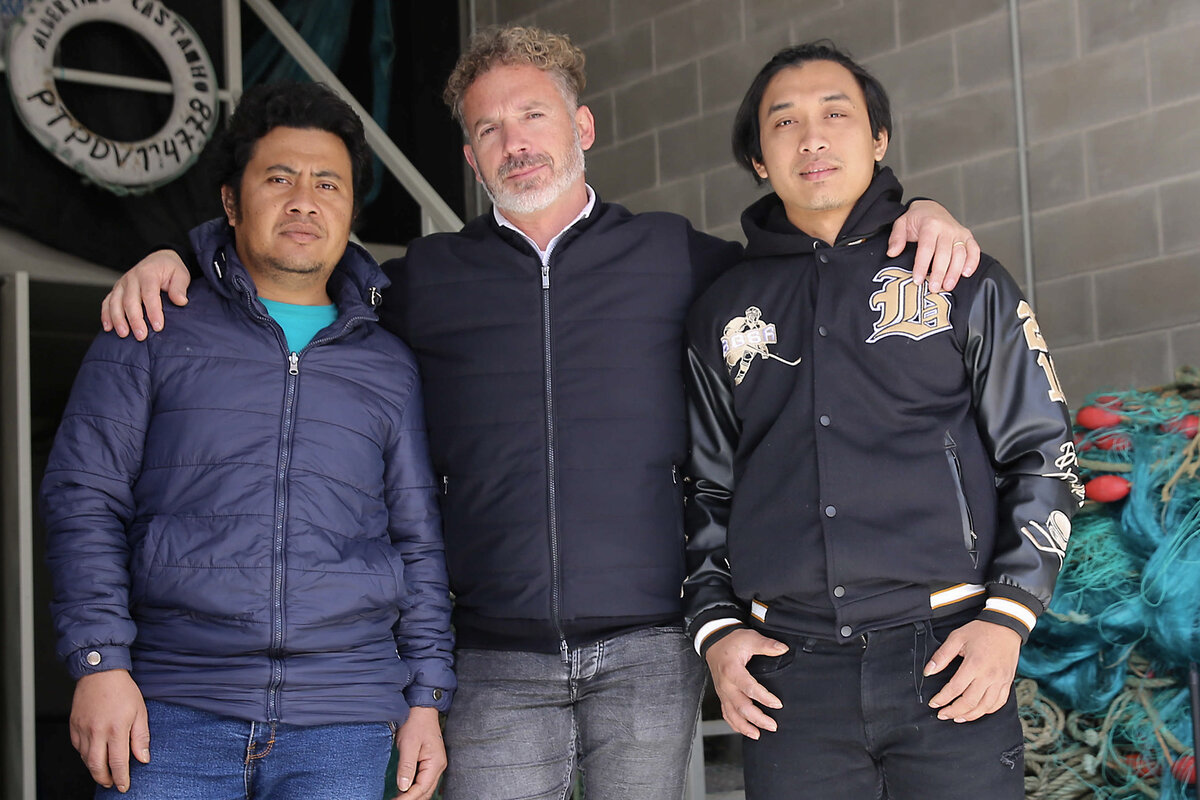
Christian Science Monitor shows a Portuguese fishing vessel captain with two of his Indonesian deckhands, March 8, 2024.

The Christian Science Monitor does a great job of finding stories about humans treating other humans with respect, even kindness. Such stories do exist. Why other media outlets don’t spend much time on them is anybody’s guess. They seem to think that anger is what people want, but why do they think that?

Dominique Soguel writes that many in Portugal are giving a welcome to migrants rejected elsewhere. They know it’s in their mutual interest. A far-right party is trying to change that, but so far harmony, says Soquel, is winning.

“Among the warehouses of one of Portugal’s oldest ports, conversations are flowing among the men sorting their fishing nets. But not without the help of Google Translate.

“The fishers at work include not just Portuguese people but also Indonesians. Thanks to a local ship captain who ventured east to solve labor shortages, Póvoa de Varzim sees a steady supply of deckhands from Indonesia, and now they account for half of all crew mates.

“And while an influx of Muslim migrants into a traditional vocation like fishing is the sort of event that would be potentially inflammatory elsewhere in Europe, in Portugal it seems to be working out without much fuss.

“ ‘The Indonesians are quite well integrated in the community,’ says another ship captain, Manuel Marques. ‘We were never against their culture. We did not ask them to change a single thing. We tried to make things as easy for them as if they were at home.

‘We do need them, and we know it. There is a mutual respect.’ …

“ ‘We also have a place to worship here, like a mosque,’ says Wahono Lucky, an Indonesian fisher. ‘I tell my boss that I don’t eat pork – I eat meat, chicken, rice, pasta, but no pork. Muslim, Christian, it’s never a problem here.’ …

“ ‘We are the only country in the European Union that allows people to come to Portugal without a job,’ notes journalist and professor Paulo Agostinho. ‘We are one of the biggest entry doors for Europe, and we are having problems with Brussels because of that. But Portugal does not have an immigration problem.’

“People from former colony Brazil make up about a third of the migrant population. Citizens of the Community of Portuguese Language Countries are also well represented, benefiting from facilitated residency procedures. In recent years, migration from India, Pakistan, Nepal, and Bangladesh has ticked up.

“Not all of Portugal’s South Asian arrivals are integrating smoothly. In the agricultural fields of Póvoa de Varzim, the sense of harmony that is palpable portside is elusive.

“Lazaro Morgado, a foreman overseeing a quartet of Indians planting seeds, clearly prefers working with a Brazilian, with whom he shares a native tongue. ‘It is complicated for the Portuguese to work with the migrants,’ says Mr. Morgado. ‘Sometimes they don’t know the procedure, and it is hard to explain. And sometimes they don’t obey the Portuguese worker even though at the end of the day, the Portuguese one is the one directly accountable to the boss.’

“Two Indian workers say they paid exorbitant sums – about €14,000 ($15,200) – to visa consultants to get here. ‘Not all Portuguese like migrants,’ notes Hardy Singh, one of the Indian workers, citing experiences of job and housing rejections on account of his ethnicity. ‘But our boss here is good.’

“Back at the port, Mr. Marques wants the Indonesian crews to stay. That’s why he – like other shipowners in the area – houses the workers in apartments scattered across the community and invites them for barbecues. The Indonesian fishers also get minimum-wage contracts and a paid-for trip home for vacation.

“ ‘Some Portuguese don’t make as much as them because they are on contract, while we only get paid if we go to sea,’ laments Tomas Postiga, an older fisher. But he grasps the importance of Indonesian workers to keep the traditional community afloat and prefers them to workers of other nationalities. Religious differences are not a problem. ‘Some are religious. Some are not. It changes nothing,’ stresses Mr. Postiga. …

“For Masrura Rashid, [Portugal’s Moorish quarter] is simply home. She arrived here six months ago, after studying engineering and wandering in the lush tea gardens of Sylhet, Bangladesh. Her father moved to Lisbon first, obtaining the right to family reunification. Now she works at her uncle’s travel agency.

“In a street rich in halal butchers and supermarkets, Ms. Rashid does not especially stand out. Donning traditional Muslim attire that fully covers her face, she is keen to learn Portuguese. ‘It’s easy here,’ she shares. ‘The weather, the environment, the people, it’s all good.’ “

More at the Monitor, here. No paywall. Subscriptions are not expensive.

Read Full Post »

Photo: Sarah Matusek/The Christian Science Monitor.
Nixon Garcia, a teaching artist at El Sistema Colorado, conducts students at the music school in Denver.

People sometimes forget that we need more immigrants, not fewer. Their contributions to the economy are well documented. In 2021, for example, they contributed more than $500 billion just in taxes (see Forbes here). Not to mention that they willingly apply for necessary jobs that go begging, sometimes for years.

And there are other contributions getting less attention. Consider what this one musician is doing. Sarah Matusek wrote about his work recently at the Christian Science Monitor.

“A few dozen children in Denver settle into seats, violins and violas in hand. With short cropped hair and a focused gaze, Nixon Garcia observes from off to one side. …

“This is a fall show-and-tell for parents at El Sistema Colorado, a free music school that prioritizes kids from low-income families. The Denver program was inspired by the original El Sistema in Venezuela, which since its founding in 1975 has sparked similar projects around the world. …

“With flutters of his hands and flicks of his wrists, the 22-year-old conjures up simple songs that he learned as a boy in the Venezuelan program. He’s brought that same sheet music to students in the United States, along with hopes for asylum. Working as a teaching artist at the Colorado program, he’s come full circle.

“ ‘El Sistema has been my second home throughout my whole life,’ says Mr. Garcia, who teaches in Spanish and English. 

“The original program’s catchphrase, ‘tocar y luchar‘ – or ‘play and fight’ in English – has evolved into a personal mantra of perseverance for the young conductor who can’t imagine returning home.  By the time he left Venezuela, in 2022, says Mr. Garcia, he’d been kidnapped three times. 

“Backdropped by mountains in northwest Venezuela, the town of La Fría sits near the Colombian border. Mr. Garcia’s family, who ran a poultry farm there, enrolled their son in the popular music program at a young age. …

“At age 5, he began learning the Venezuelan cuatro, which has four strings. Later on came the clarinet. As a teenager, Mr. Garcia began teaching other El Sistema students – a key mentorship feature of the program – and developed a love of conducting. But basic needs were stark; some students he taught sat on the floor, because there weren’t enough chairs. And beyond the solace of class, violence lurked.

“When he was a young teenager, in 2015, a criminal group, called a colectivo, kidnapped him and his family at a gas station. The group held them for several hours, his family says, and demanded thousands of dollars for their release. 

“Venezuela, meanwhile, devolved into further economic, political, and human rights crises under President Nicolás Maduro, causing millions to flee. Mr. Garcia began attending pro-democracy protests. …

‘You can see how everything is terrible. But in the end, you still love your country,’ he says. ‘You don’t want to leave.’ …

“Mr. Garcia was captured again by an insurgent group on his family farm in La Fría. Yet neither was he safe at college in another city, Mérida, where he studied engineering. … Although his family had arranged private security for him in La Fría, they decided that he had to leave. …

“A tourist visa that his family had secured some years prior still hadn’t expired. That became his ticket to the U.S. last year. Yet even as he moved into his cousin’s home in Monument, Colorado, an hour south of Denver, the adjustment was isolating. … A family member suggested he retreat to nature, take a moment to breathe. A prayerful hike in the nearby mountains, Mr. Garcia says, helped right his course. 

“Inspiration struck, tuning-fork clear: Why not return to music?  A Google search for nearby orchestras yielded a name he knew. The young conductor, in awe, reached out to El Sistema Colorado. …

“Mr. Garcia started out as a volunteer at El Sistema Colorado before the federal government issued the asylum-seeker his work authorization. That allows him to work legally while his asylum case moves forward. Now paid, he teaches groups of strings-learning students in an orchestra group called Allegro.

“The teaching artist is a ‘positive light’ at the music school, says Ingrid Larragoity-Martin, executive director of El Sistema Colorado. ‘He’s passionate about kids, and he knows how to work with them.’ …

“Meanwhile, he awaits the outcome of his asylum application, which may take years. Mr. Garcia says he wants to ‘work, make a life, and try to share as many things as we can from our country.’ ” 

More at the Monitor, here.

Read Full Post »

Photo: Natacha Larnaud for CBS News.
From CBS News: “Jacqueline and her two kids sit at a bus station in Brownsville, Texas, hours after being released from Border Patrol custody on April 30, 2021.”

This is the season of the couple who had no place to rest — and the baby who whose gifts were gold, frankincense, and myrrh. Will all the newly displaced children of 2023 have any gifts?

Theresa Vargas wrote at the Washington Post last year about a program for migrant children that made some little travelers very happy.

“The young boy in the red and black jacket didn’t need to look through the toys sitting on the blanket in front of him. As other children walked past stuffed animals, puzzles and building blocks, looking for items that called to them, he made his way straight to a dump truck almost half his size. If you had peeked in on that moment, which took place outside a Virginia church, you would have seen that boy holding the truck tightly. …

“Days before the volunteer collective Food Justice DMV planned to hold the giveaway event on Dec. 17, founder Denise Woods sent out an SOS, letting supporters know that volunteers didn’t have enough food or toys this year to give to the migrant families they serve in the Washington region. What makes the group’s toy collection different from the many others that take place at this time of year is volunteers gather secondhand items and get them to families who might fall beyond the reach of other organized efforts, because of language barriers and deportation fears.

“ ‘It pains me that people who have lost all coming here, may not celebrate Navidad the way they deserve and the way we want: a warm plate of food from home: beans, rice oil and maseca and a side of gifts,’ Woods wrote in an email at the time. …

“People in D.C., Maryland and Virginia started looking through their homes and gathering the toys their children and grandchildren no longer used. They then drove them to one of several places that were collecting items on behalf of Food Justice DMV.

“They brought puzzles and board games and art kits. They brought a toy stove, a toy shopping cart and a bike. They brought small stuffed animals and medium stuffed animals and jumbo stuffed animals. …

“Thousands of people throughout the Washington region responded. All it took was learning that children around them might go without to decide they wouldn’t let that happen. …

“By the time the giveaway event arrived, volunteers were carting truckloads of items to a church in Falls Church. There, migrant families found them spread across blankets and tables. Children who might not have received anything for Christmas left with their arms full and their parents left carrying bags of items. …

“[One teen] said her mom is from Guatemala and works hard at her cleaning job to pay the rent and keep the family fed, but that doesn’t leave much money for her to buy presents during the holidays. That day at the church, the teenager said, her mom and the whole family left smiling.

“ ‘We were so thankful,’ she said. ‘I just want to thank everyone so much.’ …

“ ‘For so long I think we felt, not accurately, that no one really cared, because we were existing on fumes and praying we would make our food costs,’ Woods said. ‘Now we know people do care and care deeply.’ …

“The strangers who came together to help the families recognized the system is broken, not people, she said.”

More at the Post, here.

Read Full Post »

Photo: Maya Pontone/Hyperallergic.
Xiyadie, “Butterfly” (2023), paper cutout featured in July art show in Queens.  

Queens, a borough of New York City, is often a gateway to America for newcomers, and as a result it has a diverse and interesting population. The art that residents produce is also diverse and interesting, as an unusual show in a mini-mall recently revealed.

Maya Pontone reports at Hyperallergic, “Located at the tail end of the 7 train not far from LaGuardia Airport, Flushing is a magnet for both longtime Asian American Pacific Islander (AAPI) residents and newcomers from overseas. Home to New York City’s largest Chinatown, the Queens community has served as an entryway for new immigrants in search of work and housing.

“A new exhibition pays homage to Flushing and its history by spotlighting the work of eight artists, most of whom are residents of the neighborhood, and encouraging community contributions and interaction. Home-O-Stasis: Life and Livelihoods in Flushing, curated by Herb Tam and Lu Zhang, is staged in one of the area’s many mini-malls — places increasingly threatened by gentrification. …

“On the inside of the space, you can find a butcher, a beauty shop, a cell phone service store, a money transfer service/tea shop, and a barber; and in the far back, a 99-cent store. …

“A community-driven exhibition, Home-O-Stasis is interwoven into the mini-mall space as though camouflaged, blending in and standing out in understated yet profound ways. At the building’s entrance among hanging real estate ads, shoppers are greeted by a red paper-cut butterfly made by Chinese artist Xiyadie, who was taught traditional paper-cut artistry by his grandmother. Decorated with Buddhist etchings and an impression of the U-Haul clocktower on College Point Boulevard, the delicate work was created for the migrant workers who come to the mini-mall in search of housing.

A handwritten sign written by Xueli Wang that reads ‘Mom, have you eaten?’ catches people searching the bulletin board off guard. …

“Above the paper ads directly in view of the shop owners, a deconstructed calendar with dates and symbols carefully cut out by hand hangs from two delicate red threads tied to the ceiling beams — an allusion to the boundless, continual nature of passing time by Flushing-born sculptor Anne Wu. …

“For Home-O-Stasis, Yuki He and Qianfan Gu from the collective Mamahuhu created ‘Flushing Polyphonous’ (2023), a humorous reinterpretation of Flushing’s map as a Monopoly-like board game. With magnetic pieces and a pair of die, the game takes players through the Queens neighborhood focusing on landmarks and shared hyperlocal experiences. …

“ ‘You would say, “Oh, you go to that dumpling house next to the gas station.” Nobody uses the title of the shop,’ Zhang, one of Home-O-Stasis’s curators and artist contributors, told Hyperallergic. …

” ‘You can get everything you need when you start a life in New York,’ Zhang said, pointing out how many newcomers, luggage in hand, will often stop at the mini-mall first to browse the bulletin’s housing options, set up their phones, buy food, send money abroad, and purchase other home supplies. …

“ ‘In the new malls, each vendor is separated in their room. It has like a hierarchy,’ she said, adding that this mini-mall’s open layout gives it a ‘more organic community.’ …

“Zhang also said that when she and Tam were first hanging up the exhibition, some of the shop owners in the mini-mall seemed skeptical. But not long after Home-O-Stasis opened in late May, local businesses adapted to the art, welcoming the works and even caring for the installations when the curators aren’t present. …

“The daughter of the barber shop’s owner, Nikki, moved the cards and magnets to the side from ‘Flushing Polyphonous’ when she noticed that people kept knocking the game pieces to the ground. Tina Lin, who runs the skincare shop Tina House, has taken to caring for Wang’s reimagined flyers and Janice Chung’s photographic series HAN IN TOWN (2022) when the works get moved around. …

“One of the final elements of the exhibition, called Dream City 2.0, is dedicated to a community archive of personal landmarks and experiences. Inspired by a 1940s commercial development project that would have eradicated much of the neighborhood, the project calls on residents to build another version of Flushing based on past dreams rather than a reimagined future. On a sheet, residents have written down the names of vanished noodle shops, bookstores, and other spaces that have since been replaced by new businesses and apartments.” Oooh, I love that concept!

See other unusual art at Hyperallergic, here. No firewall. Subscriptions encouraged.

Read Full Post »

Photo: Getty Images via New York Post.
Helping recent migrants put a strain on overworked cops in Chicago.

There are no easy stories about migration. Although most people would rather make a good life at home if they could, many launch themselves into the unknown with a vague idea that someplace else will be safer. As a popular destination, however, the US has not been on top of things for a very long time.

In one example, described by Eric Cox and Ted Hesson at Reuters in May, our confused system left “Chicago’s new mayor [grappling] with how to house hundreds of migrants arriving on buses from the U.S.-Mexico border, with some sleeping in police stations and shelters strained after border crossings. …

“Officials in the third-largest U.S. city have said they cannot afford to rent hotel rooms for all arriving migrants and have pressed for more federal funding. Some migrants seeking a safe place to sleep have turned to police stations.

” ‘We’re waiting to see where they’re going to place us,’ said Tomas Orozco, a 55-year-old migrant who arrived at a Chicago shelter on Wednesday with his family after an arduous seven-week journey from his home country, Venezuela.

“The trip took them through the Darien Gap, an inhospitable jungle separating Colombia and Panama, and his family members were still sick from drinking contaminated water, Orozco said. …

“Earlier this month, Texas Governor Greg Abbott [resumed] a campaign of busing migrants to Democratic strongholds further north, including Chicago and New York City. The busing aims to alleviate pressure on border cities and call attention to what Abbott says were overly lenient policies by Biden’s [administration].

“On Thursday, Texas began busing migrants to Denver, where [Mayor] Michael Hancock is already struggling to house new arrivals.

“New York City Mayor Eric Adams … has called on the Biden administration to provide more funding to cities. Adams suspended some of New York’s right-to-shelter rules last week, citing the strain of housing asylum seekers, and is considering using school gyms as shelters.

“Chicago Mayor Brandon Johnson … reaffirmed the city’s commitment to welcoming asylum seekers in his inauguration speech, saying ‘there’s enough room for everyone.’ …

“Dean Wynne, who owns a Chicago building serving as a temporary shelter for nearly 200 migrants, said families were ‘subdued and quiet’ on the first day they arrived.

” ‘By the second day, I could see little kids were playing around, playing catch, kicking the ball and stuff,’ Wynne said. ‘They were just happy.’

More at Reuters, here.

A more recent article, from July, may be read at the Chicago Sun-Times, here. Said one migrant through a translator, “You can rest, but this isn’t life. … I’m happy to work because that’s my goal. Because I want to fight and learn each day a little more than what I knew.”

The immigrants I’ve worked with as a volunteer in ESL classes are often suspicious of police in their home countries. I imagine the Chicago experience is unsettling, but then, maybe not as unsettling as that dangerous trip.

Read Full Post »

Photo: Elayna Yussen — Bloomberg/Getty Images.
It’s not just hospitals that have critically low staffing levels. Our aging population is retiring, and most industries are hurting for labor. We need more immigrants.

Happy Fourth!

We think of ourselves as a nation of immigrants, but only for the past. We have turned against immigration at a time we badly need more applicants for every kind of job. The effects of labor shortages can be dangerous if we are talking about hospitals or aviation, for example. But it’s bad all over. I’ve read that even the military is having trouble finding recruits.

Today’s article is about nurses, but you can substitute almost any job category and think about whether better immigration policies, with a good route to citizenship, would help.

Alex M. Azar and Kathleen Sebelius wrote in Time magazine’s Ideas section, “The United States is about to learn the hard way what happens when an entire generation of nurses retires without enough new clinicians to fill their shoes at the bedside.

“As a result, hospitals in the same country that performed the first successful kidney transplant and pioneered anesthesia and heart rhythm restoration will have no choice but to ration care.

“That’s the only way to describe what happened to an Alabama man who was turned away from 43 different hospitals across three different states before ultimately dying of a cardiac emergency 200 miles from home because no nearby system had an available intensive care bed it could staff. …

“And it’s what happened to expecting mothers in Idaho earlier this year when the only hospital in the 8,000-person city of Emmett said it had become ‘unsustainably expensive to recruit and retain a full team of high-quality, broad-spectrum nurses to work.’ That followed an earlier decision by an upstate New York facility to pause its maternity services after struggling to recruit enough replacements to offset staff resignations and retirements. …

“A nurse old enough to retire today has only known the U.S. health care system in a nursing shortage, but they’ll tell you it’s never been more challenging. It’s a crisis in five parts, including increased demand for care by an aging population and workforce, restraints that hinder nurses from practicing at the top of their licenses, lingering burnout from the pandemic, an inability to educate enough new nurses, and a recently throttled pipeline of qualified international talent.

To fill the gap in care left by retirements and burnout, federal economists calculate that the U.S. health care system will need to add at least 200,000 new nurses every year through 2026.

Nursing schools reject tens of thousands of applicants every school year. It’s not because these would-be nurses failed to meet admission criteria — it’s largely because the schools don’t have enough nurse educators to train them. As limited instruction capacity squeezes the number of new matriculating nurses, hospitals have increasingly relied on foreign-educated nurses, who’ve grown to represent roughly 15% of the U.S. nursing workforce.

Employment-based health care immigration is a complex labyrinth of rules and regulations that doesn’t make it easy or fast for an international nurse to emigrate and begin treating American patients. Under current law, international nurses compete for the same limited number of employment-based green cards within an enormous pool of applicants that include IT workers, lawyers, engineers, and architects. Unlike those other workers, nurses do not qualify for temporary visas. So, while many computer engineers from other countries apply for green cards after moving to the U.S. and working under an H1-B visa, nurses must complete the immigration process entirely overseas.

“Under the best conditions, that’s a multi-year process in which the nurse has passed English language and licensure exams, established a sterling overseas clinical record, and secured a job offer that has been demonstrated not to harm U.S. workers. Now, that timeline will grow significantly, thanks to a recent visa freeze instituted by the U.S. State Department.

“The State Department tightly monitors the number of employment-based green cards issued against the remaining number for the fiscal year, which is set by Congress and has been untouched since 1990. Post-pandemic resurgent demand for this category recently forced State to issue a notice of visa retrogression, an immigration term of art that refers to eligibility backdating when demand exceeds equilibrium. As a result, any nurse who became eligible for their green card after June 1, 2022 — which amounts to thousands of nurses who have been winding through the system for upwards of two years — is ineligible to enter the country until the backlog has cleared. In practical terms, American hospitals won’t be get the nurses they’ve been counting on any time soon.

“Despite the urgency to get more nurses to the bedside, the State Department and the White House have zero discretion. The responsibility falls to Congress, which reserves the authority to issue visas and allocate them for specific immigrant preference categories. Each year, processing issues and other inefficiencies across various government agencies involved result in thousands of issued visas going unused. Health care advocates have begun pressing Congress to recapture some of these allocated-but-untouched green cards for the express use of immigrant nurses. There’s precedent: Congress did just that in 2000 and 2005.

“More recently, one bipartisan proposal introduced last Congress, the Healthcare Workforce Resilience Act, would have set aside tens of thousands of these mothballing visas for nurses and doctors. But it didn’t pass, and a new version has yet to be reintroduced. According to the nonpartisan Congressional Research Service, there are roughly 220,000 employment-based visas that were available for recapture as of 2021. …

“The nursing shortage isn’t a red-vs-blue, rural-vs-urban issue. It’s not about the southern U.S. border or the gridlock that defines D.C. It’s about a pregnant mother getting the care she and her baby deserve. It’s about the heart attack patient not being turned away because the emergency room doesn’t have the nurses to treat him. This is a whole-of-America crisis and we need a whole-of-government response, including a sensible loosening of licensing requirements, prioritize positive patient outcomes by modernizing the responsibilities and standards of nursing, supporting expanded educational opportunities, and enabling lawful employment-based immigration.”

More at Time, here.

Read Full Post »

Photo: World Farmers.

Immigrants to the US, if they were farmers in their home countries or just want to grow food they can’t find here, may end up working in agriculture. And as this University of Rhode Island professor’s research shows, many are joining the new wave of urban growers.

Frank Carini reports at ecoRI News on John Taylor, associate professor of agroecology at URI, who recently received a $973,479 award from the National Institute of Food and Agriculture for his research.

I had to look up that new-to-me field of study. The Soil Association says that “agroecology is sustainable farming that works with nature. Ecology is the study of relationships between plants, animals, people, and their environment – and the balance between these relationships. Agroecology is the application of ecological concepts and principals in farming. [It] promotes farming practices that mitigate climate change … work with wildlife … put farmers and communities in the driving seat.” Read all about it here.

Carini writes, “The $973,479 award from the National Institute of Food and Agriculture was one of 12 to receive funding through the institute’s Urban, Indoor, and Other Emerging Agricultural Production Research, Education and Extension Initiative. The agency’s $9.4 million in grants are part of a broad U.S. Department of Agriculture investment in urban agriculture, funding research that addresses key problems in urban, indoor, and emerging agricultural systems.

“The project will bring together Taylor’s research with immigrant gardeners and farmers in Rhode Island, Julie Keller’s agriculture-focused work with diverse communities, Melva Treviño Peña’s work with immigrant fishers, and Patrick Baur’s work on food safety and urban agriculture. …

“Although always a part of city life, urban agriculture has recently attracted increased attention in the United States, as a strategy for stimulating economic development, increasing food security and access, and combating obesity and diabetes.

“Food justice is about addressing access to healthy and affordable food for low-wealth and marginalized communities. It seeks to ensure the benefits and risks of where, what, and how food is grown, accessed, distributed, and transported are shared equally.

“Many neighborhoods in metropolitan areas, including in Rhode Island’s urban core, have little to no access to fresh food or full-service grocery stores — a situation often referred to as living in a ‘food desert.’ Other marginalized communities are surrounded by ‘food swamps,’ areas in which a large amount of processed foods, such as fast food and convenience-store fare, is available with limited healthy options.

“One solution to this environmental justice problem is to encourage the growing of local food. Developing effective policies and programs demands as a first step the accurate mapping of existing urban agriculture sites, according to Taylor. He hopes to provide that template.

“Taylor and colleagues at URI, the University of Maryland, and the University of the District of Columbia will soon begin mapping the alternative food provisioning networks of immigrant communities and communities of color in three East Coast cities — Providence, Baltimore, and Washington, D.C. — to better understand these networks.

“He hopes this transdisciplinary research will reap new information about alternative food provisioning networks in the Northeast, evaluating their impact on food system outcomes, and identifying opportunities for policy support. …

“At URI, Taylor’s ‘home garden’ is a quarter-acre plot at the Gardiner Crops Research Center [at] the bottom of the Kingston Campus. His plot, visible from Plains Road, represents in microcosm the immigrant foodways he will be studying for his research during the next few years.

“At URI’s Agrobiodiversity Learning Garden and Food Forest, he grows crops that are integral to the food traditions of Rhode Island’s diverse communities: South American sweet potatoes, Mexican tomatillos, Haitian tomatoes, Mediterranean herbs, Asian bok choy, and produce from an African diaspora garden. Taylor tends the garden with students in URI’s Plant Sciences and Sustainable Agriculture and Food Systems programs and URI master gardeners, demonstrating how sustainable farming reinforces community-building.

“With the learning garden, he follows a lead set by generations of immigrants who moved to Providence and cities like it, bringing their growing practices, and sometimes seeds, with them. …

“A descendant of five generations of Pennsylvania farmers, he grew up on a 100-acre integrated crop-livestock farm near Pittsburgh. Taylor began gardening at the age of 6 and started a market garden while in high school. He left the farm to attend the University of Chicago … then managed federal education studies for 10 years before returning to school to study horticulture and practice landscape architecture.”

More at ecoRI News, here.

Read Full Post »

Photo: Matthew Healey/Boston Globe.
Jeremy Garcia, 22, of Providence takes a break from working on a mural at “The Avenue Concept” in Providence, Rhode Island.

Kids love contributing to community murals. I know because Suzanne and John helped paint one in our town years ago. But that mural — about local history — was bland compared with the passionate work of self-expression and healing by urban youth in Providence.

Alexa Gagosz writes at the Boston Globe, “After setting down her paint brush, Deborah Ndayisaba gazed up at the purple-colored protestors who spread across a section of a new large-scale mural on the exterior of The Avenue Concept’s headquarters.

“A senior at La Salle Academy in Providence, Ndayisaba, 17, said she had her own ‘advocacy awakening’ when the Black Lives Matter movement took off in 2020. She joined the diversity club at school, became involved in PVD World Music, which looks to celebrate and enrich traditional African music and arts, and researched how many of the racial injustices of the Civil Rights era are now still relevant today.

“The protestors, for her, are symbolic. ‘It’s unfair how racial discrimination can touch everything. And activism isn’t just marching on the streets,’ said Ndayisaba, who is applying to colleges to eventually go into the medical field where she hopes to help women of color.

“It’s those kind of personal elements that scatter this newly finished collage mural by local youth who are involved with the Nonviolence InstituteRhode Island Latino ArtsHaus of Codec, and PVD World Music — all Providence-based organizations. The effort was led by The Avenue Concept, a public arts organization, and international community-based public art organization Artolution. …

“The Avenue Concept, which is the state’s leading public art program, was founded in Providence in 2012. Since then, artists from around the world have been commissioned to paint mammoth-sized murals across downtown that are part of the city’s skyline today. …

“A few of the Concept’s most notable works address longstanding community issues, such as ‘Still Here‘ by muralist Gaia, which depicts Lynsea Montanari, a member of the Narragansett tribe and an educator at the Tomaquag Museum, as they hold a picture of Princess Red Wing, a Narragansett elder who founded the museum. In September, Boston-based artists Josie Morway painted a new mural in Warren that addresses sea level rise.

“This new project, which was completed after 10 painting days on Sept. 30, is a pilot for a larger community participation program that was identified in The Avenue Concept’s latest strategic plan. The goal of the program, Thorne explained, was to address representation, neighborhood voice, unique cultural perspectives, and community needs in their upcoming projects.

“ ‘Over the last year, we’ve really tried to listen and better understand the stories that are intersecting in our own neighborhood,’ [Yarrow Thorne, executive director and founder of The Avenue Concept] said. ‘We are looking to do more than just the giant pieces of beautiful art in downtown, but to serve the community that surrounds us.’

“Thorne said the Concept, which is based in the Upper South neighborhood of Providence, selected the four local organizations because of how their work makes an impact across a diverse set of communities. Each organization brought four to five members of their youth communities to learn, connect, co-create themes, and eventually execute the mural with the help of Artolution’s co-founder Dr. Max Frieder.

“Frieder, a Rhode Island School of Design graduate and former classmate of Thorne’s, brings public art projects around the world — including in refugee camps. Frieder said he trains refugee-artists on how they can work with kids who have been through trauma and teach them to express what’s most important to them through art.

“ ‘With this project, we brought four very different community groups together and it has been remarkable to see them come together and reflect on their similarities,’ said Frieder, who has participated in public art installations on all seven continents. …

“Each participant painted a scene in a ‘memory ball,’ which looked like a golden orb with a scene of their choice inside. Some painted themselves playing basketball, another read ‘stop drug abuse,’ and one painted themselves playing a trumpet.

“One memory ball said, ‘You only get one life. It’s your duty to live it as fully as possible.’ It’s a quote inspired by Jojo Moyes, an English journalist and novelist.

“Each participant talked about the issues they and their families face in South Providence today: their communities getting priced out as the cost of living increases. Others have faced racism and homophobia in school. Some say their family’s generational trauma has prevented their own parents from healing.

“For example, Jeremy Garcia, 22, a self-described ‘proud, Black-Latino,’ described the stereotypes of South Providence being considered an ‘urban hood’ where residents are predominantly people of color. Garcia said many of their neighbors have watched cases of police brutality, such as the killing of George Floyd, and are afraid to call the police.

“ ‘These are the people who are supposed to save us and who we should be able to turn to when we are in danger,’ Garcia said. ‘If you can’t turn to the police, where do you turn?’

“Expressing themselves ‘and letting go of their past is the only way we can can heal and move forward,’ said Cedric Huntley, the executive director of the Nonviolence Institute. ‘We need more of this — in Providence and around the world. We all focus so much on the negative, which certainly impacts all of us, but there’s more to it in these young people’s lives.’ ”

More at the Globe, here. Nice photos. For a no-firewall article on the mural “Still Here,” check the Brown University newspaper.

Read Full Post »

Photo: Carlin Stiehl for the Boston Globe.
Belarusian opera singer Ilya Silchukou rehearsing with pianist Pavel Nersessian. Silchukou and his wife, a mezzo-soprano, “fled their native Belarus after Silchukou publicly sided with protesters following the 2020 election,” reports the Globe.

If you live near Boston, check out a concert tonight at First Church. Not sure what is more impressive — the baritone’s voice or the backstory about defying the totalitarian regime of Belarus. To see what Ukraine would be like if Russia’s invasion succeeded, look no farther than the puppet government on Ukraine’s northern border.

Malcolm Gay reported at the Boston Globe, “By the time Ilya Silchukou performed upon the steps of the Bolshoi Theatre of Belarus in Minsk, more than 6,000 protesters had already been detained.

“It was August 2020, one tumultuous week after President Alexander Lukashenko, often described as ‘Europe’s last dictator,’ had claimed victory in a widely disputed election. His opponent had already fled the country. The government had briefly severed Internet service, as police fired rubber bullets and beat demonstrators who’d clogged the streets to protest.

“Silchukou, one of the country’s best-known opera stars, had already publicly renounced three awards he’d received from Lukashenko.

“And now he was prepared to use his most powerful tool to support the cause, channeling his rich baritone to sing ‘Kupalinka,’ a beloved song that had become an anthem of the protests.

‘Two years later, Silchukou, his wife, Tatsiana, and their three children live a quiet life in a rented house in [Wayland] west of Boston, where Silchukou tends the owner’s garden of eggplants. Their furniture is entirely donated, and Silchukou, once a star soloist at the Minsk Bolshoi who sang at opera houses across Europe, now teaches music at Star Academy, a private K-8 school, as he seeks to establish a stage career in the United States.

“ ‘It’s going to be hard,’ said Silchukou, who remains all but unknown to US audiences. ‘On the other hand, I’ve found so many new friends who support us and help us. I look forward with optimism.’

“Among those new friends is renowned Russian pianist Pavel Nersessian, who will perform a concert of songs and arias with Silchukou on Saturday at First Church Boston in Back Bay.

“Nersessian only recently met Silchukou, but during a recent rehearsal at Boston University, he described the singer’s voice as ‘multicolored,’ capable of subtly expressing the full spectrum of human emotion. …

“Silchukou joined the Bolshoi Theatre when he was just 23, making a name for himself as a soloist with leading roles for baritone, such as Tchaikovsky’s Eugene Onegin and Marcello in Puccini’s La Bohème. He traveled abroad frequently for singing competitions, winning the 2011 Hans Gabor and Helicon prizes at the prestigious International Hans Gabor Belvedere Singing Competition, among others. …

“He walked a fine line: He quietly disapproved of Lukashenko’s grip on power, but as an employee of the national opera, he was often called upon to perform at official functions. …

“In the months following the 2020 election, however, Silchukou felt compelled to take a stronger stance. He signed an open letter calling for an end to the violence and an election recount. He publicly supported other artists who’d been fired for speaking out, and he indicated his support from the stage, flashing the ‘victory’ sign as performers received red and white bouquets from the audience, a sign of resistance. …

“That October, Silchukou collaborated with other artists in a video calling for a national strike. He was fired within days, his working card stating he’d committed ‘an act of immorality.’

“Stuck at home with COVID-19, Silchukou decided to play his last card: a highly produced video he’d recorded of ‘Mahutny Bozha,’ a hymn that has become an anthem of the anti-Lukashenko movement.

“ ‘That video was in my pocket,’ Silchukou said of the searing indictment that would go on to rack up more than 500,000 views. ‘I’d been afraid to publish it because I was still working in the theater, but then I said, we have nothing to lose.’

“The family fled the following summer. …

“ ‘I dream to see Belarus free,’ he said. ‘I belong to that land.’ ”

When you think of asylum seekers, remember that most would give anything not to have had to leave their home.

Tickets at https://silchukou.eventbrite.com/ and at the door. More at the Globe, here.

This is courage.

Read Full Post »

Photo: Nathan Klima for the Boston Globe.
Health care professionals at a Mass. General vaccination van parked near the La Colaborativa food pantry administered COVID-19 vaccines and tests for residents during a mini-festival for teens in Chelsea, Mass., on Oct. 06, 2021.

Today I’m thinking about all the people who keep on keepin’ on. Some may think they have no choice, but that doesn’t make them any less heroic to me. There is a kind of unconscious daily heroism of putting one foot in front of the other without any expectation of light at the end of the tunnel that I used to see among tired commuters on the subway. Endless Covid has a bad effect on my gumption, so I greatly admire truckers, grocery workers, nurses, doctors, hospital cleaners, housecleaners, farmers, teachers, and the many others who just keep going.

Today’s article from the Boston Globe shows, I hope, that such dedication pays off. Even if things get worse after they get better, it pays off again and again.

Felice J. Freyer, Bianca Vázquez Toness and Diana Bravo wrote last fall, “The crew had been out on the streets for more than an hour before they found a man who needed a shot.

“The five young people in torn jeans and mint- and cantaloupe-colored T-shirts had already accomplished a lot on this bright late-September day. Stopping stroller-pushing moms on the sidewalk and knocking on the doors of triple-deckers, they told people about the food pantry, the English classes, the sports and music lessons for children, the upcoming block party, where to get help with a leaky oil tank — even how to register to vote.

“But until they came across Gato, sitting at the open door of a shed under the staircase to his home, the promotores de salud — community health workers — did not have occasion to talk about the vaccine against COVID-19, an illness that had stormed this small impoverished city with notorious ferocity.

“ ‘Have you been vaccinated, Gato?’ asked Natalia Restrepo, the 29-year-old engagement coordinator for La Colaborativa, the community service group that hired and trained the promotores.

“ ‘No,’ he said. Restrepo knows Gato; he’s friends with her husband. But she did not know this troubling fact about him.

“He was a member of the unvaccinated minority. According to state data, 74 percent of Chelsea residents are fully vaccinated, above the state average of 67 percent. That happened even though Chelsea’s population is dominated by groups traditionally hard to reach — immigrants, poor people, Latinos. …

“And new COVID-19 cases in Chelsea have plummeted to below the statewide average. Chelsea has made itself into a vaccination standout, the result of a person-to-person campaign by multiple community groups.

“ ‘The Chelsea experience is one we really need to learn from,’ said Carlene Pavlos, executive director of the Massachusetts Public Health Association. ‘It’s one where we can see the value of efforts that are locally designed, locally led, and developed by the people most familiar with the community and most trusted by the community.’ …

“The pandemic had raged like a wind-whipped fire in Chelsea, a 2.5-square-mile city across the Mystic River from Boston, bringing fevers and hacking coughs to apartments and houses packed with grandparents, mothers and fathers, sons and daughters — a mysterious sickness that rode home with folks who took the bus to jobs serving food or cleaning hotels or hospitals.

“In April 2020, according to a new report from the environmental group GreenRoots, the COVID-19 infection rate in Chelsea was one of the highest in the nation, 57 per 10,000 residents, higher than the worst days in New York City, six times the statewide infection rate. Researchers at Massachusetts General Hospital found that by April 2020 one-third of the city’s residents had acquired antibodies to the virus, indicating they’d been infected. …

“But sickness wasn’t the only source of pain: By June 2020, with the economy flattened by the pandemic, one in five Chelsea residents was out of work. …

“Founded in 1988 to serve a new influx of Latino immigrants, La Colaborativa [offered employment and more]. It set up a food pantry, delivering food and medicine to those in quarantine. ‘We became the survival center,’ said Dinanyili Paulino, the chief operating officer.

Gladys Vega, the CEO, recalls encountering an 11-year-old in the food line. The girl had been left to care for her 6-month-old sibling when their mother was suddenly hospitalized with COVID-19.

“ ‘We adopted that girl for three weeks,’ Vega said, making sure she had diapers and food, and neighbors checking in on her.

“So when it came time to vaccinate, Paulino said, community members wondering whether the vaccine was safe turned to La Colaborativa —’the people that have been with them from the beginning.’ …

“When the COVID-19 vaccines were approved in late 2020, the organization trained mothers to form a cadre of promotores, who teamed up with doctors from Massachusetts General Hospital going door to door to talk about the importance of vaccination. …

“Despite such preparations, despite the severity of COVID-19 in Chelsea, the vaccine itself was slow to arrive. … Advocates were outraged, and undeterred. …

“The first big vaccination clinic in Chelsea opened on Feb. 4. The doses didn’t come from the state. Instead, the East Boston Neighborhood Health Center received them through a federal program and agreed to set up a clinic at La Colaborativa.

“Offering the vaccine at their headquarters, Vega said, ‘sent a strong message that, if we are welcoming the vaccination, that means that you as an individual should get vaccinated.’ ”

More at the Globe, here.

Read Full Post »

Older Posts »