Feeds:
Posts
Comments

Posts Tagged ‘radio’

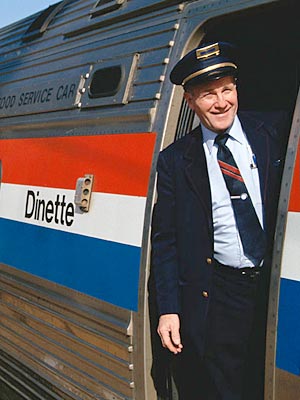
Photo: pradeepan.com
Train conductor

On the homebound train tonight, Meg an I were discussing a conductor’s stentorian way of announcing the stops. It always gives me a big smile, and I look around to see if anyone else is reacting, but — well, you know commuters.

Meg said the guy reminded her of the conductor in an old TV show for kids called Shining Time Station. He was played by the comedian George Carlin. Do you know the show? Meg’s kids are younger than Suzanne and John. I think our family missed it completely.

The conductor on our commuter train is younger than Carlin looks here. And he sounds like he’s auditioning for a major-market radio show back when you needed a “big voice” to get an on-air job. I always wonder if he is kidding around when he orates like that or serious. It probably helps to lift the tedium of going back and forth, back and forth all day long on the Fitchburg line.

Read about Shining Time Station on wikipedia, here. You can search on YouTube for episodes.

Read Full Post »

Since I like to walk everyday, even going round and round indoors for much of this past winter, I was fascinated to hear about walking as a competitive sport in the 19th century.

At his WBUR radio show yesterday, Only a Game, Bill Littlefield talked to Matthew Algeo, author of Pedestrianism: When Watching People Walk Was America’s Favorite Sport.

Here’s Algeo: “Edward Payson Weston was a door-to-door books salesman from Providence, R.I. In the autumn of 1860, he made a bet with a friend on the outcome of that year’s presidential election. Weston bet that Lincoln would lose, and, of course, Weston lost the bet. The loser had to walk from Boston to Washington in 10 days and arrive in time to witness the inauguration of Lincoln on March 4, 1861.

“So Weston set out and made his way south. Of course, this was a very tense time in American history. Southern states began seceding. There wasn’t a lot of good, uplifting news. And the idea that this guy would walk from Boston to Washington in the middle of winter on terrible roads — it really did capture the imagination of the public, especially along the East Coast. Huge crowds would turn out to see him just walk through their town. Weston didn’t make it in time. He was four hours late to the inauguration. He did meet Lincoln a couple of days later and Lincoln offered to pay his rail fare home, but Weston said he would try to walk home. But the Civil War intervened.”

Littlefield then refers to Weston as one half of “the first great rivalry in the annals of American sports” and asks Algeo who the other half was.

“Daniel O’Leary, an Irish immigrant from Chicago,” says the author. “And what happened was Weston, to capitalize on his fame, decided to take his act indoors. He began walking inside roller rinks, and he would try to walk say 100 miles in 24 hours and charge people a dime for the pleasure of watching him walk in circles all day. This proved immensely popular — thousands of people would do it. Naturally competitors rose up and Daniel O’Leary actually walked 100 miles in 22 hours. And so he bested Weston’s record and so that set up the big showdown in 1875 that you mentioned. It was a 500-mile race over six days between Weston and O’Leary. …

“They would draw a dirt track on the floor of an arena. … The competitors would be sent off, and they would walk continuously day and night for six days right up until midnight the following Saturday night. And the rules were pretty simple: whoever walked the farthest was the winner.” Read more here, where you also can listen to the interview and read Littlefield’s book review.


Read Full Post »

Photo: Ken Shulman/OAG
Players for Naat’aanii, a team created for Navajo youth, practice in Farmington, New Mexico.

Now that Native Americans are playing major league baseball, it seemed like a good time for Bill Littlefield’s Only A Game radio show to do a story about Native American kids getting into the game. Ken Shulman traveled to New Mexico “to meet a Navajo team that uses tribal lore to train quality ballplayers.”

One of the people Shulman interviews is Dineh Benally, a youth baseball coach with teams in Farmington and Albuquerque.

“’Benally learned baseball as a kid on a reservation in Shiprock, where New Mexico borders with Colorado, Utah, and Arizona. The Four Corners was the Navajo ancestral home until 1864, when the tribe was forcibly marched to a desolate reservation 500 miles away.

“ ‘Baseball is about failure,’ Benally said. ‘And I think life is about failure. You’re gonna fail more than you succeed. …’

“Benally’s had his share of hardship. And failure. Growing up on the reservation was fun. But farm chores often kept him off the ball field. And when he did play, there wasn’t much in the way of coaching. Still, the tall right hander was MVP of his all-Navajo high school team. He pitched two years in junior college. Then he got a break: a chance to make the team at New Mexico State University — and to prove that a boy from the rez could play Division I ball. He threw well in tryouts but was cut on the final day. …

“It was tough not making the team. But Benally rallied. He thought about his ancestors on that long walk from Four Corners. And he thought about what he’d learned.

“A few years after graduation, in 1999, he started a youth team, to give Najavo kids the type of training he wishes he’d had growing up. He called the team ‘Naat’aanii,’ a word that … means leader. He scoured the state for native talent, boys born on and off the rez who he could shepherd toward college baseball and maybe even the pros. …

“Naat’aanii is no longer just for native players. Any kid can join if he has talent and desire. But the logo and rhythm and ethos are still Navajo. Dineh Benally wants his players to learn more than how to turn a double play. He wants them to tap into the tribal soul, to find the strength to stick it out when times get tough. Because they will get tough.

“ ‘That’s where they’ll show me if they’re really a true Naat’aanii,’ he said. …  They look at me. They know what I’m talking about.’ ”

More at Only a Game, here.

Read Full Post »

I like to listen to a jazz radio station out of Worcester, WICN.

The other day the announcer mentioned an effort funded by TD Bank’s charitable foundation to collect old school instruments and refurbish them for a new generation.

If you live near Worcester and have been wondering what to do with those drums and violins, consider dropping them off at 50 Portland St. If you don’t live near Worcester, you might consider looking for a similar program in your town — or even starting one. Other TD Banks might help out. Banks in general can be good sources of such community support.

Here’s what the website says: “WICN 90.5, the NPR jazz station in Worcester, and Worcester Public Schools continue their collaboration called Instrumental Partners. The program collects used musical instruments from Central New England residents for the benefit of public school students. ‘We’re approaching 100 instruments donated so far!’ said WICN General Manager Gerry Weston. Instrumental Partners began in 2012.

“All instruments are accepted: brass, wind, string, percussion, acoustic, electric, etc. Worcester Public Schools Performing Arts Liaison Lisa Leach said, ‘We are very excited about this collaboration and putting instruments in the hands of young people who are unable to purchase or rent them, but still have the desire and work ethic to make music an integral part of their developing lives.’ ” More.

If you want to call first, the number is 508 752 0700.

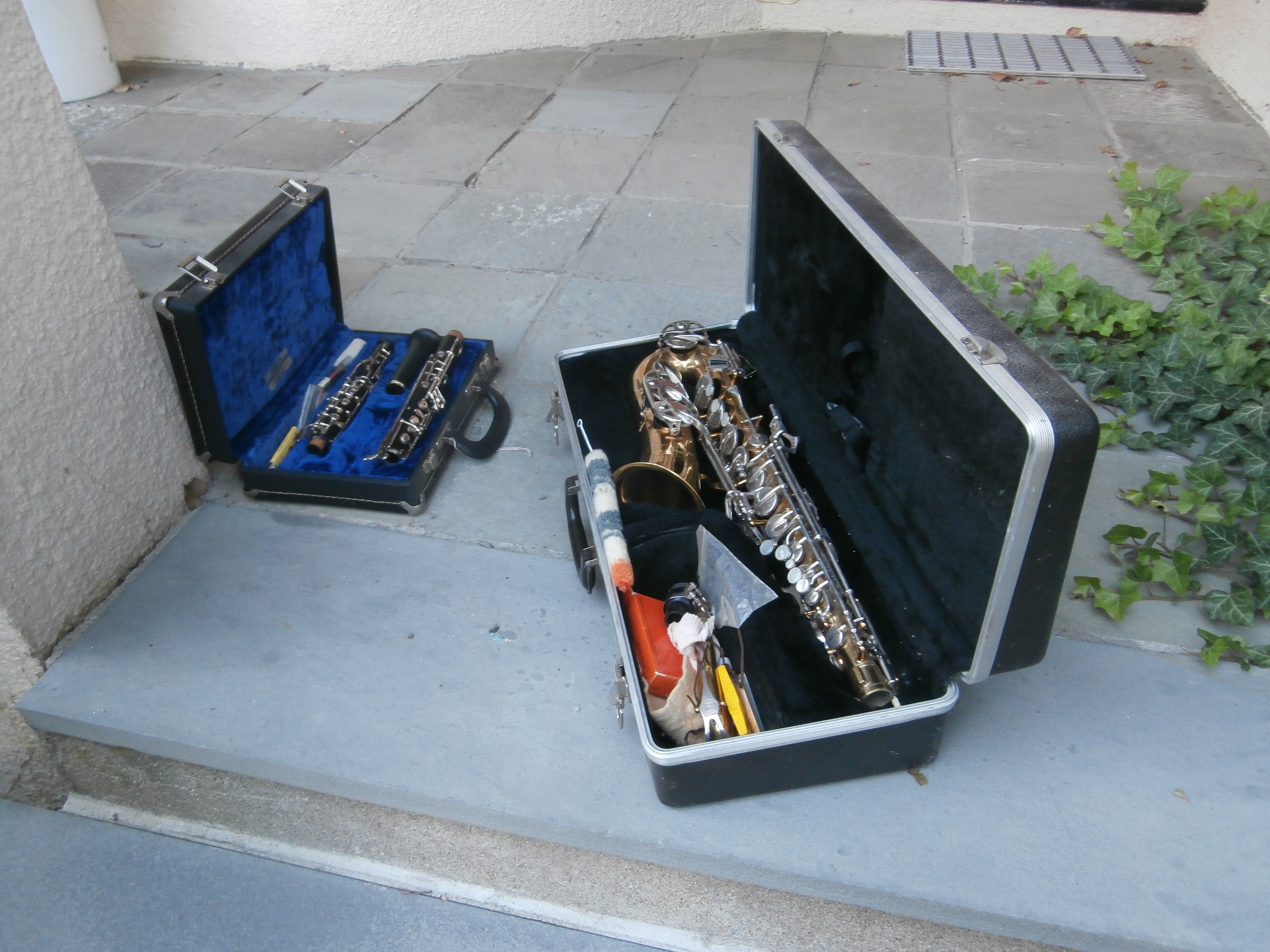
12/27/13 Update. Today I took the oboe and the alto sax below to WICN for the Worcester Public Schools music program. Now a new generation of children will play them.

school-instruments-sax=oboe

Read Full Post »

On the radio show “Living on Earth,” Bruce Gllerman interviewed Antioch education professor David Sobel recently about helping kids grow up to care about nature.

“Research shows that adults who are strong environmental stewards were allowed to explore nature unfettered as kids. …  Sobel says educators are too focused on rules and making sure that students learn correct scientific terms instead letting kids be kids. …

“SOBEL: Kids should have alone time in the woods. If it gets crazy, then there should be some adult intervention. … There needs to be a large quotient of being outdoors, in the meadows and in the woods, as well as the more didactic, pictorial experience of IMAX and National Geographic.

“GELLERMAN: So basically, take the kid kayaking.

“SOBEL: Take the kid kayaking. Take the kid berry-picking.

“GELLERMAN: Well, [with] a lot of parents — you say ‘berry-picking’ and they’ll say, ‘Oh my gosh, they’ll pick something poisonous!’ I know I take my kid mushrooming, and I tell other parents, and they look at me like ‘Oh my God, should we call the police on this guy?’

“SOBEL: Exactly. It’s fascinating how shocked and disapproving other parents are about [that] kind of behavior. … One of the things in childhood that seems to shape environmental behaviors in adulthood is parents taking their kids mushroom picking and berry picking: selecting a natural resource for consumption …

“GELLERMAN: You know, Professor, if I were asked, I could trace my environmentalism to when I was just maybe four years old. And my mother gave me a spoon, put me in the garden, and I started digging to China. Do you have a memory like that?

“SOBEL: The analogous memory that I recount is a snow day when I was about eight years old. And my friends and I decided we would play this game where they were gonna go off and I was gonna to follow them fifteen minutes later. And in the midst of tromping through waist-deep snow all by myself, my glasses were fogging up, I had one of those little epiphany moments: that I was out here, all by myself, in the snowy wilderness, and wasn’t this great! It’s a recurrent phenomenon that kids have these great moments, somewhere in early to middle childhood, that often connect them to the natural world.”

More at the website, where you also can listen to the recording of the interview.

Photo: Flickr CC/your neighborhood librarian
Walking in the woods. 

Read Full Post »

In the current heat wave, I want to blog about something cool. I thought about using today’s Globe story on the Boston bar that will be made entirely of ice, but I am not into bars and the entry fee is $19.

So here is one about a tiny kingdom in the Himalayas that is cut off from the world until the river freezes. The only problem is — the river isn’t freezing as much as it used to.

“About 1,000 years ago, the Buddhists there broke away from the Tibetan Empire [and founded a kingdom] in the very north of India, in the state of Jammu and Kashmir.

“The Kingdom is isolated other than two months a year when the river freezes over and people can cross over to India.” It’s called Zanskar.

Hear more at the Public Radio International show “The World,” where guest Daniel Grushkin describes a lucky escape he had near Zanskar when a piece of ice he was stepping on broke off.

And be sure to check out the adventurer’s other excursions at his blog “Roads and Kingdoms, here.


Photo: Sumit Dayal
Trekking over the frozen Zanskar River.

Read Full Post »

When you consider all the minority languages that are endangered today — many of which I’ve blogged about (for example, here) — it seems a bit perverse to be bringing back Latin on the radio. But as one more way to interest people in languages, how bad can it be?

For the Finns, who have to speak many languages because hardly anyone speaks theirs, it’s just one more.

As John Tagliabue wrote in yesterday’s New York Times, the Internet has given a boost to “a weekly summary of world events and news broadcast by Finnish state radio — not in Finnish, but in classical Latin. …

“In recent weeks, the subjects have included the financial crisis in Cyprus, an unusually brilliant aurora borealis and the election of Pope Francis. …

“It may be no coincidence that the broadcast began in 1989, the year Communism collapsed in Eastern Europe and the Finns turned toward Western Europe. For educated Finns, Latin had long been the country’s link to Western culture, and they were required to study the language in school. …

“While the broadcasts once went out over the airwaves, with shortwave reception for listeners outside Finland, more and more listeners tune in to the program’s Web site, through podcasts and MP3 downloads.” More.

Image: Wikipedia
Cicero Denounces Catiline, fresco by Cesare Maccari, 1882–1888. It’s what Suzanne’s Mom thinks of when she thinks “Latin.”

Read Full Post »

Here’s a guy who loves music, who loves nature, and who is taking his own quirky path to bring the two together.

On the radio show The World, Gerry Hadden interviews the impresario on location.

“We are talking about a solar power recording session in the southern Sierra Nevada mountain range, outside Granada, Spain.

“It is part of an open air recording project called Wapapura, the brain child of musician Rafa Kotcherha.

“And as Kotcherha explains, ‘for a Wapapura recording to take place, you need three elements: Music, Space and Earth.’

“ ‘The music is of course the musicians we’re going to record,’ he says.

“ ‘The space is the environment in which it is going to take place’ and ‘the earth element is the environmental non-profit, linked to the recording, which benefits from part of the purchase of the CD online when it is released.’ ”

Learn about a recording session with the European ensemble Merope high on a mountain in Spain.

Read Full Post »

I have been reading a comic book by Jessica Abel, “How to Make Radio That’s Good,” about Ira Glass and his special brand of storytelling for Public Radio International’s “This American Life.” The book was recommended by a National Public Radio guest speaker where I work. The library was able to order it from WBEZ in Chicago, but it might be out of print.

I have to admit that I have never been a huge fan of “This American Life” or the Ira Glass style of speech. But I’m really liking his ideas on how to build a story from a central character and hooking onto “something surprising.”

And I love this little animation of one of the shows, which is a near-perfect illustration of the comic book’s precepts.

Read Full Post »

Living on Earth, a national radio program produced in Somerville, Massachusetts, has interviewed an interesting guy who makes audio recordings of nature.

He may record, for example, what a woodland sounds like before a logging company comes in and what it sounds like after clear cutting. He may record the sounds of insects in trees. He says it is nearly impossible to get away from man-made sounds when recording nature.

Listening to his recordings early this morning resulted in my listening for the birds more on the walk I took later. (And I turned to see a very jubilant cardinal.)

“Few have heard the world as Bernie Krause has. Originally trained as a musician, he spent years recording the most famous musicians of the 1960s and 70s. Then he left the studio to explore the origins of music in nature. Krause has recorded wild sounds in places few have ever been or even dreamed of. Living on Earth’s Ike Sriskandarajah listens in.” Listen here or read transcript.

Krause calls his field of study soundscape ecology. Here is his new book, The Great Animal Orchestra.

Read Full Post »

Heard this interview today on the great environmental radio show Living on Earth. Tom Montgomery Fate talks about  trying to “live deliberately” like H.D.  Thoreau and connecting to nature and memories of his father in the woodland cabin he often escapes to. His book is  Cabin Fever: A Suburban Father’s Search for the Wild.

In the elementary school Suzanne attended, all second-graders learn about Thoreau, and as a parent volounteer, I went with her class to the cabin site at Walden Pond. The children had a quiz sheet with questions like, “What sounds would Thoreau have heard in his cabin?” The teacher asks,  “An airplane?” (All the kids say, “No-o-o!”) When the Living on Earth interviewer asked the author about his own retreat being near a noisy highway and a short walk to a pub, I was surprised that he didn’t point out that a Boston-Fitchburg train ran right along the edge of Walden Pond in Thoreau’s day, and that the famous naturalist had an easy walk back home to Concord for a Sunday dinner with his mother. Fate did explain that the Walden mystique was all about a mindset and keeping a balance between what’s important and the often numbing dailiness of modern life.

Asakiyume comments: Living deliberately. Something that’s very important to me about that concept is the notion that you can do it anywhere, in any circumstances. I’ll grant that some circumstances make it really hard: if you’re in a job you hate, or a relationship you hate–basically, if there’s some part of your life that’s putting a huge negative drain on you–I think it’s very hard. But I do think that living deliberately can be done in a suburb, in the country, in a city… not just in the wilderness. I think Thoreau wanted to mark, in actual space, his separation from mundane daily life, and I understand that. But I think it’s the mindset, not the location, that’s important.  

Read Full Post »

« Newer Posts