Feeds:
Posts
Comments

Posts Tagged ‘urban’

EcoRI News is a local environmental site where I often find good stories. I especially like this one. It’s not only an upbeat environmental story, but it features middle-school and high-school enrichment in a district that has not often been able to afford enrichment.

Frank Carini writes from Central Falls, “Crammed into 1.3 square miles is a diverse community of 19,300 residents, lots of traffic and plenty of pavement. The most densely populated city in the smallest state also lacks green.

“Central Falls has the lowest percentage of tree cover in Rhode Island. … Today, only 3 percent of Central Falls is green space, a problem Mayor James Diossa soon began addressing when he took office three years ago.

“ ‘Past administrations had never given priority or importance to the role of trees,’ he told ecoRI News earlier this year during a tour of revitalized Jenks Park and a nearby community garden. ‘Trees are instrumental for a community.’

“When Diossa took office in January 2013, it had been nearly three years since the city filed for receivership and nearly two years since it had filed for bankruptcy. Those challenges, however, didn’t prevent Diossa and his administration from implementing ‘Operation Tree Hugger.’

“In December 2014, students from Calcutt Middle School and Scituate High School partnered with the city to develop a proposal for the America the Beautiful-Tree Rhode Island 2015-2016 grant program. The students’ proposal was funded. Four months later, on April 10, 2015, the students planted 14 trees around Calcutt Middle School and established the Central Falls Arboretum.

“Since then, tree plantings haven’t stopped. Last year a group of local middle-school students planted 15 trees along Hunt Street. On National Arbor Day in April, six trees were planted in front of City Hall. A line item has been added to the budget to fund the planting and maintenance of the city’s slowly growing green space. …

“The city and its many partners, however, aren’t limiting new green to the tall variety. They are bringing back all kinds of vegetation. The 26th-most densely populated city in the country wants an urban jungle that features more than concrete, asphalt, steel and brick.

“The community seems to have embraced its greening. The mayor noted that neighborhood volunteers water new plantings, weed, and keep a watchful eye on new green space.”

More at EcoRI, here.

Photo: Joanna Detz/ecoRI News
Middle-school students have planted 15 trees along Hunt Street. Six trees were planted in front of City Hall in April. Central Falls High School students have planted eggplants, peppers and tomatoes in what used to be a vacant lot.

Read Full Post »

It’s so interesting to see all the different ways people are taking to farming. We’ve already covered a number of angles. Now Adele Peters at FastCoexist writes about how would-be farmers in Brooklyn are testing out “vertical farming.”

“When it opens this fall in Brooklyn, a new urban farm will grow a new crop: farmers. The Square Roots campus, co-founded by entrepreneurs Kimbal Musk and Tobias Peggs, will train new vertical farmers in a year-long accelerator program. …

“The campus will use technology from Freight Farms, a company that repurposes used shipping containers for indoor farming, and ZipGrow, which produces indoor towers for plants. Inside a space smaller than some studio apartments—320 square feet—each module can yield the same amount of food as two acres of outdoor farmland in a year. Like other indoor farming technology, it also saves water and gives city-dwellers immediate access to local food. …

“It’s intended for early-stage entrepreneurs. ‘We’re here to help them become future leaders in food,’ says Musk, who also runs a network of school gardens and a chain of restaurants that aim to source as much local food as possible.

“After building out the Brooklyn campus, they plan to expand to other cities, likely starting with cities where Musk also runs his other projects—Memphis, Chicago, Denver, Los Angeles, Indianapolis, and Pittsburgh.”

More here.

Photo: SquareRoots

Read Full Post »

090716-blackstone-valley-visitor-center

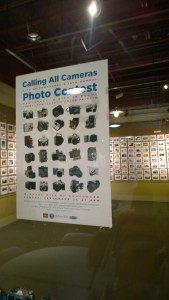
Pat Zacks at the Camera Werks in Providence feels compassion for inner-city kids whose schools can’t offer many enrichment activities. That’s why she volunteers every year to mount and hang 500+ juried photos by Pawtucket, Rhode Island, fifth graders (and a few grownups).

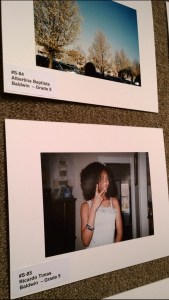
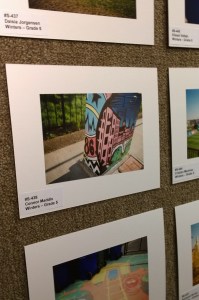
On Wednesday I stopped off at the gallery where the “Calling All Cameras” photos are on display until the end of September. The theme this year,  submitted by Linda C. Dugas, is “Pawtucket’s Color Palette.” Winners of this, the 18th, annual photo contest also get their work featured in the city calendar.

An impressive slate of judges are responsible for choosing this year’s winning photos (Butch Adams, Richard Benjamin, Christy Christopoulos, Jesse Nemerofsky, and Aaron Usher). Winners will be announced September 25.

I wish my photo of a child’s box turtle entry had turned out well enough to post, but I’m sharing a couple other favorites here.

Stop by the Blackstone River Valley National Heritage Corridor visitor center, just off Interstate 95 in downtown Pawtucket, to find the box turtle. The visitor center is opposite the historic Slater Mill, birthplace of America’s Industrial Revolution.

And if you are ever in Providence, please check out the Camera Werks on Hope Street. Pat’s Facebook page, here, has more information on the photo exhibit.

090716-pawtucket-calling-all-cameras

090716-pawtucket-photo-show-1


090716-pawtucket-photo-show-2


Read Full Post »

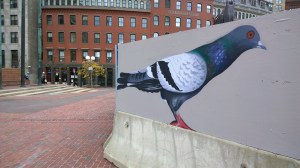
110714-a-pigeon-that-I-pass-alas


Sometimes when I’m trying to cross a city street in traffic that’s coming from all directions, I think about how people who don’t visit cities much — Inuit people, say, or rural tribesmen in Africa  — would cope. Probably about as well as I would cope dealing with the habits of lions or polar bears. We all develop the survival skills we need most.

Birds do, too. According to Scientific American, urban birds develop skills that let them outwit their country cousins on certain tests.

Christopher Intagliata reports,”While visiting Barbados, McGill University neurobiologist Jean-Nicolas Audet noticed that local bullfinches were accomplished thieves.

” ‘They were always trying to steal our food. And we can see those birds entering in supermarkets, trying to steal food there.’

“And that gave him an idea. ‘Since this bird species is able to solve amazing problems in cities, and they’re also present in rural areas, we were wondering’ are the rural birds also good problem-solvers, and they just don’t take advantage of their abilities? …

“So Audet and his McGill colleagues captured Barbados bullfinches, both in the island’s towns and out in the countryside. They then administered the bird equivalent of personality and IQ tests: assessing traits like boldness and fear, or timing how quickly the finches could open a puzzle box full of seeds.

“And it turns out the city birds really could solve puzzles faster. They were bolder, too, except when it came to dealing with new objects—perhaps assuming, unlike their more naive country cousins, that new things can either mean reward … or danger.

“The study is in the journal Behavioral Ecology [Jean-Nicolas Audet et al, The town bird and the country bird].”

More here.

Read Full Post »

As an official member of his town’s tree committee, John has been working hard to promote the many benefits of an urban tree canopy both for quality of life and for the business environment.

Now here comes a really unusual idea for fans of urban greenery. You just need a large body of water.

At the website “Pop Up City,” describes Rotterdam’s floating forest, thought up by (who else?) an artist.

“Rotterdam will get its first ‘bobbing forest’ in 2016: a collection of twenty trees that are floating in the Rijnhaven, a downtown harbor basin.

“Inspired by Jorge Bakker’s artwork ‘In Search of Habitus‘, an aquarium filled with bobbers that grow small trees, Dutch designers and entrepreneurs from Mothership decided to carry out this idea in ‘real life’. After experimenting with a sample tree last year, an entire floating forest of twenty trees is scheduled to be ‘planted’ on March 16, 2016.” Check out some intriguing photos here.

My only question as a person who grew up in a hurricane corridor: What happens if there’s a storm?

Photo: Popupcity.net

Read Full Post »

Around the country, art is playing a role in improving the livability of cities and towns.

Peter Brewitt writes at Orion magazine, “Over the past decade, communities across the nation have taken to beautifying their roads and intersections with hand-painted murals, slowing drivers as they go. Murals like these come at minimal cost — just buy some street-grade paint, get whatever permits your city requires, and figure out how to reroute traffic for a few hours. As people motor through the neighborhood, murals catch the eye, situate the mind, and lighten the right foot.

“Many of these creations did not begin as traffic-control devices — the goal was often to engage the neighborhood with itself, to display its spirits and hopes for the future, and to embrace the spaces that bind people together. But art touches drivers as well as neighbors …

Paint the Pavement [PtP], a street-art program in Saint Paul, Minnesota … offers support and advice, but the groups of friends and neighbors creating the art are self-organized and volunteer-run.”

Learn more about enlivening your neighborhood with pavement painting, here. Hat tip to Mary Ann on Facebook.

It’s an interesting art form. More lasting than children’s sidewalk chalks — which doesn’t mean that chalk is passé. In my work neighborhood, grownups have been taking up sidewalk chalk art, and I can attest that people smile when they see it.

Video: Vimeo and Orion magazine

Read Full Post »

Boston Medical Center is an inner-city hospital that takes a special interest in immigrants and the poor. It also treats patients holistically, offering a referral service for problems that get in the way of good health.

With the support of the City of Boston, Boston Medical Center has added a new item to its medicine cabinet: bike sharing.

Catalina Gaitan writes at the Boston Globe, “The City of Boston has announced a program to subsidize bike-sharing memberships for low-income residents, in partnership with Boston Medical Center.

“The program, ‘Prescribe-a-Bike,’ would allow doctors at Boston Medical Center to prescribe low-income patients with a yearlong membership to Hubway, a bike-share program, for only $5.

“Participants would be allowed unlimited number of trips on the bicycles, provided they use them for 30 minutes or less at a time. They will also be given a free helmet, the mayor’s office said in a joint statement with Boston Medical Center.

“ ‘Obesity is a significant and growing health concern for our city, particularly among low-income Boston residents,’ said Kate Walsh, chief executive of Boston Medical Center, in the statement. …

“Statistics show that 1 in 4 low-income residents in Boston is obese, almost twice the rate of higher-income residents, the statement said.

“To qualify for the prescription, participants must be 16 years or older and be enrolled in some form of public assistance, or have a household income of no more than four times the poverty level.”

More here.

bikes-in-boston

Read Full Post »

Holmes-School-Dorchester-MaA new employee goes to the Oliver Wendell Holmes School in Dorchester with the team I’m on. He can’t get over how great it is to work for an organization that gives you time to do this. We go out once a month from January to June, and other teams go once a month so that we cover every week.

I started eight years ago with the team that read picture books to a room of first graders. Then I read for a few years with fifth or fourth graders who received chapter books from the librarian. These were students whose teachers thought they would appreciate the extra reading. We all read aloud, with the adult volunteers only taking a turn if the story seemed to lag.

Holmes is a minority-majority urban school with many dedicated teachers who are tolerant of the extra work it takes to herd volunteers. (We also have volunteers who work on math.)

This year, the team I’m on includes the woman who started the whole relationship with Holmes 20 years ago and is now retired. We are assigned to read copies of printed passages and help the children answer multiple-choice questions from tests they have had in the past.

Given the current nationwide emphasis on testing and these third graders’ tendency to keep guessing wildly, I consider it my role to focus on the thought process and deemphasize getting the right answer. I ask, Why do you think that’s the answer? How did you get there?

The administrators often tell us that we make a difference. We’re probably just a drop in the bucket. But, you know, One and One and 50 Make a Million.

More employers should make it so easy to improve the world in which they operate. Other employees probably spend the hour and a half it takes to go out, tutor, and get back once a month in less valuable ways.

Read Full Post »

Got this from SmallerCitiesUnite! on twitter.

Rachel Walker writes at PeopleForBikes.org, “How do you get more people on bikes? Go to where they are, open up a ‘shop,’ teach them to build and maintain a bike. Help them earn a bike. Repeat.

“This is the philosophy behind the myriad of community bike shops sprouting up in inner-city neighborhoods throughout the country. Non-profit organizations that cater to the underserved aim to destigmatize and popularize cycling among communities that have probably not heard of Strava or clipless pedals. In these neighborhoods, bicycle lanes, racks, and, most importantly, riders, are noticeably absent.

“And that, according to the forces behind community bike shops, must change—for multiple reasons.

“ ‘For our core constituents, getting a bike and learning how to maintain it is about economic mobility,’ says Ryan Schutz, executive director of Denver’s Bike Depot. ‘Owning a bike lets them travel farther to find work and spend their money on food, instead of on gas or bus fares.’

“Like the majority of community bike shops, Bike Depot puts bikes into the hands of people who otherwise couldn’t afford them or may not choose to buy them. The organization accomplishes this through earn-a-bike programs and by selling low-cost refurbished bikes. They also teach members bike safety and maintenance skills.” More here.

Sounds like a variation on Bike Not Bombs, which started in the Greater Boston area several decades ago, refurbishing donated bicycles and sending them to poor countries.

Here’s what Bikes Not Bombs says on the website: “Bikes Not Bombs uses the bicycle as a vehicle for social change. We reclaim thousands of bicycles each year. We create local and global programs that provide skill development, jobs, and sustainable transportation. Our programs mobilize youth and adults to be leaders in community transformation.”

All good stuff.

Photo: People For Bikes
The Community Cycling Center in Portland, Oregon, offers bike camps to local kids.

Read Full Post »

People interested in imaginative uses of space to make cities more livable should get over to the Boston Society of Architects on Congress St. before September 29, when an intriguing exhibit closes.

Eight of us visited at lunch today, and the BSA’s marketing director went around the Reprogramming the City exhibit with us pointing out highlights and answering questions.

We saw photos of a lamppost that doubles as an umbrella, a staircase in Hong Kong (below) made into a public lounge, bus stops in Sweden using sun lamps at night, a “low line” community space under a highway (like New York’s high-line concept but under not over), a repurposed parking machine that spits out “tickets” describing how a nearby problem area has been fixed by the city of Boston, street mosaics in Portugal that have a QR code for accessing tourist information, and a Dutch solution to recycling teddy bears and other usable goods curbside for passerby to pick up. The list goes on.

I tried to round up more people to join the excursion, but business meetings at lunch seem to come first. It always surprises me that folks don’t take advantage of cultural activities at lunch: we are surrounded by really nice ones. At least the farmers market is popular. People always have time for that.

More on Reprogramming the City at the BSA website, where you can take an audio tour.

Update 9/18/13 — See some great pictures from the exhibit at the Boston Globe, here.

Photo: Scott Burnham
The Cascade by Edge Design Institute, 2007, Central Hong Kong.
Right, Urban Air by Stephen Glassman, 2010.

Read Full Post »

I’m hoping someone from my deep past will remember the name of the man who used to travel to my growing-up neighborhood in a blue-painted school bus to sell fruits and vegetables. The name “Mr. Mackey” is clawing itself to the surface, but I may have that wrong.

I had flashbacks about the huckster today when I read about the Fresh
Truck, an old idea made new in a time of urban food deserts and locavore sensibilities.

Christina Reinwald wrote the story for the Boston Globe.

“A food bus began to roll down the city’s streets Thursday. The retrofitted school bus, the brainchild of a Boston start-up called Fresh Truck, is expected to visit Boston communities that don’t have nearby grocery stores, selling fruits and vegetables.

“Fresh Truck founders Josh Trautwein and Daniel Clarke, recent Northeastern University graduates, came up with the idea last year and work full time now to serve neighborhoods in need of more healthful food options. …

“Fresh Truck raised more than $32,000 from over 300 contributors to its Kickstarter crowdfunding campaign earlier this year. It also received private donations to get started.

“Starting Monday outside the New England Baptist Hospital in Roxbury, Fresh Truck will sell its produce for about 20 percent less than average grocery prices, Trautwein said.

“Avoiding the traditional brick-and-mortar shop eliminates many operating costs for Fresh Truck.” More.

Photo: Yoon S. Byun/ Globe Staff
A food bus run by Fresh Truck, a Boston start-up, aims to serve neighborhoods in need of more healthful food options.

Read Full Post »

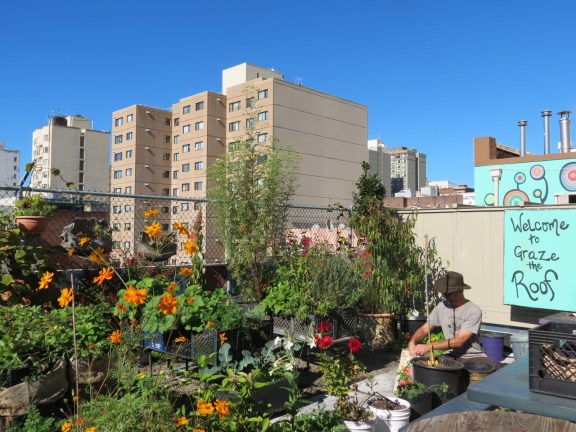
If you had to guess one church in San Francisco that would be all over the idea of rooftop gardening to feed whoever needs feeding, which one would it be?

Right. Glide. I like its garden’s name: Graze the Rooftop.

“Graze the Roof is an edible, community-produced vegetable garden on the rooftop of Glide Memorial Church, a progressive church and nonprofit located in the Tenderloin district of San Francisco.

“Graze the Roof features lightweight (upcycled) raised garden beds made from milk crates; a worm composting system and an educational mural which ties the whole project together. Glide youth and volunteers from throughout the Bay Area maintain the garden and host monthly tours and workshops.”

Do you live in the San Francisco area? Looks like there are a lot of fun workshops available, such as Designing Sustainable Habitats, Introduction to Permaculture, and Urban Fruit Tree Stewardship. Read more here.

Photo: Graze the Roof

Read Full Post »

On Saturday we watched the documentary Urbanized, about urban planning.

Although there were many discouraging notes (Mumbai slums, Beijing smog, destructive construction in Stuttgart), there were enough positive ones to give hope.

I liked the grassroots gardening efforts in Detroit, pedestrian/bike paths in Bogota (while cars were relegated to mud), miraculous transformations of aging infrastructure (the High Line in Manhattan), lighted paths in Cape Town, and bicycle commuting in Copenhagen.

The point was made that walkability (one of my favorite topics, as readers know) and similar quality-of-life improvements in cities can be hugely beneficial to the planet just because cities are so big and changes there affect so many people.

Doug Foy, who helped get Boston Harbor cleaned up and now consults with New York City’s Mayor Bloomberg, has spoken at my workplace a few times. He likes to talk about how New York avoided buying a whole new water supply simply by partnering with plumbers unions to get standard toilets gradually replaced with low-flush toilets.

Read Full Post »

Photograph: Melanie Stetson Freeman/Christian Science Monitor
Eric Schwarz, chief executive of Citizen Schools, advocates ideas such as an extended day, hands-on learning, and adult mentors in classrooms.

At work, we have a relationship with an after-school enrichment organization called Citizen Schools. One day a teacher brought in a Citizen Schools group for a special event that my friend Lillian and I attended.

At the end of the program I said to Lillian, “Do you see that girl second from left? Don’t we know her?” And then we both realized the sixth grader had the previous year been in a reading-enrichment program where we volunteer.

It makes you think. There are young people in urban public schools who understand the importance of education and will grab every opportunity they can get.

But about Citizen Schools: “Eric Schwarz is remaking public education in the United States using a simple formula: Extend the school day, give kids adult mentors, and let them get their hands dirty,” writes Gregory Lamb at the Christian Science Monitor.

“The program, called Citizen Schools, has succeeded so well that Mr. Schwarz has been invited to the White House to explain how it works ..

“Now at work in 14 US inner-city school districts and on one Indian reservation, Citizen Schools is seen as a model for making dramatic improvements at low-performing schools. To do that it partners not only with AmeriCorps, the quasi-governmental service organization, but with some of the biggest names in US business …

“The idea is to level the playing field for students who grow up in low-income households.

” ‘In this country we have a growing achievement gap based on family income. It’s actually a bigger gap than it was 50 years ago,’ Schwarz says in an interview at the Citizen Schools headquarters in a renovated brick building on Boston’s waterfront, just one pier away from the replica of the historical Boston Tea Party ship. ‘The reason, I think, is not that poor kids are learning less, but that rich kids are learning more because their families are giving them all these opportunities to get violin lessons, go to robotics camp, get extra coaching and tutoring, and have lots of chances to be [around] successful adults.

” ‘Those opportunities are incredibly unequally provided in our society, and Citizen Schools changes that.’ ”

More.

Read Full Post »

In 1972, an idealistic young man graduated from Duke University and returned to St. Louis.

There Joe Edwards became both a successful entrepreneur and “a powerful force for civic good,” writes Marjorie Kehe in the Christian Science Monitor.  …

“Casting about for a career, he decided to bank on his love of music and opened Blueberry Hill, a small restaurant and bar that featured live performances. For his venture he chose a storefront on Delmar Boulevard, a retail area that locals call The Loop (named for the trolley that once used to turn around there).

“Back in the 1920s and ’30s The Loop was an elegant shopping street, and up through the ’50s it remained a major draw for young St. Louisans …

“But by the early 1970s the street had become a ghost town. About half The Loop’s storefronts were vacant or boarded up, and crime was rampant. Edwards remembers sweeping up debris and broken glass in front of Blueberry Hill each morning and feeling despair.

” ‘Within a week of opening Blueberry Hill I realized that I wouldn’t make it if the neighborhood didn’t make it,’ he says.

“And so began his campaign of gentle persuasion. ‘I talked to other residents, to city hall, to the police,’ Edwards says. He reminded them of what many seemed to have forgotten – that The Loop was a valuable asset, graced with appealing architecture and a rich history. He formed The Loop Special Business District and served on committees that worked on issues from lighting to sanitation to flower planters to security.

“But Edwards’s best move was to become a success. ‘The business establishment has been willing to listen to him because he’s been so successful,’ says Bill McClellan, a columnist at the St. Louis Post-Dispatch newspaper. ‘He’s an unusual combination – a hippie-visionary-business type.’ ”

Read more about how one person made a big difference in a city he loved.

Photograph: Ann Hermes/Christian Science Monitor
Joe Edwards sits in the display window of his restaurant Blueberry Hill on Delmar Boulevard in St. Louis.


Read Full Post »

« Newer Posts - Older Posts »