Feeds:
Posts
Comments

Archive for January, 2018


Photo: New Zealand Herald
Royal New Zealand Ballet dance educator Pagan Dorgan said a dance initiative with women prisoners aims to build confidence and cooperation.

I like reading about programs designed to help individuals in prison grow in positive ways. I also like the idea of arts groups that, in addition to giving their art to the world, develop other ways to benefit society.

Consider this Royal New Zealand Ballet pilot for women prisoners. Meghan Lawrence at the New Zealand Herald has the story.

“Pirouettes and pliés are being used to break boundaries in a new initiative run by the Royal New Zealand Ballet (RNZB) Company.

“Best known for its dynamic dancers and eclectic repertoire of dance moves, RNZB has chosen to put accessibility and inclusion at the forefront of its latest project run in partnership with the Department of Corrections.

“Three of RNZB’s artistic staff have decided to put aside the national and international stages for [six weeks starting in November 2017] and spend their time teaching prisoners at Arohata Women’s Prison in Wellington. …

“Community manager Pascale Parenteau … said the initiative fits perfectly with the company’s primary goal of making dance accessible to all New Zealanders.

” ‘It was actually very timely because for some time the education team for RNZB have been working on developing an Accessibility Commitment Policy,’ she said.

“As part of that policy the company have run three other projects; the first sign-language interpreted guided tour of the St James Theatre, a sensory-friendly performance for children and adults with autism and special needs, and NZ’s first audio-described ballet performance for visually impaired children and adults. …

“[Parenteau] said the project aims to enhance prisoners’ confidence, communications skills and ability to work with others. …

” ‘When I was setting the programme up I was told that a lot of the women come from broken or disheartening homes and backgrounds, which means they would have never experienced participating in a high-profile training environment, so this is a bit of a boost for them.

” ‘I think they have been very courageous to put their hand up and have a go, but I think the freedom of expression that it allows them is going to be very beneficial.’

“Dance educator Pagan Dorgan was excited to take on the challenge, having previously run a similar initiative with male prisoners in the UK. …

“Dorgan said the project is run in two phases; six weeks of workshops leading up to the Christmas production, and then further sessions [in 2018] to learn specific RNZB repertoire.

“[The first session] was a little bit of everyone getting to know each other and we also did an aerobics or gym type warm-up’ she said. ‘We then went through some basic dance movements that were a mixture of jazz, contemporary and Latin.’ … There was no resistance at all and there was a nice, positive atmosphere.’

“Participants in the project said the experience gave them hope and inspiration, provided a chance to grow as individuals, and made them appreciate life outside of prison walls. …

“Parenteau said the project was set up as a one-off but she is hoping to get further funding to expand the classes.”

More at the New Zealand Herald, here. And Radio New Zealand has audio, here.

Photo: Radio New Zealand
A dance class in a prison.

Read Full Post »


Photo: Auscape/Getty Images/Universal Images Group
Scientists hope to restore damaged coral on the Great Barrier Reef with a technique that has seen success in the Philippines.

As I was preparing this post on an effort to save the Great Barrier Reef, I stumbled upon the news that the 37-year-old ocean warrior behind the climate-change movie Revolution, Rob Stewart, died a year ago in a dive off Key Largo.

That gives a whole different cast to my thoughts. I was going to say something about how happy he must be about the new coral-breeding program that offers a “glimmer of hope” to the Great Barrier Reef. Now it’s “how happy he would have been.” The world can ill-afford to lose an energetic ocean crusader like Stewart.

As the Guardian reports, the coral-breeding project has seen success in the Philippines and is now being tried in Australia.

“Scientists have stepped in as environmental matchmakers by breeding baby coral on the Great Barrier Reef in a move that could have worldwide significance.

“Coral eggs and sperm were collected from Heron Island’s reef during [the November 2016] coral spawning to produce more than a million larvae. The larvae were returned to the wild and placed on to reef patches in underwater mesh tents, with 100 surviving and growing successfully.

“The lead project researcher and Southern Cross University professor Peter Harrison, who discovered mass coral spawning in the 1980s, says the ‘results are very promising.’ …

“The project has the ability to restore damaged coral populations and has seen similar success in the Philippines where blast fishing using explosives to kill schools of fish has destroyed coral.

“The Great Barrier Reef Foundation managing director, Anna Marsden, said the research is an important step for the reef, but one that should not lessen the strong action needed against climate change.”

That’s because, as I learned watching Stewart’s movie, it’s the CO2 resulting from climate change that is the big danger.

More at the Guardian, here. See also my review of the movie Revolution, here.

Read Full Post »

Photo: Sven Creutzmann/Mambo photo/Getty Images
A performance at the 2015 Havana Biennial. When the Cuban government postponed this year’s event, artists took matters into their own hands.

The recent hurricanes have stressed official budgets all over the Caribbean, and in Cuba, the government blames Irma recovery costs for its decision to postpone a popular arts biennial.

So artists and art lovers decided to organize an alternative event, as Laurie Rojas reports at the Art Newspaper.

“A crowdfunding campaign was launched [in December] for the #00Bienal (5-15 May 2018), an independent alternative event that is due to take the place of the 13th Havana Biennial, which the Cuban government has postponed until 2019 because of a lack of resources after Hurricane Irma hit the island. …

“ ‘The democratically minded #00Bienal will be ‘the Havana Biennial for everyone,’ says the artist Luis Manuel Otero Alcántara, one of the main organisers of the event.

“The aim is to provide a platform for artists who do not have the visibility or official status to participate in a government-sponsored biennial. Street, Outsider, performance, digital and conceptual artists and photographers are all invited to submit proposals. …

“[Alcántara] says that ‘the government made a grave error’ when it postponed the Havana Biennial, describing it as ‘the most important cultural event in the country.’

“Other artists and curators, including Tania Bruguera, Alvaro Saavedra and Coco Fusco, as well as independent cultural spaces in Havana, have volunteered to help realise the #00Bienal. It will be completely self-funded and will not seek money from the state.”

Check out the Art Newspaper, here, as well as the Havana Times, here. Hyperallergic details here the government hostility Alcántara ran into for organizing the alternative event.

Two couples I know went to Cuba last year and loved it. If you go in May, please let me know if you see the arts event.

Read Full Post »


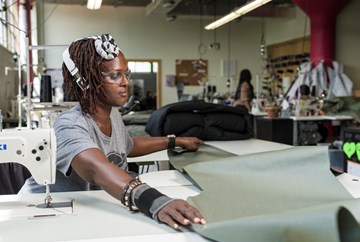
Photo: The Empowerment Plan
Many people experiencing homelessness would like a job even more than a coat warm enough to sleep in outside.

A student’s idea to help people experiencing homelessness got a whole lot better after a homeless woman offered advice.

Kimberly Wong writes at Streetwise magazine, “Some students might believe that school projects are only good for a grade, but Empowerment Plan founder and CEO Veronika Scott knew that they could be something more. Scott was a student at The College for Creative Studies in Detroit when her professor assigned her class a project to fill a real need in the community. Noticing the homelessness that pervaded the city, Scott, who was only 20 years old at the time, began to visit a homeless shelter to try to figure out how she could help people who were homeless. …

“Scott visited the homeless shelter three times a week for five months. Hearing the ideas of the people living in the shelter showed her what she needed to do — she had to make a coat. She learned to sew from her mother, and even after the project was over, she continued to work on this coat that she hoped would change the lives of as many of the homeless as possible.

“The water-resistant coat she was designing would be able to be transformed into a sleeping bag at night or into an over-the-shoulder bag on warmer days. As Scott was in the process of perfecting the design for her coat, she was approached by a homeless woman who told her emphatically that what she really needed wasn’t a coat, but a job.

“Taking this feedback to heart, Scott partnered with a shelter and hired two homeless women to start making coats that would come to be known as EMPWR coats.

“Scott paid the women to learn industrial sewing and manufacturing and brought local designers on to the project. Just like that, the Empowerment Plan was born. …

“The Empowerment Plan has been running for almost seven years and has 35 employees. All of the employees were hired while homeless and have since secured permanent housing with their families.

“Jessica West, a seamstress team leader at the Empowerment Plan, is just one example of the way the Empowerment Plan has changed lives. West was sleeping in her car with her children before they moved into a homeless shelter. She discovered the Empowerment Plan while living in the shelter and has been working with them for two years. She and her children currently live in a comfortable home fully furnished by non-profit organization Humble Design, … one of the many organizations the Empowerment Plan works with to improve the lives of their employees. …

“Usually, Empowerment Plan employees work at the organization from one to three years, but this is by no means a set timeline. Above all, the Empowerment Plan is focused on the individual growth of its employees.

“The employees at the Empowerment Plan are paid through the sponsorship of EMPWR coats — and since the coats also go toward helping the homeless community, it’s a win-win situation. Sponsoring an EMPWR coat costs $100, which covers the cost of materials, the seamstresses’ wages, and overhead. EMPWR coats are mainly sponsored by individuals, corporations, and non-profit organizations. The Red Cross has even sponsored EMPWR coats for disaster relief. …

“While the organization currently relies on donations, it is working to become self-sustaining [with] a new retail line of coats with functions similar to the EMPWR coat but with its own style.”

More here.

Hat tip: Spare Change News, Boston’s street newspaper.

Read Full Post »


Photo: Lucy Young/Evening Standard
Jonathan Privett, co-owner of Word On The Water inside the barge.

I love stories about unusual libraries and unusual bookstores. Here’s one from the New York Times about a bookselling endeavor powered by the famed eccentricity of Englishmen.

Rod Nordland writes, “The two men who run London’s only floating bookstore, Word on the Water, are living proof that there really is something you can do in life with an English lit degree, other than teach English literature.

“The store — a 50-foot-long canalboat stuffed to its bulkheads and overflowing onto the towpath with books — has a permanent berth on the Regent’s Canal, around the corner from the British Library. This comes after years of its owners staying one step ahead of eviction from the canals, by relocating fortnightly.

“It is doing so well that Paddy Screech, 51, an Oxford-educated Cornishman with a close-trimmed beard and a soft-spoken manner, and Jonathan Privett, 52, a gaptoothed Yorkshireman who has trouble staying still for long (except with a book), finally took their dream vacations this year. …

“The men got the idea for the store from a book, of course — ‘Children of Ol’ Man River,’ in which Billy Bryant recounts how his British immigrant family arrived on the Mississippi River, homeless, living on a floating board, which they built into a theater, and then into the showboat craze of the late 1800s.

“When they met, Mr. Privett was living on a canalboat, part of a subculture of boat dwellers who berth on London’s canals for free — as long as they keep moving periodically. Mr. Screech had been working with homeless people and drug addicts, while caring for an alcoholic mother at home. ‘Overnight, she stopped drinking and turned into a little old lady who only drank tea,’ he said. …

“Mr. Privett had the book-business experience. Before settling on his canalboat, he had at times been a homeless squatter who supported himself selling used books from street stalls.

“A French friend, Stephane Chaudat, provided a boat big enough to be a store, a 1920s-era Dutch barge; he remains their partner.

“Mr. Privett had a stock of used books. Mr. Screech borrowed 2,000 pounds from his then-sober mother as capital, and their business was born in early 2010. …

“Things went downstream fast. Forced by the berthing laws to move every fortnight, they often found themselves on parts of the nine-mile-long Regent’s Canal with industrial buildings and no customers. …

“Mr. Screech said. ‘For years, it just felt like it was going to sink.’

“Then it did. A friend used the sea toilet on the book barge and left an inlet open, and the boat sank to the bottom; even their prized copy of ‘Ol’ Man River’ was lost. Shortly later, the boat Mr. Privett lived on sunk as well, and he lost all of his family photographs.

“ ‘[We] were just sitting there on the towpath, crying,’ Mr. Screech said. …

“As the canal trust peppered them with legal notices, fines and threats to have the boat barge lifted out of the water and broken up, their supporters got busy, too. One rallying cry of a Twitter post, from the science-fiction author Cory Doctorow, was retweeted a million times, Mr. Screech said.”

Read the whole saga here.

As small blurbs filling out New Yorker magazine columns were once titled, “There’ll always be an England.”

Read Full Post »

Photo: Wikipedia
The facade of the BIQ (Bio Intelligent Quotient) house in Hamburg has tanks filled with microalgae that produce biomass used to generate electricity.

It’s reassuring that there are always thinkers who are really “out there,” wildly inventing better ways to do things. For example, in architecture. Did you know there was such a thing as experimental architecture? Me neither.

Rachel Armstrong is a professor of experimental architecture at Newcastle University in the United Kingdom. You can read about her views on breathable buildings at the website Aeon.

“Traditional buildings are designed to provide protection against a savage world, with us safe on one side and our waste on the other. Architects have long relied on ‘hard’ materials such as masonry, aluminium and glass, specifically chosen to prevent the outside environment from getting in. Impermeability was, and is, a driving goal.

“It is time to rethink that approach. Our current built environment squanders too much fresh water and other vital resources, and tips too many poisonous substances into our surroundings. To develop a more sustainable relationship with the natural world, we need to allow chemical exchanges that take place within our living spaces, and between the inside and the outside. We need to embrace permeability. …

“In many offices, it is no longer possible to open windows manually to let in a breeze. Automated air-conditioning systems (often answering only to sensors and software) blast summer heat out into scorching walkways, amplifying the urban heat-island effect and contributing to heat-related health risks. Such buildings ignore the metabolism that is the dynamic scaffolding of living systems.

“During the 1970s, the ecologists John and Nancy Jack Todd and William McLarney founded the New Alchemy Institute – now the Green Center on Cape Cod in Massachusetts – to reconceive building spaces as part of a self-sustaining human ecosystem. Such spaces would not be hermetically sealed, but rather open to the flow of natural elements. …

“Incorporating permeability into architecture begins with a building’s composition. In the past 20 years, engineers have developed organic construction materials that have various degrees of permeability. Mycotecture – architectural building blocks that are formed from the fibrous material of fungal roots – are as strong as concrete and as insulating as fibreglass. BioMASON bricks are built by microorganisms; they do not need firing and are as strong as traditional masonry. Bioplastics are produced by bacteria using biogas from landfills and wastewater treatment plants. Since they are not derived from petroleum, bioplastics have lower carbon footprints. Like wood, they are ‘farmed’ into existence. …

“Semi-permeable ceramics in particular can be treated to provide binding surfaces for biofilms, large coordinated colonies of bacteria or other microorganisms. Biofilms can be grown to have semiconductor properties, akin to solar cells or computer circuits. When treated with manganese, biofilms can become filters that regulate the flow of air and water into a building. …

“The BIQ House in Hamburg has a façade of thin-walled tanks filled with microalgae. The algae harvest sunlight and carbon dioxide, and produce biomass that can be used to generate electricity. The translucent, living tanks also regulate the building temperature by absorbing more sunshine as the biomass increases. In this case, the glass of the tanks is impermeable to water but lets in sunlight – a different kind of permeability, which is critical for the organic exchanges within the façade.

“The Living Architecture (LIAR) project, funded by the European Union among others, is a fruitful effort to create showcases of semi-permeable design. For instance, the project aims to transform bathrooms, kitchens and commercial spaces into environmentally sensitive, productive sites. …

“The LIAR project is still in a prototype phase. Quantitative inputs and outputs have not yet been formally established. But project leaders expect to see integrated bioreactor wall systems in real homes within the next 10 years.” More at Aeon, here.

All I can think of right now, having recently experienced a week of below zero Fahrenheit degrees, is, “Will the solar properties be enough? Can buildings turn off the permeability?”

Read Full Post »

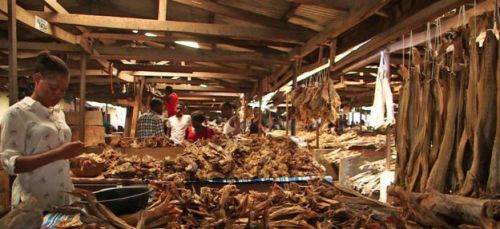
98989420_04ba6d56-1f9e-40c2-a5e0-e5d9484b2294 Photo: Penny Dale/BBC Africa
In Nigerian markets the smell of stockfish — a culinary stable that comes from Norway — permeates the air.

I was interested to learn that something called “stockfish,” from Norway, has become a staple of the Nigerian diet. Penny Dale and Victoria Uwonkunda of BBC Africa have the story.

” ‘The taste of stockfish is life. We can’t cook without stockfish.’

“That’s the verdict of women at the bustling Onyingbo market in Nigeria’s commercial capital, Lagos, as they carefully choose pieces of the specially dried cod. …

“The smell of stockfish is pungent. … As the moisture drips out, the flavour of the fish deepens to create a rich, intense and complex taste.

“It is perfect for a Nigerian palate, which favours big and bold flavours such as fermented locust beans and chilli pepper, says young chef Michael Elegbde.

“Based in Lagos, Mr Elegbde is a rising star in Nigeria’s culinary world — and his signature dishes revolve around stockfish. Growing up, he spent a lot of time helping his grandmother in the kitchen, and she loved stockfish as a key ingredient in traditional dishes. …

“It was only later in life — when he had followed in his grandmother’s cooking footsteps — that he discovered the fish that he had grown up with actually came from almost half-way round the world, in the cold Arctic waters off the coast of Norway. …

“Between January and April, millions of cod migrate from the Barents Sea to breed in the fjords — and the climate is perfect for the natural drying process.

” ‘You need both cold and dry weather, and you need sun. We have everything here. We are gifted from God,’ laughs Erling Falchs, whose family business Saga Fisk has been in the stockfish trade for six generations.

“After gutting, cod is hung out on huge wooden A-frames, up to 10 metres high, and left to dry for three months in in the cold, crisp winter air. No salt, no additives – just in the same way that it has been dried since the time of the Vikings.

“Although Nigeria has a long coastline teeming with other species of fish, people say the stockfish has a unique taste and so it is Norway’s biggest export market for the fish. …

“It was the Biafran civil war in Nigeria 50 years that really set the scene for stockfish to become a must-have ingredient in Nigerian cuisine. In the course of three bloody years, more than a million people died — mostly from hunger. It was a humanitarian crisis on an unprecedented scale, and churches and relief agencies from all over the world joined together to fly in emergency supplies.

“Norway’s contribution was stockfish. It doesn’t need refrigeration, and it is full of protein and vitamins — perfect to combat kwashiorkor, the malnutrition that characterised the Biafran war.”

Read more at the BBC, here.

Read Full Post »


Map: Athanasius Kircher, from Mundus Subterraneus (Amsterdam, 1665)
Beneath Our Feet: Mapping the World Below is on exhibit through February 25 at the Norman B. Leventhal Map Center, Boston Public Library.

You don’t have to be keen on fantasies like Alice’s Adventures Underground or Jules Verne’s Journey to the Center of the Earth to be fascinated by maps of the world below our feet.

That is why, as Allison Meier writes at Hyperallergic, the Boston Public Library (BPL) is sharing its amazing array of subterranean cartography — from mythology to science, from the God of Death in Pompeii to leaded water in Flint, Michigan.

“Only in recent centuries have cartographers visualized what’s underground,” she writes. “Early mapmakers employed mythology to explain the volcanic eruptions and earthquakes that seemed to erupt from some dark force, and sometimes swallow whole communities, like Pompeii or Herculaneum. Even now, our ability to delve below the thin crust on which we’ve built our civilization is limited by the intense pressure and molten magma that churns within the planet. …

“The Leventhal Map Center is exhibiting ‘Beneath Our Feet: Mapping the World Below,’ featuring 400 years of subterranean maps from their collections. These visualize volcanoes, catacombs, pipelines, mines, and seabeds, ranging from 19th-century geological surveys to 21st-century sensing technology. …

“ ‘We’re seeing that these maps were typically produced much later than the weather maps,’ [Stephanie Cyr, associate curator] explained. The exhibition is organized into different underground subjects, such as ‘Earth’s Crust,’ ‘Oceans,’ ‘Mining,’ ‘Archaeology,’ and ‘Beneath Boston.’ These are all further explored in an online component. …

“As soon as people found a way to map the Earth’s underground, they began to exploit it as a resource, drilling natural gas pipelines and digging coal mines.

“Yet as Cyr noted, ‘Before we could actually get down there and explore and survey it, people had to cope with things in the best way they could, and mythology helped people do that.’

“A 17th-century map on view, by Athanasius Kircher, has a tumultuous subsurface scene, with a ball of fire at the center of the Earth and all its bodies of water linked by underground waterways. …

“The maps in ‘Beneath Our Feet’ continue into the 21st century. … And (as the inclusion of maps of lead testing in Flint, Michigan, and the invasive technique of fracking remind viewers) this knowledge can have a significant impact on the lives of the people above.”

If you can’t get to the show, you can at least see some great underground maps here and explore the online features of the show.

Hat tip: Michelle Aldredge (@gwarlingo) on twitter.

Read Full Post »


Photo: Homeboy Industries
The Rev. Gregory J. Boyle, S.J., is the founder of Homeboy Industries in Los Angeles, the largest gang intervention, rehabilitation and re-entry program in the world.

I recently heard Terry Gross interview this amazing priest, founder of the world’s largest gang intervention, rehabilitation and re-entry program, on her radio show Fresh Air. This is a man who lives his religion, ministering to the outcasts of society.

“GROSS: My guest, Father Greg Boyle, has worked with former gang members in LA for over 30 years. He’s the founder of Homeboy Industries, which was created to help former gang members and people transitioning out of prison create stable lives and stay out of gangs. Instead of Father Greg trying to convince business owners to hire young people who are at risk, he created jobs for them through Homeboy Industries.

“Homeboy is a series of businesses including a restaurant, a bakery, cafe, farmers markets created with the purpose of hiring these young people so they can have on-the-job training. The employers come from rival gangs so they have to put aside their distrust and hatred of each other. Homeboy also provides other job training and social service programs. …

“Back in the ’80s and ’90s, Father Greg spent a lot of time on the streets. He’s witnessed shootings, he’s buried over 200 young people and he’s kept on with the work in spite of being diagnosed with a chronic form of leukemia about 15 years ago. He started working with gangs in 1986 when he became the pastor of the Dolores Mission Church in East LA, which was then the city’s poorest Catholic parish. He’s just written his second book, called, Barking To The Choir: The Power Of Radical Kinship.

“Father Greg Boyle … you say that employment isn’t necessarily going to totally change someone’s life. They might end up back in prison. But if somebody’s healed, that will change their life possibly forever. What’s the distinction you make between [the employment] opportunity that you’re giving them and healing?

“BOYLE: Thirty years ago when we started Homeboy Industries, you know, the motto was nothing stops a bullet like a job, and that was a response to gang members saying if only we had work. And that was essential, but then when we discovered that, you know, we would dispatch gang members to jobs. But the minute any kind of monkey wrench was tossed into the mix, they would unravel, you know, that there was no resilience.

“There was no healing. And they would go right back to gang life or go back to prison. So it was then that we kind of, probably 15 years ago, we said, you know, healing is probably more necessary along with the fact that people need to have a reason to get up in the morning and a place to go and a reason not to gang bang. …

“So we altered our [stance] from just finding a job for every gang member or employing them with us but also trying to have them come to terms with whatever suffering they’ve been through and trauma. …

“GROSS: You talk about people whose parent would put their head in the toilet and flush the toilet and nearly drown them. … So when people have been brought up like this, and they’re also poor and they have no real future prospects, how do you heal them? …

“BOYLE: Well, part of what we have at Homeboy is this irresistible culture of tenderness, you know, where people kind of hold each other. …

“We don’t get tripped up so much by behavior. Even gang violence itself is a language. … What language is it speaking? You know, it’s not about the flying of bullets. It’s about a lethal absence of hope. So let’s address the despair. And the same thing is with behavior.

“I mean, we bring it up, and at some point we say, we think you’re telling us that you’re not ready to be here. We love you. We think you’re great. Come back when you’re ready. So that’s the thing we do often enough. And we drug test because we don’t want anyone to numb their pain as they do the work. …

“They’re not going to be able to transform their pain if they’re inebriated or if they’re constantly smoking marijuana. … They’re used to self-medicating. They’re used to escape. They want to find that place where they can’t see their pain from. And the antidote, really, is to hold them in a place where they feel cherished, and that’s really compelling.”

There’s so much food for thought in this long interview. Read it at NPR, here.

Read Full Post »


Photo: Chhavi Sachdevx/PRI
On weekdays, Afroz Shah (center, in black hat) is a constitutional lawyer. On the weekends, he tries to spend at least four hours picking up trash at the beach in Mumbai.

Here is proof that “one and one and 50” really do make a million. Read about the personal mission of one man in India who put his love for the ocean into action and inspired countless others.

Chhavi Sachdev reports at Public Radio International (PRI), “Mumbai has 72 miles of coastline, some of it covered in mangroves and some of it sandy or rocky — but none of it is clean.

“There isn’t a beach culture here. It’s not a place for gathering and tanning —  more often it’s a public toilet, garbage dump and, sometimes, a free place to hang out. Exercising and running are next to impossible. The litter makes it an obstacle course. There are cows, crows and stray dogs — but there are also a gazillion candy wrappers, chips packages, cookie packages, shoes, bottles, detergent sachets, disposable cups, and thousands and thousands of blue and white plastic bags.

“But when the tide is out, hundreds of volunteers can be seen on their hands and knees — thankfully wearing gloves — and pulling all these things out of sand into a plastic tub. They’re here because of one man who’s basically tackling the trash problem head on.

“Afroz Shah is a constitutional lawyer and a full time ‘ocean lover and a beach cleaner.’ Two years ago, he moved to a beautiful apartment with a view of the ocean near Mumbai’s Versova Jetty. From his windows, he could see the sea, but, also, a disturbing amount of trash.

” ‘There was 5.5 feet of plastic at the northern end of the beach. It had piled up, piled up, piled up. So then I said I must do something,’ he explains. …

“Since Oct. 2015, he’s been clearing trash for four hours every weekend in what the United Nations has called the world’s biggest beach clean up ever. His efforts have inspired others.

“On this weekend, Shah is on the beach with 300 people. He’s in a blue T-shirt and trackpants, muddy sneakers and thick rubber gloves — which were a gift from a Norwegian volunteer. …

“When a TV reporter asks him to stand and answer some questions, he politely asks them to come crouch near him so he can keep working while they film.”

Read more about Shah and the volunteers’ wide variety of motivations, here.

Read Full Post »

pme2mifpg4ytlkw7syceccmwga

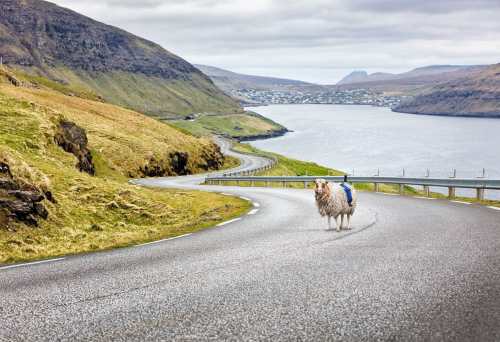
Photo: Visit Faroe Islands
Faroese sheep were strapped with cameras in a bid to get the attention of Google Street View. It worked.

If you were a promising but unknown vacation spot with incredibly picturesque sheep wandering through stunning landscapes, what would you do to attract tourists?

Enlist the sheep, of course.

Karin Brulliard writes at the Washington Post, “The Faroe Islands, a remote archipelago that juts out of the cold seas between Norway and Iceland, doesn’t even appear on some world maps. But as of last [November], the verdant slopes, rocky hiking trails and few roads of the 18 islands are on Google Street View — and a team of camera-toting sheep helped get them there.

“When the islands’ tourism board decided last year that it wanted to get the company’s attention, it knew it would need an unusual pitch. It also knew that its rugged terrain would not be easily traversed by those Google cars that ply city streets worldwide, snapping photos. So it strapped solar-powered, 360-degree cameras onto the backs of a few shaggy Faroese sheep and began uploading the resulting, and very breathtaking, images to Street View itself. …

“Sheep are a big deal in the Faroe Islands, an autonomous nation within the Kingdom of Denmark whose name translates to ‘islands of the sheep.’ The islands’ distinct breed is believed to have been imported by Norse settlers in the 9th century, and today about 80,000 sheep live there, far outnumbering the 50,000 people. …

“Locals and visitors were encouraged to share photos of the Faroe Islands on social media with the hashtags #WeWantGoogleStreetView and #VisitFaroeIslands.

“It didn’t take long for the media-friendly story to make its way to Google, which pronounced it ‘shear brilliance.’ Last summer, the company visited the islands and loaned out one of its eyeball-like Street View Trekkers, as well as some 360-degree cameras for human use. In a blog post, the former tourism board employee who spearheaded the campaign, Durita Dahl Andreassen, explained that those would be handed out to locals and tourists alike and that they would be attached to ‘sheep, bikes, backpacks, ships and even a wheelbarrow.’ …

“The tourism board has moved on to a new, sheep-free effort to get Google Translate to include Faroese, which descends from old Norse.”

More here.

Photo: Visit Faroe Islands
Faroe Islands sheep attracted Google Street View — and tourists.

agdyumy44iyappojembzvk4h6u

Read Full Post »


Photo: Ivan Pierre Aguirre/for the Washington Post
Mustafa Azimi, center, joins a discussion group hosted by Randy Harris, a friend, whose table is usually positioned near the Islamic Center’s table at a New Mexico farmers market.

Even though Thanksgiving dinners have an unfortunate reputation for fraught conversations among family members, it’s still true that sitting together and sharing food often bridges differences. That’s why going places where food is the main event — say, farmers markets — could be a great way to find commonalities with people from other cultures.

Abigail Hauslohner at the Washington Post describes one market’s experiment.

“The mother and daughter arrived just before 8 a.m., unpacking the table and folding chairs from the back of a white minivan. It was a chilly 43 degrees, and the sun cast long shadows between the farmers market stalls and the funnel cake truck, the smell of grilled meat and wood smoke hovering.

“Sureyya Hussain carefully laid out the Korans.

“Soon, the curious passersby began to approach with their questions, their comments and their concerns. The answers, Hussain hoped, would inform and enlighten — or at least spur constructive conversations about being Muslim in America.

“ ‘We wanted to have a voice about what Islam is for us,’ said Hussain, 50, who organizes the monthly table, where anyone can come to learn about Islam. …

“For some of the nation’s small-town mosques and groups of recent immigrants, the instinct has been to turn inward, keep a low profile, buy security cameras, and tell young people to avoid confrontations. Other communities have tried the exact opposite: public engagement.

“The Islamic Center of Las Cruces, the only mosque in this desert town of 101,000 about an hour north of the Mexican border, is one of them.

“Hussain and other members of the mosque’s Dawa — or outreach committee — come here, to the town’s farmers market, and set up a sign that says ‘Know Islam’ amid the stalls hawking apples, kettle corn and handmade soaps. They provide free Korans and pamphlets on different Islamic beliefs, and then they sit there for five hours, offering themselves up for whatever comes their way. …

“Sometimes the conversations get difficult — maybe even a little uncomfortable or combative — but the volunteers do their best to stay calm and friendly.

“ ‘I could very easily sit in my house and hang out, but I’ve decided to do something, and this is the consequence of doing something,’ said Mustafa Azimi, 27, a nurse, who joined Hussain and her daughter, along with his wife and another member of the mosque. ‘People are going to ask you questions. The goal is showing the community that Islam is not what the news portrays. If people knew that Muslims are also — like, that I’m a nurse who also knows how to cook food — that would be awesome.’ …

“ ‘Overall it’s been wonderful,’ said Hussain, a lawyer who grew up in Wyoming and is a mother of three. ‘People are friendly. People have a lot to say. Even people who disagree with us.’ …

” ‘We get more people that are stopping just to tell us that they either love us being here, or, like ACT for America, yell us down,’ Hussain said. ‘We get more of that because both sides feel the need to tell us how they feel.’

“As 1 p.m. approached and the farmers market began to wind down, a man in a cowboy hat, lugging a large metal washtub, walked up, looked at the sign and struck up a conversation. …

“ ‘Do you follow sharia law?’ [asked a guy calling himself Washtub Jerry.] ‘Do you want sharia law? Because it’s not compatible with the Constitution.’

“[Radwan Jallad, an electrical engineer and member of the mosque’s Dawa committee] explained: ‘Sharia law says you’re required to follow the law of the country.’

“Jerry seemed satisfied. He accepted a Koran, and said he would visit again.” More at the Washington Post, here. And check out a similar “Ask a Muslim” initiative started by one couple in Cambridge, Mass., here.

Read Full Post »

Photo: WeWork
Global shared-workspace company WeWork offers coffee, local beer, ample space for community events — and jobs for refugees and veterans.

Here’s a business that expects to do well by doing good. It’s shared-workspace company WeWork, which a news outlet in Philadelphia says has started offering jobs to refugees.

Marielle Mondon at PhillyVoice reports, “WeWork, one of the biggest companies spearheading the transition from traditional offices to millennial-luring co-working spaces, has announced a new commitment to hire 1,500 refugees globally in the next five years.

“The announcement comes just days after the company announced it would also hire the same number of veterans in its offices over the next five years. WeWork began seeking refugee employees through a pilot program based in New York [in 2017], working with the International Rescue Committee for a total of 50 hires. …

“In addition to encouraging WeWork offices to reach their hiring quotas, the company will also help provide refugees with mentorships and language courses. …

“Several other companies have made public initiatives to offer refugees a means of employment as they try to establish their new lives. … Starbucks pledged to hire 10,000 refugees by 2022. … Companies including Chobani and Uber made similar promises.

“WeWork CEO Adam Neumann told the Washington Post that the refugee pledge was … a way to help solve the growing problem of refugee displacement.

“The Post reports that the refugee jobs during the pilot program in New York [involved] workers taking care of the daily maintenance and tenant assistance needed in WeWork spaces.” More here.

You know what? Although the WeWork target client is a millennial, I can easily see an elderly person who can afford office space signing up to use his computer there and hang around young people — the way some older folks use libraries. I wonder if anyone would mind.

Read Full Post »

Ludwig L. Zamenhof, troubled by hostilities among Russians, Jews, Poles, and Germans where he grew up, invented Esperanto to serve as a “bridge” between languages. Photo taken in 1904.

I’ve posted several times about Esperanto, having been active in the bridge-language movement for quite a few years. As I was driving to Providence recently and surfing channels, I heard Freakonomics pick up the story.

“In our previous episode, we looked at the idea of a universal language. One candidate was Esperanto, a language invented in the 19th century by a Jewish ophthalmologist named Ludovik Lazarus Zamenhof. Derived from various European roots, Esperanto was meant to be easy to learn and egalitarian. The idea was not for Esperanto to supersede existing languages.

“On today’s episode: our producer Stephanie Tam takes a trip deep into Esperanto-land.

“STEPHANIE TAM: Estimates for how many people speak Esperanto range, but the Ethnologue, a comprehensive language database, cites 2 million speakers spanning 100 countries. Just 1,000 of those are native speakers, who grow up in Esperanto-speaking families and usually also speak 1 or 2 other national languages. The most famous of these is probably the billionaire financier George Soros. But for the vast majority — well, they might be the only Esperanto speakers in the area. … Why on earth learn it?

“I traveled to the Esperanto-USA National Congress to find out. For the past several years, it’s been held at William Peace University, in Raleigh, North Carolina. …

“Lee Miller [is] a 65-year-old Texan and former sign language interpreter and nurse. He learned Esperanto at 16; now, he teaches it in his retirement. He and another Esperantist picked me up from the airport and drove me to campus. …

“A lot of Esperantists describe their community as a kind of family.

“MILLER: If I were in a group like this and I needed somebody to hold my wallet, with all my money in it, I would hand it to an Esperanto speaker in full confidence that whenever I came back, they would hand it back to me and my money would still be in it. I have that level of confidence and trust in the people.

“TAM: The National Congress is a combination of socializing, workshops, and seminars … This year, there were about 70 attendees, with guests flying in from Canada, the Netherlands, and elsewhere — and about 1,000 streaming from Facebook Live. …

“This year’s keynote speaker was Humphrey Tonkin, an English professor at the University of Hartford and former president of the Universal Esperanto Association. … He delivered the speech in Esperanto, and gave me an English translation afterward.

“HUMPHREY TONKIN: Zamenhof emphasized that, first and foremost, we are human beings, and only secondarily members of particular nations or peoples or languages. If appealing to what is best in humanity rather than reinforcing what divides us is idealistic or utopian, I suppose we must plead guilty. But, if using what brings us together to talk about and celebrate what makes us all different is a rational approach to our divided world, then Esperanto seems to me to make a great deal of sense.”

Tam goes on to interview many of the participants — for example, Orlando Raola, former president of Esperanto-USA.

“RAOLA: I’m originally from Cuba, where I also was part of the Esperanto movement. In real life, I work as a professor of chemistry in Santa Rosa Junior College in Santa Rosa, California. …

“Having been born in an island, and being an islander by nature, I always had this great curiosity: what is beyond the sea? … I understood early that the only way to communicate with humans is through language, and I was interested in many different cultures. …

“I was always fascinated by the culture of Nordic countries, especially Sweden. I once wrote a letter to the Swedish Institute — it’s a Swedish institution that disseminates Swedish culture outside Sweden. I sent them a letter: ‘I want to learn this language, I want to get to know about this culture.’ A few months later, I got a big package with everything you need to know to learn Swedish — dictionaries, cassettes, courses for learning language, reading material. It was a big box! I said, ‘This is a very difficult language. I’m going to spend how many years learn[ing] this? Then, I will be able to communicate with a very tiny sliver of mankind!’ I am very interested in the culture, but I am [also interested] in the culture of Japan, Hungary, and of China! Do I have time to learn all of these languages? No, there won’t be time. …That’s the day I became an Esperantist.”

The language is easy to learn and, though European-based, has a consistency that appeals to speakers of non-European languages. I do think the accent marks that indicate how to pronounce a letter might turn off some people. But the overall concept is just too logical and loving to ever completely die out.

More at Freakonomics, here.

Photo: Philip Brewer / Flickr
An estimated 2 million people speak Esperanto worldwide. Around 1,000 are native speakers.

Read Full Post »

Photo: Pieter Kuiper
Entrance of High Chaparral in Sweden. The Wild West theme park has been used to house Syrian refugees.

I knew that Italians were fascinated by cowboys in the Wild West. I knew they made “spaghetti westerns.” But it turns out that legends of the American frontier have intrigued people in many other countries as well.

In fact, in Sweden, Big Bengt was so fascinated that he built a Wild West theme park, calling it High Chaparral. It employees Syrian refugees, among others.

Reports On the Media (OTM) at WNYC radio, “In the middle of nowhere southern Sweden, there’s a popular Wild West theme park called High Chaparral, where Scandinavian tourists relive the action of the old American cowboy films. For over a year, the park served another function: a refugee camp for some 500 of the 163,000 migrants – many from Syria – who applied for asylum in Sweden in 2015.

“That Syrians would find refuge here actually jibes with High Chaparral’s interpretation of the Old West, which emphasizes the new life that the frontier offered to beleaguered pioneers, and the community that was required to survive there. …

“OTM producer Micah Loewinger traveled to High Chaparral last summer, where he met Abood Alghzzawi, a Syrian asylum-seeker, who embarked on an incredible journey to the Wild West of Sweden. …

“Special thanks to David Smith, author of the forthcoming book Cowboy Politics: Frontier Myth and the Twentieth Century Presidency from University of Oklahoma Press. For more about High Chaparral, check out two fantastic documentaries about the park from David Freid and MEL Films”: here and here. You can listen to the WNYC radio feature here.

I wanted to know more about the park’s founder, so I went to Wikipedia: “Big Bengt was born in 1922 in Brännehylte, Småland. His parents owned a forest farm and a wood mill. Big Bengt was involved in starting [many] companies. His interest in the Wild West was born from coming from a countryside where many had emigrated to America and from the stories they told. Bengt went to the United States himself in 1956 and in 4 months covered 4,000 km. He came back to Sweden with a lot of impressions. When the Swedish national phone company had to get rid of 200,000 telephone poles, Bengt took the opportunity and constructed a fort. When many people started to get curious about the place, he realized its possibilities.”

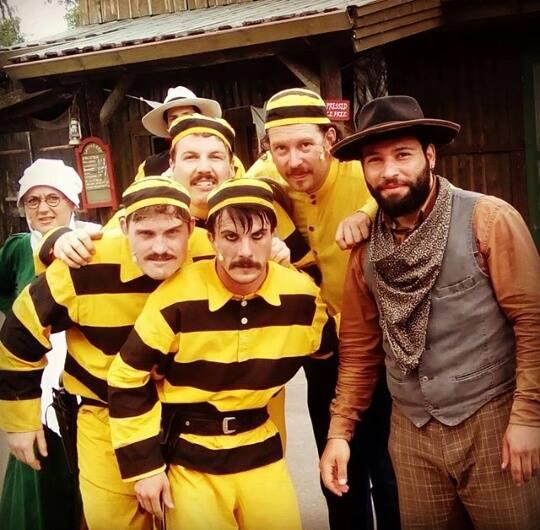
Photo: Micah Loewinger
Abood Alghzzawi, dressed as a cowboy, poses with other High Chaparral employees in southern Sweden.

Read Full Post »

« Newer Posts - Older Posts »