May 12, 2013 by suzannesmom
You may get a kick out of this BBC story on the intersection of art and engineering.
“Artist Daan Roosegaarde has teamed up with Hans Goris, a manager at a Dutch civil engineering firm with hopes of reinventing highways all over the world.
“They are working on designs that will change with the weather — telling drivers if it’s icy or wet by using high-tech paint that lights up in different temperatures.
“Another of their ideas is to create a road that charges up electric cars as they drive along it.
“Daan Roosegarde said: ‘I was completely amazed that we somehow spend billions on the design of cars but somehow the roads … are still stuck in the Middle Ages.’
“In the past he has designed a dance floor with built-in disco lights powered by dancers’ foot movements.
“They plan to trial their specially designed glow-in-the-dark paint on a strip of road at Brabant, which is near the Dutch border with Belgium, later this year.”
Read more.
Photo of a glow-in-the-dark road: Roosegarde
Posted in Uncategorized | Tagged art, bbc, Brabant, Daan Roosegaarde, dutch, Hans Goris, holland, infrastructure, Netherlands, postaday, roads that glow, roosegarde, transportation | Leave a Comment »
May 11, 2013 by suzannesmom
Yesterday I was thinking about how Lewis Carroll’s wry humor was a kind of code targeted directly at kids. No kid could miss that Alice is the only sensible person among a nutty bunch of adults in Wonderland — Caterpillars, Mad Queens, March Hares, and Mad Hatters — who can’t seem to follow the rules of social behavior they always lecture children to follow.
I was thinking particularly of Carroll’s spoof on the moralizing poem about the little busy bee — familiar to children of that day — and how he entertained with verses about a completely irresponsible and self-indulgent reptile.
Instead of admonishing children to be industrious with “How doth the little busy bee improve each shining hour,” he writes, “How doth the little crocodile improve his shining tail.” (Click there and watch the delicious Disney version on YouTube. Note how confused Alice looks at hearing the wrong words and how polite she is anyway.)
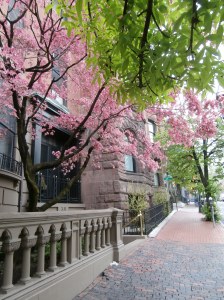
I realized I could write a post on spoofs of poems after my husband pointed out a second item this morning. It seems that the tree Joyce Kilmer praised in his best-known poem turns out to have been close to where I grew up.
And I can never hear these words by Kilmer — “I think that I shall never see/A poem as lovely as a tree” — without immediately hearing Ogden Nash spoofing Kilmer with “I think that I shall never see/A billboard lovely as a tree/And that unless the billboards fall,/ I’ll never see a tree at all.”
Please help me think of more examples. I’m sure there must be more.
Posted in Uncategorized | Tagged alice in wonderland, how doth the little crocodile, joyce kilmer, lewis carroll, ogden nash, poem, poet, poetry, postaday, spoof, trees | 4 Comments »
May 10, 2013 by suzannesmom
The 13th Fort Point Artwalk was 4 to 7 today. (Saturday and Sunday, the Artwalk will be 12 to 5.)
We got started a little late because we had dinner first at Trade, but we definitely enjoyed what we had time to see.
The Boston Design Museum at the corner of Melcher and A streets had art made of moss in frames that caught my eye. We also liked seeing the models for the Street Seats contest that I blogged about a while back.
Across the way, Ari Hauben’s show was energetic and amusing. Hauben teaches art to kids with special needs in Boston, and he has strong feelings about the country’s current emphasis on standardized tests — especially for the student population he knows best.
He and an optical-engineer friend from Rochester, NY, acquired 50 Melcher Street, and for the current show, Hauben papered the floor with standardized tests. He put up large, green chalk boards with pedagogical insights and opportunities for guest commentary.
And he was eager to explain just how he creates the current works from Instagrams sent him by friends. The website says, “His style could be defined as blending pop and street art techniques into mixed media works. The process predominantly involves newspaper, epoxy, spray paint, and layering techniques that are integrated into a variety of visual platforms.”
The prices are indicated by grades: A, B, C, D, F. I especially liked a picture of weathered yellow sheds and the work called Peach Farm, below. Lots more variety, here.
WCVB’s Chronicle interviewed Hauben here.
Art: Peach Farm by Ari Hauben

Posted in Uncategorized | Tagged ari hauben, art, artist, artwalk, boston design museum, chronicle, fort point arts, peach farm, postaday, wcvb | Leave a Comment »
May 9, 2013 by suzannesmom
Author-illustrator Jarrett Krosoczka knows the power of a kind word. He found his calling largely because of two words from a children’s book author who visited his elementary school class.
And he got through a difficult childhood nourished on the kindness of strangers, including lunch ladies, an unjustly maligned species he has honored in a superhero series. (“Serving justice! And serving lunch!)
Linda Matchan has a lovely story at the Boston Globe about Krosoczka. (I want to call your attention to how nicely she describes him, here: “with impossibly spiky hair that looks as though he penciled it in himself.”)
“Until recently,” writes Matchan, “Krosoczka was very guarded about his childhood. That changed last October when he got a call from the organizer of a TEDx program at Hampshire College, modeled after the TED Talks series. …
“Scrambling for a topic, his wife urged him to talk candidly about his childhood. With no time to come up with other options, he delivered a moving talk about his early years and the people who inspired and encouraged him. The talk caught the attention of the TED editorial team, which featured it in January on TED.com.
“He spoke in his talk about his mother — ‘the most talented artist I knew’ — who was addicted to heroin and often incarcerated. ‘When your parent is a drug addict it’s kind of like Charlie Brown trying to kick the football … Every time you open your heart, you end up on your back.’ …
“Third grade was the year something ‘monumental’ happened. Children’s book author Jack Gantos came to his school to talk about what he did for a living. He wandered into the classroom where Krosoczka was drawing, stopped at Krosoczka’s desk and studied his picture.
“ ‘Nice cat,’ Gantos said.
“ ‘Two words,’ said Krosoczka, ‘that made a colossal difference in my life.’ ”
More.
Photo: Bill Greene
Jarrett Krosoczka declared May 3 (his favorite lunch lady’s birthday) “School Lunch Superhero Day.”

Author-illustrator Jarrett Krosoczka knows the power of a kind word. He found his calling largely because of two words from a children’s book author who visited his elementary school class.
And he got through a difficult childhood nourished on the kindness of strangers, including lunch ladies, an unjustly maligned species he has honored in a superhero series. (“Serving justice! And serving lunch!)
Linda Matchan has a lovely story at the Boston Globe about Krosoczka. (I want to call your attention to how nicely she describes him, here: “with impossibly spiky hair that looks as though he penciled it in himself.”)
“Until recently,” writes Matchan, “Krosoczka was very guarded about his childhood. That changed last October when he got a call from the organizer of a TEDx program at Hampshire College, modeled after the TED Talks series. …
“Scrambling for a topic, his wife urged him to talk candidly about his childhood. With no time to come up with other options, he delivered a moving talk about his early years and the people who inspired and encouraged him. The talk caught the attention of the TED editorial team, which featured it in January on TED.com.
“He spoke in his talk about his mother — ‘the most talented artist I knew’ — who was addicted to heroin and often incarcerated. ‘When your parent is a drug addict it’s kind of like Charlie Brown trying to kick the football … Every time you open your heart, you end up on your back.’ …
“Third grade was the year something ‘monumental’ happened. Children’s book author Jack Gantos came to his school to talk about what he did for a living. He wandered into the classroom where Krosoczka was drawing, stopped at Krosoczka’s desk and studied his picture.
“ ‘Nice cat,’ Gantos said.
“ ‘Two words,’ said Krosoczka, ‘that made a colossal difference in my life.’ ”
Posted in Uncategorized | Tagged art, artist, author, bill greene, childhood, children's books, illustrator, Jack Gantos, Jarrett Krosoczka, Linda Matchan, lunch lady, nice cat, postaday, school, superhero, ted talks | Leave a Comment »
May 8, 2013 by suzannesmom
Have you ever taken out-of-town guests to see the glass flowers at Harvard? They are among the area’s must-see attractions.
The Czech father-son team Leopold and Rudolf Blaschka created the flowers in the 19th century, when they also made glass replicas of sea creatures.
Now scientists are comparing the duo’s marine life to what exists today. Have the creatures evolved? Are some extinct?
“I’ve been a marine biologist my entire professional life,” write C. Drew Harvell in the Science section of the NY Times, “spending more than 25 years researching the health of corals and sustainability of reefs. I’m captivated by the magic of sessile [attached by the base] invertebrates like corals, sponges and sea squirts — creatures vital to the ecosystem yet too often overlooked in favor of more visible animals like sharks and whales.
“The filmmaker David O. Brown and I want to change that. To make a documentary, Fragile Legacy, we are on a quest to lure these elusive and delicate invertebrates in front of the camera lens.
“Our inspiration springs from an unlikely source: a collection of 570 superbly wrought, anatomically perfect glass sculptures of marine creatures from the 19th century.
“These delicate folds and strands of glass make up the Blaschka collection of glass invertebrates at Cornell, of which I am the curator — enchanting and impossibly rare jellyfishes of the open ocean; more common but equally beautiful octopus, squid, anemones and nudibranchs from British tide pools and Mediterranean shores.
“They are the work of an extraordinary father-and-son team, Leopold and Rudolf Blaschka.”
The rest of the story is worth your time. Check it out.
Photo: Kent Loeffler
A glass sculpture of Facelina drummondii, a sea slug in Cornell’s Blaschka collection.

Posted in Uncategorized | Tagged c drew harvell, corals, cornell, david o borwn, endangered, film, fragile legacy, glass sea creatures, leopold, marine biology, octopus, postaday, Rudolf Blaschka, sea squirts, sessile invertebrates, sponges, undersea | 2 Comments »
May 7, 2013 by suzannesmom
If you had to guess one church in San Francisco that would be all over the idea of rooftop gardening to feed whoever needs feeding, which one would it be?
Right. Glide. I like its garden’s name: Graze the Rooftop.
“Graze the Roof is an edible, community-produced vegetable garden on the rooftop of Glide Memorial Church, a progressive church and nonprofit located in the Tenderloin district of San Francisco.
“Graze the Roof features lightweight (upcycled) raised garden beds made from milk crates; a worm composting system and an educational mural which ties the whole project together. Glide youth and volunteers from throughout the Bay Area maintain the garden and host monthly tours and workshops.”
Do you live in the San Francisco area? Looks like there are a lot of fun workshops available, such as Designing Sustainable Habitats, Introduction to Permaculture, and Urban Fruit Tree Stewardship. Read more here.
Photo: Graze the Roof

Posted in Uncategorized | Tagged agriculture, church, community garden, ecology, environment, farm, food access, glide memorial, good works, local food, permaculture, postaday, rooftop garden, sustainability, urban, urban farming, worm composting | Leave a Comment »
May 6, 2013 by suzannesmom
More than likely, when certain preteen girls I know were doing headstands on the beach and singing “Girls Just Want to Have Fun,” they had no idea that the the singer was thinking about her Sicilian grandmother and mother and how they deserved more out of life than the servitude allotted women in their culture.
The preteens wouldn’t have known that Cyndi Lauper made sure her video was filled with girls of all races so that any young girl could identify with it.
I learned all that Saturday, when radio host Brooke Gladstone interviewed Lauper at On the Media. The interview started way back in Lauper’s Queens childhood and moved up to the Tony nomination for best score in a musical, Kinky Boots.
From On the Media’s website: “For more than 30 years Cyndi Lauper has been a creative force, as a singer, songwriter, author and now composer of the music and lyrics for a hit Broadway play. Last month Brooke talked to Cyndi Lauper before a live audience in NYC about her life, her art and where she draws her inspiration.”
Listen to the interview here.
Photo of Cyndi Lauper: Gavin Bond

Posted in Uncategorized | Tagged brooke gladstone, cyndi lauper, feminism, gavin bond, girls just want to have fun, kinky boots, music video, on the media, postaday, public radio | Leave a Comment »
May 5, 2013 by suzannesmom
This morning as my almost-three-year-old grandson was “fixing” the downspout with a pair of pliers, I passed along what I like about spring.
You don’t have to put on coats and scarves and boots and hats and mittens every time you go out. It’s warm and sunny. There are lots of flowers. The flowers smell good.
He didn’t say much, probably because he had already gotten me to smell a large, red tulip, and he was focused on his work.
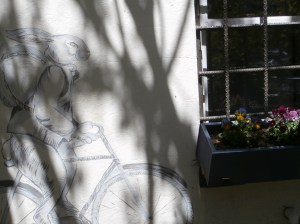
Here are some spring pictures. Look closely to see the mural of a rabbit in the shadows at Olga’s, where our one-year-old grandson escorted us for brunch.
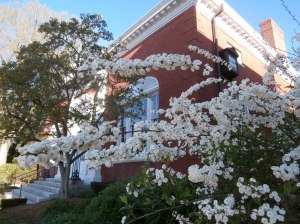
Help me identify the sprays of flowery branches? The only one I can say for sure is the yellow forsythia. For the others, I will have to upload the photos at the website of the almost-three-year-old’s dad to get a crowd-sourced identification, Mister Smarty Plants. Do you think the pink spray is quince?




Posted in Uncategorized | Tagged brunch, flowers, forsythia, grandchildren, olga's, photography, photos, postaday, providence, shadows, spring | Leave a Comment »
May 4, 2013 by suzannesmom
Vermonters care a lot about their farms. So when a dairy farm in South Woodstock was threatened with development, the neighbors bought it.
“Perched on a hill overlooking a valley,” writes Ann Trieger Kurland at the Boston Globe, “Farmstead Cheese Co. began as a neighborly plan to preserve a dairy farm.
“The bucolic 18-acre site was a former water buffalo farm and creamery that produced mozzarella and yogurt. When its owners moved to Canada and put the land up for sale, locals worried about the loss of jobs and the disappearance of another bit of the Green Mountain State’s rich heritage. They feared that the pastoral landscape might be grabbed by a developer.
“So 14 neighbors banded together to buy the farm and decided cheese making might safeguard its future. Within the year, they rebuilt the creamery, brought in a mixed breed herd — Holstein, Jersey, Ayrshire, and Swiss Brown — to blend milks and make farmstead cheese. They started the first community-owned dairy farm in the state. In two years, the company has won dozens of awards for its cheddar, a harvarti-style tilsit, Edam, and English and French-style cheeses.
“The new owners are not novices. They include seasoned farmers and food industry executives who hired experienced staff. The top cheese maker, Rick Woods, 46, has been plying his craft for 19 years. ‘We’re a new company, but it’s not the first time around the block for these people,’ says Sharon Huntley, who is in charge of marketing.” Read more about the community-owned farm and where you can buy the cheeses.
Photo: Vermont Farmstead Cheese Co.
At the community-owned in South Woodstock, Vt., there are 135 cows.

Posted in Uncategorized | Tagged agriculture, Ann Trieger Kurland, cheese, community farm, community owned, cow, dairy, dairy farm, farm, postaday, south woodstock, Vermont, water buffalo farm | Leave a Comment »
May 3, 2013 by suzannesmom
My friend Meg is a runner. She runs for the joy of running, and she runs to support worthy causes like research on liver disease. Several times a week, she rises early and runs with friends and a few homeless folks who have found running to be a step toward getting their lives in order.
Meg blogs about running, too. Here she talks about running “with a team of homeless men and women from Downtown Crossing’s Boston Rescue Mission.”
Here she tells how she learned about Back on My Feet after seeing the program’s T-shirts being worn in a race:
“Running, as a means of teaching work and life skills to residents of homeless shelters. Using their attendance, attitude, dedication to morning runs to gain access to job training, housing assistance, and help paying for and attaining education. Intriguing, indeed. Especially since I’d not noticed a single homeless person in that crowd of runners.
“A lifelong runner myself, I could evidence upticks in productivity and personal satisfaction when I was most engaged in running. Was it possible that what worked for me could work for the city’s most troubled?
“I filled out the online interest form. A few weeks later, I got an email confirming an evening orientation session, where nearly a dozen gathered to learn about the program. Vic Acosta, Boston Chapter Program Director, filled me with hope, enthusiasm, and energy – from that moment, I knew that Back On My Feet would be my kind of group.
“A few days later, I set that early morning alarm for the first time.
“I met the team – residents and non-residents both – that morning. We ran a few miles, and I went home to prepare for work, still not knowing which runners were the residents [of the homeless shelter]. Then, I began to really understand the power of Back On My Feet: on those early mornings, we weren’t residents or non-residents, we were teammates.”
Now can I tell you the rest of story as it was told to me?
One day Meg mentioned to one of the homeless guys that she planned to drive up to Lowell with friends for a race. He was interested. He asked if he could come along. He said he was from Lowell and had been estranged from his family for years because of troubles with the law and with substance abuse. He wondered tentatively, hopefully, whether anyone in his family might like to see him now that he had gotten clean.
Meg took him along, and he ran with her group. At the end of the race his family was there. Cheering.
Photo: http://www.backonmyfeet.org/

Posted in Uncategorized | Tagged back on my feet, homeless, postaday, race, running, Vic Acosta | Leave a Comment »
May 2, 2013 by suzannesmom

We’re going to the Mother’s Day brunch at Verrill Farm, one of 18 farms in the Boston suburb Concord.
The farm started out as a dairy business in 1918, but today just raises flowers, fruits, and vegetables. There’s an enclosed farmstand that in addition to produce and flowers, sells prepared meals, baked goods, and specialty items. Verrill bounced back from a devastating fire a few years ago and is often credited on menus around the region.
We enjoy the farm’s outdoor brunches. Suzanne and John are likely to run into people they knew in elementary school, now with their own kids in tow. We’ll eat at trestle tables under tents, and the grandsons will be able to ride ponies, climb on a wooden climbing thing like a boat, and roll down the hill. Our granddaughter usually gets a kick out of watching whatever her brother is doing.
The moms will probably be wearing their birthstone jewelry from Suzanne’s company, Luna & Stella. You may want a piece, too, for yourself or your mom. If so, Suzanne says, “You can use BLOGMOM13 for free shipping.”

Posted in Uncategorized | Tagged agriculture, birthstone jewelry, brunch, concord, farm, farmstand, free shipping, gifts, luna and stella, mother's day, tent, verrill farm | 2 Comments »
May 1, 2013 by suzannesmom

Photo: Getty Images
I have been as keen as anyone to talk about the arts in terms of their economic contributions to communities. (You have to defend the arts in the language people understand.) But in the end, a focus on economic return is limiting. There are other values on the spectrum from “art for art’s sake” to “art for the economy’s sake.”
How about art for wonder’s sake, joy’s sake, self-expression’s sake, mystery’s sake — for the sake of just seeing what comes out and where it leads?
Over in Scotland, Tiffany Jenkins of The Scotsman is having a fit about Maria Miller, the Scottish Secretary of State for Culture, Media and Sport (Sport?!), who expressed her own take on the arts in a recent speech.
Says Jenkins, “The speech began with the right noises – ‘culture educates, entertains and it enriches’ – but quickly took a wrong turn, concentrating on what culture can ‘deliver,’ specifically for the economy, using sentences such as: ‘It allows us to build international relationships, forging a foundation for the trade deals of tomorrow.’ ”
Uh-oh.
“It matters,” writes Jenkins, “because of what happened with the funding body Creative Scotland, where there was a major negative reaction … in part due to an agenda that instructed the arts to be about the economy …
“To her credit Fiona Hyslop, Cabinet secretary for culture and external affairs for Scotland, was reported on Twitter responding to Miller’s speech stating: ‘The Scottish Government does not see arts and culture as a commodity.’ …
“That the arts are central to the economy is not an isolated idea, or a new one. … [But] it is a philistine approach that misses the value and point of culture. It is true that the Edinburgh festivals, for example, bring a strong financial return. … But even in this case, the financial return is not the best thing about the festivals – or why people come back every year to perform or to watch. They do it because they love it, enjoy it and are driven to participate in something meaningful. …
“Let us not forget the economic climate in which the Arts Council was established. This was a period in the 1940s, after a devastating war, when Britain was in a dire financial situation. The funding body was set up not to use the arts to get the country out of the economic crisis, in the blunt instrumental terms they are discussed today, but to stimulate ‘the best’ work.
“Economist John Maynard Keynes, the council’s first chairman, wanted to bring forth a ‘creative renaissance’ that was artist led, and acted at ‘arm’s length’ from the government, a vision that I would have no trouble with if it were realized today.” But it isn’t, complains Jenkins. Many of her concerns are pretty universal. More.
It’s an argument we will never hear the end of, having been debated in every generation. I am coming down firmly on the side of “yes, and…”
In other words, the arts can be great for the economy, but that is just the tiniest part of why they are great.
Posted in Uncategorized | Tagged art, art for art's sake, culture, maria miller, postaday, scotland, scotsman, tiffany jenkins, value | Leave a Comment »
April 30, 2013 by suzannesmom
Judith Ross has a beautifully written and photographed WordPress blog she calls Shifting Gears. Recent posts have covered a visit with her younger son, who is a Peace Corps volunteer in Morocco.
I was particularly taken with an entry in which Judith captures a luscious blue color that is reiterated all over one picturesque town, on everything from fishing boats to bread baskets.
She writes that one morning, she and her husband and son “climbed into our rental car and headed to Essaouira, a beach town. Much less intense than Marrakech, it was a good place to start our journey. [Our son] has friends there, who are also in the Peace Corps.
“The name of the riad where we stayed, Les Matins Bleus, reflected the town’s color scheme. …
“At the docks you can buy fish directly from the fishermen. Then, back in the medina, stop at the market for vegetables, before taking these purchases to a restaurant where they grill your food to perfection and serve it to you with bread – which also functions as your knife, fork, and spoon.” More.
Photo: Judith A. Ross

Posted in Uncategorized | Tagged blue, essaouira, Les Matins Bleus, medina, morocco, photo, photographer, photography, postaday, riad, shifting gears | 4 Comments »
April 29, 2013 by suzannesmom

Photo: Cassandra Giraldo / Wall Street Journal
Slow Art Day host Phil Terry, center, points to El Anatsui’s installation ‘Gli (Wall).’
Thank you, Anna, for pointing out reporter Rebecca Bratburd’s cool story in the Wall Street Journal.
“If art-museum crowds appeared to be moving at snail speed on Saturday,” writes Bratburd, “it’s because they were celebrating Slow Art Day, during which participants in 274 museums around the world got a new, slower perspective on enjoying art.
“Inspired by the experience of gazing at Hans Hofmann’s ‘Fantasia’ and Jackson Pollock’s ‘Convergence’ for hours, Phil Terry launched the art appreciation day in 2010. …
“Mr. Terry, CEO of the New York City-based consulting firm Creative Good, noticed that no one had planned to host an event at Brooklyn Museum this year, so he did the honors. On Saturday, he handed instruction sheets to each of the 35 or so participants. They included straightforward tips, including but not limited to: “Look closely. Back up. There is no wrong way.’ …
“The group then set off at a turtle’s pace to meditate on five of the museum’s roughly 1.5 million works: El Anatsui’s ‘Gli (Wall),’ ‘Waste Paper Bags’ and ‘Peak’; Valerie Hegarty’s ‘Fallen Bierstadt’; and an untitled work by Richard Pousette-Dart. …
“Part of the point is to counteract the rapid pace of modern life, as much as the often overwhelming museum routine, said another participant, Sam Davol, a musician in the band the Magnetic Fields. ‘I felt like I was in slow motion and everyone was whizzing by,’ he said. ‘I began to become self-conscious about it, like a guard would think it was weird that I was standing there for so long.’ …
“Elizabeth Ferguson … said her smartphone complicated matters. ‘I wanted to focus on the piece of art in front of me, but in the midst of it I was getting texts, I wanted to Instagram it, check in on Foursquare and tag #SlowArtDay,’ she said.”
Read more — and try moving slower in your next museum, too.
Posted in Uncategorized | Tagged art, broklyn museum, Cassandra Giraldo, El Anatsui, Phil Terry, Rebecca Bratburd, Richard Pousette-Dart, sam davol, slow art | Leave a Comment »
April 28, 2013 by suzannesmom
Sitting high up in the nosebleed gallery at the Shubert Theater (aided by great, great Aunt Julia’s opera glasses), we watched the Scottish version of Wagner‘s Flying Dutchman today.
“A sea captain doomed by a curse to an existence of eternal wandering, a yearning heroine desperate to escape her restricting world – set against the uncontrolled violence of the sea.” Thus the Boston Lyric Opera. More.
GiltCity.com had this take: “With her free spirit constrained by the rigid confines of society, one woman yearns for escape. … Taking off on an adventure of a lifetime, with the mercurial sea as violent backdrop, she encounters a captain doomed to wander the endless waters for eternity.”
Enjoyed the production, said to be the first in America using the original version of the opera, which Wagner kept tinkering with over his life. The sets were striking — spare suggestions of ships like bleachers, bathed in blood-red light, and a movie of raging seas across the whole back wall. I liked the psychological take, with Senta [Allison Oakes] responding to yarns about a Flying Dutchman [Alfred Walker] at three different ages (and portrayed by three different performers).
The opera was sung in German, with English on two video monitors.

Posted in Uncategorized | Tagged Alfred Walker, Allison Oakes, boston lyric opera, curse, flying dutchman, gilt city, richard wagner, scotland, senta | 2 Comments »
« Newer Posts - Older Posts »






 Suzanne's Mom's Blog