Feeds:
Posts
Comments

Posts Tagged ‘education’

In October, Tim Faulkner of ecoRI wrote that for the local celebration of National Food Day, “there was plenty to celebrate about Rhode Island’s food industry. During a downtown food festival, leaders and pioneers in the local food movement explained how they are connecting Rhode Island’s restaurants and culinary arts sector with farming, education, environmentalism, entrepreneurism and social justice.

“This effort was best demonstrated by Julius Searight, founder of a new food truck and mobile soup kitchen. Searight’s Food4Good held its grand opening during the Oct. 24 Providence Food Day Festival, selling chicken waffle sandwiches and baked potatoes. Proceeds from food sales are expected to fund about 400 meals a week for the needy.

“Searight, 26, grew up as a foster child in Providence and graduated from Johnson & Wales University in 2013. He got the idea for the hybrid food operation after volunteering at local nonprofits and wondering what it was like for his biological mother to get fed.

“ ‘I really just saw the need to give back to those in need,’ he said.

More here.

Photo: Tim Faulkner/ecoRI News
Julius Searight is the founder of Food4Good food truck and mobile soup kitchen. Every $5 dollars earned buys two meals for people who need them.

Read Full Post »

I thought today would be a good day to note that, with the right supports in place, veterans who have suffered post-traumatic stress while serving the country can move forward with their lives.

The willingness of some of these service men and women to expose their story in the media strikes me as an extra level of bravery.

Kathy McCabe writes at the Boston Globe about Army veteran Michael Saunders.

“Saunders, who served from 2002 to 2006, deployed twice to Iraq … He started therapy at the VA outpatient clinic in Lynn, where a counselor suggested he focus on a new mission: going to college.

“ ‘She said I would make more money with a college degree,’ said Saunders, who worked for a lumberyard after his discharge from the Army.

“He enrolled in VITAL — an acronym for Veterans Integration to Academic Leadership — a national program that helps veterans transition from soldier to student. VITAL brings VA services, including mental health counseling, to college campuses. …

“According to Pam Flaherty, dean of students, Middlesex Community College had nearly 600 student veterans in 2014-15. In the last year, 70 who have PTSD have taken part in VITAL and received mental health care on campus. …

“The Bedford VA also offers the VITAL program at Bunker Hill Community College in Charlestown, Mount Wachusett Community College in Gardner, Northern Essex Community College in Haverhill, North Shore Community College in Danvers and Lynn, Endicott College in Beverly, and Salem State University.

“Saunders, who graduated from Everett High School in 1999, is in his second year studying liberal arts at Middlesex Community College in Bedford. He has discovered a talent for writing, and hopes to transfer to Emerson College next year.

“ ‘It was a rough start, but I’m doing fine now,’ said Saunders, who also has a job at the college’s Veterans Resource Center. ‘Had the VA not had the service in place here, I wouldn’t have come.’ …

“ ‘I can sit in class now, for an hour and 20 minutes,’ Saunders said. ‘I couldn’t sit still for 10 minutes before.’ He has a lingering fear of crowds, so he adjusted his seat in the classroom.

“ ‘ I have to be able to see the door, and I don’t like anybody behind me,’ Saunders said. ‘If I can’t do that, I can’t focus.’

“For one class, Saunders wrote a story called ‘The Dark Is Afraid of Me,’ a fictional account of a military mission in Iraq.

“ ‘It was really easy for me to tell the story,’ Saunders said. ‘When the professor read the paper, she was like, “You need to go see a publisher, now.”

” ‘Maybe I will.’ ”

More such stories at the Globe, here.

080115-flag

Read Full Post »

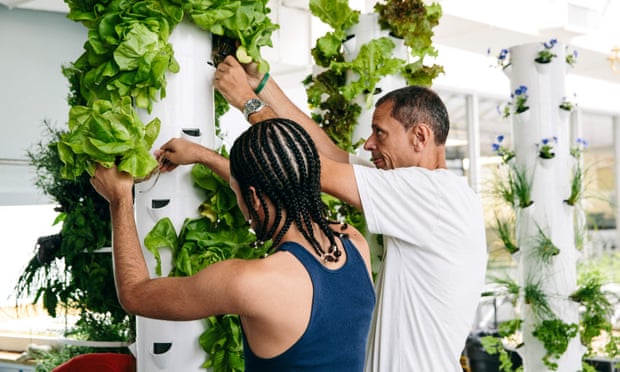
At the Guardian, teacher Steve Ritz tells Matthew Jenkin about how he began growing food in a troubled South Bronx school.

“The Green Bronx Machine was an accidental success. I wound up working at a very troubled high school in New York’s South Bronx district. It had a very low graduation rate and the bulk of my kids were special educational needs, English language learners, in foster care or homeless. It was dysfunctional to say the least.

“Someone sent me a box of daffodil bulbs one day and I hid them behind a radiator – I didn’t know what they were and figured they may cause problems in class. A while later … we looked behind the radiator and there were all these flowers. The steam from the radiator forced the bulbs to grow.

“That was when I realised that collectively and collaboratively we could grow something greater. We started taking over abandoned lots and doing landscape gardening, really just to beautify our neighbourhood. … We then moved on to growing food indoors in vertical planters around the school.

“By building an ‘edible wall’ to grow fresh vegetables in our science classroom, I gave the kids a reason to come to school. …

“Remarkably the plants grew. The kids really believe that they are responsible for them and attendance has increased from 43% to 93%. Students come to school to take care of their plants – they want to see them succeed. Along the way, the kids succeed, too.” More here.

Photo: Progressive Photos  
Steve Ritz gets students involved in the natural world. Attendance has more than doubled.

Read Full Post »

Thomas Whaley, a teacher of 7-year-old English-language learners on Long Island came up with a creative way to build confidence while building writing skills. He has students make the case for why they should be president.

Jasmine Garsd reports at National Public Radio, “Whaley does not look like the kind of guy that dabbles in magic markers. Before he was a second-grade teacher, he worked at a public relations company in New York City.

“He says he started thinking about doing something else while riding to and from work on the Long Island Rail Road. ‘I would talk with people on the train at 6 a.m. and 8 p.m. on the way home,’ he recalls. ‘They were people who had a complete disconnect from the young people of the world. They were all so focused on adults and the rat race. And I realized that this was not for me.’

“That was 16 years ago. He has been teaching ever since.

“In addition, Whaley has found time to write a novel called Leaving Montana, and he’s starting to write children’s books. Last year, he won the New York state teacher-of-the-year award.

“This second-grade presidential campaign is an example of why. He tells me he got the idea when he asked the children one day to raise their hands if they thought they could never be a U.S. president.

“The answer broke his heart.

” ‘Almost every single child who is an English-language learner believed that they couldn’t be,’ Whaley recalls. They’d say things like, ‘ “I can’t run for president because my parents are from a different country.” That was a biggie. “Because I’m poor, and you need a lot of money to be the president.” “Because I don’t like to read, or I can’t read.” ‘

“Whaley says the presidential speech project is about more than just learning to read and speak in public. He wants these kids to learn to boast about themselves.

” ‘Bragging about yourself, and your best qualities,’ Whaley says, ‘is very difficult for a child who came into the classroom not feeling any confidence whatsoever to read three or four words.’

“Robert Epstein, the principal at Canaan Elementary, says this is the essence of what makes Whaley such a great teacher.

” ‘There’s a sense of community that’s really unsurpassed,’ and the students will take risks as a result, Epstein says. He adds that Whaley goes above and beyond what is expected of him as a teacher. ‘If one needs sneakers, I’ve seen him go out and buy sneakers. He’s gone to homes. He’s constantly on the phone, constantly emailing parents.’ ”

More at NPR.

Photo: Christopher Gregory for NPR
Thomas Whaley walks his students back to class from the library.

Read Full Post »

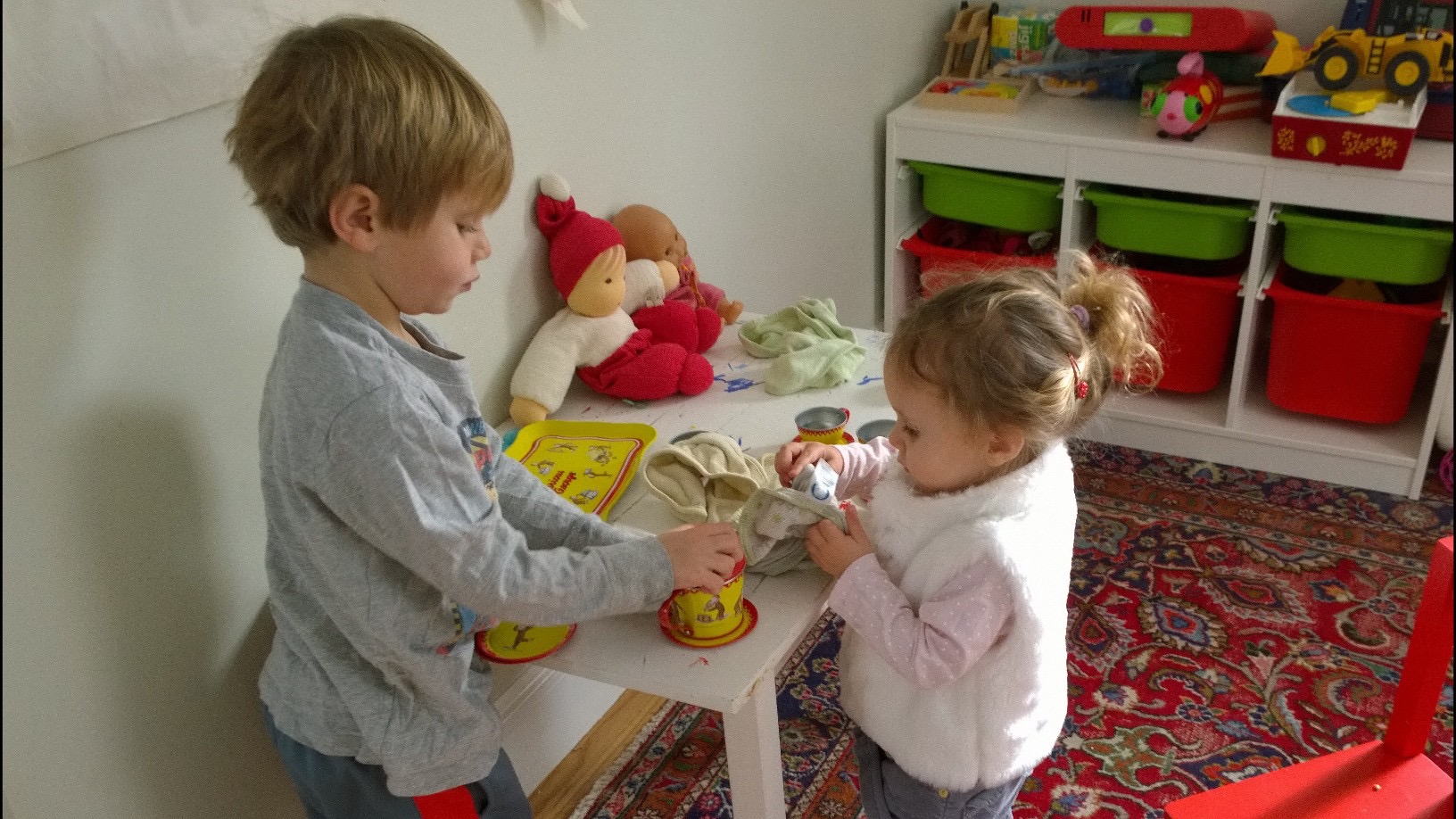
I read this NY Times article with relief. It seems that educators are returning to (or perhaps being heard about) the importance of play in learning.

Reporter Motoko Rich says, “Call it Kindergarten 2.0. Concerned that kindergarten has become overly academic in recent years, this suburban school district south of Baltimore is introducing a new curriculum in the fall for 5-year-olds. Chief among its features is a most old-fashioned concept: play.

“ ‘I feel like we have been driving the car in the wrong direction for a long time,’ said Carolyn Pillow, who has taught kindergarten for 15 years and attended a training session here on the new curriculum last month. ‘We can’t forget about the basics of what these kids need, which is movement and opportunities to play and explore.’

“As American classrooms have focused on raising test scores in math and reading … even the youngest students have been affected, with more formal lessons and less time in sandboxes. But these days, states like Vermont, Minnesota and Washington are again embracing play as a bedrock of kindergarten. …

“Still, teachers like Therese Iwancio, who works at Cecil Elementary School in Baltimore’s Greenmount neighborhood, where the vast majority of children come from low-income families, say their students benefit from explicit academic instruction. She does not have a sand table, play kitchen or easel in the room. …

“Traci Burns, who has taught kindergarten for the last five years at Annapolis Elementary School, said she was looking forward to retrieving previously banished easels.

“ ‘With the Common Core, this has been pushed and pushed and pushed that kids should be reading, sitting and listening,’ she said. ‘Five-year-olds need to play and color. They need to go out and sing songs.’

“At Hilltop Elementary, a racially and economically diverse school in Glen Burnie, Melissa Maenner said she had found that teaching kindergartners too many straightforward academic lessons tended to flop.

“ ‘They are 5,’ Ms. Maenner said. ‘Their attention span is about five minutes.’ ”

Read more here.

013115-spilt-tea (1)


Read Full Post »

After work yesterday, I went with a colleague to observe a parent-engagement program organized by Lawrence Community Works (LCW) at the Oliver Partnership School, in Lawrence, Mass. I had long been interested in LCW’s use of circles to build a sense of community among strangers of very different backgrounds.

Lawrence is what is sometimes called a Gateway City, meaning it’s always been a gateway to the U.S. culture and experience for new waves of immigrants. It currently has a large Spanish-speaking Dominican population and foreign-born and native-born residents from all over.

The parent night was the third in a series. In the first two, facilitators had helped the participants to come up with agreed-upon ground rules (come on time, no cellphones, respectful attention to one another) and to choose an “obstacle” that they would like to address related to their children’s life at the school. They had selected recess, which is only 10 minutes. (Lunch is 15 minutes.)

Everything was conducted in both Spanish and English.

As the evening was getting going, Tony told me his children love school. He believes a good education is vital. He wishes he had more. He did learn Spanish and English in addition to his native Portuguese. The languages help him in his job working with troubled youth, a job he loves to go to every day.

In a warm-up exercise, we stood in a circle and stated our name, followed by our favorite fruit and the name and favorite fruit of everyone who spoke previously. It was fun and a great equalizing experience as anyone can be good at that and anyone can struggle with it. The people who went last had about 20 names and fruits to report and did really well despite language differences.

To discuss the recess issue, we separated into two groups — those who felt comfortable speaking English (which included the two teachers in attendance) and those who felt comfortable speaking Spanish. At the end we came together with the results of our investigation of three questions: why having a longer recess is important, why it might have been set up that way, and what parents themselves could do about it. (Asking the administration’s help was to wait for a joint meeting in June.)

I won’t make this post much longer, but I do want to say that I thought the way this was handled was very good. Parents appeared to feel that their opinions were welcome and that they could accomplish something. Continued engagement with them will be important as the work is a piece of a much bigger project by LCW that aims to help parents get skills for jobs. Unemployment is a serious issue in a city where many of the people are poor, have not had good educational opportunities, and are still learning English.

Photo: Family literacy night at the Oliver Partnership School in Lawrence, Mass.

Read Full Post »

Sometimes it just takes one person to be a catalyst. Internationally known jazz musician Danilo Pérez is a catalyst for a growing jazz scene in his native Panama. He has a special focus on getting young people excited about jazz and giving them a chance to become musicians.

At the NY Times, Melena Ryzik writes, “Even in jazz, which has a long tradition of mentorship, Mr. Pérez, 49, has emerged as a singular figure. Nearly 30 years after he left his native Panama to study jazz composition at Berklee [College of Music in Boston], he has made promoting musicianship in Panama — using music as a springboard, cultural unifier and teaching tool — his life’s work.

“In 2005, a year after he started [a] jazz festival with his family, he created the Danilo Pérez Foundation, a nonprofit center for music education and outreach; the festival, which draws as many as 30,000 people over its six-day run each January, provides money for the foundation. The club, which opened last February at the new American Trade Hotel, a luxe outpost of the Ace Hotel chain, is, in his view, the last piece of the puzzle.”

Read more.

Photo: Jennifer Shanley
Danilo Pérez (right) directs the Berklee Global Jazz Institute inaugural class.

Read Full Post »

Everything old is new again. Here’s a story about a type of teaching that is coming back in vogue.

Peter Balonon-Rosen writes for WBUR radio, “Closing the gap between the achievements of low-income students and their peers is such a formidable challenge that some experts say it cannot be done without eliminating poverty itself. By the time children enter kindergarten, there is already a significant skills gap across socioeconomic lines that manifests in an income achievement gap that has widened dramatically over the past 25 years.

“In Revere [MA], a high-poverty school district, school officials have turned internally to raise outcomes for kids in poverty. Their notion is that school success can begin with a successful teaching model.

“ ‘What is this?’ kindergartner Thea Scata asks. She taps the picture of a rabbit with a wooden pointer and looks to the three other girls seated at her table.

“The group of four kindergartners at Revere’s A.C. Whelan Elementary School is learning about the letter ‘R’ — writing its shape and reviewing words that begin with the letter.

“ ‘Bunny!’ replies Bryanna Mccarthy.

“ ‘No, what’s the first sound? “R”— rabbit,’ Scata says to the group. …

“Whelan is one of 43 public elementary schools in the state that Bay State Reading Institute (BSRI), a Holliston-based education nonprofit organization, partners with to implement this teaching model into Massachusetts schools.”

Said “Kimberlee Clark, a first grade teacher at Whelan, ‘I’m really able to target those that need to be challenged and go above and beyond and I’m able to work with those students that need the extra support to get onto grade level.’ …

“Core to BSRI’s approach is independent student learning. As teachers work closely with small groups of students, the other students are expected to work by themselves on separate tasks.

“ ‘Students then own a piece of the learning,’ said Ed Moscovitch, chairman and co-founder of BSRI. ‘They learn how to learn from an independent perspective.’

“ ‘When they’re working together it’s not so much that students are teaching students, but they’re discovering and coming to the knowledge together,’ said Lenore Diliegro, a fifth grade teacher at Whelan.” More here.

Photo: Peter Balonon-Rosen/WBUR
Thea Scata, left, leads a group of kindergarten peers at A.C. Whelan Elementary School in Revere.

Read Full Post »

Speaking of libraries, if any of you decide to publish a collection of stories on the value of libraries, be sure to include this one about a family in India.

The nonprofit Read Global provided opportunity to them. “Om Prakash and his wife Sheela Devi raised three daughters and a son in the rural community of Geejgarh, in Rajasthan India. There were no educational resources nearby except for underfunded public schools, where books and computers were rare. …

“When we opened a READ Center in their village, the whole family was excited to join.

“ ‘It is a safe place for my daughters and wife to visit because it is close by, and it’s community owned and operated,’ Om Prakash says, ‘The staff are like family members. Anyone can visit and see what’s going on.’

“Their daughter Anuradha was the first to join the local READ Center. She took trainings in English, computer skills, and radio, where she created programs on health and women’s rights to help spread awareness in her community.  …

“Their daughter Archana started an online college program, and uses the books and computers at the Center for school. After graduating, she wants to become a teacher …

“Their son Pankaj is applying for government jobs. He took computer training from the Center and uses the library daily to prepare for the government’s required entrance exam.

“Mahima is the youngest. She participated in beautician training at the Center, and now she plans to become a makeup artist and open a beauty parlor of her own. …

“Anuradha says there has been a change in social norms in her community because of the Center: ‘Earlier, villagers were totally against letting their wives and daughters work, but now many of them have changed. They see women with respect, and they value their opinions.’ ”

More at Read Global.

Photo: ReadGlobal.org 

Read Full Post »

An organization that I follow on twitter called SmallerCitiesUnite! (@smallercitiesu) tweeted today about a design for an educational marine center in Malmö, Sweden. It caught my eye because I like marine centers and because two novels I read recently took place in Malmö: Murder at the Savoy, by Maj Sjöwall and Per Wahlööand Karl Ove Knausgaard’s Book 2, based on his life. (And of course, we have a Swedish connection in the family.)

Dezeen magazine reports, “Danish studio NORD Architects has released designs for a new Marine Educational Centre in Malmö, Sweden, comprising a 700-square-metre visitor centre with a large overhanging roof structure that covers an external aquatic learning environment. …

“The education centre will be set in 3,000 square metres of landscaping, including small ponds and planting that are intended to mimic an assortment of marine ecologies and create ‘an engaging learning landscape’ that allows visitors to have a hands-on experience of nature.

” ‘In the learning landscape, users will find floating laboratories on small removable pontoons, teaching signs on the seabed and underwater sea binoculars to name a few,’ said the studio.” More at Dezeen magazine, here.

Photo: NORD Architects

Read Full Post »

Adele Peters writes at FastCoExist that some schools, “like Ward Elementary in Winston-Salem, North Carolina, are starting to fill classrooms with exercise bikes, so students can work out while they learn.

“The Read and Ride program at Ward began five years ago. One classroom is equipped with enough exercise bikes for a full class of students, and teachers bring students throughout the day to use them. As they ride, they read. The combination burns calories, but it turns out that it also helps students learn better. As the elementary school analyzed testing data at the end of school year, they found that students who had spent the most time in the program achieved an 83% proficiency in reading, while those who spent the least time in the program had failing scores–only 41% proficiency.” More here.

The concept, which I learned about at Andrew Sullivan’s blog, is interesting. I hope most such efforts are in addition to recess, not instead of, but I know from experience that physical motion can helping with learning. And if the kids like it, so much the better.

Photo: Read and Ride

Read Full Post »

And speaking of schools that develop a love of the natural world, check out this story from the radio show Living on Earth.

“On the other side of the world, in the tourist paradise of Bali, there’s a school that the U.S. Green Building Council named the greenest school on Earth for 2012. It’s called the Green School, and it educates some 300 students from 25 different countries. Living on Earth’s Bobby Bascomb went to check out what’s so green about the school.”

Among the people he spoke with was Charis Ford, director of communications for the Green School.

“BOBBY BASCOMB: It rains a lot in Bali. Humidity and bugs typically destroy a bamboo structure in about 4 years, but the Green School buildings should survive 20 years or more.

“CHARIS FORD: We use treated bamboo, but it’s been treated with salt essentially. We heat water and we submerge the bamboo poles into the saltwater and it makes the bamboo unpalatable to termites and mold and funguses and other things that would biodegrade the bamboo. …

“FORD: All the building companies that he spoke with were like well, ‘You have to have walls. All schools have to have walls,’ and John [Hardy, a Canadian jewelry designer who moved to Bali in the 1970s and founded the school] said, ‘Why do they have to have walls?”’ They rubbed their chins and scratched their heads and said, “’Well, where are the kids going to hang the art?’ As it turns out, you don’t have to have walls. And we don’t have walls and we’re quite happy about it.

“BASCOMB: Just outside the classroom, a chicken wanders through a patch of green beans. Gardens are everywhere, integrated throughout the campus. They mimic a natural forest ecosystem using edible plants, a design called permaculture.

“FORD: When you wander around Green School’s campus, you might think it looks kind of like it’s wild, but then as you tune in and look at the plants that you’re around, you’ll see that that’s a bean trellis, and that’s a guava tree, and that’s ginger. Even though it looks like a jungle setting, you get a little closer and you see that’s chocolate — cacao pods — hanging from a tree next to you.” Lots more here. You also can listen to the recording of the radio interview.

Photo: Mark Fabian
On extremely hot days a canvas envelope can be pulled around a wall-less Green School classroom so cool air can be piped in to keep kids comfortable. 

Read Full Post »

As a kid of 10 or so, I played in the woods, frequently all alone. It was magical.

As an adult, I wonder if it’s no longer considered safe. I don’t ever hear of children playing in the woods. That’s why I was interested to read about a growing movement called Forest Schools.

Siobhan Starrs writes for the Associated Press, “In the heart of north London lies the ancient Queens Wood, a green forest hidden away in a metropolis of more than 8 million residents. The sounds of the city seem to fade away as a group of children plays in a mud kitchen, pretending to prepare food and saw wood.

“These aren’t toddlers on a play date — it’s an unusual outdoor nursery school, the first of its kind in London, following a trend in Scandinavia, Germany and Scotland. It allows local children to learn, and let their imagination run free, completely surrounded by nature. …

“Each morning a group of children gather at the Queens Wood camp, which the nursery team prepares each morning before the children arrive. A circle of logs provides a place to gather for snacks, stories and songs. The mud kitchen provides an opportunity to make a proper mess and have a sensory experience, a rope swing provides some excitement and a challenge, and several tents are set up for naps and washing up.

“In a clearing in the woods, a fallen tree trunk can be transformed by imagination into a rocket train, calling at the beach and the moon, with leaves for tickets.

“A 2-year-old, Matilda, finds a stick — but in her mind it’s not a stick. It’s a wand. She says she is a magic fairy who can fly. Then suddenly the stick has become a drum stick, and a gnarled tree stump her drum. She taps away contentedly, the rhythm all her own.” Read more here.

Speaking of fallen tree trunks, I particularly remember a big tree that fell in the forest after a storm and the fun a friend and I had making up stories on it.

Photo: Matt Dunham/AP
Forest schools are increasing in popularity in the United Kingdom.

Read Full Post »

An Associated Press blurb in the Globe caught my eye today.

Here it is in its entirety: “Unity Plantation, Maine. A two-year quest by Unity College students to fit a black bear with a video collar has succeeded. The Morning Sentinel said Professor George Matula and about a dozen students trekked deep into a 4,000-acre patch of woods off Route 139 Thursday to fit the collar on a trapped bear. While one student kept the angry bear’s attention, another sneaked in from behind to deliver a shot to knock it out.”

I had to find out more. The website of Unity College, “America’s Environmental College” located north of Augusta in Waldo County, explains it wasn’t a professor-assisted prank.

“With permission from the Maine Department of Inland Fisheries and Wildlife, the Unity College Bear Study team does hands-on research to provide information on a bear population in Central Maine. Students work with faculty mentor George Matula and alumna mentor Lisa Bates ’08 to tag, tattoo and radio collar bears to collect data and monitor activity.” More at Unity College, here.

But about actually collaring the bear. …

Matt Hongoltz-Hetling  writes at the Kennebec Journal/Morning Sentinel, “Once Matula gave the all-clear, the students descended on the bear, intent and serious as each performed a well-defined role. They still spoke in whispers as they took blood samples, checked its vital signs and prepared to affix the all-important video collar to its neck. …

“One student, Leon Burman, cradled the bear’s head in his lap while he pulled back its lips, using a tattoo gun to leave an identification mark on the gums.

“[Student Jonah] Gula lifted the bear’s front right paw, inspecting a raw and red line defining the previous capture’s cable. Gula speculated later that it meant the bear was pulling at its snare more aggressively than most. The team treated it with a first-aid kit.” More here.

Photo: Mark Bennett

Read Full Post »

My friend Jean Devine is always up to something interesting. A Brown U grad, with an MBA from Simmons, she used to work in investor relations but in recent years has been testing the waters of social entrepreneurship.

Her latest initiative, with Barbara Passero of Sandpiper Creative, is called meadowscaping and is intriguing on many levels.

With access to a Waltham church lawn for a summer youth program, Jean and Barbara will work with kids to convert the yard into a meadow that uses native species from Garden in the Woods and provides a habitat to the bugs and other small creatures that make a healthy environment.

From the Meadowscaping for Biodiversity website: Meadowscaping “is an outdoor, project-based, environmental education program that provides middle school youth with real-world experiences in STEAM learning (Science, Technology, Engineering, Arts and Math), while inspiring and empowering them to address challenges to the environment and our society.

“Today, few children spend time experiencing Nature and the benefits of outdoor recreation, education, and contemplation. Founder and former Director of the Children and Nature Network (C& NN) Richard Louv coined the phrase nature-deficit disorder to describe the negative effects of reduced outdoor time on children’s development. …

“Children who spend little time outdoors may value nature less than children who spend time outdoors in free play. Similarly, children who feel part of something bigger than themselves may … understand their dependence on a clean environment and know that they are responsible for caring for the Earth as their home.” More here.

The idea behind the meadowscaping summer program is that children, both at a young age and as they become adults, can actually do something about the environment.

Remember our post “The Doctor Is In” about the woman who sets up in a Providence park to listen to your worries about global warming (here)? Stop worrying and do something, say the meadowscape entrepreneurs. Give up lawn chemicals, plant a meadow, provide a home for tiny necessary critters, and work to make change.

white-iris-in-morning

Read Full Post »

« Newer Posts - Older Posts »