Feeds:
Posts
Comments

Posts Tagged ‘postaday’

What? Another story on naps?

This time, no less a personage than Arianna Huffington of the Huffington Post is weighing in on the importance of catching 40 winks if you need them. She has written a book called The Sleep Revolution, in which she predicts that most offices will have nap rooms in the not-too-distant future.

“Huffington’s mission: to eliminate the stigma long associated with sleeping at work. … In the HuffPost newsroom, ‘having a nap in the middle of the afternoon is actually a performance-enhancing tool,’ she said. …

“Experts like Sara Mednick, a researcher at the University of California, recommend a short nap in the middle of the day because you won’t feel groggy when waking up.

“Other companies like Google, Zappos and Ben & Jerry’s are getting on board with the napping trend. All now have built nap rooms in their offices. …

“Sleep is ‘the gateway through which a life of well-being must travel,’ Huffington recently wrote. It allows people to be more productive, lead healthier lives and connect more deeply to themselves, she added.

“Huffington will soon embark on a college tour, where she plans to visit 50 schools with leading sleep experts.” More here.

Hmmm. Time for a nap.

Photo: cdnimg

Read Full Post »

Dan Holin, who used to run a Concord-Lowell volunteer partnership called the Jericho Road Project, is now director of special projects at UTEC in Lowell. (UTEC doesn’t use the longer title its youth founders originally came up with, but since people ask, it was United Teen Equality Center.)

UTEC describes itself as a nonprofit that “helps young people from Lowell and Lawrence, Mass., trade violence and poverty for social and economic success. It works to remove barriers that confront them when they want to turn their lives around and offers young people paid work experience through its social enterprises: mattress recycling, food services and woodworking.”

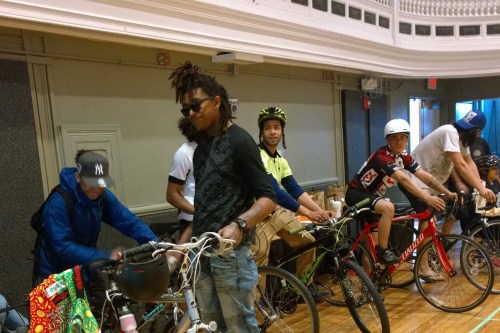
On May 15, Acton’s Pedal Power joined members of the Concord-based Monsters in the Basement bicycling club to share their bike-repair expertise with young people who wanted to acquire bikes and learn to maintain them. Holin, a serious biker himself, organized the event to give UTEC young people two things that he said they normally lack: transportation and fun.

At the event, one of them, Sav, recounted his story of change. Before UTEC I never talked to anyone,” he said. “I was a problem child on the streets. I was hanging around with gangs, selling drugs. I don’t do that now. Seven months ago, I moved from a place with nothing positive. Atlantic City. I let my family know I’m ready to live life. It was hard for me to get into something good: I’ve got a lot of tattoos and a record. But I’m in the culinary program here. It’s a family. They make you feel like you are somebody that has a chance. They give me love like a family. They changed my life for the better. There are so many new things to do here. Yesterday I went kayaking.”

More here.

Sav, in sunglasses, got a good bike at UTEC’s bike event in Lowell on May 15. The bike will provide transportation to his job at UTEC. It will also provide some much needed fun.

051516-UTEC-bike-clinic.jpg

Read Full Post »

It’s amazing what mysterious creatures scientists find in the fossil records of life on our planet. Jonathan Webb describes one such creature at the BBC.

“A 430 million-year-old sea creature apparently dragged its offspring around on strings like kites — a baffling habit not seen anywhere else in the animal kingdom.

“Scientists who discovered the fossil have dubbed it the ‘kite runner.’ Ten capsules tethered to its back appear to contain juvenile progeny, all at different stages of development.

“Reported in the journal PNAS, the many-legged, eyeless, 1 centimeter [fossil] was dug up from a site in Herefordshire before being taken to Oxford and computerised. This process involved grinding away the specimen, slice by slice, and photographing each of those sections to assemble a 3D reconstruction. …

” ‘You take its anatomy, code it into a data set and then run probabilistic methods on it, which will tell you how likely it is that something evolved in a particular way,’ [David Legg, a palaeontologist from the Oxford University Museum of Natural History,] explained. …

” ‘Nothing is known today that attaches the young by threads to its upper surface,’ said co-author Derek Briggs, from Yale University. …

“It was the variety of shapes seen among the 10 tethered babies that Dr Legg found most convincing. ‘We see them develop and begin to resemble the adult form more and more, as they get bigger,’ he said. ‘I’m definitely convinced that that’s what they were.’ ”

More at the BBC, here.

Photo: D Briggs/D Siveter/ Sutton/D Legg
This tiny, eyeless fossil creature, unrelated to any living species, carried babies in capsules tethered to its back.

Read Full Post »

Some initiatives that are costly up front have benefits that far outweigh those costs but don’t show up for years. Even then, people may disagree about what caused the outcomes.

One such initiative sends nurses to new mothers who are young, poor and often friendless to help ensure that their babies get a leg up in life.

At the Washington Post

“A high school senior learns that she’s pregnant — and she’s terrified. But a registered nurse comes to visit her in her home for about an hour each week during pregnancy, and every other week after birth, until the baby turns 2. The nurse advises her what to eat and not to smoke; looks around the house to advise her of any safety concerns; encourages her to read and talk to her baby; and counsels her on nutrition for herself and her baby.

“This kind of support, with trained nurses coaching low-income, first-time mothers, is among the most effective interventions ever studied. Researchers have accumulated decades of evidence from randomized controlled trials — the gold standard in social science research — following participants for up to 15 years. They have consistently found that nurse coaches reduce pregnancy complications, pre-term births, infant deaths, child abuse and injury, violent crimes and substance abuse. What’s more, nurse coaches improve language development, and over the long term, cognitive and educational outcomes.

“Nurse coaching is a vital tool that addresses both the liberal concern about income inequality and the conservative concern about inequality of opportunity. …

“Still, nurse coaching reaches only 2 to 3 percent of eligible families. Which raises the question: if it’s so successful — and people on both sides of the aisle support it — why can’t it be scaled to reach every eligible family?”

There are two stumbling blocks according to the reporters: First, funding must be cobbled together from numerous unpredictable sources; second, the costs are up front, whereas the benefits to government and society appear over time.

“If nurse coaching were fully scaled to reach every eligible family, the costs to state and federal governments would outweigh the savings for the first five years. But then the savings would start to outweigh the costs. Over 10 years, the net savings would be $2.4 billion for state governments and $816 million for the federal government.”

So the question becomes: do we have the patience? More here.

A similar initiative that Suzanne started supporting when she lived in San Francisco focuses on homeless mothers. Read about the great results of the Homeless Prenatal Program here.

Photo: iStock
When nurses coach low-income moms, their babies benefit.

Read Full Post »

In India, a civic-minded restaurant put a working fridge out front so patrons could join the eatery in offering leftovers to the hungry instead of throwing good food away.

Elyse Wanshel writes at the Huffington Post, “Pappadavada, a popular restaurant in Kochi, is urging customers and the community to put their leftover food in a refrigerator located outside of the eatery for the hungry to take. …

“The fridge is open 24-hours a day, seven days a week and stays unlocked. … Pauline told the Huffington Post that despite a huge response from the community and ample donations, the fridge needs to be restocked regularly. Pauline herself adds around 75 to 80 portions of food from Pappadavada a day in the fridge. …

“The idea to put a fridge on the street came to Pauline late one night when she saw a lady searching in a trashcan for food. As she watched the woman, she had a terrible thought:

“ ‘That the woman had been sleeping and was woken up by her hunger, so she had to go in search of food instead of sleeping.’

“She was especially saddened because that particular night, her restaurant had made a ton of food that they could’ve easily given the woman, instead of her searching for it.

“The experience made her feel like she contributed to waste, and avoiding waste is what Pauline is focused on.

“ ‘Money is yours but resources belong to society,” she told HuffPost. “That’s the message I want to send out. If you’re wasting your money, it’s your money, but you’re wasting the society’s resources. Don’t waste the resource, don’t waste the food.’ ”

More here.

Photo: Thesny Alikhan
Minu Pauline, right, the restaurateur behind the free food fridge, with a supporter, actor/director Thesny Alikhan

Read Full Post »

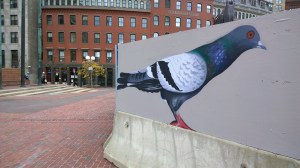
110714-a-pigeon-that-I-pass-alas


Sometimes when I’m trying to cross a city street in traffic that’s coming from all directions, I think about how people who don’t visit cities much — Inuit people, say, or rural tribesmen in Africa  — would cope. Probably about as well as I would cope dealing with the habits of lions or polar bears. We all develop the survival skills we need most.

Birds do, too. According to Scientific American, urban birds develop skills that let them outwit their country cousins on certain tests.

Christopher Intagliata reports,”While visiting Barbados, McGill University neurobiologist Jean-Nicolas Audet noticed that local bullfinches were accomplished thieves.

” ‘They were always trying to steal our food. And we can see those birds entering in supermarkets, trying to steal food there.’

“And that gave him an idea. ‘Since this bird species is able to solve amazing problems in cities, and they’re also present in rural areas, we were wondering’ are the rural birds also good problem-solvers, and they just don’t take advantage of their abilities? …

“So Audet and his McGill colleagues captured Barbados bullfinches, both in the island’s towns and out in the countryside. They then administered the bird equivalent of personality and IQ tests: assessing traits like boldness and fear, or timing how quickly the finches could open a puzzle box full of seeds.

“And it turns out the city birds really could solve puzzles faster. They were bolder, too, except when it came to dealing with new objects—perhaps assuming, unlike their more naive country cousins, that new things can either mean reward … or danger.

“The study is in the journal Behavioral Ecology [Jean-Nicolas Audet et al, The town bird and the country bird].”

More here.

Read Full Post »

So, what do we have here? Mysterious pillars supporting a gazebo roof on Canal St., Providence. Toadstools. Tulips. Branch over the Concord River. Boots for sale. Two Seekonk River scenes, one with swans. Nautical rope design on railing along Woonasquatucket River in downtown Providence. Fairy Garden. Shadows on an appleknocker that my mother’s company used to make.

051316-someone-has-been-nibbling051716-pillar-Canal-St-Providence


050616-toadstools

051316-catalog-worthy-tulips-Concord-MA


051416-leaves-over-concord-river

051516-boots-for-free050816-Seekonk-River-Providence


050816-swans-in-river


051816-nautical-river-railing

050616-fairy-garden-Nashoba-Brooks


051416-backdoor-and-appleknocker

Read Full Post »

Photo: Mary MacDonald/Providence Business News
A rehabilitation project recently turned the old Mechanical Fabric Company mill in Providence’s West End into a live-work space for culinary entrepreneurs.
Providence can be a good place for starting a food business, partly because Johnson & Wales turns out so many good cooks, partly because the cost of a restaurant liquor license is much less than in many other cities.

And in recent years, the arrival of food incubators like Hope & Main in nearby Warren have provided a way for food entrepreneurs to get up and running without going deep into debt.

Recently, Providence Journal reporter John Hill wrote about a new food incubator, combined with living space, going into the old Mechanical Fabric Co. mill in Providence’s West End.

“In its 125 years,” writes Hill, “the old brick factory at 55 Cromwell St. has made bicycle tires, electronic components and jewelry. Now it’s getting ready to make dinner.

“The interior of the 1891 building, once filled by the clatter and thrum of steam-powered, belt-driven machines, is being gutted and rebuilt as the new home of two commercial kitchens, restaurant space and 40 efficiency apartments for young food-industry entrepreneurs.

“Federico Manaigo, whose Cromwell Ventures LLC owns the building, said the conversion is aimed at capitalizing on Providence’s reputation as a restaurant mecca. When finished, he said, the factory will be home to recent college graduates considering the restaurant business, either as chefs or owners. …

“Manaigo wants to see if he can duplicate the success of Hot Bread Kitchen, an incubator program in East Harlem in New York City. That program, without apartments, rents space to people with small ethnic food businesses who want to grow into full-fledged commercial operations. It also provides training programs and rents space to start-ups that grow from those efforts.

“The idea is to give promising food-business grads a way to stay in Providence, he said, where they can hone their skills and, when they’re ready to open a restaurant, bakery or catering company, do it in Rhode Island and hire Rhode Islanders. …

“Manaigo said he wants to see if the project can tap into sources of culinary inspiration beyond the colleges. The East Harlem incubator found success by recruiting immigrants, especially women, from the neighborhood, persuading them to share their recipes from home and start small bakeries selling their food. The West End has Middle Eastern, Asian and Central and South American restaurants in its storefronts, a sign of a diverse ethnic population Manaigo said he hopes the kitchen can work with.”

Mayor Jorge Elorza has said he likes that the project offers “a way for the city to use the colleges in the area as sources of potential new business owners and play off the restaurant business in a way that could make it even bigger in the future.

” ‘The whole food scene is a strategic strength for the city,’ he said. ‘This fits squarely within that.’ ” More here.

Read Full Post »

Here is an idea whose time has come. Aux armes! We need to remove the barriers to napping!

Olivia Vanni at BostonInno explains the revolutionary new Sleepbox concept.

“Sleepbox, a startup that’s recently set Boston roots, is making our wildest dreams come true: You will soon be able to sleep soundly and safely in any public place conceivable. As the name implies, the company has developed cozy, technologically decked-out cabins that can be set up just about anywhere — in airports, offices or downtown metropolitan areas — and rented by folks looking to catch some Zs.

“How did this visionary venture come about? According to Mikhail Krymov, CEO of Sleepbox and research fellow at MIT, he and his business partner Alexey Goryainov started it as a theoretical side project for their architecture firm Arch Group. The two professionals travel a lot for work and were constantly subjected to flight delays and layovers where all they could do was wish for a comfortable, private place to rest. From their personal experience, they created an initial design for Sleepbox. But it was meant only as a concept, at first.

” ‘It was just a design idea, but then it was published — it was actually published quite a few times — we started receiving requests and orders from all over the world,’ Krymov told me. …

“There are some customers who are buying them for noncommerical uses — say, companies installing them in their offices for employees to use for free. However, there are clients who buy them with the intention of charging people to rent them, like airports and municipalities. …

” ‘I really want people to be more happy, productive and healthy by having enough sleep, and hope that our solution will help,’ Kyrmov said.”

Ye-es!

More here.

Photo: Mikhail Kyrmov

Read Full Post »

Recently I read that there is a 5,000-year-old tree at a location in the United States that rangers won’t reveal for fear of too many curiosity seekers. Is that even possible to know — 5,000 years?

At National Geographic, Beth Moon has published photographs of other trees that are old, if not quite that old, and they look amazing.

Becky Harlan provides some background.

“Over three trillion trees live on planet Earth, and yet we know so few of their stories. Of course all trees play an important role—purifying the air, hosting the feathered and the furry, teaching kids (and kids at heart) how to climb—but some have spent more time doing these things than others. Quiver trees, for example, can live up to 300 years, oaks can live a thousand years, and bristlecone pines and yews can survive for millennia.

“In 1999, photographer Beth Moon took it upon herself to begin documenting some of these more seasoned trees. Specifically, she sought out aged subjects that were ‘unique in their exceptional size, heredity, or folklore.’ …

” ‘I am always amazed at the way trees have the ability to endure and adapt to severe conditions. Some ancient trees hollow out as they age as a survival technique. The tree will send an aerial root down the center of the trunk, which will continue to grow from the inside out.’

“In her book Ancient Trees: Portraits of Time, she explains that these ancient individuals ‘contain superior genes that have enabled them to survive through the ages, resistant to disease and other uncertainties.’ …

“Many of the real trees represented, however, face hard times ahead. ‘Quiver trees are dying from lack of water in Namibia. Dragon’s blood trees are in decline and on the endangered list, and three species of baobab trees are currently listed as endangered on the IUCN Red List,’ says Moon. …

“She hopes sharing her wonder will begin a conversation about the conservation of these arboreal treasures.”

Click here to read more and see magical photographs of ancient trees in Cambodia, Wales, Yemen, England, Madagascar, Florida, and Namibia.

Photo: Beth Moon
Rilke’s Bayon,
Tetrameles nudiflora, in Ta Prohm, Siem Reap Province, Cambodia

Read Full Post »

I read a silly headline today. It said that books are “in” again.

I’m pretty sure that for a lot of people, they were never out. But maybe the timing is particularly good for the new, roaming branch of independent bookstore Parnassus Books.

Alexandra Alter reports at the NY Times, “Nashville’s newest bookstore is an old van. The bright blue bookmobile, which hit the road [in March], is a roving offshoot of Parnassus Books, a popular independent bookstore. It will roam around town, stopping at food truck rallies, farmers’ markets and outside restaurants.

“The arrival of a bookstore on wheels is a fitting evolution for Parnassus, which is co-owned by Karen Hayes and the novelist Ann Patchett. The store’s name comes from Christopher Morley’s 1917 novel ‘Parnassus on Wheels,’ about a middle-aged woman who travels around selling books out of a horse-drawn van.”

[We will pause here to note that Morley, 1890 -1957, is a Haverford College grad, as are two members of my family.]

“Since Parnassus opened in 2011, Ms. Hayes has wanted a traveling bookstore of her own. She looked at taco trucks and ice cream trucks and felt envious of their freedom to take business wherever people gathered, she said.

“ ‘A bookmobile made so much sense, because food trucks work so well in this town,’ Ms. Hayes said by telephone. ‘It’s a great way to get our name out there, too. It’s a rolling advertisement.’ …

“ ‘One of my hopes is that we’ll be able go into some of the outlying suburbs and cities that don’t necessarily have a bookstore,’ said Grace Wright, a Parnassus bookseller who will manage the bookmobile. ‘There’s nothing like a good bookstore.’ ” More here.

Speaking of bookstores, I’ve been trying to patronize my local indy routinely, even though Amazon delivers. When I lived in Minneapolis, Amazon got an independent women’s bookstore called Amazon to relinquish the name it had had for years, and I had a sense at the time that it was only the first step in the online behemoth’s march across the globe. Didn’t realize how much more than a bookseller it would become.

Photo: Nathan Morgan for The New York Times
Karen Hayes is a co-owner of a Nashville bookstore named after Christopher Morley’s 1917 novel “Parnassus on Wheels,” about a middle-aged woman who travels around selling books out of a horse-drawn van.
 

Read Full Post »

There’s always something fun over at PRI’s environmental radio show Living on Earth. Here’s a story that ran in March about the unique bird species isolated in Northeastern Australian rainforests.

Bob Sundstrom wrote up the audio report of BirdNote‘s Mary McCann: “The Eastern Whipbird hangs out in the dense understory. It’s dark, crested … nearly a foot long and emerald-green with white spots. … The large, pigeon-like Wompoo Fruit-Dove … feathered in a stunning combination of green, purple, and yellow, [is] clearly named for its voice.

“Pig-like grunting on the forest floor tells us we’re in the company of the largest bird on the continent – the Southern Cassowary. On average, the female weighs 130 pounds and stands around 5 feet tall, looking like a giant, lush, black hairpiece on thick legs. A helmet called a casque makes it look as much like a dinosaur as any living bird.” Five feet tall? I think I know a one-year-old who would like to try riding it.

The bird sounds on the radio show were provided by The Macaulay Library of Natural Sounds at the Cornell Lab of Ornithology. Hear them all here, where you can also enjoy the equally far-out pictures.

Photo: Jan Anne
Southern Cassowary

Read Full Post »

Erik’s sister and family are off on their five-month European sailing trip. The three children have homework to do during the first part of the trip, when they would ordinarily be in school. All five family members are contributing to a WordPress blog they call Burning Cloud. Four write their posts in English; the youngest sometimes writes in Danish. The entries are a lot of fun to read.

Here is the oldest child’s May 11 post:

this is a word for word conversation.

Klara : the first qustion is, why are we not moving

Klaus: because we are waiting for our gear to come back from the repair shop

Klara : the second question is: when are  we going to move?

Klaus: on Friday

Klara: the third question is: what is wrong with the motor?

Klaus: the gear is leaking a bit of oil.

Karl-Oscar: how will they fix the gear?

Klaus : it will be repaired in Køge  with some spare parts that are cominng form Gottenburg.

written by Axel.

Join the fun at Burning Cloud Blog. You can follow the route on maps the family posts periodically along with other entertaining pictures. (Don’t miss the photo of everyone making sushi on shipboard.)

Photo: School at sea.

Read Full Post »

Radio show Living on Earth did a segment in February on new technology to store and release solar heat. Here is host Steve Curwood on his outing to MIT to learn about the breakthrough.

“A team of researchers at MIT has come up with a chemical that would let windshield glass directly store solar energy and then release it on demand as heat to melt the ice. … The same chemical could be woven into clothing fibers to capture the sun’s energy and then give you some added warmth when you ask for it, even days later.

“I paid a visit to the lab where the MIT team has been working on this breakthrough and met up with researchers David Zhitomirsky and Eugene Cho, who work in the lab of professor Jeffrey Grossman.”

To Curwood’s question about the difference between the familiar electrical, battery-enabled solar technology and the MIT lab’s chemical version, Zhitomirsky replies,”We use these molecules that can absorb UV light and instead of generating charges, what they do is that they change shape, and by changing shape, they can store chemical energy …

“CURWOOD: OK, so sunlight hits this molecule, it changes shape and can storage its energy. And how do you get the energy out?

“ZHITOMIRSKY: So you can figure the material in several ways. One way is to add a small amount of heat, and the material will release more heat than you add in. The other methods are triggering it with light or you can apply an electrical field to the material. …

“The way we envision using it is to integrate into fibers that you then make clothing out of.” More here.

Release solar heat from my coat in a blizzard? Where do I sign up?

Photo: Helen Palmer
Living on Earth host Steve Curwood, right, in the MIT lab with Eugene Cho and David Zhitomirsky.

Read Full Post »

Never underestimate the wisdom of the pachyderm. Here’s one that would make an undetectable spy.

Jeffrey Gettleman writes at the NY Times, “Elephant experts in Kenya were excited recently by some rare good news: An elephant had crossed into Somalia — and survived.

“Somalia, one of the world’s most war-torn nations, used to be home to thousands of elephants, but they were wiped out during the 1980s and ’90s as the country descended into chaos.

“For the first time in decades, researchers said, there is now anecdotal evidence that a small elephant population still exists in Somalia, a finding based on the unusual migration of one big bull named Morgan who journeyed stealthily across the Kenya-Somalia border, most likely to look for a mate.

“Fitted with a GPS tracking collar, Morgan was found to have traveled more than 130 miles, demonstrating an uncanny sense of direction — and self-preservation. He moved mostly by night. During the day, he rested in thick bush.

“ ‘This is extreme behavior adapted to survive the worst known predator on Earth: man,’ said Iain Douglas-Hamilton, one of the scientists closely monitoring Morgan. ‘His behavior was a bit like an S.A.S. patrol: Hide by day, keep out of sight and, at night, travel fast,’ he added, referring to the British special forces. …

“He surmised that Morgan, who is in his mid-30s, had made a similar journey years ago and that a faint memory of the route was lodged somewhere deep in his elephant brain.” More here.

As you no doubt learned in childhood: Elephants never forget.

Photo: Save the Elephants, via Agence France-Presse — Getty Images
Morgan, a male bull in his 30s, was fitted with a tracking collar in Kenya’s coastal Tana River delta around December.

Read Full Post »

« Newer Posts - Older Posts »