Feeds:
Posts
Comments

Posts Tagged ‘postaday’

A nonprofit book service in Portland, Oregon, has recognized that “people living outside” are as likely to enjoy a book as people who live indoors.

Kirk Johnson writes in the NY Times, “A homeless man named Daniel was engrossed in a Barbara Kingsolver novel when his backpack was stolen recently, and Laura Moulton was determined to set things to right.

“Ms. Moulton, 44, an artist, writer and adjunct professor of creative nonfiction, did not know Daniel’s last name, his exact age, or really even how to find him — they had met only once. But she knew the novel, ‘Prodigal Summer,’ and that was a start. So, armed with a new copy of the book, off she went. Such is the life of a street librarian.

“This city has a deeply dyed liberal impulse beating in its veins around social and environmental causes, and a literary culture that has flourished like the blackberry thickets that mark misty Northwest woods. It is also one of the most bike-friendly, if not bike-crazed, urban spaces in the nation, as measured by commuters and bike lanes. All three of those forces are combined in Street Books, a nonprofit book service delivered by pedal-power for ‘people living outside,”’ as Ms. Moulton, the founder, describes the mission. …

“ ‘It’s not just a little novelty act — “Oh, that’s so Portland and cute,” ’ ” says Diana Rempe, a community psychologist. “Taking books to the streets, she said, sends the message that poor and marginalized people are not so different from the ‘us’ that defines the educated, literate mainstream of the city, whether in its hipsters, computer geeks or bankers.”

More here.

Photo: Thomas Patterson for The New York Times
Laura Moulton and Matt Tufaro in Portland, Ore. Ms. Moulton founded Street Books, a nonprofit book service for “people living outside.”

Read Full Post »

When you drop your cellphone on the subway tracks, who ya gonna call?

In New York City, you call the pick-up crew.

According to Matt Flegenheimer in the NY Times, the need for these finders is increasing as travelers seem more distracted than ever.

“The requests trickle through the bowels of the New York City subway system, funneled to workers more accustomed to calls about tunnel fires or ceiling leaks. A problem is reported at Columbus Circle one recent afternoon. A passenger could be in great distress. Delays are minimal, but movement on the tracks has perhaps never been slower.

“So would a crew mind collecting its helmets and hauling its mechanical claw to rescue the turtle — fumbled by a rider — currently plotting its very methodical getaway from Midtown train traffic?

“ ‘It’s a big city,’ a transit worker, Vinny Mangia, had said a day earlier, reciting a mantra of his office. ‘Somebody’s going to drop something.’

“And somebody, if the item is sufficiently treasured, is going to try to pick it up. These are the fishermen of the subway system, cobbling together homemade instruments to pluck items from the tracks and release them to a grateful city.

“Workers have returned a bag of hospital-bound blood and corralled a collection of artificial body parts, scooped engagement rings from the rails and reunited children with stuffed animals. …

“There is the occasional aggrieved passenger, chafing at the response time if a crew is traveling from another call at a far-off station. But almost universally, riders are appreciative. A few have tried to tip the workers, though they say they have never accepted.

“ ‘A little hug, we take,’ Leonard Geraghty said. ‘I usually tell them, if it’s a man: “Take your wife out. Have a good time on us.” ‘ “

More here.

Photo: Sally Ryan, NY Times
Bob Devine uses a mechanical claw to grab a book lost at 34th Street.

Read Full Post »

Recently, I found myself trying to remember the Middle English opening to Chaucer’s Canterbury Tales, several lines I had to memorize in college. I did memorize them back then, but my professor wasn’t crazy about my pronunciation even though I tried hard to imitate the Middle English record he assigned.

I wish I could remember why I wanted to resurrect Chaucer this week. It might have been that Karl Ove Knausgaard mentioned him admiringly in My Struggle: Book Two, which I’m currently reading.

No sooner had I begun working on “Whan that Aprille with his shoures soote” (“When April with his showers sweet”) than John, all unaware, sent me a John Skelton Middle English video about a parrot.

It’s hard to figure out the words, but the sound of them is lovely. And I do understand the meow, which apparently is a source of anxiety to the parrot.

If you can tell me more about the words, please do. (There is also some Latin and French, to keep us all on our toes.)

Read Full Post »

As usual, John has a pretty good idea of the kind of story that really floats my boat. Mysterious green balls washing up on the beaches of Australia, Anyone?

The Science Alert website reports that on the weekend of September 20, “thousands of peculiar green balls appeared on Dee Why Beach near Sydney in Australia. About 6 centimetres in diameter, these squishy little spheres are living organisms – seaweed balls known as ‘marimo’.

” ‘They’re actually a really unusual growth form of seaweed, because seaweeds mostly grow on the rocks but occasionally they get knocked off and rolled around in the ocean forming these beautiful little balls,’ Alistair Poore from the University of New South Wales explained to 7News.’It’s quite an unusual phenomenon, it’s only been seen a handful of times around the world.’

“First discovered in the 1820s by Austrian botanist Anton Eleutherius Sauter, and named by Japanese botanist Tatsuhiko Kawakami in 1898 (‘marimo’ roughly means ‘bouncy play ball’ in Japanese), colonies of these little balls have only been seen off the coast of Iceland, Scotland, Japan, Estonia and now Australia.”

See videos at Science Alert, here.

More on the green balls at Wikipedia and at Smithsonian.

Read Full Post »

Art: Vita Wells
‘Flights of mind,’ 2007. Book, hair, lights, fan, key, screws, hinges, glue.

Maria Popova’s website, Brain Pickings, is a never-ending source of inspiration, and my only regret is that when her e-newsletter arrives each week, there never is enough time to savor it.

In a recent one, she was a reviewed Art Made from Books: Altered, Sculpted, Carved, Transformed, which she got at the library. The pictures are terrific and remind me of other items we’ve featured. (Remember the lead from Asakiyume about the stealth artist in Scotland who made sculptures from books and left them in libraries? I wrote about that here.)

“As a fervent lover of papercraft, book sculpture, and creative repurposing of physical books,” writes Popova at Brain Pickings, “I was instantly taken with Art Made from Books: Altered, Sculpted, Carved, Transformed (public library) — a compendium of extraordinary artworks from the around the world, using the physical book as raw material for creative contemplation and cultural commentary.

“Sensual, rugged, breathtakingly intricate, ranging from ‘literary jewelry’ to paperback chess sets to giant area rugs woven of discarded book spines, these cut and carved tomes remind us that art is not a thing but a way — a way of being in the world that transmutes its dead cells into living materials, its cultural legacy into ever-evolving art forms and creative sensibilities.”

Read more here, and be amazed by the other pictures of book art.

Art: Jennifer Khoshbin
“Prove It,” 2009, cut book.

Read Full Post »

I like the radio show “Studio 360” for its kooky interviews. Comedienne and multifaceted creative force Jenny Slate provided an especially fun one this weekend.

Jenny, now 32, graduated as valedictorian from Milton Academy in Milton, Mass., and suffered through the dubious distinction of being hired and fired by “Saturday Night Live” at a young age. The daughter of a poet and a ceramic artist, she is creative enough to keep reinventing herself.

Just for no reason, she made an oddball video that went viral, “Marcel the Shell with Shoes On,” which her husband filmed using stop-motion. It’s about an extremely awkward and self-deprecating snail.

You can read more about Jenny at wikipedia, here. Listen to the interview at Studio 360, here, and look for Jenny’s “Catherine” series on YouTube. It’s even more offbeat than “Marcel the Shell.”


Read Full Post »

And speaking of schools that develop a love of the natural world, check out this story from the radio show Living on Earth.

“On the other side of the world, in the tourist paradise of Bali, there’s a school that the U.S. Green Building Council named the greenest school on Earth for 2012. It’s called the Green School, and it educates some 300 students from 25 different countries. Living on Earth’s Bobby Bascomb went to check out what’s so green about the school.”

Among the people he spoke with was Charis Ford, director of communications for the Green School.

“BOBBY BASCOMB: It rains a lot in Bali. Humidity and bugs typically destroy a bamboo structure in about 4 years, but the Green School buildings should survive 20 years or more.

“CHARIS FORD: We use treated bamboo, but it’s been treated with salt essentially. We heat water and we submerge the bamboo poles into the saltwater and it makes the bamboo unpalatable to termites and mold and funguses and other things that would biodegrade the bamboo. …

“FORD: All the building companies that he spoke with were like well, ‘You have to have walls. All schools have to have walls,’ and John [Hardy, a Canadian jewelry designer who moved to Bali in the 1970s and founded the school] said, ‘Why do they have to have walls?”’ They rubbed their chins and scratched their heads and said, “’Well, where are the kids going to hang the art?’ As it turns out, you don’t have to have walls. And we don’t have walls and we’re quite happy about it.

“BASCOMB: Just outside the classroom, a chicken wanders through a patch of green beans. Gardens are everywhere, integrated throughout the campus. They mimic a natural forest ecosystem using edible plants, a design called permaculture.

“FORD: When you wander around Green School’s campus, you might think it looks kind of like it’s wild, but then as you tune in and look at the plants that you’re around, you’ll see that that’s a bean trellis, and that’s a guava tree, and that’s ginger. Even though it looks like a jungle setting, you get a little closer and you see that’s chocolate — cacao pods — hanging from a tree next to you.” Lots more here. You also can listen to the recording of the radio interview.

Photo: Mark Fabian
On extremely hot days a canvas envelope can be pulled around a wall-less Green School classroom so cool air can be piped in to keep kids comfortable. 

Read Full Post »

As a kid of 10 or so, I played in the woods, frequently all alone. It was magical.

As an adult, I wonder if it’s no longer considered safe. I don’t ever hear of children playing in the woods. That’s why I was interested to read about a growing movement called Forest Schools.

Siobhan Starrs writes for the Associated Press, “In the heart of north London lies the ancient Queens Wood, a green forest hidden away in a metropolis of more than 8 million residents. The sounds of the city seem to fade away as a group of children plays in a mud kitchen, pretending to prepare food and saw wood.

“These aren’t toddlers on a play date — it’s an unusual outdoor nursery school, the first of its kind in London, following a trend in Scandinavia, Germany and Scotland. It allows local children to learn, and let their imagination run free, completely surrounded by nature. …

“Each morning a group of children gather at the Queens Wood camp, which the nursery team prepares each morning before the children arrive. A circle of logs provides a place to gather for snacks, stories and songs. The mud kitchen provides an opportunity to make a proper mess and have a sensory experience, a rope swing provides some excitement and a challenge, and several tents are set up for naps and washing up.

“In a clearing in the woods, a fallen tree trunk can be transformed by imagination into a rocket train, calling at the beach and the moon, with leaves for tickets.

“A 2-year-old, Matilda, finds a stick — but in her mind it’s not a stick. It’s a wand. She says she is a magic fairy who can fly. Then suddenly the stick has become a drum stick, and a gnarled tree stump her drum. She taps away contentedly, the rhythm all her own.” Read more here.

Speaking of fallen tree trunks, I particularly remember a big tree that fell in the forest after a storm and the fun a friend and I had making up stories on it.

Photo: Matt Dunham/AP
Forest schools are increasing in popularity in the United Kingdom.

Read Full Post »

According to the website Days of the Year, today was Custodial Worker Day. I learned this by following a link at an Andrew Sullivan post.

Andrew quotes Megan Garber at the Atlantic, who writes, “Micro-holidays, which teeter somewhere in the center of the continuum between universality and irrelevancy, are political. They do what all holidays will, in the end: convene our attention around a cause. But they are different from official holidays in one crucial way: They are opt-in. …

“They’re about finding communities of like minds within the social chaos of the Internet. Every year, people will discover delightfully nerdy new ways to celebrate National Grammar Day – and they will do that in part because they are self-identified grammar nerds. Who are sharing a thing with other self-identified grammar nerds. … It says something, also, about what they want to share as people.”

By the way, Friday is Boyfriends Day, Virus Appreciation Day, and two other special days. Saturday has six micro-holidays, including World Card Making Day, Ship in a Bottle Day, and Taco Day.

You can sign up here to be notified about what each new day brings to celebrate.

Read Full Post »

John found a sweet little video clip of the 1955 Danny Kaye film The Court Jester featuring my favorite lullaby.

I often sing “I’ll Take You Dreaming” to my grandchildren, and I sang it to John when he was a baby and to Suzanne. (A pre-verbal Suzanne used to make a squeaking noise when I came to the word “dreaming,” and I finally figured out she thought the word was “screaming.”)

The YouTube video refused to embed, try as I might, and as I poked around the web for another video, I came on some information about Danny Kaye, who was hilarious in that movie. I never saw my mother laugh so hard. The lullaby was one of the few quiet places.

“Danny Kaye left school at the age of 13 to work in the so-called Borscht Belt of Jewish resorts in the Catskill Mountains. It was there he learned the basics of show biz. From there he went through a series of jobs in and out of the business. In 1939, he made his Broadway debut in Straw Hat Revue, but it was the stage production of the musical Lady in the Dark in 1940 that brought him acclaim and notice from agents.”

Oh, boy, I saw a production of Lady in the Dark in the 1980s at the Boston Conservatory. What a show!

“Samuel Goldwyn had been trying to sign Kaye to a movie contract for two years before he eventually agreed. Goldwyn put him in a series of Technicolor musicals, starting with Up in Arms (1944). His debut was successful, and he continued to make hit movies such as The Secret Life of Walter Mitty (1947) and The Inspector General (1949). In 1954, he appeared with Bing Crosby in White Christmas (1954), which was based on the Irving Berlin song of the same name. In 1955, he made what many consider his best comedy, The Court Jester (1955). …

“He also worked tirelessly for UNICEF.” More at IMDb.

You can find the lullaby scene on YouTube. I thought the sound quality was best here.

Studio publicity photo of actor and comedian Danny Kaye. 

Read Full Post »

I’ve written a couple times about Sandy and Pat’s niece, who graduated from Sarah Lawrence College and went into farming in a serious way. My most recent post is here.

On Saturday, Sandy and Pat went to Letterbox Farm in Hudson, New York, to see their niece and enjoy a magnificent farm-to-table spread.

The original invitation said, “The meal is in motion.  Meats from the farm are curing in Ko’s kitchen.  Our beekeeper is spinning honey from the combs, and the blue corn is waiting at the mill.  Will you join us in the fields for an incredible feast?

“The culinary team at Momofuku Ko joins the Letterbox farmers to host a celebratory evening of dinner and drinks.

“The night begins with farm-made sodas and cocktails in the garden, complete with bar snacks and live music.  In our silent auction, guests can bid for offerings from bee hive installations to garden consultations or a night on the town, provided by farmers and friends.  Before dusk arrives, we will move to the hillsides for dinner and sunset views of the Catskill Mountains.

“All proceeds from this event go to support the farm as it puts down permanent roots on new land.”

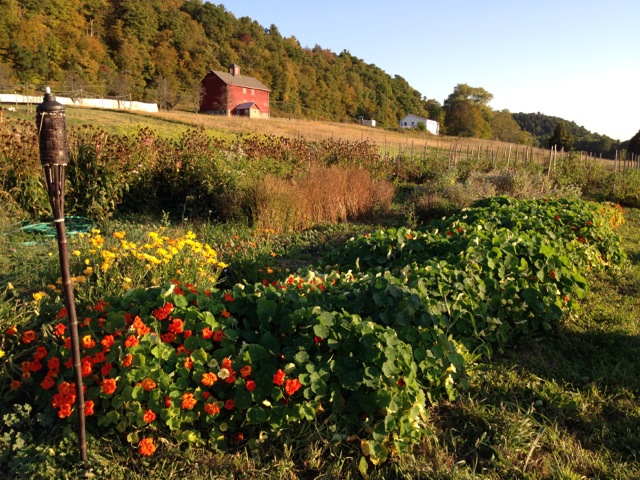
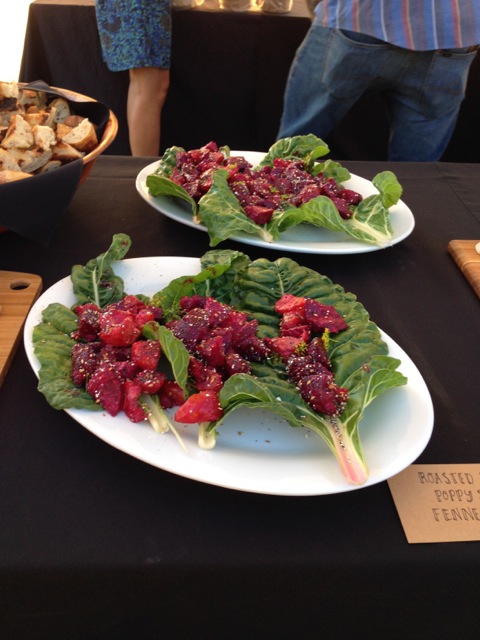
I wish I could show you all the wonderful photos of the event I just received, but I think you’ll enjoy this sampling. Note the roasted beets on greens and the elegant pork, marinated for two weeks in a marinade featuring sumac.

Photos: Sandra M. Kelly

092714-Letterbox-Farm-garden

092714-Letterbox-Farm-tables


092714-Letterbox-Farm-beets

092714-pork-marinated-for-2-weeks


092714-Letterbox-dinner-dessert

Read Full Post »

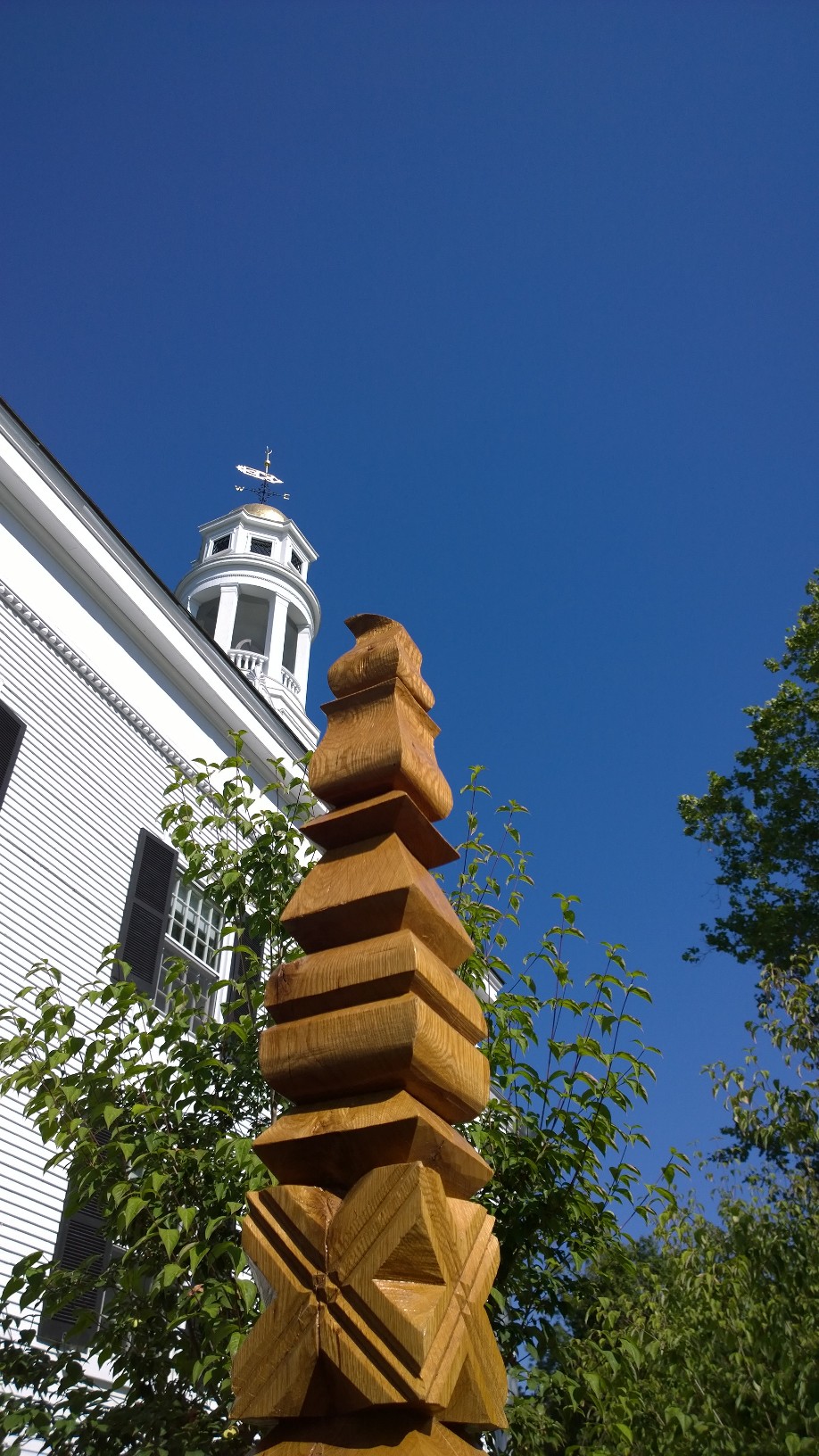
OK, it’s not really a totem pole, but I was afraid the word kopjafa wouldn’t ring any bells with readers.

Today at church we dedicated a wooden pole that was carved by the minister of our sister church in Transylvania when he visited Massachusetts last year.

A translated Wikipedia entry says that, originally, two kopjafa poles were to used to carry a coffin to a cemetery. The poles were then placed at the head and foot of the mound. But according to my minister, nowadays kopjafa poles are set outside churches and, as in our case, sometimes given to a partner church.

The minister read the poem below as he spoke about our church’s connection to Transylvanians of the (almost) same religion. The subject is a little sad for what we do at Suzanne’s Mom’s Blog, but it fits with our previous discussions about the value of preserving language and customs in minority communities. (Hungarian Transylvania was handed over to Romania after World War I, and has had some challenges, starting with language challenges.)

“Leave, if you can …
“Leave, if you think,
“That somewhere, anywhere in the world beyond
“It will be easier to bear your fate.
“Leave …
“Fly like a swallow, to the south,
“Or northward, like a bird of storm,
“And from high above in the wide skies
“Search for the place
“Where you can build a nest,
“Leave, if you can.
“Leave if you hope
“Against hope that homelessness
“Is less bitter abroad than at home.
“Leave, if you think
“That out in the world
“Memory will not carve new crosses from
“Your soul, from that sensitive
“Living tree.”

Read about the poem’s author, Hungarian poet Sandor Remenyik, here.

Transylvania-kopjafa-at-sister-church

Read Full Post »

Photo: Boston architecture firm IKD.
Designer Timothy Olson, material supplier Fraserwood/Mack Magee. The wood is cypress. “The presence of natural materials such as wood is associated with lower stress and positive feelings.”

There’s a great exhibit about using wood in construction at the Boston Society of Architects on Congress St. in Boston, but only until Tuesday, September 30.

I was surprised to learn that nowadays it is actually possible — and maybe even safer — to use wood for city buildings.

According to the BSA website, the timber “exhibition celebrates wood as the region’s most sensible and abundant choice of material for urban building, highlighting its flexibility and technical qualities, including timber’s potential to combat climate change.

“Yugon Kim, founding partner of IKD, Associate/Director of TSKP Boston, and co-curator of the exhibition explains, ‘We now know that timber is a superior structural building material that should be considered alongside steel and concrete. The carbon offset and sustainability benefits of wood make it an ever-relevant and timely building material in the urban landscape.’

” ‘Urban Timber: From Seed to City’ shows that recent developments — including numerous successful implementations of timber as primary structural for midrise buildings in Europe — point to a different future.

“The exhibition includes a number of case studies, examples of existing wood technology and recent material innovations in the many kinds of engineered timber available to the building industry today.”

Read more about the exhibit here.

Meanwhile, at Andrew Sullivan’s blog (here), we find a quote from James Hamblin about why trees are good for our health: “It is becoming increasingly clear that trees help people live longer, healthier, happier lives—to the tune of $6.8 billion in averted health costs annually in the U.S., according to research published this [year]. And we’re only beginning to understand the nature and magnitude of their tree-benevolence.

“In the current journal Environmental Pollution, forester Dave Nowak and colleagues found that trees prevented 850 human deaths and 670,000 cases of acute respiratory symptoms in 2010 alone. That was related to 17 tonnes of air pollution removed by trees and forests, which physically intercept particulate matter and absorb gasses through their leave.”

More from Hamblin at the Atlantic.

Read Full Post »

ICYMI (that’s twitter-speak for “in case you missed it”), a young man who decided to go on the crowdfunding site Kickstarter to raise money to buy ingredients for one small potato salad got more than $55,000.

According to the Associated Press, “A man who jokingly sought $10 from a crowdfunding website to pay for his first attempt at making potato salad and ended up raising $55,000 is making good on his promise to throw a huge party.

“Zack Brown is planning PotatoStock 2014, an all-ages, charity-minded party Saturday in downtown Columbus featuring bands, food trucks, beer vendors, potato-sack races, and definitely potato salad.

“His effort on Kickstarter in early July to buy potato salad ingredients took on a life of its own and attracted worldwide attention as the amount grew.

“The 31-year-old eventually raised $55,492. The Idaho Potato Commission and corporate sponsors have donated supplies for Brown and volunteers to whip up 300 pounds of potato salad for the event.

“The Columbus Dispatch reported that Brown partnered with the Columbus Foundation to start an endowment to aid area charities that fight hunger and homelessness. The account, started with $20,000 in postcampaign corporate donations, will grow after proceeds from PotatoStock are added.” More here.

By golly, I do love quirky.

Photo: Chris Russell/The Columbus Dispatch via AP
Zack Brown’s PotatoStock 2014, an all-ages, charity-minded party, is set for Saturday in Columbus, Ohio.

Read Full Post »

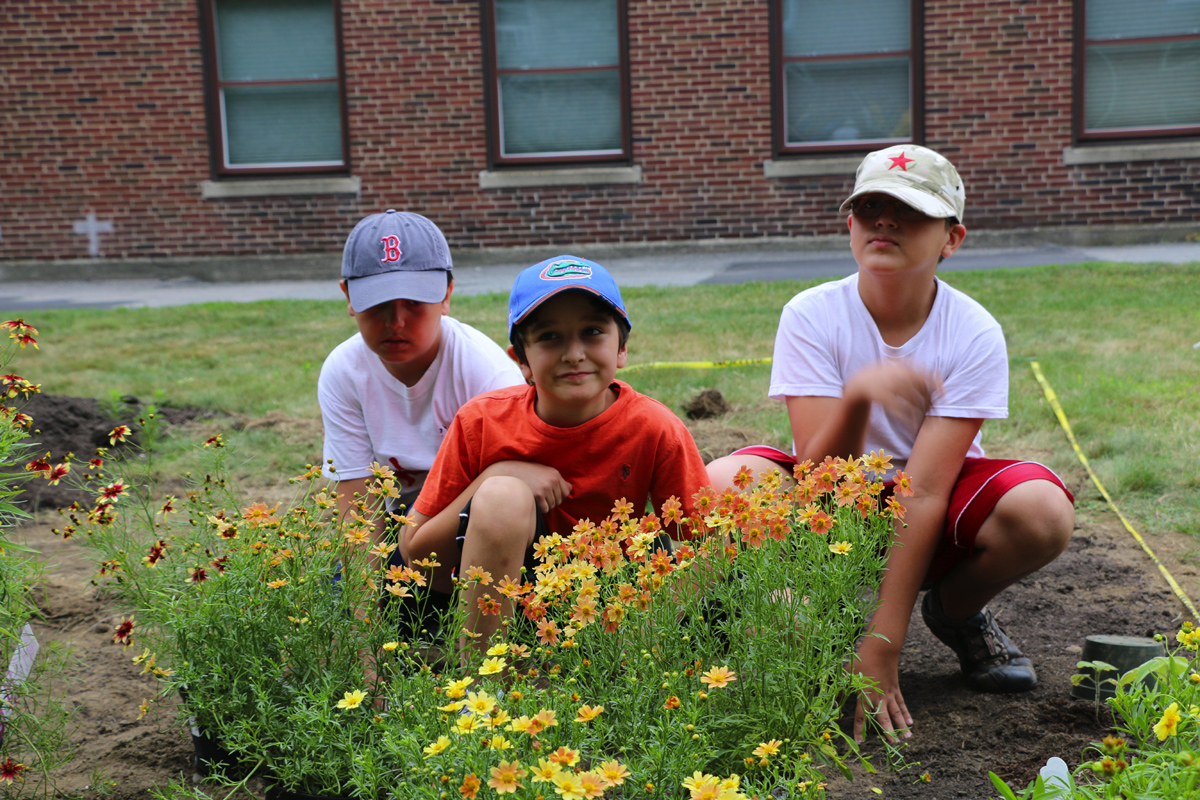
In June I wrote (here) about my friend Jean Devine’s latest venture, “Meadowscaping for Biodiversity.” Jean hoped to get middle-grade kids involved in creating a meadow where once there was lawn juiced with chemicals — and learning how meadows provide habitat for many small creatures. She conducted a pilot program over the summer with her collaborator Barbara Passero and an 8th grade science teacher, Steve Gordon.

Jean e-mails her friends and fans, “We’re delighted to announce that our 8-week summer pilot of “Meadowscaping for Biodiversity” in Waltham, MA, was a great success! The three of us, along with a strong soil turner and a landscape designer, worked with a few boy scouts (and their mothers) to repurpose a 400 square foot plot on the east lawn of Christ Church Episcopal (750 Main St. across from the Waltham Public Library) into a meadow filled with native plants.

“Why did we do this? To engage youth in fun, project-based, outdoor education, while providing native plants as habitat — especially food source — for bees, caterpillars, butterflies, birds, etc.

“The end result? An aesthetically pleasing product and proof that Meadowscaping for Biodiversity, a generative/environmental education program, pays a solution forward to the next generation by inspiring, engaging, and empowering students to be problem solvers and stewards of the Earth. All involved, including the vendors who supplied plants and garden materials, were able to see that this program helps heal the Earth and improve outdoor educational opportunities for youth ‘one meadow at a time.’ Now all we have to do is convince funders, teachers, city planners etc. of the benefits of this program!”

If you fit any of those categories or just want to learn more, contact information is here.

biodiversity-kids

Read Full Post »

« Newer Posts - Older Posts »