Feeds:
Posts
Comments

Posts Tagged ‘street art’

Photo: Tamara Merino/The Guardian.
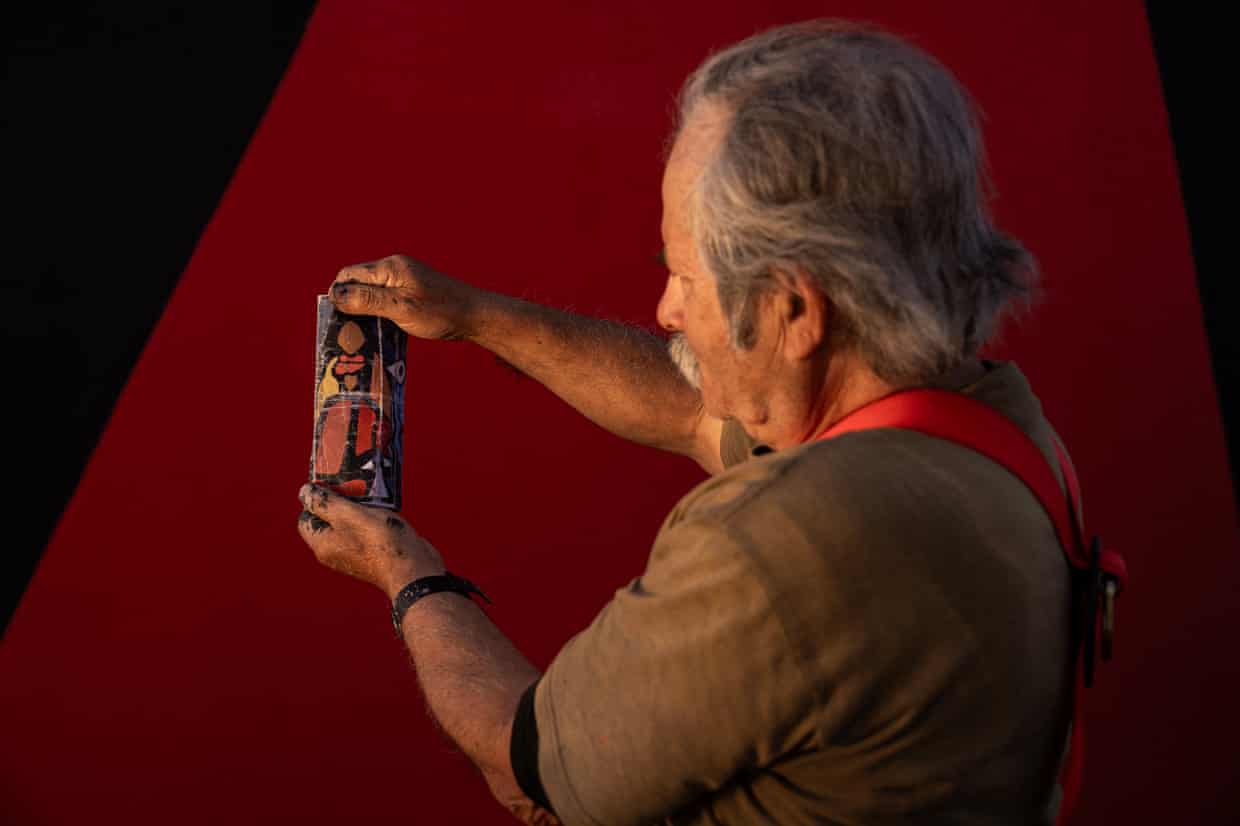
Chilean muralist Alejandro ‘El Mono’ González compares the dimensions between his mock-up and a recent mural. 

For a long time, I’ve been curious about murals and street art. (Search on those terms at the top of this blog if you are interested.) Whether the art is shared openly or under cover of darkness, it seems to convey messages we don’t usually hear from smaller, less public works.

At the Guardian recently, John Bartlett wrote that “in Chile, walls and public buildings are blank canvases to express dissent, frustration and hope.” Blogger and friend of Chile Rebecca will know all about that.

“Bridges across dry riverbeds in the Atacama desert,” Bartlett continues, “are daubed with slogans demanding the equitable distribution of Chile’s water, and graffiti on rural bus stops demand the restitution of Indigenous lands from forestry companies. Every inch of the bohemian port city Valparaíso is plastered with paint and posters. …

“One renowned street artist in paint-spattered jeans spent two weeks transforming a water tower at the country’s national stadium into a powerful symbol of Chile’s battle to remember its past.

“ ‘I have always had a strong social conscience,’ Alejandro ‘Mono’ González exclaims brightly. ‘The fight was born inside me, it just didn’t have an escape. There’s so much you can say with paint and a blank surface.’

“González, 77, has painted across Latin America and Europe, and his murals adorn hotels and public buildings in China, Cuba and Vietnam.

“González’s giant creations combine bright petals of color, separated by thick black lines, and resemble stained-glass windows.

“ ‘I wouldn’t say it’s cheerful, but they’re hopeful colors, which go beyond victimhood, pain and sadness,’ he said.

“The stadium was one of Chile’s most notorious detention centers, where thousands were held after Gen Augusto Pinochet’s 1973 coup d’état. …

“González talks animatedly about how colors vibrate and interact. … His approach reflects a selfless view of the collective.

“ ‘In the streets, anonymity is important,’ he says, ‘The individual isn’t, it’s the message that is interpreted by the viewer that I care about.’

“González was born in the city of Curicó, 120 miles (193km) south of Santiago, in 1947, the son of a laborer and a rural worker. At primary school, his friends named their energetic classmate ‘Mono’ – monkey. …

“After dark, González would go out painting with his parents, both committed members of Chile’s Communist party. In art, he found a release for his burning social conscience. González joined the communist youth ranks in 1965 to develop its propaganda activities, and painted his first mural at the age of 17 during socialist candidate Salvador Allende’s presidential campaign.

“He was among the founders of the Brigada Ramona Parra, a street art and propaganda collective named after a murdered activist, during the heady days of the Allende campaigns. ‘We’d go out every night, sometimes to paint murals, sometimes just to write ‘Allende’ on any blank surface,’ he remembers.

“After Allende won the presidency in 1970, a sinister black spider began to appear on walls, sprayed by the adherents of a fascist paramilitary group. A battle for the streets began, and it has never truly died away.

“In 2019, protesters thronged the streets of Chile’s cities demanding a host of improvements to their lives and an end to the country’s entrenched inequalities. … Those protesters included members of Todas, a collective of more than 100 female muralists who mobilized in a WhatsApp chat.

“ ‘We organized ourselves so we could occupy the walls,’ said Paula Godoy, 34, an artist and muralist from a southern Santiago suburb. ‘We were talking all the time – “Where is there a wall free? Where do we need to get this message across?” – it was a really beautiful period.’ …

“Half a century earlier, González was 24 when Pinochet seized power on 11 September 1973, deposing Allende. … González slipped into the shadows. He stopped wearing his glasses, shaved off his mustache, and went by the name Marcelo as he worked as a set designer in the Municipal Theatre in Santiago.

“When the end of the dictatorship neared, González helped design the most famous campaign in Chile’s political history, the NO campaign against Pinochet’s continued rule in a 1988 plebiscite. …

“ ‘Chile is very conservative and reactionary – we advance, and then we go backwards,’ he says, stepping back from the water tower and shielding his eyes. ‘But memory is the one constant. The most important thing is having a lasting effect. This will still be here in 50 years’ time, and people will still have their memory.’ ”

More at the Guardian, here. No firewall. Donations solicited.
Read Full Post »

Art: Bordalo II.
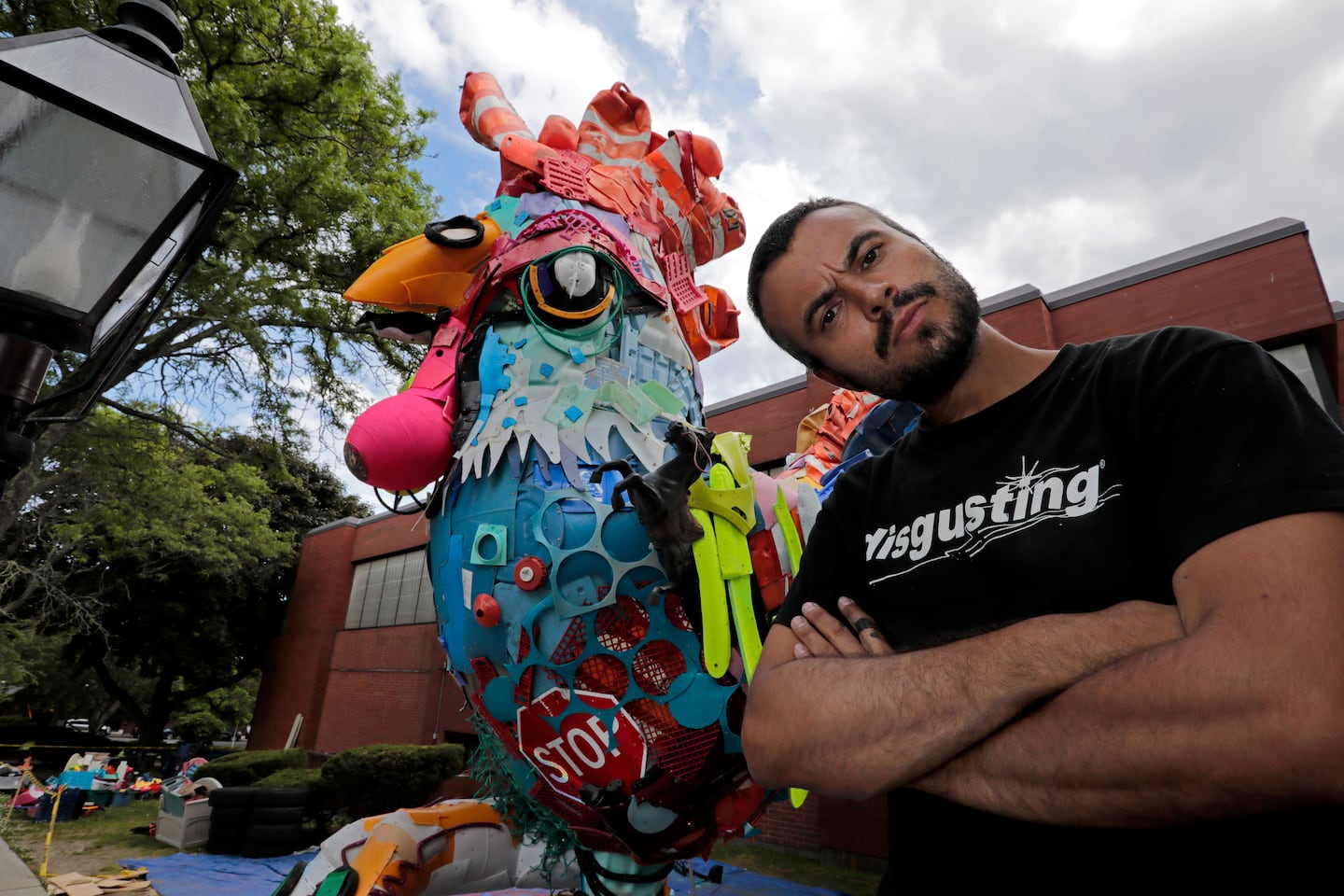
Photo: Pat Greenhouse/Boston Globe.
I’ve been following this Portuguese sculptor on Instagram for several years. Now he’s worked with high school students to create a sculpture for Portuguese-speaking New Bedford, Mass., not too far from where I live.

I have been curious about this artist, age 36, for a long time. He makes vibrant sculptures from trash and shows them on Instagram.

Cate McQuaid wrote recently at the Boston Globe about Bordalo II’s “Plastic Rooster.” 

“There’s a new rooster in town,” she says, “and he’s close to 20 feet tall and kind of trashy. Portuguese artist Bordalo II’s ‘Plastic Rooster’ sits beside the New Bedford YMCA, the centerpiece of Massachusetts Design Art and Technology Institute’s (DATMA) ‘TRANSFORM: Reduce, Revive, Reimagine’ public-art initiative through Oct. 14. …

“Bordalo has traveled the world, from Bora Bora to Montreal, painting and building gaudy, charismatic animal sculptures out of waste materials. He was in town in mid-June putting finishing touches on ‘Plastic Rooster.’ The giant bird is clad in nautical refuse, plastic, street signs, and more collected by locals. He wears a plastic penguin under his beak like a bowtie, and his talons are cut from bright-pink safety cones. …

“[He says] ‘My grandfather, he was an artist. I was really young and I always tried to dig into his studio and steal his paints and draw stuff.’

“The artist, whose first name is Artur, calls himself ‘Bordalo II’ as a tribute to his grandfather, Real Bordalo. At 11, the younger Bordalo became a graffiti artist.

“ ‘It shaped the person I am, the way we do everything,’ he said. “Not being afraid to risk, to really do it. The scale. The sense of how it connects with the street.’ …

“The artist’s lighthearted characters carry messages about over-consumption and conservation. ‘With the big trash animals, it’s like you make portraits of the victims with what destroys them or their habitats,’ he said. …

“ ‘Plastic Rooster’ was commissioned by DATMA, which has partnered with local landfill management departments and the Greater New Bedford Regional Vocational Technical High School to involve the community.

“Bordalo sent his rooster image to the school’s 11th-grade Metal Fabrication students, who built the structure from steel and wood.

“ ‘After that we have a list of plastic trash materials that we know we’re going to need, and we ask the local production team to collect all those materials,’ Bordalo said. ‘My team starts to cover it, to make the first skin. I join them in the middle of the process, and I make more skin, more volumes, all the details. I make the head, the eyes, the nose.’ …

“Public art and programming presented around New Bedford by Massachusetts Design Art and Technology Institute through Oct. 14, www.datma.org/transform.”

I am adding more fromWikipedia, as I felt I had more questions.

“He studied painting at the Faculty of Fine Arts at University of Lisbon in Lisbon for eight years, but never finished the course, instead experimenting with ceramics, sculpture, and other materials. …

“His work has been shown in solo and group exhibitions and mounted in streets across the world, including Singapore, the United States, French Polynesia, and Europe. In the 10 years between 2012 and 2022, he used over 60 (or 115, by another estimate) tons of waste materials to create around 200 sculptures of animals.

“Bordalo’s work is focused on the themes of ecology, waste, and recycling, and makes use of garbage in his work as a method of critiquing over-consumption in the world. Using materials such as old tires, pieces of wrecked cars, discarded appliances, plastic waste, and aluminum cans, he challenges materialism and consumerism in the modern world. …

“Bordalo supports Portuguese refugee advocacy organization Humans Before Borders, which helps to fund five medical NGOs working in refugee camps on the Greek islands of Lesbos and Samos.

“A short documentary film entitled Bordalo II: A Life of Waste was released by the Irish Film Board in 2017.”

More at the Globe, here, and at Wikipedia, here.

Read Full Post »

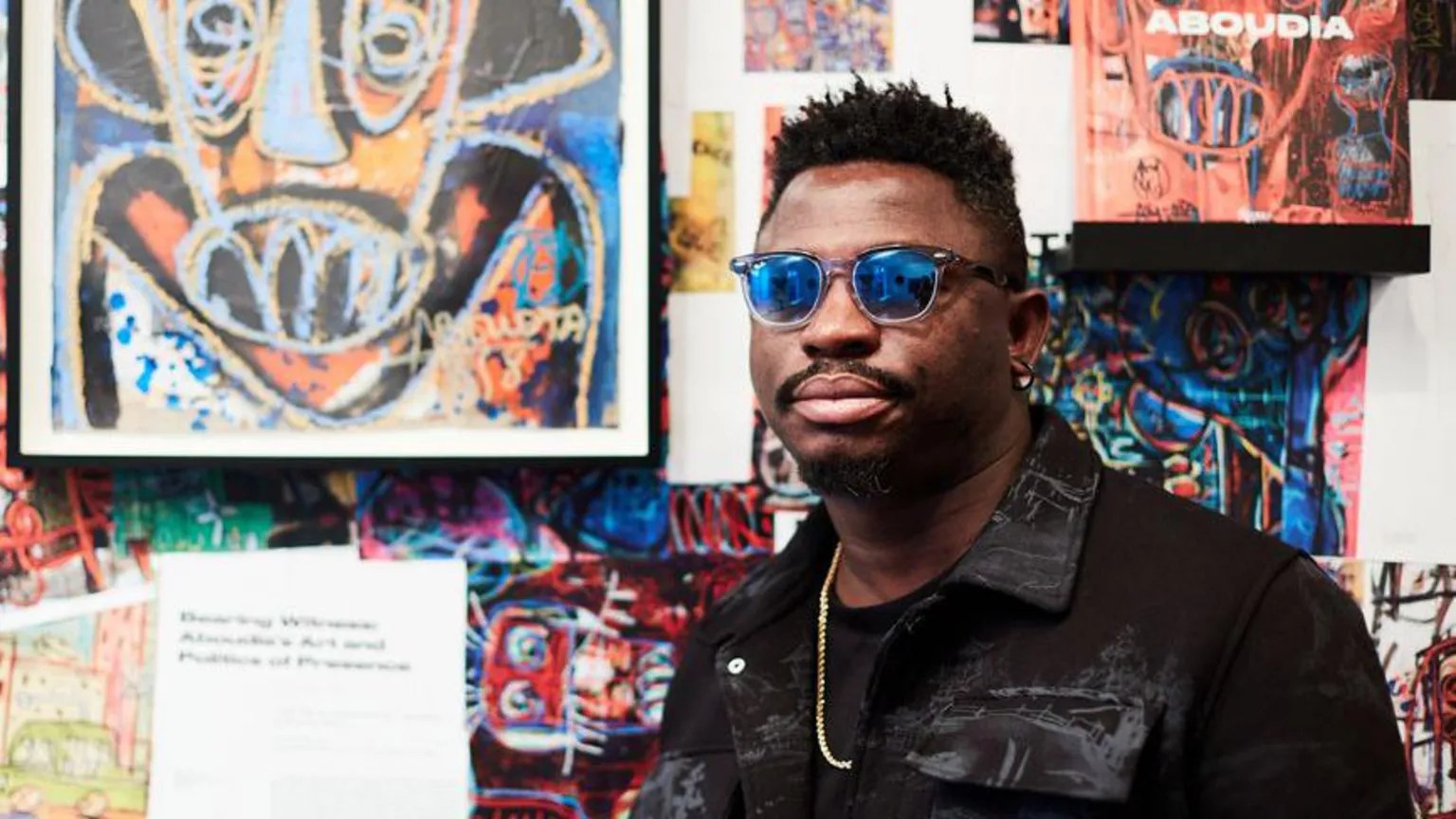
Photo: Larkin Durey.
Aboudia’s work has been shown in exhibitions held in Abidjan, London, New York and Tel Aviv
. Hiscox Artist Top 100 says he sold more than even Banksy in one year.

The art world is becoming more international, and that’s a good thing. For too long, people have used their own world’s cultural references to judge the quality of art. And how can only one culture be the only worthy measure?

Wedaeli Chibelushi reports at the BBC about an African that is currently making a big splash internationally.

“Back in September, global art experts were taken aback by the name topping a fresh list of the world’s best-selling artists.

“Aboudia, a graffiti-inspired artist from Ivory Coast, had beaten well-known names, like Damien Hirst and Banksy, to sell the most pieces at auction the previous year.

“According to the Hiscox Artist Top 100, Aboudia, real name Abdoulaye Diarrassouba, had flogged 75 lots. One of these canvasses had gone for £504,000 ($640,000).

“Leading online marketplace Artsy called Aboudia’s triumph ‘striking,’ while The Guardian said market experts were ‘blindsided by the ranking.

“Months later, sitting in a London gallery plastered with his paintings, Aboudia tells me the survey results were no surprise to him. ‘Because if you work hard, the success is going to come,’ he says. …

“Aboudia’s mellow disposition clashes with the art surrounding him – his vividly colored, heavily layered canvases feature a cast of cartoon-like figures plucked from the streets of Abidjan, Ivory Coast’s largest city. Through a blend of oil sticks, acrylic paints and recycled materials like newspapers, Aboudia depicts the hardships of life in downtown Abidjan.

He particularly focuses on the children who live and work on the city’s streets.

“His eyewitness portrayals of Ivory Coast’s 2011 civil war are equally arresting. Figures gaze at the viewer with vacant eyes, while armed soldiers and skulls crank up the intensity. …

“Aboudia was born in 1983, in Abengourou, a small town around [124 miles] from Abidjan. In a 2012 essay, the artist said he was kicked out of his home aged 15 after telling his father he wanted to paint for a living.

“After being cast out, the young Aboudia pressed on and enrolled in art school. Due to a lack of financial support, he slept in his classroom after the other students went home for the day. These uncomfortable nights paid off — after graduating in 2003 the soon-to-be-star was accepted into Ivory Coast’s leading art school, École des Beaux-Arts.

“Abidjan’s École des Beaux-Arts would expose Aboudia to the Ivorian art icons whose influence can be found in his current work. For instance, Aboudia’s focus on his direct surroundings and his use of recycled materials can be traced back to Vohou Vohou, a modernist collective established in the 1970s by artists like Youssouf Bath, Yacouba Touré and Kra N’Guessan.

“Aboudia began to veer away from traditional styles of art, instead using untamed brushstrokes and earthy colors to recreate graffiti produced by Abidjan’s underprivileged children. In Aboudia’s words, these young, de facto street artists ‘draw their dreams on the world.’

“The children are his main influence, he says. …

“After establishing his core style, Aboudia would lug his paintings around the galleries of central Abidjan, hoping for a way in.

” ‘It was very hard. … They’d say: “Are you crazy? What is this work? You better go to London, to United States or Paris, because this work … here it doesn’t make sense,” ‘ Aboudia recalls.

“The adversity did not end there. In 2010, Laurent Gbagbo, the then president of Ivory Coast, refused to step down after losing an election to rival Alassane Ouattara. A civil war broke out, killing 3,000 people and forcing another 500,000 from their homes.

“Throughout the four-month conflict, Aboudia sought refuge in his basement studio, documenting the horrors he saw when venturing above ground.

“The war ended with Mr Gbagbo’s dramatic capture by UN and French-backed troops — and Aboudia emerged from his haven with 21 disconcerting paintings.

“Art-lovers and journalists from Ivory Coast and beyond lauded his work and Aboudia’s ascent to global success began. He was championed by renowned art collectors Charles Saatchi and Jean Pigozzi — and went on to exhibit his work at prestigious venues like Christie’s New York and the Venice Biennale.

“Aboudia’s first solo exhibition was at the setting for this interview, London’s Larkin Durey (then named the Jack Bell gallery). Owner Oliver Durey, who has now known Aboudia for over a decade, tells the BBC: ‘There is something we can all relate to in his paintings; hiding amidst the uncertainty and horror there are balanced moments of strength and beauty.’

“African art expert Henrika Amoafo [notes] reasons for his success … like his ‘authenticity, the really raw emotional power that he’s able to convey, the way that he speaks to urban life, the way that he speaks about conflict and its impact on children.’ …

“Aboudia’s rise also coincides with that of the African art market. In 2021, art analysis firm ArtTactic reported that the auction sales value of contemporary and modern African art surged by 44% to a record high of $72.4m. …

“Aboudia’s rise has led to him splitting his time between his country of birth and New York. When he is back in Ivory Coast, he pours his efforts into the Aboudia Foundation, an organization he launched to support the country’s children and young artists.

“This is yet another example of the star’s drive — but when I ask him if he has any plans lined up for his career, he … says he takes things one day at a time.”

More at the BBC, here. No paywall.

Read Full Post »

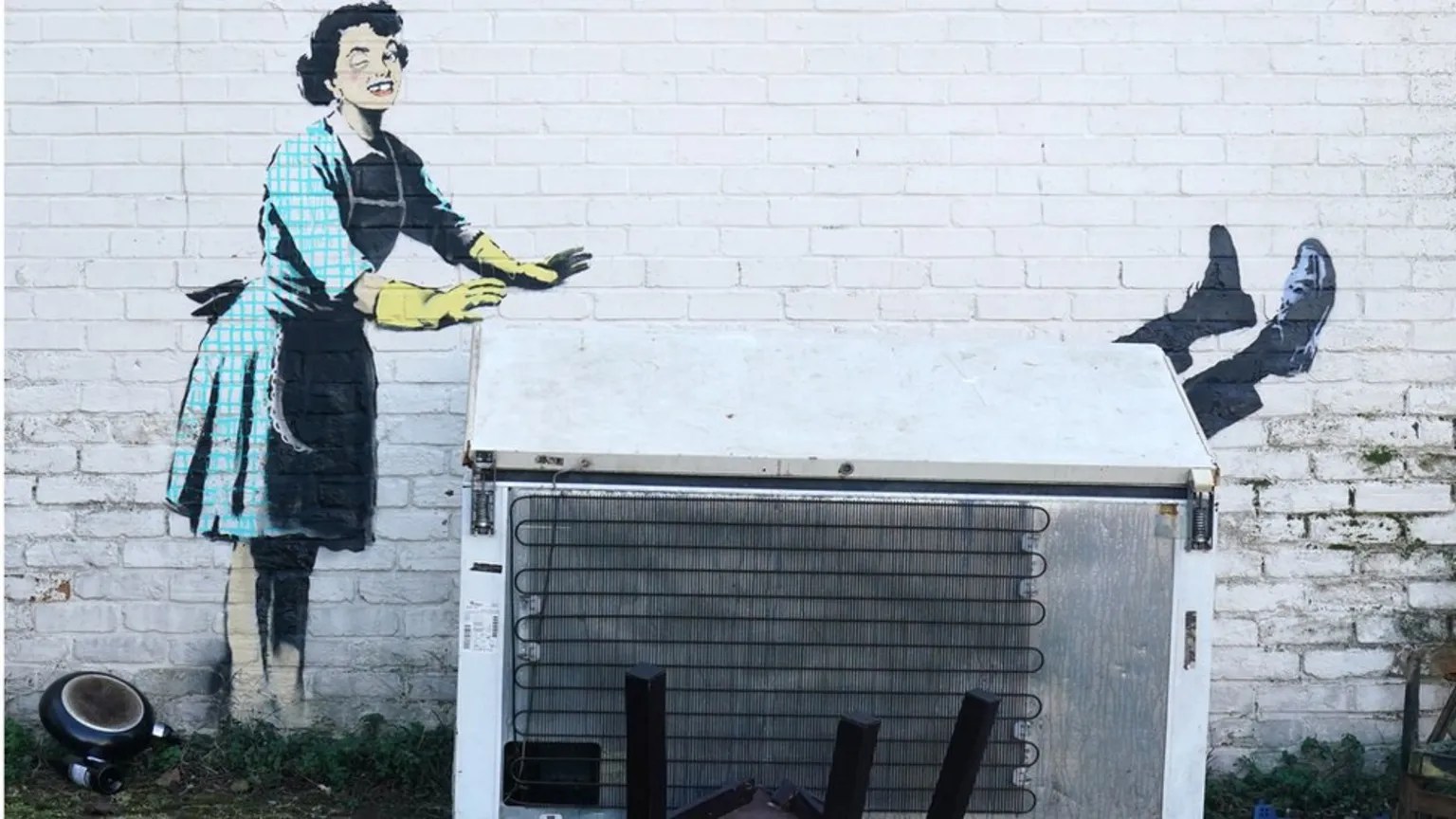
Photo: Fareth Fuller, PA.
Valentine’s Day Mascara is one of Banksy’s murals in Margate, Kent.

I like Banksy’s stealth art a lot and have seen works — or imagined I’ve seen works — in both Boston and New York. But Loraine Holmes is a super fan, and she really knows what’s what.

Hayley Coyle writes at BBC News, “Rumblings a few weeks ago about a new piece of work by world famous street artist Banksy appearing in London meant it was not long before social media was awash with rumors.

“About 200 miles away in Leeds, one of those caught up in the buzz was Loraine Holmes, a self-confessed Bansky super fan and co-founder of a Facebook group charting the elusive graffiti artist’s work.

“Within an hour of Banksy’s new tree-themed mural in Finsbury Park being ‘claimed,’ Mrs Holmes was already at the spot — one of the first in the world to view the fresh and, as she put it, ‘raw’ mural.

“After being tipped off the night before, Mrs Holmes, 61, had taken an early train from Leeds. …

” ‘I spent a total of about five hours there, just taking it all in and observing people,’ she added.

“Banksy’s latest offering, which he later confirmed on his Instagram account was one of his, was a green spray-painted wall depicting foliage, with a stencil of a person holding a sprayer standing next to it.

“Mrs Holmes was one of the lucky ones who got to see it before it was covered in plastic and surrounded by wooden boards after it was defaced with white paint.

“The self-confessed super fan is such a hardcore Banksy aficionado that she said she also once drove 14 hours from Leeds to Margate and back so she could spend just 10 minutes taking some photos of his mural in the Kent seaside town. …

“Mrs Holmes co-founded a Facebook super fan group called Banksy Locations in 2020 with fellow street art enthusiast Jay Tompkins. The group now has 20,000 members worldwide and covers ‘every single aspect of Banksy’ from the 1990s to today, Mrs Holmes said.

“The group also shares information on what condition Banksy’s works are in and where they can be found. In fact, Mrs Holmes said it was members of the Banksy Locations group who ‘unofficially confirmed’ the new London mural before the artist himself.

“Mrs Holmes, a senior business analyst, said she first discovered Banksy’s works in 2018 after seeing some of them online. Her admiration for the anonymous artist ‘spiraled’ and she said that now he would be her ‘Mastermind specialist subject.’

“She said: ‘It started out with me not knowing much about graffiti, but after I saw some pictures I liked on eBay, I started doing some research, read a few books and joined a few groups.’ …

“Mrs Holmes said other Banksy-related adventures included traveling to Paris while suffering with a broken ankle to see Man with Dog. She had undergone surgery a few weeks before to have screws put in her leg, but that did not put her off the journey.

” ‘I still managed to see six Banksy pieces that weekend,’ she recalled. … Mrs Holmes now has plans to visit San Francisco and Los Angeles in the near future to see more of the artist’s work.”

More at the BBC, here.

Photos below: John and Suzanne’s Mom.

Read Full Post »

Photo: Erin L. Thompson/ Hyperallergic.
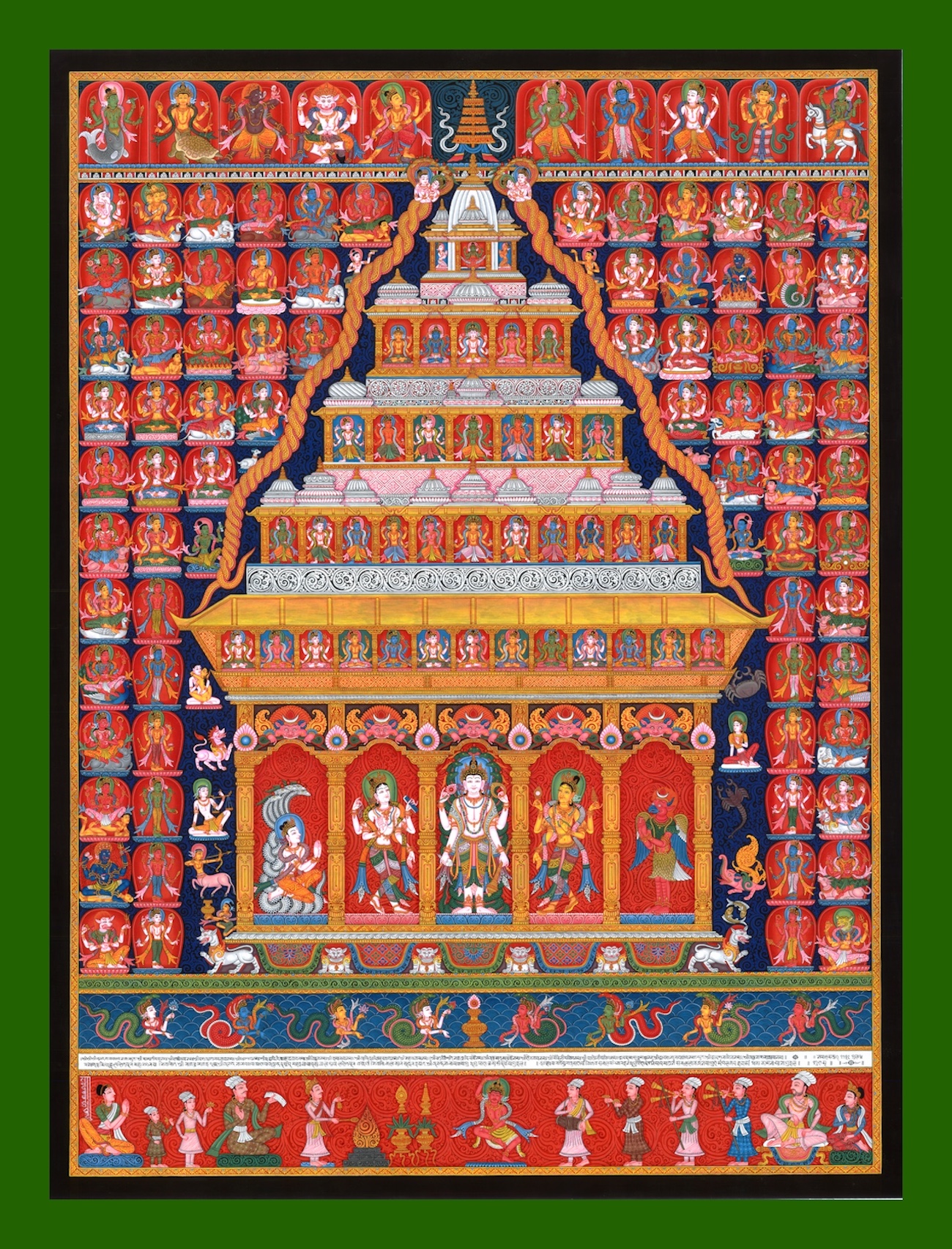
Paubhā painting of Vishnu surrounded by other major Hindu deities, based on various historical paintings from the Malla era.

Around the world, artists are finding unique ways to blend ancient and contemporary, taking the most meaningful aspects of tradition and interpreting it for new generations.

Erin L. Thompson has a story about Nepal artists at Hyperallergic.

“The Vietnamese monks said they wanted a river. So Lok Chitrakar, one of Nepal’s most prominent painters, wrote ‘need river’ amid the folds of a landscape on a preparatory sketch for the gateways of a Buddhist monastery in Vietnam.

“These drawings stretched across the wall of a room in Chitrakar’s studio when I visited Nepal late last year. I was there to see the reinstallation of a 10th-century sculpture of a deity into the shrine it had been stolen from in 1984 … but I couldn’t help being drawn into Nepal’s vibrant contemporary art scene. …

“The Chitrakars have long followed their name’s Sanskrit meaning: ‘image maker.’ But Chitrakar’s father tried to persuade him to follow a different career path, believing that it had become impossible to make a living creating paubhā, the devotional paintings used in Newar Buddhism. …

“But Chitrakar, born in 1961, persevered. His paubhās, painted following the exacting dictates of traditional form and subject matter in hand-ground mineral pigments bound with buffalo-hide glue, are now in collections and Buddhist sites across the globe. Chitrakar also receives commissions, like the one from the Vietnamese monastery. …

“Chitrakar correctly anticipated that the lull during his youth was temporary. Now, the streets around the major Buddhist pilgrimage sites in the Kathmandu Valley are lined with artists’ shops selling deities in paint, limestone, wood, and copper. Ordinary tourists take some home, but the most magnificent examples are commissioned by Tibetan Buddhists eager to establish new sanctuaries outside their homeland.         

“The Valley’s sought-after artists used the pandemic to catch up on these orders, often placed years ahead of time. Chitrakar also finished an enormous painting of the elephant-headed deity Ganesha, who is worshipped in both of Nepal’s major religions, Newar Buddhism and Hinduism. The artist had to climb a ladder to unveil the painting to me. Its intricate details took him 20 years to complete. Ganesha, worshipped as a remover of obstacles, is usually shown as a peaceful deity sampling a bowl of sweets. Chitrakar’s magnum opus depicts his wrathful side. Holding a skull cup and flourishing a variety of weapons, Ganesha dances, symbolizing the strength necessary to protect his devotees.

“Chitrakar was easy to find, but it took me much longer to track down another artist I wanted to meet. … I especially admired a mural with saddhus — Hindu ascetic sages — meditating on heaps of coals, intertwined with bouncy figures wielding spray-paint cans, wittily squirting out the traditional scroll-shaped depictions of clouds.

“I finally spoke to Sadhu X, who created the mural in collaboration with the illustrator Nica Harrison. Today, Sadhu X’s works blend traditional iconography and modern influences into his own distinct style. But when he was growing up, the only street art in Nepal was made by visiting foreign artists. In 2010, as he was completing his undergraduate degree, a teacher suggested he use the stencils he was creating on walls outside those of his art school. He followed the advice, soon met others interested in creating street art, and helped found the art space and community Kaalo.101.

“Helena Aryal, who also joined the video call, is another of Kaalo.101’s founders. She expressed her frustration at the perception, both inside and outside Nepal, that street art is a Western phenomenon. Aryal insisted that although the medium might be foreign, the form is deeply rooted in Nepal’s history. The hand-painted paper illustrations of snakes (nagas), pasted on many homes and buildings in the Valley during the annual rainy season festival, confirm that paste-ups are nothing new in Nepal. And the concept of creating art by modifying the public landscape also fits in well with the interactive, multisensory nature of devotion in Nepal, where worshippers in open street-corner shrines leave fingerprint marks in vermillion powder on deities’ foreheads and offer them marigolds, perfumes, food, and even music, by ringing bells. Some shrines are covered in names written in marker — not casual graffiti, but reminders to the gods about who has prayed for what.

Sadhu X told me that he’s never seen a rigid distinction between the style of traditional paubhās and the work of street artists he admires from other parts of the world. …

“Sometimes he thinks that his work is helping traditional Nepali art to evolve, but more often he’s just mixing together his influences and inspirations because he wants to tell stories using a visual language that he hopes his audience will understand. …

“I also had long discussions about this question with Birat Raj Bajracharya, a scholar of Newar Buddhism and part owner of a gallery selling the works of artists intent on both preserving and transforming paubhā painting. …

“Like Sadhu X, Bajracharya does not see a fundamental distinction between traditional Newar style and classical European models. For example, he pointed out to me that the texts describe paintings as portraying deities with emotionally expressive faces. But such expressions are difficult to render in the linear style of traditional paubhās. Bajracharya thus believes that the more complex shadings of emotion captured by artists who use European Renaissance techniques and the full range of colors of modern pigments may better approximate the ancient texts than the older paubhās. …

“Bajracharya advises the artists associated with his gallery about details like the color, attributes, and hand positions of deities in their paintings, making sure they follow the standards passed down in Buddhist and Hindu texts. He wants art to transform without ‘letting go of its core sense.’ “

More at Hyperallergic, here. No firewall.

Read Full Post »

I liked this story from Stefan Andrews at Vintage News about a 91-year-old grandmother who’s a kind of street artist.

“For most of her life, Anežka Kašpárková (also known as Agnes) has been making her income by working as a farmer. … Ever since she retired, Kašpárková has used many of the sunny days each year to make her home village of Louka a little bit more beautiful.

“The village is found in the South Moravian region of the Czech Republic. The [artist] is now an expert on how to decorate window frames, doors and facades across her village with traditional Moravian folk art. She mostly works on flowery patterns, giving a fresh feeling to the old facades worn by time. …

“Other women have done a similar type of decoration in the past and Kašpárková has worked tirelessly to continue the tradition. …

‘I try to help decorate the world a bit,’ she is recorded as saying.

“Kašpárková uses mainly blue paint and works simply with one small brush. Her color choice blends perfectly with the old, white-painted village houses and buildings.

“Kašpárková says that she does her artwork for the pleasure she gets from it, and that she never makes any plan how her next creation is going to look. She just takes up her brush and gets things going. …

“Given her age, Agnes complains that sometimes she finds it challenging to paint. Yet … she has been comfortable enough to climb a ladder almost every spring and refresh the design on the village chapel.” More at Vintage News, here.

Most people know by now that buildings make great canvases for outdoor murals. I myself have blogged a lot about this form of art. The blue Czech designs represent a different take from urban graffiti, say, as does the current London art walk experienced through windows.

Hannah Jane Parkinson writes at the Guardian, “Artists Walk is … a simple idea for an art trail that began as a joint endeavour between printmaker and painter Rosha Nutt, and her art marketing consultant friend Holly Collier. Those who in normal times would be exhibiting in galleries or community spaces can now place their work in the windows or surroundings of their homes for passers-by to admire. …

“ ‘Lockdown was the catalyst,’ Collier tells [Parkinson]. ‘So many artists have moved studios into their homes. Exhibitions and events have been cancelled. It’s pretty depressing being an artist who can’t show work. We wanted to do something that had a positive action.’ …”

“Until 14 December, London artists working in whichever medium – painters, photographers, illustrators, film-makers, ceramicists and more – can pay £15 to have their location added to the ‘interactive map’ on the website, as well as a short bio and links to the artists’ website and social media profiles, plus a custom poster.

“Collier and Nutt pulled the whole thing together in seven weeks. ‘It’s been late nights, early mornings and a lot of elbow grease,’ Collier says. They applied unsuccessfully for an Arts Council grant, but local collectives and businesses stepped in. An estate agent became a sponsor and organised a leaflet drop. Alexandra Palace – usually home to concerts and comedy gigs – lent its support, including what amounts to a quasi window-residency.” More.

Such a creative way to help artists show their work to potential customers in this difficult year!

Photo: Hannah Jane Parkinson
Paintings displayed by Sarah Barker Brown for Artists Walk 2020 in London.

Read Full Post »

merlin_159839055_96531db4-6471-4426-8d7a-ac42eb8b93d1-jumbo

Photo: Yagazie Emezi for the New York Times
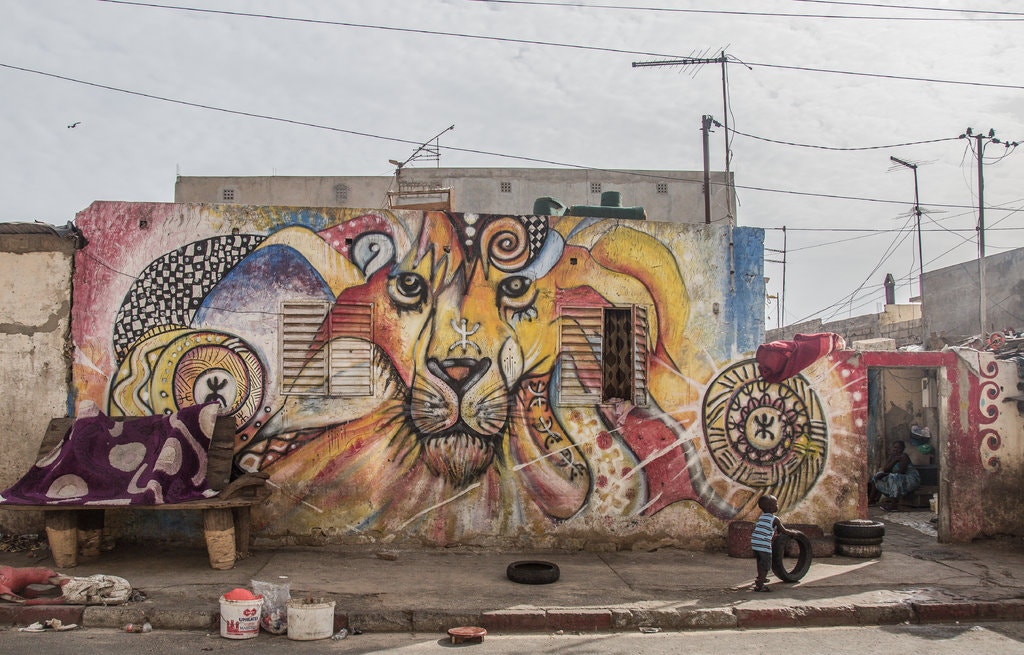
“The neighborhood of the Médina in Dakar has welcomed street artists from all over the world to practice their craft in what the founder of the project calls an open sky museum,” writes the
New York Times.

You can’t keep a good artist down. Art will out. It’s a reassuring thought. In the course of history, we’ve seen governments that think they know best, branding cutting-edge art and architecture as “degenerate.” Fortunately, such governments don’t last.

In Senegal, Anemona Hartocollis of the New York Times discovered a vibrant street art community that has grown up almost spontaneously.

She writes, “On one wall, the painting of a marabout, a Muslim holy man, peers out from behind a line hung with laundry. Nearby, a poster of an African woman in a bustle has been pasted to a house. …

“These are the painted houses of the Médina, a poor and working-class neighborhood near downtown Dakar. The neighborhood has welcomed street artists from all over the world to practice their craft in what the founder of the project calls the open sky museum. …

“Artists from not just Senegal but Burkina Faso, Algeria, Morocco, Congo, France and Italy have come to paint on these walls. They in turn have brought art lovers and tourists into a neighborhood where they otherwise might not go, to mingle with people they otherwise might not meet. …

“Street art seems to come naturally to Senegal, where many small shops are adorned with images of what they sell. Paintings of scissors signify tailors; heads with fancy hairstyles advertise barbers; images of cows and bowls of milk herald the ubiquitous sweet milk shops; a drawing of a sheep broadcasts the presence of a vendor serving grilled meat.

“Shop art is commissioned by the shop owners, and sometimes painted by them too. But to paint on a house in the Médina neighborhood, it helps to go through Mamadou Boye Diallo, known as Modboye.

“Mr. Diallo, 31, was born and raised in the Médina, the son of an elevator operator. He dropped out of school at 15 to become a break dancer and rollerblader. He got to know the art scene by working as a messenger, delivering fliers on roller blades for art galleries.

In 2010, he created Yataal Art, a nonprofit arts collective, and painted the first wall in the Médina with friends. The beauty of it is that ‘you don’t have to take a nice shower and wear perfume’ to see the art, Mr. Diallo said. …

“ ‘You have to pass by him in order to work in the Médina,’ one of the street artists, Doline Legrand Diop, said. ‘He functions a bit like a curator.’ …

“In the beginning, it was not always easy to convince homeowners to let people paint on their walls.

“ ‘They wanted money,’ Mr. Diallo said. But as the project caught on, they wanted to keep up with their neighbors. …

“The painted-houses project has gotten so big that this year, Delphine Buysse, a Belgian curator, has arranged for artists in residence to live at a luxury hotel in Dakar, the Pullman, for a week, while painting in the Médina.

“One of the most recent wall paintings was a collaboration between Kouka Ntadi, a Congolese-French artist, and Barkinado Bocoum, a Senegalese artist. Mr. Ntadi painted abstract portraits in black-and-white, and Mr. Bocoum added folksier portraits in bright colors.

” Mr. Ntadi loved sharing the neighborhood with the commercial artists of the barbershops and the milk stores.

“ ‘I would say there is not really a border between the two in Africa,’ he said. ‘It’s not like in France or the U.S. where there is a snobbism about art, and you can’t be in marketing. So for sure, we can still be an artist and make a design for a bottle of milk or a side of beef.’ ”

More here.

Read Full Post »

091918-Banksy-tagged-5-NYC-boroughs-in-2013

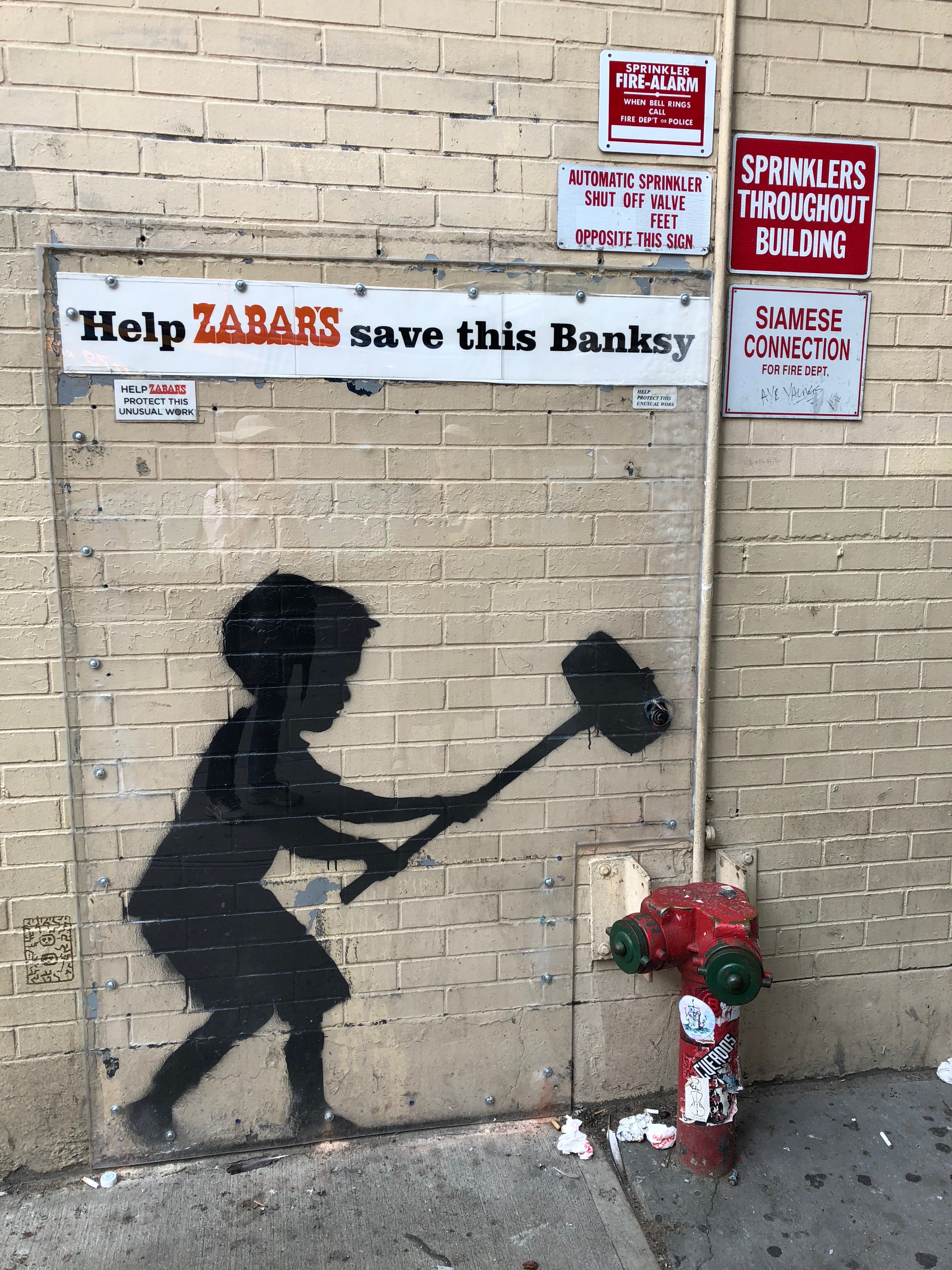
When I was last in Manhattan, I took a photo of a putative Banksy stencil. It’s one that the gourmet food emporium Zabar’s helped to preserve in 2013, when the British street artist was said to be tagging all five New York City boroughs.

I have written often about Banksy — here, for instance. I get a real kick out of his ideas and the fact that he works by stealth. (Speaking of that, if you search on the word “stealth” at the blog, you will find all kinds of examples.)

Banksy’s art, like other street art, is not necessarily meant to last for the ages, but he has become such a phenomenon that there are now efforts to restore murals that have been painted over.

The BBC reports from Scotland, “Restoration work is under way on three early works by the artist Banksy which were accidentally painted over with grey emulsion in a Glasgow nightclub.

“The murals, which feature a gun-toting monkey in a tutu and a framed Mona Lisa, were created as part of an exhibition at The Arches in 2001. But they were mistakenly covered in 2007 then left after the club went into administration [bankruptcy] in 2015.

“A team of restorers are expected to take five months to uncover the works. … Banksy created the works, which also feature the words ‘Every time I hear the word culture I release the safety on my 9mm’ when he was beginning his career as a graffiti artist.

“They were shown as part of the ‘Peace is Tough‘ exhibition in March 2001, … but six years later, and long after Banksy had established himself as an international artist, the murals were covered with grey emulsion during refurbishment work at the nightclub.

“When the club went into administration in 2015, the then owners had considered restoring the murals and selling them to clear the club’s debts.

“Chris Bull, technical director at Fine Arts Restoration Co (Farco), which is carrying out the restoration, said the murals were the only known works by Banksy in Scotland with any provenance. …

“The new owners of the venue, Argyle Street Arches, say they now want to save the works for the nation. … Once complete the works will be put on permanent display.”

More at the BBC, here.

Read Full Post »

Photo: Joseph Eid / Agence France-Presse
Painting the word “Peace” in Arabic over 85 rooftops on a Tripoli street for a project led by twin Lebanese street artists over a three-year period.

Nearly everyone wants peace. Nearly everyone expresses that over and over. You would think we would have peace by now. One large-scale expression of the world’s fervent wish in a city badly damaged by conflict took three years to accomplish.

Agence France-Presse reports, “From the street below it’s easy to miss the workers daubing rooftops as part of an ambitious art project in two battle-scarred neighbourhoods of Lebanon’s Tripoli.

“But the Ashekman street art duo behind the project say that once they’re done, the pistachio-green rooftops they are painting will spell out the word ‘Salam’ — Arabic for ‘peace’ — on a scale visible from space.

“The project, three years in the making, is the brainchild of 34-year-old twins Mohammed and Omar Kabbani. …

“They chose a site spanning the Bab Al Tebbaneh and Jabal Mohsen neighbourhoods, which have fought successive rounds of armed clashes in recent years. …

“Peace has been elusive in Sunni-majority Bab Al Tebbaneh and the adjacent Alawite-majority Jabal Mohsen. Fighters from the two areas have battled each other periodically for decades, and the war in neighbouring Syria, pitting a Sunni-dominated uprising against Alawite president Bashar Al Assad, has further stirred existing enmities. …

“Ashekman’s project runs on either side of the infamous Syria Street separating the two neighbourhoods. The duo hired workers from across the divide to help them complete the project.

” ‘All of the workers live here in the neighbourhood, they lived the conflict, some of them got shot,’ Omar Kabbani said.

” ‘Two years ago they were hiding from bullets … now they’re painting their rooftops proudly.’

“The brothers are sensitive to the observation that their project does little to address the most obvious scars of fighting or the area’s desperate poverty, often identified as a catalyst of the violence.

“They say they chose paint that will seal rooftops against rain and reflect ultra-violet rays, cooling the homes below.

“And in order to paint the rooftops, they had to negotiate with residents and often had to clear large amounts of trash and debris. …

“Walid Abu Heit, 29, joined the project as a painter after hearing about it from March, a Lebanese NGO that has worked on reconciliation and rehabilitation in the rival neighbourhoods. …

“He and other workers lugged heavy tubs of paint up seven floors and began plastering a roof with the fluorescent green, which flecked his hands and boots.

” ‘It’s an amazing project,’ he said, smiling and shading his eyes from the blazing sun.

” ‘The word peace, it’s a great word … we haven’t seen it for a long time, now we’re seeing it again.’

Read more here; also at National Public Radio, here.

And ponder the power of artistic twins here, at one of my posts on street artists Os Gemeos. The Greenway’s first giant mural, which they painted, is still my favorite. It makes you think about “The Other” as a sweet little kid.

Read Full Post »


Photo: Shelly Davidov/Miami New Times
In Miami’s Wynwood neighborhood, street art transformed Jose de Diego Middle School.

It’s interesting to see how street art can be a route to gallery representation for painters, especially if they apply their tagging to public projects.

Ahmed Fakhr writes at Rolling Stone about how painting the walls in a Florida neighborhood helped some artists gain wider recognition.

“Miami is becoming a destination for global collectors looking for a multimillion-dollar Jeff Koons sculpture or one-off by Gerhard Richter. While some opt for the hallowed white-walled galleries to sip white wine, other local artists continue to gain notoriety when by taking to the streets to paint huge murals on bare walls with cans of spray paint. This graffiti explosion was the creation of the street art scene in Wynwood.

“In 2007, Wynwood was a rundown textile and manufacturing area. Then a cohort of street artists decided to bring attention to their neighborhood, but as a way to establish their own art.

“Slowly the area transformed into a haven for creative people looking for a way to express themselves. Soon enough, a developer purchased the properties and capitalized on the growing art culture in the gentrifying area now known as the Wynwood Arts District. …

“Native Robert de los Rios, founder of the RAW project, has been entrenched in street art scene in Miami for years, so he used this opportunity as a way bring art to underfunded schools in the area. ‘Art budgets for schools in the Wynwood area were slashed to zero,’ Rios says.

“So he decided to approach the area school district and street artists from around the world to paint murals on the indoor and outdoor walls of the school. By doing so, Rios hoped this would jumpstart the issue of funding art in schools again and to inspire kids’ creativity. ‘They felt like they were coming to a prison before,’ he says. ‘But now they come to school excited and happy.’ …

“While Rios prides himself in being able to bring an international graffiti scene together to transform the aesthetic of the school, he also collaborated with multiple Miami artists – Ahol Sniffs Glue, Typoe, Santiago Rubino and FL.Mingo – to bring challenging concepts to the school’s campus.

“Typoe, one third of an art collective known as Primary Flight, along with Cristina Gonzalez and Books Bischof, started in Wynwood when Art Basel launched in 2007. Having no luck at the fair, the trio decided street art was more lucrative. … Now they have a gallery space in the Design District.”

Read about more of the artists at Rolling Stone, here, including the one who prefers to stick to illegal tagging of trains and remain anonymous.

I’d be very curious to know how all this has affected the students at the middle school. Perhaps some are aiming to become artists now or are just feeling more special.

Read Full Post »


Photo: Hannah Ellis-Petersen for the Guardian
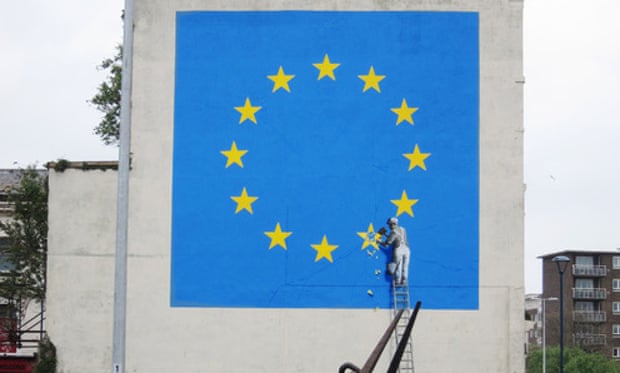
This mural of a worker removing one star from the European Union logo appeared overnight in Dover, Kent. It’s Banksy’s reaction to the Brexit vote.

When I was at the magazine and collecting articles for the next issue, I was sometimes surprised to discover I had a whole issue — or almost a whole issue — on one topic. Suddenly several articles on prisoner issues came together, or maybe immigrant issues, or agriculture issues. It was not planned that way, it just happened.

Today I notice that another United Kingdom topic has popped up after yesterday’s entry on UK election artists. This post is about the street artist Banksy and his stealth reaction to the vote that authorized the UK to leave the European Union and expel many immigrants. Hannah Ellis-Petersen at the Guardian reported the story in May.

“A Brexit-inspired mural by Banksy showing a metalworker chipping away at a star on the EU flag has appeared in Dover. …

“The mural, which was confirmed by Banksy’s representatives to be a genuine work by the elusive artist, is his first comment on the Brexit vote last year.

“The stars of the flag ‘stand for the ideals of unity, solidarity and harmony among the peoples of Europe,’ according to the EU website. …

“The Dover artwork is across the Channel from Calais, where a Banksy mural appeared at the main refugee camp in 2015, showing the Apple founder, Steve Jobs, whose biological father was a Syrian immigrant,” reminding people that immigrants should be valued. More at the Guardian.

I have posted a few times about this street artist, and once I took a photo of what people said was his work. Check these links to a few of my Banksy posts: herehere, and here.

Banksy appears in Boston. Maybe.

Read Full Post »

screen-shot-2017-04-28-at-153802

Photo: SWG3/Facebook
Y
ardworks takes place May 6 and 7
, 2017, in Glasgow, Scotland.

Melita knows I like artistic graffiti. In fact, we are both such fans of Lata_65 (graffiti for old folks) that we intend to try our hand at spray painting if the organization ever comes to the Boston area.

Today Melita shared a link on Facebook about graffiti in Glasgow.

Gregor Kyle wrote at GlasgowLive, “Scotland’s first dedicated graffiti festival will take street art into the heart of the community in Glasgow and open up new opportunities for young people across the city.

“Next weekend (May 6 and 7) in Finnieston, SWG3 will host over 30 of the world’s finest graffiti artists and 50 of Scotland’s street artists at the Yardworks Festival. …

“One of its main aims is to strengthen SWG3’s bond with the local community and the city of Glasgow as a whole.

“School and youth groups have been invited, with the days featuring specialist graffiti workshops and a ‘Creation Station’ for children which will allow everyone the chance to try their hand at painting. …

“ ‘It’s Scotland’s first graffiti festival and the scale of it now, the way it has grown, it’s massive now,’ explained Gaz, who is himself a graffiti artist and part of the management team at SWG3. …

“Most Glaswegians will know SWG3 as a club and concert space but by day it is a thriving hub for artists, filled with studio spaces and workshops. Slowly but steadily it has progressed over the years with the scale and ambitions of its projects growing bigger and bigger.

” ‘The yard is now basically a massive canvas for the artists,’ continued Gaz. ‘We have rendered the walls, wrapped containers in sheet metal – at no small expense – and every surface will be perfect for the artists to paint on. …

” ‘We are trying to build a sense of community in the area, which can be hard sometimes when you have a transient population with some of the students maybe only staying in the flats here for a term and then moving on.

“ ‘Finnieston has this reputation as this hipster area; what people forget is that there is this core population here and in the likes of Partick and Anderston who have lived here a long time. …

“ ‘The Commonwealth Games in Glasgow were fantastic for the city. They drew people together and, through a number of projects, connected me with a lot of other artists and graffiti writers that I didn’t know in the city.

“ ‘We will be looking to run workshops in the summer for young people and will try to play our part in improving the area and bringing the community together.’ ”

More at GlasgowLive, here.

Read Full Post »

The street art in St. Petersburg, Florida, is a selling point for tourism. It started with unwanted tagging on buildings and evolved into murals authorized by building owners and respected by taggers.

Tampa Bay Times art critic Lennie Bennett has the backstory.

“In recent decades, murals have become a way to spruce up bare walls of buildings and to discourage graffiti. St. Petersburg has street murals in many areas but there is a concentration of them along the downtown Central Avenue corridor. To see them at their best, you need to walk through the area. Even if you travel the route regularly by car, you’ll miss many of them because they adorn the once-drab back walls facing alleys.

“An incentive for owners of the buildings, says [Florida CraftArt executive director Diane Shelly], is that they were regularly ‘tagged,’ meaning a graffiti artist would use an exterior wall as a canvas or to scrawl messages with spray paint. ‘It’s illegal and the city has a graffiti removal program,’ so city workers come out and use whatever paint is available to cover up the tags, which led to a different kind of unsightliness, she said. ‘But taggers respect art, and most won’t tag an existing mural.’ …

“Shelly commissioned Derek Donnelly to create a mural that would replace those painted-over areas and discourage future tagging. ‘A Moment to Reflect ‘was created by Donnelly and Sebastian Coolidge, another well-known street painter whose most beloved work is probably the image of a young man with elongated limbs stretching for an orange on the exterior of the clothing store Freshly Squeezed at First Avenue N and Dr. Martin Luther King Jr. Street.

” ‘Reflect’ is the largest of the Central Avenue murals, stretching up four floors. It depicts a businessman wearing a green tie, the color associated with CraftArt’s neighbor and sponsor of the mural, Regions Bank, discovering his creative side. ‘I think it’s the largest free-hand mural in St. Petersburg,’ Shelly says, meaning it wasn’t done using a grid method or projector. …

“Because of the murals’ growing popularity, some business owners rehire the artists to freshen up the works rather than painting over them.

“But in [the experience of Leon Bedore, or Tes One] ‘You end up learning that all murals are temporary art and not intended to stay up forever. (When painting illegally) I felt lucky to have one up for a night. A week was amazing. When an owner didn’t have one removed I thought, ‘” might be on to something if they’re keeping it up.” ‘ ”

The Tampa Bay Times article by Lennie Bennett is here. A comprehensive tour of the murals is here.

Photo: Creative Loafing

Read Full Post »

Our friend Mika is back in Hokkaido these days, after several years in New York working in restaurants and perfecting her “house” dancing. But every once in a while she ventures out to help on a street art project. Here is her friend Florence Blanchard’s mural for CBM Network (Crossing Biological Membranes) at the University of Sheffield in England.

At her WordPress site, Florence explains what the art represents, “I am delighted to present my newest mural here – a collaboration with CBMNet at the University Of Sheffield, in conjunction with Festival Of The Mind 2016 / Fear of the Unseen: Engineering Good Bacteria.

“The ‘Crossing Biological Membranes Network’ is composed of scientists working to understand the mechanisms by which substances are transported into, within, and out of cells. Their ultimate aim is to produce knowledge which will enable the development of new technologies in the Industrial Biotechnology and Bioenergy sector (eg: producing biofuels using E coli bacteria).

“My role in this collaboration has been to translate the CBMNet area of work into a large outdoor mural located within the university campus. For this occasion I have presented my interpretation of a detail of a cell membrane as seen under an electron microscope, having undergone a cryofracture.

“A cryofracture is a procedure in which the sample is frozen quickly and then  broken with a sharp blow so you are able to study its structure in very close detail – Imagine breaking a bar of chocolate with hazelnuts, this way you can see how hazelnuts are positioned inside the bar.”

“For an online animation of a biomembrane cryofracture follow this link: http://www.sciencephoto.com/media/530082/view.”

Check out the WordPress post.

Photo: Florence Ema Blanchard
Blanchard’s street art is tied to a scientific quest: “Engineering Good Bacteria.”

Read Full Post »

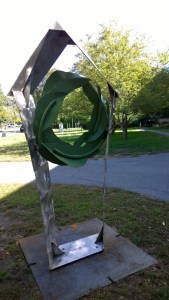
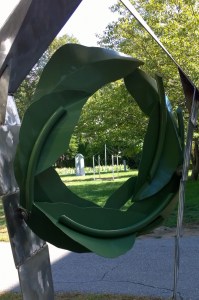
Among the sights I’ve wanted to photograph in the last few weeks is a sculpture outside the Umbrella Community Arts Center. It invites you to look through and focus on an aspect of the view.

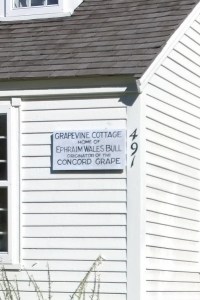
Next up, the old house where Ephraim Bull developed the Concord Grape. Another sign there told me that there was a “Sale Pending.”

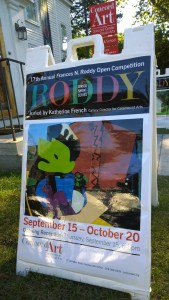
My friend Meredith is a featured artist at Concord Art’s new juried show. She has done several treatments of her fica plant, but the one in the show is a lovely collage of painted paper.

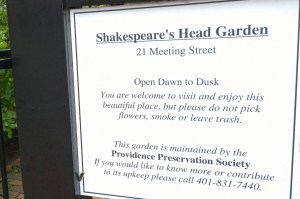
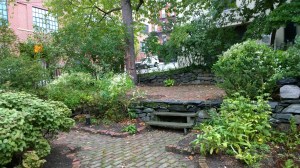
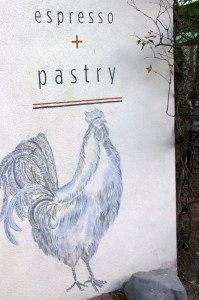
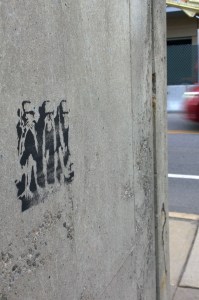
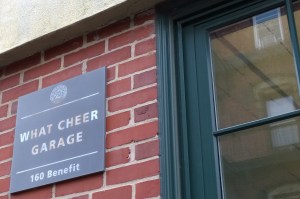
I recently discovered on a morning walk that the Providence Preservation Society has generously opened its multilevel garden to the public during certain hours of the day. What a peaceful place to just sit and think! Not far away is the What Cheer Garage (I like the name). Across Providence, you can discover a fine-looking hen on the wall of Olga’s Cup and Saucer, and a street art stencil recommending Speak no evil, See no evil, Hear no evil.

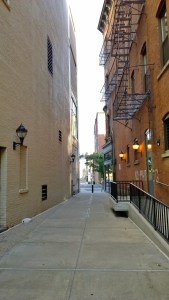
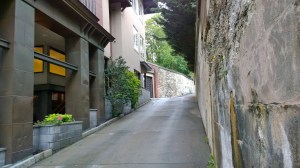
I also like the alley alongside the Providence Performing Arts Center and a hilly street that looks more like Europe than New England.

092416-sculpture-at-umbrella-center

092416-looking-thru-sculpture


092516-concord-grape-origins

092516-meredith-fife-day-at-juried-show


092016-please-enjoy-our-garden

092016-preservationists-share-garden


092116-hen-at-olga

092116-3-no-evils


092016-what-cheer

092116-providence-alley


092016-providence-street

Read Full Post »

Older Posts »