Feeds:
Posts
Comments

Posts Tagged ‘training’

elelwa-cake

I lifted this from Beautiful Day, an organization I’d like you know about if you don’t already.

Founder Keith Cooper writes, “A couple months ago a guy named Scott Axtmann brought a great group of interns from his church (Renaissance) to visit our kitchen facility at Amos House. We did the things we usually do — greeted the trainees, chatted with our chef and other staff, then sat out in the dining hall to talk more about mission and share thoughts about resettlement, the job market, and being a part of positive change in our city.

“This is an aside — but if you live in driving distance of Providence and are interested in our work, you should stop by for this kind of tour. Plan to come after 5 on Tuesday, Wednesday or Thursday. If possible give us a couple weeks warning. A tour doesn’t take long, but seeing something with your own eyes usually takes the strangeness out of it. I know we are intense and painstaking about the way we make granola, but making granola is still not rocket-science. Neither is job training. What I always find mysterious in our kitchen (though I know we’ve also been painstaking about creating this atmosphere too) is the laughter shared by a group of trainees and staff who don’t even share a language. This is always the thing that reassures me that we are doing something right. But please take this as an open invitation. These tours are part of our mission to connect more people with refugees. Our organization may lack a lot of things, but we’re rich in relationships with former refugees and would love to share our wealth with you.

“Anyway, during that tour Scott challenged me in the style some faith leaders have perfected—encouragement that leads to self discovery. In this case, he created space for me to say something I hadn’t intended to say. The gist went something like this:

Scott (to the interns): Keith writes a [something flattering here] blog for Beautiful Day about immigration and refugee resettlement.

Me (grimacing): Oh thanks Scott. Actually I’ve hardly been writing anything this year.

Scott: Really? Why not? You should be. [Then, to the interns, some thoughts about how critical it is for people of faith to welcome refugees and what a privilege it is. Scott has a contagious enthusiasm about our city that I love.]

Me: Honestly, I feel like I’ve lost my voice over this last year. I’m really struggling with it.

Scott: You had better get it back.

“Then suddenly we all had to go.

“That was back in July and I’ve been chewing on this ever since. I’m pretty sure I intended to answer his question by complaining about how busy I am, how many hats I need to wear. These things are true and I say them all the time. Saying I lost my voice instead provoked me to think about what’s happening to or in me. Beautiful Day works with marginalized people who, for the most part, are hidden and voiceless — most obviously because they don’t speak English and don’t yet understand much about American culture, but also because they’ve had experiences of being chased away, silenced, discarded, warehoused. We live in a country that has welcomed them, yet is also growing more ambivalent and sometimes openly hostile to them. I believe we all have something critical to learn from these voices.

“So how can I possibly advocate for voiceless people if I don’t have a voice myself?

“And another thought: isn’t saying I’m voiceless another way of saying I’m afraid. What am I afraid of?

“But, okay, Scott. Thank you both for the compliment and the invitation to think. Here’s my idea. I’ll try to start writing more often. I know I need to do this right now if only because we are heading into the holiday season when we hope (need!) to sell about 75,000 dollars of granola in 3 months. These sales are vital to our training program, so I need to be connecting and resonating with our customers.

“(And, a sideways invitation here: as part of this sales initiative, we are currently launching efforts to increase traffic to our website. Part of what helps attract traffic is interaction, so if you appreciate anything in this blog and what Beautiful Day is doing, please speak up and comment either here or on our Facebook or Instagram feeds. It’s okay if you disagree as a long as you’re not trolling. A voice isn’t very real until it’s in dialogue.)

“Along the way, maybe I can try to figure this out by writing it out. I know one of my fears is that I just can’t write an Inc-style business post where I try to play the confident hipster entrepreneur and wax eloquent on how great our product is, how well we are doing, how hard we work, and which fancy apps we use. Something about who I am and about working with voiceless people makes that impossible. Nor can I promise that it will be consistent or coherent or polished. It will need to just come out of what’s in my head at that moment with what time I’ve got available. But I’ll give it a try. Maybe I’ll rely on some of the internet’s favorite formats like top 10 lists. But I’ll try to let it be a real voice. I suspect I’m not the only one trying to retrieve theirs these days.”

Read Full Post »

header-1-1068x400

Photo: Rhode Island Inno
Refugees learn US workplace skills thanks to a nonprofit called Beautiful Day.

For my taste, there can never be too many admiring articles about Beautiful Day (aka Providence Granola Project). I find the nonprofit’s model to be both wise and kind, and my only wish is that more markets would carry the products and more employers would hire the refugees after graduation.

I’ve known a number of immigrants who have gone through the training (including the somber Congolese girl above, who is still learning to share her radiant side more often).

Bram Berkowitz writes at Rhode Island Inno, “On many accounts, granola is considered a nutritious, lightweight and high-energy snack that has become a popular breakfast item, as well as a pick-me-up for hikers and campers.

“But at the Providence-based nonprofit Beautiful Day, the crumbled, whole-grain based food has become a path to the labor market for many refugees that come to this country lacking the skills needed to obtain a job.

“Keith Cooper, a former campus ministry veteran, founded Beautiful Day about 10 years ago as a granola business that employs refugees in order to give them hands-on experience and training they can use later on to gain permanent employment.

“As the United States prepares to take in the least amount of refugees since the 1980s, Cooper is gearing up to double growth at Beautiful Day so the organization can expand its services by taking on more refugees or train refugees for longer periods of time. …

“The organization finds refugees through various agencies, such as the Dorcas International Institute of Rhode Island. Cooper said typical candidates are those that have extremely high barriers to entry, whether its lacking cultural literacy or English speaking skills.

“Cooper said he chose granola because its non-perishable, healthy and a food that requires a lot of work to make, but not a lot of finesse.

“ ‘I had never run a food production company, but we have been determined to become our state’s premier granola company,’ he said, adding that the organization uses local distributors and suppliers when possible. ‘We try to use the highest quality ingredients we can to make granola people will really like.’

“Beautiful Day provides 200 hours of work to refugees in various parts of the granola business, which gives them experience for when they apply to their next job. The placement also comes with a stipend and has opportunities for refugees to interact with others in the community when the company goes to public places like farmer markets to sell the granola. … Cooper said most of the kitchen workers go onto entry level jobs such as working at a laundromat, in a warehouse, as a janitor or sometimes in food production.

“ ‘Most lack English language, but they can still learn pretty quickly how to look someone in the eyes during an interview,’ he said, adding that all of the program participants, many of whom lived for years in refugee camps, are extremely eager to work. ‘The primary skill we teach is confidence … In a lot of work settings you may not need much English, but you absolutely have to be able to communicate when you do or you don’t understand something. That takes confidence.’ …

“Cooper sees huge scalability through online subscriptions and consumer sales. He is also looking to sell directly to universities and law offices, which will also help spread Beautiful Day’s mission because subscribers receive a postcard each month with a story about a new trainee. …

“ ‘People can do something about refugee resettlement. … By making a small choice about what you eat for breakfast or for a snack, you can provide crucial on-the-job training for someone who otherwise can’t get a job.’ ”

More here.

Read Full Post »

Photo: Julie Van Rosendaal
EthniCity chef and kitchen manager Ajoy Sehgal helps immigrants to Canada as they acclimate to a new land and develop food and hospitality-industry skills.

I’ve written before about how immigrants often start their own businesses, especially food businesses. And I’ve also blogged on nonprofit organizations that use a food business to acclimate refugees to US job expectations and teach marketable skills. (Beautiful Day, “Granola on a Mission,” is a favorite.)

Today I have a story about the same sort of thing going on in Canada — and how great it’s been for both immigrants and customers.

Julie Van Rosendaal reports at CBC News, “Sharing a meal remains one of the best ways to get to know someone, and to learn more about different cultures and backgrounds.

EthniCity catering, a non-profit social enterprise run by Calgary’s Centre for Newcomers, taps into the culinary knowledge of new Canadians, turning their cooking skills into a business, while helping prepare them to work in the food and hospitality industry.

” ‘It’s training for us also,’ says chef and kitchen manager Ajoy Sehgal, who worked in kitchens around the world, including Bangkok, Hong Kong, Dubai and throughout the Middle East, before coming to Calgary. ‘They may not be chefs, but they bring expertise about their cuisine. We hope they take something in return.’

“Founded in 1997 as a Collective Kitchen, EthniCity Catering began as a peer support group for women in a church basement and has grown into a full commercial kitchen, providing work experience and training to immigrants during their transition to Canada. …

“Each course runs for 10 weeks with a group of 16 students, who learn in the classroom as well as in the kitchen and on location at catering jobs, under the wing of Sehgal. The group generated $216,000 last year, with profits reinvested into the program. …

“The Centre for Newcomers serves over 10,000 new Canadians each year. With a staff of 130 in their northeast office and students and visitors often in the building for classes and other events, the caterers have a built-in customer base for morning coffee and pastries and unique lunch offerings. …

“EthniCity caters groups of up to 500, and offers their homemade appetizers — pakoras, fatayer, spring rolls, samosas, satay and the like — for customers to bake themselves at home.

“The menu is inspired by cuisines from around the world — the regular menu includes chickpea chaat and bahjis, Philippine pancit noodles, Thai green curry, Indian korma, Arabic mujaddara, Greek moussaka and Russian stroganoff. New dishes are regularly added, and they create custom menus. …

” ‘We’re trying to give them exposure to as much as possible,’ says Sehgal.” More here.

That list is making me hungry. And I’m remembering one of the things I loved about the years we lived near Rochester, New York — the annual international food festival held outside the museum. If I was lucky, my husband would babysit, while I walked around in a happy haze, tasting everything. Mmm.

Read Full Post »


Photo: Jason Rosewell
No one’s singing is hopeless, says a Toronto voice teacher.

I know many people who say they can’t sing, but a teacher in Toronto begs to differ. Anyone can sing, she says. People just need a little help.

Anya Wassenberg writes at Ludwig van Toronto, ” ‘I’m tone deaf. I can’t sing.’ It’s usually accompanied by a smile or laugh, but the message is both clear and absolute. And wrong.

“Lorna MacDonald is Professor of Voice Studies and Vocal Pedagogy at the University of Toronto, and she puts it even more strongly. ‘That’s a blatant lie.’

“Of all creative endeavours, singing is perhaps the most poorly understood. To the chagrin of vocal teachers everywhere, singing is the one pursuit where you will be told, you can’t sing, so don’t bother. Parents will readily pony up the resources for acting lessons, or soccer, but when it comes to the ability to sing, many people are still under the impression that it’s something magical – you either have it, or you don’t. …

“Sean Hutchins is the Director of Research at Toronto’s Royal Conservatory of Music. His lab looks into how music affects the mind, and how the mind affects music, in essence. …

“He points out that in older generations, in particular, the sole emphasis was on performance. When school children who couldn’t naturally hit the right notes, rather than training them, they would simply be told to mouth the words, and not sing at all. ‘There’s no better way to make sure someone is bad at something than to tell them they can’t do it.’ …

“Lorna MacDonald cites breath, posture, and vowels as the essential elements that are integral to vocal training for anyone. ‘It’s very much a physical process,’ she explains. ‘Our larynx isn’t necessarily made to create those beautiful sounds, any more than our legs were designed to kick soccer balls.’ …

“[MacDonald] suggests that thinking about what styles and genres you’d like to sing, and your ultimate goals as a singer are a good place to start. ‘It’s so important that it comes from a place of communication — not to be famous.’ …

“In reality, people with congenital amusia, or the innate inability to hear pitch properly, form a very small percentage of the population. The study of amusia is still quite recent, but estimates put it at no more than 1.5 to 4 percent. …

“In essence, amusia testing looks for evidence of faulty pitch perception. That’s the difference. Someone with clinical amusia actually can’t hear variations in pitch. …

“In extreme cases, a little delusional thinking can help. Florence Foster Jenkins was a Manhattan heiress in the early 1920s to 1940s who dreamed of being an opera singer, and was somehow entirely convinced of her talent. There are a smattering of Youtube videos that attest to the fact that she was, let’s say, entirely lacking in training. Still, she went on to become a cult favourite of the NYC music scene. …

“So why sing, in the end? Professor MacDonald puts it best. ‘You contribute beauty to the world,’ she says.” And pleasure to yourself, I’d add.

More here, at Ludwig van Toronto.

Read Full Post »

Photograph: Cassady Rosenblum
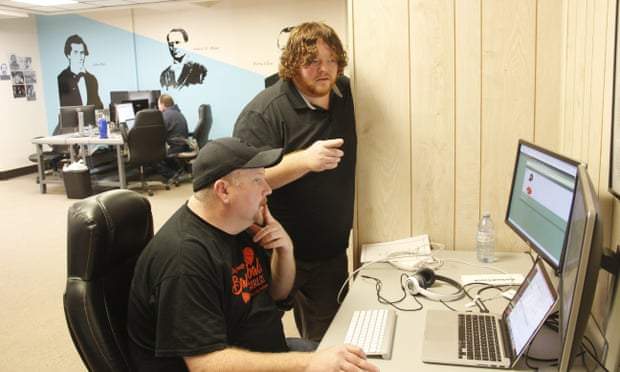
Garland Couch (seated) works on some code with James Johnson. The men are part of an effort to turn coal country into Silicon Holler.

About a year ago, I wrote a post about Mined Minds, a nonprofit founded by two young Northerners to help jobless miners learn computer coding skills.* This follow-up shows that the idea is taking root and spreading.

Cassady Rosenblum writes at the Guardian, “As Highway 119 cleaves through the mountains of eastern Kentucky, exposed bands of black gold stretch on for miles – come get us if you can, they tease. And for years, miners did: they had good employment that earned them upwards of $70,000 a year and built a legacy of blue-collar pride in the region. ‘We felt like what we did was important,’ says Rusty Justice, a self-described entrepreneur who hauled his first truck of coal in eighth grade. And it was. In 2004, coal powered half of America’s electrical needs.

“But by 2011, Justice and his business partner, Lynn Parish, who worked in coal for 40 years, began to worry. … So the two coal men from Pikeville began thinking about how they could diversify.

Coal country must transform itself into something else, a new place on the map the hopeful call ‘Silicon Holler.’

“In its own, proud way, Pikeville has a new message for America: we’re ready to move on if you’re ready to let us do it our way. That means some help from the government, but not a handout. ‘We need to identify the doers and facilitate their ideas,’ Justice says. …

“ ‘We considered just about everything. Windfarms, solar farms, hog farms – you name it,’ he laughs. As unemployment tore through their 7,000-person town, Justice and Parish prayed for a business idea that would not just pay, but pay people what they had been making before in the mines. …

“Their breakthrough came when Justice and Parish visited a workforce retraining expo in 2014 in Lexington, where they learned about coding.

“The concept appealed to them. Each year, 600,000 US tech jobs go unfilled, jobs that ultimately go overseas but could be on-shored if more Americans had the right skills. Even better, the job paid the same as the mines.

“Justice had seen first-hand how miners employed logic to solve life or death problems underground. Still, he wondered, could a coal miner really code? He called his computer-savvy friend Justin Hall with that question. ‘I don’t see why not,’ Hall said. ‘Great, you’re hired,’ Justice told him.

“They placed ads for their new web and app design company, Bitsource, in 2015, then watched as more than 900 applications rolled in. From this pool, they chose 11 former miners who scored highest on a coding aptitude test. Two years later, in an old Coca-Cola factory by the Big Sandy river, nine men and one woman remain.

“On a late March day, Hall stands at a whiteboard [and] fills the board with modules and nodes as the guys shout out ideas in lingo that eventually makes Garland Couch, a 55-year-old coder, pause at how far they’ve come. ‘Man, we’re nerds now,’ he laughs, pushing his Under Armour cap back on his head. After the session, they break for lunch, then return to work with Drupal software on laptops whose Apple icons glow next to bumper stickers that say ‘Friend of Coal.’

“Despite the team’s new profession, the stickers are a nod of respect to an industry they all got their start in, an industry that still employs some of their friends and family. As Parish is fond of saying, change is necessary, ‘but you don’t want to upset the one who brought you to the dance.’ ”

Read about other companies retraining miners in Kentucky, here.

*Update May 12, 2019: Uh-oh. Read about an unfortunate outcome, described at the New York Times, here. I still think it was a worthy effort.


Read Full Post »

Restaurants are having trouble finding trained workers, and many low-income people have trouble getting themselves qualified for a job.

Enter the Culinary Arts Training Program at the Salvation Army’s Kroc Center in Dorchester, Mass.

Sacha Pfeiffer writes at the Boston Globe, “A recent business survey found that the state’s dining sector is facing its worst labor shortage in more than three decades. That survey, by the Federal Reserve, called the staffing situation a ‘crisis,’ and Boston-area restaurants of all types report that hiring at every level, from dishwashers to chefs, is a major challenge.

“But those industry woes pose an opportunity for graduates of free culinary training programs offered by the Salvation Army, Pine Street Inn, Lazarus House Ministries, Community Servings, UTEC, Roca, and other local nonprofits, which have become a small but valuable source of employees for the region’s food service industry. …

“At [November’s] culinary graduation at the Salvation Army’s Kroc Corps Community Center in Dorchester, for example, several prospective employers attended the event to canvass for possible hires. …

“Aimed at low-income students, the programs generally offer basic training in cooking techniques, knife skills, food terminology, menu planning, nutrition, and kitchen safety standards. Many also teach ‘soft skills,’ such as resume writing and effective interviewing, and job-readiness, like the importance of punctuality. …

“Most also provide job placement assistance at not only restaurants, but school cafeterias, hospital kitchens, nursing homes, sporting venues, corporate cafes, and large food supply companies such as Aramark and Sodexo.

“ ‘There are more jobs than we have students for,’ said Paul O’Connell, the former chef/co-owner of Chez Henri in Cambridge who is now culinary director at the New England Center for Arts & Technology, which offers a 16-week culinary training course. … And even low-level jobs in the food sector can lead to lasting careers.

“ ‘The beauty of our industry is if people have a really good attitude and want to learn, they can go from the dish room to the boardroom and everywhere in between,’ said Robert Luz, chief executive of the Massachusetts Restaurant Association, which collaborates with many nonprofit programs.

“ ‘I’ve seen an incredible number of people grow their career from line cook to assistant kitchen manager to kitchen manager to chef and beyond,’ Luz added, ‘so it’s the road to middle income for a lot of people.” More here.

Photo: Jonathan Wiggs/Globe Staff
A graduate of the Culinary Arts Training Program at the Salvation Army’s Kroc Center shows off his certificate.

Read Full Post »

Photo: STR/Reuters /Landov
Prisoners at Halden in Norway have private rooms, which all have a fridge, desk and flat-screen TV. Inmates who don’t follow the rules and attend classes and counseling are sent to conventional prisons. NPR story here.

A perhaps surprising finding: In Norway, spending time in prison, where there are intensive job-training opportunities, results in 27 percent less recidivism than being sentenced to something lighter, like community service or probation.

As reported last summer in Science Newsline, “The research project ‘The Social Costs of Incarceration’ is the largest study of imprisonment and return to a normal life that has ever been conducted in Europe.

“In the study, researchers looked at prison sentences linked to recidivism. In addition, the researchers looked at the extent to which former inmates have returned to work. What makes the project unique is linking large administrative data sets to data sets from the courts.

“They have done this to measure the effect of what happens when the criminals have received different penalties for the same offense because they randomly met different judges in court with different leniency towards incarcerating. In other words: if a judge incarcerates differently for the same offense, what will be the consequences for the offender in the long term?

” ‘The results show that the Norwegian prison model with extensive use of labour training while serving time, gives surprisingly good results,’ says Professor Katrine Løken at the Department of Economics, University of Bergen (UiB), who led the research project.

“The study shows: Five years after conviction, there is a 27 per cent lower risk that convicts who have been in prison have committed new crimes, compared to those who were given more lenient penalties, like probation and community service. For the 60 per cent of inmates who had not been employed for the last five years preceding the conviction, the decline in criminal activity is even bigger. … The study is published as a Working Paper in Economics at the University of Bergen.”

Løken doesn’t necessarily think the answer is sending more people to prison; providing more job training outside of prison might be.

” ‘A relevant question is whether we should aim for full package of job-training outside prison. But research shows that work training outside of prison is more difficult to enforce. It appears that a certain element of coercion is needed to get offenders on a new track.’

“Katrine Løken stresses that the research does not take a stand on the principle of imprisonment, but simply says something about how prison is perceived for the individual, and shows the effects of different sentencing.”

Many studies show that incarceration in the United States leads to more crime, not less. Different kinds of prisons, for sure.

More here.

Read Full Post »

Although I completely understand the indignation of civil libertarians about some Massachusetts prisoners being obliged to make business cards for state officials, I think prisoner job-training programs like Michigan’s show real promise.

Consider this Associated Press story by David Eggert about “a new program that removes soon-to-be-released inmates from the general population and assigns them to an exclusive ‘vocational village’ for job training. The idea is to send them out through the prison gates with marketable skills that lead to a stable job, the kind that will them out trouble long term. …

“Jesse Torrez, 41, is among the prisoners who were admitted to vocational housing at the Richard A. Handlon Correctional Facility in Ionia, about 110 miles northwest of Detroit. There, the inmates receive full days of training in high-demand skills such as welding, machining and carpentry.

“Torrez, who is imprisoned for unarmed robbery, served two previous prison terms. Each time after release, he said, he reverted to ‘drinking and drugging’ when he could not find steady work. If he lied about his criminal record, the employer would inevitably find out and fire him.

” ‘It was just real tough, due to my past, which I created and am totally accountable for,’ said Torrez, a father of five who is hoping to be paroled in 2017 and is being trained in construction trades.

“He said he has a job waiting for him with a manufacturer. …

” ‘We see an untapped talent pool here,’ said Mark Miller, president and CEO of Cascade Engineering Inc. in Grand Rapids, which makes automotive parts, trash carts, storage containers and other goods.

“Cascade does not ask job applicants about their crimes until they have been extended an offer. Depending on the job, inmates can make between $11.60 to start and $15.15 an hour within a year.”

More.

Photo: AP
Inmate William Garrett works on a cabinet at the Habitat for Humanity Prison Build at the Ionia Correctional Facility in Ionia, Mich.

Read Full Post »

Love this story by Leigh Vincola at EcoRI News.

“The Harvest Kitchen Project is one of the many arms of Farm Fresh Rhode Island that keeps local food circulating in our communities. The program takes area youth, ages 16-19, who are involved with juvenile corrections, and puts them to work making sauces, pickles and other preserves.

“The teenagers participate in a 20-week job-readiness program that prepares them for employment in the food industry. The program touches not only on kitchen skills but the on the many aspects of work in the culinary industry, from sales and customer service to local farm sourcing to teamwork and cooperation. …

“For the past several years, Harvest Kitchen has operated out of a commercial kitchen space in Pawtucket.”

But when Pawtucket Central Falls Development (PCF) “approached Farm Fresh with its rehabilitation plan for 2 Bayley St., a downtown [Pawtucket] multi-use building that would include affordable housing, retail space and job-training opportunities, the match seemed perfect.” More  at EcoRI, here.

I’ve been buying Harvest Kitchen’s applesauce at the Burnside Farmers Market, and I’m being completely honest when I say it’s the best applesauce I’ve had in years. That’s partly because I love chunks in my applesauce, but also because it’s sweet with no sugar added. If you return the empty jar, you get 25 cents back on the next jar.

Harvest Kitchen offers cranberry and strawberry applesauce, too. Other products include dried apple slices, peach slices in season, whole tomatoes, pickles with veggies, dilly beans and onion relish.

In addition to PCF, organizations that have helped to make this happen include Rhode Island Housing, RI Department of Children Youth and Families (Division of Juvenile Correction), Amgen Foundation, Fresh Sound Foundation, The Rhode Island Foundation and TriMix Foundation.

Find sales locations here.

Photo: FarmFreshRI

Read Full Post »

Readers know I’m a fan of the Providence Granola Project, a social enterprise that, by training refugees to make a product, acclimates them to US employment norms and aids their transition to self-sufficiency.

Recently, the organization produced an annual report that explained how it developed a different sort of model for small business, a model they hope others will use or adapt.

Founder Keith Cooper says, “The Providence Granola Project started as an experiment to explore what might help refugees enter the job market. Building a small business seemed like a logical place to start. But what a revelation it has been to discover how nearly every aspect of a small business—from capital to product—can serve a higher purpose.”

The organization’s Big Idea tweaks all the traditional elements of a business.

New hires: workers who are the least prepared, workers the training could really help.

Customers: frequently people who not only like granola but share the mission.

Investors: people whose desired return on investment is the ability to benefit immigrants on their path to becoming contributing members of their new nation.

Work: “repurposed as hands-on education. Making granola is transformed into an experiential classroom.”

Products: delicious foods that are simultaneously tools for raising awareness.

Check out the remarkable variety of granola flavors, granola bars and snacking nuts at the website. You can also sign up for a Granola of the Month package here if you’re up for giving this worthy cause a bit more predictability about resources.

Infographic: Providence Granola Project

Our Big Idea

Read Full Post »

The Institute for the Study and Practice of Nonviolence is an outstanding Providence nonprofit that takes a holistic approach to ending violence in poor communities.

On Thursday, I went to an open house and barbecue organized by the students in the Institute’s work program, and was mightily impressed. I shook hands with Mayor Jorge Elorza and chatted at some length with Chief of Police Hugh Clements and the Institute’s executive director, Teny Gross. Not to mention the retired priest who was a founding member, the youth themselves, and the dedicated staff. I heard some pretty inspiring stories!

The young organizers provided a tour of their headquarters, a lovely converted convent on Oxford St.

It was a great event. But here is something sad. In the five years since I visited the Institute’s old quarters, the vagaries of funding sources have forced cutbacks. They no longer have 17 streetworkers turning youth from violence toward work and better lives. They can afford only four. It seems a shame when the need is still significant.

The Institute is advertising for a development director, and they sure need a way to get more support. A big endowment to protect the work from shifts in the winds would be ideal. Read more here.

By the way, Teny Gross has been called to teach nonviolence techniques around the nation and world. He has received many acknowledgments for his success. An unusual honor this month gave him one of his proudest moments. It relates to a George Washington letter about religious tolerance.

“225 years ago, George Washington wrote a letter ‘To the Hebrew Congregation in Newport,’ which is now known as the Touro Synagogue in Newport, Rhode Island. To mark the historic importance of the letter, the congregation and the Touro Synagogue Foundation conduct an annual ‘Letter Reading,’ around the time that the letter was sent. The setting is the beautifully restored Touro Synagogue, built in 1763.

“The letter was only four paragraphs long, but they were four powerful and significant paragraphs and they are regarded as critical in the history of the Jewish people in the Colonial United States.  The letter reading evolved into today’s two hour event filled with greetings from dignitaries, announcements of scholarships and an award to Teny Gross, leader in the Institute for the Study of the Practice of Nonviolence.”

Goes to show that teaching nonviolence can spread out in many unexpected ripples.

Read the details here.

Photo: Institute for the Study and Practice of Nonviolence

Read Full Post »

Here’s a green-transportation update from the radio show Living on Earth.

“ELF stands for Electric, Light and Fun, And this particular Elf is an invention that launched with a Kickstarter in 2013. As Living on Earth’s Helen Palmer reported, it’s a human- and solar-powered, covered tricycle that aims to create a commuting revolution, and might just help combat climate change. Now two years on from the Elf’s Kickstarter campaign, its designer and developer, Rob Cotter, tells Living on Earth’s Helen Palmer how successful the invention has proved. …

“COTTER: Many years ago I was working for Porsche and BMW more on the race-car side of things — and I was living in Southern Calif. — and they were building the Gossamer Condor and Gossamer Albatross — the pedal-powered aircraft — not too far from me, so I kind of linked up with those folks. … I became vice president of land for human-powered vehicles, I built a 62 mph tricycle about 30 years ago — and once I realized you could go highway speeds at one horsepower — I realized how inefficient everything is that we do. …

“PALMER: [Elf] uses no gas at all: just human-power, sun-power and a battery pack with a 30-mile range. It’s not built for highways though — only for local roads, and bike trails, as federal regs say a bicycle can’t go faster than 20 miles an hour. Cotter says if enough people who drive about 30 miles a day climbed out of their cars and into an Elf, the effect on greenhouse gas emissions could be startling. …

“COTTER: Each one of these on the road takes about 28 tons of CO2 out of the atmosphere per year — so 100 of these on the road are equivalent to a 4-megawatt wind turbine at about 20% of cost. … The base price is $4,000 [and] we have over 400 orders or reservations currently, just from our website.

“PALMER: And that was before the Kickstarter campaign got underway — they reached their $100,000 funding goal in 12 days, and 40 people have actually paid for the vehicles. …

“COTTER: We actually worked with an organization in San Jose that trains homeless people to become bicycle mechanics, so we went there as kind of a test pilot to see who could build this and how, and in a week’s time we taught them how actually to build ELFs, and maintain them, and service them …

“COTTER: People are using them all winter long in places like Canada. They’re pulling trailers, 500, 600-pound trailers around with snow-blowing equipment and yard equipment on there. They turn them into food trucks. There’s a gentleman in Pasadena that has a gelato freezer on the back … One gentleman rode from Ontario, Canada, to Key West, Florida, on his Elf all on secondary roads and bike paths. But the thing that amazes me most I think is people with disabilities that are using the Elf to increase their mobility. So, this one woman, she broke both her legs in 20 places and doctors said she would never walk again without assistance. And she purchased an Elf, she lowers herself in it, and takes off on electric power, and when she can she goes ahead and just rotates the pedals. And six months later, she’s riding 22 miles a day and able to walk without a cane.”

More here.

Photo: Joanna Rifkin
Inventor Rob Cotter shows reporter Helen Palmer the ELF.

Read Full Post »

Got this from SmallerCitiesUnite! on twitter.

Rachel Walker writes at PeopleForBikes.org, “How do you get more people on bikes? Go to where they are, open up a ‘shop,’ teach them to build and maintain a bike. Help them earn a bike. Repeat.

“This is the philosophy behind the myriad of community bike shops sprouting up in inner-city neighborhoods throughout the country. Non-profit organizations that cater to the underserved aim to destigmatize and popularize cycling among communities that have probably not heard of Strava or clipless pedals. In these neighborhoods, bicycle lanes, racks, and, most importantly, riders, are noticeably absent.

“And that, according to the forces behind community bike shops, must change—for multiple reasons.

“ ‘For our core constituents, getting a bike and learning how to maintain it is about economic mobility,’ says Ryan Schutz, executive director of Denver’s Bike Depot. ‘Owning a bike lets them travel farther to find work and spend their money on food, instead of on gas or bus fares.’

“Like the majority of community bike shops, Bike Depot puts bikes into the hands of people who otherwise couldn’t afford them or may not choose to buy them. The organization accomplishes this through earn-a-bike programs and by selling low-cost refurbished bikes. They also teach members bike safety and maintenance skills.” More here.

Sounds like a variation on Bike Not Bombs, which started in the Greater Boston area several decades ago, refurbishing donated bicycles and sending them to poor countries.

Here’s what Bikes Not Bombs says on the website: “Bikes Not Bombs uses the bicycle as a vehicle for social change. We reclaim thousands of bicycles each year. We create local and global programs that provide skill development, jobs, and sustainable transportation. Our programs mobilize youth and adults to be leaders in community transformation.”

All good stuff.

Photo: People For Bikes
The Community Cycling Center in Portland, Oregon, offers bike camps to local kids.

Read Full Post »

Photo: The Slater Mill, Pawtucket, Rhode Island, bears the name of Samuel Slater, the father of the American Industrial Revolution.

Suzanne is interested in textiles as well as jewelry. (Check out the little purses she had made for Luna & Stella using weavers in Bhutan, here.) So I wasn’t surprised when she passed along an article from the NY Times on the U.S. textile industry today.

It seems that in addition to artists who create textiles for artistic purposes (see yesterday’s post), niche textile businesses still exist in the United States.

Rivka Galchen writes, “In 1776, America didn’t have a single textile mill. There were no spinning mules, no water-powered looms. There were only rumors of what such things might look like … Nearly every American woman, except the wealthiest, knew how to spin her own yarn and weave her own cloth …

“Samuel Slater was 14 when he began working at a cotton-spinning mill in Derbyshire, England. Seven years later, in 1789, he disguised himself as a farmer to pass English customs and board a ship to the United States. When he arrived in America, he got a mechanized loom up and running, then a textile factory and later factory towns, eventually becoming known as both Slater the Traitor and the father of the American Industrial Revolution.”

In 2010, Galchen continues, photographer Christopher Payne “came across a yarn mill in Maine and was transfixed by the way it seemed to exist both in the past and the present; it became the first textile mill he photographed.” He has since photographed more than 20.

“Langhorne Carpet Company, in Penndel, Pa., used to share its building with a hosier, but that business closed long ago. … On the day I visited, a young man in a hooded sweatshirt and jeans was making a five-color runner on one of the narrow looms, while an older man in a denim smock was restringing a broad one; 5,040 spools of yarn needed to be knotted on.

“ ‘We’ve stayed in business because we’ll take a 20-yard order, that’s our niche,’ said Langhorne’s president, Bill Morrow, whose grandfather and great-grandfather founded the company in 1930. … Langhorne has made reproductions of historic carpets for the Frederick Douglass house in Washington; the Congress Hall of Philadelphia; and the Rutherford B. Hayes home in Fremont, Ohio. …

“Langhorne employs about 40 people, whom it trains in-house. When a machine needs a new part, it is specially forged. ‘We’ve bought a lot of [our] machinery from other companies that have closed down,’ Morrow said.” More here.

Kind of nice to know that not all manufacturing has gone overseas. American ingenuity still can create jobs doing specialty work, training people in-house.

Read Full Post »

Portland, Maine, has a reputation for being welcoming to immigrants and refugees. As a result, newcomers have been giving back, taking seriously their training in how to start a business, for example, hiring people, and boosting the city’s economy.

In this story by Jess Bidgood at the NY Times, we learn about Portland’s “class intended to help immigrants from warm countries cope with the cold.”

Bidgood writes about newcomers “squeezed into a plain conference room at the city’s center for refugee services … to be schooled in a central piece of Portland’s cultural curriculum for its growing population of new arrivals, many of whom are asylum-seekers from Central Africa: the art of handling a Maine winter.

“The instructor, Simeon Alloding, a human services counselor here, sat at the front of the room, ticking off winter’s many perils as clip art images of a penguin and an elephant decked out for cold weather hovered in a PowerPoint presentation behind him. ‘Everyone here has fallen, right?’ Mr. Alloding asked as he began a discussion on how to navigate the city’s icy sidewalks. ‘You don’t walk too fast, you don’t take long steps.’ …

“On this slushy morning, there were more attendees than could possibly find seating, and late arrivals clustered around the entrances to the room, many still wrapped in winter coats and hats despite the stifling heat of the room.”

The refugees help each other with translation, but some questions are hard to answer, like how to know what tomorrow’s weather might be.

“Miguel Chimukeno, from Angola, rose to ask a question in Portuguese, which another student translated to French, which the French interpreter, Eric Ndayizi, posed to Mr. Alloding.

“ ‘He’s low income — zero income — and you said they should watch TV and know some information. How does he get TV?’ Mr. Ndayizi asked.

“ ‘There’s nobody that’s going to issue out TV’s,’ Mr. Alloding said. ‘My only suggestion is that you talk to your neighbors.’ ”

More.

Photo: Craig Dilger for The New York Times

Read Full Post »

« Newer Posts - Older Posts »