Sometimes I get blog ideas from Facebook, which is one reason I can’t see myself pulling out despite all the irrelevant, unwanted clutter there.
Former colleague Scott G. recently posted a curious item on Facebook about turning pineapple waste into leather — real leather, not “fruit leather.” It’s much better for the environment than animal-based leathers and more appealing to sustainability-conscious consumers than petroleum-based ones.
Adele Peters at FastCoexist says that Carmen Hijosa got the idea for a new, sustainable industry on a visit to the Philippines years ago. But first she needed a PhD.
“When leather expert Carmen Hijosa visited the Philippines to consult with the leather industry there, she discovered two big problems: The leather was poor quality, and producing it was bad both for the local environment and the people involved.
“But as she traveled around the country, she had an epiphany. The Philippines grows a lot of pineapples — and ends up with a lot of wasted pineapple leaves. The leaves, she realized, had certain features that might make it possible to turn them into a plant-based leather alternative. …
“She also looked at other local plants, such as banana fibers and sisal. But only pineapple fibers were strong and flexible enough to handle the manufacturing process she had in mind.
“Hijosa left her work in the traditional leather industry and spent the next seven years at the Royal College of Art in London, developing the material into a patented product while she earned a PhD. Now running a startup — at age 63 — she’s ramping up manufacturing of her pineapple-based leather, called Piñatex. …
“Her startup, Ananas Anam, has built its production from 500 meters to 2,000 meters, and [by August], she expects the next batch to be around 8,000 meters. But as the company’s capacity grows, demand is already outpacing supply. Companies like Puma and Camper have made prototypes with the material, and others are already using it.”
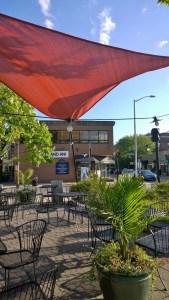
The first two photos today are from Wayland Square in Providence. My husband and I thought the shade covering at l’Artisan looked like something we could use at our house, but by the time we walked back from dinner at the Salted Slate, the pretty covering had gotten all twisted up by the wind.
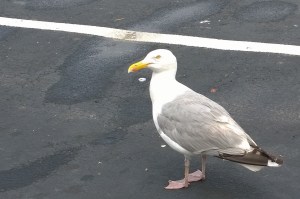
The flowers casting early shadows are Marsh Mallows. The little frog in New Shoreham also cast a long shadow. In the next photo, perhaps you can tell that the herring gull is looking for more of my sandwich.
There’s a sliver of moon above the hanging basket. Hope you can see it. Next is a sample of New Shoreham’s lovely fields and stone walls.
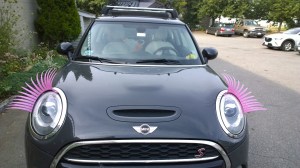
My older granddaughter wanted to know if the car with pink eyelashes was mine. No, but maybe I should think about getting eyelashes for the Fusion.
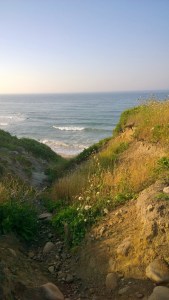
One of my favorite views is looking down the bluffs to the ocean. Often there are surfers riding the waves at this spot. Finally, see how my youngest grandchild cooks breakfast for me in the playhouse.
“The Harvest Kitchen Project is one of the many arms of Farm Fresh Rhode Island that keeps local food circulating in our communities. The program takes area youth, ages 16-19, who are involved with juvenile corrections, and puts them to work making sauces, pickles and other preserves.
“The teenagers participate in a 20-week job-readiness program that prepares them for employment in the food industry. The program touches not only on kitchen skills but the on the many aspects of work in the culinary industry, from sales and customer service to local farm sourcing to teamwork and cooperation. …
“For the past several years, Harvest Kitchen has operated out of a commercial kitchen space in Pawtucket.”
But when Pawtucket Central Falls Development (PCF) “approached Farm Fresh with its rehabilitation plan for 2 Bayley St., a downtown [Pawtucket] multi-use building that would include affordable housing, retail space and job-training opportunities, the match seemed perfect.” More at EcoRI, here.
I’ve been buying Harvest Kitchen’s applesauce at the Burnside Farmers Market, and I’m being completely honest when I say it’s the best applesauce I’ve had in years. That’s partly because I love chunks in my applesauce, but also because it’s sweet with no sugar added. If you return the empty jar, you get 25 cents back on the next jar.
Harvest Kitchen offers cranberry and strawberry applesauce, too. Other products include dried apple slices, peach slices in season, whole tomatoes, pickles with veggies, dilly beans and onion relish.
In addition to PCF, organizations that have helped to make this happen include Rhode Island Housing, RI Department of Children Youth and Families (Division of Juvenile Correction), Amgen Foundation, Fresh Sound Foundation, The Rhode Island Foundation and TriMix Foundation.
The Atlantic magazine says Estonia is the new Finland, meaning that it is doing a bang-up job with quality education for all. Educating the poor turns out to be a salient strength of the system.
Sarah Butrymowicz writes, “In 2012, Estonia’s 15-year-olds ranked 11th in math and reading and sixth in science out of the 65 countries that participated in an international test that compares educational systems from around the world (called the Programme for International Student Assessment, or PISA).
“In addition to beating out western nations such as France and Germany and essentially tying Finland in math and science, Estonia also had the smallest number of weak performers in all of Europe, about 10 percent in math and reading and 5 percent in science.”
In comparison, the United States hovers in the middle of the pack.
“While there is less income inequality in Estonia than in the United States—and, with 1.3 million people, the country is significantly smaller—the Baltic nation also has its share of cultural diversity.
“When it achieved independence from the Soviet Union 25 years ago, Estonian became the official language and the language of school instruction. Yet about a fifth of its students come from families that still speak Russian at home, and they have historically lagged behind their native speaking counterparts on tests such as PISA. …
“Marc Tucker, president of National Center on Education and the Economy in Washington, D.C., visited Estonia last year to find out what they’re doing right. He said that after the fall of the Iron Curtain other former Soviet satellites, such as Hungary and the Czech Republic, transitioned to a system preferentially suited to the needs of its elites. Estonia, however, kept giving equal opportunities to students of all backgrounds. …
“There are many factors that may contribute to Estonia’s success on PISA beyond their focus on equality. Education continues to be highly valued. Teacher autonomy is relatively high, which has been shown to be related to better test scores. Teachers stay with the same students in grades one to three – or sometimes even up to sixth grade – allowing deep relationships to develop.”
Maybe we could learn something from this small Baltic state. Read more here about why Estonian students are so successful on tests and whether they are happy with the system and why the country is trying to encourage more individuality and creativity without losing rigor.
Photo: Ints Kalnins / Reuters
First graders take a computer class in Tallinn, Estonia.
Shows how far we have come from ancestors who let nothing go to waste that making clothes out of leftover fabric is a novelty. But it’s a good idea nevertheless.
Katherine Martinko at TreeHugger writes that Beru Kids is a children’s clothing company in downtown Los Angeles that makes use of textiles that would otherwise be landfilled.
“The garment workers are mostly female,” she says, “and are paid higher than minimum wage (not per-garment, as is usual in the fashion industry).
“What’s really interesting about Beru is that it repurposes deadstock fabrics to make its clothes. ‘Deadstock’ refers to surplus fabric that has not been used by other factories. In LA, it is sent to a warehouse, where Beru’s founder Sofia Melograno goes on a regular basis to purchase whatever textiles catch her eye. Beru has also begun recently incorporating organic, traceable cotton into its garments.”
Traceability means the cotton can be traced back to its original source so it’s possible to assess whether all steps in the supply chain are environmentally and ethically sound.
Martinko adds that because the fashion industry is a huge polluter, finding a use for fabric that would otherwise get thrown away is good for the planet.
If you don’t already follow Maria Popova’s Brain Pickings on twitter or receive her emails, you might want to consider it. For me, she is a source of science ideas and children’s book reviews and all sorts of deep thoughts on a myriad of topics. And she always suggests complementary readings at the end of her posts.
Here she reports on a short, animated Ted-Ed that romps through the history of books.
“Carl Sagan saw books as ‘proof that human beings are capable of working magic,’ Popova begins. ‘Reading books is the most glorious pastime that humankind has yet devised,’ Polish Nobel laureate Wisława Szymborska observed in her memorable meditation on why we read. …
“Books, Susan Sontag wrote in her beautiful letter to Borges, grant us ‘a way of being fully human.’
“Indeed, any thinking, feeling human being knows that it is impossible to be fully alive and awake to the world without reading, and so we’ve come to see books not only as essential to our humanity.
“But this wasn’t always so. …
“How did something so nascent become so elemental to our humanity? That’s what educator Julie Dreyfuss and animator Patrick Smith … explore in this short TED-Ed animation chronicling the history of books:
As the book evolves and we replace bound texts with flat screens and electronic ink, are these objects and files really books? Does the feel of the cover or the smell of the paper add something crucial to the experience, or does the magic live only within the words, no matter what their presentation?
Sweet potato evangelism has won the World Food Prize. I learned about this at National Public Radio, which has a regular feature on eating and health called the Salt.
Dan Charles reports, “One summer day in 2012, on a long drive through northern Mozambique, I saw groups of men standing beside the road selling buckets filled with sweet potatoes. My translator and I pulled over to take a closer look. Many of the sweet potatoes, as I’d hoped, were orange inside. In fact, the men had cut off the tips of each root to show off that orange color. It was a selling point. …
“In Africa, that’s unusual and new. Traditionally, sweet potatoes grown in Africa have had white flesh. …
“Those orange-fleshed sweet potatoes along the road that day represented the triumph of a public health campaign to promote these varieties — which, unlike their white-fleshed counterparts, are rich in Vitamin A. [In June], that campaign got some high-level recognition at a ceremony at the U.S. State Department. Four of the main people behind it will receive the 2016 World Food Prize. This prize is billed as the foremost international recognition of efforts to promote a sustainable and nutritious food supply.
“This year’s laureates are Maria Andrade, Robert Mwanga, Jan Low and Howarth (Howdy) Bouis. Three of them — Andrade, Mwanga and Low — worked at the International Potato Center, which is based in Peru, but has satellite operations in Africa. Bouis worked at the International Food Policy Research Institute in Washington, D.C. …
“In recent years, researchers have documented health improvements among villagers in Mozambique and Uganda, simply because they chose to eat sweet potatoes with orange flesh.” More at NPR.
Don’t you love the orange truck? I call that multichannel messaging.
Photo: Dan Charles/NPR Maria Isabel Andrade is one of four researchers honored with the World Food Prize for promoting sweet potatoes that are orange inside to combat malnutrition.
The humble horseshoe crab is a reminder of prehistoric times. Public Radio International’s Living on Earth recently devoted a segment to this curious character.
From the transcript of the show …
Steve Curwood: “For healthy oceans, it’s not enough to protect just the top of the food chain – the cod or halibut or swordfish we eat. The bottom of the food chain is vital too. That could be the plankton or the tiny forage fish eaten by many species – or it could be the extraordinary prehistoric-looking horseshoe crab.
“These helmet-shaped arthropods have been around for millions of years, and up and down the east coast of the US, volunteers come out to count them as the females come ashore to spawn. On Cape Cod, as Karen Zusi reports, scientists and volunteers are tagging and labeling the crabs to help conserve them.”
Karen Zusi: “There are a lot of reasons why someone might appreciate the lowly horseshoe crab. Eel and conch fishermen use them as bait, and medical companies draw blood from the animals. Horseshoe crab blood will clot in the presence of bacteria, so these companies can use the crab’s blood to make sure vaccines and medical implants are free of germs. Their blood is worth sixty thousand dollars a gallon.
“But horseshoe crab populations are dropping. To preserve them, scientists and volunteers on Cape Cod are wading into the water to count and tag the animals.
“Special labels help them keep track [says] Mark Faherty, the science coordinator at Audubon’s Wellfleet Bay Sanctuary. …
“The Massachusetts Audubon Society just recruited graduate student Michael Long to lead their newest horseshoe crab study. With researchers from the University of Massachusetts, he will be tagging the crabs this summer with a telemetry [label], glued onto the crab’s shell.”
Faherty: “My acoustic study is going to be putting on acoustic receivers out in the bay, and acoustic markers on the crabs. The receivers have about a 600-meter detection radius so anytime a crab that’s marked with an acoustic receiver comes within 600 meters of that receiver, it will mark where it is. So based on where each crab pings, you can kind of track its movements around the bay.”
Zusi: “None of this would be possible without the Audubon Society’s volunteers. They come from all walks of life.
“At an Audubon horseshoe crab conference, Long organizes new volunteers to help him count horseshoe crabs on the beach, and Faherty trains them in the basic survey procedures. …
“Once they got down to business, the volunteers were trained to divide the beach into small sections, count the horseshoe crabs, and record all of their information. The volunteers go out to survey when female crabs are coming to lay their eggs in the sand. Males follow to fertilize the eggs after they’re laid.”
Faherty: “The male crabs you quickly learn to recognize because they’re by themselves. They will mate with a model, if you make a model of a horseshoe crab — the males will congregate around it. They’ll spawn. They’ll spawn with your boot. These are just hormonally-charged animals that are ready to mate with anything. Females are not lonely for long in the horseshoe crab world.”
More here on the effort to study and protect horseshoe crabs.
Photo: Peter Massas, Flickr CC BY-SA 2.0 A horseshoe crab floats by the shore on Union Beach in New Jersey. The species is listed as Near Threatened by the International Union for the Conservation of Nature.
Once again, Sweden is ahead of the curve, as it tests two versions of an electric road. The idea is to move away from fossil fuels and creative a more sustainable energy future.
Green Car Congress is a website that covered the story in June.
“Sweden inaugurated a test stretch of electric road on the E16 in Sandviken, thus becoming one of the first countries to conduct tests with electric power for heavy transports on public roads.
“The test stretch on the E16 is two kilometers long. The technology is similar to light rail, with contact lines 5.4 meters over the roadway. The truck has a pantograph on the roof that feeds 750 VDC to the truck’s hybrid electric system. The current conductor can connect automatically at speeds up to 90 km/h (56 mph). The test stretch is equipped with posts 60 meters apart that hold up the electric lines over one of the lanes.
“At a rest area, there is a transformer for low-voltage direct current of the same type as in the light rail network. Other traffic on the road will not be affected. …
“An electrified road is one in which the electricity supply for vehicle propulsion is continuously supplied in order to keep the vehicle moving and to avoid recharging requirements. …
“The technologies for electric roads have developed rapidly over the last few years, and are now mature enough that some of them can be tested. Last year, the Swedish Transport Administration, in consultation with Vinnova [Sweden’s innovation agency for sustainable growth] and the Swedish Energy Agency, decided to give support to two test facilities. The two systems differ as to how electric power is transferred to the heavy vehicles.
The test on the E16 in Sandviken is being carried out by Region Gävleborg, and involves a pantograph on the roof of the truck cab feeding the current down to a hybrid electric motor in the truck.
Outside Arlanda, the eRoadArlanda consortium company will test a technology that involves an electric rail in the roadway charging the vehicle during its trip. …
“The tests will continue up through 2018. They will provide knowledge of how electric roads work in practice, and whether the technology can be used in the future. The experiment is based on the Government’s goal of energy efficiency and a fossil fuel-free vehicle fleet by 2030, and will contribute to strengthening Sweden’s competitiveness.”
I gravitate to stories about older people who keep on truckin’ and don’t let age keep them from doing what they love.
Here’s one about a 102-year-old museum docent, who is being honored with a café in her name.
Chuck Hinman of Rhode Island Public Radio reported, “There’s something new at the Rhode Island School of Design in Providence … . Visitors to the [Rhode Island School of Design] Museum have been unable to use its Benefit St. entrance since mid-April, but that entrance now has been re-opened, as RISD unveils what it’s been working on these past few months: its first café, called Café Pearl, after one of the museum’s most dedicated and long-serving docents, Pearl Nathan.
“RIPR’s Chuck Hinman talked to the 102-year-old Nathan at her home in East Providence, about her long association with the RISD Museum.”
Hinman goes on to say Nathan is bemused by the café and her new fame. She tells him her “emphasis was on my art collection,” not the food. She graduated with a degree in art history in New York. When she came to Providence, a friend got her involved in “touring with the children,” and she stayed on. For 70 years.
When Hinman asks who Nathan’s favorite artist is, she says she thinks she will surprise him: “I adore Francis Bacon!”
Now, that takes a certain kind of person, I’d say. A person open to experience. Listen to the audio here and see a photo of Nathan leading a tour in 1962.
Photo: Chuck Hinman / RIPR
Pearl Nathan, 102, a guide at the museum of the Rhode Island School of Design.
Among all the sad aspects of the refugee crisis, children in refugee camps going without any education — sometimes for years — has to be one of the saddest.
10 million under the age of 8 are displaced
Fortunately, there are occasional rays of light, such as adult refugees deciding to start their own school. And here is a story from Mashable about a partnership between the International Rescue Committee and the makers of Sesame Street.
Matt Petronzio writes, “A new partnership between Sesame Workshop, the brand’s educational nonprofit, and global humanitarian aid organization International Rescue Committee (IRC) will allow the two groups to develop, distribute, and test educational resources and programs designed with young refugees in mind. …
“The first phase is to develop educational multimedia content that can reach children living in displaced or resettled communities through mobile devices, radio, TV and printed materials in engaging, enjoyable ways.
” ‘We really set out to find a partner that complements our offerings, and I think the IRC is ideal,’ said Sherrie Westin, executive vice president of global impact and philanthropy at Sesame Workshop. …
“Sesame Workshop and the IRC will adapt existing Sesame products and content for regions where the two organizations already have a presence working with young children and their families. …
“The partnership is aimed at the children who make up half of the record 60 million people currently displaced around the world, specifically the one-third of that population under the age of eight. In addition to a lack of education, these children also often deal with toxic stress and trauma.
” ‘We’ve seen time and time again, in the context of conflict and crisis, that those very young children don’t have a safety net to support them,’ Sarah Smith, senior director for education at the IRC, told Mashable. …
“Most recently [Sesame] launched Zari, the first local Muppet in Afghanistan, a country where many young children lack access to education, especially girls.
“Zari’s gender was a deliberate choice to promote girls’ empowerment — an example of tailoring curricular goals to the needs of a particular country. (According to Westin, recent research showed that fathers in Afghanistan changed their minds about sending their daughters to school after watching Baghch-e-Simsim, the local language version of Sesame Street.)”
A friend from my childhood called Caroline has been following this blog, sometimes making comments related to her field, which is architecture.
Today Caroline sent me a link that she knew would be a perfect fit here. The story is about a design competition to address New York City’s rising seawater.
Kayla Devon wrote about it at Builder Online, “In the next 30 years, roughly 30% of Manhattan is expected to sink below sea level, according to a climate study by the NASA Goddard Institute for Space Studies. Instead of trying to stop the inevitable, Brazilian architect Walmir Luz focused on embracing it.
“After studying climate predictions from the United States Landfalling Hurricane Probability Project and the history of Manhattan’s edge, Luz designed a utopian/dystopian future for New York (depending if you’re a glass half-full or half-empty kind of person).
“Luz’s NYC 2050 concept makes flooding a part of city life by taking inspiration from Venice. Luz designed structures as levels that could allow water to move through lower levels as the sea rises. Streets would become permeable so water can wash over the roads instead of flooding them, and more barriers would surround the city’s edges.
I love it when people who read the blog come upon topics that they know will fit and then send them along. I like being able to share the cool stuff with a wider audience. Thank you, Caroline.
Design: Walmir Luz
Luz won a design award for a concept making the best of rising sea levels in New York City.
Christo is known for making impossible-seeming public art, and just recently, he made some again. Margaret Rhodes reported the story at Wired magazine.
“It takes serious engineering to let 640,000 people walk on water. Luckily, that’s exactly the kind of technical and creative challenge that Christo — the artist who wrapped the Reichstag and dotted Central Park with 7,503 orange panels of fabric—excels at. …
“The new project, the ‘Floating Piers,’ comprises two miles of marigold-yellow walkways gently bobbing on top of Lake Iseo, a small lake in northern Italy, connecting the waterside town of Sulzano with two small islands. …
“Making them work was tricky. Marinas often use temporary, floating piers; a common technique involves propping them atop styrofoam cubes. ‘We discovered very soon that this cube system was perfect for us,’ says Wolfgang Volz, Christo’s project manager. So in the fall of 2014, Christo’s team ran a secret simulation of the Floating Piers in Germany. But the styrofoam blocks were too small and too dense.
“So they built their own blocks—220,000 in total. They’re about 20 percent bigger than the ones marinas use, and more buoyant. A Bulgarian company supplied the materials, and Christo hired four different manufacturing companies to ensure they’d have enough.
“Once Christo had his blocks, he, Volz, and a few dozen workers started connecting the cubes into 50- by 330-foot sections. They attached the cubes with giant screws, right on the water, in a corralled section of Lake Iseo.
“One by one, workers pushed the white styrofoam rafts out into the lake and anchored them to 5.5-ton concrete slabs arranged on the lake floor in a configuration conceived by Christo. ‘Very tedious work,’ Volz says. ‘Every day the same.’
“It took four months, with workers doing shifts of two weeks on, two weeks off the job. ‘The same as an oil rig schedule,’ Volz says.’ ” More here.
Temporary, like most of Christo’s work, the walkway was scheduled to come down early this month and get recycled. But it lives on in photographs — and the memories of those who visited and got a chance to walk on water.
Photo: Wolfgang Volz
Christo’s project the “Floating Piers” comprised two miles of marigold-yellow walkways on Lake Iseo in northern Italy. Visitors walked the path without handrails.
It’s been sweltering in Southern New England lately, but one doesn’t want to stay indoors all summer.
Taking pictures can be a distraction from the heat. Some of the pictures I’m posting may actually look like they were taken on a cool day, but take my word for it, they weren’t. Even the indoor photo of my grandson and his construction project reminds me it was too hot to play outside last Thursday.
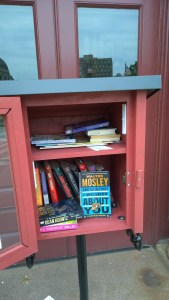
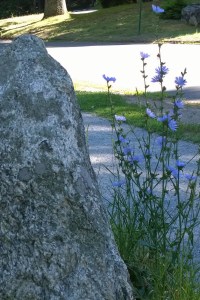
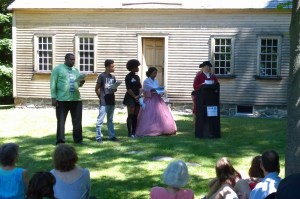
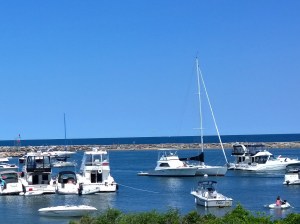
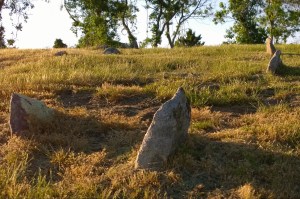
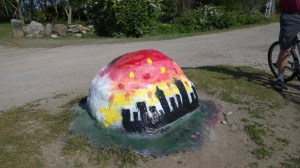
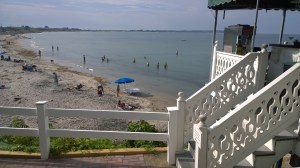
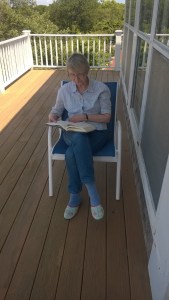
So, here’s what I have: A weed by the dry cleaner’s, Ragged Sailor (chicory) beside a lichen-covered rock, a Fourth of July reading outside the home of a former slave who fought in the American Revolution, my grandson, boats moored in New Shoreham’s Old Harbor, the Indian burying ground at Isaac’s Corner, a city scene on the Painted Rock, Crescent Beach swimmers, Bouncing Bet flowers at Fresh Pond, and yours truly reading Evictedand trying to stay cool.
To expand on a couple of these: I’m told that the Manissean Indians in the cemetery were buried standing up so they could walk into the next life.
And the Fourth of July reading at the home of ex-slave Caesar Robbins was amazing. First the Declaration of Independence was read, which was an eye opener for me because I remembered only the first lines.
Next, anyone who wanted to could read aloud a section of Frederick Douglass’s powerful 1852 Fourth of July speech on the lack of independence for so many people on that Independence Day. Hearing this speech, I could readily imagine how Douglass’s soaring rhetoric helped pave the way for the Civil War and Emancipation.
It’s interesting to me how artists who believe in a particular cause will use what they know best to advance that cause. Sometimes it takes art to get a wider audience to understand an issue.
At the Greenpeace blog, Elvira Jiménez and Erlend Tellnes wrote in early June about how pianist and composer Ludovico Einaudi is raising awareness of global warming.
“The Greenpeace ship Arctic Sunrise set off from the Netherlands carrying a very special load: the voices of eight million people. Messages from around the globe calling for governments to save the Arctic from threats such as oil drilling and destructive fishing. …
“As the ship stopped in Svalbard, Norway, Europe’s gateway to the Arctic, it welcomed aboard a very special guest: renowned pianist and composer, Ludovico Einaudi. With him a grand piano, to undertake his most challenging performance yet, in the Arctic surrounded by ice. …
“As he performed this piece for the first time — in front of a magnificent surging glacier — the music echoed across the ice, a moment that will remain in our minds forever.” More here.
If one picture is worth a thousand words, maybe this one had an effect: a couple weeks later an international conference voted for protection of the Arctic.
Pilar Marcos followed up at the Greenpeace blog on June 30: “At a meeting held in Ostend, Belgium, last week, the OSPAR Convention agreed to adopt specific measures to protect its Arctic region, including a commitment to secure a marine protected area (MPA) in 2016.
“This means an unprecedented agreement on Arctic protection, which could result in safeguarding the first piece of a future sanctuary in the High Arctic in just a few months’ time. [It’s an] area equivalent in size to half of the surface of Spain, [where] no oil drilling or large industrial fishing will take place, and where the protection of threatened habitats and species will be the priority.”
Photo: Greenpeace Acclaimed Italian composer and pianist Ludovico Einaudi performs “Elegy for the Arctic” on a floating platform in the Arctic Ocean, the world’s most vulnerable ocean.