Feeds:
Posts
Comments

Posts Tagged ‘farm’

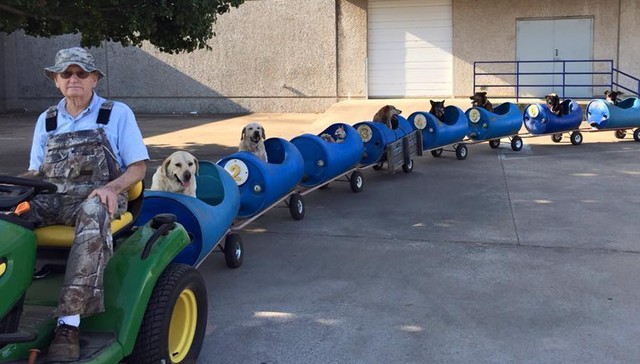
The website “The Dodo: For the Love of Animals” recently posted about a man who built a little choo-choo train to give dogs rides.

Stephen Messenger writes, “Eugene Bostick may have officially retired about 15 years ago, but in some ways that was when his most impactful work began. Not long after, he embarked on a new career path of sorts — as a train conductor for rescued stray dogs. …

“Over the years, Bostick has taken in countless abandoned dogs. But more than just keeping them safe, he’s found an adorable way to keep them happy, too.

“While the rescued dogs have plenty of room to run and play on Bostick’s farm, the retiree thought it would nice to be able to take them on little trips to other places as well. That’s about the time he was inspired to build a canine-specific form of transportation just for them.

” ‘One day I was out and I seen this guy with a tractor who attached these carts to pull rocks. I thought, “Dang, that would do for a dog train,” ‘said Bostick. ‘I’m a pretty good welder, so I took these plastic barrels with holes cut in them, and put wheels under them and tied them together.’ And with that, the dog train was born. …

“The dog train has come to attract a fair share of attention among locals who occasionally stop to ask if they can take a few pictures. But for Bostick, it’s all about bringing a bit of joy to a handful of dogs who had been through so much before finding themselves as his cheerful passengers.”

Bostick tells Messenger, “Whenever they hear me hooking the tractor up to it, man, they get so excited, they all come running and jump in on their own. They’re ready to go.”

More.

Photo: Tiffany Johnson/Facebook

Read Full Post »

Who can resist a farmers market at this time of year? They are such joyful places.

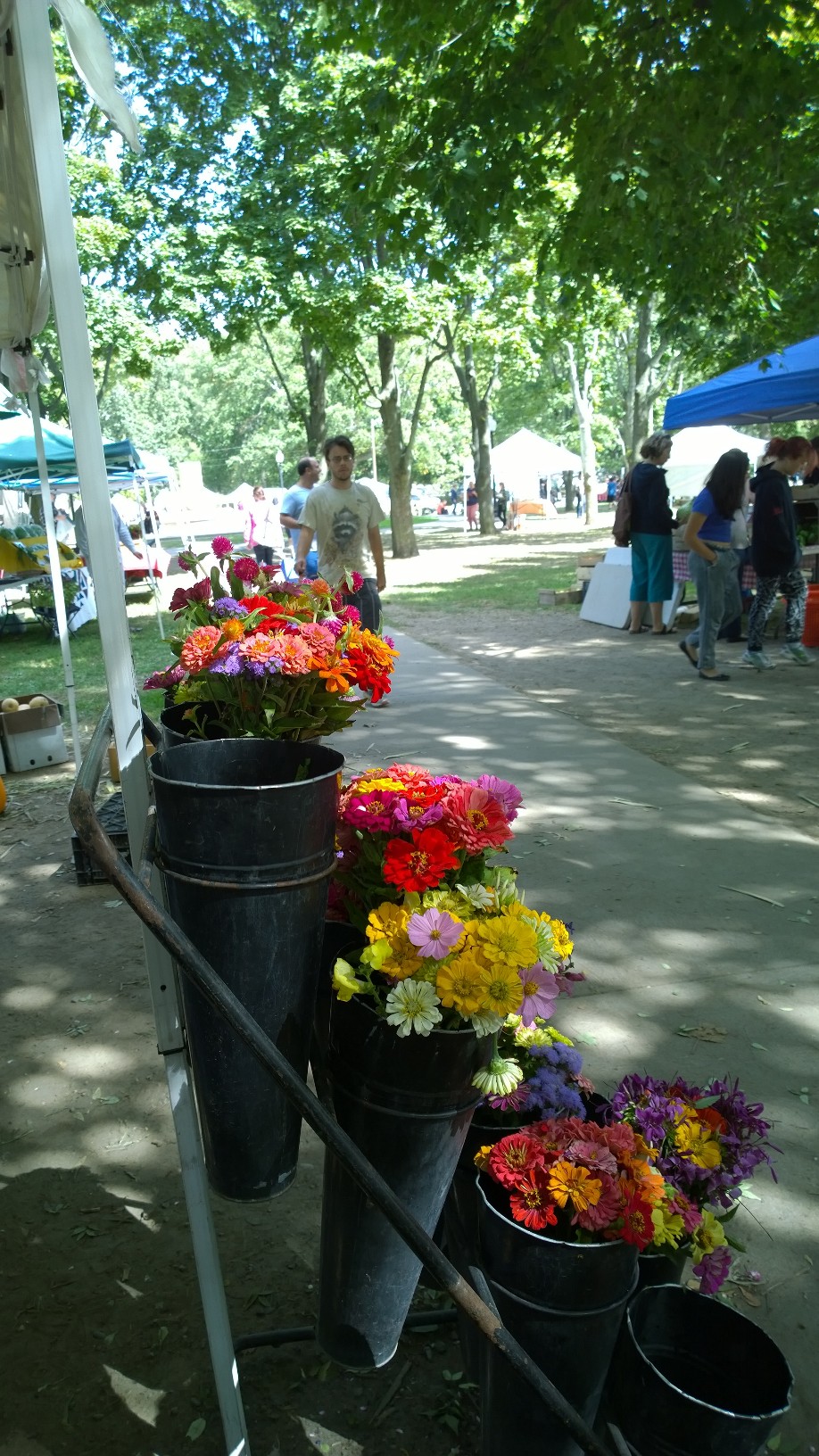
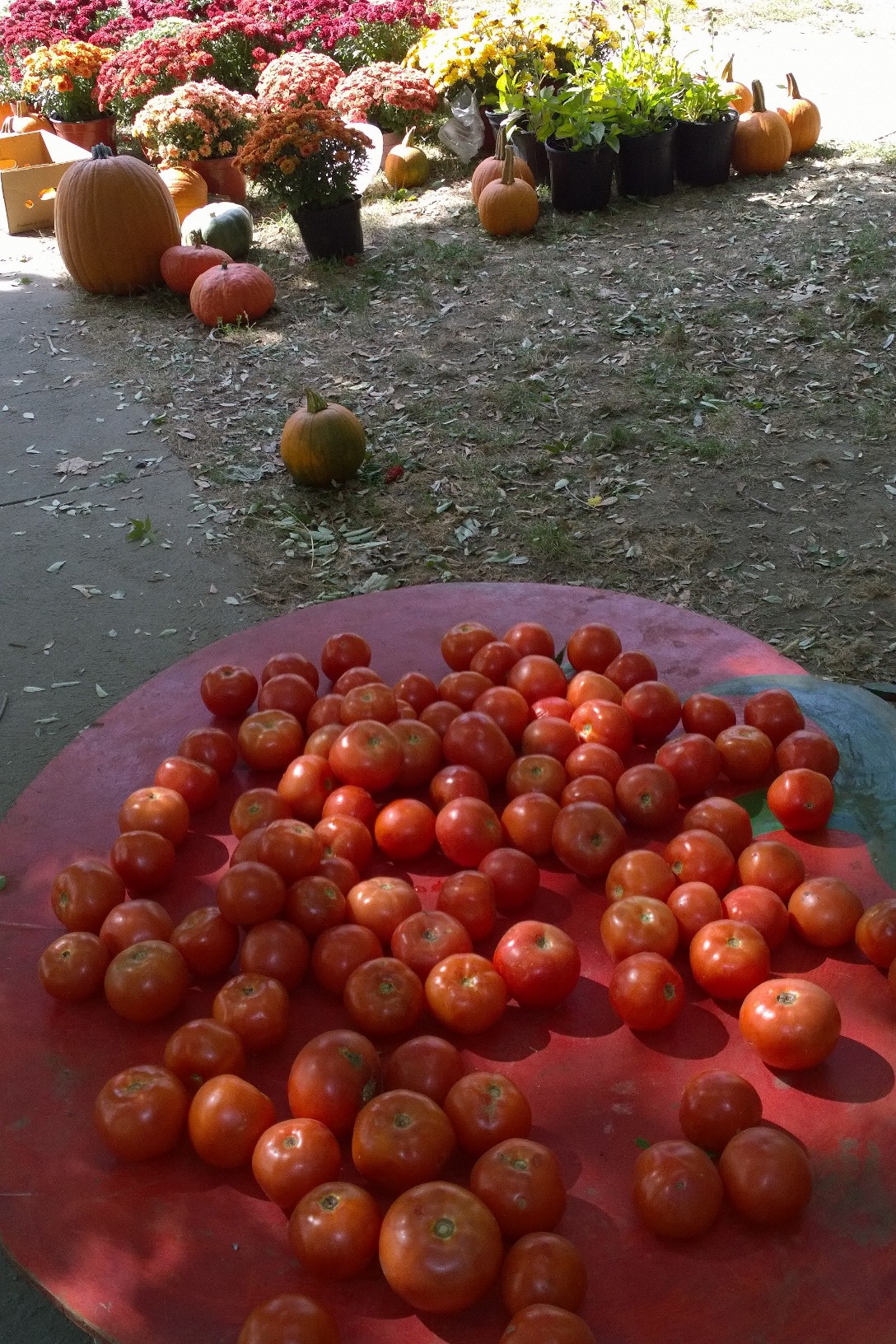
Saturday we went with Erik and the kids to the Hope Street Farmers Market in Providence. It’s in a good-sized park where there is a playground as well as farmstands, crafts, live music, samosas, tacos, flowers, raw juices, fish, sausages, granola made by refugees …

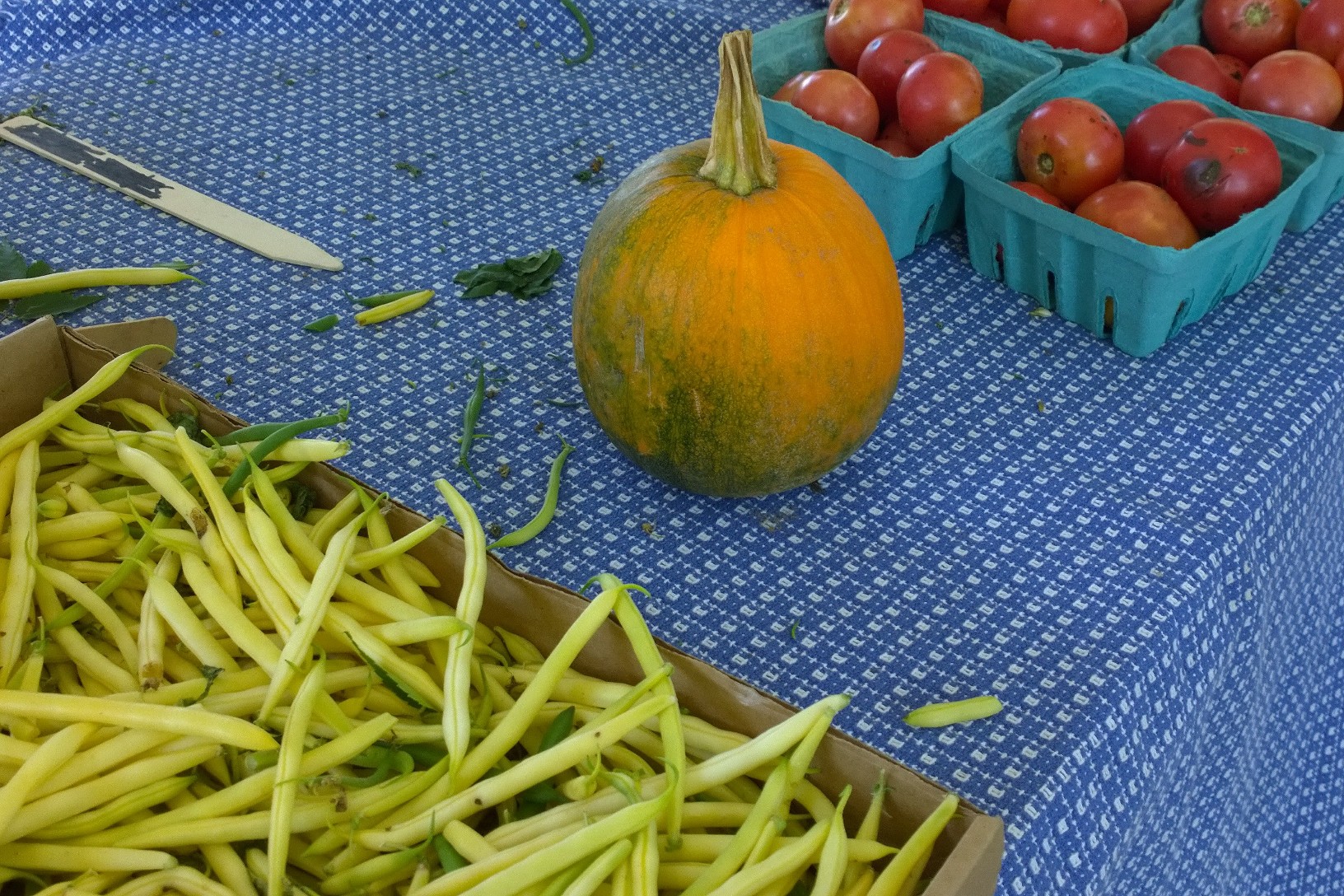
After his grilled cheese and his Del’s lemonade, our 3-year-old grandson chose the little green and orange pumpkin below. It’s now on his dining-room table at home. His sister, when she wasn’t sleeping, worked hard at inspecting everything on the ground and trying to put it in her mouth.

A few words from the website on extra offerings that might interest backers of other farmers markets: “For your convenience, here are some of the unique features of the Hope Street Farmers Market: The Bicycle Valet at the Saturday morning market, run by Recycle-A-Bike, a volunteer-based community organization that connects people with refurbished bikes, provides practical bike knowledge, and advocates bicycle use by safer, more confident cyclists. Anyone can drop off their bike while shopping and know that it will be safely watched and sometimes even tuned up, for a small fee, while they shop. http://www.recycleabike.org gives a full description and mission of the organization.

“Knife Sharpening while you shop is another new feature of our Saturday market. You can drop our your knives (wrap them carefully and mark them with your name please!) to be professionally sharpened for a small fee while you shop.

“Live music at the markets features local musicians or acoustic bands playing every Saturday and some Wednesdays, so feel free to bring a blanket, buy your picnic lunch or supper and enjoy the entertainment.”

092615-RI-farmers-market

092615-Prov-Farmers-Market

092615-market-Providence

Read Full Post »

Over at radio show Living on Earth, “Steve Curwood spoke with farmer and author Audrey Levatino, who has written Woman Powered Farm: Manual for a Self-Sufficient Lifestyle from Homestead to Field. …

“CURWOOD: Why did you decide to write a book about farming specifically for women?

“LEVATINO: Well, women were coming up to me at the farmers’ market and asking about what I did and were very interested. Many of them wanted to know how to get into farming and growing things themselves, and so they wanted advice and instructions on how to get started. …

“CURWOOD: Audrey, what do women farm more typically as opposed to men?

“LEVATINO: That’s a great question, and that’s another thing that I really investigated when I was writing the book. And many women get into this farming business. It starts off as just wanting to provide the best and healthiest, most local food that they can for their families. So women are growing a lot of different things, but in many cases it is healthy, delicious, seasonal food. They know exactly where it came from, so that their children and their husbands and their neighbors can have the best food possible.

“But the other thing that I discovered as I got further into my research and interviewed lots of women farmers in my area and around the country is women are just amazingly creative: they grow herbs and other medicinal plants to make cheese, salves and tinctures. Women also tend to farm — when they do livestock — smaller animals. You know, things that are a little more manageable. And sometimes it’s for fiber — sheep and llamas and alpacas — other times it’s for milk, such as using goats to make cheese.” More here.

Audrey’s farm, Ted’s Last Stand, is located near Charlottesville, Virginia.

Photo: Michael Levatino
Audrey Levatino grows specialty cut flowers and sells them at local farmers’ markets to florists and restaurants, and for weddings.

Read Full Post »

This story comes from Heather Dockray at Good magazine (by way of the Huffington Post). It’s about a life-affirming project in Atlanta.

“Good, local, nutritious food shouldn’t be expensive,” she writes, “and shouldn’t only be enjoyed by people who can afford it.  A homeless shelter in Atlanta decided that their residents desperately needed access to healthy food — but instead of sourcing out, encouraged residents to grow their own. Now, the shelter is home to a huge rooftop garden planted by the residents themselves, which is expected to yield hundreds of pounds of great quality greens. …

“While eating discounted snacks might give homeless residents short-term financial benefits, the long-term health consequences are substantial. The Metro Atlanta Task Force for the Homeless, who runs the gardening program, wanted to give homeless people access to food previously considered out-of-reach. Now, residents are responsible for 80 garden beds, producing kale, carrots, chard, and squash, among other vegetables.” More here.

Dockray doesn’t mention how gardening and donating to the shelter makes residents feel, but I am going to guess it builds their self image and confidence.

Photo: Metro Atlanta Task Force for the Homeless

Read Full Post »

Not sure how I learned about this story in the St. Louis Post-Dispatch, but I knew right away it would be good for the blog. It seems that enterprising neighbors of some vacant urban land started a garden on it 35 years ago, always wondering what would happen if the owners ever turned up.

Reporter Paul Hampel writes, “Joe Spears was ready to give up the farm. He had no legal claim to the plot of land in Kinloch, after all. Spears was just one of several dozen people who, without any official clearance, had been planting and harvesting greens, okra, melons, beans, tomatoes and peppers for the past 35 years on about nine vacant acres abutting North Hanley Road.

“When an executive from one of the largest construction firms in the Midwest approached the amateur farmers in the fields last fall, it looked like a good thing was coming to an end.

“ ‘We were never trying to pull the wool over anyone’s eyes,’ Spears, 70, of Rock Hill, said … ‘It wasn’t our property. And it wouldn’t be right for us to make a scene when the rightful owners told us to move on.’

“The rightful owner, Clayco Inc., explained that the minifarms lay in the path of the planned expansion of NorthPark Business Park, the company’s massive development … Then came a proposal that caught the farmers, including Armstead Ford, by surprise.

“ ‘Clayco offered to give us another place to farm,’ Ford, 75, of Northwoods, said. ‘I was hopeful but skeptical.’ …

“Clayco president Bob Clark allayed those concerns when he announced that the company was relocating the farmers to 8 acres in Berkeley that they had asked him for, just across North Hanley Road from the old farm.

“And the farmers won’t have to capture rain in barrels or haul in water to the new site: Clark, 56, was throwing in an irrigation system, along with a building on the property that has running water, electricity and restrooms.”

Read the rest of the story here, and check out the other photos.

Read Full Post »

I have written a few times about young people who commit themselves to a life of farming. At National Public Radio, Jennifer Mitchell explains why Northern New England states like Maine are particularly attractive to beginning farmers.

“On a windy hillside just a few miles from Maine’s rocky mid-coast, it’s 10 degrees; snow is crunching underfoot. Hairy highland cattle munch on flakes of hay and native Katahdin sheep are mustered in a white pool just outside the fence. Not far away, heritage chickens scuttle about a mobile poultry house that looks a bit like a Conestoga wagon.

“Marya Gelvosa, majored in English literature and has never lived out in the country before. ‘Just a few years ago, if you’d told me that I was going to be a farmer, I would have probably laughed at you,’ she says.

“But Gelvosa and her partner, Josh Gerritsen, a New York City photographer, have thrown all their resources into this farm, where they provide a small local base of customers with beef, lamb and heritage poultry. Gerritsen says their livelihood now ties them to a community. …

” ‘It’s very fulfilling work,’ Gelvosa says, ‘and noble work.’ …

“In Maine, farmers under the age of 35 have increased by 40 percent, says John Rebar, executive director of the University of Maine Cooperative Extension: ‘Nationally, that increase is 1.5 percent.’

“And young farmers are being drawn to other rural Northeastern states as well, he says. Maine, New Hampshire and Vermont were all hotbeds of activity during the previous back-to-the-land movement of the 1970s. Many of those pioneers stayed and helped create farming and gardening organizations that now offer support and encouragement for new farmers. …

“Sparsely developed states like Maine still possess affordable lands, which savvy young farmers with a little money — and a lot of elbow grease — are starting to acquire.” Read all about it here.

Photo: Josh Gerritsen/Donkey Universe Farm
Marya Gelvosa and Josh Gerritsen run a small farm on Maine’s rocky mid-coast, providing their local community with beef, lamb and heritage poultry.

Read Full Post »

Looking through a pile of magazines recently, I found a 2011 newspaper article I had cut out about Hardwick, Vermont. It’s about reinventing the local culture around food and food-related businesses.

Dirk Van Susteren wrote at the Boston Globe, “If there were a ‘Locavore Capital of America’ one would expect it to be in sunny California or perhaps somewhere in the heartland … But, surprisingly, in rocky northern New England, just 45 miles from the Canadian border, is a place that could contend for that honor: Hardwick, a former quarrying town that until recently knew more pain than promise.

“In recent years Hardwick, population 3,200, located along a tumbling stretch of the Lamoille River, has seen a half-dozen innovative agricultural enterprises crop up, many with mission statements including such words as ‘community-based,’ ‘sustainable,’ and ‘organic.’

“The town, always a bit scruffy, and with a high jobless rate, might be on a green trajectory. And people are taking notice.

“Among the new operations here or in nearby towns: Jasper Hill Farm, which makes artisanal cheeses and provides aging, distribution, and marketing services to local cheesemakers; High Mowing Seed Co., an organic seed business, whose owner likes traveling around the country to tell the Hardwick farm and food story; Highfields Center for Composting, a soil-making business that collects its raw materials from restaurants, farms, and schools; Pete’s Greens, a CSA (community-support ed agriculture) farm that grows organic vegetables in gardens and greenhouses; and, finally, Vermont Soy, a tofu and soymilk producer.

“The area also has dozens of small-scale producers, from orchardists to maple sugarmakers. Their products sell at farm stands, at the summer farmers’ market, and at Buffalo Mountain Food Co-op and Cafe, a landmark in its 36th year. …

“Monty Fischer, the executive director of the Center for an Agricultural Economy, the nonprofit organization that helped spur these farm efforts, has kept count. ‘People from 40 states and 40 countries have come to ask about our agricultural cluster,’ he reports, from his downtown office.”

Read about the 2011 federal grant for the Vermont Food Venture Center, an incubator facility, the organic North Hardwick Dairy, where sunflowers are grown as a value-added crop, mead maker Caledonia Spirits, and more here.

And if anyone has been up there recently, I sure would love to know if the food culture is still going strong.

Photo: Wikipedia
North Main St., Hardwick, Vermont

Read Full Post »

Martha Bebinger had a great story at WBUR recently. It’s about an immigrant from Burundi with a mission.

“There were still drops of dew on the stalks of thick, spear-shaped leaves Fabiola Nizigiyimana slashed and tossed into a box one early morning.

“ ‘We call them lenga lenga, in our language,’ she said, laughing the words. “They are [a] green.’

“The 40-year-old single mother of five farms a one-acre plot in Lancaster. She’s one of 232 farmers who share the 40-acre Flats Mentor Farm. Last year, Nizigiyimana helped found a co-op that teaches farmers, many of whom can’t read or write in English or their native tongue, how to turn their plots into a business.

“They get help with packaging and selling their goods to local restaurants, ethnic food stores and farmers’ markets, many of them creating budgets and balance sheets for the first time.

“Nizigiyimana [was] honored for her work … at a White House ceremony after being selected as one of 15 USDA Champions of Change, who represent the next generation of farmers and ranchers.”

Read about all that this optimistic, cheerful woman has overcome and what challenges lie ahead for her business here.

Photo: Martha Bebinger/WBUR
Fabiola Nizigiyimana helped found a co-op that teaches farmers how to turn their plots into a business.

Read Full Post »

The radio show Living on Earth is a font of useful and interesting environmental knowledge.

In a recent show, host Steve Curwood spoke with “agronomist Frank Forcella about how he modified the common sand blaster to simultaneously fertilize and weed food crops.”

Curwood introduces the topic thus, “If you’ve ever weeded a garden, you know it’s a backbreaking job, and if you have row upon row of crops, it’s, well, it’s easier to use herbicides. But then the crop is not organic. Enter a team of soil scientists for the U.S. Department of Agriculture who harnessed a common tool of the building trades to blast away those unwanted weeds without chemicals. Joining me to explain this breakthrough is Frank Forcella. He’s an agronomist with the USDA’s North Central Soil Conservation Research Laboratory.”

Forcella then tells Curwood how he got the idea. “One of my hobbies here in Minnesota is growing apricots, and 2007 happened to be a wonderful year for apricot production in Minnesota.

“We ended up with about a five gallon bucket worth of apricot pits, and I was wondering what can we do with apricot pits. One of the things you can do with them is to grind them up and use then as a grit in sandblasters, and I was talking about that with one of the fellows who works with me, Dean Peterson, on our way out to our field plots. Both of us work on weeds, and we had more or less simultaneously had the idea, ‘I wonder if you could use sandblasters to kill weeds.’ Initially we thought that had to be the dumbest idea in the world, but it was one of those ideas we just couldn’t get out of our heads.”

Read how a dumb idea led to a great invention here.

Photo: Frank Forcella
The four-row grit applicator in action, driven by Charles Hennen.

Read Full Post »

Did you ever see tiny, straw-colored objects like the plant called Japanese Lantern at a farmers market and think, “What the heck?” I have. But I would pass them by incuriously, assuming they weren’t edible. They are husk tomatoes.

Turns out my train buddy Kathy grows them. One day this week she surprised me with a little bag of them. She said, “You just squeeze the husk and pop the little tomato into your mouth.”

The taste was sublime. Very sweet. But unlike any tomato or anything else I’ve had before. John thought they looked like a snack his family ate in Egypt, but my daughter-in-law said that was not the same. My grandson liked the idea of popping the tomato out of the husk for me.

That reminded me of car trips when John and Suzanne were little and how my niece said she could always recognize our car because the back seat was full of peanut shells. Husking peanuts was a reliable car-trip occupation for years.

Read more about husk tomatoes (also called ground cherries) here. I’m going to a farmers market Sunday, and if I see any husk tomatoes, I’m going to buy them.

Read Full Post »

Cousin Claire sent me a good link. I had heard about the trend of tying farms to housing developments, but according to the Smithsonian magazine, Development Supported Agriculture is striking a chord with Millenials in particular.

Shaylyn Esposito writes, “A new fad in the housing world is a concept called Development Supported Agriculture (DSA), or more broadly, ‘agrihoods.’

“DSA is the child of Community Supported Agriculture (CSA), in which consumers pledge money or resources to support a farm operation, and in turn, receive a share of what it produces, but take the concept one step further by integrating the farm within residential developments. Instead of paying for access to a golf course or tennis courts, residents pay to be a part of a working farm—helping with the growing process and reaping the crops it produces. …

“The largest demographic of those trying to reconnect with the farm is Millennials, those born from the 1980s to the 2000s who ironically grew up farthest from the farm. As the average age of farmers continues to rise, it is this generation that is stepping in to fill the gaps.” More here.

Among the cohort of Millennial farmers are Sandy and Pat’s niece, now at the the Letterbox Farm Collective in the Hudson Valley. I blogged about her here and here.

Photo: Willowsford
This DSA community in Ashburn, Virginia, is hoping to fill 2,200 homes. Sounds like too many to be serious about the farming side of things.

Read Full Post »

A couple years ago I asked someone who organizes gleaners in Vermont to write an article for the place that I work. Gleaning was new to me then, but now I read about it often.

The idea is that volunteers are invited into farms after a harvest to pick the perfectly good remnants that would otherwise be plowed under. The excess produce is then handed over to food banks at peak of freshness.

Kathy Shiels Tully wrote for the Globe today about one gleaning effort.

“Founded in 2004 by Arlington resident Oakes Plimpton, Boston Area Gleaners organizes volunteers, sometimes on only one to two days’ notice.

“Timeliness is important, said Emma Keough, market and food access manager at Brookwood Community Farm.

“ ‘It’s really critical people show up … We’re growing really intensively, so there’s only a small window to pick excess crops in order to give us time to turn over the land and plant a new crop.’ …

“Todd Kaplan of Somerville signed on four years ago after hearing about Boston Area Gleaners ‘through the grapevine.’

“Averaging a dozen gleaning sessions a year, Kaplan, a legal aid attorney at Greater Boston Legal Services, has gleaned mostly on farms west of Boston — Dick’s Market Garden in Lunenburg, where he’s picked kale, tomatoes, and green peppers; Kimball Fruit Farm in Pepperell, which has offered the group first pick of apples; and the Food Project Farm in Lincoln.

“The gleaning nonprofit ‘moves an inordinate amount of food that would otherwise go to waste into the hands of people who really need it,’ Kaplan said.

“Lynn Langton, a North Andover resident, says her immediate reaction to learning about gleaning in a newspaper article three years ago was ‘I want to do that!’ … It’s such a high-quality, fresh product. It’s unbelievable.’ ”

More here.

Photo: John Blanding/Globe Staff
The Boston Area Gleaners program organizes volunteers. to pick excess crops from farms and donate them to food banks for distribution. Matt Crawford is the group’s coordinator.

Read Full Post »

Here’s an update on the Wooly Pig farmers I blogged about in 2012. (See that here.) At that time, they were raising chickens in Connecticut. They have since joined forces with other young farmers and are now part of the Letterbox Farm Collective in Hudson, New York. If you have Facebook, that’s the best place to see their photos and learn what they are up to. (Click here.)

From the Letterbox Farm About page: “We are a group of people growing meals and medicine on shared land in the Hudson Valley. We take our time and listen.”

If you don’t have Facebook, you might enjoy the pictures at a Turnquist Photography post called “Young Farmers of the Hudson Valley.”

The photographer writes, “We were recently contacted by Chronogram Magazine, a tremendous monthly publication circulated in and around the Hudson Valley based out of Kingston, NY. They asked that we photograph some young farmers local to the Hudson area for an article being written for their September issue. … It was a true honor to be considered for this assignment, especially after meeting these amazing people who UNDERSTAND what it means to eat responsibly.

“My first stop was just outside of the Hudson city limits to Letterbox Farm Collective.” (Turnquist photos here.)

Letterbox farmer Nichki’s Aunt Sandra sent me a photo of a spring farmers market that the collective attended in Rhinebeck. I’m told they can hardly keep up with the demand from restaurants for duck eggs, rabbits, and quail.

Read Full Post »

I’m grateful to Scott, a former colleague, for putting this cool thing on Facebook. Looking at these healthy, growing plants is especially warming today, now that the temperature has gone back to 15 F.

Tim Blank at Future Growing LLC (which produces vertical aeroponic food farms) writes, “When you hear about a farm that supplies all-natural, sustainable produce, using 90% less water and 90% less land, one that utilizes the most advanced vertical aeroponic technology on earth, you surely would not guess it would be an Amish farm.

“Yet in Topeka, Indiana, you cannot get produce that is more local, fresh, healthy, and sustainable — even in the middle of an Indiana blizzard — like you can get at Sunrise Hydroponics, an Amish farm.

“Sunrise Hydroponics is owned and operated by husband-and-wife team Marlin and Loretta Miller on their rural farm in Topeka. I have had the privilege of working with the Amish community for more than half a decade, and have come to learn that, while their lives seem simple to many outsiders, their homes, farms, and businesses are highly innovative. The Amish utilize cutting-edge and creative forms of technology to improve their lives, while still falling within the guidelines of their belief system.” Read more here.

Greenhouse at Sunrise Hydroponics

Read Full Post »

Here’s something fun from the UK paper the Telegraph: Irish farmers taking pictures of themselves on mobile phones. The farm animals add that certain je ne sais quoi.

Emily Gosden has the story.

“Photos of Irish farmers taking ‘selfie’ photos with their livestock have gone viral,” writes Gosden, “being republished on dozens of news sites around the world. …

“The snapshots were originally submitted to the Irish Farmers Journal for its ‘selfie on the farm’ competition. Ten finalists picked by the journal include a photo by Patricia Farrelly from Ballyjamesduff, posing with a goose and an axe, and a shot entitled ‘two fine beards’ by Peter Desmond from Ballinhassig, sporting a beard and posing alongside a bearded goat.”

More here.

Photo: Irish Farmers Journal/Facebook
Farmer P.J. Ryan from Newport, County Tipperary, in his prize-winning selfie. The picture was submitted by his daughter Aisling.

Read Full Post »

« Newer Posts - Older Posts »