Feeds:
Posts
Comments

Posts Tagged ‘postaday’

I love stories about young people who have an impulse to help people in need. And I like that they often have creative ideas about how to do so that an older person might never have considered.

At the Boston Globe, Astead W. Herndon recently covered a high school student, now at Tufts University, who got her creative idea in a rather unusual way — while watching reality television.

Herndon reports, “Before Hannah Steinberg had a day named in her honor and was recognized by a US senator, the Tufts junior was just another high school student watching reality television.

“On that day about four years ago, Steinberg’s show of choice was ‘Extreme Couponing,’ the cable program that follows discount-obsessed shopaholics who go to supreme lengths to buy ultra-cheap items regardless of whether they need them.

“But as she watched the show’s stars proudly hoard their deeply discounted prizes, Steinberg said she had a thought: What if she could coupon with a conscience?

“These days, the 20-year-old Steinberg has a registered charity that has donated more than $100,000 worth of household items, canned goods, and electronics to homeless shelters and hospitals by using the couponing tricks she observed on the show. …

“Steinberg uses the example of a chocolate bar priced at $1.19. If she finds a buy one, get one free coupon, and pairs it with a buy two, get one free coupon and a $4 off any $10 purchase discount, Steinberg said she can purchase 30 chocolate bars for only $6.

“To fund her purchases, Steinberg solicits donations to Our Coupons Care, her federally recognized nonprofit charity. By mixing that money with her coupon magic, Steinberg said she can make “every dollar count for four to five dollars.” More here.

Although this seems like a lot of work, to me that’s not the point. Here’s a young woman who is transforming a consumerism that has run amok — until it is almost an illness — into something positive. And she is demonstrating that people with kind hearts and compassion continue to be born.

Photo: John Tlumacki/Globe
Tufts student Hannah Steinberg surrounded by the coupons she collects to buy goods to donate to charity.

Read Full Post »

The semicolons’ mournful racket
is drowned out by surrounding brackets

Maria Popova recently wrote at Brain Pickings about a 1905 poem that playfully imagines warfare among various kinds of punctuation.

She reports that a new edition, In the Land of Punctuation, is “a beautiful and clever type-art adaptation of German poet Christian Morgenstern’s darkly delightful 1905 poem ‘Im Reich der Interpunktionen,’ illustrated by Indian graphic artist Rathna Ramanathan and translated into English by Sirish Rao. …

“Silkscreened on handmade paper with traditional Indian dyes and hand-bound in a limited edition of 3,000 numbered copies, this gorgeous large-format book comes from South Indian independent publisher Tara Books — a small team of passionate book- and art-lovers who have spent two decades giving voice to marginalized art and literature through a commune of artists, writers, and designers collaborating on books handcrafted by local artisans in a fair-trade workshop in Chennai.”

The peaceful land of Punctuation
is filled with tension overnight

When the stops and commas of the nation
call the semicolons “parasites”

More.

Art: Rathna Ramanathan

Read Full Post »

Time for a photo round-up. Winter in New England: warm days, cold days, snow, ice, complicated shadows, empty facades, food and drink.

If you get any time to be alone and quiet — maybe just nursing a head cold — use it well. Everyone needs time to think.

020516-6tag-lichen-and-snow

020516-dogwood-and-fence-in-snow


020516-sun-on-snow

021316-garage


021316-ice-and-shadows

021316-ivy-shadows


020316-facade-providence

020216-food-and-drink-mural


Read Full Post »

Photo: Bob Plain

I do love the inventiveness of entrepreneurs. A friend of Suzanne and Erik’s is an inventive entrepreneur — an oyster entrepreneur, to be specific. Since oysters are a seasonal crop, he looked for something that might become his winter crop.

Bob Plain’s Narragansett Bay Blog has the story on Jules Opton-Himmel, RI’s first kelp farmer.

“Kelp, you may or may not have heard, is the next super food. It’s nutritious, sustainable and ecologically beneficial,” writes Plain.

He continues with a quote from a recent New Yorker article by Dana Goodyear: ” ‘Seaweed, which requires neither fresh water nor fertilizer, is one of the world’s most sustainable and nutritious crops. It absorbs dissolved nitrogen, phosphorous, and carbon dioxide directly from the sea — its footprint is negative — and proliferates at a terrific rate.’ …

“Coincidentally – and quite auspiciously – just as the blockbuster New Yorker article hit the newsstands, Opton-Himmel was gearing up to introduce kelp farming to Rhode Island. …

“Farm-raised kelp is grown on a longline – a submersible thick rope, held in place by anchors and buoys, that is used to hold in place seafood harvesting equipment. A thin string of kelp spores is wrapped around the longline, and the kelp grows toward the bottom. Opton-Himmel, with the help of Scott Lindell and David Bailey from the Marine Biological Laboratory in Woods Hole, Mass, planted 1,000 feet. …

“Unlike oysters, which grow in the warmer months, kelp only grows when it’s cold. That means it could prove an off-season bumper crop for otherwise summertime-only seafood harvesters. Walrus and Carpenter downsizes from 7 to 3 employees in the winter, Opton-Himmel said, and kelp could help him keep the other four on the payroll all year long.

“ ‘I’d love to keep all 6 on year-round,’ Opton-Himmel said.”

More here.

Read Full Post »

021416-luna-and-stella-at-playtimeNYJPG


Trade shows have been helpful to Suzanne’s birthstone-jewelry company, Luna & Stella, as it branches out from being strictly online to selling to retail outlets like Talulah Cooper Boutique in Providence.

A couple weeks ago, Suzanne took Luna & Stella to the trade show NewYorkNow (“the market for home, lifestyle + gift”). Today, she is making an impression at PlaytimeNewYork — while making friends with other relationship-oriented businesses, like Little Paisley People.

I love how the founder of Little Paisley People describes the origins of her business: “I spent the most memorable summers of my childhood in Amalsaad, a quaint village, in Gujarat, India. … I grew up watching my mom work with the local artisans to hand-make toys that would support the local community. Those are the toys you also see in the Little Paisley People line. And that’s the logo you see – the passing on of the thread over the generations. …

“We create handcrafted lifestyle products for children, never forgetting that kids need to be kids. The handmade nature of these products evoke an understated elegance but are always playful. Social responsibility, the people who make these products, and how they make them are very important to us.”

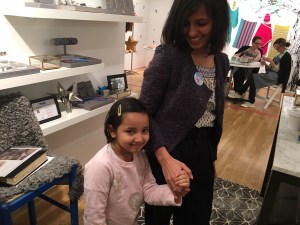
Here, she and her daughter model Luna & Stella’s mother-daughter heart rings. How nice that new businesses are emphasizing the importance of family and friend relationships!

Luna-and-Stella-heart-rings

mother-daughter-of-little-paisley-people


Read Full Post »

021116-Valentines-for-nursery-school

A few Valentine’s Day items.

Suzanne, her son, and I made 50 valentines, and I trotted along Thursday when he carried them in a little striped bag to nursery school. The school had told parents that it was fine if kids didn’t do valentines, but if they wanted to bring any, then they needed to bring them for everyone.

Suzanne reports the cards were a great success: “They decorated bags and then went around putting valentines in each others’ bags. G really liked opening the valentines at home and reading the kids’ names.  He particularly liked the one from a boy whose parents didn’t follow the rules and included a lollipop. 🙂 ”

My Valentine is in New York to help Erik with the kids while Suzanne attends the Playtime trade show. The cookies I made are for him when he gets home.

By the way, if you want to see some funny valentine gifs that listeners made at the behest of the radio show Studio 360, click here.

021416-valentine-cookies


Read Full Post »

It’s back to the Book of Holidays Around the World to see what Alice van Straalen has to say about Lunar New Year (also called Spring Festival or Chinese New Year).

“A huge dragon — a symbol of good luck — leads the Chinese New Year processions. It’s made of bamboo covered in paper or silk, and more than 50 people may support it underneath, making it weave and wind though the streets. Dancers, acrobats, clowns, and stilt walkers accompany the dragon, and firecrackers go off to scare away evil spirits. In Chinese homes families hang red scrolls printed with wishes for good luck and prosperity, and children receive coins inside little red packets.”

When my husband was working in Shanghai, I went to visit at Lunar New Year and have never seen — or heard — so many fireworks in my life. More recently, at Water Fire in Providence, a summer event, I got to see a fun dragon dance.

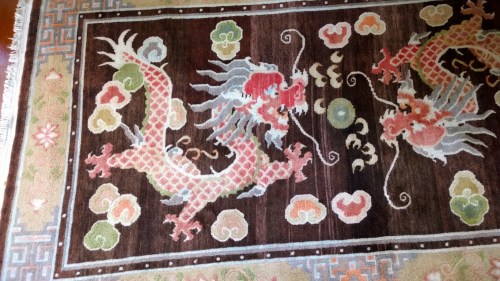
(Hmmm, just remembered I had a dragon rug I could use to illustrate this post. Happy Year of the Monkey!)

021316-dragon-rug

Read Full Post »

A couple years ago, I was taken with a newspaper photograph of pink and blue buildings in a lonely North Korean square. So foreign. So melancholy.

I tried to get in touch with the photographer, David Guttenfelder, to see if I could buy a print. That didn’t work out, but I learned quite a bit about him and his special status as an approved photographer for Western outlets in North Korea. I became a follower on twitter and instagram, where I discovered that his photos of everyday life in the isolated country had inspired other Westerners living there. Now I follow posts on instagram by a group of people calling themselves everydaydpk.

So I was intrigued when Studio 360 also took an interest in photographs from North Korea.

Khrista Rypl posts on the radio show’s website, “North Korea’s seclusion makes pictures from inside the country irresistible novelties. But while the country’s borders are tightly controlled, visiting isn’t as difficult as you might expect. Almost anyone with enough cash can book a tour (although the US State Department advises against it) and people even travel there to run in an annual marathon. Officially, North Korea says it hopes to attract two million visitors by 2020.

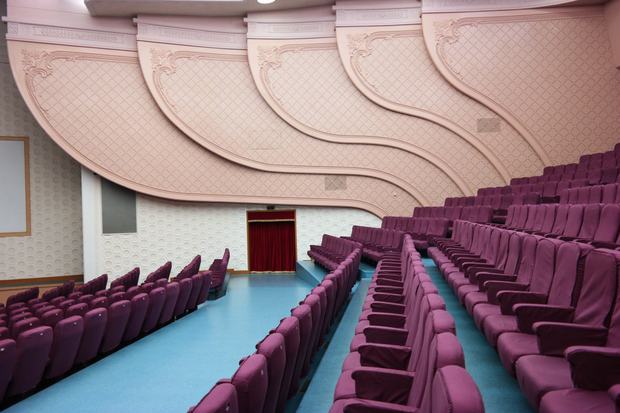
“One of the tours available is an architectural survey of the nation’s capital, Pyongyang. Oliver Wainwright, architecture and design critic for The Guardian, recently visited the country with that itinerary. He’s been posting photos of interiors of the city’s buildings, and wrote a nice piece about his visit. It’s a fascinating glimpse inside a closed society. The empty interiors look like they’re part of an abandoned theme park from the 1980s.

“Wainwright notes that pastel colors appear everywhere in the city and calls the aesthetic ‘kindergarten kitsch’ — ‘the logical next step for a regime intent on projecting an image of carefree prosperity.’ …

” ‘In every refurbished building we visit, there is a peculiarly consistent style of preschool colour schemes and shiny synthetic surfaces, the pastel palettes and axial symmetry giving an eerie feeling of walking into a Wes Anderson film set, or a life-size Polly Pocket toy,’ [he adds].

“The decor certainly has a child-like quality, both in the color palate as well as in how each room has been pared down to a few essential elements, like a dollhouse.”

See if you agree, here.

Photos: Oliver Wainwright/Tumblr
The National Drama Theater in Pyongyang

Below, a rendering of an architectural project from the Paektusan Academy of Architecture in Pyongyang 

Read Full Post »

Here’s a recent story about how fungi, of all things, may be affecting global warming.

From ScienceDaily: “Microscopic fungi that live in plants’ roots play a major role in the storage and release of carbon from the soil into the atmosphere, according to a University of Texas at Austin researcher and his colleagues at Boston University and the Smithsonian Tropical Research Institute. The role of these fungi is currently unaccounted for in global climate models. Some types of symbiotic fungi can lead to 70 percent more carbon stored in the soil.

” ‘Natural fluxes of carbon between the land and atmosphere are enormous and play a crucial role in regulating the concentration of carbon dioxide in the atmosphere and, in turn, Earth’s climate,’ said Colin Averill, lead author on the study and graduate student in the College of Natural Sciences at UT Austin. …

“Soil contains more carbon than both the atmosphere and vegetation combined, so predictions about future climate depend on a solid understanding of how carbon cycles between the land and air.

“Plants remove carbon from the atmosphere during photosynthesis in the form of carbon dioxide. Eventually the plant dies, sheds leaves, or loses a branch or two, and that carbon is added to the soil. The carbon remains locked away in the soil until the remains of the plant decompose, when soil-dwelling microbes feast on the dead plant matter and other organic detritus. That releases carbon back into the air. …

“Where plants partner with [ecto- and ericoid mycorrhizal] (EEM) fungi, the soil contains 70 percent more carbon per unit of nitrogen than in locales where [other] fungi are the norm. The EEM fungi allow the plants to compete with the microbes for available nitrogen, thus

reducing the amount of decomposition and lowering the amount of carbon released back into the atmosphere.

More.

Photo: Colin Averill
The fruiting body of a fungus associated with the roots of a Hemlock tree in Harvard Forest.

h

Read Full Post »

Raising a family is challenging under any circumstances, but Simon Romero of the NY Times can tell you about families that have added on a somewhat more extreme challenge: settling in Antarctica.

He writes from Villa Las Estrellas, “Children at the schoolhouse here study under a portrait of Bernardo O’Higgins, Chile’s independence leader. The bank manager welcomes deposits in Chilean pesos. The cellphone service from the Chilean phone company Entel is so robust that downloading iPhone apps works like a charm. …

“Fewer than 200 people live in this outpost founded in 1984 during the dictatorship of Gen. Augusto Pinochet, when Chile was seeking to bolster its territorial claims in Antarctica. Since then, the tiny hamlet has been at the center of one of Antarctica’s most remarkable experiments: exposing entire families to isolation and extreme conditions in an attempt to arrive at a semblance of normal life at the bottom of the planet.

“It gets a little intense here in winter,” said José Luis Carillán, 40, who moved to Villa Las Estrellas three years ago with his wife and their two children to take a job as a teacher in the public school.

“He described challenges like trekking through punishing wind storms to arrive at a schoolhouse concealed by snow drifts, and withstanding long stretches with only a few hours of sunlight each day. …

“Most of the students at the village’s small school, who generally number less than a dozen, are the children of air force officials who operate the base; some of the parents say the isolating experience strengthens family bonds.

“That Villa Las Estrellas is so remote — its name can be translated as Hamlet of the Stars, since the lack of artificial light pollution here enhances gazing into the heavens — sits just fine with many who live here.

“ ‘People in the rest of Chile are so afraid of thieves that they build walls around their homes,’ said Paul Robledo, 40, an electrician from Iquique (pronounced E-key-kay). ‘Not here in Antarctica. This is one of the safest places in the world.’ More here.

And here you thought our cold snap was a little intense!

Photo: Daniel Berehulak for The New York Times  
Children being picked up from school in Villa Las Estrellas. Most of the students at the village’s small school, who generally number less than a dozen, are the children of air force officials who operate a nearby base. 

Read Full Post »

Germans who open their homes to refugees don’t necessarily think of it as that big of a  deal.

Josie Le Blond writes for UNHCR Tracks, “Wael and Ibrahim sleep in their hosts’ home offices, while Homam and Samira are sharing an artist’s home studio. Mohamad has his own room, and Mecid’s large family has been given an entire house to call their own. …

“Ibrahim, a 29-year-old Syrian seeking asylum in Europe, has slotted easily into the lives of his German hosts, Maximilian and Carolin. The couple, both journalists, offered him their spare room when they heard he was having a hard time finding accommodations in Berlin.

“ ‘I met Max when he interviewed me for an article. He invited me to stay if I had any difficulties,’ says Ibrahim, who fled fighting last summer near his home in the Syrian port city of Latakia.

“After five months moving between emergency shelters in Germany, Ibrahim was told he had to find a hostel. But an administrative problem meant he quickly found himself without a roof over his head. Ibrahim remembered Maximilian’s offer.

“What we’re doing is the least we could do.”

“ ‘It’s unbelievable, really. If it weren’t for volunteers offering their places, many people might be out on the streets,’ says Maximilian, 29. ‘What we’re doing is the least we could do. We have a three room apartment – it’s easy.’ …

“Weeks later, Maximilian and Carolin now view Ibrahim just like any other lodger. ‘At this point I don’t see Ibrahim as a refugee that is staying at our place,’ says Maximilian. ‘He’s more like a flatmate who joins us for football every Monday.’ ”

More here.

Photo: UNHCR/Ivor Prickett
Max and Carolin offered their spare room to Ibrahim, an asylum-seeker from Syria, after he struggled to find somewhere to stay in Berlin.

Read Full Post »

As an official member of his town’s tree committee, John has been working hard to promote the many benefits of an urban tree canopy both for quality of life and for the business environment.

Now here comes a really unusual idea for fans of urban greenery. You just need a large body of water.

At the website “Pop Up City,” describes Rotterdam’s floating forest, thought up by (who else?) an artist.

“Rotterdam will get its first ‘bobbing forest’ in 2016: a collection of twenty trees that are floating in the Rijnhaven, a downtown harbor basin.

“Inspired by Jorge Bakker’s artwork ‘In Search of Habitus‘, an aquarium filled with bobbers that grow small trees, Dutch designers and entrepreneurs from Mothership decided to carry out this idea in ‘real life’. After experimenting with a sample tree last year, an entire floating forest of twenty trees is scheduled to be ‘planted’ on March 16, 2016.” Check out some intriguing photos here.

My only question as a person who grew up in a hurricane corridor: What happens if there’s a storm?

Photo: Popupcity.net

Read Full Post »

Germany is opening a 62-mile bike path. That’s what I call a long ride.

See what Charlie Sorrel (“previously found writing at Wired.com, Cult of Mac and Straight No filter”) has to say about it at Fast Company.

“Germany, the country famous for its speed-limit free stretches of Autobahn, is building car-free Autobahns for bikes. The Radschnellweg (‘fast bike path’) RS1 runs 62 miles between the cities of Duisburg and Hamm, passing through eight other cities along the way.

“Cycling is big and growing in Germany. In Berlin, the school run is more likely to consist of a parent on a bike with two child seats than in an SUV. Cycling is done for pleasure, but also as just another way to get around. Cities already have extensive cycling infrastructure, and in the countryside, you can find wide, smoothly-paved bike highways.

“According to the ADFC, one kilometer of road costs around €10 million. One kilometer of bike highways runs to just €1.8 million. …

Says the ADFC’s (Germany’s bike association and advocate group) Ulrich Syberg. ‘When it’s ready, the world will look upon the Ruhr area and wonder, how many people can you motivate to switch from the car to the bike, and much this will relieve congestion in city centers.’

“How much congestion? A 2014 study into the lane by the Federal Ministry of Transport says that it could replace up to 52,000 car journeys. But that’s not even the best part. The study also estimated that savings due to the health benefits of cycling could be as much as five times the cost of building the bikeway.” More here.

Photo: via Radschnellweg
The Radschnellweg (“fast bike path”) RS1 runs 62 miles between the cities of Duisburg and Hamm, passing through eight other cities along the way.

Read Full Post »

Some Massachusetts river enthusiasts were concerned about the amount of rainwater runoff that goes into the big sewage-treatment plant on Boston’s Deer Island and then out to sea. So they came up with a different concept.

Jon Chesto reports at the Boston Globe, “The massive Deer Island Sewage Treatment Plant was once hailed as an environmental victory, one that would revive a then-defiled Boston Harbor while processing sewage for more than 40 cities and towns. But roughly 15 years after the plant’s completion, one local group still isn’t ready to celebrate.

“The Charles River Watershed Association has instead proposed an unusual alternative to the hulking plant: smaller, neighborhood treatment centers that would convert waste water and discarded food into energy. That energy would then be sold to help defray the cost of the projects.

“The nonprofit group’s primary aim in developing the concept was to limit the vast amounts of rainwater and ground water that get sucked into sewer pipes to be washed out to sea via Deer Island, a phenomenon that is harming the Charles River by decreasing its water volume. …

“These plants would first need to attract customers. Some of their business would come from the Boston Water and Sewer Commission, which would redirect some of its waste water to the facilities to be processed. More income would come from a food processing business that would rely on large customers such as colleges, hospitals, and big restaurants to ship discarded food to the facilities.

“Like the waste-water residue, the food trash can be placed in an anaerobic digester system that breaks down the organic material and converts it to methane gas to generate electricity. That power could reduce a facility’s operating costs and be sold into the region’s grid. The remnants could be converted into fertilizers.

“ ‘We’re throwing away a lot of potential revenue as if it were waste, as if it were a bad thing,’ [Charles River Watershed executive director Bob] Zimmerman said. ‘It’s only waste water if you waste it.’ ”

More here.

Infographic: David Butler/Globe Staff
Source: Charles River Watershed Association

Read Full Post »

If I didn’t know that Finns were good at finding creative solutions to problems, I would think Cara Giaimo was pulling my leg. Belatedly, I give you her Atlas Obscura story about reindeer that glow in the dark.

“If you’re on the lookout for magical reindeer this year, don’t bother gazing skyward — turn your attention to Finland, where local herders are using iridescent antler paint to cut down on deer-car collisions.

“In Finland’s Lapland region, vehicles share space with huge groups of freely roaming reindeer, herded by the Sami people. During the long, dark winter, this coexistence can be dangerous.

” ‘Every year, about 4,000 reindeer are lost on Finnish roads in car accidents,’ explained Juho Tahkola of the Reindeer Herder’s Association in an email. ‘We need to find a way to get these numbers down.’ …

“This year, after spray paint and fur-coating both proved lackluster, they’ve swabbed a test group of antlers with a thick brushing paint.”

More here.

Photo: Reindeer Herders Association
A Finnish reindeer browses “reflectively.” (Wish I could take credit for that bon mot.)

Read Full Post »

« Newer Posts - Older Posts »