I’ve been meaning to share a charmingly illustrated 1986 publication called The Book of Holidays around the World. The author is Alice van Straaten.
Her entry for January 1 mentions the Rose Bowl Parade, of all things, and how it was launched in 1890 in imitation of the Festival of Flowers in Nice, France.
She also describes a celebration in Greece honoring St. Basil: “Children go from door to door, carrying an apple, a paper ship — or a paper star — and receive coins for singing calends, carols of good wishes for the year.”
(Kind of makes me think of going door-to-door at day camp on Fire Island with a list of scavenger-hunt needs. Of course, in that case, you’d be asking for a paper ship or an apple, not carrying items to the houses. Summer renters were very tolerant of scavenger hunts. Today, you’d probably want to do a scavenger hunt only where you knew the neighbors.)
I’ll conclude with one more tradition, highlighted on the website Watching the Swedes.
“Almost every New Year’s Eve since 1896, a well-known person has stood on the stage at a Swedish open-air museum and recited the poem ‘Ring out Wild Bells’ by Lord Alfred Tennyson written in 1850. This may seem weird, but nowadays, the event is televised and attracts a large public. Translated into Swedish, the poem is called ‘Ring Klocka Ring’ and it has a very meaningful and deep content as we leave one year and enter into another.
“Various famous people, mostly actors, have had the honour of delivering this rousing poem throughout the years. Of the 20 narrators so far, only one has been a woman. However, this year the second female narrator – popular opera singer Malena Ehrman – will take the stage.”
Art: Edmund Dulac Father Time, featured in The Book of Holidays around the World.
I’m leaving a job that has been a great fit for me and starting at another organization. Although I’m really looking forward to new experiences after 10 years, there are a few things I’m likely to miss …
an unusual number of really nice co-workers, the building’s art collection and landscaping, subway musicians, the weary dignity of homeward-bound commuters, sunrise over Boston Harbor, Styrofoam sheep floating in Fort Point Channel, a vast array of food trucks, the farmers market, the Rose Fitzgerald Kennedy Greenway, conversations on the commuter rail, the conductor with the circus-announcer’s voice, a commute that allows me to read …
A US student studying in Hungary was stunned by the refugee crisis at his doorstep and felt compelled to do something.
David Karas wrote in early November at the Christian Science Monitor, “Among those struck by the extreme hardships confronting the refugees is a graduate student from Mobile, Ala., who had been traveling in Europe. Motivated to find a way to help, he used his background in information technology and software to help provide something in high demand but extremely scarce: information.
“David Altmayer has launched the Refugee Help Map – an interactive mapping platform using Google tools that provides details on where refugees are traveling and what needs they have – to assist volunteers in best providing aid.
“ ‘At the beginning, it was just to get more information out there,’ Mr. Altmayer says. ‘I started helping in the first place because I couldn’t just sit by and not help. And then I just tried to find ways that I could best use my skill set to help.’
“Altmayer had worked in Seattle on IT and software projects, and is currently pursuing an MBA and master’s degree in global management through the Thunderbird Graduate School of Global Management and the University of Indiana, Bloomington. In order to finish his degree, he had to select a couple of courses that would be held abroad. …
“ ‘I live about one kilometer [0.6 miles] from the main railway station here in Budapest,’ he says, By mid-August, migrants had begun to flock to the station to take shelter. ‘Every day there were more and more people basically living there – camping, setting up tents, sleeping on cardboard,’ he says.
“Some of Altmayer’s friends had been providing support to refugees, mainly by bringing them meals. Altmayer noticed other volunteer groups were providing assistance. Wanting to learn more, he began to explore online – only to discover a need that he and his computer-literate colleagues could help to address.
“ ‘More and more people had been asking where they could get information in English,’ he says. Most efforts to provide information were in Hungarian. Before he knew it, he had become part of a group that launched an English website, making details about locations and needs accessible to English-speaking refugees and volunteers. …
“In the first six weeks the map was online, it received more than 80,000 views. It is constantly updated with markers indicating the location and urgency of needs, as well as comments about conditions facing refugees.
“ ‘There are so many people using it and counting on it,’ Altmayer says.”
More here. I do love stories about people working to solve a problem by offering the skills they have.
Photo: Andrea Giuliano US college student David Altmayer created the online Refugee Help Map while living in Budapest, Hungary. Here he is shopping for supplies to help migrants in Serbia.
I am a fan of UTEC, the United Teen Equality Center, in Lowell, Mass., which has many programs for helping acting-out youth choose a better path. A couple aspects of UTEC’s approach strike me as fundamental to its success, which was recognized by the governor in his inaugural address.
For one thing, UTEC gives people a second, third, fourth, fifth … chance. (ROCA in Chelsea is like that, too.) It tries to remove barriers to success but holds that it’s up to the individual to take up opportunities. For another thing, teen decisions are key to the organization’s direction. After all, young people concerned about gang violence were the founders in 1999.
An impressive staff, led by Gregg Croteau, is also dedicated to making change.
One of UTEC’s initiatives, as I learned from a recent presentation at church, is called Teens Leading the Way. The members are actually working to change government policy. Right now they are focused on expungement of early criminal behavior after teens have served their time. They believe underage offenders must deal with the consequences of their actions but be able to start over and not be blocked from education and jobs.
Here’s what the website says, “Expungement essentially erases a criminal record, including police reports and arrest records, as if it never existed. This would be a unique opportunity for young people with criminal records to obtain a clean slate after completion of their sentences. In 2012 a report titled ‘An Exploration of Juvenile Records Maintenance Across America: A Way Forward for the Commonwealth’ looked into the status of juvenile records in Massachusetts and recommended policy changes to offer expungement to juveniles. …
“Teens Leading The Way youth … have coined the motto: “Erase our sentence so we may write a novel,” which highlights their belief that young people should be held accountable for their actions, but additional rehabilitative actions should be taken to remove barriers upon re-entry and to prevent recidivism.”
You may recall a post I wrote about the Daily Table, which takes produce that would’ve been wasted and uses it to provide good meals at low cost.
Jennifer Medina writes at the NY Times that Imperfect Produce, a San Francisco Bay Area start-up, has also “been selling what it calls ‘cosmetically challenged’ fruit and vegetables. …
“Imperfect Produce delivers boxes of ugly fruit and vegetables to people’s doorsteps in the Bay Area. A large box of mixed produce — 17 to 20 pounds of fruits and vegetables, with five to eight types of items, depending on what is in season — costs $18, for example; a small box of fruit (10 to 15 pounds) costs $12 a week. [Chief supply officer Ron] Clark primarily relies on buying produce directly from California farmers …
“Ben Simon, the chief executive, and Ben Chesler, the chief operating officer, began their work on food waste as college students, when they saw trays of food from the campus cafeterias thrown out each night. Mr. Chesler and Mr. Simon created Food Recovery Network, which now has more than 100 colleges donating uneaten food to soup kitchens. …
“The pair met Mr. Clark, who had spent more than a decade working to bring produce that would have otherwise gone to waste to food banks across California. Using his relationship with suppliers, the three have created a business that has attracted attention from many of the tech luminaries in the region, including the design firm Ideo, which receives its own drop-off each week.” More here.
Photo: Jim Wilson/The New York Times Imperfect Produce, a San Francisco Bay Area start-up, specializes in produce that is misshapen or cosmetically deficient but otherwise perfectly edible.
The poet Marianne Moore once helped to save a special tree by writing a poem about it, proving that art is more powerful than apathy.
Maria Popova writes at Brain Pickings, “In 1867, Brooklyn’s Prospect Park, once an American Revolution battlefield, opened its gates to a community hungry for a peaceful respite of wilderness amid the urban bustle. So intense was public enthusiasm that local residents began donating a variety of wildlife to fill the 585-acre green expanse, from ducks to deer. But the most unusual and enduring gift turned out to be a tree, donated by a man named A.G. Burgess and planted in 1872.
“This was no ordinary tree. Ulmus glabra ‘Camperdownii,’ better-known as Camperdown Elm, is a species unlike regular trees in that it cannot reproduce from a seed. The rare elm carries its irregularity on the outside — its majestic, knobby branches grow almost parallel to the ground, ‘weeping’ down. To ameliorate its reproductive helplessness, the Camperdown Elm requires outside help — a sort of assisted grafting, be it by accident of nature or intentional human hand. …
“As excitement over the novelty of Prospect Park began dying down, the Camperdown Elm came to suffer years of neglect. …
“But then, in the 1960s, it was saved by a force even more miraculous than that by which its Scottish great-great-grandfather had been born — not by a botanist or a park commissioner or a policymaker, but by a poet fifteen years the tree’s junior.
“The poet was Marianne Moore (November 15, 1887–February 5, 1972), who had been elected president of New York’s Greensward Foundation — an advocacy group for public parks — in 1965. This brilliant and eccentric woman … created a citizen group called Friends of Prospect Park, aimed at protecting the Camperdown Elm and other endangered trees in the park.
“In 1967, eighty at the time and with a Pulitzer Prize under her belt, Moore penned ‘The Camperdown Elm’ — a beautiful ode to this unusual, dignified, yet surprisingly fragile life-form of which humans are the only bastions. …
“Moore’s poem mobilized the Friends of Prospect Park to envelop the Camperdown Elm in attentive and nurturing care, which ultimately saved it.”
Ready for another post on tiny houses? Here is a house built from scratch in Burrillville, Rhode Island, near the border of Massachusetts.
Kim Kalunian (now at WPRI) wrote about it last summer when she was still working at WPRO.
“Jessica Sullivan shares a nearly 200-square-foot tiny house with her husband in Burrillville. It’s 8 by 16 feet, but a small loft gives them extra space for a bed.
“While some tiny homes come prefabricated, the pair decided to build theirs from scratch, and started the process in 2013. They moved in full-time last summer.
“Today, they live on an organic farm, and their tiny home is completely off the grid – they use solar power and carry in their water. They don’t have an oven and instead cook on a RV-style stove top. They have a small bathroom, but there’s no shower. (Don’t worry, they haven’t abandoned personal hygiene: they go to the local gym or shower outside in the warmer months.)
“ ‘We don’t have a water bill, we don’t have an electric bill,’ said Sullivan. ‘For us it costs roughly $800 to $900 a month, that’s including our overhead in the house … our rent, our cellphone, our heat, our groceries.’ ”
Isa Cann of Tiny House Northeast, a professional tiny home design and building company, “who said it’s common for folks to put their tiny homes on wheels, said placement of tiny homes depends a lot on zoning.
“ ‘If the question is, “Where can we park a tiny house?” the first and best answer will always be, “Read the zoning requirements of the town [or towns] you’d like to live in before you get started to buy or build your own tiny house,” ‘ she said.” More here.
Kalunian also describes a tiny apartment in downtown Providence. All these adventurers in miniature living seem to cook on something like hot plates. Other than that I am a terrible pack rat and could never fit everything into a tiny house, having nothing more than a hot plate or camping stove would be a deal breaker for me.
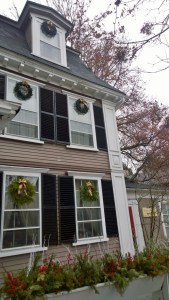
Wherein the grandmother is too tired to talk but will describe the photos. Wreaths on the Colonial Inn, grandson with new truck, church nativity scene early Christmas morning, Christmas tree at John’s house, grandfather with two granddaughters.
So much fun to be around little kids at Christmas. Also very good for sleeping soundly the following night.
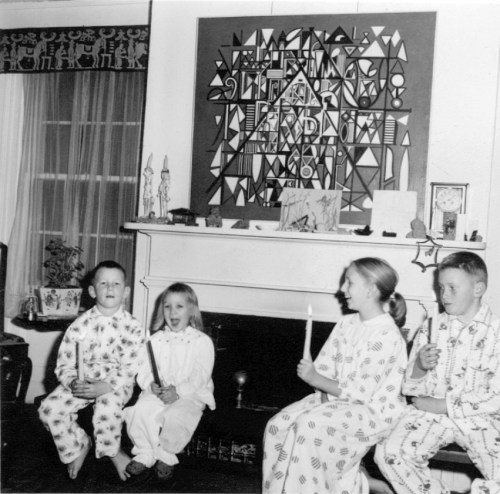
Here I am with my siblings, posing before the fireplace in our Christmas Eve pajamas long ago and far away. (We used to be allowed to open one present before Christmas morning — pajamas.) I’m the kid with the ponytail. Today, the boy on the left does biomedical research, the little girl is a psychiatrist, and the boy on the right writes business books.
May all the good things about the season wrap you ’round, and may the not-so-good things roll off your back and vanish.
What I liked about this story on rescuers in Iceland was how the volunteer tradition started when “women banded together and organized a rescue crew to curtail the loss of their men at sea.” The part that wasn’t so great was about tourists endangering everyone with harebrained feats for their bucket list.
Nick Paumgarten writes at the New Yorker, “Iceland, with a population of little more than three hundred thousand, is the only NATO country with no standing Army. It has police, and a coast guard, but these, like the citizens they are paid to protect, are spread thin, so come accident or disaster, disappearance or storm, the citizens, for the most part, have always had to fend for themselves.
“[Slysavarnafélagið Landsbjörg, or, in English, the Icelandic Association for Search and Rescue] has evolved into a regimented volunteer system that serves as a peerless kind of national-emergency militia. It is not a government program, and so represents a tithing of manpower. There are close to ten thousand members in all, with four thousand of them on ‘callout’ duty, on ninety-seven teams. … They are well trained and well equipped, self-funded and self-organizing, and enjoy a near-mythical reputation among their countrymen, who, though often agnostic regarding the existence of elves and gnomes, are generally not inclined toward reverence or exaggeration. …
“Landsbjörg traces its roots back to the formation, in 1918, of a rescue team in the Westman Islands, an archipelago just off the southern coast. The women on shore banded together and organized a rescue crew to curtail the loss of their men at sea, and in time other fishing communities established similar groups and protocols. Eventually, the fishing industry, as it grew, supported these efforts with donations. On land, farmers, left to their own devices, looked after each other, as they will.” More at the New Yorker, here.
You may get a kick out of the fundraising based on selling fireworks. Setting them off is legal in Iceland once a year. “Last year, Icelanders blew up five hundred tons of fireworks.”
Photo: Benjamin Lowy / Getty Images for The New Yorker “People think of the rescue teams as the Guardians of the Galaxy,” a mountain guide said. “They forget these are normal people.”
I love experiments that garner a new audience for the work of writers and other artists. I remember one effort I tried to join: short fiction for postcards. My submissions weren’t used, but I received a postcard a month for a year, each with a tiny tale.
If you’ve traveled the subway in New York or Boston, you may also have seen posters with some very accessible, but not dumbed-down, poetry.
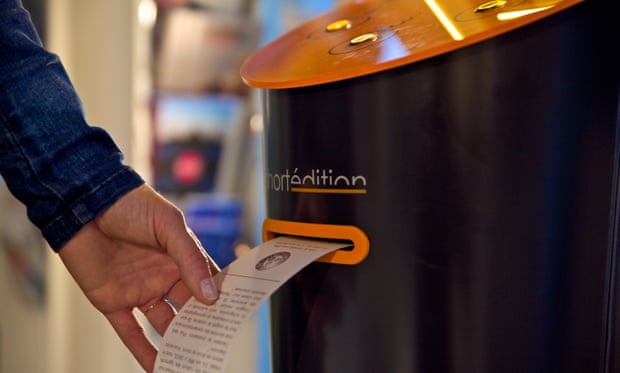
In France, there’s a vending machine. Alison Flood writes at the Guardian, “Readers in Grenoble can now nibble fiction instead of vending machine snacks, after publisher Short Édition introduced eight short-story dispensers around the French city. …
“Readers are able to choose one minute, three minutes or five minutes of fiction, and, just two weeks since launch, co-founder Quentin Pleplé says that more than 10,000 stories have already been printed.
“ ‘The feedback we got has been overwhelmingly positive … We are getting requests from all over the world – Australia, the US, Canada, Russia, Greece, Italy, Spain, Chile, Taiwan.’ …
“The French publisher hopes the stories will be used to fill the ‘dead time’ of a commute, ‘in a society where daily lives are moving quicker and quicker and where time is becoming precious.’
“ ‘In the bus, the tram or the metro, everyone can make the most of these moments to read short stories, poems or short comics,’ said a statement from Short Édition. ‘And they can be sure to enjoy the ending.’ …
“The stories are drawn from the more than 60,000 stories on Short Édition’s community website, with the publisher’s 142,000-strong reader community selecting the best 600 for the vending machines. Users are not able to choose what type of story – romantic, fantastical or comic – they would like to read. ‘Just the length, it’s the beauty of it,’ said Pleplé.”
I am still employed at my job of 10-plus years until January 1, but since so many people are on vacation the last fortnight of the year, I got my good-bye party last week.
Wow. Only nice things were said. Kind of like Tom Sawyer attending his own funeral. Here you see my friend Lillian giving me credit for a discussion group that she was more than half responsible for.
A senior vice president surprised me by researching my online theater reviews (I used to moonlight as a critic) and reading two passages that suggested a strong social-justice interest, a theme I hadn’t realized was there. Another colleague commented that she had never met anyone that nice who was also so subversive. Then my top boss stood up to redefine “subversive” in a flattering way that related to the perceived social-justice streak.
Man, now I have to live up to all that. I should say that I have worked at about 10 places since starting as a camp counsellor, and I have never had affirmation like this. A number of those places were glad to see me go. I guess I have learned to tone down the subversive side so it sounds nice.
Good news for scavengers who collect fruit they see going to waste in cities.
A new study reveals that, unlike urban root vegetables or leafy vegetables that grow close to the ground, fruit is not in danger of contamination by lead and, mysteriously, contains more nutrients than most grocery-store fruit.
Bella English writes at the Boston Globe that Amy Jarvis, of Boston’s League of Urban Canners [LUrC], was concerned about fellow forager Matthew Schreiner, who had tested positive for high levels of lead. She “went online and found [Wellesley College geoscience professor Dan] Brabander, who since 2003 has been working with the nonprofit Food Project, monitoring lead in urban soil.
“In the past year, LUrC members have given Brabander and his students 197 foraged food samples to analyze, including berries, cherries, apples, plum, peaches, and pears. Both groups believe it is the only such ‘citizen-scientist’ collaboration in the country.
“ ‘It’s an example of a successful approach to doing applied science that matters,’ says Brabander. So far, he and his students, including Wellesley juniors Ciaran Gallagher and Hannah Oettgen, have analyzed 40 samples for trace elements, both toxins and nutritents.
“Their results startled many, including themselves. Urban fruit not only doesn’t absorb high levels of lead, it has more than twice the amount of calcium concentrations as commercially grown fruit. The results were the same for washed and peeled fruit as they were for unwashed and unpeeled samples.
“The primary source of lead in an urban environment is the soil, and leafy vegetables and root vegetables, which grow close to the ground, take up lead in more significant amounts than fruit. ‘If most of the fruit is high up [on trees], that minimizes the likelihood that re-suspended soil, or soil with lead in it, will reach up there,’ Brabander says.” More here.
Photo: Pat Greenhouse/Globe Staff Wellesley College student Ciaran Gallagher checks the lead content in an apple tree in Cambridge.
Not sure who put me on to this story — maybe Asakiyume, who has an interest in different cultures. It’s about languages in which a slight change in tone can change the meaning of a word.
John McWhorter writes at the Atlantic, “People don’t generally speak in a monotone. Even someone who couldn’t carry a tune if it had a handle on it uses a different melody to ask a question than to make a statement, and in a sentence like ‘It was the first time I had even been there,’ says ‘been’ on a higher pitch than the rest of the words.
“Still, if someone speaks in a monotone in English, other English-speakers can easily understand. But in many languages, pitch is as important as consonants and vowels for distinguishing one word from another. In English, ‘pay’ and ‘bay’ are different because they have different starting sounds. But imagine if ‘pay’ said on a high pitch meant ‘to give money,’ while ‘pay’ said on a low pitch meant ‘a broad inlet of the sea where the land curves inward.’
“That’s what it feels like to speak what linguists call a tonal language. At least a billion and a half people worldwide do it their entire lives and think nothing of it. …
“There are certain advantages to speaking tone languages. Speakers of some African languages can communicate across long distances playing the tones on drums, and Mazatec-speakers in Mexico use whistling for the same purpose.
“You know those people who can hear a stray note and instantly identify its pitch, for instance recognizing that a certain car horn is an A flat? They have ‘absolute pitch,’ and there is evidence that speakers of tone languages are more likely to have it. In one experiment, for instance, Mandarin-speaking musicians were better at identifying musical pitches than English-speaking ones. The same has been found for speakers of Cantonese—which has six or even nine tones, depending on how you count—relative to English- and French-speakers.” More here.
I used to be quite good at Mom Tonal Language. A change in tone pronouncing a kid’s name can convey anger or amusement or affection. I don’t use the subtleties much now that I’m a grandmother. It’s mostly the affection tone.
You have until Jan. 3 to see beloved Boston landmarks in the form of gingerbread, gumdrops, frosting, and pretzels. The annual competition is put on at the Boston Society of Architects, which has a public exhibit area on Congress Street between Atlantic and Dorchester avenues.
The public is invited to a reception on Monday.
“Please join the Community Design Resource Center (CDRC) for the Gingerbread Reception, where we will view more than 20 gingerbread designs from teams of architecture and landscape architecture firms on exhibit, enjoy light refreshments, announce the winners, celebrate the incredible bakers, and launch CDRC’s first Open Call for Projects.
“At the Gingerbread Reception we will launch our first Open Call for Projects — an open invitation to neighborhood groups and community nonprofits in the greater Boston area to apply for a design assistance grant. Underserved audiences are especially encouraged to apply, as well as projects that otherwise fall between traditional funding cracks but that somehow serve to make communities better. …
“While challenging designers to explore a new medium, this sweet event also raises funds for the CDRC. A special thank you to the Boston Society of Landscape Architects and the BSLA ‘gingerscapes’ for joining us this year!” More here.
The BSA’s photos are on instagram. Look for bsaaia. It’s fun to guess what you are seeing.












 Suzanne's Mom's Blog