Feeds:
Posts
Comments

Posts Tagged ‘agriculture’

It’s so interesting to see all the different ways people are taking to farming. We’ve already covered a number of angles. Now Adele Peters at FastCoexist writes about how would-be farmers in Brooklyn are testing out “vertical farming.”

“When it opens this fall in Brooklyn, a new urban farm will grow a new crop: farmers. The Square Roots campus, co-founded by entrepreneurs Kimbal Musk and Tobias Peggs, will train new vertical farmers in a year-long accelerator program. …

“The campus will use technology from Freight Farms, a company that repurposes used shipping containers for indoor farming, and ZipGrow, which produces indoor towers for plants. Inside a space smaller than some studio apartments—320 square feet—each module can yield the same amount of food as two acres of outdoor farmland in a year. Like other indoor farming technology, it also saves water and gives city-dwellers immediate access to local food. …

“It’s intended for early-stage entrepreneurs. ‘We’re here to help them become future leaders in food,’ says Musk, who also runs a network of school gardens and a chain of restaurants that aim to source as much local food as possible.

“After building out the Brooklyn campus, they plan to expand to other cities, likely starting with cities where Musk also runs his other projects—Memphis, Chicago, Denver, Los Angeles, Indianapolis, and Pittsburgh.”

More here.

Photo: SquareRoots

Read Full Post »

Missing the excitement of the summer Olympics? As these Vermont farmers show, any determined and organized group can have their own “Olympics” and have a lot of fun.

Jessica Rinaldi writes at the Boston Globe, “With the world’s attention focused on the Olympic Games in Brazil, a decidedly different type of competition was held in a small corner of New England, as farmers took to the field for the second annual Farmer Olympics in Vershire, Vt.

“After taking part in warm-up events that included a hay bale toss, the crowd gathered for an opening ceremony where a quartet performed the Olympic theme song on kazoo. When the competition began, 60 farmers sprinted up a hill, empty bins and shovels in hand, for the manure relay. The event was sponsored by the Northeast Organic Farming Association of Vermont. In the end it was a team from Cedar Circle Farm in East Stepford who took the gold. Their team’s name? Soil’d.

Click here for a terrific collection of photos from the second annual Farmer Olympics.

Photo: Northeast Organic Farming Association of Vermont
Competing in the Farmer Olympics, Vershire, Vermont.

Read Full Post »

Photo: Leigh Vincola, ecoRI News
David Kuma, left, is learning to farm under the tutelage of Ben Torpey.

In this story from Leigh Vincola, an ecoRI News contributor, several good things are happening simultaneously.

“David Kuma set out to grow more of his own food as he learned about industrial agriculture and all of its poisons. His father, a biologist, always had a garden growing up, so an innate knowledge of plants followed his curiosity.

“Born in Brooklyn, N.Y., raised partially in rural Illinois and then in Attleboro, Mass., Kuma understands urban, rural and suburban lifestyles and how plants can fit into each.

“Today, Kuma is one of three participants in the Southside Community Land Trust’s (SCLT) farm apprentice program …  Acknowledging that it has been historically difficult for minority populations to enter into commercial growing, the program’s mission is to provide organic farming experience and education to those who are interested.

“Kuma is partnered with Ben Torpey at Scratch Farm, a small-scale, chemical-free operation at Urban Edge Farm. Urban Edge is a state-owned, 50-acre piece of land managed by SCLT, where seven separate farms grow and share resources. The farm was established to give new farmers access to land and a community to learn from. As part of his paid apprenticeship, Kuma spends a full day on the farm two days a week and is learning a lot quickly. …

“From transplanting and cover crops to solarizing and low-till cultivation, Kuma is learning what it takes to run a small-scale farm naturally. His eyes have been opened to the importance of soil health.

“ ‘There’s a lot more to it than putting seeds in the ground,’ he said.

“For Torpey, having an apprentice is rewarding.

“ ‘Dave comes with a intuitive sense of plant biology and his curiosity reminds me that what we’re doing is fun,’ Torpey said. ‘It encourages me to experiment with new things.’ ” More here.

Don’t they both look happy? Nature can do that to you.

Photo: Scratch Farm


Read Full Post »

A Lancaster, Massachusetts, woman who came to the country at age 12 without a word of English is giving back by helping immigrants get a start in farming — and her model is being picked up around the nation.

Jane Dornbusch at the Boston Globe writes, “Maria Moreira, 62, is fond of the proverb ‘Necessity is the mother of invention.’ When her kids were small and she and her husband had a dairy farm in this Central Massachusetts town, she had plenty of milk, hungry kids to feed, and a need to make a little money.

“So she started a business making a soft Portuguese cheese — she calls it simply Portuguese fresh cheese — that reflected her roots in the Azores, where she was born.

“That was in 1986. A year earlier, she had seen another need, and, in her own inventive way, she’d set about meeting it. Moreira and her husband, Manny, had a 70-acre field, not far from their farm, that they used to grow corn.

“A Hmong woman, an immigrant from Laos, approached Moreira about using a small corner of the field to grow her own crops. Soon, word spread, and little by little the entire field was given over to immigrant farmers, each in charge of his or her own plot. Today, says Moreira, 275 farmers are growing more than 75 kinds of vegetables at what is now called Flats Mentor Farm. …

“Gus Schumacher, former Massachusetts commissioner of food and agriculture, came to know Moreira’s work when he served as a USDA undersecretary in the late ’90s. He notes that she was among a handful of leaders — others included John Ogonowski (one of the pilots killed on 9/11) and Jennifer Hashley, of New Entry Sustainable Farming Project — supporting refugees and immigrants in establishing themselves as farmers and market gardeners. It’s a movement that has since gained momentum nationally, he says. ‘But it all started in Massachusetts.’ ”

More at the Globehere.

Photo: Joanne Rathe/Globe Staff
Maria Moreira, of Flats Mentor Farm, holds some lemon basil.

Read Full Post »

Who can resist a farmers market at this time of year? They are such joyful places.

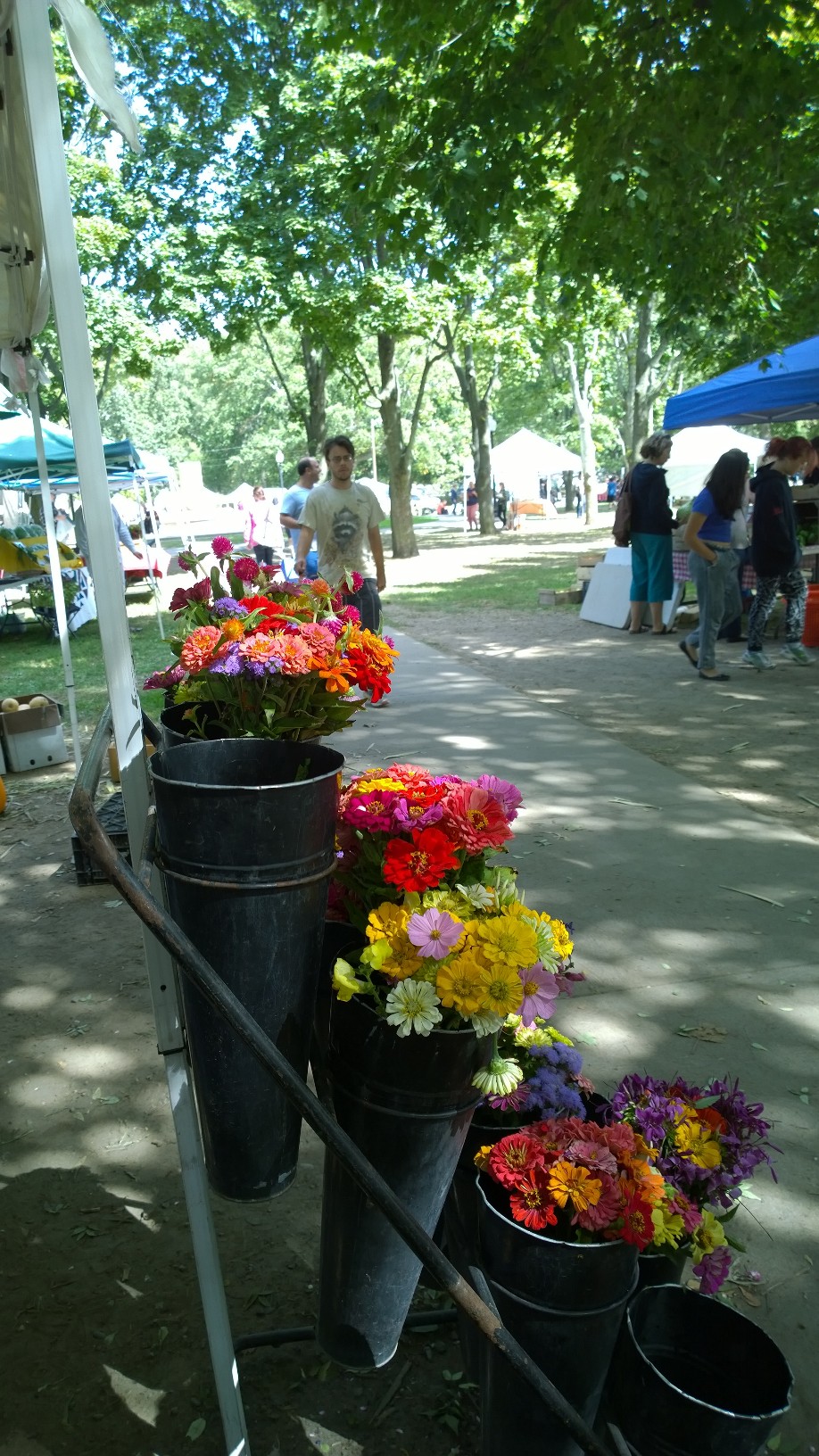
Saturday we went with Erik and the kids to the Hope Street Farmers Market in Providence. It’s in a good-sized park where there is a playground as well as farmstands, crafts, live music, samosas, tacos, flowers, raw juices, fish, sausages, granola made by refugees …

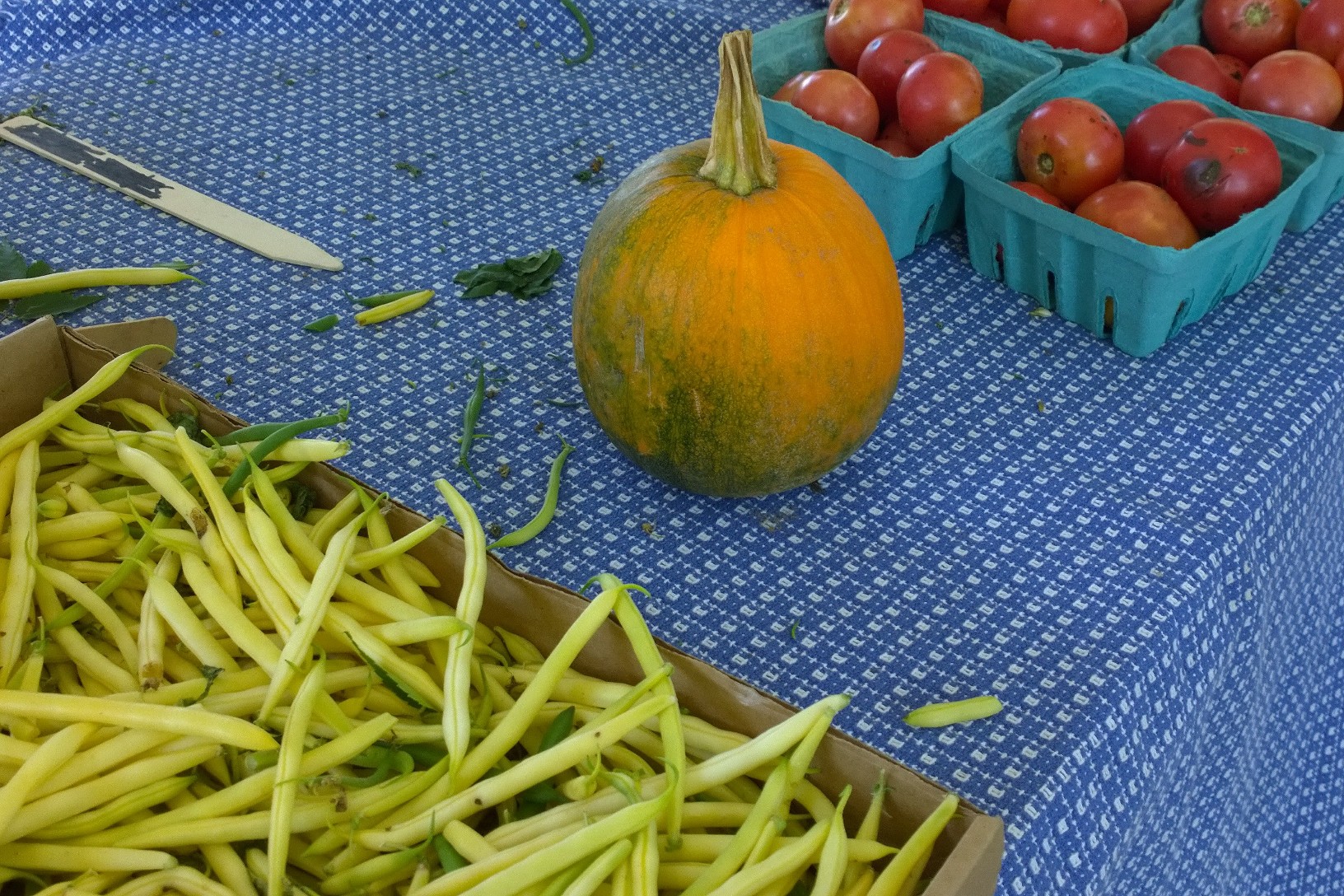
After his grilled cheese and his Del’s lemonade, our 3-year-old grandson chose the little green and orange pumpkin below. It’s now on his dining-room table at home. His sister, when she wasn’t sleeping, worked hard at inspecting everything on the ground and trying to put it in her mouth.

A few words from the website on extra offerings that might interest backers of other farmers markets: “For your convenience, here are some of the unique features of the Hope Street Farmers Market: The Bicycle Valet at the Saturday morning market, run by Recycle-A-Bike, a volunteer-based community organization that connects people with refurbished bikes, provides practical bike knowledge, and advocates bicycle use by safer, more confident cyclists. Anyone can drop off their bike while shopping and know that it will be safely watched and sometimes even tuned up, for a small fee, while they shop. http://www.recycleabike.org gives a full description and mission of the organization.

“Knife Sharpening while you shop is another new feature of our Saturday market. You can drop our your knives (wrap them carefully and mark them with your name please!) to be professionally sharpened for a small fee while you shop.

“Live music at the markets features local musicians or acoustic bands playing every Saturday and some Wednesdays, so feel free to bring a blanket, buy your picnic lunch or supper and enjoy the entertainment.”

092615-RI-farmers-market

092615-Prov-Farmers-Market

092615-market-Providence

Read Full Post »

Over at radio show Living on Earth, “Steve Curwood spoke with farmer and author Audrey Levatino, who has written Woman Powered Farm: Manual for a Self-Sufficient Lifestyle from Homestead to Field. …

“CURWOOD: Why did you decide to write a book about farming specifically for women?

“LEVATINO: Well, women were coming up to me at the farmers’ market and asking about what I did and were very interested. Many of them wanted to know how to get into farming and growing things themselves, and so they wanted advice and instructions on how to get started. …

“CURWOOD: Audrey, what do women farm more typically as opposed to men?

“LEVATINO: That’s a great question, and that’s another thing that I really investigated when I was writing the book. And many women get into this farming business. It starts off as just wanting to provide the best and healthiest, most local food that they can for their families. So women are growing a lot of different things, but in many cases it is healthy, delicious, seasonal food. They know exactly where it came from, so that their children and their husbands and their neighbors can have the best food possible.

“But the other thing that I discovered as I got further into my research and interviewed lots of women farmers in my area and around the country is women are just amazingly creative: they grow herbs and other medicinal plants to make cheese, salves and tinctures. Women also tend to farm — when they do livestock — smaller animals. You know, things that are a little more manageable. And sometimes it’s for fiber — sheep and llamas and alpacas — other times it’s for milk, such as using goats to make cheese.” More here.

Audrey’s farm, Ted’s Last Stand, is located near Charlottesville, Virginia.

Photo: Michael Levatino
Audrey Levatino grows specialty cut flowers and sells them at local farmers’ markets to florists and restaurants, and for weddings.

Read Full Post »

This story comes from Heather Dockray at Good magazine (by way of the Huffington Post). It’s about a life-affirming project in Atlanta.

“Good, local, nutritious food shouldn’t be expensive,” she writes, “and shouldn’t only be enjoyed by people who can afford it.  A homeless shelter in Atlanta decided that their residents desperately needed access to healthy food — but instead of sourcing out, encouraged residents to grow their own. Now, the shelter is home to a huge rooftop garden planted by the residents themselves, which is expected to yield hundreds of pounds of great quality greens. …

“While eating discounted snacks might give homeless residents short-term financial benefits, the long-term health consequences are substantial. The Metro Atlanta Task Force for the Homeless, who runs the gardening program, wanted to give homeless people access to food previously considered out-of-reach. Now, residents are responsible for 80 garden beds, producing kale, carrots, chard, and squash, among other vegetables.” More here.

Dockray doesn’t mention how gardening and donating to the shelter makes residents feel, but I am going to guess it builds their self image and confidence.

Photo: Metro Atlanta Task Force for the Homeless

Read Full Post »

In a move that will benefit the environment, farmers are placing increased emphasis on the quality of their soil and cutting back on ploughing. It took a kind of soil evangelist to create the revolution.

Erica Goode has the story at the NY Times.

“Gabe Brown is in such demand as a speaker that for every invitation he accepts, he turns down 10 more. …

“Mr. Brown, a balding North Dakota farmer who favors baseball caps and red-striped polo shirts, is not talking about disruptive technology start-ups, political causes, or the latest self-help fad.

“He is talking about farming, specifically soil-conservation farming, a movement that promotes leaving fields untilled, ‘green manures’ and other soil-enhancing methods with an almost evangelistic fervor.

“Such farming methods, which mimic the biology of virgin land, can revive degenerated earth, minimize erosion, encourage plant growth and increase farmers’ profits, their proponents say. And by using them, Mr. Brown told more than 250 farmers and ranchers who gathered at the hotel for the first Southern Soil Health Conference, he has produced crops that thrive on his 5,000-acre farm outside of Bismarck, N.D., even during droughts or flooding.

“He no longer needs to use nitrogen fertilizer or fungicide, he said, and he produces yields that are above the county average with less labor and lower costs. ‘Nature can heal if we give her the chance,’ Mr. Brown said.” More here.

Sounds like wisdom that even a backyard farmer could embrace.

Photo: Brandon Thibodeaux for The New York Times
“My goal is to improve my soil so I can grow a better crop so I can make more money,” [says Texas farmer Terry] McAlister, who farms 6,000 acres of drought-stricken cropland. 


Read Full Post »

I thought you would like this story from the National Deseret News about refugees making a new life for themselves in Arizona.

Lourdes Medrano writes, “In a small field on the outskirts of [a] desert town near the Mexican border, close to 30 women and men stoop over rows of pumpkins, carefully picking the pulpy autumn fruit along with its flowers, stems and leaves.

“The volunteers are part of an innovative program that helps refugees from war-torn countries find work and food. Called the Iskashitaa Refugee Network, the Arizona-based organization consists of a diverse group that harvests donated crops from local farms and people’s backyards to feed displaced populations from Africa, Asia and the Middle East.

“On this recent fall afternoon, Adam Abubakar, a refugee in his early 30s who came to Arizona two years ago from the conflicted Darfur region of Sudan, quickly clips pumpkin leaves and drops them in a tote bag for later distribution to newcomers who eat them. For Abubakar, picking fruits and vegetables comes second nature. Back in his homeland, he grew most of the food his family consumed …

“The government provides refugees limited resettlement assistance and organizations such as Iskashitaa work to help the newcomers become self-sufficient as they adapt to American society. Refugees working in the pumpkin field not only harvest the fruits and vegetables they eat, but they also distribute crops to fellow newcomers, learn about urban gardening, market what they grow, and participate in cross-cultural food exchanges. …

“The number of incoming refugees has fluctuated over time and reflects shifting world conflicts and heightened security concerns. In 1980, for instance, 207,000 refugees — including many displaced by the Vietnam War — resettled within the country.

“Iskashitaa was founded in 2003 by Barbara Eiswerth, an environmental scientist, with help from Somali Bantu refugee students who began harvesting crops no one was picking to boost their diet. The refugees inspired the name of the fledgling group: ‘working cooperatively together.’ …

“By tapping into the agricultural roots of refugees, Iskashitaa aims not just to provide food, but also to empower those they’re helping.”

More here.

Photo: Lourdes Medrano/National Deseret News

Read Full Post »

Photo: Geoff Childs
Cleaning harvested yartsa gunbu prior to sale. 

Thanks so much to the folks who recently signed up to follow this blog. If you joined hoping that I would blog often about the topic that drew you here, you will soon find that the posts are rather eclectic. A couple years back, Suzanne thought it would be nice to have a blog tied to Luna & Stella, and she said I could write about anything that interested me. I thought, Wow! What an opportunity!

Today’s story is from the radio show Living on Earth. It’s about Tibetans in Nepal who have managed to avoid overharvesting a fungus that’s wildly popular in China.

“Anthropologist Geoff Childs of Washington University tells host Steve Curwood how one [area] is managing to harvest the resource sustainably. …

“Nubri is a valley in Gurkha district in the country of Nepal. The residents are ethnically Tibetan. They’ve been living there for about 700 or 800 years, so it’s an indigenous population of Nepal. What they have done in contrast to other areas is they’ve limited the number of collectors to only residents of the villages, and so that keeps the number of collectors way down. …

“CHILDS: What they’ve arrived at in Nubri is a combination of what they call ‘yultim,’ which we could translate as village regulations, secular regulations, and ‘chutim,’ which are religious regulations. … What they will do is, they will decree certain areas off-limits to human exploitation, and usually that’s a sacred grove of trees, a certain slope of a mountain that a deity inhabits or something like that. … In terms of the sustainability of Yartsa Gunbu, that’s going to be important because those are areas where annually nobody will harvest it. So it can come to fruition. It can spore. It can live out its normal life cycle.

In terms of the village regulations the first one that I just mentioned is the exclusion of all outsiders. The second one is they’ve got a designated starting date, and they arrive at that by looking at the snow melt, looking at the conditions in the alpine pasture and figuring out what’s going to be the likely time when it’s best to gather it.

“And so for a couple weeks prior to the official starting date, every adult in the village has to check in four times daily to the village meetinghouse to prove that you’re not collecting early. A third thing that they do is they tax it. For the first member of your household, the tax is very low; it’s 100 rupees or approximately $1 dollar … they gather that tax and use it for communal purposes.

“CURWOOD: So this consensus process, everybody agrees, everybody trusts, but they also verify. … looking at this from a broader resource management perspective, what are some lessons that we can take away from what’s happening in Nubri?

“CHILDS: Trust indigenous people. Don’t immediately assume that as outsiders with more education we can come in and devise a system that will work for them. I think, first of all, study what’s in place. Study with an open mind and move from there.”

Photo: Geoff Childs 
Mt. Manaslu (26,759ft.) in Nubri is the 8th highest mountain in the world.

Read Full Post »

I’ve written a couple times about Sandy and Pat’s niece, who graduated from Sarah Lawrence College and went into farming in a serious way. My most recent post is here.

On Saturday, Sandy and Pat went to Letterbox Farm in Hudson, New York, to see their niece and enjoy a magnificent farm-to-table spread.

The original invitation said, “The meal is in motion.  Meats from the farm are curing in Ko’s kitchen.  Our beekeeper is spinning honey from the combs, and the blue corn is waiting at the mill.  Will you join us in the fields for an incredible feast?

“The culinary team at Momofuku Ko joins the Letterbox farmers to host a celebratory evening of dinner and drinks.

“The night begins with farm-made sodas and cocktails in the garden, complete with bar snacks and live music.  In our silent auction, guests can bid for offerings from bee hive installations to garden consultations or a night on the town, provided by farmers and friends.  Before dusk arrives, we will move to the hillsides for dinner and sunset views of the Catskill Mountains.

“All proceeds from this event go to support the farm as it puts down permanent roots on new land.”

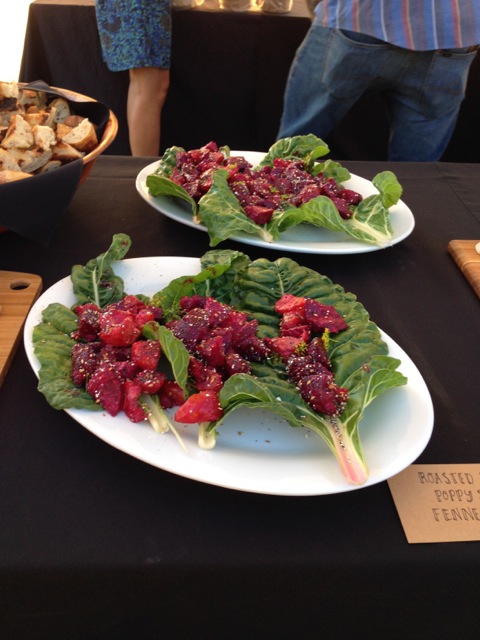
I wish I could show you all the wonderful photos of the event I just received, but I think you’ll enjoy this sampling. Note the roasted beets on greens and the elegant pork, marinated for two weeks in a marinade featuring sumac.

Photos: Sandra M. Kelly

092714-Letterbox-Farm-garden

092714-Letterbox-Farm-tables


092714-Letterbox-Farm-beets

092714-pork-marinated-for-2-weeks


092714-Letterbox-dinner-dessert

Read Full Post »

Did you know that plants can protect themselves from predators?

Writes Douglas Quenqua at the NY Times, “It has long been known that some plants can respond to sound. But why would a plant evolve the ability to hear? Now researchers are reporting that one reason may be to defend itself against predators.

“To see whether predator noises would affect plants, two University of Missouri researchers exposed one set of plants to a recording of caterpillars eating leaves, and kept another set of plants in silence. Later, when caterpillars fed on the plants, the set that had been exposed to the eating noises produced more of a caterpillar-repelling chemical. …

“Plants exposed to other vibrations, like the sound of wind or different insects, did not produce more of the chemical, suggesting they could tell the difference between predator noises and atmospheric ones. The researchers published their work in the journal Oecologia.” More here.

I have an idea. How about farmers, instead of using genetically modified seed to protect plants, just pump recordings of crunching predators into their fields so that the plants could protect themselves?

As they say where I work, “More research is needed.”

The NY Times posted this Pieris Silhouette video by mubondlsc
Can you hear the crunching of the caterpillar?

Read Full Post »

I’m grateful to Scott, a former colleague, for putting this cool thing on Facebook. Looking at these healthy, growing plants is especially warming today, now that the temperature has gone back to 15 F.

Tim Blank at Future Growing LLC (which produces vertical aeroponic food farms) writes, “When you hear about a farm that supplies all-natural, sustainable produce, using 90% less water and 90% less land, one that utilizes the most advanced vertical aeroponic technology on earth, you surely would not guess it would be an Amish farm.

“Yet in Topeka, Indiana, you cannot get produce that is more local, fresh, healthy, and sustainable — even in the middle of an Indiana blizzard — like you can get at Sunrise Hydroponics, an Amish farm.

“Sunrise Hydroponics is owned and operated by husband-and-wife team Marlin and Loretta Miller on their rural farm in Topeka. I have had the privilege of working with the Amish community for more than half a decade, and have come to learn that, while their lives seem simple to many outsiders, their homes, farms, and businesses are highly innovative. The Amish utilize cutting-edge and creative forms of technology to improve their lives, while still falling within the guidelines of their belief system.” Read more here.

Greenhouse at Sunrise Hydroponics

Read Full Post »

Here is an annual spectacle I’d love to see.

“Shepherds led a flock of 2,000 sheep through the streets of Spain’s capital and largest city on Sunday, in defense of ancient grazing, droving and migration rights that have been increasingly threatened by urban sprawl and modern agricultural practices.

“Those urban settings were once open fields and woodlands, crisscrossed by droving routes. Since at least the year 1273, the country’s shepherds have had the legal right to use about 78,000 miles of droving routes around the country to move livestock seasonally between summer pastures in the cool highlands and more protected lowland grazing areas in the winter.

“Every year, a handful of shepherds defend that right in Spain’s capital city.”

I guess it’s use it or lose it. Plus it’s good to make people think about where their food and wool come from, and whether things have changed for the better.

More from the Associated Press.

Photo: Andres Kudacki/Associated Press
Shepherds led a flock of 2,000 sheep through some of Madrid’s most sophisticated settings on Sunday.

Read Full Post »

If you had to guess one church in San Francisco that would be all over the idea of rooftop gardening to feed whoever needs feeding, which one would it be?

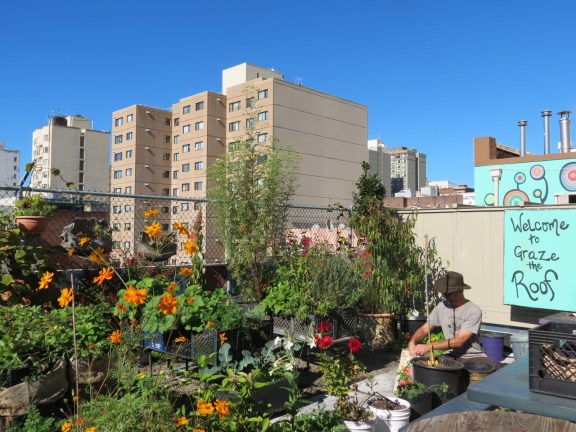
Right. Glide. I like its garden’s name: Graze the Rooftop.

“Graze the Roof is an edible, community-produced vegetable garden on the rooftop of Glide Memorial Church, a progressive church and nonprofit located in the Tenderloin district of San Francisco.

“Graze the Roof features lightweight (upcycled) raised garden beds made from milk crates; a worm composting system and an educational mural which ties the whole project together. Glide youth and volunteers from throughout the Bay Area maintain the garden and host monthly tours and workshops.”

Do you live in the San Francisco area? Looks like there are a lot of fun workshops available, such as Designing Sustainable Habitats, Introduction to Permaculture, and Urban Fruit Tree Stewardship. Read more here.

Photo: Graze the Roof

Read Full Post »

« Newer Posts - Older Posts »