Photo: AP/Andrew Medichini. A section of the restored 49-foot wall mosaic from the Painted City site, discovered in the late 1990s in Rome.
I’m not sure if you have to be a closet archaeologist to appreciate the beauty of tiny pieces of frescoe from long ago, but most of us are drawn to a mystery. And pictures like the ones in today’s story remind us that people who lived in ancient times may not have had cellphones, but they weren’t stupid or unskilled.
Nicole Winfield wrote at the Associated Press last month, “Authorities on Tuesday unveiled what is believed to be the largest fresco and mosaic complex of ancient Rome, a first century A.D. depiction of a maritime city in what became the largest bath complex in the world.
“Mayor Roberto Gualtieri presented the recently restored ‘Painted City’ fresco and ‘Great Mosaic’ that were discovered in an underground gallery during excavations in the 1990s of the Baths of Trajan on the Oppio hill near the Colosseum.
“The works are opening to the public for the first time, initially in small groups of 15 and during a trial period of weekend access starting this month. The aim is to determine how the delicate works respond to increased humidity and climactic impacts before allowing more general access.
“Gualtieri said the fresco, which features images of a walled port city from a birds-eye view perspective, was the largest wall fresco of its kind from ancient Rome and as such needs to be open to the public. …
“Rome’s cultural superintendent, Claudio Parisi Presicce, said the grandeur of the port city as depicted in the fresco, with buildings, a theater and temple, public piazzas and towers, was particularly well conserved. The restoration work included techniques to preserve and improve visibility, remove surface deposits and consolidate the grouting to keep the decorated surfaces intact. …
“The mosaic, for its part, measures some [49 feet] high and features intricately decorated columns and architectural elements and figures over four different levels. The top levels are up-close images with people that are almost like theatrical scenes, while at the bottom are views of the [unknown] port city’s layout from above.
“The Baths of Trajan, which were dedicated by Emperor Trajan in 109 A.D., extended over [15 acres] and were at the time the largest bath complex in the world.”
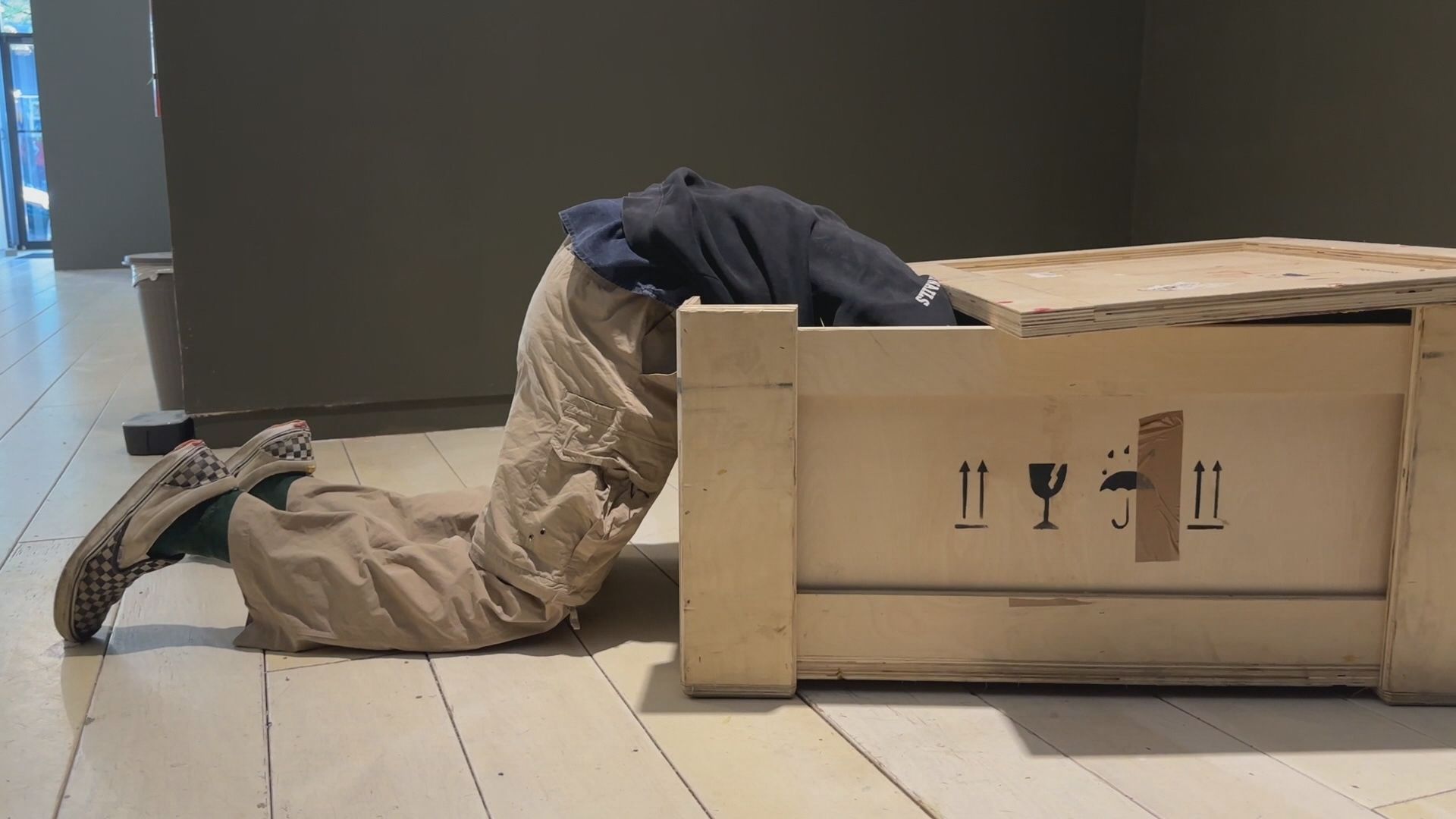
Photo: City News. This art sculpture caused distress in Vancouver, and the police were summoned.
I do love stories about art interacting with daily life. In today’s article, someone who cared about fellow humans in trouble called police on a sculpture in distress.
Despite the inherent humor of the situation, the Access Gallery director was angry she would have to pay $1,000 for lock repair in the midst of the gallery’s fundraising campaign. The police hadn’t believed a neighbor who knew the figure was not human. They smashed the lock to rescue him.
Cecilia Hua writes at Vancouver City News, “When the director of Vancouver’s Access Gallery received a phone call from police late Friday night, she was alarmed — at first.
“Saghi Ehteshamzadeh says the Vancouver Police Department (VPD) informed her there was someone in the gallery.
“ ‘I’m getting worried as the call goes on,’ Ehteshamzadeh said. ‘I was thinking I had locked the door and had the alarm on. How could someone get in?’
“According to the VPD, a caller reported seeing a person’s feet sticking out from behind a counter and believed medical assistance was needed.
“When police couldn’t get in touch with the gallery, firefighters breached the door to gain entry. But what they found inside was not a human at all.
“The 911 call had been prompted by a sculpture: ‘The Preparator,’ by Alyssa Pierre.
“The piece depicts an art preparator — sometimes referred to as an art handler — kneeling over a crate with their upper body disappearing inside.
“ ‘Every show that goes on display has one or many technicians creating the best display for the artwork, and it’s a work that a lot of times goes unnoticed,’ said Ehteshamzadeh.
“In this case, this unnoticed labor drew a bit too much attention. The break-in cost the gallery close to $1,000 to replace the lock and gate. …
“ ‘One of the close friends of the artist lives across from the gallery. She comes and tells police that this is actually an artwork, and they don’t take her word for it. The work is featured on our website,’ Ehteshamzadeh said. …
” ‘This situation is absurd and could be funny, but it has made us sit with harder feelings around,’ she said. ‘There are people who are actually deserving of this response, and they’re not receiving it. Yet those resources are being spent on non-emergencies.’ “
More at Vancouver’s City News, here. The story was widely cited. See also Hyperallergic, here, and the Art Newspaper, here.
Photo: Marcus Maddox/New York Times. Diya Vij, New York’s commissioner of the Department of Cultural Affairs, was appointed by Mayor Zohran Mamdani in February 2026.
New York City has often seemed different from the rest of the world, and that’s especially so today with Zohran Mamdani, a democratic socialist, as mayor. People are watching New York to see what it will be like under his community-focused vision.
One thing we can already see is that it will aim to bring more people, especially young people, into the arts.
Sonia Rao wrote at the Gothamist in August, “Diya Vij was appointed commissioner of New York City’s Department of Cultural Affairs — or DCLA — in late February, which puts her at six months overseeing the country’s largest municipal funder of artists and cultural programming. The department supports more than 1,200 organizations across the five boroughs, including major institutions like the Metropolitan Museum of Art, the Queens Botanical Garden and the Bronx Zoo as well as smaller nonprofits supporting public arts programming at the grassroots level.
“Matters of the DCLA should concern all New Yorkers because, well, our tax dollars are funding it. But Vij said in a Wednesday interview with Gothamist that the department’s impact goes further: A healthy arts scene is vital to the city’s overall well-being.
” ‘We know the presence of art in a neighborhood leads to better outcomes in health, safety and education,’ she said. ‘We know it matters to the economy, to people’s bodies, to their relationships, to their ability to find each other. On a policy level, it’s essential to the full life of a New Yorker.’
“Vij holds a prestigious and powerful position in the cultural world. But she said that she wouldn’t have been as eager to take it on had she not been asked by Mayor Zohran Mamdani. She was encouraged by his administration-wide focus on affordability, she said, as ‘artists are leaving the city for the first time in a really long time.’ …
“Budget negotiations consumed many of Vij’s earliest months on the job. DCLA received $323 million in the 2026-2027 budget, the highest amount ever allocated to the department. It allowed for the establishment of the Cultural Stability Fund, which Vij described as a pool of quick-fix grants intended to help struggling arts organizations, nonprofits and community organizations solve ‘the crises of the day.’
“ ‘Sometimes that’s like, your boiler burst or your rent just skyrocketed — everyday crises that might be the end of your business,’ she said.
“The fund, which will distribute $10 million annually over the next three years, will also help offset cuts to federal arts funding, rising health care costs and other financial pressures.
“One of the keys to sustaining a healthy arts and culture scene is making it accessible to New Yorkers, Vij said. Among the department’s most recent initiatives is a partnership with the Theater Development Fund, which encouraged New York City high schoolers to enter a lottery giving away more than 2,000 free tickets to Broadway shows such as Buena Vista Social Club or Two Strangers (Carry a Cake Across New York). …
“Arts organizations ‘need these young people coming in, having their first encounters with art [and] going even deeper if they want to: joining a teen council, doing summer youth programs,’ Vij said. ‘They are really diving in, because that’s the next generation of audience, of artists, of playwrights, of costume designers, of set designers.’
“Vij was introduced to New York’s vibrant arts scene as a teenager making the trek from suburban Connecticut to see Broadway shows and concerts. But it wasn’t until she worked at the Queens Museum as a curatorial fellow that ‘my entire universe [began] to shape around art,’ she said. Eventually, she followed the Queens Museum’s longtime director Tom Finkelpearl to DCLA when then-Mayor Bill De Blasio appointed him commissioner.
“As part of her work in the department’s special projects unit, Vij helped launch a Public Artist in Residence program, which embedded arts in local government. …
“ ‘Having that stint in city government before really prepared me’ for being commissioner, Vij said. ‘I came in [with] eyes wide open about the ways that being stewards of taxpayer dollars is really different than working in a private organization.’ …
“ ‘With anything you do, you also have to think about who you might be inadvertently leaving out, or what might be the unintended consequences of that. … The mayor has such a clear agenda and a clear way to get there. The pothole politics of it is really all of our mandates. How are people seeing that we’re working for them?’
“Vij plans to continue drawing on her past stints at arts organizations such as Friends of the High Line and Creative Time as inspiration for how ‘art and life should be intertwined.’ She was just a few months into a leadership role at Powerhouse Arts, a Brooklyn nonprofit, when she got the DCLA offer.
“ ‘I’ve been a part of a lot of different organizations, some really big, some really small,’ she said. ‘The throughline is that I’ve worked with artists that love working with the community, that think community engagement is a big part of their art practice, and that are very interested in how art can be a catalyst to material change in the city.’ …
“ ‘Something that is really important to me is being able to [devote] as much attention to individual artists and cultural workers as we do to the cultural organizations, from a policy perspective,’ she said. She added that New York City has funded the arts since the late 1800s, and she hopes to keep artists living and working in the city by helping alleviate some of their most pressing financial concerns.
“ ‘There’s a space for all the practices … the avant-garde, the experimental, the political,’ she said. ‘All of it can happen here. But I truly believe it only happens here because there is robust public funding.’ ”
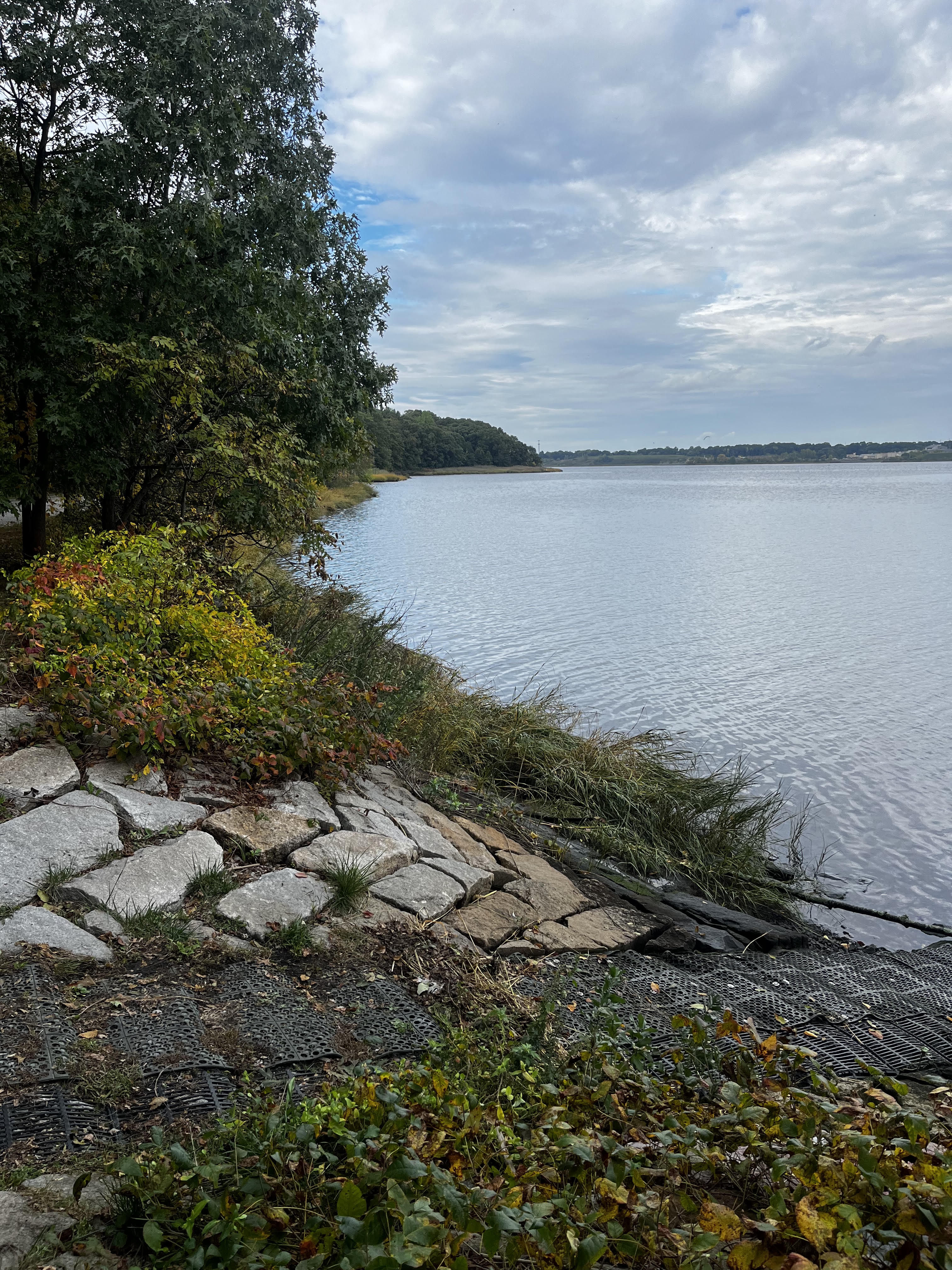
Photos: John and Suzanne’s Mom. Providence’s Seekonk River in early October.
I’ve been enjoying the changing seasons so much lately, I often forget to take a picture of what I see. I’m just walking along and thinking, “How wonderful!”
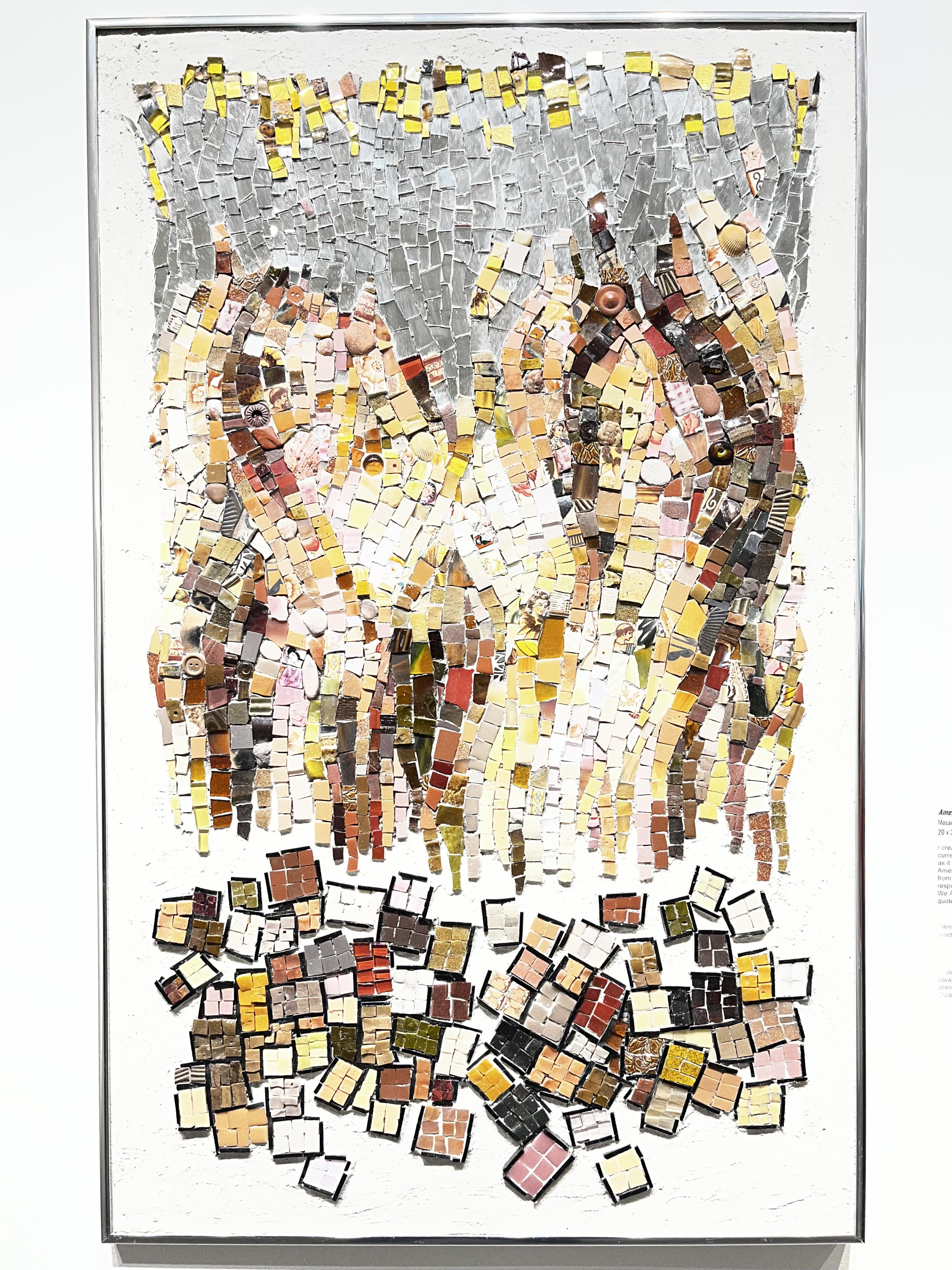
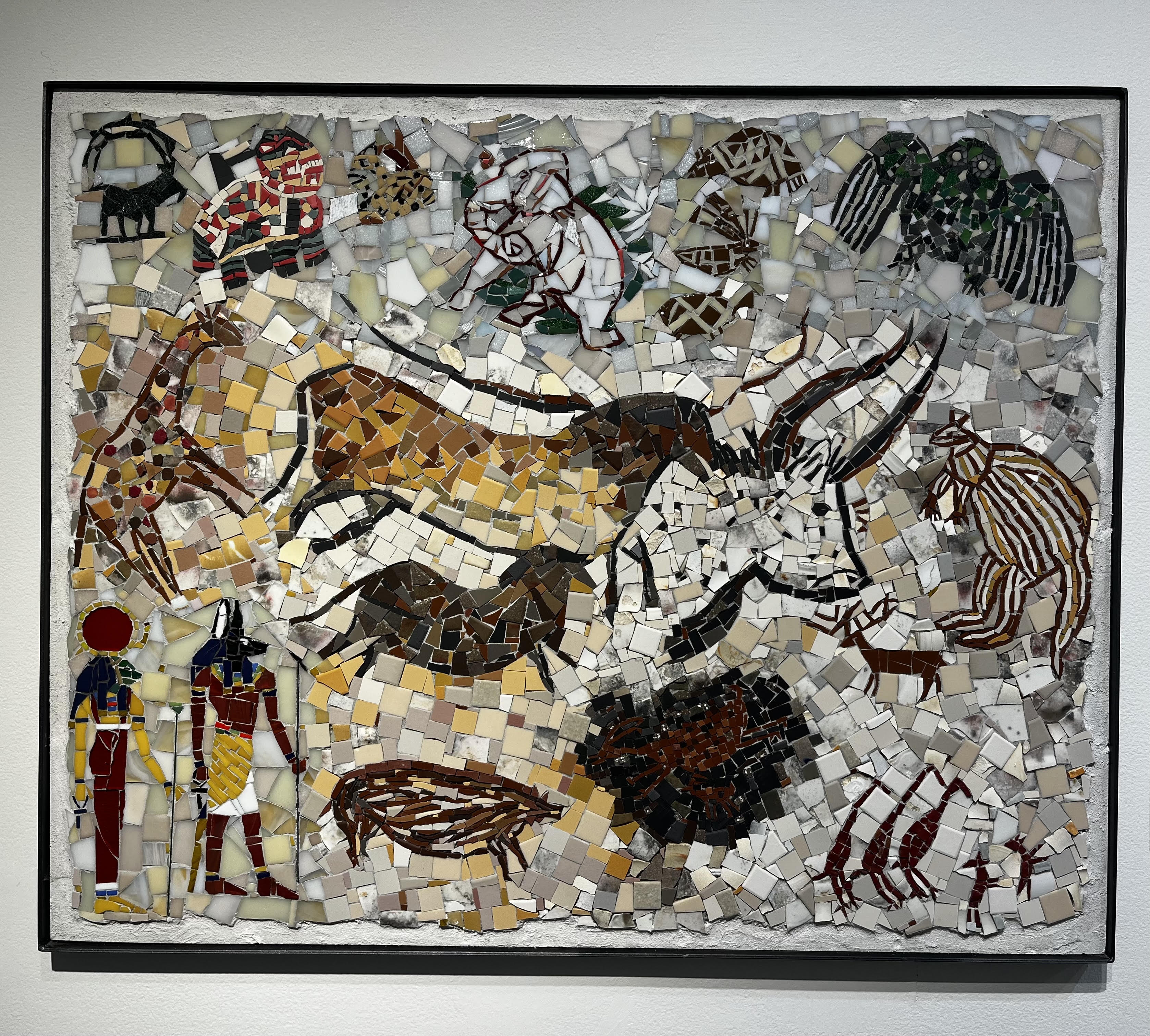
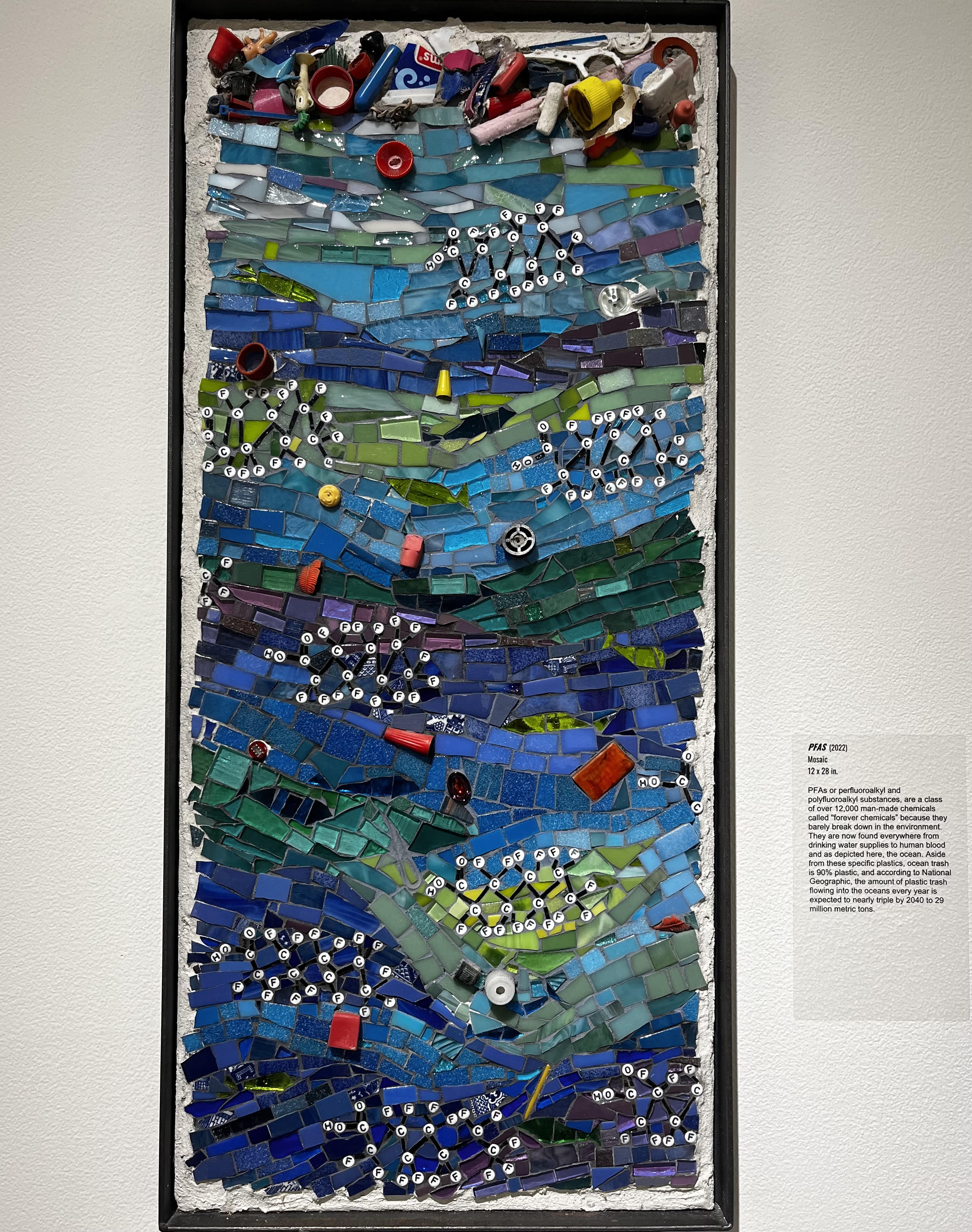
Nevertheless, I have a few nature scenes for you today, and art pieces from a fascinating mosaic show by Cynthia Fisher at Umbrella Arts.
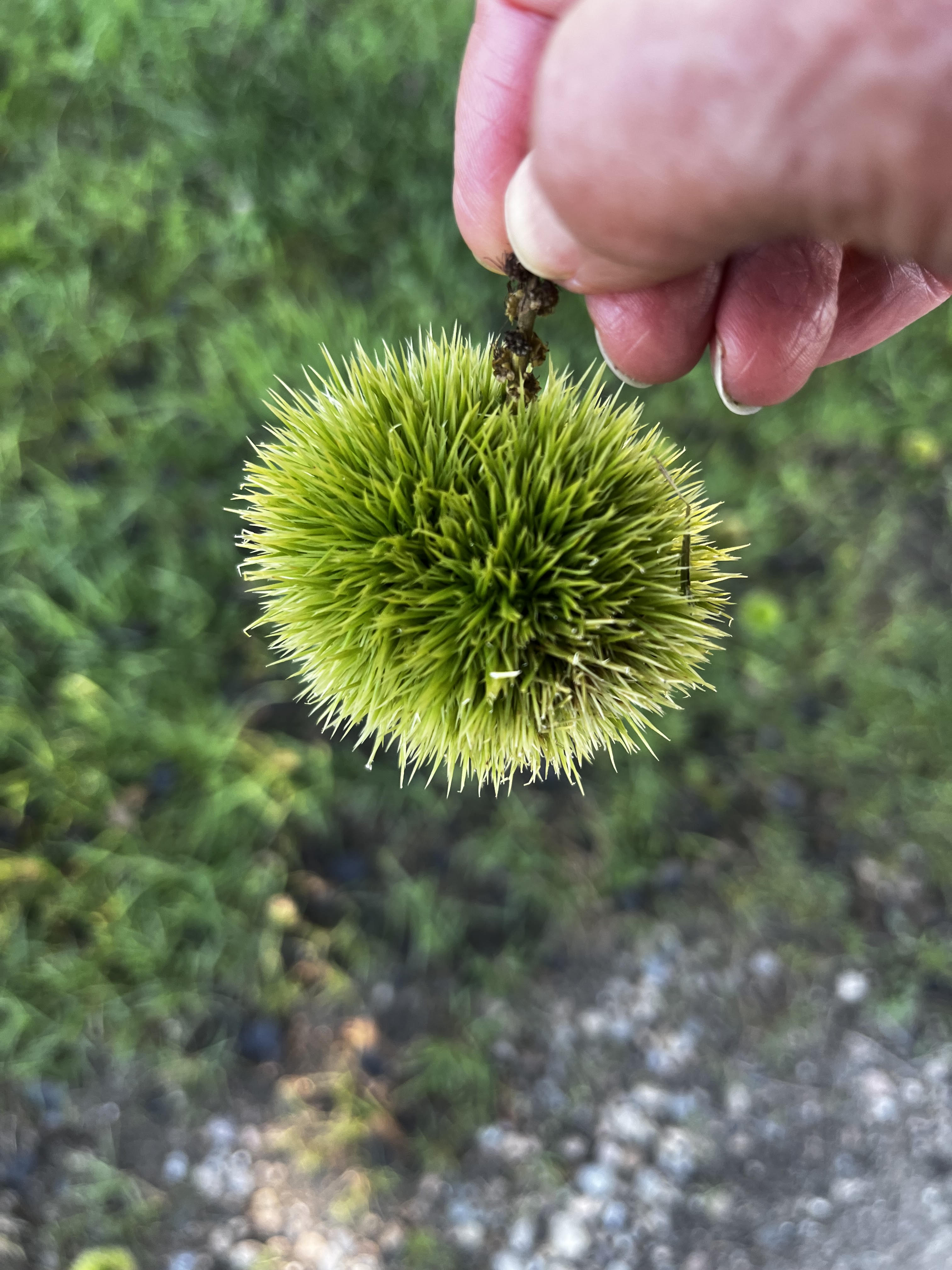
The first shot below is from a tree I pass when taking walks in New Shoreham. My app calls it a Chinese chestnut.
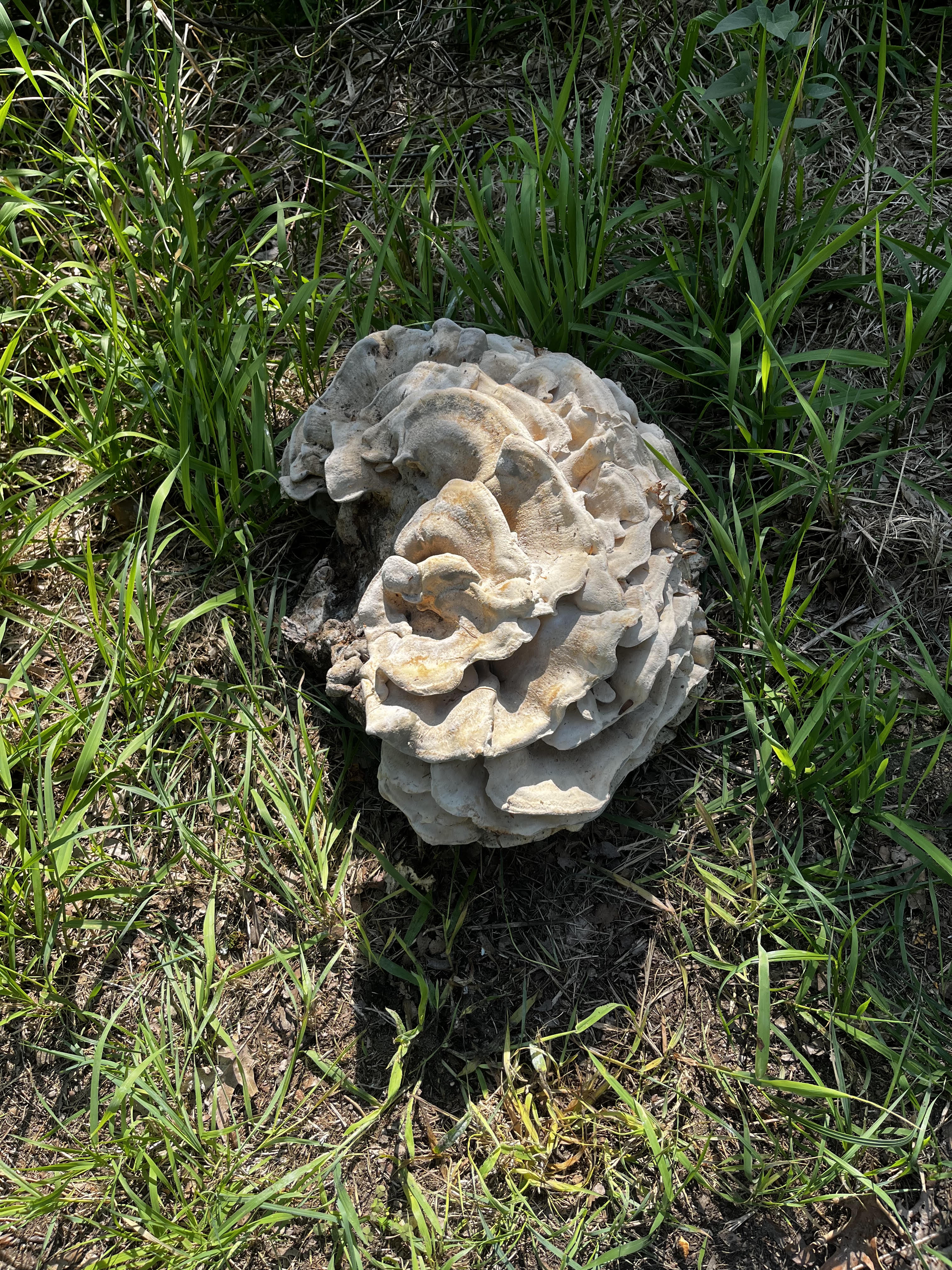
Next is an exotic-looking fungus said to be edible. It’s a Black-staining polybore on a red oak stump. I didn’t take a bite!
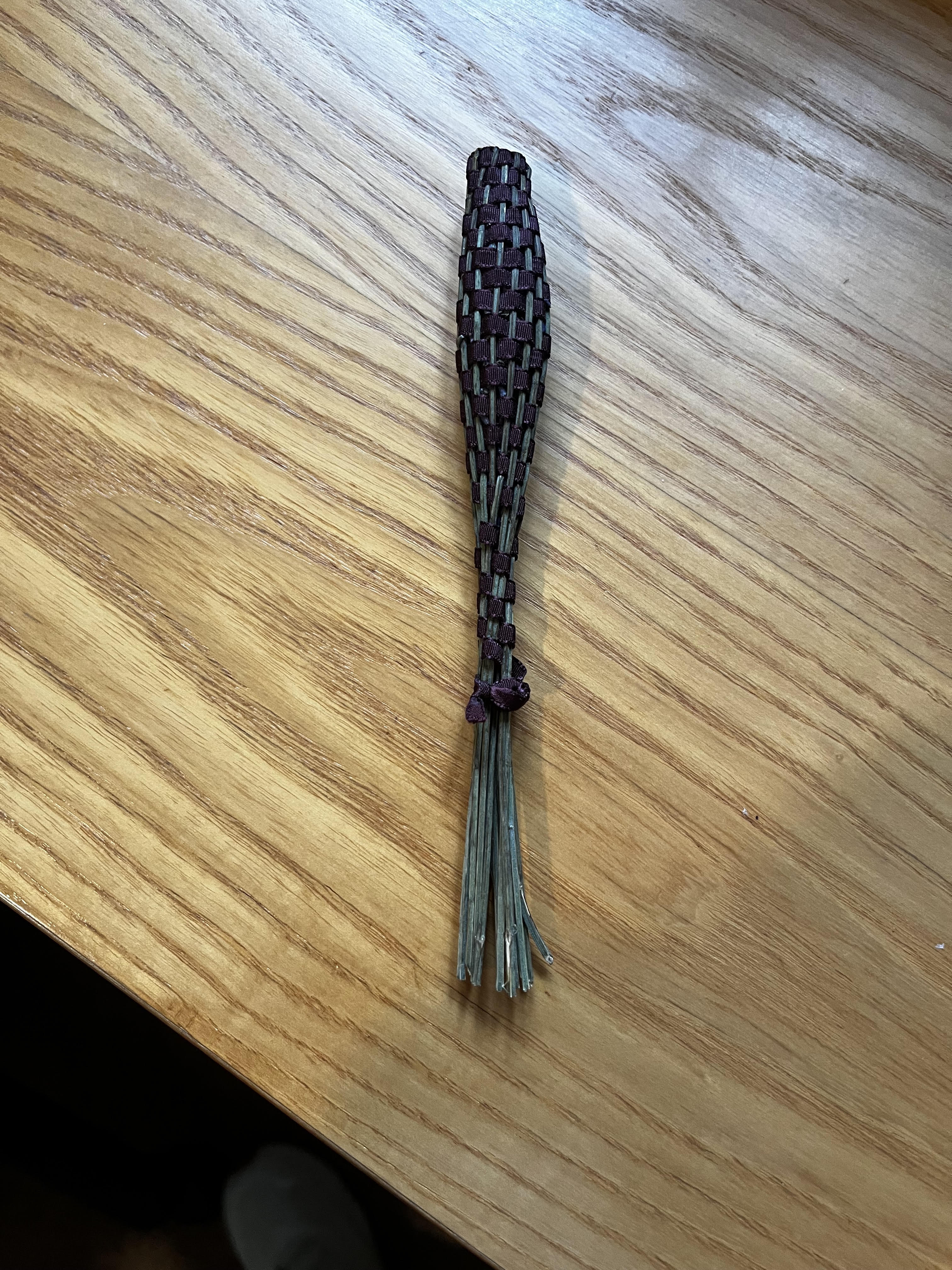
Kristina gave me a sweet-smelling lavender wand, an example of a French folk tradition involving sticks of lavender woven with ribbon. I had never seen one.
The first of Fisher’s mosaics here honors the American “tapestry,” the rainbow of skin colors (and personalities and traditions and cultures) that shows the best of us. Next we see Fisher’s modern version of ancient art, including cave paintings and figures from pyramids. The lovely blue mosaic drew me in but turned out to be a harsh commentary on what we have allowed plastics to do to our waterways. It’s called “PFAS,” pollutants you may know as “forever chemicals.”
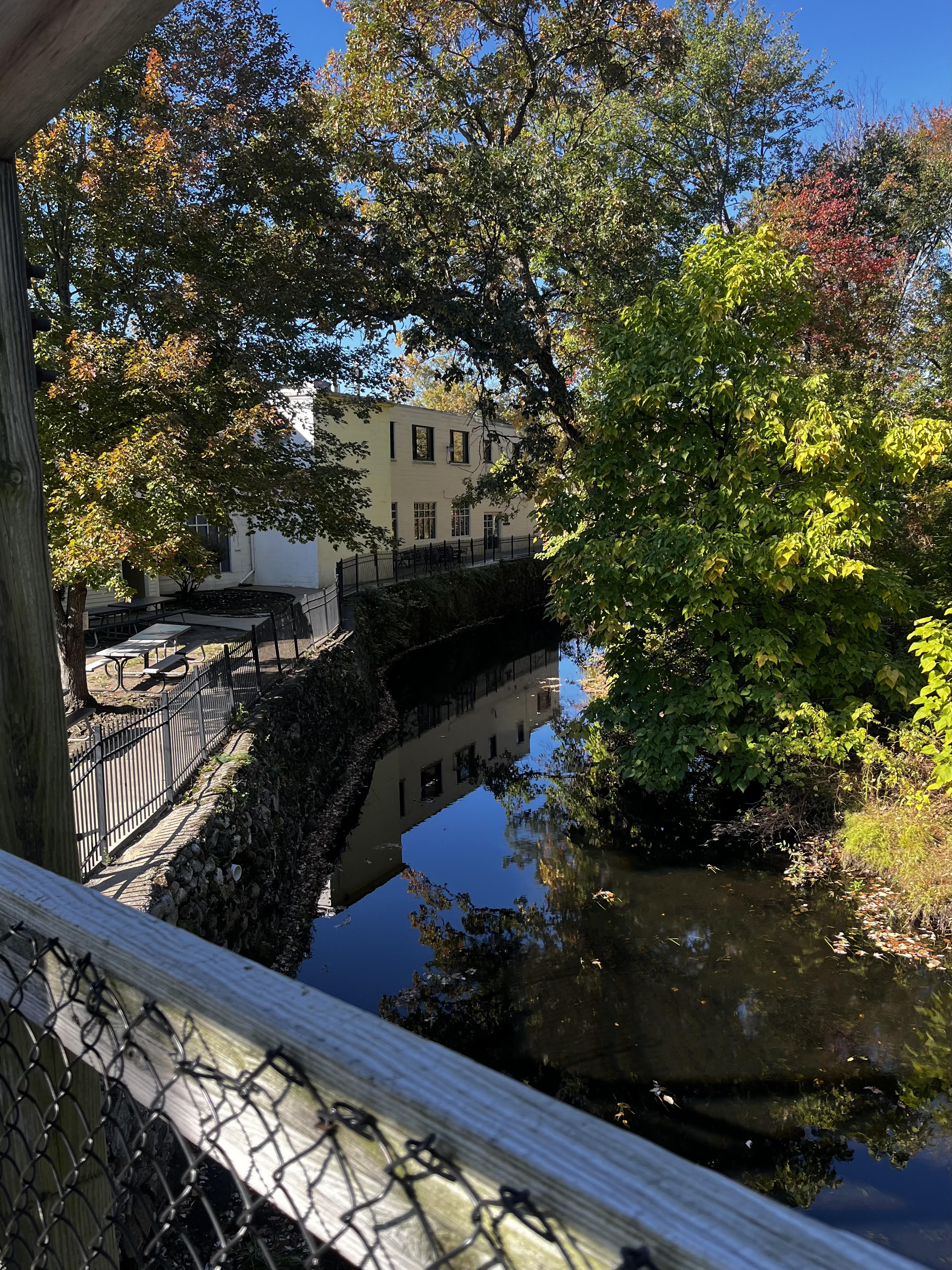
Last is the stream by the Nashoba Bakery in Concord, Massachusetts, a favorite spot to eat a sandwich or pastry. The water is very low, reflecting the drought this year.
Photo: Sasha Arutyunova. Austin Phillips, one of the last full-time professional makers of ventriloquist dummies in America.
Sometimes the unusual careers that one reads about seem to fall out of the blue onto the people.
Not so in the case of the young man making ventriloquist dummies in today’s story. It sounds like he was born to do this work.
Cornelia Channing writes at the New York Times, “In the backroom of a small, cluttered workshop in Portland, Maine, a figure lies facedown on a table. Its head has been cut open, exposing a delicate anatomy of brass rods, hinges and levers.
“It is motionless, as though sleeping. But soon it will turn its head, blink, crack a wry smile and part its lips to speak. Each movement will be directed by an intricate network of hand-soldered mechanisms concealed inside its small, hollow body.
“The figure is a recent creation of Austin Phillips, one of the last full-time professional makers of ventriloquist dummies in America. A craftsman working in a tradition that stretches back to Victorian music halls and vaudeville theaters, Phillips, 33, creates custom figures for performers and collectors while preserving a disappearing art.
“ ‘To some people, these are just puppets,’ Phillips said in a recent interview at his shop. ‘To me, there’s so much to them. It’s sculpture, casting, painting, sewing, mechanics, history, research, performance design — all at once. ‘They are like kinetic art objects.’ …
“Making a dummy begins with the face. Phillips pours resin into a handmade mold and then reinforces the shell with epoxy. Once the casting cures, a hollow skull is ready for eyes, a mouth and internal mechanisms. Phillips then paints the dummy’s features, creating distinct, expressive characters. …
“Phillips’s fascination with puppets began early. When he was 5, his parents took him to a mall where he spotted in a shop window a toy Charlie McCarthy, the monocled dummy made famous by the ventriloquist Edgar Bergen.
“Phillips was transfixed. ‘There was something about it that really drew me in,’ he said. ‘It looked mechanical and yet somehow alive.’
“By 14, he was carving his own figures from wood and building simple machines, obsessed with anything that could be taken apart and fixed, like pinball machines and motorcycles. While studying technical theater at the University of Maine at Farmington, he built dummies in his dorm and began selling them on eBay, which snowballed into a career. …
“To create the interior mechanisms, Phillips hand-solders brass components that will control every blink and smile. Each element is attached, via wires or strings that run through the neck, to a small lever in the puppet’s torso. …
“The puppets vary in complexity. Some have simple designs with just a moving head and mouth, while others are elaborately mechanized with 10 or more finger-operated levers. These can have eyelids that blink and wink, eyebrows that rise and lower, lips that appear to spit, ears that wiggle and legs that kick — all in one figure. …
“Most of his customers are collectors and hobbyists, but a few are professional ventriloquists. He recently repaired a talking-dog apparatus for a performer. Another customer, the comedian and ventriloquist Sophie Becker, has called him from the road for emergency repairs.
“ ‘We changed a string over FaceTime once,’ he said.”
Photo:mor Charpentier, Malo Chapuy’s “Scene of Pilgrimage,” 2025, is an example of one contemporary artist’s love of the medieval.
Here’s an artist who imitates the medieval painters, adding threatening hints about our world’s destiny. Not exactly upbeat, but interesting. His paintings make me wonder if I have missed hidden messages in paintings that were actually created in the Middle Ages.
Wilson Tarbox writes at Artnews, “Medieval art continues to resurface as a foil for the art of subsequent generations. … By the mid-19th century [revivalists] looked to it for inspiration, an egress from the calcified obsequiousness of neoclassicism and the depredations of industrialization.
“The latter had torn up the old social fabric, killed hundreds of thousands during the Napoleonic wars, and displaced millions from the countryside to the cities. Yet what emerged was a radically new interaction between old forms and new ideologies. William Morris, the socialist founder of the Arts and Crafts movement, believed medieval art embodied artisanal brilliance and collaboration. By contrast, Augustus Pugin, a monarchist architect of Westminster Palace, hoped it would usher in ‘a return to the faith and the social structures of the Middle Ages.’
“Malo Chapuy is the latest avatar of medieval revivalism. Born in 1995 in northeastern France, he studied philosophy before turning to art history at the Sorbonne, and then to studio art at the École des Beaux-Arts in Paris. At art school, Chapuy resisted pressure from his advisor to ‘paint like Rothko,’ gravitating to late 13th- and early 14th-century art. He obsessed over ancient techniques, probing manuals by famous conservationists and counterfeiters. He learned how to not only paint like the Old Masters but also make his surfaces look faded and cracked. For his thesis exhibition in 2022, he produced an illuminated manuscript, several small paintings in egg tempera, and a tapestry of faux stained glass made from Covid-19 face shields.
“Today he paints religious scenes, altarpieces, and early Renaissance-style portraits that look like museum artifacts save for the proliferation of wind turbines, water towers, astronauts, and spaceships. … When we met, he had just returned from Bogota, where his gallery, Mor Charpentier, had organized a solo show of recent work.
“Chapuy isn’t his gallery’s only medieval revivalist. Sacha Cambier de Montravel, a Belgian artist also born in 1995, whose studio is located across the courtyard from Chapuy’s, contributed dark diptychs and triptychs evocative of Hieronymus Bosch to the [Lens, France] ‘Gothiques’ exhibition. … Clearly, there is a movement—a new neogothic revival — to which Chapuy belongs.
“Big tech, after all, has created a new click-based serfdom, as Yanis Varoufakis asserts in Technofeudalism, replacing capitalist markets and profit with platforms and rents. But Chapuy’s skewering of techno-feudalist fantasies shuns the digital in favor of tactile materiality, just as his 19th-century counterparts resisted industrialization. Although he denies any specific political subtext, something is happening underneath the artificially aged surfaces of his work — a new synthesis of past forms and modern ideas that says as much about ambient apocalyptic fears as it does about desires for alternative futures.
“In one of his two paintings of Saint George (2024), the monstrous dragon of legend appears as a serpentine oil pipeline. Black viscera seeps from its flank, pierced by George’s lance, as the saint raises his sword to strike the fatal finishing blow. Here, the potent beauty and storytelling of medieval religious art, used to such great disciplinary effect under feudalism, is reimagined as indistinguishable from the dream of overcoming present ecological and political crises.”
More at ArtNews, here. Strange pictures. No paywall.
Photo: Chile’s National Monuments Council. Chilean artist Julio Escámez finished “Beginning and End” in 1972. Dictator Pinochet ordered it destroyed, but it was recently discovered to have been only painted over.
Today’s story reminds me of the Power of One. It’s not the only example of a person (or persons) being be ordered to destroy a work of art and finding a way to hide it instead, but it was new to me. Probably Rebecca at the Fake Flamenco blog knows all about it.
Min Chen writes about the discovery at Artnet.
“Long thought lost, a historic mural by Chilean artist Julio Escámez that was erased by Augusto Pinochet’s military regime in 1973 is finally reemerging in Chile’s city hall.
“A team from the Heritage Unit of the Municipality of Chillán (UPA) is currently in its third phase of uncovering and restoring the celebrated mural in the Salon de Honor. Begun in 2021, the project involves the millimeter-by-millimeter removal of 12 layers of white paint, which were slathered over the original composition decades ago. The restoration is slated to be completed in December 2027.
“ ‘We will be working in grids, carrying out manual stripping daily,’ Elvira Fuchslocher, head of the restoration team, said in a statement. …
“The work by Escámez was commissioned in 1969 by Mayor Eduardo Contreras Mella on the eve of Salvador Allende‘s presidential election victory. Escámez spent two years creating the mural, which, when completed, spanned some 452 square feet across a wall of the Salon de Honor. Titled Beginning and End, it depicted the triumph of people over oppression. …
“In 1972, the mural was unveiled by Mella’s successor, Ricardo Lagos Reyes, before Allende visited the work himself months later. Nobel laureate Pablo Neruda described it as containing ‘the most extraordinary essences of creation have been recognized, essences that possess the stillness of depth, of truth.’
“The ardently right-wing Pinochet, however, saw the artwork differently, linked as it is to a democratic socialist project. After his military junta overthrew Allende, the dictator ordered the mural destroyed. Escámez was forced into exile in Costa Rica, wounded by the erasure of his work. …
“Nearly five decades on, Chile’s current mayor, Camilo Benavente, spearheaded the effort to recover Escámez’s mural. But the chances were slim that the work still survived. Over the years, reports had circulated about how the artwork was destroyed: It was demolished with bayonets, it was covered with tar, or, in the artist’s own account, chipped away with ‘chisel and hammer.’
“But in 2021, an initial analysis of the wall in the Salon de Honor by the University of the Arts found the first trace of Beginning and End. ‘We locked ourselves in the council chamber, and in a small window that opened [by removing the white paint], the orange color appeared, which is prominent in the mural and corresponds to the flame,’ Karin Cárdenas, a historian who worked on this first analysis, told El Pais. ‘We stopped and said, “There might be something here.” ‘
“Turns out, the mural had not been tarred or slashed with bayonets — it had simply been painted over. But as the UPA continued to uncover more of the artwork over the years, the team learned that its original height was reduced to make room for a second story, with a window cut directly through it.
“They also discovered that the mural was larger than previously believed. In fact, the city now suspects the artwork’s title, Beginning and End, might refer to two artworks, likely Beginning and End. Where the first part portrays the dramatic class struggle, the second reveals a serene group of women peering through a telescope, reflecting ‘calm and contemplation,’ said Cárdenas.”
What an emotional moment — that might-be-something-here moment! How I long to experience a moment like that for values that have been trashed! More at Artnet, here.
Photo: Diana Panuccio/Art Gallery of New South. One of the new landscapes of Aboriginal artist Billy Bain — a new development in his career.
Around the world, indigenous people have been pushed and pushed into spaces nobody wants. That is, until the land becomes desirable for new reasons, and then they have to fight to keep it.
As Steve Dow writes at the Guardian, an artist in Australia is intent on reclaiming the beaches for Aborigines.
“As a teenager in the mid 2000s, Billy Bain would ride waves around Sydney’s northern beaches, having traveled the world watching his champion surfer father Rob Bain compete. But even though he was minutes from his home in Avalon, he was often made to feel an unwelcome outsider.
“ ‘I’d be told that I’m not from there, so I need to go in [to shore],’ he says, seeing these warnings as veiled threats of violence. ‘Otherwise, you know, “something’s gonna happen to you.” ‘
“Now 33, the Dharug artist sees simply being an Aboriginal surfer as a way of reclaiming space. ‘[The northern beaches are] quite an isolated and predominantly white place,’ he says.
‘You know, the beach was and still is an Aboriginal space, but in popular culture it has been represented as a very white space.
” ‘There’s obviously the bronze Aussie, which is your typical tan, athletic white male, but it’s not seen as being a space that Aboriginal people inhabit any more.’
“In his studio in Granville in Sydney’s inner west, Bain is preparing for an upcoming solo exhibition at the Art Gallery of New South Wales, ‘By the River.’ The survey will feature new work, including five landscape paintings of the Dyarubbin/Hawkesbury river – a location that connects the Manly born artist with the country of his ancestors.
” ‘Geographically it was actually very close for us,’ says Bain, who has come to see surfing on the northern beaches as a form of cultural return, because the Dyarubbin flows into an estuary at Pittwater. ‘I see the story of the eel and how it spawns out at sea and then it finds its way back up these river systems to be an interesting metaphor for a return. I see myself as having a similar journey.’
“For ‘By the River,’ Bain has made 11 funny, figurative Indigenous family members (and one dog) dressed in bikinis, shorts and even a pair of budgie smugglers painted in Aboriginal colors: red and black with a yellow tie. …
“The figures will be displayed holding aloft a four-meter, long-finned eel – a totem animal and spirit of resilience known in Dharug language as a burra – which Bain has fashioned as a soft sculpture using cloth on a wire and steel frame, adorned by 200 textile elements handwoven by his mother, Kathleen Bain.
“Kathleen, a Dharug woman … would encourage her children to create with all sorts of materials, and Bain would especially love making faces and figures from the wax scraped from his surfboards.
“Bain’s surfer father has also been part of his artistic process. The pair took a small ‘tinny’ boat up the Dyarubbin, bush bashing along the clifftops and finding ancient Aboriginal handprints in caves, to help form the drawings for his five landscape paintings. …
“Ultimately, Bain’s art practice has become ‘a healing thing,’ he says. ‘It’s been such a massive part of learning to express myself.’ …
“Artists don’t exist to change the mind of doubters, but ‘fun, seductive’ humor in art can convey some serious ideas, Bain says. … ‘I do have quite a positive look on the human spirit and people’s ability to be good-natured and embrace other people. I think that’s intrinsic in us as humans.’ ”
If you live in New South Wales, you have until November 8 to see the show.
More at the Guardian, here. No firewall, but please consider supporting their outstanding joyrnalism.
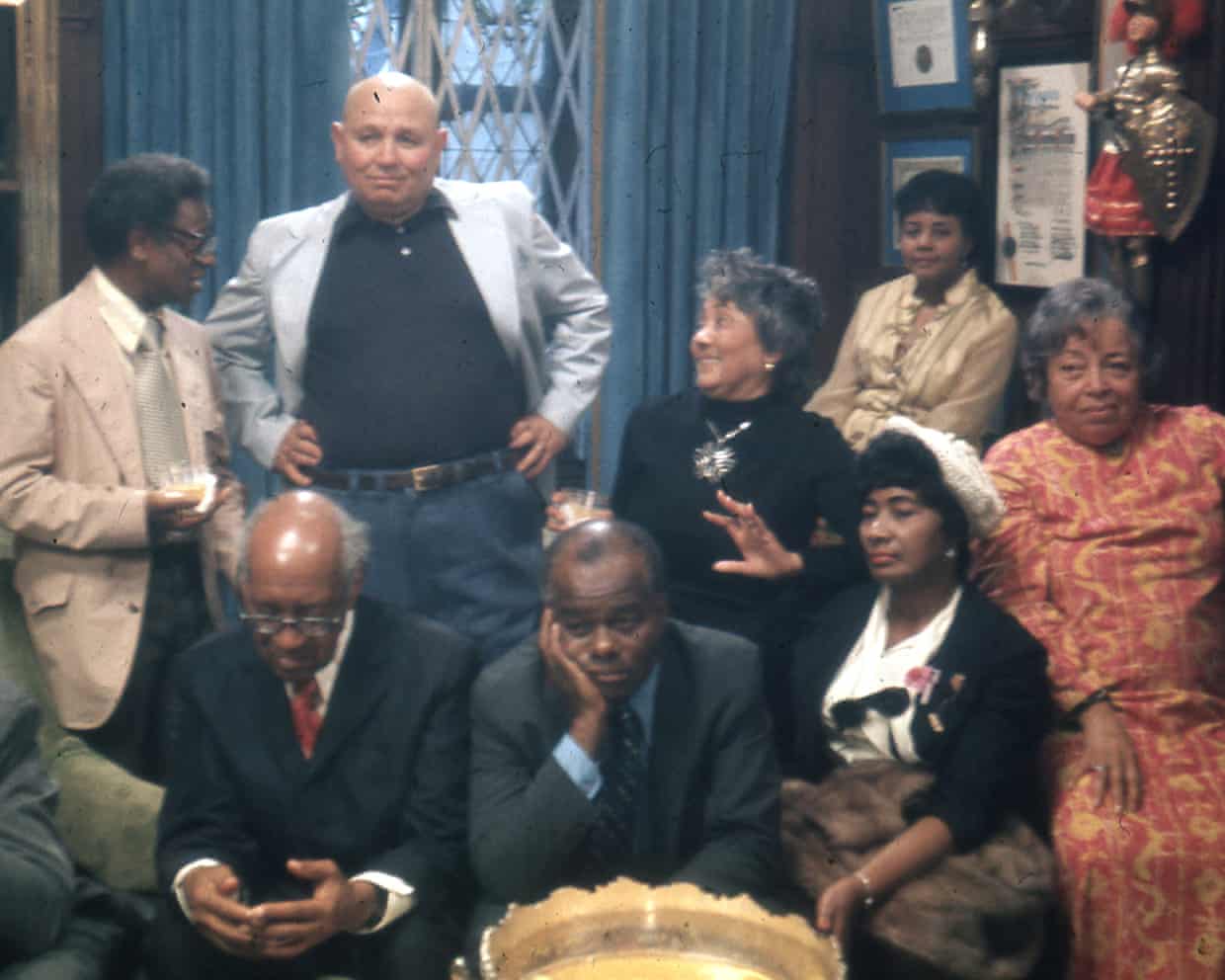
Photo: William Greaves Productions. The film Once Upon a Time in Harlem centers on a cocktail party William Greaves hosted in August 1972 with men snd women of the Harlem Renaissance who were still living.
Many Americans know of the Harlem Renaissance as the flourishing of African American arts and culture in New York in the 1920s and 1930s. But a documentary about it was filmed mostly in the 1970s when William Greaves rounded up the remaining members of the movement and had a party.
Nadia Khomami explained recently at the Guardian, “In 1969, the pioneering documentarian William Greaves wrote of his fury over the racially degrading stereotypes that white film producers threw up on American screens. …
“Three years later, Greaves began work on what he considered the most important footage he ever shot: a feature documentary gathering surviving figures of the Harlem Renaissance to reflect on the movement they had built half a century earlier.
“Now, more than 50 years after cameras rolled,Once Upon a Time in Harlem is finally receiving its international premiere in Cannes’ Directors’ Fortnight – completed not by William Greaves, who died in 2014, but by his son David and granddaughter Liani.
“The documentary centers on a cocktail party Greaves hosted at Duke Ellington’s townhouse in Harlem in August 1972 – an attempt to capture the voices of artists, writers, musicians and organisers whose work had transformed Black American culture in the 1920s, but whose stories were already at risk of being sidelined.
“Greaves invited every surviving participant he could locate. Many had not seen one another for decades. They included the painter Aaron Douglas; the queer artist and writer Richard Bruce Nugent; the poet Arna Bontemps; the musicians Eubie Blake and Noble Sissle; the photographer James Van Der Zee; and Ida Mae Cullen, the widow of Countee Cullen.
“For four hours, Greaves filmed them as they laughed, reminisced and debated. The resulting film follows the rhythm of the party itself: tentative greetings and warm memories gradually giving way to animated debates over politics, language and legacy.
“David Greaves, who was there in 1972 aged 22, worked on the shoot as a cameraman under his father. …
“Duke Ellington himself was unwell and did not attend, but his sister Ruth was present. ‘There were four cameras, two crews circulating through the apartment catching conversations, these little moments between them,’ David said. ‘Mostly my father just let them freestyle, it was very fluid.’
“Among the film’s strengths is precisely that looseness. At one point, guests debate whether the term ‘Negro’ should be discarded in favor of ‘Afro-American.’ Elsewhere, they discuss Marcus Garvey and Langston Hughes and the global reverberations of anti-colonial struggle. Aaron Douglas reflects on jazz, telling the room: ‘It would be considered a revolution in relation to other music. It was not a revolution to us.’
“For David Greaves, those conversations feel strikingly current. ‘When they talk about whether to call themselves Black or Negro, that’s a discussion still happening now – you’ve got Black, African American, people of color. And then there is still this question of what the diaspora should do in relation to Africa.’ …
“The film also reminds viewers how recent America’s racial violence remains. David points to footage accompanying the anti-lynching poem ‘The Lynching,’ ending on a young white girl watching with what he calls ‘fiendish glee. … The US is not that far away from that time.’ …
“For him, the film arrives as Black history is once again being fought over in the US. … ‘They’ve been doing everything they can to erase the Black experience in America, even removing signage from park service sites. What this film does is show a group of wonderful people sitting around talking about a time 50 years ago, and about their own present. These giant intellectuals that the media didn’t even realize existed.’ …
“After William’s death, the material passed to his widow Louise, who continued working on it until her own death in 2023. David and Liani then took over, restoring and digitizing 60,000 feet of 16mm film. …
“When shaping the final cut, he followed one of his father’s principles: ‘My dad used to say if there’s something that affects you viscerally, go with it.’ …
“David, who has spent the past three decades publishing Our Time Press, a Brooklyn community newspaper focused on Black civic and cultural life, with his wife, Bernice Green, said he hoped to release the film in time for Greaves’ centenary in October, with retrospectives planned in New York and at the Barbican in London.
“ ‘My dad was appreciated by those who knew documentary film, but he didn’t have the acclaim that he has now,’ he said. ‘This film should cement him as a chronicler of the history of African Americans.’ ”
Photo: David Levene/The Guardian. A man engages with Laure Prouvost’s art installation ‘Above Front Tears Oui Float’ at the Nasjonalmuseet, Oslo, Norway.
I can’t get enough of emerging research on what activities are good for your brain. It’s interesting that so many of the studies focus on the role of art.
As Denis Campbell wrote at the Guardian in May, “Singing, painting or visiting a gallery or museum helps people age more slowly, according to the latest study to link taking an active interest in art and culture with improved health. The findings are the first to show that both participating in arts activities and attending events, such as viewing an exhibition, lead to people staying biologically younger.
“ ‘These results demonstrate the health impact of the arts at a biological level. They provide evidence for arts and cultural engagement to be recognised as a health-promoting behavior in a similar way to exercise,’ said Prof Daisy Fancourt, the lead author of the research and the head of the social biobehavioral research group at University College London.
“However, slower ageing does not necessarily mean someone will live longer. … Previous studies have suggested a link between arts engagement and longer lifespan, but much more research would be needed to establish potential causal effects on longevity.
“[A new test] showed that those who undertook an arts activity at least once a week were on average a year younger biologically than those who rarely engaged in such pursuits. Those who exercised once a week were only six months younger by that measure.
“The benefit the arts confer on the pace at which people age is so dramatic that it is comparable to the difference between smokers and those who have given up smoking, the researchers say. …
“Said Dr Feifei Bu, a senior author and also a UCL academic, ‘This builds on a growing body of evidence about the health impact of the arts, with arts activities being shown to reduce stress, lower inflammation and improve cardiovascular disease risk, just as exercise is known to do.’
“The results, published in the journal Innovation in Aging, are based on blood test and survey response data from 3,556 adults taking part in the UK Household Longitudinal Study. It uses blood samples to estimate people’s biological age and the pace at which they are ageing.
“Participants were asked how often over the last year they had taken part in singing, dancing, painting, photography or crafting, or had attended an art exhibition or event, visited a heritage site such as a monument or historic building or park, or been to a museum, library or archive. …
“Evidence is emerging that the arts can improve both mental and physical health. In 2019 the World Health Organization published a report, by Fancourt and Saoirse Finn, which highlighted initiatives such as playing music to patients before surgery and using the arts with people with dementia. In the latest study, the middle-aged and older adults aged 40 or above received the biggest boost to the pace at which they aged as a result of taking part in the arts.
“ ‘Across the arts sector we have known for a long time that getting creative yields extraordinary benefits for our health, and this latest research adds a vital new piece to the puzzle, proving that arts and culture can even slow down the biological clock,’ said Mark Ball, the artistic director of the Southbank Centre, a multi-arts venue in London.
“The Southbank complex was born in 1951 out of the Festival of Britain. Its description as ‘a tonic for the nation’ was not a coincidence, Ball said. ‘It was an explicit recognition that, after the destruction and gloom of the second world war, the country needed to be convened through the arts to find a sense of optimism and healing. That sentiment is enduring and is needed now, more than ever.’ ”
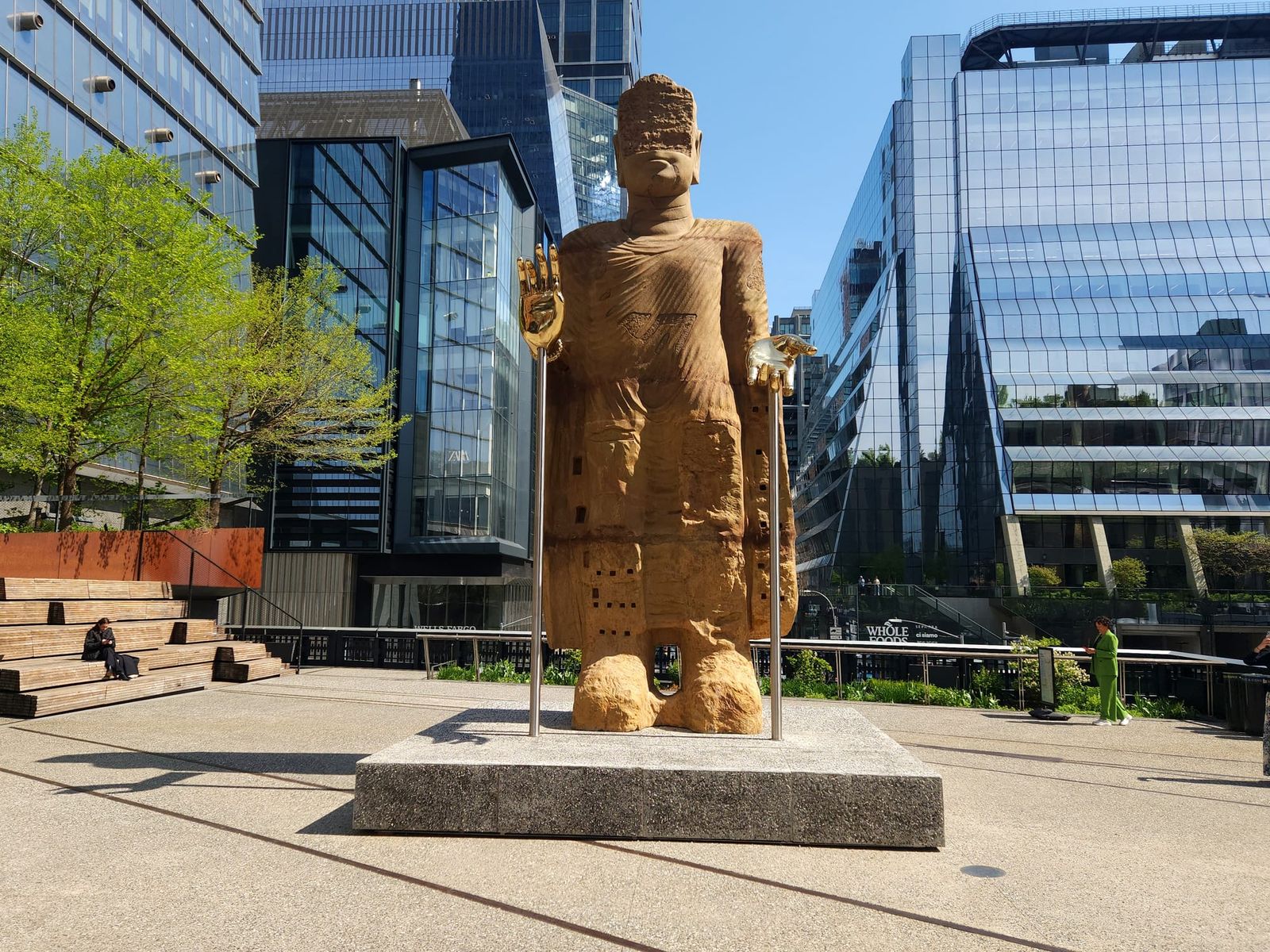
Photo: Rhea Nayyar/Hyperallergic. Frontal view of Tuan Andrew Nguyen’s High Line commission“The Light That Shines Through the Universe” (2026) in New York City.
It’s always a tragedy when warfare destroys art. I remember how I felt for Buddhists when the Taliban destroyed the famous Bamiyan Buddhas in 2001 in Afghanistan.
Now, an exhibit honoring those statues has appeared on New York City’s beautiful elevated park, the High Line. Rhea Nayyar at Hyperallergic describes seeing it and what it signifies to her.
“Between the sea of sky-blue high-risewindowsand the traffic funneling toward the Lincoln Tunnel, a large sandstone Buddha stands tall on the High Line, inviting Manhattan to embrace a moment of tranquility.
“Tuan Andrew Nguyen’s ‘The Light That Shines Through the Universe‘ (2026), the park’s fifth site-specific commission, was selected from nearly 60 proposals. It was recently installed at West 30th Street and 10th Avenue, and is on view through Spring 2027. The 27-foot-tall sculpture stands out from its contemporary surroundings not only because of its warmth and timeworn quality, but because it resurrectsa critical piece of destroyed cultural heritage — the Bamiyan Buddhas.
“ ‘This sculpture creates a friction with the surroundings here in New York. It’s not sleek like everything else you can see here,’ High Line’s art director and chief curator Cecilia Alemani said to Hyperallergic. ‘It offers a hint to the public that temporality is not necessarily a straight line, that things can come back.’ …
“The Bamiyan Buddhas, enormous reliefs that dated back to around the 6th century, were hewn into a sandstone cliffside of the Bamiyan Valley in Afghanistan, a region along the Silk Road trade route that became a prominent Buddhist site. Of the two figures, the larger Buddha was affectionately referred to as ‘Salsal,’ which translates to ‘the light that shines through the universe.’ …
“Nguyen, who has recast or reinterpreted artillery associated with the Vietnam War throughout his practice, took the same approach to make the sculpture’s hands, which are disconnected from the sandstone body. He told Hyperallergic that he was able to source artillery brass from Afghanistan through a friend’s network across the Bamiyan region and bring it over the Pakistani border.There, he recast them into the shapes ofmudras— symbolic hand gestures used extensively in Buddhist and Hindu iconography — before transporting them to Vietnam, where the sandstone was sourced and carved.
“Glinting from the sun overhead, the right hand invokes the Abhaya mudra, which signifies fearlessness, while the left hand connotes compassion and sincerity through the Varada mudra.
“Nguyen statedthat his statue was not a replica of the lost cultural heritage, but rather an “echo.”
“ ‘ You keep a story, idea, or memory alive by retelling,’ he explained. ‘When I engage in this process of remaking, it’s like retelling the story. It gets translated through my hands and eyes.’
“Though it feels particularly timely because of the ever-evolving United States- and Israel-ledviolence in Iran,Alemani noted that Nguyen’s proposal had been selected a long time ago. ‘It’s a testimony to the strength of the artist’s voice that sometimes, the works we select become even more relevant when we install them,’ Alemani said.”
Do you agree with the writer that the sculpture is telling us that history repeats itself? Do you have other reactions? I feel it’s also about humanity refusing to let good things be destroyed entirely.
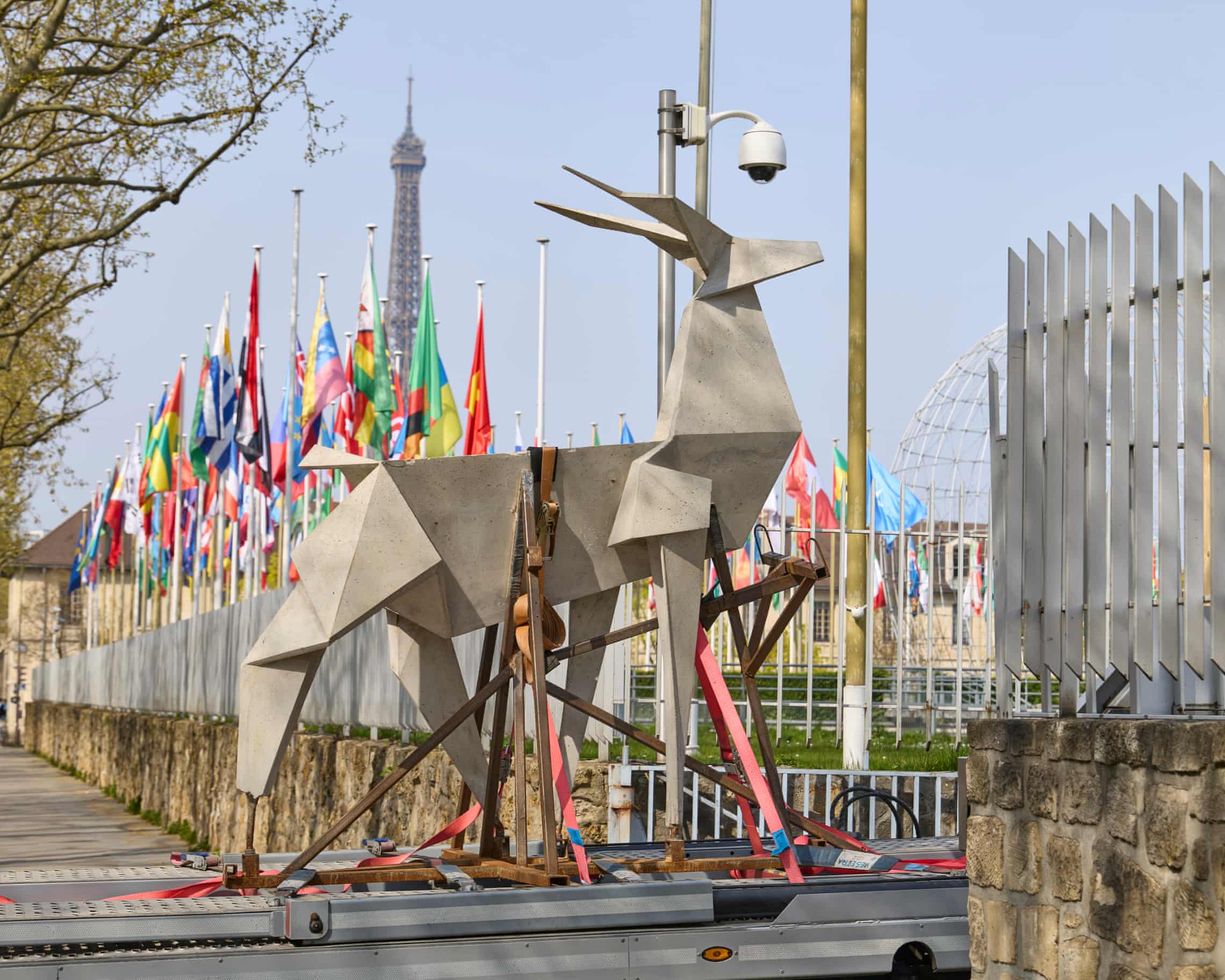
Photo: David Levene/Guardian. Zhanna Kadyrova’s sculpture arrives at the headquarters of Unesco in Paris, on its way to the Venice biennale. “It has become a symbol of hope” in Ukraine.
The Venice Biennale is a celebration of art and culture from countries around the world. What different nations send to the event shows what they think they stand for and what they want others to know. This year, war-torn Ukraine didn’t try to send high art but a sculpture that has become a symbol of hope.
Charlotte Higgins reported at the Guardian in May, “On a perfect spring day in Paris, the deer is first visible in the distance, poised between an avenue of just-budding plane trees in the 7th arrondissement. Its head is raised, its body poised. Seen there among the trees, it really could be a wild animal. In reality, it is a concrete deer, and not even a particularly naturalistic one, since it has the distinct look of origami about it. The sculpture is a play of scale and weight, as if feather-light folded paper has been enlarged and transformed into heavy concrete.
“The deer is strapped to a flat-bed truck, and it is being driven into the grand modernist headquarters of Unesco, the UN agency that looks after heritage, culture and education. It will stand there for a day in its gardens, with Alexander Calder’s Spirale for company and the Eiffel Tower as a backdrop. It is the last stop on a long overland journey across eastern, central and western Europe before it crosses the Venetian lagoon and docks in Venice for the 2026 art biennale, where, from this month, it will be the most prominent component of Ukraine’s national pavilion.
“The deer sculpture is by Kyiv-based artist Zhanna Kadyrova, who has been making resonant work reflecting the violence of the Russian attack of Ukraine since 2022. The work, however, predates Russia’s full-scale invasion. In 2018, she was commissioned by the city of Pokrovsk, in the Donetsk region, to help regenerate a large park. It was one of a number of efforts to invest in the cities of Ukraine’s east after Russian-backed separatists took over chunks of territory in the Donetsk and Luhansk regions. She and her partner, Denys Ruban, worked in the city for several months. …
“Fast forward to the summer of 2024. More than two years into Russia’s invasion of Ukraine, Pokrovsk was on the frontline. Kadyrova’s friend Leonid Marushchak – an educator, historian and now co-curator of Ukraine’s Venice pavilion – was at that time organizing perilous evacuations of museum collections from frontline towns. … Marushchak said: ‘I saw the deer was still standing there. I called Zhanna to find out if she was not against the evacuation of the sculpture. We went to the local museum – some of the staff were still working. They said they understand that they have to evacuate it, but they had no idea how to do it.’
“Marushchak began negotiating with the city authorities – whose first priority, as drone and artillery attacks heightened in their intensity, was not a slightly odd contemporary concrete sculpture in the park. His ‘trick,’ as he called it, was to undertake to evacuate a statue of Mykola Leontovych, too – a beloved Ukrainian composer who wrote the renowned, evocative Carol of the Bells. …
“A moving film, which will also be shown in Venice, documents the process. While the men are at work, Kadyrova asks locals – some about to leave for ever, some determined to tough it out come what may – what they think of the sculpture. Some are nonplussed, but others clearly love it, and the conversation is bound up with the ache of leaving a place, maybe for good. …
“It was last year that Kadyrova and Marushchak, with fellow curator Ksenia Malykh, proposed a project centering on the sculpture for Ukraine’s Venice Biennale pavilion. … And so, early this spring, the sculpture set out on its journey to Venice – a slow and circuitous one through Warsaw, Prague, Vienna, Brussels and finally Paris.
“Along the way, it has paused in each city, often in grand imperial architectural settings in which it was never intended to be seen, designed as it was for a park in a small, industrial city. And over the course of its journey, it has accrued more and more meaning and significance. Refugees from Pokrovsk, Kadyrova tells me, regularly come to see the deer, and a new tradition has arisen, of touching it and making a wish.”
For some reason, I haven’t been taking as many photos as usual. On recent perfect days, I just drink in the beauty and laugh at the number of bird calls — so many that even the Merlin app has trouble keeping track.
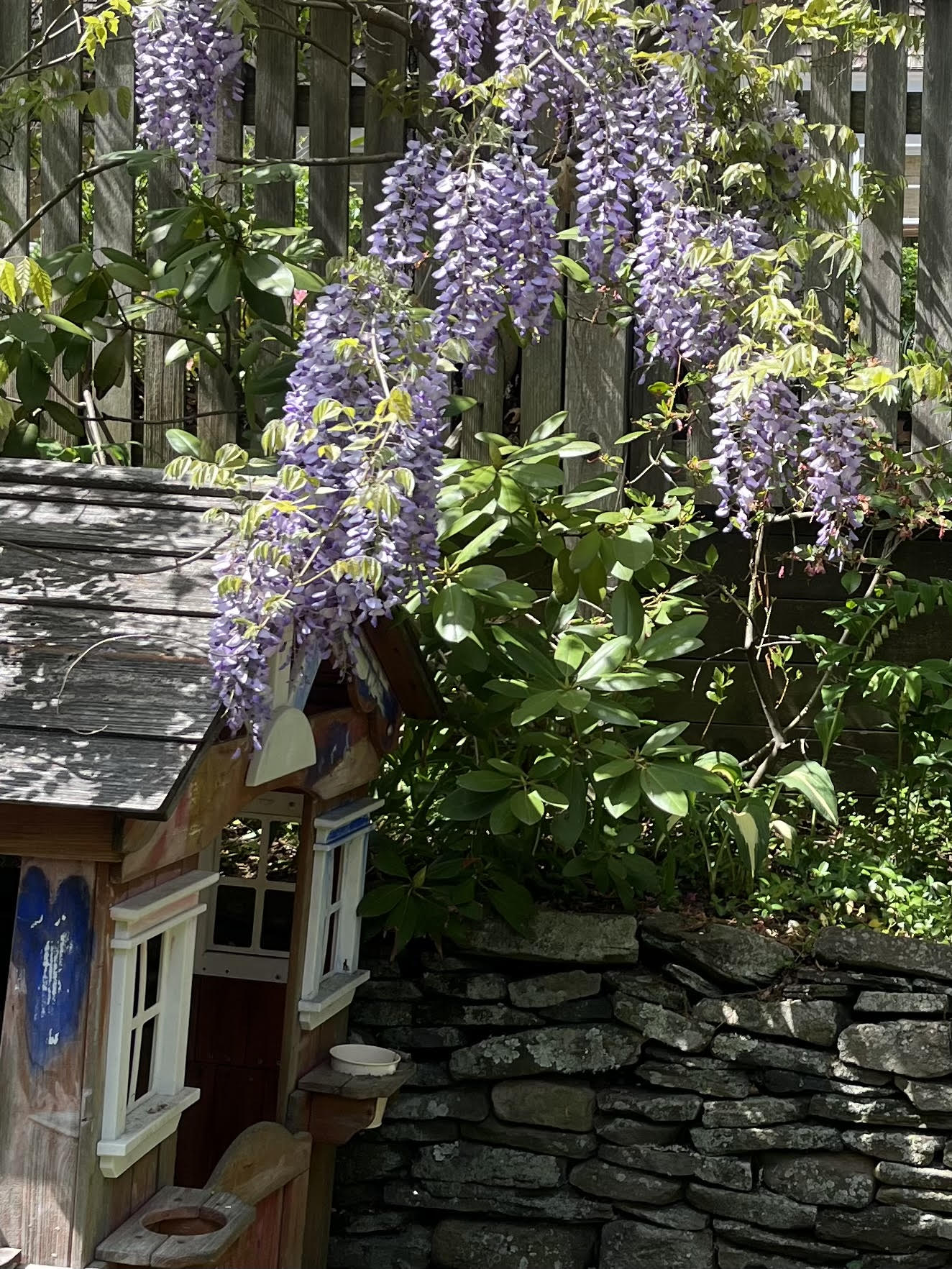
Still, there are some photo ops I can never resist: wisteria, for example. Above, you see Suzanne and Erik’s wisteria in a flourishing state. Ten years ago, when Farmor first provided the playhouse and our granddaughter took over (then age 1), the wisteria was a bit of a baby, too.
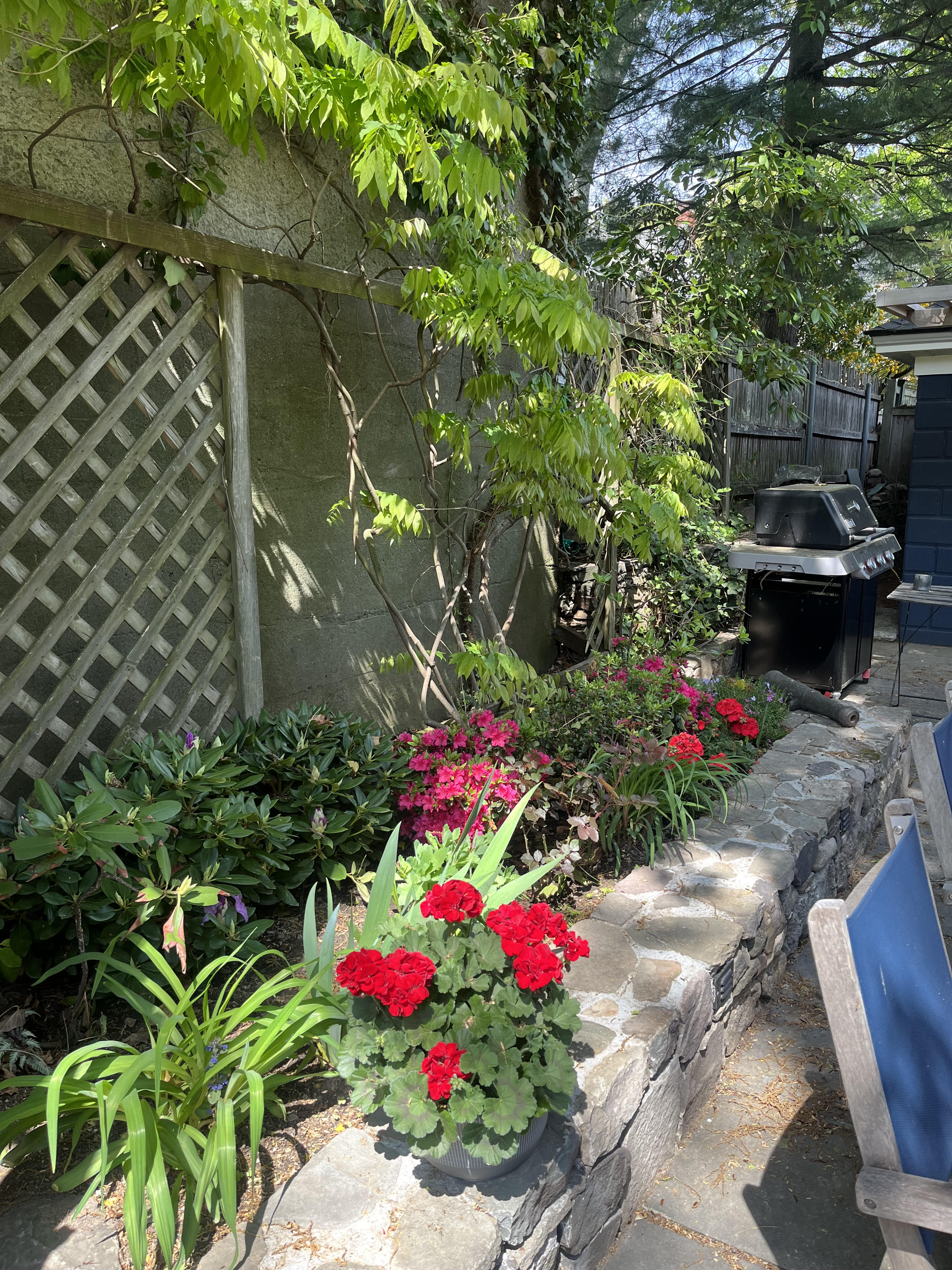
The playhouse is now old and worn, and the wisteria has grown up with our young lady. (Note the second wisteria over near the grill.)
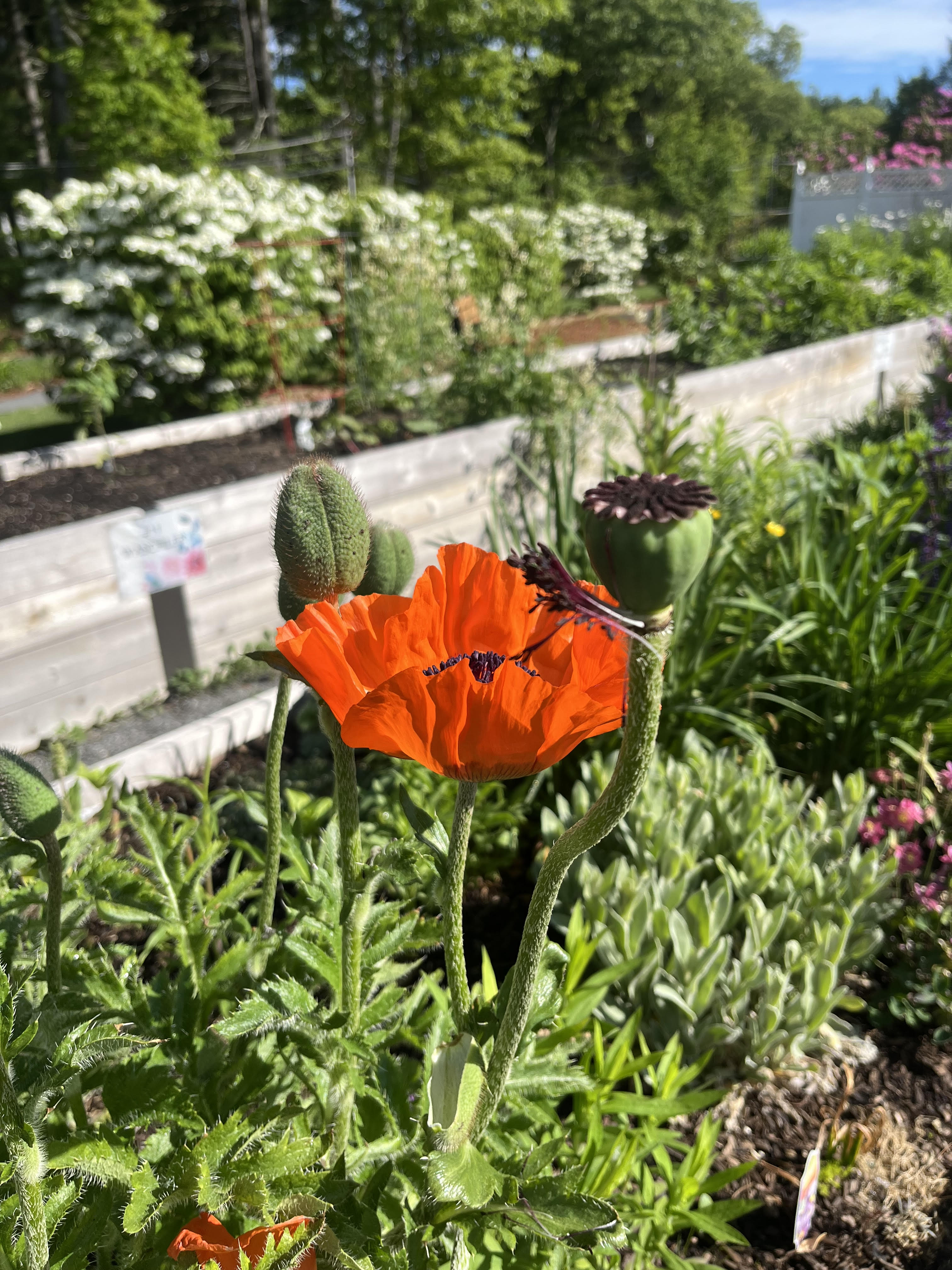
Poppies are also irresistible. This one is in one of the garden boxes where I live. We have unusually big raised beds here. Unfortunately, not enough to please all the gardeners who left growing at home when they downsized.
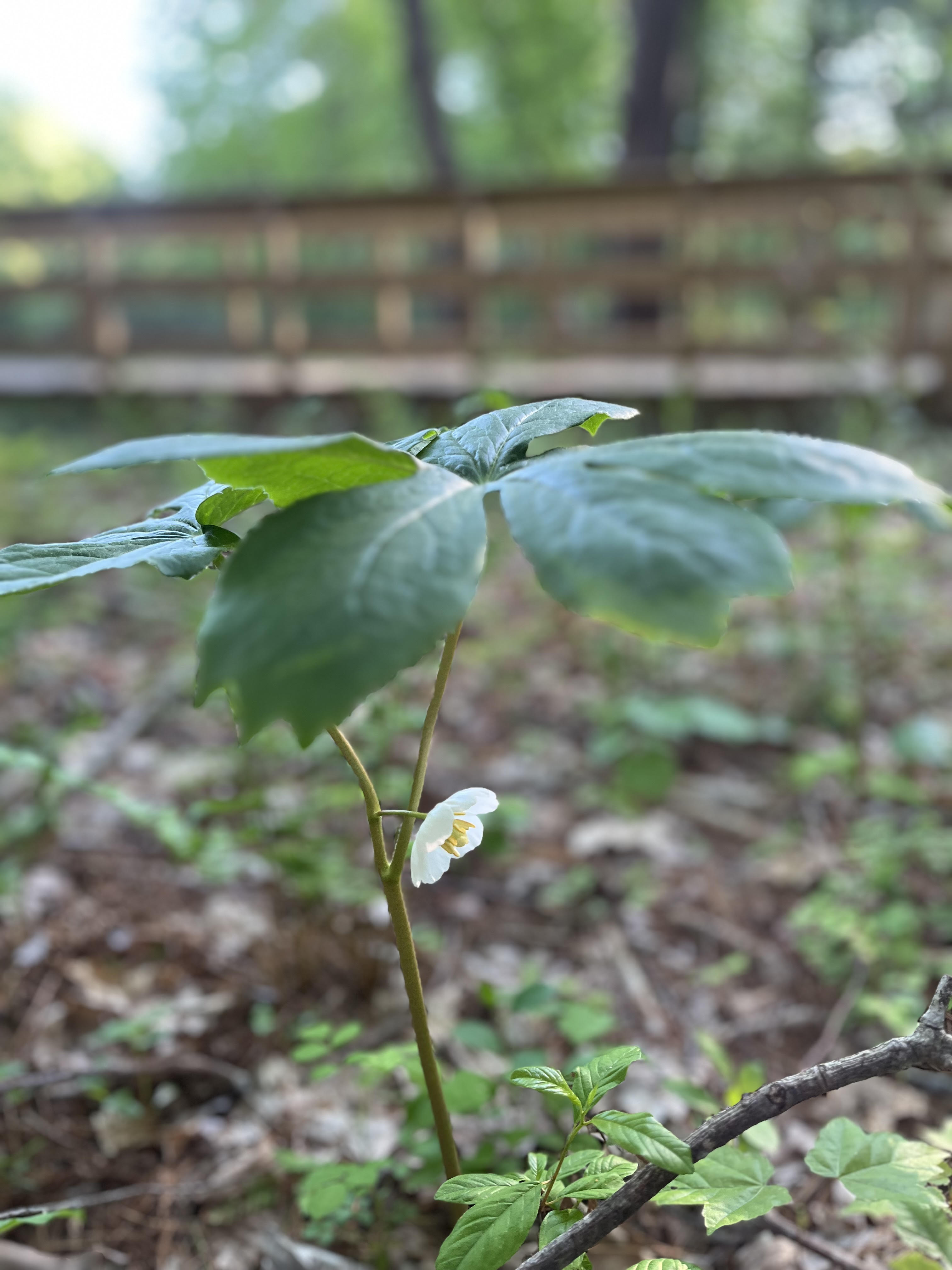
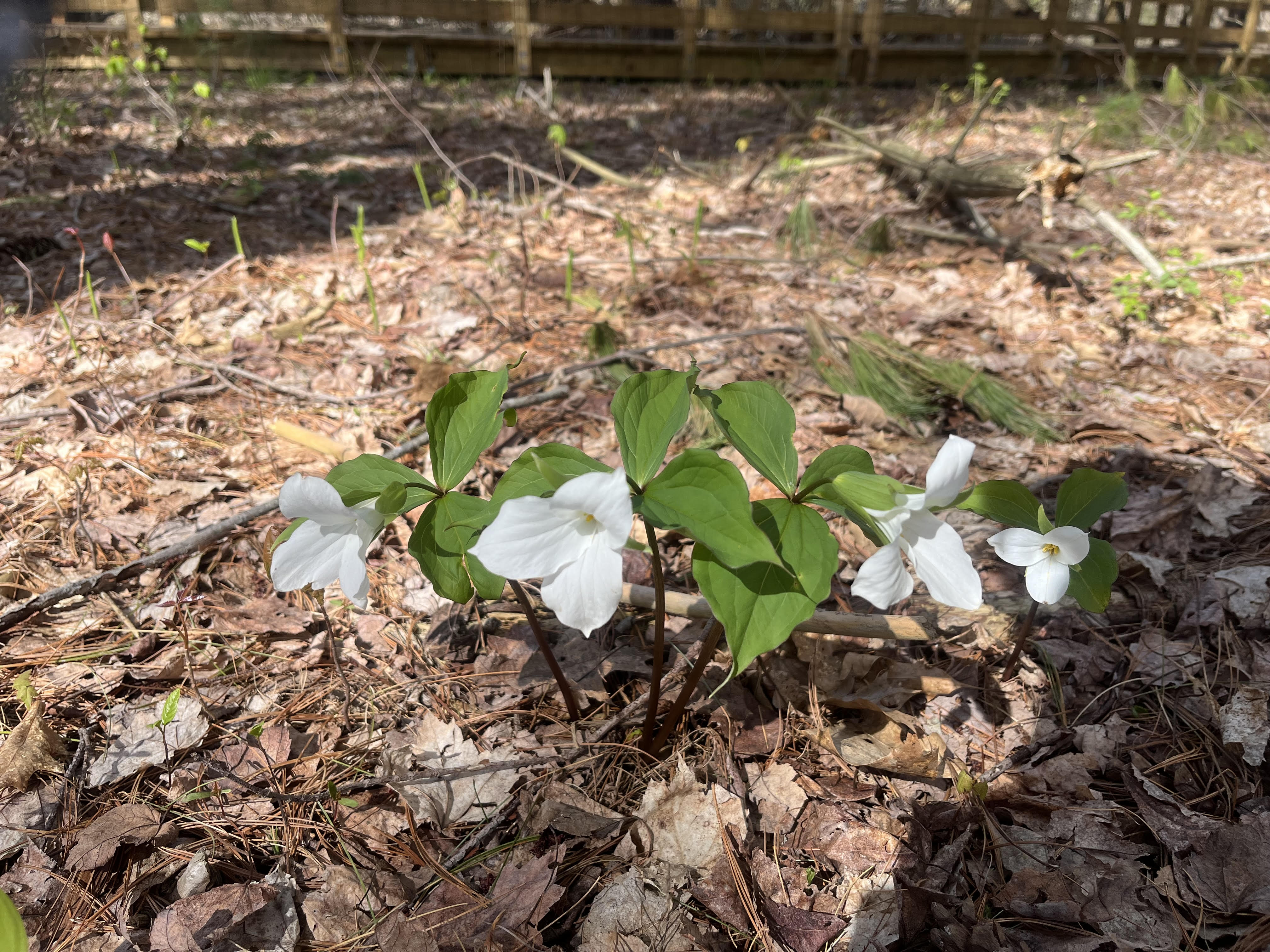
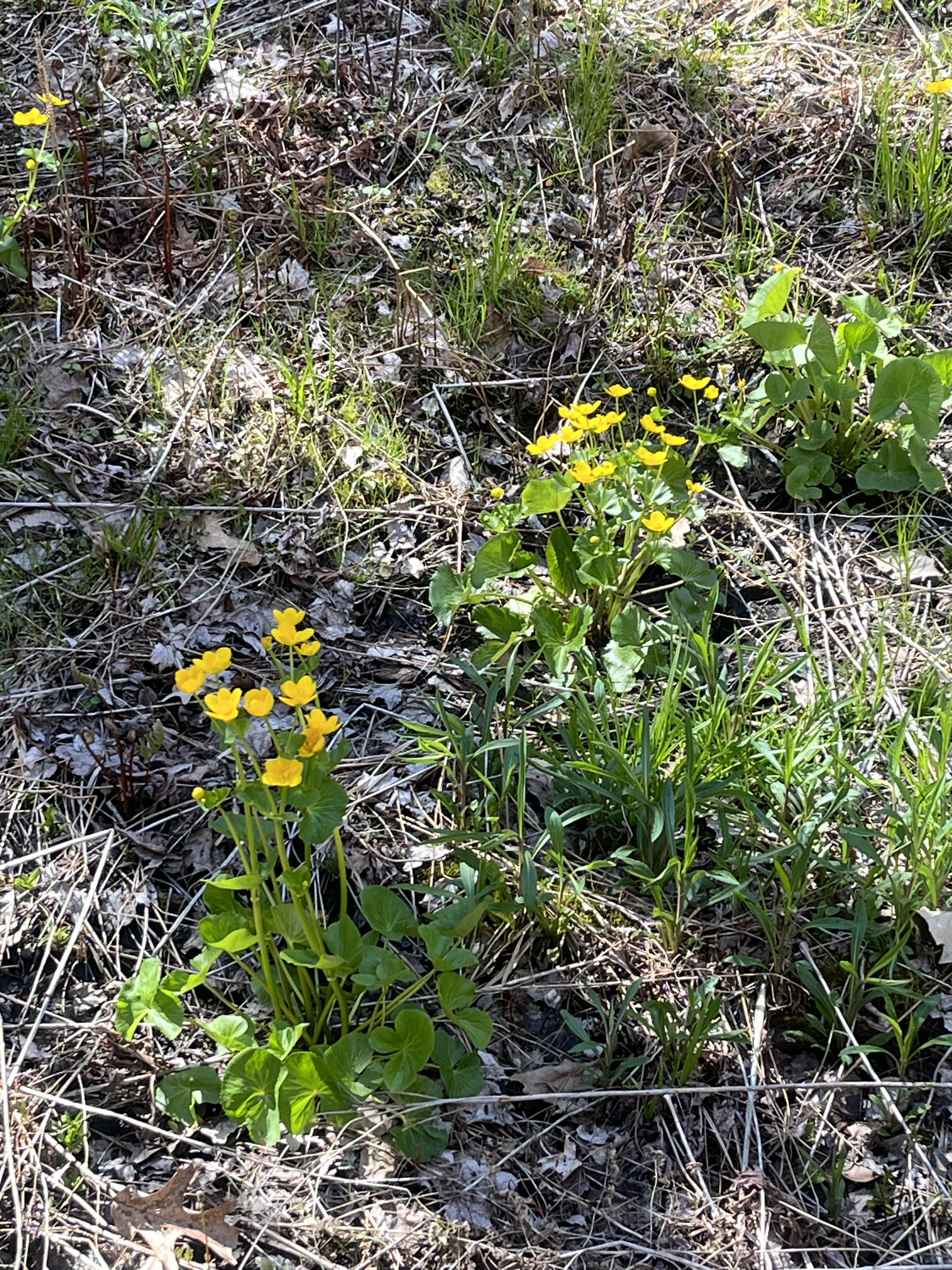
In the woods near the boardwalk, there are lots of wildflowers — including the mayapple below, the trillium, and the marsh marigolds.
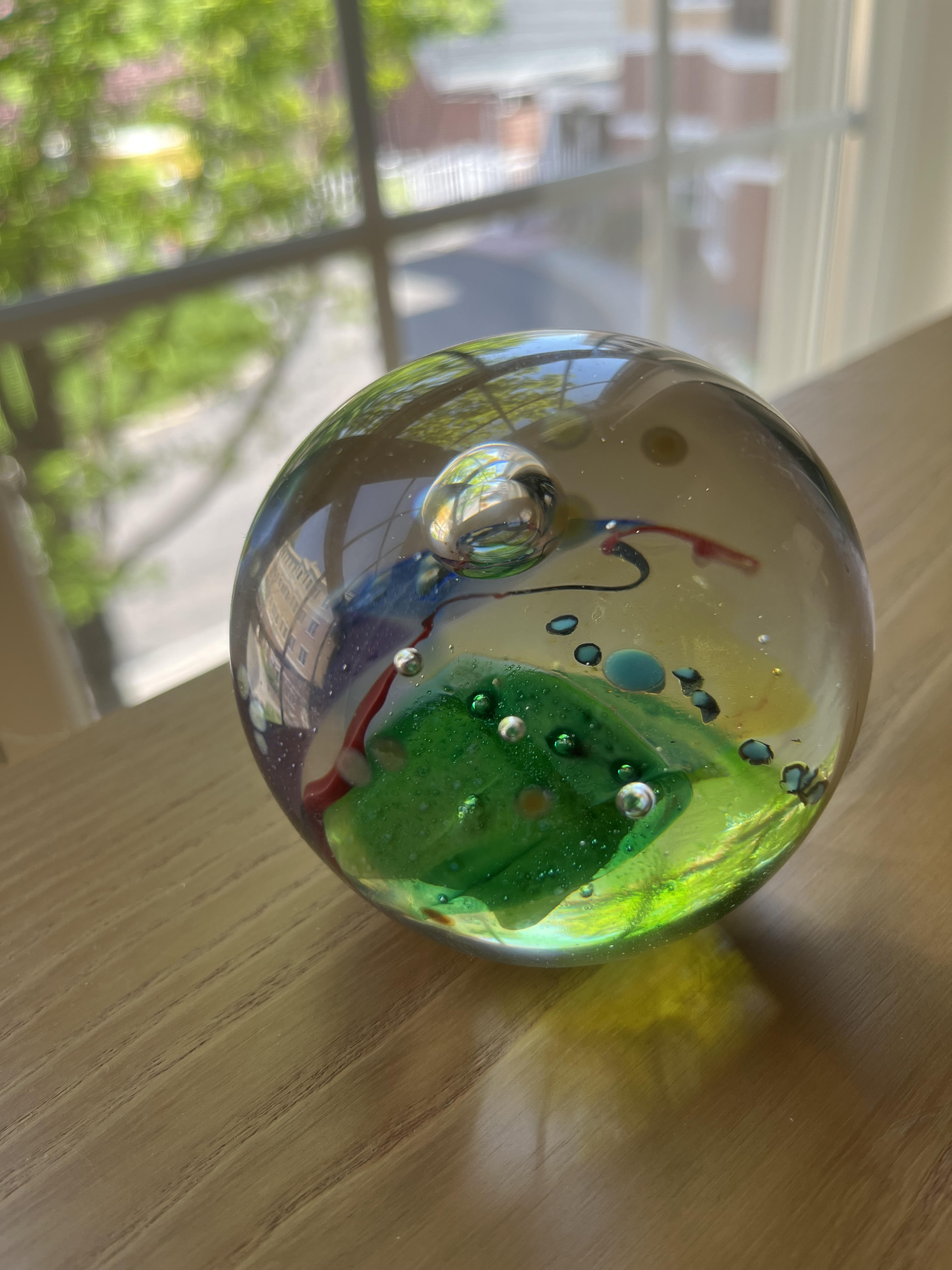
On a sunny day, my camera was drawn to the paperweight a colleague gave me when I left a job in Minneapolis, quite a while ago now. I think of her when I see it. I appreciated getting a little piece of art.
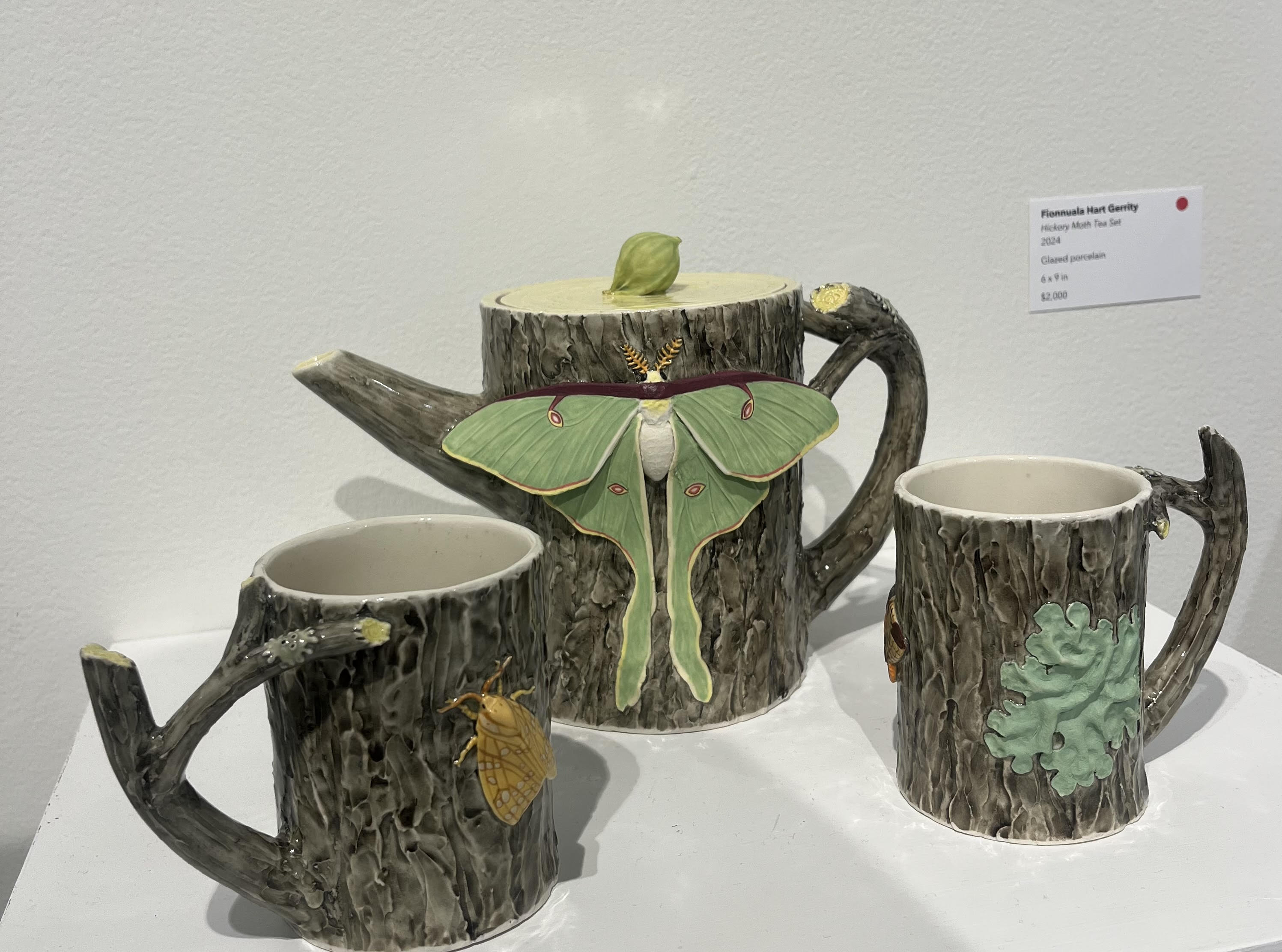
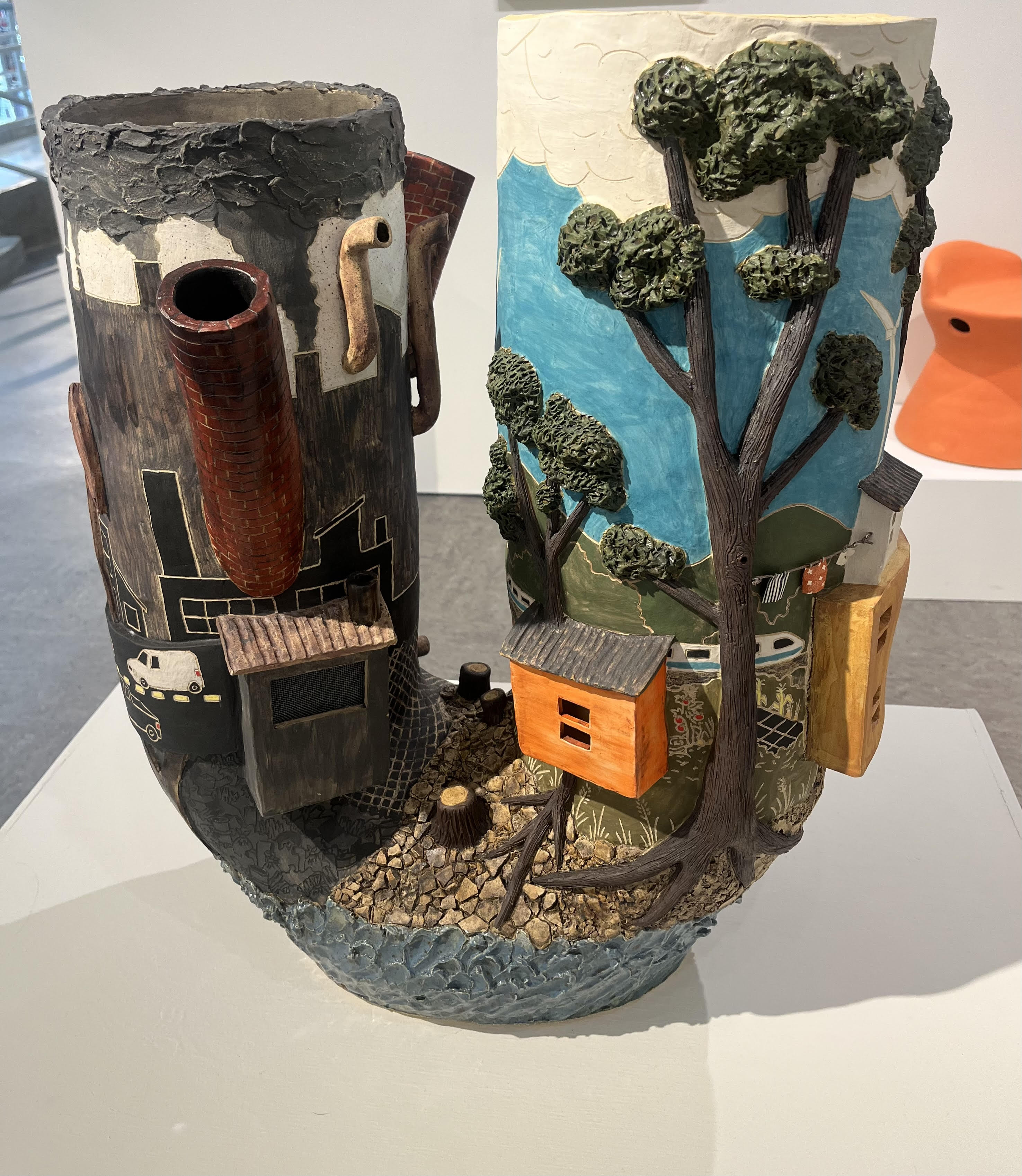
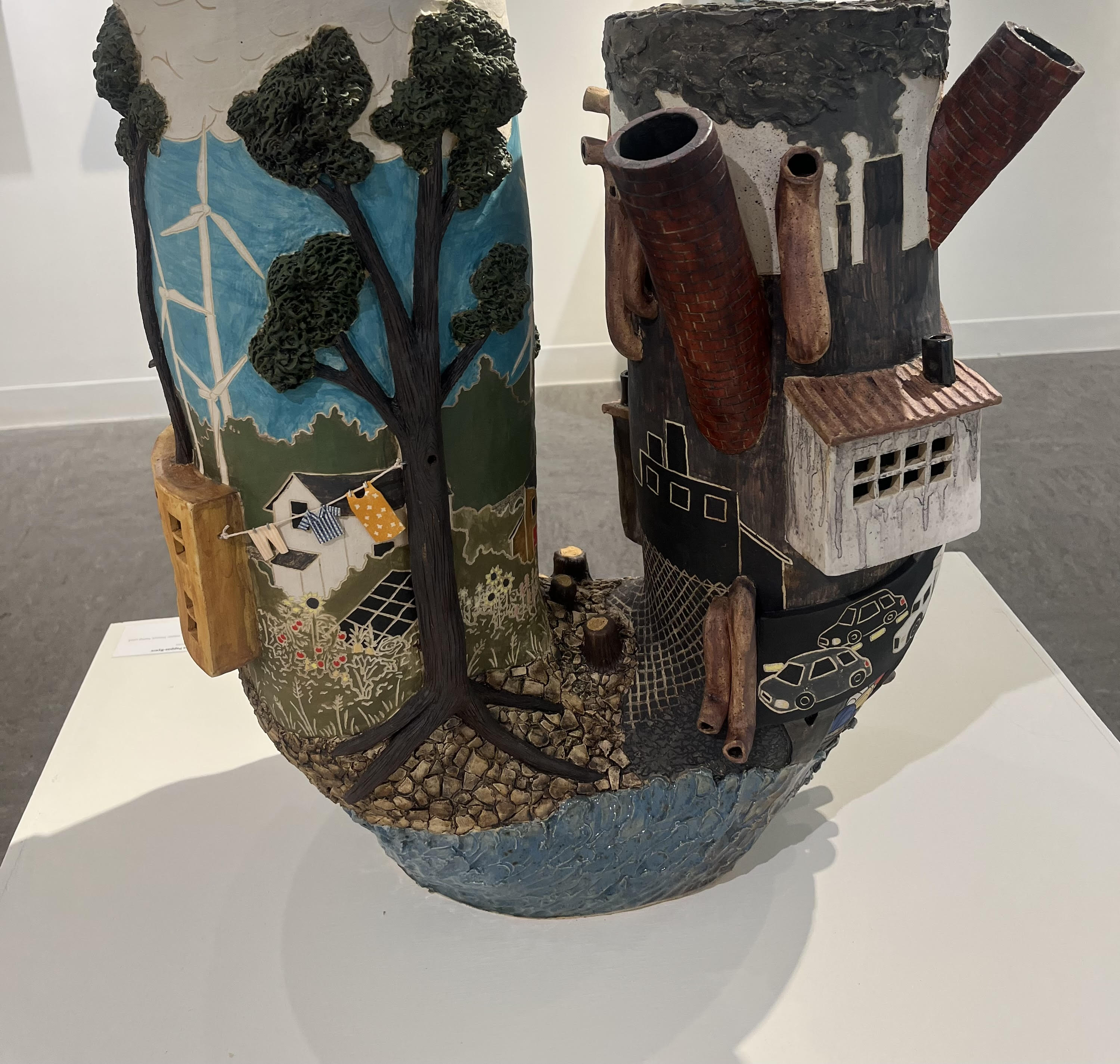
Speaking of art, the ceramics biennial at the Umbrella was outstanding, with its focus on nature and how we humans relate to the natural environment.
Finnuala Hart Gerrity made the “Hickory Moth Tea Set.”
Linnea Pappas-Byers won grand prize for the intriguing “Two Futures,” which seems to demand close scrutiny and reflection. Which future will be ours?
Photo: Rebecca Rosman for NPR. For 20 years, Dutch art detective Arthur Brand has acted as an intermediary between the police and people who know where stolen artwork might be hidden.
Is there one thing that makes someone successful at recovering stolen art?
According to today’s article about Arthur Brand, the secret might be motive. You can’t get both police and thieves to trust you if you are in it for the money. Arthur Brand is in it to save art.
Rebecca Rosman reports from Amsterdam for National Public Radio (NPR), “In his modest IKEA-furnished apartment, Arthur Brand paces to distract himself.
” ‘I’m nervous,'”‘ he says, with the honesty of a man who has learned that bravado is useless in his line of work. He lights a cigarette, leans out the window, and scans the street below. ‘The waiting is the hardest part.’
“Brand, 56, has made a career out of waiting: for a phone call, a knock at the door, and, every once in a blue moon, a Picasso or a Van Gogh left discreetly on his doorstep.
” ‘Those are the moments you realize it’s worth it,’ he says. …
“In another life, Brand says, he’ll take his mother’s advice and ‘find a normal job.’ But in this one, he’s helped recover stolen art for two decades — often the cases police can’t solve alone. …
“He says he has recovered more than 150 stolen paintings and artifacts. His cases regularly make international headlines.
“There’s the stolen Van Gogh that showed up on his doorstep in 2023, stuffed into a blood-soaked pillow in a blue IKEA bag. The Salvador Dali painting he recovered in 2016. The Picasso he tracked down for a Saudi sheikh in 2019. …
” ‘You know, you cannot go to university and say, I want to become an art detective,’ Brand says. ‘This is a job created more or less out of lack of other opportunities.’
“He traces his entry point to Michel van Rijn, a notorious Dutch figure in the art underworld who introduced [him] to a shadowy ecosystem of smugglers, thieves and forgers — and law enforcement.
“After making a cold call to van Rijn’s office, Brand says he became his apprentice in London — which regularly involved sitting quietly in a corner while older men swapped stories. ‘Everybody thought — who is this idiot?’ he says.
“Van Rijn, Brand later discovered, was straddling two sides. In 2009, he walked away after learning his boss was working with police while still keeping ‘one leg’ in the criminal world.
“The experience left him with a simple rule for survival: In a world where people expect betrayal, being honest — and keeping your word — is its own form of power. …
” ‘The police don’t trust the informants. The informants don’t trust the police. So I want to form a bridge between them to see what can be done. And in most cases, it’s possible.’
“The bridge only holds if Brand is seen as independent. ‘I’m not hired by an insurance company,’ he says. ‘The police, of course, don’t pay me. So I do this work [at my own expense].’
“He supports himself by consulting for art galleries and helping Jewish families trace art looted during World War II. But the majority of his energy goes to the work he does on his own dime — acting as a go-between when someone wants to quietly unload a masterpiece they can’t keep.
“Stolen masterpieces, he says, are hard to enjoy and even harder to sell. ‘Who buys stolen art? You cannot show it to your friends. You cannot leave it to your children. ‘
“Dutch police say Brand’s motive matters. Richard Bronswijk, who heads the Dutch police art crime unit, says he’s seen private detectives create problems when money is the driver. … Brand, he points out, has always been driven by something else: the thrill of the chase. …
“Still, sometimes Brand’s trust isn’t enough on its own. When an informant is deciding whether to return stolen art, Brand says fear can take over … of the police, of retaliation, of being tricked.
“That’s when he calls in his ace — Octave Durham.
“In 2002, Durham, already a seasoned bank robber, stole two Van Gogh paintings from the Van Gogh Museum in Amsterdam. … ‘I’m a born burglar,’ adding he doesn’t steal anymore but ‘still can.’
“Today, he works with Brand to recover stolen art.”
At NPR, here, you can read how that partnership led to the moment Brand “opened his door and found a blue IKEA bag on his doorstep” with a pillow soaked in blood and a missing Van Gogh.
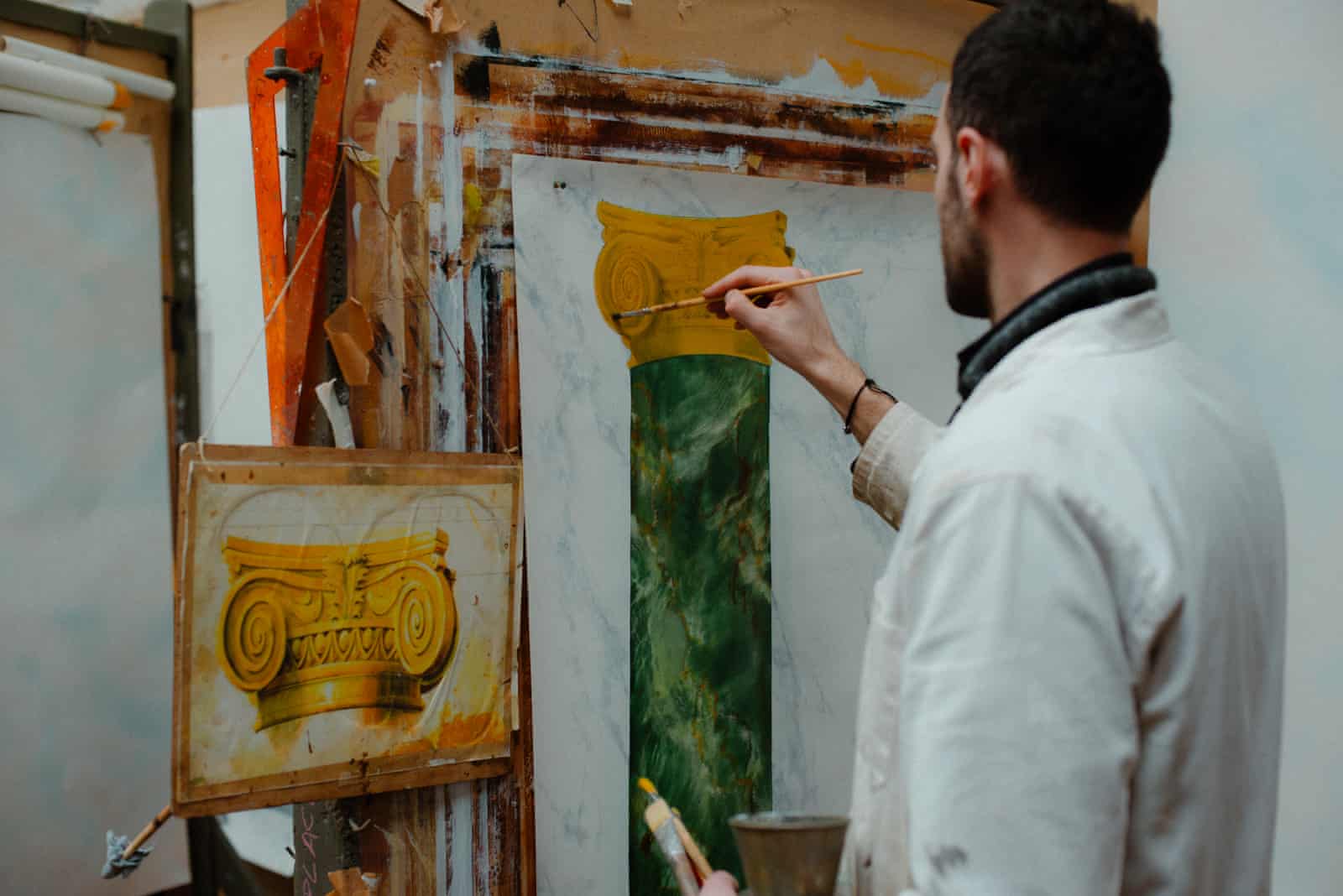
Photo: Felix Bazalgette. Federico Piccolo at work at the Van der Kelen.
I’ve always been fascinated by trompe l’oeil art (fool the eye) — pillars that aren’t there, window vistas that are solid walls.
Today, I’m learning from Felix Bazalgette at the Guardian that a painting school in Belgium is the place to learn how to do that. But the school is rigorous.
“One morning last February, in a chilly studio in Brussels,” writes Bazalgette, “28 people in white coats gathered to watch Sylvie Van der Kelen paint the sky. ‘The first touch of the brush is generally the best,’ said Van der Kelen as light, pink-tinged clouds began to appear. ‘It is preferable not to make revisions.’
“For a few days this winter I was allowed to sit in on classes at the École Van der Kelen-Logelain, a mythologized painting school in Brussels that is unlike any other arts education institution in the world. Run by the same family since it was founded in 1892, the Van der Kelen course takes place every winter. …
“Students must arrive by 9am, otherwise they will be shut out until lunchtime; they must not bring phones or cameras into the school’s workspace; they must wear white lab coats while they work; and they must work in silence. They also must be able to stand the cold: the studio is ineffectually heated by an ancient single wood-fired stove. …
“If students can tolerate these strictures, by the end of the six-month course they will possess a number of specialized skills, from sign painting and lettering to the application of gold and silver leaf, and manipulation of textural finishes. The core of the course, though – what the school is most famous for – is its trompe l’oeil painting techniques. …
“Trompe l’oeil refers to a genre of illusionistic painting with a history stretching back to the time of the ancient Egyptians, in which artists use textures, shading and tricks of perspective in order to create three-dimensional illusions. At the Van der Kelen, students learn to conjure fake relief sculptures and architectural details out of flat surfaces; create copies, in oil paints, of 28 different types of wood grain and 33 different types of marble; and, like Sylvie, paint a perfect trompe l’oeil sky. …
“The passion for decorative painting among the wealthy upper middle class has evaporated, and fussy-seeming trompe l’oeil has fallen out of style in interior decoration and high art. Student numbers have correspondingly dropped to dangerously low levels.
“And yet, every winter, the family continue to oversee a course that has barely changed since 1892, and students still arrive from across the world to put themselves through a bizarre and sometimes punishing routine (‘There is roughly one breakdown every week,’ a student told me). …
“Everybody is in search for something special here,” Sylvie tells me after her demonstration that morning as the students quietly set to work. “Everyone is here for a reason.”
“This year marks the first time that Sylvie, 52, has taken over the running of the school from her mother Denise – the ‘Coco Chanel of fake marble’ – who herself has been in charge since 1995. …
“Every morning a new technique is demonstrated by one of the Van der Kelens (the school invites outside teachers to teach extra classes, but only members of the family teach the core trompe l’oeil course). The students observe and make notes, before producing an exact copy themselves on a large sheet of paper; this piece of work is known as a ‘panel.’
“No panel, however, can be finished in a single day, because each requires multiple ‘operations’: different stages of work, separated by a day or more to allow the drying of paints and varnishes. As a result, students end up with a dizzying number of panels in progress at any one time, with more added every morning. Even after the workshop closes at 6pm, everyone has homework, sometimes until midnight. ‘It’s brutal,’ one student, a British painter, told me. …
“Why would anyone put themselves through this? Talking to this year’s cohort, I hear a number of reasons. There’s a small but significant contingent of people from various professions – architects, graphic designers, interior designers – who have become dissatisfied with the computer-based nature of their industry and are looking for something more hands-on. After graduating, students might hope to find work as painting assistants for established artists, painting interiors for wealthy clients, working on film or theatre sets, or working for European fashion houses periodically drawn to the trompe l’oeil aesthetic for runway shows and boutiques.
“Every student from an arts background that I speak to, however, cites the work of another painter, Lucy McKenzie, who has arguably done more to revive the school’s fortunes than any other person of late. The young Glaswegian artist was browsing in a secondhand bookshop in Brussels in 2007 when she came across a mention of the school in a book of interiors and – amazed that such a place still existed – immediately enrolled. At that time, McKenzie was almost a decade into an already accomplished arts career, but she signed on because she found the school’s illusionistic techniques fascinating. …
“By the mid-oos, the school was in crisis. … That is until McKenzie used the school’s techniques to create thrilling large-scale paintings, such as the vertigo-inducing Untitled (2010), and, along with a book she published about her time at the school, it is works such as these – exhibited at London’s Tate Britain, Amsterdam’s Stedelijk and the Art Institute of Chicago – that have caused a steadily increasing stream of students to arrive at the Van der Kelen’s imposing wooden doors. ‘Lucy McKenzie has a lot to answer for,’ one student told me cheerfully.”